

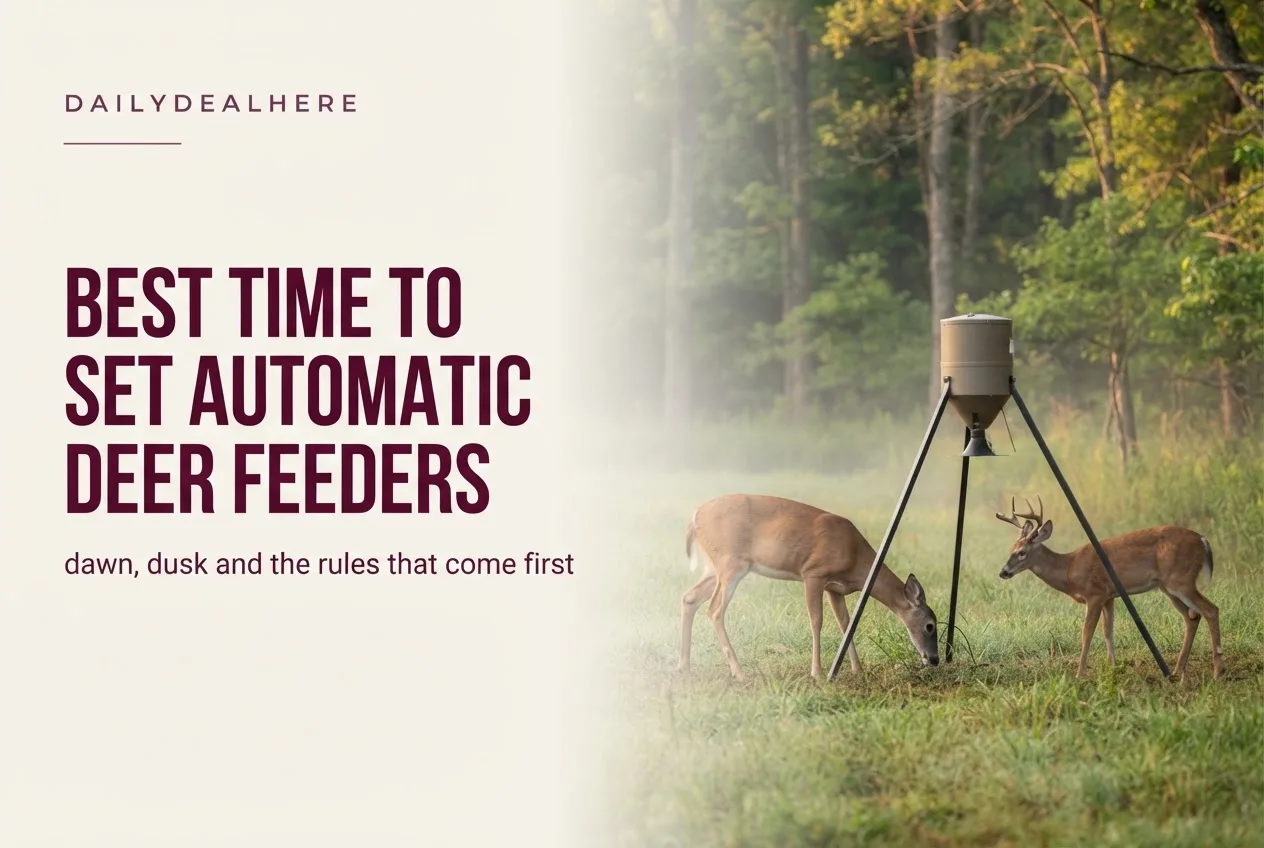
The best time to set an automatic deer feeder is around dawn and dusk, because deer are crepuscular and move most in the twilight hours at the start and end of each day. A common setup is one feed cycle shortly before sunrise and another an hour or two before sunset, adjusted every few weeks as sunrise and sunset times shift. If you hunt over the feeder, set the evening cycle so deer arrive while it is still legal shooting light. Before any of that, check that feeding or baiting is legal where you are, and throw only as much as deer will clean up within a few days, because corn left on the ground can grow a toxin that harms wildlife.
This guide explains why deer follow a dawn and dusk rhythm, how to translate that into timer settings, how the seasons and weather change things, how much feed to put out per cycle, and the legal and health issues every feeder owner should know. It draws on the National Deer Association’s summary of deer movement research, its report on a Mississippi State University study of aflatoxin in feeder corn, feeder maker Moultrie’s guidance on feeding times, and the Michigan DNR baiting and feeding rules as an example of state regulation.
The short answer
- Main windows: dawn and dusk, when deer are most active.
- Typical schedule: one cycle shortly before sunrise and one an hour or two before sunset.
- For hunting: time the evening cycle so deer are drawn in during legal light, and check your state’s shooting hours.
- Keep it current: sunrise and sunset move through the year, so revisit the timer every few weeks.
- Keep it small: put out only what will be eaten within about three days to limit mold and toxins.
- Check the law first: some states ban baiting or feeding entirely, often because of disease concerns.
Why deer move at dawn and dusk
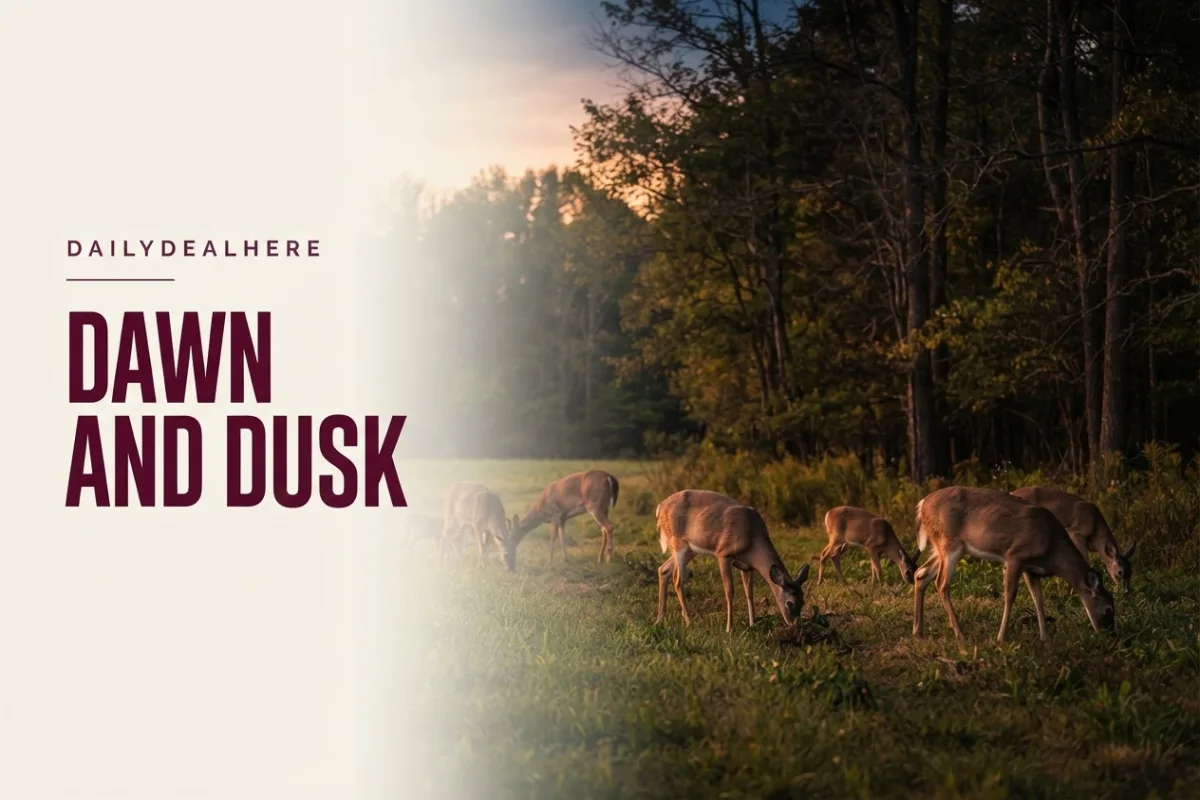
The National Deer Association describes deer as crepuscular, meaning they are most active during the twilight hours of dawn and dusk. The organization’s director of conservation, Matt Ross, points to several independent lines of evidence for this pattern.
- Trail cameras. Snapshot Wisconsin, a citizen science project run by the Wisconsin DNR, recorded more than 5.7 million deer detections between January 2017 and December 2021, with a clear peak of activity around dawn and dusk.
- Vehicle collisions. Of nearly 18,000 deer vehicle collisions documented by the Georgia Department of Transportation in 2017, at least 40 percent happened at dawn or dusk, which covered only six of the day’s 24 hours.
- GPS movement. In the Penn State Deer-Forest Study, deer covered about 60 meters per hour at night and under 50 meters per hour during the day in October, but moved more than twice that rate at dawn and dusk.
The NDA explains the reason as predator avoidance. Deer are a prey species, and most of their predators either hunt most intensively at night or see best at midday in full sun. Twilight is the gap between those two risks.
Morning or evening: which matters more?
Both, but deer are doing different things at each. The NDA describes a typical day: in the morning, deer generally move from their nighttime feeding areas back to bedding cover. They spend most of the day in thick cover, resting and finishing the previous night’s meal, then in the evening move out to a food source to feed and rest again.
That suggests the evening cycle is the one most likely to catch deer heading toward food, while the morning cycle catches them on the way back to bed. Moultrie makes a similar point, noting that deer typically eat in the early morning before bedding and again in the evening and through the night, and that bucks in particular tend to be active after dark. Setting both cycles covers both movements.
The NDA is careful to add that deer are not robots. Individual deer vary, activity peaks shift slightly by season and hunting pressure, and deer do move at midday and at night. The dawn and dusk peaks are the pattern, not a timetable.
A practical timer schedule
How you set the timer depends on why you run the feeder. Here are common goals and how the research above translates into settings.
| Your goal | Morning cycle | Evening cycle | Notes |
|---|---|---|---|
| Hunting over the feeder, where legal | Shortly before first light | An hour or two before sunset | Deer should arrive during legal shooting hours, not after |
| Wildlife viewing | Around sunrise | Late afternoon, while there is still light to watch | Pick times you are actually home to watch |
| Trail camera inventory | Before sunrise | Before sunset | Consistent times make camera photos easier to compare |
| Keeping feed fresh | Short cycles | Short cycles | Small, frequent amounts beat one large dump |
Most feeders run each cycle for a few seconds, and the run time controls how much is thrown. Start short, see how much is left on the ground a day or two later, and adjust. The goal is ground that is picked clean within a few days, for the health reasons covered further down.
Adjust as sunrise and sunset move
Because deer key on light rather than the clock, a fixed clock time drifts. Through the fall, sunrise comes later each morning until clocks fall back at the end of daylight saving time, when it suddenly jumps an hour earlier on the clock. Sunset moves the same way in reverse. A schedule that was right a month ago can easily drift out of the dawn or dusk window.
- Check local sunrise and sunset times every couple of weeks and move your cycles to match.
- Pay particular attention to the start and end of daylight saving time, when every clock based schedule jumps an hour.
- If your timer supports sunrise and sunset based settings, use them so the schedule follows the light automatically.
- Replace timer batteries on a schedule. A dead battery silently stops the feeder, and Moultrie mentions dead batteries and jammed feeders as exactly the kind of problem that can throw off your plans. Some feeders use a small solar panel to keep the battery topped up.
Timing around legal hunting hours
If you hunt over the feeder, the evening cycle should draw deer in while you can legally shoot. The NDA notes that New York changed its hunting hours from “sunrise to sunset” to extend 30 minutes before sunrise and after sunset, bringing it in line with every other state, after the association pointed out that deer activity peaks at exactly those times.
That half hour at each end is valuable, but shooting hours are set by each state and can have exceptions, so check your current regulations. A practical approach is to run the evening cycle early enough that deer arrive and settle while there is still good light, rather than at the very edge of legal time.
Can a feeder train deer to come in daylight?
Moultrie argues that a timer creates a consistent food source that deer learn to visit, and that feeding during the day can train deer to eat in daylight more. There is some logic to consistency: deer that find food at a predictable time and place have a reason to return.
The NDA adds an important counterpoint about pressure. It says deer do not become nocturnal when pressured. If you stop seeing them at the same time and place, it is more likely they have changed where they spend their time, not when. In practice, that means a feeder in a heavily disturbed spot may simply be avoided in daylight, whatever the timer says. Keeping disturbance low around the feeder, refilling at midday and approaching from downwind, is likely to matter as much as the schedule.
How much to throw per cycle
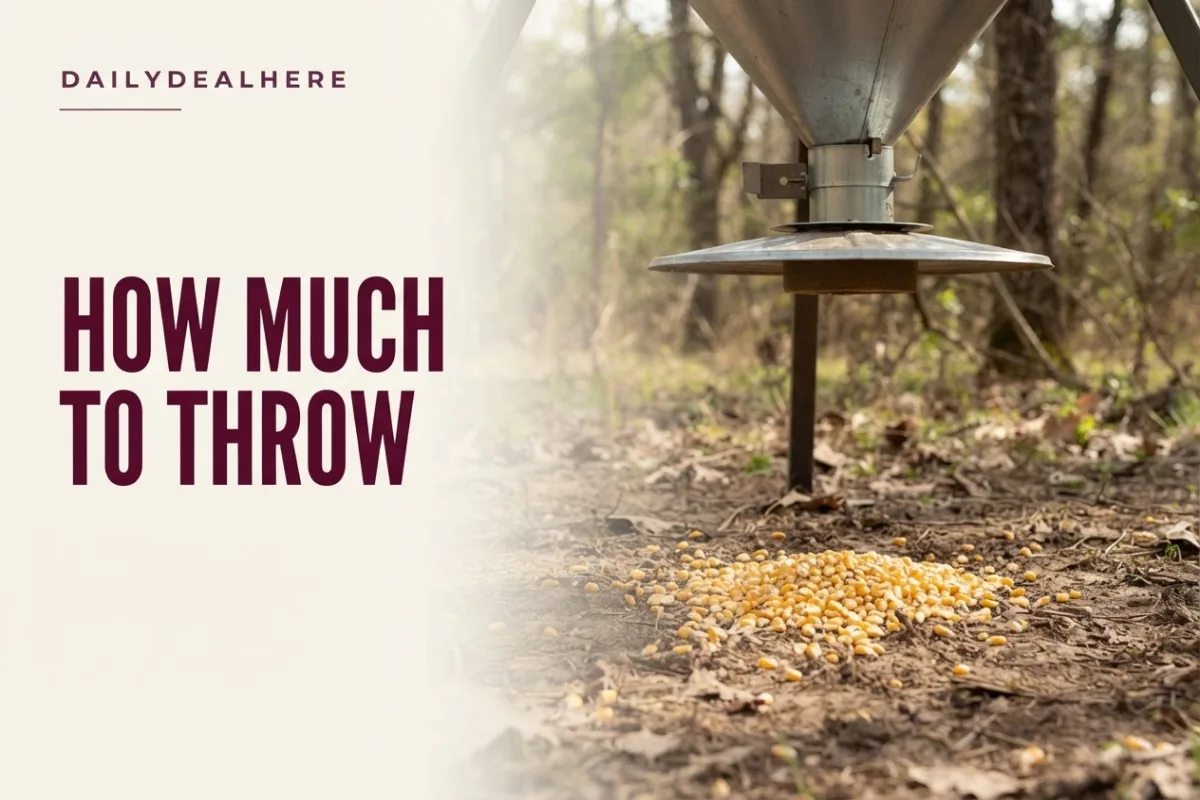
More feed is not better. The Mississippi State research described by the NDA recommends limiting the amount distributed on the ground to what will be consumed within about three days, because in warm, humid conditions a toxin called aflatoxin can form quickly on corn left lying on the ground.
Regulations can set hard limits too. In Michigan’s Upper Peninsula, for example, bait at a hunting site cannot exceed two gallons and must be scattered over at least a 10 foot by 10 foot area, and recreational feeding is limited to two gallons per residence per day. Even where no limit applies, those numbers show the scale regulators consider reasonable.
How the seasons change feeding
Moultrie describes how the time of year shapes when and how much deer feed.
- Spring and summer: deer feed heavily when vegetation is abundant, which Moultrie puts between April and September in most regions, and they settle into their crepuscular schedule.
- Fall: deer eat frequently to build fat for winter, and Moultrie notes the rut makes daylight movement more likely than in any other season.
- Acorn drop: Moultrie notes acorns usually begin to fall in September through October, and deer shift toward oaks when they do, which can pull them away from a feeder.
Natural foods compete with your feeder. When acorns are dropping or crops are standing nearby, expect fewer visits regardless of timing. When natural food is scarce, a feeder may see more use.
Weather and temperature
Moultrie lists weather as a major factor. Deer tend to feed right before and immediately after storms and bed down during high winds, blizzards and heavy rain. On hot days, deer slow down and bed through daylight, then movement picks up as temperatures cool toward evening.
You cannot program a timer for the weather, but you can plan around it. During a heat wave, a later evening cycle may line up better with movement. Ahead of a front, deer may come in earlier. A trail camera on the feeder shows you how your local deer respond.
Is feeding or baiting legal where you are?
This is the first question to answer, not the last. Rules vary widely by state, and within states by region. Michigan is a good example of how detailed they can be.
- Definitions matter. Michigan defines bait as food used as an aid in hunting, and feed as food that may attract deer or elk for any reason other than hunting. Both are regulated.
- Regional bans. Baiting and feeding are banned in Michigan’s Lower Peninsula, with a narrow exception for qualifying hunters with disabilities during specific hunts.
- Seasonal windows. In the Upper Peninsula, baiting is allowed only from September 15 to January 1, and supplemental winter feeding only from January 1 to May 15 under distance and feed type rules.
- Mechanical feeders. Michigan allows spin-cast feeders to scatter bait or feed only if they do not distribute more than the maximum volume allowed.
Other states have their own rules, and many have added or expanded bans in response to chronic wasting disease. Check your state wildlife agency’s current regulations before you hang a feeder, and again each season.
Disease and feeder placement
Concentrating deer at one spot raises the chance of disease spreading between them. Michigan’s DNR explains that using bait to lure deer increases the chance of spreading disease, and where baiting is allowed, it recommends not placing bait or feed repeatedly at the same point on the ground, and only baiting when actively hunting.
For timer feeders, that advice suggests a few habits: keep volumes modest, avoid building up piles, and consider moving the feeder periodically rather than creating a permanent gathering point. Where the law and your goals allow, running the feeder only during the period you actually hunt or observe reduces the time deer spend concentrated there.
Aflatoxin: the hidden risk in feeder corn
Aflatoxins are toxic chemicals produced by some Aspergillus fungi, and corn is a common carrier. The Mississippi State University Deer Lab study reported by the NDA looked at feed on sale, in feeders and on the ground.
| What was sampled | What the study found |
|---|---|
| Bagged and bulk wildlife feed, 64 samples from six states | 7 samples (11 percent) contained aflatoxin, at up to 23 ppb |
| Mississippi deer feeders, summer | Aflatoxin in 4 percent of feeders, at up to 139 ppb |
| Mississippi deer feeders, hunting season | Aflatoxin in 6 percent of feeders, at up to 61 ppb |
| Corn left on the forest floor in July | Detected by the fifth day, in all piles after the eighth day, and above 1,000 ppb |
| Corn left on the forest floor in November | Only 1 of 50 samples positive, likely due to cooler temperatures |
Texas A&M AgriLife Extension guidance adds practical thresholds. It says corn with 100 ppb or more aflatoxin should not be fed to wildlife, and that wildlife specialists recommend using only corn labeled as containing less than 20 ppb. It also notes that warm temperatures around 77 degrees Fahrenheit combined with wet corn at 15 to 30 percent moisture create prime conditions for aflatoxin in stored corn, and that feeders and storage should be kept clean and free of leaks.
- Buy feed that states on the label it has been checked for aflatoxin and is below a set level, as the NDA article recommends.
- Store corn cool and dry, and never let it get wet.
- Keep cycles small, especially in summer heat and humidity.
Who else eats at your feeder
Your feeder serves more than deer. In the Mississippi State study, deer accounted for only 25 percent of the animals visiting feeders. That matters for toxins, because the NDA notes birds are at higher risk than mammals. Turkeys fed aflatoxin levels as low as 100 to 200 ppb showed liver damage and reduced immune function within two weeks, and northern cardinals showed reduced immune function at levels as low as 25 ppb.
The AgriLife guidance agrees that deer, with their complex ruminant digestion, seem less susceptible to mycotoxins than grain eating birds like quail and turkey and small mammals such as squirrels and rabbits. Keeping feed clean protects every animal that visits, not only the deer you are feeding.
Keeping the feeder clean and working

The NDA article recommends cleaning feeders regularly: remove debris with soap and water, then clean with a solution of 1 part household bleach to 6 parts water, and let the feeder dry completely before refilling. If the fungus is not present, it notes, aflatoxin cannot be produced.
- Check the hopper seal and lid so rain cannot reach the feed.
- Clear old, clumped or moldy feed before adding fresh.
- Inspect the spinner plate and motor for jams.
- Replace timer and motor batteries before they fail.
- Refill at a time of day when deer are least likely to be nearby, to limit disturbance.
Use a trail camera to fine-tune timing
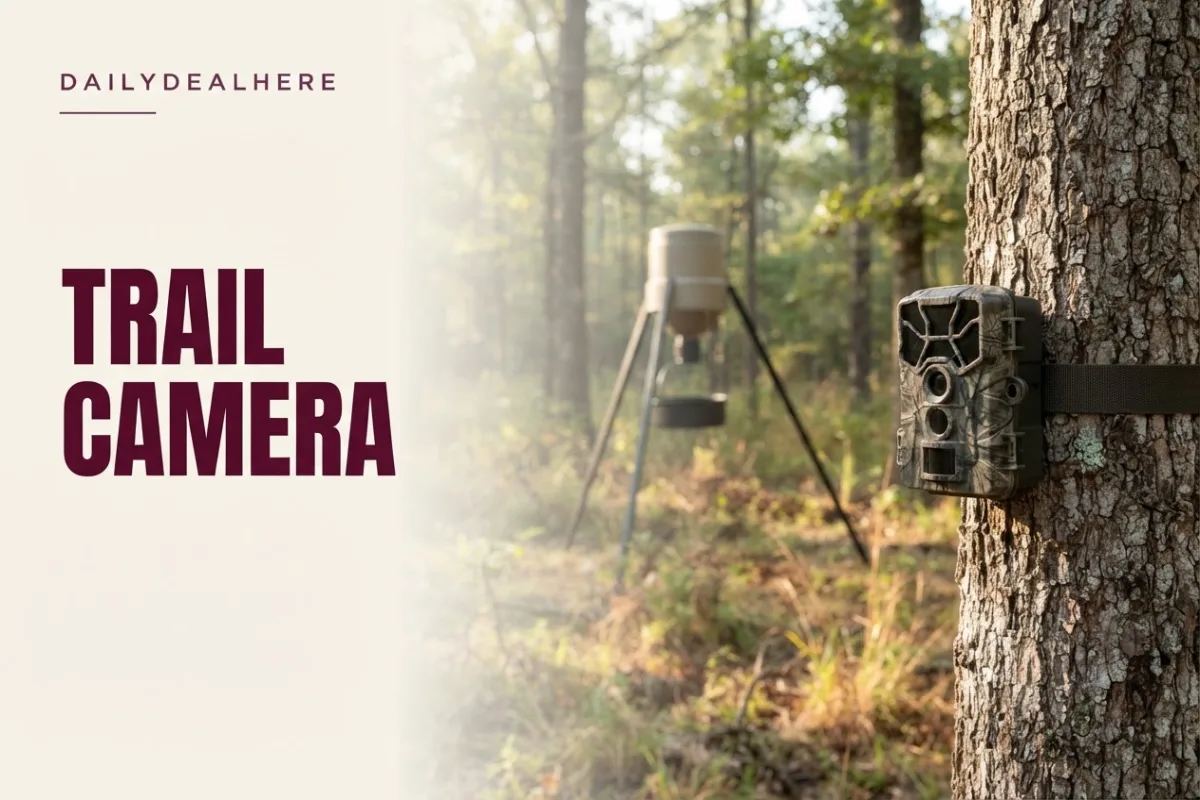
The research gives you the general pattern, but your deer set the details. Moultrie recommends pairing a trail camera with a feeder to track behavior and changes, and the NDA suggests trail cameras for spotting when deer shift where they spend their time.
- Run the feeder at your chosen times for a couple of weeks and review when deer actually arrive.
- If most visits come well after the cycle, try moving it later, or the reverse.
- Watch how visits change around the rut, the acorn drop and cold fronts.
- Look at which animals are eating the feed, since the MSU study found most visitors were not deer.
If you are setting up a spot to watch or hunt from, our guides to the best deer stands, best hunting blind chairs and best lightweight binoculars for hunting cover the gear that makes those dawn and dusk hours more productive.
A feeder setup checklist
- Confirm feeding or baiting is legal in your area and season, and note any volume limits.
- Buy feed labeled as checked for aflatoxin, and store it cool and dry.
- Place the feeder away from heavy disturbance, and plan an approach route downwind.
- Set one cycle shortly before sunrise and one an hour or two before sunset.
- Start with short run times and adjust so the ground is picked clean within a few days.
- Check sunrise and sunset times every couple of weeks, and after daylight saving changes.
- Clean the feeder regularly with soap, water and diluted bleach, and dry it before refilling.
- Use a trail camera to see when your deer really come, and adjust.
Frequently asked questions
What is the best time to set an automatic deer feeder?
Around dawn and dusk, when deer are most active. A common setup is one cycle shortly before sunrise and another an hour or two before sunset, adjusted every few weeks as daylight changes. Hunters should time the evening cycle so deer arrive during legal shooting hours.
Do deer feed more in the morning or the evening?
They are active at both. The National Deer Association describes deer moving from feeding areas to bedding cover in the morning and back out to food in the evening. Moultrie notes most deer feed from dusk into the evening, so the evening cycle often lines up best with feeding, but setting both covers both movements.
How often should a deer feeder go off?
Usually twice a day, at dawn and dusk, with short run times. Adjust the amount so feed is eaten within about three days, which the Mississippi State research recommends to limit aflatoxin forming on corn left on the ground.
How long does it take deer to find a new feeder?
It varies with the deer population, natural food supply, season and disturbance. Moultrie notes that a consistent schedule helps deer learn when food appears. A trail camera is the best way to see when your local deer start using it.
Can a feeder make deer come out in daylight?
It may help, since a consistent food source gives deer a reason to return. But the National Deer Association notes pressured deer tend to change where they spend time rather than becoming nocturnal, so a disturbed feeder site may still be avoided in daylight.
Is it legal to use a deer feeder?
It depends on your state and sometimes your region within it. Michigan, for example, bans baiting and feeding in its Lower Peninsula and limits volumes and seasons in the Upper Peninsula. Check your state wildlife agency before setting up a feeder.
Is feeder corn safe for deer?
It can be if handled carefully. Texas A&M AgriLife advises using corn labeled below 20 ppb aflatoxin and never feeding corn at 100 ppb or more. Store corn dry, keep feeders clean, and limit how much sits on the ground, especially in summer.
Should I change my feeder times during the year?
Yes. Sunrise and sunset move through the seasons and jump with daylight saving time, so a fixed clock time drifts out of the dawn and dusk windows. Check times every couple of weeks, or use a timer that follows sunrise and sunset.
Follow the light, not the clock: feed shortly before sunrise and ahead of sunset, keep amounts small and feed clean, and let a trail camera tell you how your own deer respond.










Write Your Review
No reviews yet. Be the first to share your experience!