

Walk down the binocular listings sold for hunting and the largest number on the box is almost always the magnification: 20×50, 20×70, a folding pair claiming 30×60. Those numbers are the reason to put the listing down. Magnification multiplies everything, including the tremor in your hands, and it takes light away from your eye at exactly the hour a deer decides to move. Our top pick is the Vortex Crossfire HD 10×42 for pairing a usable magnification with enough objective glass to stay bright at first light. This shortlist of 6 lightweight binoculars for hunting options is built from Vortex, Nikon, Bushnell, Occer and USCAMEL, and every one of them sits between 8x and 12x for reasons the guide below sets out in numbers.
Weight is the second half of the brief, because glass that stays in a truck helps nobody. The pairs here run from a compact that disappears into a shirt pocket to a full sized roof prism model in a chest harness, and the trade in each case is between how much light the objective can gather and how much mass hangs off your neck for a day. For related gear, see our sports and outdoors guides.

Pros
- 10x42 format gives a 4.2mm exit pupil for low light use
- Waterproof and nitrogen filled, so internal fogging is not an issue
- Chest harness included rather than a thin neck strap
- Tripod adaptable for long sessions from one position
- Unlimited unconditional warranty behind it
Cons
- Heavier on the body than any compact here
- Bulkier than a folding pair for walking cover
The Crossfire HD takes the top spot because it sits on the right side of every trade this category forces. Ten power is about as much as a person can hold steady without bracing, and pairing it with 42 millimetre objectives yields a 4.2 millimetre exit pupil, which is wide enough to keep working through the half hour either side of sunrise when most hunting actually happens.
The body is the other half of the argument. It is sealed and filled with dry nitrogen, so rain is a non event and carrying it from cold air into a warm cab does not fog the inside of the glass, which is the failure that ruins a morning and cannot be wiped away. Coatings are applied across all air to glass surfaces, and the image holds up when you glass toward a low sun.
Two practical extras matter more than the specification sheet suggests. The chest harness holds the weight against your body instead of swinging from your neck, which is the difference between carrying a full sized pair all day and leaving it behind, and tripod adaptability turns a long sit into steady work. The warranty is unusually strong for glass at this level.
Bottom line: the most complete hunting binocular here, and the default recommendation unless weight is your first constraint.
- Magnification: 10x
- Objective: 42mm
- Exit pupil: 4.2mm
- Prism: roof
- Coatings: fully multi coated HD optics
- Sealing: waterproof and nitrogen filled
- Included: GlassPak chest harness
Hunters who glass across open ground, sit in a stand, or hunt in weather they cannot choose, and who want one pair to do all of it.
Anyone counting every ounce over long distances on foot will be happier with a 25 millimetre compact, accepting an earlier fade in the evening.
Set the dioptre once before first use: cover the adjustable side, focus with the centre wheel, then adjust only the dioptre ring for the other eye.
Use the harness rather than a thin strap. It keeps the pair still while you walk and takes the load off your neck, which is what keeps it accessible instead of stowed.
Pros
- Same 10x42 format and 4.2mm exit pupil for less outlay
- Waterproof and fogproof sealed construction
- Chest harness supplied in the box
- Tripod adaptable for glassing from one spot
- Covered by the same unconditional warranty
Cons
- Optics are a step below the higher HD line
- Still a full sized pair rather than a packable one
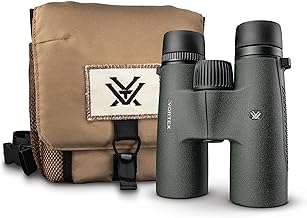
The Triumph HD is the value pick because it keeps everything that decides whether a binocular is useful and gives up only refinement. The format is identical at 10x42, so the exit pupil is the same 4.2 millimetres and the dawn performance is in the same class, and the body is sealed and nitrogen filled in the same way.
You also keep the two things that usually get cut at a lower outlay: a chest harness rather than a thin strap, and the same unconditional warranty, which for glass that lives outdoors is worth as much as any coating. Tripod adaptability is present too, so it works for long sits as well as walking.
What you give up is the finer glass of the higher line, which shows as slightly less resolution and marginally less contrast when you push it in poor light or study fine detail at distance. Side by side against the Crossfire HD the difference is visible; used alone in the field it is easy to forget.
Bottom line: nearly all of the capability of our top pick for a smaller outlay, and the sensible buy for most hunters.
- Magnification: 10x
- Objective: 42mm
- Exit pupil: 4.2mm
- Prism: roof
- Coatings: multi coated HD optics
- Sealing: waterproof and nitrogen filled
- Included: Glasspak chest harness
Choose this over the Crossfire HD unless you regularly study fine detail at long range in poor light, which is where the better glass earns its difference.
Both are full sized. If the pair has to travel in a shirt pocket, look at the compacts here instead and accept the smaller exit pupil.
Wear the harness high and snug so the pair does not swing when you move through brush, and leave the objective covers off in the field where they will only get lost.
Judge it in the last twenty minutes of light rather than in daylight, since that is the condition a 42 millimetre objective is bought for.

Pros
- Folds small enough for a shirt or jacket pocket
- Very light, so it is genuinely always carried
- Multilayer coated lenses from an established optics maker
- Smooth central focus and comfortable grip
- Ten power in a body that weighs almost nothing
Cons
- A 2.5mm exit pupil fades early in the evening
- Short eye relief is awkward for spectacle wearers
The ACULON A30 is the pair you actually have with you. A dual hinge folding body collapses to something that rides in a jacket pocket, the weight is close to negligible on a long walk, and it comes from a maker with a long record in optics rather than from an anonymous listing. For hunters covering ground on foot, that combination beats a better pair left in the truck.
Optically it behaves like a good compact. Multilayer coatings keep the image reasonably bright for the size, the central focus wheel is smooth enough for quick adjustments on a moving animal, and the grip suits one handed use while the other hand is busy.
The arithmetic is the limit. Ten power over a 25 millimetre objective gives a 2.5 millimetre exit pupil, which is less than half of what your eye opens to at dusk, so the image dims noticeably in the last part of legal light. Eye relief is short by the fifteen millimetre standard, so spectacle wearers should check it, and the body is not a sealed nitrogen filled design.
Bottom line: the lightest credible option here, best treated as a daylight and early evening glass.
- Magnification: 10x
- Objective: 25mm
- Exit pupil: 2.5mm
- Prism: roof, dual hinge folding
- Coatings: multilayer coated
- Sealing: not a nitrogen purged design
- Focus: smooth central wheel
Hunters walking long distances who want a pair that is never a burden, and anyone who also wants a compact for hiking and travel.
If most of your glassing happens in the first and last minutes of light, a 42 millimetre pair will show you more.
Spectacle wearers should confirm the eye relief suits them, since a short figure crops the field when glasses hold your eye further back.
Treat it as water resistant rather than waterproof. Carry it inside a pocket in heavy rain and let it warm up slowly to avoid internal condensation.

Pros
- BAK4 prisms keep illumination even toward the edges
- Large eyepiece makes the view easy to find quickly
- Compact and light enough for a pocket
- By far the deepest customer rating history in this group
- Twelve power reaches slightly further in daylight
Cons
- An exit pupil of about 2.1mm is the smallest here, so it dims early
- Twelve power handheld shows shake more than eight or ten
The Occer is the budget compact with by far the deepest rating history in this group, and it earns a place because twelve power is a modest step beyond ten rather than one of the twenty and thirty power claims this guide rejects. BAK4 prisms are named, which is the cheapest genuine optical upgrade a maker can offer, and the oversized eyepiece makes it quick to get your eye behind the glass and find what you saw.
For daylight work it does what a compact should. It is small, light, easy to focus and inexpensive enough to keep in a pack without worrying about it, which for scouting trails and checking ridgelines in the middle of the day is most of what is required.
The trade is written into the numbers. Twelve power over a 25 millimetre objective gives about 2.1 millimetres of exit pupil, the smallest in this shortlist, so it is the first pair here to go dim as the light drops. Twelve power also shows hand shake more than eight or ten does, so brace it against something for anything more than a quick look.
Bottom line: a lot of daylight capability for very little, and the wrong choice if dawn and dusk are your hunting hours.
- Magnification: 12x
- Objective: 25mm
- Exit pupil: about 2.1mm
- Prism: roof with BAK4 glass
- Eyepiece: oversized for easy viewing
- Sealing: treat as water resistant
- Format: compact and pocketable
Daylight scouting, mid day glassing and anyone who wants a spare pair in a pack or a vehicle without a large outlay.
Hunters working the first and last half hour of light should choose a 42 or 50 millimetre pair instead.
Brace it against a tree, a pack or a truck window frame for any long look, since twelve power magnifies every movement of your hands.
Set the dioptre ring before first use, then leave it alone. Most complaints of a soft image in compacts come from a pair nobody set up.

Pros
- A 5.0mm exit pupil is the brightest arrangement here at dusk
- Porro design gives strong image quality for a modest outlay
- Instafocus lever changes focus quickly on moving game
- Camouflage finish suited to hunting use
- Long standing model with a deep rating history
Cons
- Wide porro body is heavy and awkward on a chest
- Not a sealed nitrogen purged design
The PowerView is the light gathering choice. Ten power over 50 millimetre objectives produces a five millimetre exit pupil, the widest in this shortlist, and that is the number that decides how much you can see in the twenty minutes before legal light ends. Porro prisms help here as well, since the simpler layout delivers more image quality per unit of outlay than a budget roof prism design can.
Instafocus lever focusing is a genuine field advantage on animals that are moving. One finger sweeps the focus across its range rather than winding a wheel, which is quicker to react with, at the cost of fine precision when you want to settle exactly on a distant detail.
The costs are shape and sealing. A porro body is wide at the objectives and heavy, so it sits awkwardly against a chest and is the least comfortable pair here to carry on foot all day, and this is not a nitrogen purged sealed design, so treat it as water resistant and let it acclimatise slowly rather than fogging it between cold air and a warm cab.
Bottom line: the brightest glass in this group at the price of bulk, ideal for glassing from a stand or a fixed position.
- Magnification: 10x
- Objective: 50mm
- Exit pupil: 5.0mm
- Prism: porro, glass grade not stated
- Focus: Instafocus lever
- Finish: Realtree AP camouflage
- Sealing: water resistant rather than sealed
Buy this if you glass from one place. The five millimetre exit pupil is the strongest low light arrangement here, and sitting still removes the objection to its bulk.
If you walk all day, a 42 millimetre roof prism pair in a harness will be far more comfortable for a small loss of brightness.
Keep it out of sustained rain and dry it before storing, since it is not a sealed design and moisture that gets inside will not simply evaporate.
Let it change temperature slowly. Carrying it straight from cold air into a heated cab is what fogs internal surfaces, and internal fog cannot be wiped.

Pros
- Eight power is the steadiest magnification in this shortlist
- Fully multi coated optics with BAK4 prism glass
- Widest field of view here for finding moving animals
- Light enough to forget it is on you
- Small enough for a shirt pocket
Cons
- A 21mm objective gathers the least light of any pair here
- Small body suits smaller hands better than large ones
The USCAMEL is the steadiest pair here, and that is a real advantage rather than a consolation. Eight power multiplies your hand tremor less than ten or twelve does, so the image sits still, and it gives the widest field of view in this shortlist, which is what lets you lift the glass to a movement and have it already inside the circle.
The specification is better than the size suggests. Fully multi coated optics means every air to glass surface carries multiple anti reflection layers, which is the level worth paying for, and BAK4 prisms keep the illumination even toward the edges instead of letting the corners fall into shadow. Both are named rather than implied.
The limit is the objective. Twenty one millimetres is the smallest light collector here, so despite the efficient eight power arrangement it gathers less than the compacts with 25 millimetre lenses and far less than a 42. It is a daylight and travel glass that happens to be excellent at being carried, not a dawn tool.
Bottom line: the lightest and steadiest option here, best kept for daylight scouting and general outdoor use.
- Magnification: 8x
- Objective: 21mm
- Exit pupil: about 2.6mm
- Prism: roof with BAK4 glass
- Coatings: fully multi coated
- Field of view: wide for the class
- Format: pocket compact
Hunters who want a pocket pair for scouting and walking, and anyone who also uses binoculars for hiking, travel or watching birds.
Buyers whose main need is the last half hour of light should look at the 42 and 50 millimetre pairs instead.
Keep it in the supplied pouch in a pack so grit does not reach the focus mechanism, and clean the lenses with a blower and a proper cloth rather than a shirt.
Treat it as water resistant. Small compacts are rarely sealed, so dry it fully before putting it away.
How to Choose Lightweight Binoculars For Hunting
The criteria below are ordered by how much they change what you can actually see and carry, which is not the order the marketing on the box uses.
Magnification Multiplies Your Hands As Well As the Animal
Magnification is a multiplier applied to the whole image, and your hands are part of that image. At 10x, a tremor of one degree in your grip moves the view by ten degrees worth of apparent shake. This is why a pair that looks fine on a shop counter turns into a swimming, jittering mess when you raise it toward a distant treeline and try to hold it there.
The practical ceiling for handheld use sits at about 10x for most people, and a little lower for anyone tired, cold or breathing hard after a climb. Beyond that you are not seeing more detail, you are seeing a larger version of your own unsteadiness, and the shake actively hides the small movement in the brush that you are scanning for. Bracing against a tree or a pack raises the ceiling, but you cannot brace while walking.
Eight power is the quiet expert choice for moving through cover. It gives a steadier image, a wider view and better brightness for the same objective size, and the difference in apparent size between 8x and 10x is far smaller than the difference in steadiness. Ten power is the sensible compromise if you also glass across open ground, which is why most of this shortlist sits there.
Exit Pupil Decides What You See at First and Last Light

Here is the arithmetic that the box never prints. Divide the objective diameter by the magnification and you get the exit pupil, the width of the cone of light leaving the eyepiece. A 10×42 gives 4.2 millimetres. A 20×50 gives 2.5. An 8×21 compact gives about 2.6, and a 10×50 gives a full 5.
Now compare that to your eye. In daylight the human pupil closes to around 2 to 3 millimetres, so almost any pair looks bright at noon. In low light it opens to somewhere between 5 and 7 millimetres depending on your age, and any exit pupil smaller than that leaves part of your pupil receiving no light at all. The image does not just look dimmer, it is dimmer.
Hunting happens in the half hour either side of sunrise and sunset more often than at midday, so this is the specification that decides whether the glass earns its place. A 20×50 pair marketed on its power is measurably darker at dawn than a 10×42 sitting beside it, and it is darker at the only moment you needed it to be bright. A larger exit pupil is also more forgiving of your eye not being perfectly centred behind the eyepiece.
Field of View Narrows As Magnification Rises
Field of view is how wide a slice of the world you see, usually quoted in feet at a thousand yards or in degrees. It shrinks as magnification climbs, which is a straightforward consequence of enlarging a smaller piece of the scene, and it is the second reason high power hurts rather than helps in the field.
A wide field makes finding an animal possible in the first place. You lift the glass toward a movement you caught with your eyes, and a wide view puts that movement inside the circle without a search. A narrow view means raising the binocular, seeing bark, and hunting around blindly for the thing that was in plain sight a second ago, which is how animals get away.
Following something that is walking is harder still at high power, because the animal crosses your narrow field quickly and every correction you make is magnified. Eight power gives the widest view here, ten power is workable, and the folding pairs marketed at twenty and thirty power give a field so narrow that using them handheld on a moving animal is close to pointless.
Why No 20x or 30x Model Is on This List
This shortlist deliberately excludes every 20×50, 20×70 and folding 30×60 pair, and there were plenty available to include. They dominate the listings because a big number sells, and each of the three arguments above works against them at once: unusable shake handheld, an exit pupil far below what your eye opens to in low light, and a field of view too narrow to find or follow anything.
The compact folding pairs claiming thirty power deserve a specific warning, because that figure is frequently not even true. A body that small cannot contain the optical path such magnification requires, and what you get is a heavily cropped, soft, dim image with an apparent size nowhere near the claim. Genuine high power exists, and it comes in spotting scopes on tripods, which is a different tool bought for a different job.
So the usable range for hunting glass carried on foot is 8x or 10x with an objective between 25 and 42 millimetres, and everything here sits in or beside that window. If you want to reach further than 10x can, the answer is a tripod and a spotting scope for glassing from a fixed position, not a bigger number on a handheld pair.
Objective Size Against the Weight on Your Neck
The objective lenses are the light collectors, and bigger ones gather more. A 42 millimetre objective takes in noticeably more light than a 25, which is why full sized pairs stay usable in the last minutes of legal light while compacts have already given up. That advantage is real and it is paid for in glass, which means mass and bulk.
Weight matters more than buyers expect because a binocular is not carried in a pack, it is worn. A full sized pair swinging on a thin neck strap for eight hours over broken ground stops being a tool and becomes a nuisance, and a nuisance gets left behind or stuffed away where it cannot be used quickly. A chest harness fixes most of this by holding the weight against your body, and the Vortex pairs here include one.
The compromise depends on how you hunt. Covering ground on foot favours a 25 millimetre compact you barely notice, and if you carry your kit any distance, our backcountry hunting pack guide is worth reading alongside this one. Sitting in a stand or glassing a hillside favours the 42 or 50 millimetre pairs, and a tripod adapter turns a long sit into steady, comfortable work rather than an arm ache.
Prism Glass: BAK4 Against BK7

Prisms fold the light path so a binocular can be shorter than the optics inside it, and the glass they are cut from comes in two common grades. BAK4 is barium crown glass with a higher refractive index, and BK7 is borosilicate. Both work. One works better at the edges, and the edges are where cheap glass gives itself away.
The visible symptom of BK7 prisms is a darkened, squared off edge to the circle of light leaving the eyepiece, which shows up in use as corners that fall away into softness and shadow while the centre stays acceptable. BAK4 keeps the cone round and the illumination even across more of the field, so more of what you are looking at is actually usable rather than decorative.
Every model in this shortlist that states its prism glass states BAK4, and the budget compacts here list it as a headline feature precisely because it is the cheapest genuine upgrade a manufacturer can make. If a listing avoids the subject entirely, assume BK7 and judge the pair by the edges of the image rather than the centre.
Roof Prism or Porro Prism

Roof prism binoculars are the straight barrelled shape most modern pairs use. The light path folds inside a compact body, so the whole instrument is slimmer, easier to hold in one hand and easier to pack. The catch is that roof prisms need phase correction coatings and tighter tolerances to reach their potential, which costs money, so a cheap roof prism pair is optically compromised in ways a buyer cannot see on a shelf.
Porro prisms are the older offset shape, wide at the objectives and narrow at the eyepieces. They are simpler to make well, so at the same modest outlay a porro pair usually delivers a brighter, sharper image than a roof prism pair, and they give a slightly better sense of depth. The Bushnell PowerView here is the porro example, and its 50 millimetre objectives with 10x magnification produce the largest exit pupil in this group.
What porros cost you is shape. They are wider, more awkward against a chest, harder to seal against water, and heavier for the same objective size. If your priority is the best image for the least money and the bulk does not bother you, porro is the smarter buy. If the pair has to ride comfortably on your body all day, roof prism is worth its premium.
Coatings, and What Fully Multi Coated Means
Every air to glass surface reflects a few percent of the light hitting it, and a binocular has a dozen or more such surfaces. Left untreated, those reflections steal a large share of the light and scatter the rest inside the barrels as haze. Anti reflection coatings are the single largest reason a good pair looks bright and a bad pair looks milky.
The vocabulary is precise and worth learning, because it is chosen carefully in listings. Coated means at least one surface has a single layer. Fully coated means all air to glass surfaces have one layer. Multi coated means at least one surface has multiple layers. Fully multi coated means every air to glass surface carries multiple layers, and that is the level worth paying for.
You can see the difference by tilting the objectives toward a light. Deep green, blue or purple reflections indicate real multi layer coatings, while a bright white glare suggests very little is happening. Coatings also control flare when you glass toward a low sun, which is a common situation at exactly the hour you are most likely to be out.
Waterproofing and Nitrogen Purging
Two different claims hide behind similar words. Water resistant means the pair survives rain if you do not submerge it. Waterproof, properly specified, means sealed with O rings and rated for immersion. For a tool used in weather that is chosen for you rather than by you, sealing is not a luxury.
Fogproofing is the related and less obvious feature. A sealed binocular has the air inside replaced with dry nitrogen or argon, which contains no moisture to condense. Without it, carrying a cold pair into a warm truck cab, or a warm pair into cold morning air, fogs the internal surfaces, and internal fog cannot be wiped. You wait for it to clear, which can take the whole of the window you got up early for.
The two Vortex pairs here are waterproof and fogproof, and that is a large part of what separates them from the budget compacts. The Nikon compact and the Bushnell porro are best treated as water resistant rather than sealed, so a rain cover and a habit of letting them acclimatise slowly are worth adopting. Fog resistant is not the same claim as nitrogen purged.
Eye Relief, Dioptre and Wearing Glasses
Eye relief is the distance behind the eyepiece at which you see the full field, and it is the specification spectacle wearers must check first. Glasses hold your eye further back, so short eye relief leaves you looking down a tunnel with the outer part of the image cut off. Around 15 millimetres or more is the working threshold, and less than that means either removing your glasses or accepting a reduced view.
The eyecups matter alongside the number. Fold down rubber cups or twist up eyecups let a spectacle wearer sit closer to the glass while still letting someone without glasses reach the correct distance, and a pair with fixed cups and short relief simply will not suit half the people who pick it up.
Set the dioptre once before you use a new pair. Cover the adjustable side, focus the other eye with the centre wheel, then uncover and adjust only the dioptre ring until that eye is sharp too. Most eyes differ slightly, and a pair that seems soft in the field is very often a pair that nobody ever set up properly.
| Model | Format | Prism | Exit pupil | Notable |
|---|---|---|---|---|
| Vortex Crossfire HD | 10×42 | Roof | 4.2mm | Waterproof, fogproof, harness included |
| Vortex Triumph HD | 10×42 | Roof | 4.2mm | Same format and warranty for less |
| Nikon ACULON A30 | 10×25 | Roof | 2.5mm | Folding dual hinge, very light |
| Occer | 12×25 | Roof | About 2.1mm | Deepest rating history here |
| Bushnell PowerView | 10×50 | Porro | 5.0mm | Brightest of this group at dusk |
| USCAMEL | 8×21 | Roof | About 2.6mm | Lightest and steadiest to hold |
Why You Should Trust Us
We rank on exit pupil, field of view and carry weight because those three decide whether a pair is useful in the first and last hour of the day, and none of them appears in large type on a box. Every model here is a current listing with enough accumulated customer feedback to show how it holds up after real seasons outdoors, rather than how it photographs in a studio.
We also say plainly what we left out and why. Every 20×50, 20×70 and folding 30×60 pair was excluded on the arithmetic above, not on price or brand, and we would rather explain that than pad a list with the models that sell fastest. Where a pair is water resistant rather than sealed, or where a small objective means it fades early in the evening, that appears in its entry instead of being left out. We do not accept payment for placement.
Final Thoughts
The Vortex Crossfire HD 10×42 is our best overall pick because it lands on the useful side of every trade in this guide: 10x is the highest magnification most people can hold steady, a 42 millimetre objective gives a 4.2 millimetre exit pupil that still works at dawn, the body is sealed and nitrogen filled, a chest harness comes with it, and the warranty behind it is unusually strong for this class of glass.
The Vortex Triumph HD 10×42 is our best value choice, delivering the same format, sealing and warranty for less outlay. If weight is your first constraint, the Nikon ACULON A30 folds into a pocket and is the lightest option here from an established optics maker, and the USCAMEL 8×21 is steadier still at eight power. If you glass mostly from a fixed position and can accept the bulk, the Bushnell PowerView 10×50 porro pair gathers the most light of anything in this shortlist.
Whatever you choose, set the dioptre before you take it out, carry it in a harness rather than on a thin strap, and judge it in the last twenty minutes of light rather than in a shop. More outdoor gear guides are in our latest guides.
Frequently Asked Questions
Do lightweight binoculars for hunting need more than 10x magnification?
No, and more usually makes them worse. Magnification multiplies hand shake as well as the image, so above about 10x a handheld pair swims too much to study detail. It also narrows the field of view, which makes finding and following a moving animal harder. If you genuinely need to reach further, the tool is a spotting scope on a tripod rather than a higher powered handheld pair.
Why do 20×50 binoculars look darker than 10×42?
Because of exit pupil, which is the objective diameter divided by the magnification. A 20×50 gives 2.5 millimetres while a 10×42 gives 4.2. Your pupil opens to roughly 5 to 7 millimetres in low light, so the narrower cone leaves part of it unlit and the image is genuinely dimmer, not just apparently so. At noon both look bright, which is why the problem is invisible in a shop.
What objective lens size suits hunting in 2026?
Between 25 and 42 millimetres for glass carried on foot. A 42 millimetre objective gathers appreciably more light and stays usable until the end of legal shooting light, while a 25 millimetre compact weighs almost nothing and fades earlier in the evening. A 50 millimetre pair is brighter still but wide, heavy and awkward on a chest, which suits sitting rather than walking.
Do BAK4 prisms actually matter?
They matter at the edges of the image. BK7 prisms leave a darkened, squared off edge to the light cone, which appears in use as corners that go soft and dim, while BAK4 keeps illumination even across more of the field. It is the cheapest genuine optical upgrade in a budget pair, which is why listings that have it say so and listings that do not stay quiet.
Can I use hunting binoculars if I wear glasses?
Yes, provided the eye relief is long enough, which in practice means about 15 millimetres or more. Less than that and your glasses hold your eye too far back to see the full field. Look for fold down or twist up eyecups so both spectacle wearers and others can reach the correct distance, and set the dioptre ring before first use. More outdoor picks are in our category directory.

Write Your Review
No reviews yet. Be the first to share your experience!