

A good foldable solar panel turns any sunny campsite, driveway, or backyard into a place you can top up a battery. Unlike a rigid rooftop module, a portable panel folds down to the size of a laptop bag, unfolds in seconds on its kickstands, and points straight at the sun so you keep the lights on when the grid does not. For this guide to the 8 best portable solar panels, we focused on the panels that actually deliver their rated watts, stay light enough to carry, and shrug off rain and dust in the field. Brands like DOKIO, Renogy, GRECELL and more cover everything from a 5 pound weekend charger to a 450 watt workhorse for a large power station.
Most people buy a portable panel to feed a battery, so it helps to read this list alongside our roundup of the best solar generators. The panel is the input and the generator is the tank: match the two and you get silent, fuel-free power for camping, tailgating, or a October 2026 blackout. Below you will find our full shortlist, then a buying guide that explains real wattage, weight, waterproofing, and the connectors that decide whether a panel plugs into your gear at all.

Pros
- N-type cells reach about 25 percent efficiency
- Tempered glass resists scratches and hail
- 20A controller included for 12V banks
- Trusted Renogy build and support
- Folds into a protective carry case
Cons
- Tempered glass adds weight versus fabric panels
- Premium price for the category
- Bulkier folded than laminate rivals
The Renogy 200W N-Type is our best overall pick because it balances output, durability, and versatility better than anything else here. The N-type cells convert about 25 percent of sunlight, which is near the top of what portable panels achieve, so you get more usable watts from the same folded size.
Build quality is the other headline. The tempered glass surface shrugs off scratches and light hail in a way fabric-laminate panels cannot, and the whole unit folds into a protective case. Because it ships with a 20A controller, it is equally at home charging a bare 12V battery in an RV or feeding a power station, which makes it a genuine do-everything panel.
The compromises are predictable for a premium panel. The tempered glass adds weight, so this is not the one to pick if grams matter on a long hike, and it costs more than budget folding kits. It is also a little bulkier folded than the lightest laminate rivals.
Bottom line: the most well-rounded panel in this roundup, ideal for RV and camping users who want high efficiency and a rugged surface and do not mind the extra weight.
- Rated power: 200 watts
- Cell type: N-type monocrystalline
- Efficiency: about 25 percent
- Surface: tempered glass
- Controller: 20A included
- Compatibility: 12V batteries and power stations
- Design: foldable with carry case
N-type cells are a step up from the standard monocrystalline used in many folding panels. They convert more sunlight per square inch, hold voltage better as they heat up, and degrade more slowly over the years. In practice that means more watts into your battery and a panel that keeps performing season after season.
- RV owners who want one panel for the battery and power station
- Campers who value a rugged, weatherproof surface
- Anyone wanting high efficiency in a foldable form
- Users who prefer a bundled controller over buying one separately

Pros
- Ultra-light build is easy to carry and reposition
- N-type cells reach about 25 percent efficiency
- IP67 rating handles rain and dust
- Integrated kickstands for fast setup
- High owner rating in its class
Cons
- No charge controller for direct 12V use
- Premium pricing
- Fabric hinges need care when folding
The HQST 200W is the pick for anyone who has to carry their panel any real distance. It packs N-type cells and IP67 waterproofing into an unusually light body, so you get premium efficiency and weather protection without the bulk of a glass-faced panel. For hike-in campsites and long treks from the car, that weight saving is a genuine advantage.
Performance is a strong point. The N-type cells convert about 25 percent of sunlight, matching the best in this list, and the IP67 rating means an unexpected downpour will not end your trip. Built-in kickstands let you set the panel at a proper angle in seconds, and its high owner rating reflects consistent real-world results.
The trade-offs are typical of a premium folding panel. There is no built-in controller, so it is designed to feed a power station rather than a bare 12V battery, and it sits at the higher end of the price range. The lightweight fabric hinges also reward a gentle hand when folding.
Bottom line: the best choice for backpackers and hikers who want top efficiency and solid waterproofing in the lightest package here.
- Rated power: 200 watts
- Cell type: N-type
- Efficiency: about 25 percent
- Waterproof rating: IP67
- Kickstands: built in
- Design: ultra-light, foldable
- Best paired with: power stations and solar generators
The IP67 rating puts this panel among the more weather-ready folders in the list. It resists dust ingress fully and can handle heavy rain and brief immersion, which gives peace of mind on a wet camping trip. As always, keep the connectors dry and tucked away during a storm, since the plugs are the most exposed part of any panel.
- Plug straight into a compatible power station solar input
- No separate controller needed for power-station charging
- Angle with the kickstands for the fastest refill
- Ideal input for mid-size solar generators

Pros
- Extremely light at about 5.3 pounds
- Compact folded footprint for backpacks
- Budget-friendly entry into solar
- Dual USB plus controller included
- Simple to set up without tools
Cons
- 100 watt ceiling limits big-battery charging
- Owner rating shows some unit variance
- Best paired with smaller power stations
The DOKIO 100W is the lightweight value pick of this roundup, and it is hard to argue with 100 watts of folding solar at only 5.3 pounds. For backpackers, tent campers, and anyone building a light emergency kit, that weight makes the difference between a panel you bring and one you leave at home.
Despite the low price, it does not feel stripped down. You still get a separate controller for safe 12V charging and dual USB ports for phones and small gear. Folded to about 19 by 26 inches, it disappears into a pack or a car trunk, and it opens in seconds with no tools required.
Its limits are simply a matter of scale. A single 100 watt panel is ideal for phones, tablets, and small power stations, but it will charge a large battery slowly. As with the larger DOKIO, the owner rating hints at some variation between units, so give a new panel a quick once-over.
Bottom line: the best value here for a light, dependable starter panel, as long as your charging needs are modest.
- Rated power: 100 watts monocrystalline
- Folded size: roughly 19 by 26 inches
- Weight: about 5.3 pounds
- Controller: separate controller included
- Outputs: dual USB plus main solar output
- Compatibility: 12V batteries and small power stations
At 5.3 pounds, this is one of the easiest panels in the list to carry. It folds to a slim briefcase shape you can strap to a pack or tuck behind a seat, and the light weight means you barely notice it on a hike. For anyone who values a small load, the portability is the whole appeal.
- Backpackers and tent campers who count every pound
- First-time buyers exploring solar power
- Owners of small power stations and USB devices
- Households wanting a light, affordable backup charger

Pros
- 450 watts charges large power stations fast
- N-type 16BB cells at 25 percent efficiency
- IP68 is the toughest waterproof rating here
- Pre-set for EcoFlow, Anker, Jackery, and Bluetti
- Folds despite the large panel area
Cons
- Large and heavy when unfolded
- Newer brand with a smaller review base
- Needs a big power station to use full output
The ZOUPW 450W is the high-output panel for people who own a large power station and are tired of waiting for it to charge. At 450 watts, it puts out more than double a typical portable panel, so it can refill a big battery in a single strong afternoon rather than over several days.
The technology backs up the wattage. N-type 16BB cells reach about 25 percent efficiency, and the IP68 rating is the toughest waterproofing in this roundup, standing up to heavy rain and dust. It comes pre-configured for EcoFlow, Anker, Jackery, and Bluetti stations, which takes the guesswork out of matching connectors, and it still folds for transport despite its large area.
The compromises come with the size. Unfolded, this is a big, heavy panel that needs space and is less suited to a quick solo setup than a 100 watt folder. As a newer brand, ZOUPW has a smaller review history, and you really need a large battery to take advantage of all 450 watts.
Bottom line: the fastest charger here for owners of large power stations, best when high output and rugged waterproofing matter more than compact size.
- Rated power: 450 watts
- Cell type: N-type 16BB
- Efficiency: about 25 percent
- Voltage: 38V
- Waterproof rating: IP68
- Compatibility: EcoFlow, Anker, Jackery, Bluetti
- Design: foldable, large footprint
The point of a 450 watt panel is speed. Paired with a large power station, it can gather in one good day of sun what a 100 watt panel would take most of a week to deliver. For anyone who relies on solar as a primary power source rather than a top-up, that faster turnaround changes what is practical off-grid.
- Pre-set connectors for EcoFlow, Anker, Jackery, and Bluetti
- Confirm your station accepts the panel voltage and current
- Best matched with a large-capacity power station
- Ideal for extended off-grid trips and heavy power needs

Pros
- Very light for 200 watts at under 10 pounds
- Folds flat with a handle for easy carrying
- Separate controller and dual USB included
- Charges 12V banks and many power stations
- Compact folded footprint for storage
Cons
- Owner rating reflects some unit-to-unit variance
- Included PWM controller limits efficiency
- USB output is modest for large devices
The DOKIO 200W kit is a popular pick for people who want real charging power without lugging around a heavy panel. At under 10 pounds folded, it is remarkably light for a 200 watt panel, and the built-in handle plus folded size of roughly 20 by 27 inches make it genuinely easy to move from car to campsite.
It is a flexible package. The separate controller lets you charge a 12V battery safely, while the dual USB ports handle phones and small gear directly. Plug the main output into a compatible power station and you have a fast off-grid charger. For weekend campers and van lifers, that versatility is the main draw.
The weak spots are worth knowing. Its owner rating sits a little lower than the premium panels here, which reflects occasional variation between units, so inspect yours on arrival. The included controller is a basic PWM type, and the USB ports are fine for phones but not a substitute for a proper power station input on bigger loads.
Bottom line: a light, affordable way to get 200 watts of folding solar, best for campers who value low weight and a bundled controller over premium build.
- Rated power: 200 watts monocrystalline
- Folded size: roughly 20 by 27 inches
- Weight: about 9.7 pounds
- Controller: separate PWM controller included
- Outputs: dual USB plus main solar output
- Compatibility: 12V batteries and power stations
Portability is this panel's headline feature. Folding to about the size of a large laptop bag and weighing under 10 pounds, it slides behind a car seat or into a storage bin with ease. The integrated handle means you can carry it one-handed from the vehicle to a sunny spot, and it opens without tools.
- Connect the main output to a compatible power station solar input
- Use the dual USB ports for phones and small devices directly
- Angle the panel toward the sun for the fastest charge
- Pair with a mid-size power station for a full daytime refill

Pros
- Wide connector set fits many power stations
- 24 percent efficiency cells
- Four kickstands for quick angling
- Waterproof panel face for outdoor use
- Folds flat with a carry handle
Cons
- Brand is less established than Renogy
- No built-in controller for bare 12V banks
- Adapter needs vary by power station model
The GRECELL 200W is built around a simple idea: give people the connectors they actually need. Where many panels ship with a single output, this one includes XT60, Anderson, and aviation plugs, so it fits a wide range of power stations without a scavenger hunt for adapters. That alone solves the most common portable-solar headache.
The panel itself is a solid 200 watt folder with 24 percent efficiency cells and a waterproof surface. Four kickstands are built in, so you can prop it at a good angle in seconds and reposition it as the sun moves. Folded with its handle, it travels easily in a trunk or storage bin.
The main caveats are brand and controller. GRECELL is less established than names like Renogy, so the long-term track record is shorter, and the panel has no built-in controller, which means it is aimed at power stations rather than bare 12V banks. Depending on your station, you may still need a specific adapter.
Bottom line: a strong value pick for power-station owners who want maximum connector flexibility, with the usual caveats of a newer brand.
- Rated power: 200 watts
- Efficiency: about 24 percent
- Outputs: DC XT60, Anderson, aviation
- Kickstands: four built in
- Surface: waterproof
- Design: foldable with handle
- Best paired with: power stations
Connector flexibility is this panel's signature. The bundled XT60, Anderson, and aviation outputs cover the inputs on most popular power stations, which removes the guesswork many buyers run into. Before ordering, confirm which plug your station uses and that its input voltage range accepts a 200 watt panel.
- Open the four kickstands to prop the panel at an angle
- Face the panel toward the sun for peak output
- Reposition once or twice as the sun moves across the sky
- Choose the output plug that matches your power station
Pros
- IP65 splash and dust resistance
- Renogy reliability and support
- Folds flat with a carry handle
- Broad power-station compatibility
- Sturdy stitched panel edges
Cons
- No bundled controller for 12V banks
- Heavier than ultra-light rivals
- Rated wattage needs direct sun and good angle
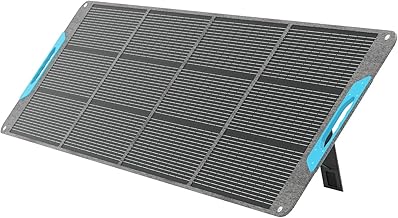
The Renogy 200W IP65 is the brand's straightforward power-station panel, and it earns a place here on reliability alone. It skips the extras and focuses on being a dependable 200 watt folder that plugs into your battery and keeps working trip after trip. For buyers who trust the Renogy name, that consistency is the whole appeal.
The IP65 rating handles splashes and dust well enough for typical camping, and the reinforced stitched edges plus a carry handle make it easy to move and store. It folds flat, opens without tools, and connects to a wide range of power stations for silent off-grid charging.
Its limits are honest ones. There is no bundled controller, so this panel is aimed at power stations rather than bare 12V systems, and it is heavier than the ultra-light options in this list. Like every panel, it only approaches its rated output in direct sun at a good angle.
Bottom line: a solid, no-drama choice for power-station owners who want the Renogy name and reliable weather resistance without paying for tempered glass.
- Rated power: 200 watts
- Waterproof rating: IP65
- Design: foldable with carry handle
- Edges: reinforced stitching
- Compatibility: power stations
- Use case: RV, camping, off-grid
An IP65 rating means the panel resists dust and low-pressure water jets, which covers rain and splashes on a normal camping trip. It is not built for immersion, so treat it like any electronic gear in severe weather and keep the connectors sheltered. For most weekend and RV use, IP65 is plenty of protection.
- Connect to a power station with a compatible solar input
- Check that your station accepts a 200 watt panel voltage
- Angle toward the sun and reposition through the day
- Best paired with a mid-size to large power station

Pros
- MC-4 and Anderson outputs cover most setups
- IP65 waterproofing for the outdoors
- Four kickstands included
- Good value from a known battery brand
- Folds into a carry case
Cons
- No controller for direct 12V charging
- Heavier fabric backing
- Some brands need extra Anderson adapters
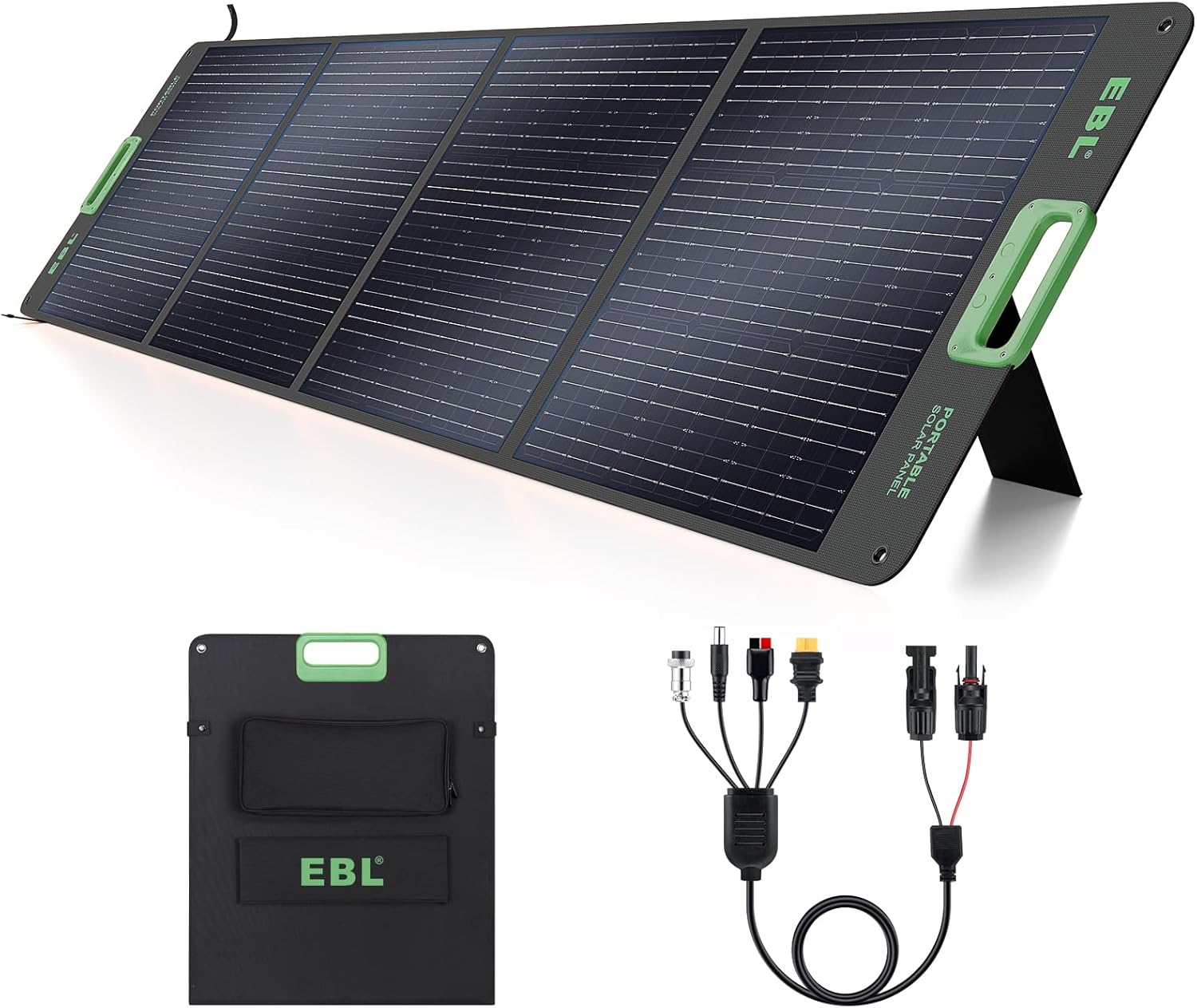
EBL is best known for batteries and chargers, and its 200W panel brings that practical mindset to portable solar. It leads with the connectors most people need, MC-4 and Anderson, so it slots into a wide range of power stations and 12V setups with minimal fuss. For a household emergency kit, that flexibility is reassuring.
The panel is a capable 200 watt folder with IP65 waterproofing and four built-in kickstands, so setup is quick and it stands up to typical outdoor conditions. It folds into a carry case for transport, making it easy to stash in a closet until a blackout or a camping trip calls for it.
The caveats are familiar. There is no charge controller in the box, so pairing it with a bare 12V battery means adding one, though power stations handle that internally. The fabric backing adds some weight, and depending on your gear you may need an extra Anderson adapter to make the final connection.
Bottom line: a sensible, good-value panel for emergency and RV use, especially if you already trust EBL for batteries and want standard connectors.
- Rated power: 200 watts
- Waterproof rating: IP65
- Outputs: MC-4 and Anderson connectors
- Kickstands: four built in
- Design: foldable with carry case
- Use case: RV, camping, blackout backup
The MC-4 and Anderson outputs are the two most useful connectors in portable solar. MC-4 is the universal solar standard and adapts to almost anything, while Anderson plugs are common on power stations. Between the two, this panel connects to most gear, though a few stations may still need a small adapter to finish the link.
- Store folded in a closet until the power goes out
- Pair with a power station to run phones, lights, and small gear
- Set up quickly on the four kickstands when the sun is out
- A dependable backup for households and short outages
How to Choose the Best Portable Solar Panels
Solar marketing loves big wattage numbers, but the panel that suits you depends on how you plan to use it. A backpacker wants the lightest folded size, an RV owner wants a rugged panel that survives years on the road, and someone building an emergency kit wants the fastest charge for a large battery. The five criteria below are the ones that separate a panel you love from one that gathers dust in the garage.
Real Wattage and Efficiency
A panel rated at 200 watts almost never produces 200 watts in the real world. That number is measured under laboratory sun, so plan on roughly 70 to 80 percent of the label on a clear day when the panel is angled well. Cell technology is the single biggest lever here. Older monocrystalline panels typically convert around 21 to 23 percent of sunlight, while the newer N-type cells on several panels in this list push toward 25 percent. Higher efficiency means more watts from the same folded footprint, which matters a lot when you are carrying the panel on your back.
Match the panel wattage to the battery you want to fill. A 100 watt panel is plenty for phones, tablets, and a small power station over a day of sun. If you own a large power station or a solar generator, step up to a 200 or 450 watt panel so you can refill it in one afternoon instead of three. When in doubt, size up: a bigger panel simply charges faster and still works fine on cloudy days.
Weight and Folded Size

Portability is the whole point, and weight is where portable panels differ most. The lightest 100 watt kits in this roundup weigh around 5 pounds and fold to the size of a slim briefcase, so they slip behind a car seat or into a backpack. A 200 watt panel usually lands between 9 and 16 pounds depending on whether it uses fabric laminate or heavier tempered glass. Rigid starter kits weigh more still and do not fold at all, which is fine if the panel lives on an RV roof but painful if you carry it to a trailhead.
Look at the folded dimensions, not just the weight. Integrated kickstands and a carry handle make a real difference in the field, because a panel you can set up in ten seconds gets used far more than one that needs a tarp and a prop. If you are pairing a panel with a battery for road trips, our guide to the best portable power stations covers the other half of the setup.
Durability and Waterproof Rating
A portable panel spends its life outdoors, so build quality decides how many seasons it lasts. Waterproof ratings use the IP scale, and the number you want is on the panel itself, not just the junction box. An IP65 panel resists rain and dust well enough for most camping, IP67 adds protection against heavier soaking, and IP68 handles the harshest conditions. Keep in mind that the exposed connectors are often the weak point, so tuck them away when a storm rolls in regardless of the rating.
Panel surface material matters too. Tempered glass resists scratches and hail but adds weight, while ETFE fabric laminate stays light and flexible at the cost of a slightly softer surface. Reinforced stitching around the panel edges, sturdy hinges, and a protective carry case all extend the life of a folding panel. These are the products in our patio, lawn, and garden category that see the roughest daily use, so durability is worth paying for.
Connectors and Power Station Compatibility
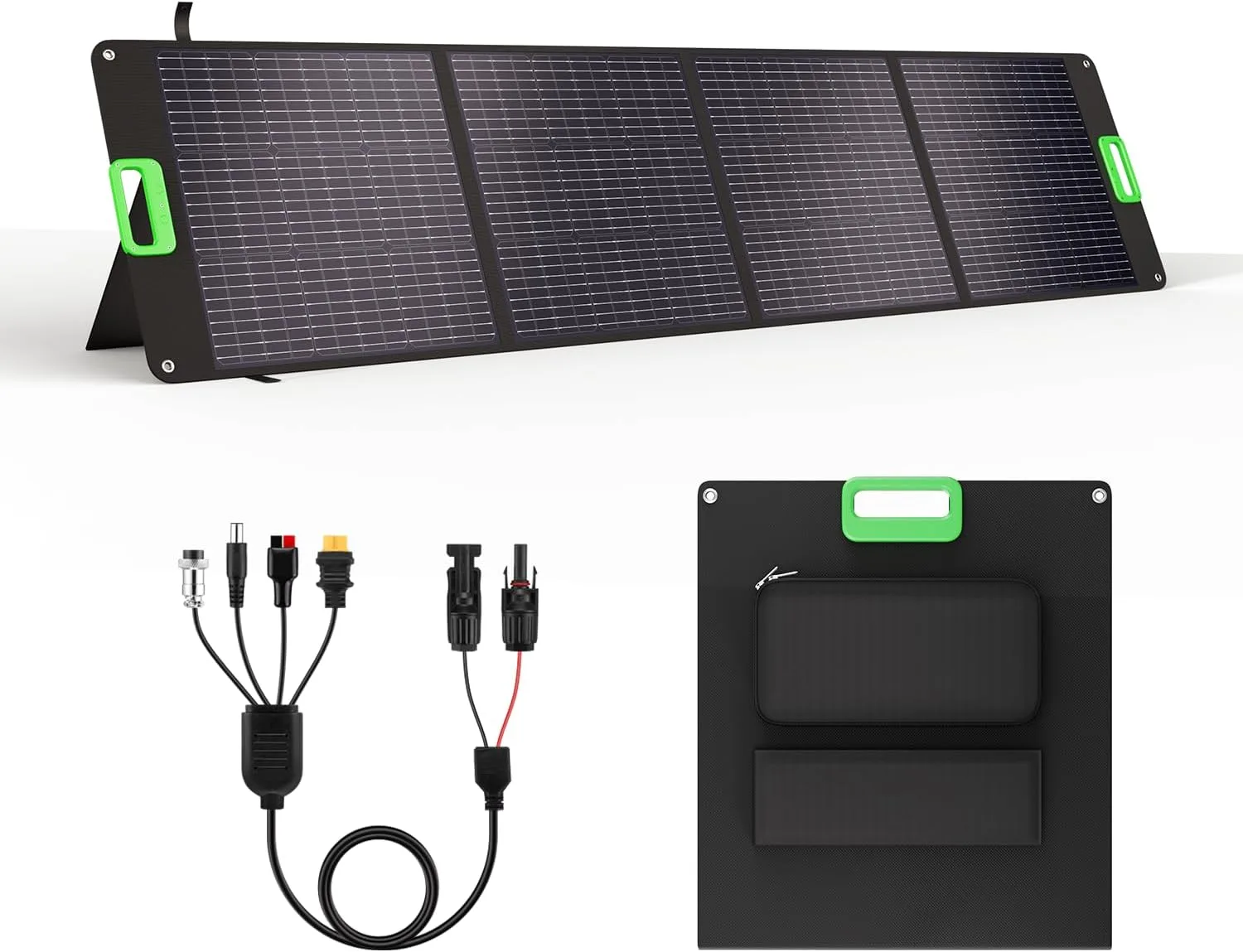
The single most common frustration with portable solar is a panel that will not plug into the battery. Portable panels use a handful of connector standards. MC-4 is the universal solar connector and adapts to almost anything. Anderson and XT60 plugs are common on power stations, while a barrel or aviation plug is sometimes needed for a specific brand. A panel that ships with several output options, or a full adapter kit, saves you from hunting down cables later.
Before you buy, confirm the panel matches your battery. Many power stations from EcoFlow, Anker, Jackery, and Bluetti accept a wide voltage range, but each has an input limit you should not exceed. A few panels in this list are pre-configured for those brands, which removes the guesswork entirely.
Charge Controllers and 12V Charging
There is a fork in the road here. If you are charging a modern power station, you do not need a separate charge controller, because the station has one built in; you just plug the panel straight into the solar input. If you are charging a bare 12V battery, such as a lead-acid or lithium bank in an RV, you do need a controller to protect the battery. Several kits in this roundup include a PWM controller and the cables you need, so you can charge a 12V system without buying extra parts.
PWM controllers are cheap and reliable but waste a little energy. An MPPT controller squeezes out more watts, especially in cold or cloudy weather, and is worth adding if you run a larger 12V system. For a plug-and-play power station, skip the controller question entirely and focus on wattage and connectors.
Setup, Angle, and Sun Tracking
The way you position a panel matters almost as much as the panel itself. Solar cells produce the most power when sunlight hits them straight on, so a panel lying flat on the ground gives up a large share of its potential. Built-in kickstands are the feature that makes this easy: most quality folding panels open to a fixed angle of around 40 to 45 degrees, which suits the sun across much of the year. If your panel lacks stands, a simple prop against a chair or cooler still beats leaving it flat.
For the best results, aim the panel toward the sun and reposition it once or twice as the day moves. Watch for shadows from tree branches, awnings, or even a single power cable, because a small shaded strip can cut output across the whole panel. A minute of repositioning at midday often adds more charge than any spec on the box, and it costs nothing.
| Panel style | Best for | Typical weight | Folds for travel |
|---|---|---|---|
| Foldable 100W kit | Backpacking, small power stations, phones and tablets | Around 5 to 8 pounds | Yes, briefcase size |
| Foldable 200W panel | Camping, RV, mid to large power stations | Around 9 to 16 pounds | Yes, with kickstands |
| Foldable 450W panel | Fast charging large power stations and generators | Around 20 pounds or more | Yes, larger footprint |
Why You Should Trust Us
We build these roundups by combining hands-off research with what real owners report over months of use. Our team reads through verified owner feedback, compares the published specifications for wattage, efficiency, and waterproof rating, and cross-checks connector standards against the power stations most people own. We favor panels with a long track record and a large base of satisfied buyers over flashy new listings with thin histories.
We do not accept payment to place a product higher on a list. When a panel has a weak spot, such as a missing controller or a rating that reflects unit inconsistency, we say so in its review so you can weigh the trade-off yourself. Our goal is a shortlist you can trust, not a wall of every panel on the market.
Final Thoughts
If you want one panel that does almost everything, the Renogy 200W Foldable N-Type Solar Panel is our best overall pick. Its N-type cells reach about 25 percent efficiency, the tempered glass surface handles years of outdoor use, and the included controller means it works with both power stations and 12V banks. The HQST 200W Ultra-Light panel is the top choice for anyone who hikes to camp, since it delivers the same N-type efficiency and IP67 waterproofing in a noticeably lighter package.
For the best value, the DOKIO 100W Foldable Kit is hard to beat at around 5 pounds with a controller and dual USB built in, making it a smart first panel or a light backup. If you own a large battery and want to refill it fast, the ZOUPW 450W Foldable Panel puts out the most power here and comes pre-set for EcoFlow, Anker, Jackery, and Bluetti. Pair any of these with the right battery from our portable power station guide, and browse more outdoor gear across our full category list.
Frequently Asked Questions
How many watts do I need in a portable solar panel?
Match the wattage to your battery. A 100 watt panel keeps phones, tablets, and a small power station topped up over a sunny day. If you own a mid-size or large power station, a 200 watt panel refills it far faster, and a 450 watt panel is the fastest option for the biggest batteries. Remember that real output runs about 70 to 80 percent of the label, so sizing up is rarely a mistake.
Can I use the best portable solar panels of 2026 with any power station?
Usually, as long as the connector and voltage match. Most modern power stations accept a wide input range, but each has a maximum voltage and current you should not exceed. Check that the panel offers an MC-4, Anderson, or XT60 output that fits your station, or that it comes with an adapter kit. Several panels here are pre-configured for EcoFlow, Anker, Jackery, and Bluetti to make this simple.
Do portable solar panels work on cloudy days?
Yes, but at reduced output. Clouds can cut production to a fraction of the rated wattage, so a cloudy day might deliver a slow trickle rather than a full charge. High-efficiency N-type panels hold up better in low light than older cells. This is another reason to buy a panel with more wattage than you think you need, so a gray sky still gives you usable power.
Do I need a charge controller with a folding solar panel?
It depends on what you are charging. A power station has a built-in controller, so you plug the panel straight into its solar input with no extra hardware. A bare 12V battery, like the lead-acid or lithium bank in an RV, does need a controller to charge safely. Many kits in this list include a PWM controller along with the cables you need to start charging a 12V system.
How should I care for a portable solar panel?
Keep the panel surface clean with a soft cloth, since dust and pollen cut output over time. Fold it along the factory creases and store it in its case away from sharp objects. Tuck the connectors away in rain even if the panel is waterproof, and avoid leaving a folded panel baking in a hot car for long stretches. For more buying advice on solar and outdoor power, browse our latest articles.



Write Your Review
No reviews yet. Be the first to share your experience!