

A good portable power station is a quiet box of stored electricity you can carry to a campsite or wheel next to the fridge when the grid goes down. Unlike a gas generator, it makes no fumes and almost no noise, so you can run it indoors during a blackout or beside your tent without waking the whole campground. For this guide to the 9 best portable power stations in October 2026, we focused on the units themselves: how many watt-hours they store, how many watts they can push into your appliances, how tough their batteries are, and how quickly they refill from a wall outlet or your car. You do not need a sunny day or a roof full of panels to get value from any pick on this list.
Brands like MARBERO, EcoFlow, Anker and more now cover every tier, from a jacket-pocket battery for phones and a CPAP to a 2,000 watt-hour station that keeps a refrigerator, router, and a few lights alive for a long evening. We leaned on real owner ratings, published capacity and output specs, and the port layouts that actually matter in a power cut. If you want to see how these stack up against sun-charged options, our companion roundup of the best solar generators covers the same hardware with panels bundled in. You can also browse more buying guides on our articles hub.

Pros
- Balanced 1,024Wh capacity suits most home and camping needs
- 1,800W output with X-Boost handles many high-draw appliances
- Recharges to about 80 percent in under an hour from the wall
- LiFePO4 cells rated for thousands of cycles
- App control and expandable capacity
Cons
- Heavier than compact camping units
- Cooling fan is audible under heavy load
The EcoFlow DELTA 2 is the station most people should look at first. It stores 1,024 watt-hours in durable LiFePO4 cells and pushes 1,800 watts of clean, pure sine wave power, which is enough to run a refrigerator, a router, a laptop, and a few lights at the same time. That makes it a natural fit for home backup during an outage as well as a long weekend of camping.
Its standout trait is speed. Plugged into a wall outlet, it climbs to around 80 percent in under an hour and reaches full not long after, so you can top it up the moment a storm appears in the forecast. An X-Boost mode lets it briefly power resistive appliances that draw a little more than its rating, and you can bolt on an extra battery later if your needs grow.
The trade-offs are modest. It is comfortable to carry short distances but not something you will backpack, and the cooling fan becomes audible when you lean on the inverter hard. Standby drain is low but present if you leave it armed for weeks.
Bottom line: the DELTA 2 balances capacity, output, recharge speed, and a proven track record better than almost anything at its size, which is why it earns our best overall spot.
- Capacity: 1,024Wh LiFePO4 (LFP)
- Continuous output: 1,800W pure sine wave
- Surge: 2,700W with X-Boost
- AC outlets: six
- USB-C: up to 100W PD
- Wall recharge: about 80 percent in under an hour
- Inputs: AC, 12V car, solar-ready
- Expandable with add-on battery
- Full-size refrigerator during an outage
- Router, modem, and a laptop for a workday
- CPAP machine overnight
- Small microwave or coffee maker in short bursts
- Phones, tablets, and camera gear on a trip
The DELTA 2 refills three ways. A standard wall outlet is the fastest, reaching roughly 80 percent in under an hour. A 12V car socket trickles it back up on a long drive, and it is solar-ready if you add a compatible panel later. For most owners the wall outlet does all the work, and solar simply extends its reach off the grid.
Pros
- Full recharge in roughly 49 minutes from the wall
- Strong 2,000W continuous output, 3,000W peak
- Compact, stackable 1,024Wh LiFePO4 design
- Fast UPS switchover for sensitive gear
- Quiet operation under light loads
Cons
- Fewer AC outlets than some rivals
- Draws a little standby power if left armed for long periods
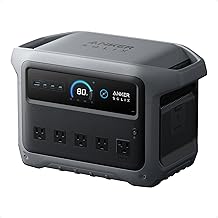
The Anker SOLIX C1000 Gen 2 is built for people who hate waiting. From a wall outlet it refills to full in about 49 minutes, which is the fastest recharge of any mid-size station here. Combined with 2,000 watts of continuous output and a 3,000 watt peak, it can start and run appliances that make smaller inverters stumble.
Its 1,024 watt-hour LiFePO4 battery covers the same everyday duties as our best overall pick, from a fridge and router during an outage to a full slate of camp gear. Anker keeps the footprint compact and stackable, and a fast UPS mode makes it a strong guardian for a home office or a desktop that cannot tolerate a hard shutdown.
The compromises are small. It offers fewer AC outlets than a couple of rivals, so a power strip may be in your future for a busy setup, and like any always-on backup it sips a little standby power when left armed. Neither is a dealbreaker for its intended job.
Bottom line: if you want a mid-size station that is ready again almost as soon as you unplug it, the C1000 Gen 2 is the fast-charging standout of this list.
- Capacity: 1,024Wh LiFePO4
- Continuous output: 2,000W (3,000W peak)
- Full wall recharge: about 49 minutes
- UPS switchover for backup
- Inputs: AC, 12V car, solar-ready
- Expandable with add-on battery
- App control over Wi-Fi and Bluetooth
Anker's rapid charging is the headline feature. Plugged into a standard outlet, the C1000 Gen 2 reaches full in roughly 49 minutes, so a station that ran your fridge overnight can be ready again before you finish breakfast. That turnaround makes it far more practical during a multi-day outage, where slower stations spend the day only half-charged.
- Fast UPS switchover keeps a router or desktop running when the grid drops
- Sits plugged in and armed as a silent backup
- Expandable capacity for longer outages
- Clean pure sine wave power for sensitive electronics

Pros
- 1024Wh LiFePO4 battery rated for about 4000 charge cycles
- Recharges from empty to full in roughly one hour from a wall outlet
- 1500W continuous output with X-Boost to run higher-draw appliances
- Fast UPS switchover protects a router, modem, or desktop during an outage
- Quiet operation with Wi-Fi app control for monitoring and charge limits
Cons
- At around 27 pounds it is heavier than compact camping units
- Reaching whole-home runtime means adding an expansion battery
The EcoFlow DELTA 3 Classic is a mid-size power station built around a 1024Wh lithium iron phosphate battery, aimed at people who want reliable home backup and enough capacity for a long weekend off the grid. It sits in the sweet spot for most households, covering a fridge, router, and a handful of devices without the weight of a whole-home unit.
Its strongest feature is charge speed. The DELTA 3 Classic refills from empty to full in about an hour from a standard wall outlet, so you can top it up quickly before a storm arrives. The 1500W continuous output, with X-Boost stretching to cover higher-draw resistive loads, runs most kitchen and office gear, and the fast UPS switchover keeps sensitive electronics alive when the grid drops.
The trade-offs are weight and expansion cost. At roughly 27 pounds it is comfortable to move around the house but not something you backpack, and reaching multi-day whole-home runtime means buying an add-on battery. For a single dependable station that charges fast and protects your gear, it is one of the easiest picks to recommend.
Bottom line: a fast-charging LiFePO4 mid-size station that balances runtime, output, and price better than most, and a natural default for home backup buyers.
- Capacity: 1024Wh LiFePO4 (LFP), about 4000 cycles
- Continuous output: 1500W, with X-Boost for higher resistive loads
- Wall recharge: roughly one hour from empty to full
- UPS switchover: under 10 milliseconds
- Ports: multiple AC outlets, USB-C PD, USB-A, and a 12V car socket
- Extras: Wi-Fi app control, expandable with add-on batteries
- Weight: around 27 pounds
The DELTA 3 Classic shines as an always-ready backup box near your electrical panel. Left plugged in as a UPS, it keeps a router, modem, and desktop running through an outage without a flicker, and its fast wall charging means it is rarely caught low. The 1024Wh capacity can nurse an energy-efficient fridge through a long evening while still powering lights and phones.
Beyond the one-hour wall charge, the DELTA 3 Classic accepts a 12V car input for topping up on the road and is solar-ready if you add a panel later. The port layout covers multiple AC outlets for appliances, high-wattage USB-C Power Delivery for laptops and phones, USB-A for smaller gear, and a car socket, so a mixed household load plugs in without adapters.

Pros
- Four AC outlets in a smaller-than-average body
- 1,800W output with a 3,600W surge
- Fast UPS for a home office
- Quick wall recharge
- LiFePO4 cells for long service life
Cons
- No wheels, so whole-home runtime means add-on batteries
- Companion app occasionally needs a reconnect
The BLUETTI Elite 100 V2 packs a lot of backup into a small case. It holds 1,024 watt-hours of LiFePO4 power and offers four AC outlets rated for 1,800 watts continuous, with a 3,600 watt surge for appliances that spike on startup. BLUETTI trimmed the body to around a third smaller than earlier models, so it slots onto a shelf near your panel without dominating the room.
It is aimed squarely at home backup. A fast UPS mode lets it sit between the wall and your router, modem, or desktop and take over in milliseconds if the grid fails, and the four outlets mean you rarely need a power strip for essentials. Wall recharging is quick, and the LFP chemistry is built to be topped up for years.
There are limits. Without wheels it is a lift rather than a roll, and reaching whole-home runtime means adding an expansion battery rather than buying one giant unit. The companion app is handy but occasionally wants a reconnect.
Bottom line: for a compact home backup station with plenty of outlets and true UPS protection, the Elite 100 V2 is one of the smartest 1,000Wh class buys here.
- Capacity: 1,024Wh LiFePO4 (LFP)
- Continuous output: 1,800W across four AC ports
- Surge: 3,600W
- Fast UPS switchover
- Around 35 percent smaller than prior models
- Inputs: AC, 12V car, solar-ready
- App control
- Home offices that need reliable UPS protection
- Renters who want backup without a big footprint
- Campers who value several outlets in a small case
- Anyone starting a stackable backup system
The Elite 100 V2 shines as an always-on guardian. Keep it plugged in with your essential electronics connected, and its fast UPS mode switches to battery quickly enough that a router or desktop never reboots. When you need more runtime for a long outage, an expansion battery raises the capacity without replacing the unit you already own.

Pros
- Light enough to carry with one hand
- 288Wh LiFePO4 in a truly compact body
- 140W two-way USB-C charges and recharges fast
- Quiet, fan-light operation
- Sturdy, travel-friendly design
Cons
- 300W output limits it to smaller devices
- Not enough for a full-size fridge for long
The Anker SOLIX C300 is the station you actually carry. It stores 288 watt-hours in LiFePO4 cells and delivers 300 watts, which is plenty for phones, tablets, a laptop, a CPAP machine, and camp lighting on a weekend away. A standout 140 watt two-way USB-C port charges a laptop directly and also refills the station quickly when you plug it back in.
Its appeal is portability. This is a one-hand carry that disappears into a car trunk or a tent corner, yet it still uses the same long-lived LFP chemistry as the big units. For desk gear during a short blackout or a light camping kit, it hits a sweet spot between capacity and convenience.
Know its ceiling. At 300 watts it will not run a microwave, a hair dryer, or a full-size fridge for long, so it is a companion battery rather than a whole-home backup. Buy it for mobility and device charging, not for heavy appliances.
Bottom line: as a genuinely portable everyday battery with fast USB-C, the SOLIX C300 is the easiest station here to keep within reach.
- Capacity: 288Wh LiFePO4
- Continuous output: 300W
- USB-C: 140W two-way
- Weight: light one-hand carry
- Inputs: AC, 12V car, solar-ready
- Multiple USB and DC ports
- Phones and tablets for many recharges
- A laptop through the 140W USB-C port
- CPAP machine overnight on eco mode
- Camp lights and a small fan
- Cameras and drone batteries on a shoot
Weight is where the C300 wins. It is light enough to carry in one hand and small enough to tuck beside a car seat, so it rides along on road trips, tailgates, and camping weekends without a second thought. The 140 watt USB-C port means it recharges quickly at a rest stop and tops up your laptop on the way.

Pros
- 600W output, higher than most compact stations
- 10ms UPS protects small electronics
- 1,500W power-lifting mode for resistive loads
- 288Wh LiFePO4 for long life
- Compact and easy to store
Cons
- Single battery with no expansion path
- Power lifting does not help motor-driven appliances
The BLUETTI Elite 30 V2 proves a small station can still act like a real backup. In a 288 watt-hour body it delivers 600 watts continuous, more than most compact units, and a power-lifting mode that briefly reaches 1,500 watts to run resistive appliances like a small kettle. That extra muscle makes it more versatile than its size suggests.
Its headline feature is a 10 millisecond UPS. Plug your modem, router, or a small desktop into it while it stays on the wall, and it switches to battery fast enough that nothing reboots when the grid drops. For a bedside CPAP, a home network, or a work-from-home nook, that is meaningful protection in a case you can lift with one hand.
The limits are the ones you expect from a compact station. It is a single battery with no expansion path, and the power-lifting trick works for heaters and kettles but not for motor-driven appliances, so read the specs if a particular device is your goal.
Bottom line: for a small, quiet home backup with genuine UPS protection, the Elite 30 V2 punches well above its size.
- Capacity: 288Wh LiFePO4
- Continuous output: 600W
- Power lifting: up to 1,500W for resistive loads
- UPS switchover: 10 milliseconds
- Inputs: AC, 12V car, solar-ready
- App control
The 10 millisecond UPS is the reason to choose the Elite 30 V2 over a plain camping battery. Keep it plugged in with your network gear or a small desktop connected, and the switchover is quick enough that a video call or a download survives a grid drop untouched. It is one of the smallest stations here that offers this level of protection.
- Keep it on the wall in UPS mode for always-on protection
- Use power lifting for kettles and heaters, not motors
- Recharge from the wall or a 12V car socket
- Monitor remaining runtime in the app

Pros
- Extremely light and pocketable
- Very affordable entry point
- AC outlet plus USB and DC ports
- Built-in LED emergency light
- Simple, grab-and-go operation
Cons
- Small 88Wh capacity suits only light devices
- Standard lithium-ion rather than LiFePO4
The MARBERO 88Wh station is the easiest way to keep small devices alive without spending much. It is tiny, light, and inexpensive, with an 80 watt AC outlet, a 120 watt peak, and a handful of USB and DC ports. A built-in LED light adds a genuinely useful touch for a power cut or a campsite.
Think of it as a supersized power bank that also happens to have a wall outlet. It will recharge phones and tablets several times, run a small fan, keep a CPAP going on low settings, and power camp lighting. For a car kit, a bug-out bag, or a first camping trip, its size and price are hard to argue with.
The compromises are honest. The 88 watt-hour battery is small, so it is strictly for light loads, and it uses standard lithium-ion rather than the LiFePO4 chemistry of the bigger units, which means fewer lifetime cycles. Neither matters much for its role as an emergency and travel companion.
Bottom line: as the budget grab-and-go pick, the MARBERO 88Wh delivers real portability and a wall outlet for very little, making it our value choice for light duty.
- Capacity: 88Wh lithium-ion
- AC output: 80W (120W peak)
- Ports: AC, multiple USB, DC
- Built-in LED flashlight
- Ultra-light, pocketable size
- Solar-ready input
- Several phone and tablet recharges
- A small fan or string of camp lights
- CPAP on low settings for a short trip
- A laptop for a top-up
- The built-in flashlight in an emergency
This is the station that lives in a glovebox or a backpack. It weighs about as much as a hardcover book, so it goes everywhere without thought, and the built-in light and AC outlet make it a tidy little emergency kit on their own. For anyone who wants a first, inexpensive backup battery, it is the natural starting point.
Pros
- Large 2,073Wh capacity for long outages
- 2,600W across four AC outlets, 3,900W surge
- Reaches 80 percent in about 50 minutes
- Fast UPS for whole-desk protection
- Long-life LiFePO4 cells
Cons
- Heavy enough to want a stable home base
- Larger footprint than mid-size stations
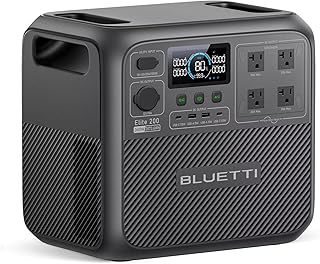
The BLUETTI Elite 200 V2 is built for the long outage. Its 2,073 watt-hour LiFePO4 battery pairs with four AC outlets rated for 2,600 watts continuous and a 3,900 watt power-lifting surge, so it can carry a refrigerator, a few lights, a router, and other essentials at the same time. This is a station you keep near the electrical panel and lean on when the grid is out for hours.
Despite the size, it charges fast, reaching around 80 percent in roughly 50 minutes from the wall so it is ready before the next round of weather. A fast UPS mode protects a full desk of electronics, and the LFP cells are rated to be topped up for years without meaningful fade. Four outlets mean most households can plug in essentials directly.
The trade-off is heft. This is a two-hand lift that prefers a permanent spot rather than a backpack, and its footprint is larger than the 1,000Wh class. For a portable everyday battery you would look smaller, but for real home backup that is exactly the point.
Bottom line: when you need to carry your whole house through a long outage, the Elite 200 V2 brings the capacity, the outlets, and the fast recharge to do it.
- Capacity: 2,073Wh LiFePO4 (LFP)
- Continuous output: 2,600W across four AC outlets
- Power lifting: up to 3,900W
- Wall recharge: about 80 percent in 50 minutes
- Fast UPS switchover
- Inputs: AC, 12V car, solar-ready
- App control
- Full-size refrigerator through a long outage
- Router, modem, and a home office
- Several lights and phone chargers at once
- A microwave or coffee maker in bursts
- A CPAP for multiple nights
With four outlets and a fast UPS, the Elite 200 V2 can shelter an entire desk or an essentials circuit. Keep it plugged in and armed, and it takes over the moment the grid fails, quickly enough that computers and networking gear stay up. Its large LFP battery means that protection lasts for hours rather than minutes.

Pros
- Large 2,042Wh LiFePO4 capacity
- 2,200W output runs heavy household loads
- 100W USB-C PD charges laptops directly
- Fast wall recharging
- Trusted Jackery reliability
Cons
- Heavy, best kept on a cart or fixed spot
- Premium price for the capacity
The Jackery Explorer 2000 v2 is a whole-home backup in a single case. It stores 2,042 watt-hours in LiFePO4 cells and delivers 2,200 watts of pure sine wave power, enough to run a refrigerator alongside several other loads during a long outage. Jackery's long reputation for dependable stations makes it an easy recommendation for buyers who want a known quantity.
The unit balances big capacity with sensible everyday features. A 100 watt USB-C PD port charges a laptop without a brick, wall recharging is quick, and an app lets you watch the remaining runtime from across the room. For emergencies, power outages, or extended camping where you want to run more than just the basics, it has the headroom to cope.
The compromises come with the size. It is heavy enough that most owners keep it on a cart or in a fixed backup spot rather than hauling it far, and the capacity carries a premium price. Those are the expected costs of stepping up to the 2,000 watt-hour tier.
Bottom line: for a high-capacity station from a trusted name, the Explorer 2000 v2 is a reliable choice to power a home through a long outage.
- Capacity: 2,042Wh LiFePO4
- Continuous output: 2,200W pure sine wave
- USB-C: 100W PD
- Fast wall recharging
- Inputs: AC, 12V car, solar-ready
- App monitoring
- Full-size refrigerator during a long outage
- Home office with laptop, router, and monitor
- Lights and fans across a room
- A microwave or kettle in short bursts
- CPAP for several nights
- Homeowners preparing for multi-hour outages
- RV and van owners who want ample power
- Anyone wanting a trusted brand at high capacity
- Off-grid stays that need more than the basics
What to Look For in the Best Portable Power Stations
A portable power station is really two things bolted together: a battery that holds energy and an inverter that turns that energy into the wall-style power your devices expect. The battery decides how long you can run something, and the inverter decides what you can run at all. Get both numbers right for your needs and the rest is comfort and convenience. Below are the factors that separate a station you will love from one you will quietly resent.
Watt-Hours and How Long a Station Actually Lasts
Capacity is measured in watt-hours (Wh), and it is the single most important number on the spec sheet. A rough rule is that a station will run a device for roughly its watt-hour rating divided by the device’s wattage. A 1,000Wh unit can keep a 50W router and a 60W laptop going for most of a workday, or nurse a small energy-star fridge through an overnight outage if the compressor only cycles part of the time. A 288Wh unit is happier with phones, tablets, a fan, and a CPAP machine.
Be honest about what you plan to plug in before you chase the biggest battery. A compact 88Wh to 300Wh station is light enough to carry with one hand and covers weekend camping and desk gear during short cuts. A 1,000Wh class unit is the sweet spot for most homes because it balances runtime against weight. Only step up to a 2,000Wh station if you expect long outages or want to run a full-size refrigerator plus several other loads at once. Buying more capacity than you need means carrying dead weight you rarely use.
Continuous Watts, Surge, and the Appliances You Can Run

Capacity tells you how long; continuous wattage tells you what. Every station lists a continuous output in watts and a higher surge or peak figure. The continuous number is what the inverter can deliver all day. The surge number is a brief burst that covers the spike a motor draws when it first kicks on, like the compressor in a fridge or the pump in a coffee maker. A microwave, a space heater, or a hair dryer can pull well over 1,000W, so if you want to run one of those you need a station rated for it, not just a big battery.
Look for pure sine wave output, which every unit on this list provides. It is clean, grid-quality power that keeps sensitive electronics and motors happy. Some of the newer stations add a power-lifting mode that briefly reduces the incoming draw of a resistive load so a station can run a bigger appliance than its raw rating suggests. That trick works for kettles and heaters but not for motors, so read the fine print if a specific appliance is your reason for buying.
| Tier | Capacity | Continuous Output | Best suited for |
|---|---|---|---|
| Ultra-compact | 88Wh to 300Wh | 80W to 600W | Phones, CPAP, camping lights, laptops |
| Mid-size | Around 1,000Wh | 1,500W to 2,000W | Fridge, router, TV, small appliances |
| Whole-home | 2,000Wh and up | 2,200W to 2,600W | Long outages, multiple heavy loads |
How Fast It Recharges From the Wall and Your Car
The most overlooked spec is how quickly the station refills from a standard wall outlet, because that is how most people will top it up between uses and after an outage. Older stations crawled to full in six or more hours. The current generation from Anker, EcoFlow, and BLUETTI can reach 80 percent in under an hour and full in well under two, which changes how you use the thing. If a storm is coming, you can leave a station on the charger and know it will be ready before the first raindrop.
Car charging matters too. Every station here accepts a 12V input from a cigarette-lighter port, so a road trip or a long drive doubles as a slow recharge. Solar is a bonus rather than a requirement: most of these units are solar-ready if you buy a panel later, but you never need the sun to keep one useful. If sun charging is central to your plan, our guides to the best portable solar panels and to outdoor power gear cover the panels that pair with these stations.
LiFePO4 Cycle Life and Why It Outlasts Older Batteries

Battery chemistry is where quiet, long-term value hides. Almost every station worth owning in 2026 now uses lithium iron phosphate cells, written as LiFePO4 or LFP. Compared with the older lithium-ion packs, LFP cells are far more thermally stable and rated for many more charge cycles, often 3,000 to 4,000 down to eighty percent of original capacity. In plain terms, you can cycle a good LFP station most days for the better part of a decade before you notice meaningful fade.
That longevity is why LFP is worth a small premium over an older chemistry, especially for a station that will sit as home backup and get topped up regularly. It also handles the heat of a car or a summer tent far better than legacy cells. Only the smallest, cheapest camping batteries still ship with standard lithium-ion, and even there the gap is closing. When you compare two similar stations, the one with LFP cells is almost always the smarter long-term buy.
UPS, Passthrough, and Keeping Sensitive Electronics Safe
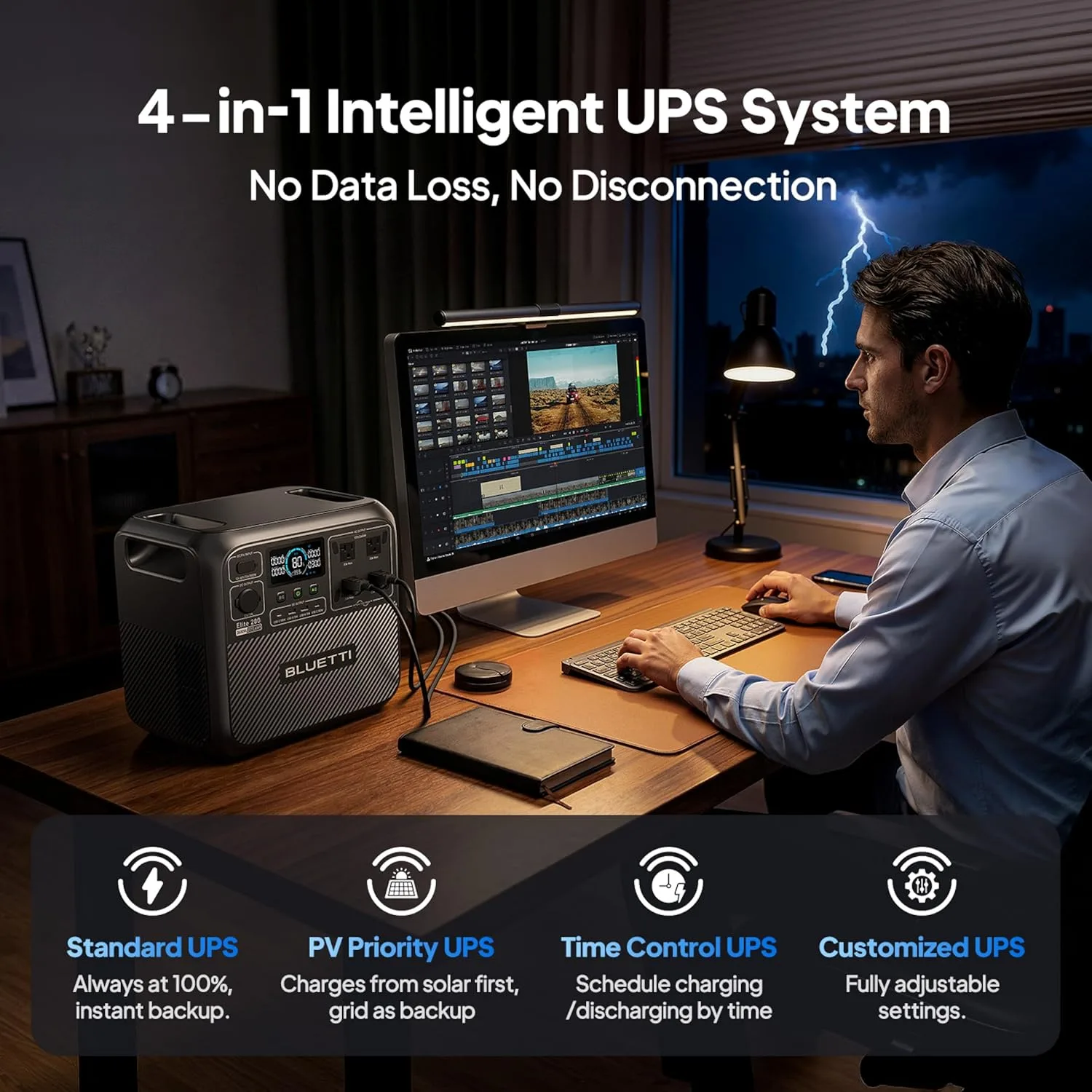
Here is a feature that separates a true backup station from a glorified battery: uninterruptible power supply, or UPS, mode. A station with fast UPS can sit plugged into the wall with your router, modem, or desktop plugged into it. When the grid drops, it switches to battery in a handful of milliseconds, fast enough that your electronics never notice. Several picks on this list advertise a 10 to 20 millisecond switchover, which is quick enough to protect a home office or a gaming rig from a hard shutdown.
Passthrough charging is related and just as handy. It lets you power devices from the station while the station itself is charging, so it never becomes a bottleneck. Not every model handles a true zero-gap UPS transfer, and standby power for the always-on models draws a trickle from the battery, so factor that in if you leave one armed for weeks. If protecting sensitive gear during an outage is your main goal, prioritize the UPS-capable stations here over a slightly larger battery without the feature.
Ports, Weight, and Living With It Day to Day
The best portable power stations earn their place through the small details you touch every day. Count the AC outlets and make sure there are enough for your real loads, then check for high-wattage USB-C ports, because a 100W or 140W USB-C output can charge a laptop directly and skip the bulky brick. A 12V car socket and a couple of USB-A ports round out a flexible layout. A bright, readable display that shows remaining runtime in real time removes a lot of blackout anxiety.
Weight is the trade-off you live with. A 1,000Wh station usually lands in a range you can carry short distances but would not want to backpack. The 2,000Wh giants really want wheels or a two-person lift, so keep one on a cart near your electrical panel rather than hauling it around. Handles, a solid case, and app control for monitoring the charge from your phone all add up to a station you will actually reach for instead of leaving in a closet. You can find more of these picks across our category guides.
Why You Should Trust Us
We build every roundup by starting from what real buyers report, not from a manufacturer’s marketing deck. For this guide we gathered the current portable power stations that people actually own and rate highly, then read through their capacity, output, chemistry, and recharge specs to sort genuine backup workhorses from underpowered filler. We weighted verified owner ratings, the honesty of each brand’s stated numbers, and the port layouts that matter when the lights go out.
Our aim is to match a station to the way you will use it, whether that is a weekend of camping, a home office you cannot afford to lose, or a fridge you need to protect during a long outage. We do not chase the flashiest surge numbers or the biggest battery for its own sake. We update this list as new models arrive and as owner feedback accumulates, so the shortlist reflects what is worth buying right now rather than what launched with the loudest campaign.
Final Thoughts
If you want one station that fits most homes, the EcoFlow DELTA 2 is our best overall pick. Its 1,000Wh class battery and 1,800W output cover a fridge, a router, and a few devices at once, it recharges from the wall in about an hour, and its long owner track record inspires confidence. For the fastest turnaround between uses, the Anker SOLIX C1000 Gen 2 refills to full in under an hour and delivers a strong 2,000W of continuous power, which makes it a superb storm-season standby.
On a budget or packing light, the MARBERO 88Wh station is the easiest to grab and go for phones, a CPAP, and camp lights, while the Anker SOLIX C300 steps up the runtime without becoming a burden. When you need to carry your whole house through a long outage, the BLUETTI Elite 200 V2 and the Jackery Explorer 2000 v2 bring more than 2,000 watt-hours and enough output to run multiple heavy loads. Whichever tier fits your life, match the watt-hours to your runtime and the watts to your appliances, and you will not go wrong. Browse related picks in our patio, lawn, and garden guides.
Portable Power Station FAQs
How long can the best portable power stations run a refrigerator during an outage?
It depends on the fridge and the battery. A typical energy-efficient refrigerator averages around 50 to 80 watts once it settles, because the compressor cycles on and off rather than running constantly. A 1,000Wh station can usually keep that fridge cold for a long evening, and a 2,000Wh unit can often stretch it through an overnight outage or longer. Match the station’s watt-hours to the runtime you need and leave headroom for the compressor’s startup surge.
How fast can you recharge a portable power station from a wall outlet?
The newest stations are remarkably quick. Several mid-size units from Anker, EcoFlow, and BLUETTI reach 80 percent in under an hour and full in well under two hours from a standard outlet. Older or budget models can take five or six hours. If you want a station ready before a coming storm, fast wall charging is one of the most useful specs to prioritize, more so than a small difference in battery size.
Do you need solar panels to use a portable power station?
No. Every station in this guide charges fully from a wall outlet and from a 12V car socket, so you can keep one topped up and ready without ever seeing the sun. Solar is an optional extra for people who want off-grid recharging on long trips. If that is your goal, pair one of these stations with a panel from our guide to the best solar generators, but treat sun charging as a bonus rather than a requirement.
Are LiFePO4 portable power stations worth it in 2026?
For most buyers, yes. LiFePO4 cells are rated for thousands more charge cycles than older lithium-ion packs and handle heat far better, so a good LFP station can serve as home backup for the better part of a decade. The small price premium pays off in longevity and safety, especially for a unit that will sit charged and get topped up often. Only the smallest camping batteries still use older chemistry, and even those are switching over.
Can you safely run a portable power station indoors during a blackout?
Yes, and that is one of the biggest advantages over a gas generator. A battery station produces no exhaust and almost no noise, so it is safe to use inside your home, unlike a fuel-burning generator that must stay outdoors. Many models add a fast UPS mode that keeps a router, modem, or desktop running through the switchover without a flicker. That combination of clean, quiet, indoor-safe power is exactly why a portable power station has become the go-to backup for so many homes.



Write Your Review
No reviews yet. Be the first to share your experience!