

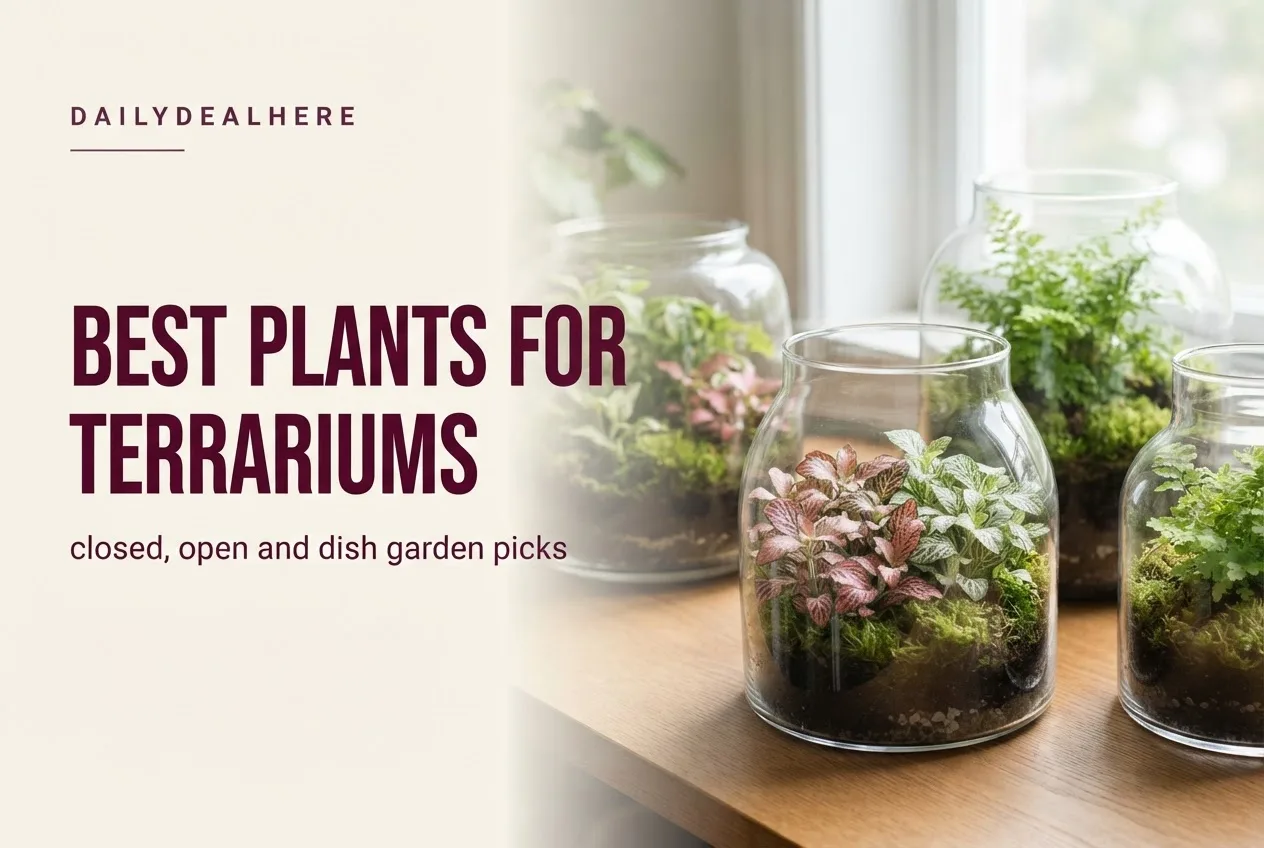
The best plants for terrariums are small, slow growing plants that love humidity and share the same light, water and temperature needs. For a closed terrarium, reliable choices include nerve plant (fittonia), creeping fig, baby’s tears, emerald ripple peperomia, aluminum and artillery plants, strawberry begonia, club moss and small ferns. Open terrariums can also take plants that dislike constant humidity, and cacti and succulents belong in an open dish garden, not a sealed jar, because moist air makes them rot. Pick plants that match each other first, and the terrarium will largely look after itself.
This guide explains what makes a plant suit a terrarium, lists good choices for closed, open and dish style containers with their size and light needs, covers flowering, carnivorous and woodland options, and walks through what to avoid, how to plant, and how to keep a terrarium healthy. It draws on two university extension guides we read in full: University of Missouri Extension’s terrarium guide and Iowa State University Extension’s guide to creating and caring for a terrarium.
The short answer
- Best all around: nerve plant (Fittonia), with white or pink veined leaves, 3 to 6 inches tall, medium light.
- Best groundcovers: baby’s tears, creeping fig and creeping moss (Selaginella), all low and spreading.
- Best foliage fillers: emerald ripple peperomia, aluminum plant, artillery plant and strawberry begonia.
- Best ferns: maidenhair fern, table fern and other small ferns.
- Best for a conversation piece: carnivorous plants such as sundews, which Missouri lists for closed containers in bright light.
- Keep out of closed jars: cacti and succulents, which both guides say suffer in humid air.
What makes a good terrarium plant
Iowa State describes the ideal candidates as plants with slow growth rates, tolerance of high humidity and small leaves. It stresses that because the plants share one space, the most important consideration is that they all tolerate the same soil moisture, light levels and other conditions. Missouri Extension agrees: plants with a low, dense growth habit are usually best, larger plants must be kept small by cutting back the tips, and you should never mix plants that need widely different light, temperature and moisture.
Iowa State explains why the right plants thrive. In a sealed terrarium, water taken up by the plants is released through the leaves, condenses on the glass and runs back to the soil, so the plants can go for months without watering. The result is high humidity, warm temperatures and no drafts, which suits many tropical houseplants that struggle in a dry, drafty home.
Closed, open or dish garden: decide first
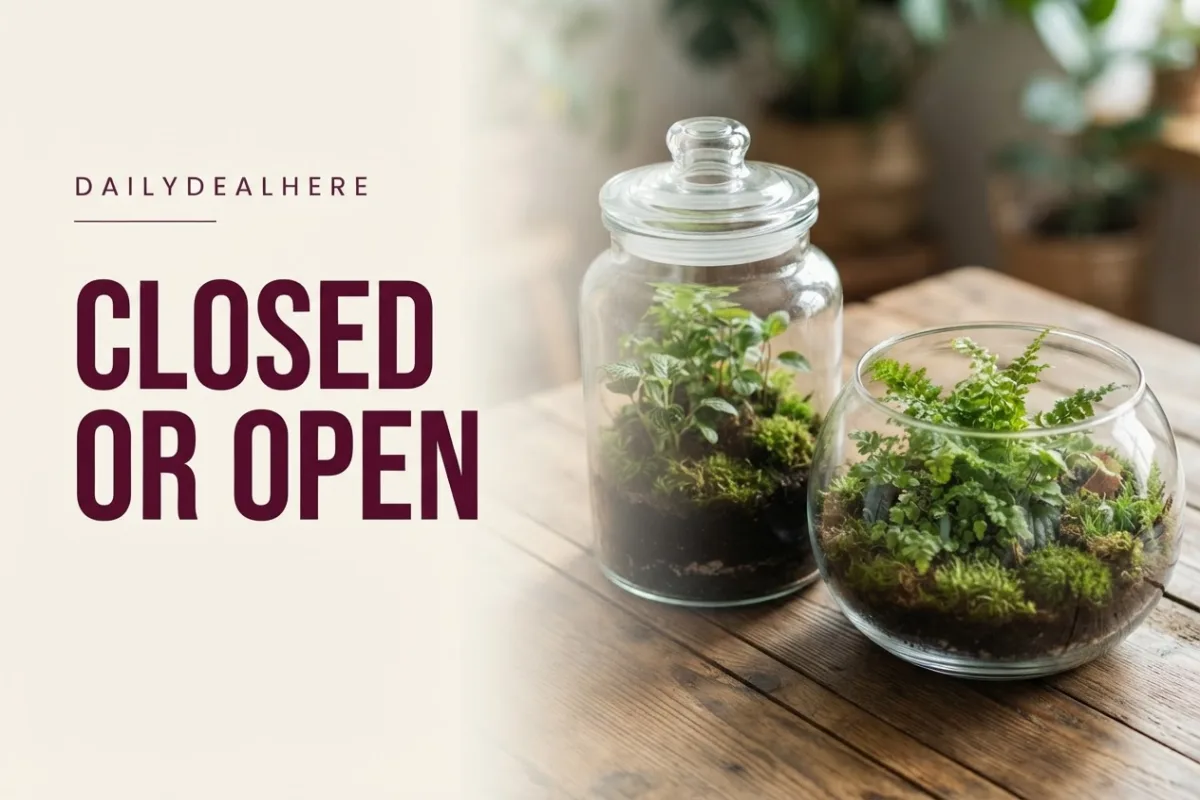
Missouri Extension says the first step is deciding whether the terrarium will be closed or open, because that determines which plants will work.
- Closed: a tightly covered container, like the original Wardian case. It holds the most humidity and needs the least watering, but disease risk is greater because of the high humidity.
- Open: a container with high sides, at least as tall as the plants, and no cover. It is drier, needs more frequent watering and is less prone to disease.
- Dish garden: a container with sides lower than the plants, so the planting is exposed to normal room conditions. Plants that tolerate low humidity suit it best.
Best plants for closed terrariums
Missouri Extension publishes a detailed table of terrarium plants with their height, light, container type and temperature needs. These are some of the small plants it lists as suitable for closed containers.
| Plant | Height | Light | Temperature | Missouri’s note |
|---|---|---|---|---|
| Nerve plant (Fittonia) | 3 to 6 in | Medium | Warm | Leaf veins white or pink |
| Baby’s tears (Helxine soleirolii) | 1 to 3 in | Medium | Warm | Vigorous groundcover |
| Creeping fig (Ficus pumila) | 1 to 3 in | Medium | Warm | Forms a dense mat, clings to rough surfaces |
| Emerald ripple (Peperomia caperata) | 3 to 6 in | Medium | Warm | Avoid overwatering |
| Miniature peperomia (Pilea depressa) | 1 to 3 in | Medium | Warm | Avoid overwatering |
| Strawberry begonia (Saxifraga sarmentosa) | 1 to 3 in | Medium | Warm | Runners like a strawberry |
| Dwarf gloxinia (Sinningia pusilla) | 1 to 3 in | Medium | Warm | Very dainty, keep warm |
| Irish moss (Selaginella) | 1 to 3 in | Low to medium | Not specified | Groundcover, likes most organic soils |
| Club moss (Lycopodium) | 3 to 6 in | Medium | Cool | Woodland plant |
| Maidenhair fern (Adiantum cuneatum) | 6 to 12 in | Medium | Warm | Dead fronds may need removal |
Iowa State’s own list overlaps heavily, naming net plant (Fittonia), creeping moss (Selaginella), baby’s tears, strawberry vine (Saxifraga sarmentosa), creeping fig and silver sparkles (Pilea glauca) among its low and trailing plants, and prayer plant, radiator plant (Peperomia), begonia, aluminum plant and several ferns among its mid-size plants.
Best plants for open terrariums
Open terrariums keep some humidity but let air circulate, so they suit plants that like moderate humidity but would sulk in a sealed jar. Missouri lists several plants for open containers but not closed ones.
- African violet (Saintpaulia): 1 to 6 inches, medium light, open or dish containers, must have good drainage.
- Earth stars (Cryptanthus): 1 to 3 inches, medium light, open or dish, foliage may be colorful.
- Piggyback plant (Tolmiea menziesii): 3 to 6 inches, medium light, open or dish, small plants grow on old leaves.
- Moss sandwort (Arenaria verna): 1 to 3 inches, bright light, open or dish, cool temperatures, needs excellent drainage.
- Rosary vine or string of hearts (Ceropegia woodii): 1 to 3 inches, medium to bright light, open or dish, a trailing vine.
Many closed terrarium plants also work in open containers, but you will need to water more often. Missouri notes that open terrariums need watering occasionally, though less often than ordinary houseplants. The tradeoff runs the other way for disease: Missouri points out that open terrariums are drier and less subject to disease than closed ones, which makes an open container a forgiving choice for a first attempt or for plants that resent stagnant, saturated air.
Dish gardens, cacti and succulents
Cacti and succulents are popular in open glass bowls, but both extension guides are cautious. Missouri calls succulents and cacti less desirable for terrariums because moist conditions promote rot, and warns never to mix desert plants with moisture loving tropicals. Iowa State says the humid terrarium environment suits any houseplant except cacti and succulents, which suffer in humid air.
The solution is a dish garden. Missouri lists haworthia, hen and chicks (Echeveria), jade plant, panda plant, pygmy cactus (Rebutia) and stonecrop (Sedum) as suitable for a desert style dish garden, most in bright light. Missouri notes that cacti and succulents in a dish garden benefit from bright exposure, even direct sun, but that closed containers should never be put in full sun.
Best plants for beginners
For a first terrarium, choose plants the guides describe as durable, small and forgiving, and stick to one set of conditions.
- Nerve plant (Fittonia): listed by both guides, colorful, and suited to closed or open containers.
- Creeping fig: a dense, low mat that tolerates closed, open or dish containers, according to Missouri.
- Swedish ivy (Plectranthus): Missouri describes it as low, creeping and very durable, in low to medium light.
- Chinese evergreen (Aglaonema): Missouri calls it very durable and notes it can be cut back.
- Strawberry begonia: small, spreads by runners, and suits closed, open or dish containers.
- Emerald ripple peperomia: compact and textured, but Missouri warns to avoid overwatering.
If you are not sure where to start, our guide to the best indoor plants covers easy houseplants, several of which have compact varieties suited to glass containers.
Carnivorous plants
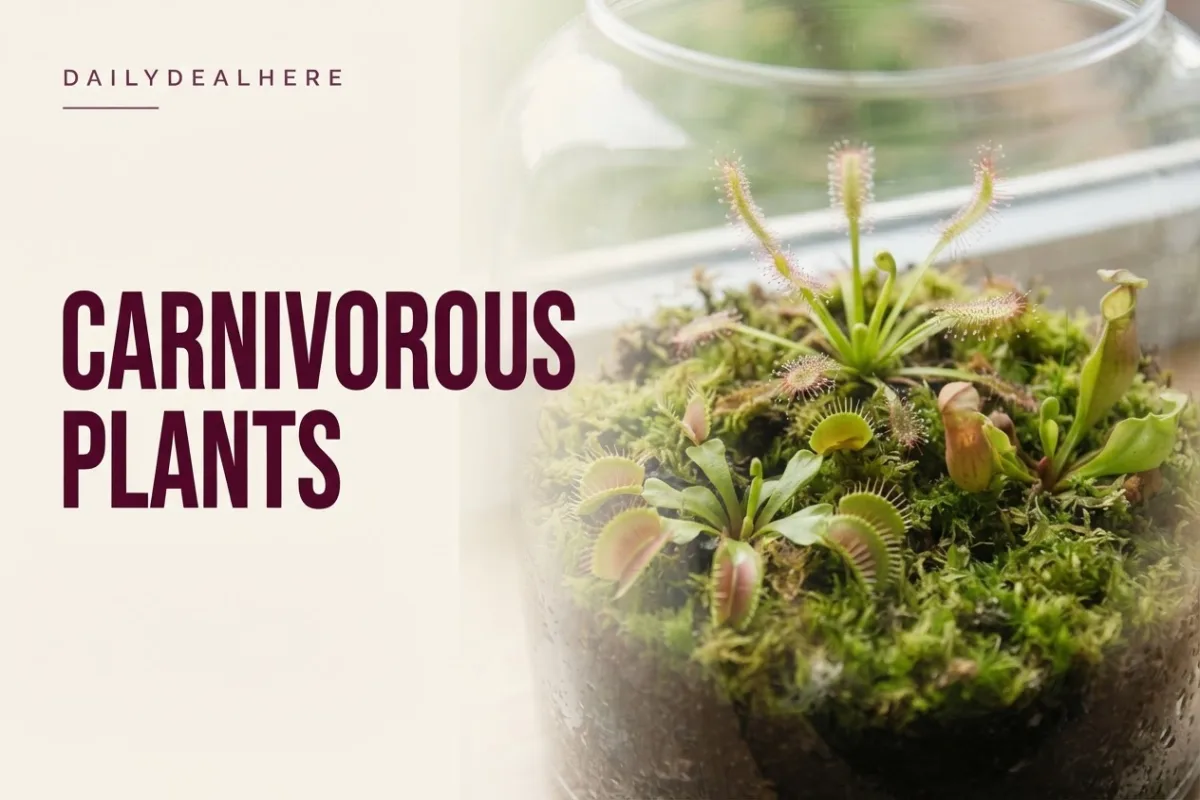
Iowa State calls carnivorous plants such as pitcher plants and Venus flytraps beautiful and fun additions to terrariums, and lists pitcher plants (Sarracenia), tropical pitcher plants (Nepenthes), sundews (Drosera) and Venus flytraps among its suggestions. Missouri lists sundews as 1 to 3 inch plants for closed containers in bright light and warm temperatures.
Carnivorous plants tend to want brighter light than most foliage terrarium plants, so they are best grouped together rather than mixed with shade lovers like ferns. Follow the same rule as always: match light and moisture first.
Ferns and mosses
Ferns are the classic terrarium plant. In fact, Missouri tells the story of Dr. N.B. Ward, the London physician who struggled to grow ferns in his garden, noticed a fern and grass sprouting in a sealed bottle, and watched them grow for four years without adding water. His 1842 book led to the Wardian case, the ancestor of today’s terrarium.
- Maidenhair fern: 6 to 12 inches, medium light, closed or open, warm. Remove dead fronds.
- Table fern (Pteris): 6 to 12 inches, medium light, closed or open, cool temperatures per Missouri.
- Iowa State’s fern picks: holly fern and bird’s nest fern for height, cloak fern, table fern, maidenhair and rabbit’s foot fern for the middle.
- Mosses and moss-like plants: Selaginella and club moss make soft green carpets, with club moss preferring cool temperatures.
Flowering terrarium plants
Most terrarium plants are grown for foliage, but a few flower in the right conditions. Iowa State mentions miniature African violets as beautiful additions. Missouri lists dwarf gloxinia, a very dainty plant for closed or open containers, and flame violet (Episcia cupreata), which it says to grow like an African violet. Keep in mind Missouri places the standard African violet in open or dish containers with good drainage, not closed ones.
Woodland terrariums for cool rooms
Missouri describes a woodland theme built around plants that prefer cool temperatures, with nights around 50 to 55 degrees Fahrenheit. It notes such spots can be hard to find indoors, but a windowsill close to the glass with drapes drawn behind the plants in winter can create a cool pocket.
Cool woodland plants on Missouri’s list include club moss, partridge berry, pipsissewa, spotted wintergreen, hepatica, foam flower and rattlesnake plantain, a small woodland orchid. Several are native wildflowers, so buy them from nurseries that propagate them rather than digging them from the wild. Missouri also recalls that early American terrariums featured partridge berry in hand blown glass bowls.
What not to put in a terrarium
- Cacti and succulents in closed containers: both guides say humidity makes them rot or suffer.
- Plants with mismatched needs: Missouri warns not to mix plants requiring widely different light, temperature and moisture.
- Fast, large growers: Iowa State says a terrarium is not the place for a common philodendron or spider plant.
- Sick plants: Missouri stresses using only healthy, disease free plants, because closed terrariums are ideal for plant diseases.
- Wood decorations: Iowa State advises against driftwood and similar wood, which breaks down quickly and can bring in insects and fungi.
- Too many showy plants: Missouri suggests avoiding a collection of variegated or unusual plants that compete with each other.
Where the two guides disagree
Reading the guides side by side turns up a few differences worth knowing.
- Spider plant and philodendron. Missouri’s table includes spider plant and heart leaved philodendron, while Iowa State says a terrarium is not the place for them. The practical reading: they can be used if kept trimmed, but faster, larger growers need more pruning.
- Wood accessories. Missouri lists sticks, wood and bark among natural accessories, but warns against introducing insects or disease. Iowa State advises against wood entirely. In a closed, humid terrarium, the cautious choice is stone.
- Watering interval. Missouri says a closed terrarium normally will not need water for 4 to 6 months. Iowa State says many closed terrariums need water every 3 to 6 months, with wide variation.
- Drainage layers. The two give slightly different recipes, covered below.
Designing with heights and textures
Missouri groups terrarium plants into small (1 to 6 inches), medium (6 to 12 inches) and tall (over 12 inches), and favors small plants. Iowa State offers a simple design rule: choose an upright plant, a trailing plant and an intermediate sized plant.
- Place taller plants toward the back, since terrariums are usually viewed from one side, Missouri advises.
- Slope the soil toward the viewing side and create hills and valleys for interest.
- Use a low, coarse textured plant as a focal point near the front.
- Keep foliage from touching the glass in a closed container, where leaves that touch collect water and decay.
Building the layers
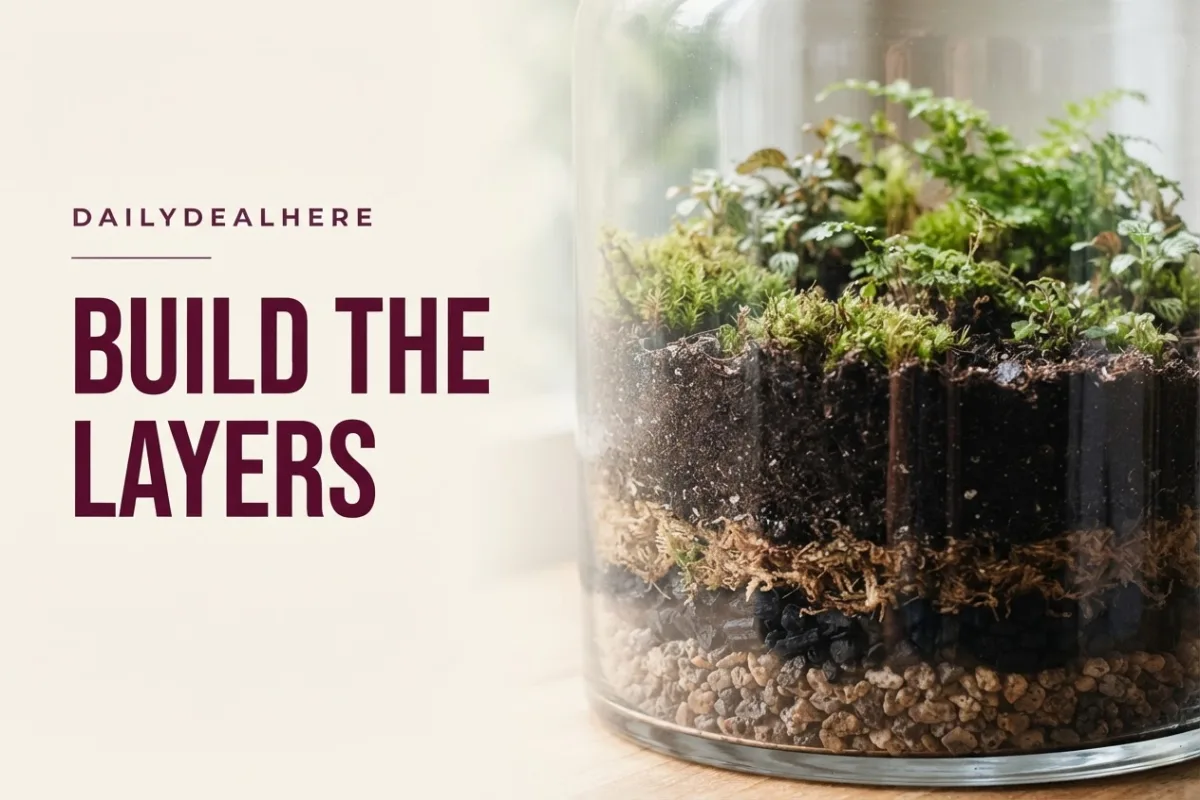
Terrariums have no drainage holes, so the bottom layers hold excess water away from the roots.
| Layer | Iowa State | Missouri |
|---|---|---|
| Drainage | A 2 inch layer of gravel, pebbles or perlite | Pebbles, gravel, crushed pots or marble chips |
| Charcoal | A quarter inch layer, which aids drainage and controls odors | A half inch layer above the gravel, especially important in closed terrariums |
| Separator | Not specified | Sphagnum moss to stop soil sifting into the drainage |
| Growing medium | 1 to 4 inches of light, well drained potting soil | At least 1.5 inches of clean, well drained medium high in organic matter |
| Overall | Not specified | Drainage plus medium about one quarter of the container’s volume |
Planting step by step
- Clean the container with hot soapy water, rinse and dry it. Missouri notes that if you use a glass cleaner, let the open container air for several days before planting.
- If you worry about disease, Missouri suggests enclosing new plants in a plastic bag in bright light for about two weeks first, so any problems show up before they go in.
- Add the drainage, charcoal and soil layers.
- Remove plants from their pots, loosen and trim roots as needed, and remove yellowed or damaged leaves.
- Dig holes with a stick, set the plants, firm the soil, and add gravel or moss as a finish.
- Mist to rinse soil off leaves and glass. Missouri advises leaving the terrarium uncovered until the foliage dries before adding the lid.
Light and temperature
Most terrarium plants need medium light. Missouri recommends placing a terrarium within several feet of a bright window but not in direct sun, and warns that direct sun on a closed or tall open container causes heat buildup that injures most plants. Iowa State suggests medium to bright indirect light, such as an east or north window.
If natural light is weak, Missouri suggests supplemental artificial light run 16 to 18 hours a day. Warm terrarium plants, it notes, do well with night temperatures around 65 degrees Fahrenheit and days about 10 degrees warmer, normal for most homes. Turn the terrarium occasionally, since plants lean toward the window.
Watering
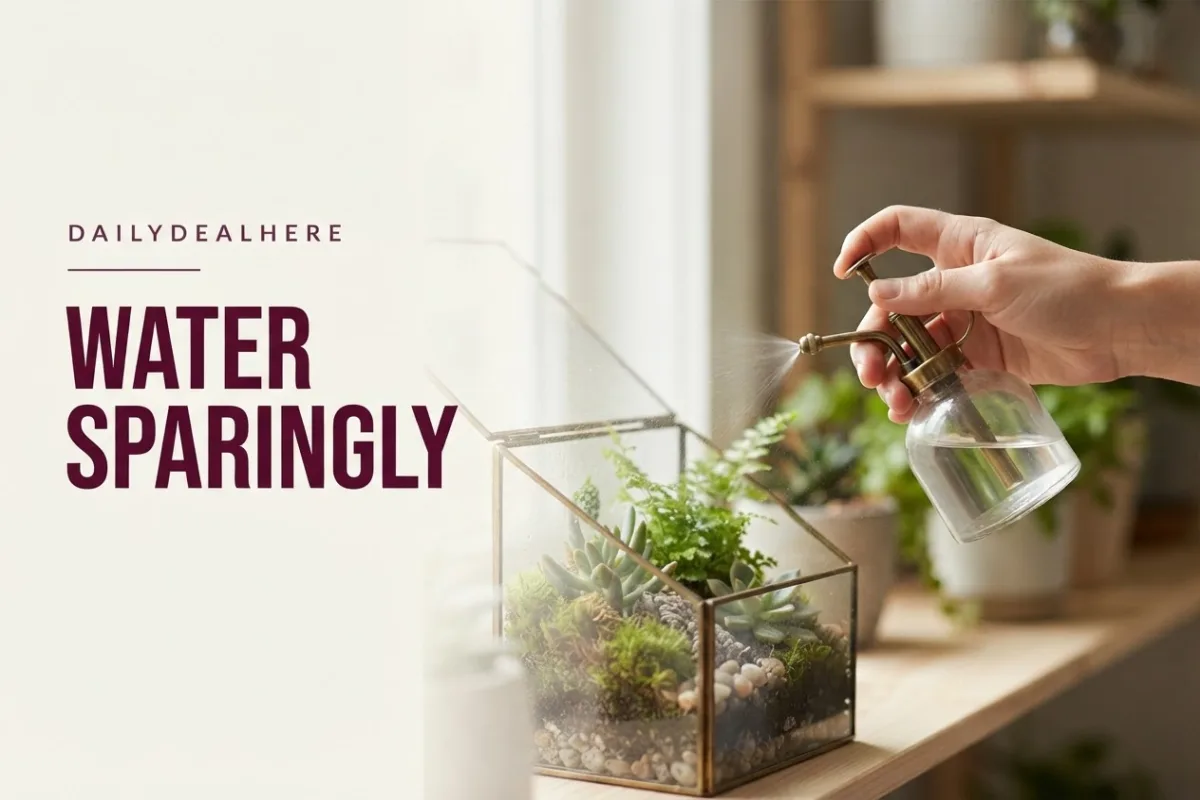
Overwatering is the most common way to kill a terrarium. Missouri’s caution is blunt: never overwater, because excess water is almost impossible to remove, and it is better to be a little too dry than too wet. Heavy watering leaves standing water in the drainage layer and encourages root disease.
- Missouri says a lack of condensation on the glass, or wilting plants, signals a closed terrarium needs water.
- Iowa State suggests checking every few weeks and adding water when the soil becomes dry.
- If heavy condensation builds up, Iowa State recommends cracking or removing the lid until some evaporates.
- Always water lightly, with a mister or bulb sprayer.
Plants that love humidity but do not fit in a jar can still thrive in a humid room. Our guide to the best humidifiers covers options for the rest of your houseplants.
Pruning, feeding and replacing plants
Terrarium plants should grow slowly. Missouri advises not fertilizing for at least a year after planting, and then only lightly, at about one quarter of the normal houseplant rate, if plants look yellowish and lack vigor. Iowa State similarly suggests a balanced fertilizer at quarter strength only if plants show low fertility symptoms. If you do need a houseplant fertilizer, our guide to the best fertilizer for pot plants covers gentle options.
Pinch out tips before plants get too tall, which Missouri says gives better growth than severe cutbacks, and remove all trimmings. Iowa State points out that no plant is a permanent addition: when one outgrows the space, pull it out and try something new.
Troubleshooting common problems
- Rot or mold: Missouri links root rots to too much moisture. Remove the cover to let the terrarium dry, and remove affected plants promptly. If a fungus spreads through the soil, replace that portion of the medium.
- Leggy, stretched plants: usually too little light. Missouri notes aluminum plant gets leggy in poor light and polka dot plant needs pinching.
- Constant fogged glass: too wet. Vent the lid for a while.
- No condensation and wilting: too dry. Add a small amount of water.
- Overcrowding: prune, or swap out the fastest grower.
Missouri notes the first few weeks after planting are when diseases most often appear, and that the risk drops once the terrarium is established. Watch closely early on and remove anything that starts to decay.
Frequently asked questions
What are the best plants for a terrarium?
Small, slow growing, humidity loving plants that share the same needs. Good choices include nerve plant (Fittonia), creeping fig, baby’s tears, emerald ripple peperomia, aluminum plant, strawberry begonia, Selaginella, club moss and small ferns such as maidenhair and table fern.
What should a beginner put in a terrarium?
Start with durable, forgiving plants that suit the same conditions, such as Fittonia, creeping fig, strawberry begonia and Swedish ivy, which Missouri Extension describes as very durable. Use a closed or open glass container, medium indirect light and light watering.
What should you not put in a terrarium?
Cacti and succulents in closed containers, plants with very different light or water needs, large fast growers, sick plants, and wood such as driftwood, which Iowa State says can break down and bring in insects and fungi.
Can succulents go in a closed terrarium?
Not well. Missouri Extension says moist conditions promote rot in succulents and cacti, and Iowa State says they suffer in humid air. Grow them in an open dish garden in bright light instead.
What plants are best for a closed terrarium?
Plants Missouri lists for closed containers include nerve plant, baby’s tears, creeping fig, emerald ripple peperomia, miniature peperomia, strawberry begonia, dwarf gloxinia, Selaginella, club moss and maidenhair fern.
How often do you water a closed terrarium?
Rarely. Missouri Extension says a closed terrarium normally needs no water for 4 to 6 months, and Iowa State says many need water every 3 to 6 months. Water lightly when condensation stops forming or plants wilt.
Do terrarium plants need sunlight?
They need good light but not direct sun. Missouri recommends a spot within several feet of a bright window, and Iowa State suggests an east or north window. Direct sun can overheat a closed container.
Can you put carnivorous plants in a terrarium?
Yes. Iowa State calls pitcher plants, sundews and Venus flytraps fun additions, and Missouri lists sundews for closed containers in bright light. Group them with plants that share their brighter light needs.
Choose the container type first, then pick small plants that all want the same light and moisture. Get that match right, water sparingly, and a terrarium is one of the easiest ways to grow plants that would struggle anywhere else in the house.










Write Your Review
No reviews yet. Be the first to share your experience!