
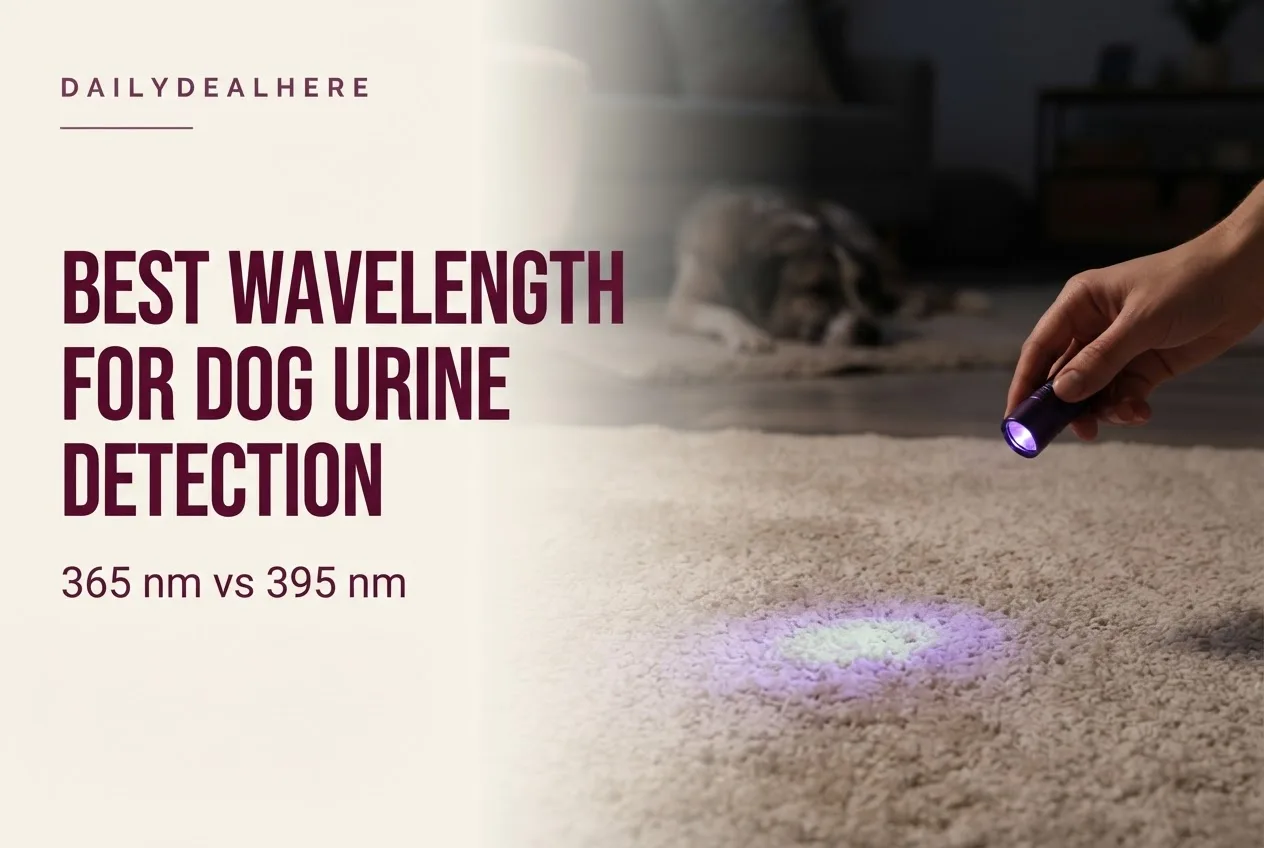
The best wavelength for finding dog urine is around 365 nanometers. A 365 nm ultraviolet light excites the fluorescent compounds in dried urine strongly while giving off very little visible light, so stains stand out as a faint glow instead of being washed out by a purple beam. A 395 nm light will also find urine, and it costs less, but it throws much more violet light that can drown out faint or old stains. Whichever you choose, use it in a fully dark room, hold it close to the floor, and confirm anything that glows with your nose before you start cleaning.
This guide explains why urine glows under ultraviolet light, what a published study found about which wavelengths make it glow brightest, the real difference between 365 nm and 395 nm lights, what else in your home glows and can fool you, how to search a room properly, and how to clean what you find so your dog does not come back to the same spot. The technical detail comes from Waveform Lighting’s comparison of 365 and 395 nm LEDs, a 2023 Scientific Reports study on body fluid fluorescence, and the cleaning steps from Humane World for Animals.
The short answer
- Best wavelength: 365 nm. It sits closer to the wavelengths that make dried urine fluoresce most strongly, and it emits almost no visible violet light.
- Budget option: 395 nm. It still causes fluorescence, but a significant part of its output is visible violet light that competes with the glow you are looking for.
- Look for a filtered lens: a dark filter that blocks visible light makes any UV light more useful for detection.
- Use it in the dark: close blinds and turn off every light. Faint stains disappear in even a little ambient light.
- Confirm before cleaning: detergents, paper and some fabrics also glow under UV. Sniff the spot to be sure.
- Clean with an enzymatic cleaner: and avoid ammonia, vinegar and steam, which can make the problem worse.
Why urine glows under UV light
Ultraviolet light is invisible, but some substances absorb it and give the energy back as visible light. That glow is fluorescence. Wikipedia’s entry on blacklights explains that this is exactly why a blacklight is needed to see it: other kinds of UV lamps emit visible light that drowns out the dim fluorescent glow.
Urine contains a mix of compounds that fluoresce. The 2023 study discussed below notes that forensic light sources are routinely used at crime scenes to locate biological traces, and Wikipedia’s blacklight entry even describes small portable blacklights sold specifically as pet urine detectors. Humane World for Animals recommends using a black light to find old pet messes that have dried invisibly, and lightly outlining them with chalk so you can clean the exact area later.
The glow is not bright. A dried stain under a good UV light looks like a faint, pale patch, often with a ring or splash shape. That is why every detail below, from wavelength to room darkness, is about making a weak signal easier to see.
What the research says about urine fluorescence
A 2023 study in Scientific Reports, by researchers based in the Netherlands, measured how dried stains of several body fluids fluoresce across 81 excitation wavelengths from 200 to 600 nm. Its urine samples were human, from seven volunteers, so the results are a guide rather than a direct measurement of dog urine. The findings are still the most useful public data on which wavelengths make urine stains glow.
- A broad excitation band. The study describes urine’s excitation spectrum as broader than the other fluids, with one major peak around 335 to 350 nm.
- A shift as stains age. Fresh urine fluoresced most strongly when excited at 335 nm. As the stains aged, the peak shifted about 15 nm toward longer wavelengths over the first fourteen days, then stopped moving.
- Blue to blue-green emission. The main emission peak sat between roughly 420 and 445 nm, with a second peak near 495 nm.
- Big variation between people. The authors note urine varies more between donors than some fluids, because it carries compounds from food and medicines.
The practical takeaway is simple arithmetic. A 365 nm light sits about 15 to 30 nm away from the excitation peak the study measured. A 395 nm light sits about 45 to 60 nm away. Both are on the slope of a broad band, which is why both work, but 365 nm is closer to where urine responds most.
365 nm versus 395 nm
Most UV flashlights sold for pet stains are labeled either 365 nm or 395 nm. Waveform Lighting, an LED manufacturer, explains the difference clearly.
| Feature | 365 nm | 395 nm |
|---|---|---|
| Where it sits | Deeper in the UV-A range | About 30 nm closer to visible violet light |
| Visible light | Virtually all output is invisible UV-A, with a dull bluish-white tint from slight leakage | A pronounced violet glow, with significant output at 400 to 410 nm |
| Fluorescence | Many materials fluoresce most strongly at 365 nm, according to Waveform | Produces fluorescence, but visible violet light competes with it |
| Cost | LED chips are less efficient and more costly | Cheaper and widely available |
| Best for | Faint, old or small stains | Obvious fresh stains on a budget |
Waveform’s key point is that a 395 nm LED does not emit only at 395 nm. It peaks there but also puts out quite a bit of energy at 400 nm and even 410 nm, which is solidly visible violet light. A 365 nm LED’s output tails off before reaching 400 nm, which maximizes UV relative to visible light.
Why visible light is the enemy
The glow from a urine stain is dim. Anything else lighting up the floor at the same time, including the violet light coming straight out of the flashlight, raises the background and hides the stain. That is the same principle Wikipedia describes when it says ordinary UV lamps emit visible light that drowns out fluorescence.
With a 395 nm light, the floor is washed in purple, and everything white or light colored in the beam reflects that purple back at you. Strong, fresh stains still show. Faint, old or thin stains can vanish in the purple haze. With a 365 nm light, the floor looks nearly dark apart from a dull bluish tint, so a faint glow has much more contrast.
Is a 395 nm light useless for pet stains?
No. Waveform notes that the portion of a 395 nm LED’s output below 395 nm is very effective at creating fluorescence. A 395 nm light will find fresh, heavy stains on a dark carpet or a hard floor without trouble, and it is a reasonable choice if you want an inexpensive tool for obvious accidents.
It struggles in three situations: small or faint stains, old stains that have been partly cleaned, and light colored or white surfaces that reflect the violet beam. If you are hunting for the source of a smell you cannot locate, which is the most common reason people buy these lights, 365 nm is the better tool.
Filters and why they matter
Wikipedia describes a blacklight as a lamp that emits long-wave UV-A and very little visible light, and notes that one common design uses a violet filter material, on the bulb or in a separate glass filter, that blocks most visible light while letting UV through. Wood’s glass, named after physicist Robert Williams Wood, was the original filter of this kind, and in medicine and forensics a filtered UV source is still called a Wood’s lamp.
For pet stain hunting, the practical lesson is to prefer a 365 nm light with a dark filter lens. Waveform notes that even 365 nm LEDs leak a tiny amount of visible light, and that some applications add extra filtering to remove it. A filtered 365 nm flashlight often looks disappointingly dim to the eye, which is a good sign: you are seeing very little visible light, so the fluorescence stands out. Our guide to the best black light flashlights compares options by wavelength and design.
What color does urine glow under UV?
Based on the emission peaks measured in the 2023 study, around 420 to 445 nm with a second peak near 495 nm, urine fluorescence falls in the blue to blue-green part of the spectrum. What you actually see depends on the surface, the stain’s age and concentration, and the light. On a carpet, stains often show as a paler patch with a visible edge where the liquid spread and dried.
Do not rely on color alone. As the next section explains, several common household materials glow in a similar range, so shape, location and smell are better clues than hue.
Things that glow but are not urine

The most common false alarm comes from optical brighteners. Wikipedia explains that these compounds, added to many detergents, fabrics and papers to make them look whiter, absorb light in the ultraviolet and violet region, usually 340 to 370 nm, and re-emit it in the blue region, typically 420 to 470 nm. That overlaps with both the wavelengths your flashlight emits and the blue glow of urine.
- Detergent residue: spots where laundry detergent or carpet shampoo dried can glow, especially on rugs cleaned with products containing brighteners.
- White fabrics and paper: towels, socks, receipts and white paper can glow strongly.
- Spills and residues: some drink spills, cleaning products and cosmetics can fluoresce.
- Whole carpets: a carpet treated with brighteners may glow evenly, so urine shows as a different colored or darker patch rather than a bright one.
A few habits separate real stains from false ones. Urine stains usually appear as splash shapes or rings, often near walls, furniture legs, doorways and corners where dogs mark. Glowing spots in the middle of a walkway may just be spilled drinks or tracked residue. And the final check is always the nose: kneel down and sniff the spot, as Humane World suggests.
How to search a room properly
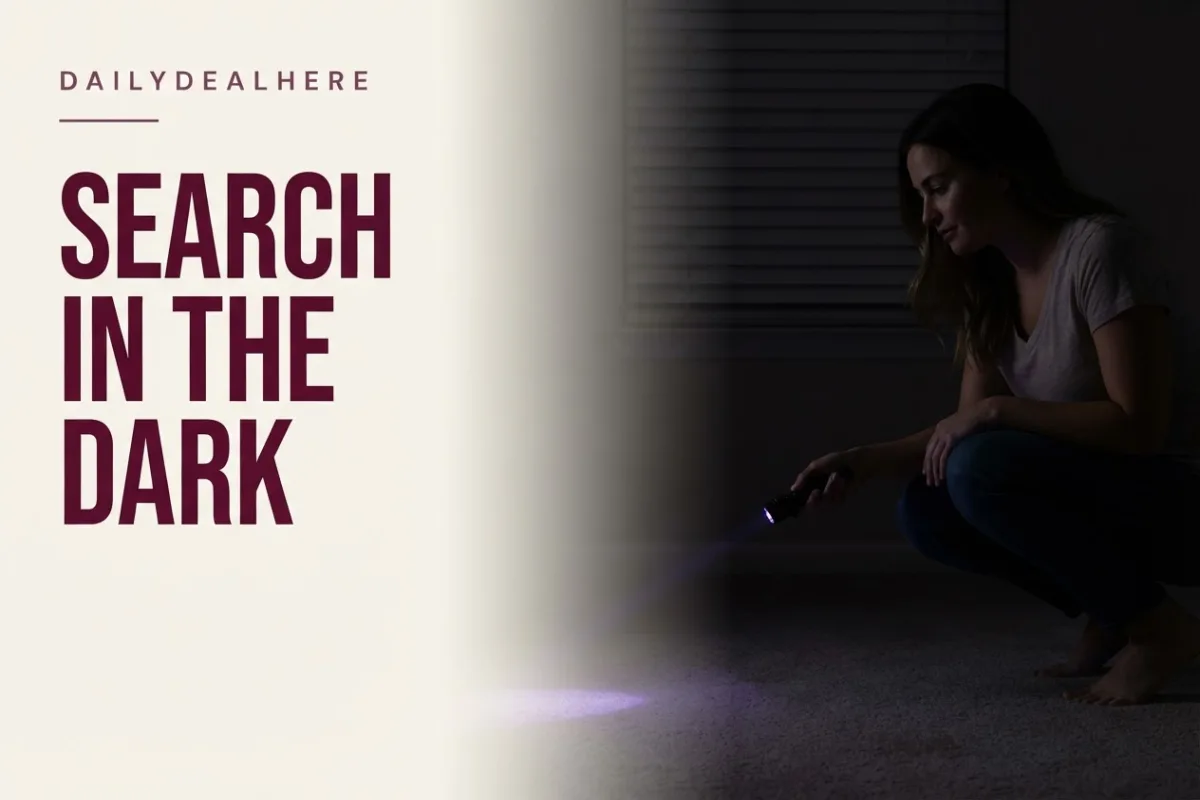
- Make it dark. Search at night, close blinds and turn off every light, including hallway lights and screens.
- Let your eyes adjust. Give yourself a minute or two in the dark before you start.
- Hold the light low. Keep it a foot or two from the surface and sweep slowly. Closer gives a brighter spot and better contrast.
- Work in a grid. Cover the room in strips so you do not miss areas.
- Check vertical surfaces. Dogs that mark may target walls, furniture sides, curtains and door frames.
- Look along edges. Baseboards, corners and the edges of rugs are common spots.
- Mark what you find. Humane World suggests lightly outlining soiled areas with chalk so you can find them again with the lights on.
- Confirm by smell. Before cleaning, check each marked spot with your nose.
Old stains versus fresh stains
Fresh, wet urine is easy to find by sight and touch. The UV light earns its keep on stains that have dried invisibly, which Humane World notes are common and hard to locate. The 2023 study found urine stains kept fluorescing over its two month observation period, with the excitation peak shifting slightly as they aged, which supports using UV to find stains that are weeks old.
Stains that have been partly cleaned can be harder to see, because cleaning dilutes the fluorescent compounds without always removing the odor. If you smell urine but see nothing, try a 365 nm light in total darkness and check the padding side of a rug if you can lift it.
How surfaces change what you see
| Surface | What you tend to see under UV | What to keep in mind |
|---|---|---|
| Carpet | Wider patches, because urine wicks outward and downward | The area affected underneath may be larger than the visible stain |
| Hardwood and laminate | Stains along board seams where liquid pooled | Humane World notes discolored wood may mean the finish reacted to the acid in the urine |
| Tile and grout | Glow concentrated in grout lines | Grout is porous and can hold odor even when the tile looks clean |
| Walls and baseboards | Drip or splash marks low on the wall | Humane World notes paint can react to urine, and washable enamel may respond well to enzymatic cleaners |
| Upholstery | Marks on sides and front edges | Check where a dog could lift a leg or sit |
Cleaning a fresh stain

Finding the stain is only half the job. Humane World’s steps for a stain that is still wet are straightforward.
- Soak up as much urine as possible. Put a thick layer of paper towels on the wet spot, cover it with newspaper, and put newspaper underneath if you can.
- Stand on the padding for about a minute, and repeat until the area is barely damp.
- Rinse the area thoroughly with clean, cool water and blot it dry.
- Use a pet odor neutralizer or enzymatic cleaner once the area is clean, following the product directions.
Humane World also suggests putting a urine soaked paper towel in your dog’s designated bathroom area, so the scent there tells your dog where to go.
Set-in stains and soaked padding
Older stains need more work. Humane World suggests considering renting a carpet cleaner, then using a high quality pet odor neutralizer once the area is clean, and a carpet stain remover if the area still looks stained after it is completely dry. For stains on fabric, our guide to the best fabric stain removers covers the options.
The hardest case is urine that has soaked through to the carpet padding. Humane World notes the job is more difficult then, and that in some cases you may need to replace portions of carpet and padding. If your UV search shows a large patch and the smell keeps returning after cleaning, the padding is the likely reason.
What not to clean with
- Steam cleaners: Humane World warns that heat can permanently set the stain and odor by bonding the proteins into man-made fibers.
- Ammonia and vinegar: Humane World advises avoiding cleaning chemicals with strong odors such as these, because they may encourage your pet to reinforce the scent mark in that area.
- Masking sprays alone: covering the smell does not remove it, and your dog can still detect what you cannot.
For lingering room odor after cleaning, passive absorbers can help in the meantime. Our guide to the best charcoal odor absorbers covers options that do not add fragrance.
Washable items
For bedding, blankets and washable covers, Humane World suggests adding a one pound box of baking soda to your regular detergent and washing as usual, air drying if possible. If you can still see or smell the soiling, wash again with an enzymatic cleaner. Your UV light is useful here too: check items after washing to see whether the stain is really gone. Keep in mind that detergent with optical brighteners can make washed fabric glow on its own. Washable rugs make the whole cycle easier, and our guide to the best washable rugs covers pet friendly choices.
Stopping repeat accidents
Humane World points out that as long as a pet can smell its own scent, it may keep returning to the same spot. That is why thorough cleaning matters more than speed. Its other recommendations focus on behavior.
- Make cleaned areas unattractive or unavailable, and make the proper bathroom area attractive.
- Keep objects that can trigger marking, such as guests’ belongings and new purchases, out of reach.
- Watch your dog indoors for signs it needs to go, and calmly take it outside.
- When you cannot watch, use a crate if your dog is crate trained, or keep it on a leash near you.
- If accidents are regular, have your dog checked by a veterinarian to rule out medical causes.
- Use positive reinforcement, and expect retraining to take a week or more.
If you are setting up crate training, our guide to the best dog crates covers sizes and styles.
Using UV lights safely
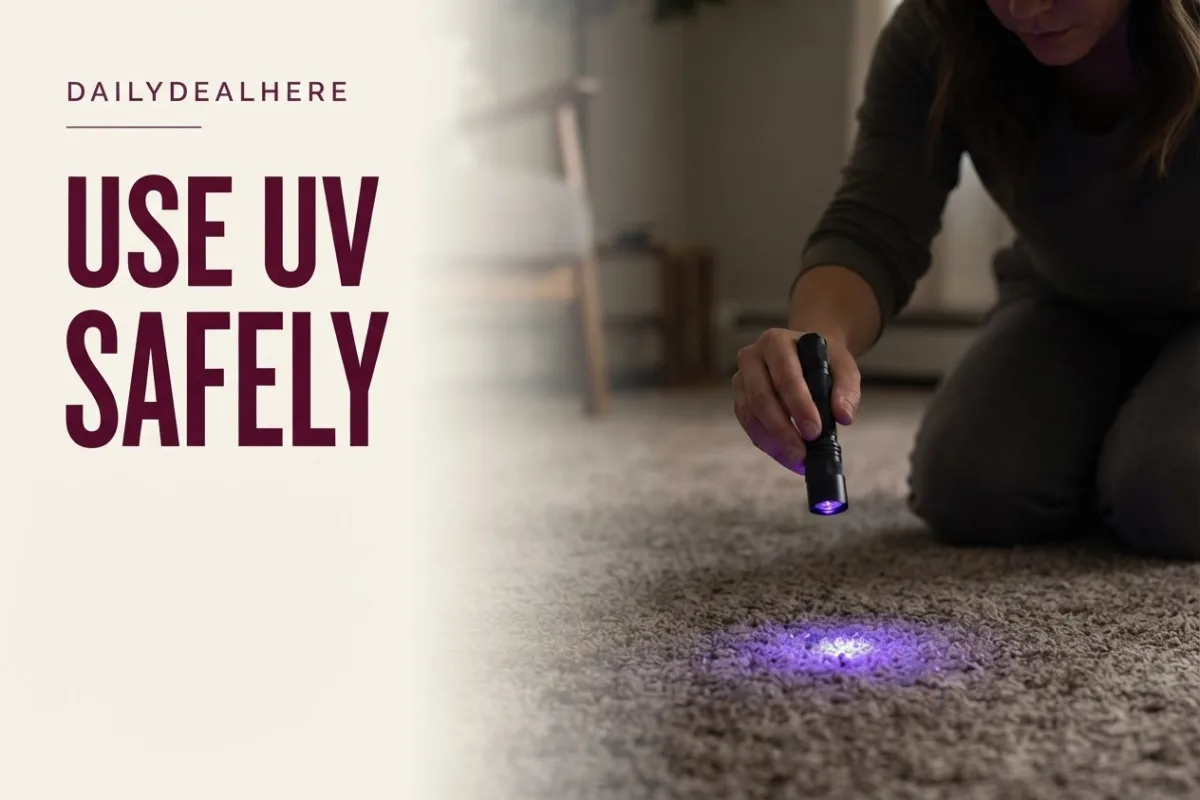
Pet stain lights emit UV-A, the longest wavelength and lowest energy form of ultraviolet. Wikipedia notes that UV-A presents a potential hazard to eyes and skin, especially from high power sources, and can affect the eyes in both the short and long term. It also notes there is little evidence that blacklight products above 350 nm designed for domestic use and intensities have adverse health effects.
- Never shine the light into your own eyes, anyone else’s, or your dog’s.
- Point it at the floor and surfaces you are searching, not around the room.
- Keep high power UV lights away from children.
- Use it for short searches rather than as general lighting.
A quick buying checklist
- Choose 365 nm if you want to find faint or old stains. Choose 395 nm only for obvious stains on a tight budget.
- Prefer a light with a dark filter lens that blocks visible light.
- Pick a beam that suits your space: a wider flood for sweeping rooms, a tighter beam for checking corners and furniture.
- Check how it is powered and charged, since you may use it in bursts over several nights.
- Pair it with an enzymatic cleaner so you can treat stains as soon as you find them.
Frequently asked questions
Which is better for dog urine, 365 nm or 395 nm?
365 nm. It emits almost no visible violet light and sits closer to the wavelengths that make dried urine fluoresce most strongly, so faint and old stains stand out better. A 395 nm light still works on obvious stains and costs less, but its violet glow can wash out faint ones.
What UV wavelength is best for urine detection?
Around 365 nm for a consumer flashlight. A 2023 Scientific Reports study of dried human urine stains found the strongest excitation around 335 to 350 nm, and 365 nm is the closest common flashlight wavelength to that band.
Does dog urine glow under a black light?
Yes. Urine contains compounds that fluoresce under ultraviolet light, which is why UV flashlights are sold as pet urine detectors. Humane World for Animals recommends using a black light to find old pet stains that have dried invisibly.
What color is pee under UV light?
Usually a pale blue to blue-green or whitish glow. The 2023 study measured urine’s main emission peak around 420 to 445 nm with a second near 495 nm. The exact look depends on the surface, the age of the stain and the light.
Why does my whole carpet or clothing glow under UV?
Probably optical brighteners. These compounds in many detergents, fabrics and papers absorb UV around 340 to 370 nm and glow blue. On a treated carpet, urine may show as a differently colored or darker patch instead of a brighter one.
Can a UV light find old urine stains?
Often, yes. The 2023 study found urine stains kept fluorescing over its two month observation period. Stains that have been partly cleaned can be fainter, so search in total darkness with a 365 nm light and confirm by smell.
Are UV flashlights safe to use around my dog?
Used sensibly, yes. Never shine the light into eyes, human or canine. Wikipedia notes UV-A can harm eyes and skin, especially at high power, but that there is little evidence of harm from domestic blacklight products above 350 nm.
What is the best way to clean the stains I find?
Blot up as much as possible, rinse with cool water, then use an enzymatic cleaner or pet odor neutralizer. Humane World advises avoiding steam cleaners, which can set the stain and odor, and ammonia or vinegar, which may encourage your dog to mark the spot again.
Pick a filtered 365 nm light, search in total darkness, confirm every glowing spot with your nose, and clean with an enzymatic product. The light finds the problem, but the cleaning is what stops your dog from coming back to it.










Write Your Review
No reviews yet. Be the first to share your experience!