

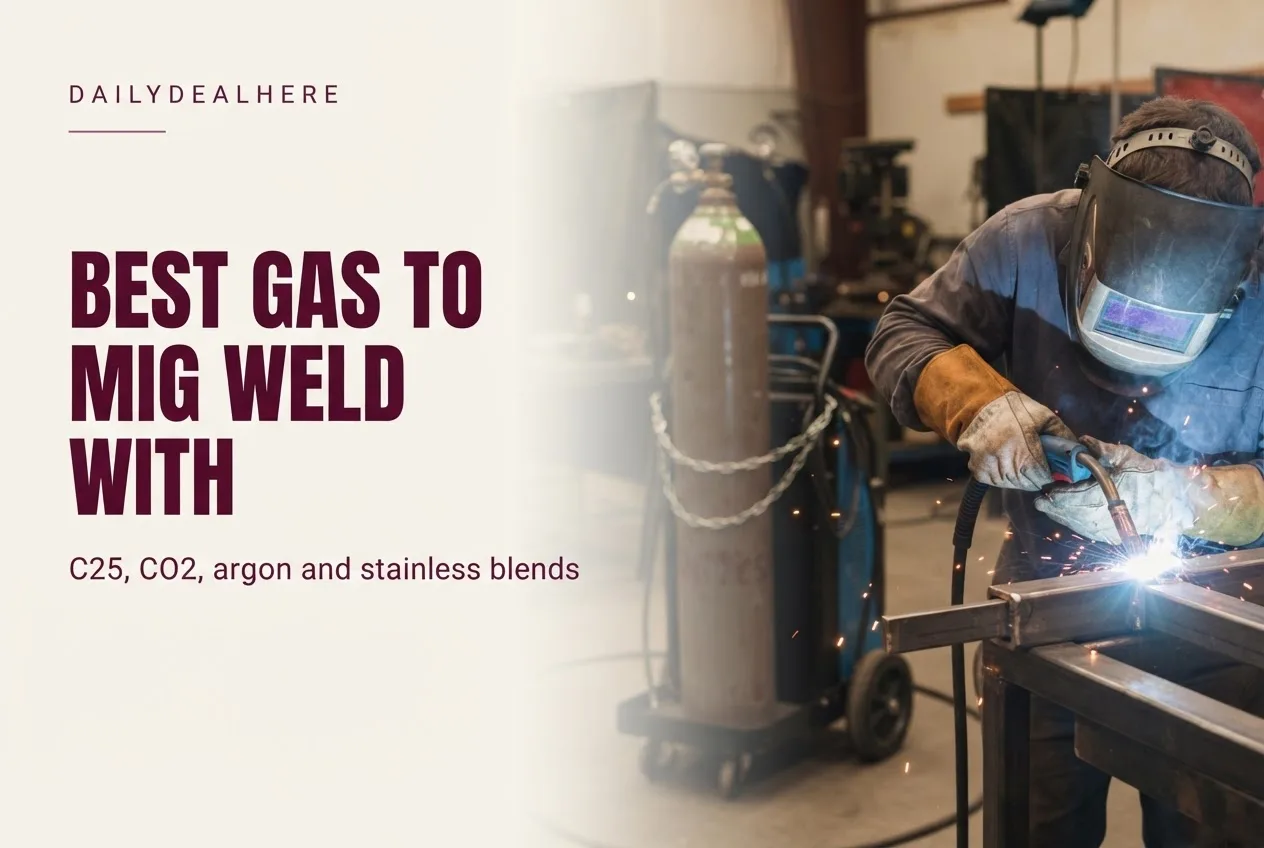
The best gas to MIG weld with depends on the metal. For mild steel, most home and hobby welders use 75 percent argon and 25 percent carbon dioxide, often called C25, because it gives low spatter, a stable arc and a neat bead. Straight carbon dioxide works on steel for less money but spatters more. Aluminum needs 100 percent argon, with no carbon dioxide at all. Stainless steel uses special blends with very little carbon dioxide, such as the classic 90 percent helium, 7.5 percent argon and 2.5 percent carbon dioxide tri-mix or a 98 percent argon, 2 percent carbon dioxide mix. Match the gas to the wire and base metal, and follow the wire maker’s recommendation when in doubt.
This guide explains what shielding gas does, which gas suits each metal and why, the real difference between C25 and straight CO2, when blends like C10 make sense, how to set flow rate, and how to fix porosity when gas coverage goes wrong. It draws on Miller Electric’s guide to MIG shielding gas for DIY welders and Lincoln Electric’s guide to MIG welding stainless steel.
The short answer
- Mild steel, best all around: 75 percent argon, 25 percent CO2 (C25).
- Mild steel, cheapest: 100 percent CO2 (C100), with a bit more spatter.
- Thicker steel with spray transfer: 90 percent argon, 10 percent CO2 (C10).
- Aluminum: 100 percent argon, or an argon and helium blend. Never carbon dioxide.
- Stainless steel: a helium tri-mix (90/7.5/2.5) or 98 percent argon, 2 percent CO2, depending on your machine and transfer mode.
- Silicon bronze: 100 percent argon.
What shielding gas actually does
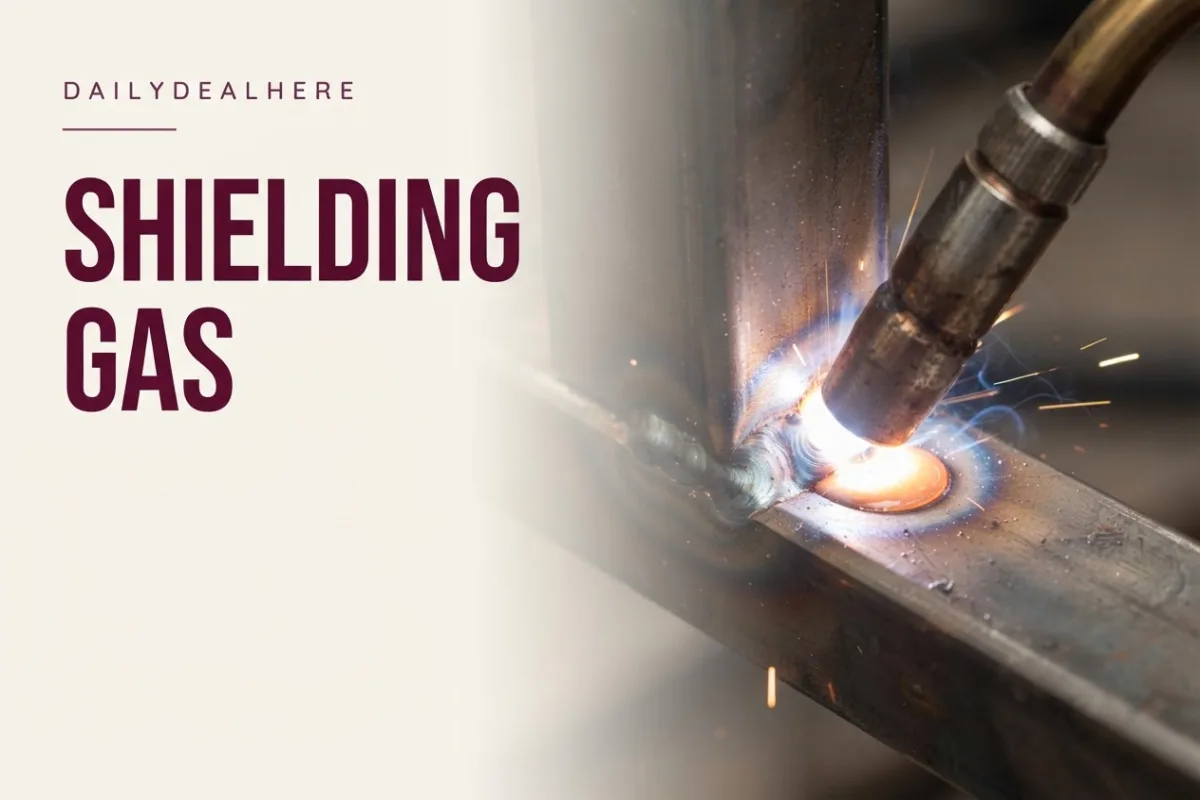
Miller explains that MIG welding creates a molten puddle of base metal and filler wire, and shielding gas protects that puddle from contaminants in the air such as nitrogen and hydrogen. Without it, the weld would be weak and full of pinpoint holes once it solidifies, a defect called porosity.
The gas does more than protect. Miller notes the type of gas also affects spatter, arc stability, arc performance and other weld characteristics. That is why the “best” gas is really a trade-off between cost, appearance, penetration and the metal you are joining.
Shielding gas by material
Miller points out that welders use different filler wires for different metals, solid steel wire for mild steel, aluminum wire for aluminum and stainless wire for stainless, and that the gas options change with the material.
| Material | Common gas | What the sources say about it |
|---|---|---|
| Mild steel | 75% argon, 25% CO2 (C25) | Minimal spatter, good arc and bead profile, but more expensive (Miller) |
| Mild steel | 100% CO2 (C100) | Cost effective, a bit more spatter and a slightly erratic arc (Miller) |
| Thicker steel, spray transfer | 90% argon, 10% CO2 (C10) | A good option for spray transfer on thicker plate (Miller) |
| Aluminum | 100% argon | Most common, easy spray or pulsed transfer, also usable for TIG (Miller) |
| Aluminum | Helium and argon blends | Effective but costly because of helium (Miller) |
| Stainless, short circuit | 90% helium, 7.5% argon, 2.5% CO2 | Desirable bead contour with CO2 low enough to protect corrosion resistance (Lincoln) |
| Stainless, spray or pulsed | 98% argon, 2% CO2, or argon with 1 to 2% oxygen | 98/2 suits spray and pulsed spray on machines programmed for it (Miller). Lincoln recommends argon oxygen mixes for spray and pulsed arc |
| Silicon bronze | 100% argon | Gives a smooth short circuit transfer for MIG brazing (Miller) |
Mild steel: C25 versus straight CO2
This is the decision most home welders face. Miller describes 75 percent argon, 25 percent CO2 as very common for mild steel. It produces minimal spatter, good arc characteristics and a good bead profile that washes out well at the toes of the weld. Its drawback is cost, since it is more expensive than the alternatives.
Straight CO2 is the budget option. Miller says it may produce a bit more spatter and a slightly erratic arc, but also notes that modern welding machines perform better with C100 than machines from 10 or 15 years ago. Some machines even let you select C25 or C100 on the front panel so the machine adjusts for the gas.
- Choose C25 if appearance matters, you weld thinner sheet, or you want less cleanup.
- Choose C100 if cost matters most and you are welding heavier, less visible work where some extra spatter is acceptable.
- Check your machine. If it has a gas selection setting, match it to the gas you actually use.
When C10 makes sense
Most hobby MIG welding on steel uses short circuit transfer, where the wire touches the puddle many times a second. For thicker plate, some welders switch to spray transfer, where the metal crosses the arc as a fine stream of droplets at higher current. Miller says that while C10, 90 percent argon and 10 percent CO2, is less common for DIY users, it is a good option if you plan to use spray transfer when welding thicker plates.
Spray transfer needs a capable machine. Lincoln notes, for stainless, that spray transfer with a 1/16 inch wire needs roughly 300 to 350 amps, well beyond most 120 volt hobby welders. If your machine is a small plug-in unit, C25 or C100 in short circuit mode is the practical choice.
Aluminum: 100 percent argon
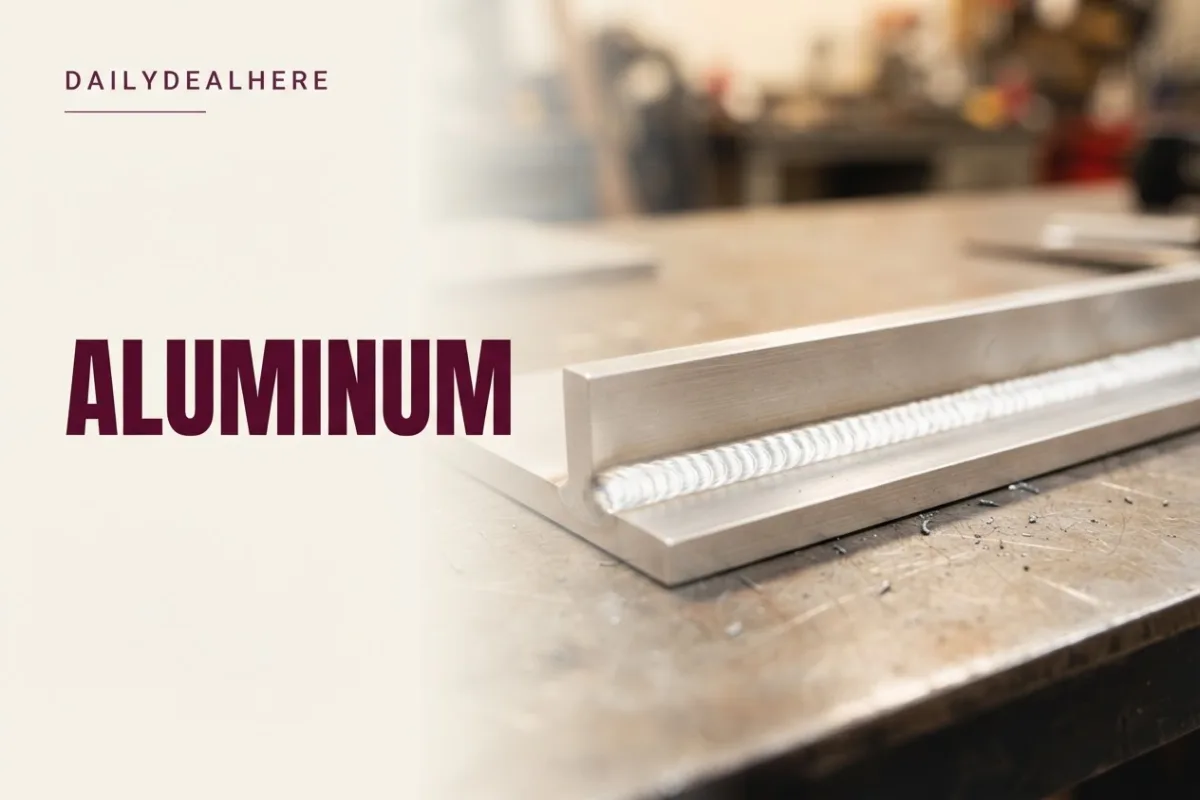
Miller calls 100 percent argon the most common gas for MIG welding aluminum. It allows easy spray or pulsed spray transfer because of its low ionization value, and it is also the standard gas for TIG welding aluminum, so one cylinder can serve both processes in a shop that does both.
Helium and argon blends are also effective on aluminum, Miller notes, but costly because of the high price of helium. What you must avoid is carbon dioxide. Miller explains that aluminum is highly sensitive to contamination and that a gas containing CO2 will introduce contamination into the weld. So the C25 cylinder that works so well on steel is the wrong gas for aluminum.
Is 100 percent argon OK for steel?
For MIG welding mild steel, the sources we read do not recommend straight argon. Every steel option Miller lists, C25, C100 and C10, contains carbon dioxide, and its straight argon recommendations are for aluminum and silicon bronze. The same pattern holds for stainless, where Lincoln and Miller both recommend blends with small amounts of CO2 or oxygen rather than pure argon.
The practical rule: keep straight argon for aluminum, silicon bronze and TIG welding, and use a CO2 mix for MIG welding carbon steel. If you only want one cylinder in a steel focused garage, C25 is the usual choice.
Stainless steel gases
Stainless has the most options and the most nuance. Lincoln recommends a gas of 90 percent helium, 7.5 percent argon and 2.5 percent carbon dioxide for short circuit welding of stainless, explaining that it gives the most desirable bead contour while keeping CO2 low enough not to affect the metal’s corrosion resistance. Lincoln adds that welds made with this mix show good corrosion resistance and coalescence across common grades such as 304, 316, 321, 347, 310 and 410.
Miller describes the same tri-mix as the traditional short circuit gas for many machines, noting that helium helps the puddle wash out for a good bead profile, but that helium’s cost can be prohibitive. As an alternative, Miller recommends 98 percent argon and 2 percent CO2 for machines programmed for it, a versatile option for spray and pulsed spray transfer that gives a good bead profile and wetting without helium’s premium price.
For spray arc and pulsed arc welding of stainless, Lincoln recommends argon with 1 or 2 percent oxygen, with argon plus 1 percent oxygen for pulsed arc.
Can you use 75/25 on stainless?
It is not what the stainless guidance recommends. Lincoln notes that single pass welds may be made with argon and CO2 gas, but that the CO2 in the shielding gas will affect the corrosion resistance of multipass welds made with short circuit transfer. Miller warns that with stainless, as with aluminum, too much CO2 in the mix can cause porosity or other weld defects.
C25 contains more than twelve times the CO2 of a 98/2 blend. For a quick, non critical single pass repair it may hold together, but for anything where corrosion resistance or appearance matters, use a proper stainless blend and stainless wire.
Silicon bronze and MIG brazing
Miller notes silicon bronze filler, such as ERCuSi-A, is increasingly used to join dissimilar metals and coated materials, especially in automotive repair and metal art. The result is essentially MIG brazing. For this, Miller recommends 100 percent argon, which allows a smooth short circuit transfer that helps the puddle wash out.
Gas and wire go together
Shielding gas is only half of the setup. Miller stresses that the filler wire is chosen to match the base metal: solid steel wire for mild steel, aluminum wire for aluminum and stainless wire for stainless. The gas then follows from that pairing. Miller’s own machines illustrate the point with separate settings for aluminum 4XXX and 5XXX series wires, stainless and several steel gases, because the machine behaves differently with each combination.
Silicon bronze shows how the wire can change the gas even on steel parts. With ERCuSi-A silicon bronze wire, Miller recommends 100 percent argon, not the C25 you would use with steel wire on the same steel panel. When you change wire, recheck the gas.
How gas choice shows up in the weld
You can often see the gas in the finished bead. Miller describes C25 as giving a good bead profile that washes out well at the toes, the edges where the weld meets the base metal, with minimal spatter. Straight CO2 tends to leave a bit more spatter to clean up and a slightly less steady arc while you weld.
On stainless, Miller credits the helium tri-mix with deep penetration, arc stability and excellent weld properties, particularly corrosion resistance, while 98/2 gives a good bead profile and wetting without helium’s cost. On aluminum, straight argon supports the smooth spray or pulsed spray transfer that aluminum welds depend on.
Transfer modes in plain language
Gas choice interacts with how metal crosses the arc. Lincoln describes three modes for stainless that apply broadly.
- Short circuiting transfer: the more economical process for thinner material, and the mode most hobby machines use. Lincoln recommends it for overhead and horizontal positions, at least for the root and first passes.
- Spray arc transfer: uses relatively high current, with fine droplets crossing the arc. Suited to thicker material.
- Pulsed arc transfer: alternates high current pulses with a lower background current, allowing spray style transfer at a lower average current, which Lincoln says lets thin material be welded with a smooth weld and less spatter than short circuit.
If your machine only does short circuit, choose the short circuit gas for your metal: C25 or C100 for steel, or the tri-mix for stainless where your machine supports it.
Setting the flow rate

The right gas at the wrong flow still fails. Miller recommends 25 to 35 cubic feet per hour for MIG short circuit welding, and notes that other transfer modes can run slightly higher than 35.
| Flow setting | What happens | Fix |
|---|---|---|
| Too low | Not enough coverage, so the puddle picks up contaminants and porosity forms (Miller) | Raise flow toward the recommended range |
| In range (25 to 35 cfh for short circuit) | Steady coverage over the puddle | Leave it, and keep the nozzle clean |
| Too high | Wastes gas and creates turbulence that pulls air into the shield, also causing porosity (Miller) | Lower flow back into range |
Miller describes the typical regulator as having two gauges: one showing the pressure left in the cylinder and one showing the flow rate, set with the adjustment screw. More is not better. Too much gas causes the same defect as too little.
Welding outdoors and in wind

A breeze can blow the gas shield away from the puddle. Miller advises setting up a wind block or tent any time you weld outdoors with a gas shielded process. Turning up the flow is not a real fix, since excessive flow creates turbulence of its own. Indoors, the same problem can come from a shop fan, an open door or a heater blowing across the work, so position fans to move fumes away from you without blowing straight across the weld.
For regular outdoor work, many welders choose a process that does not rely on external gas, covered next.
Welding without a gas cylinder
Some machines can run self shielded flux cored wire, which produces its own shielding from the flux inside the wire and needs no cylinder. Miller’s own welders include a flux cored steel setting alongside the gas settings. Flux cored welding generally leaves slag that must be chipped off and more spatter than gas shielded MIG, but it is convenient outdoors and avoids cylinder costs.
Stick welding is the other gas free option and is especially forgiving outdoors and on dirty or rusty steel. If you are weighing the two, our guide to the best budget stick welders covers affordable machines.
Setting up a new cylinder
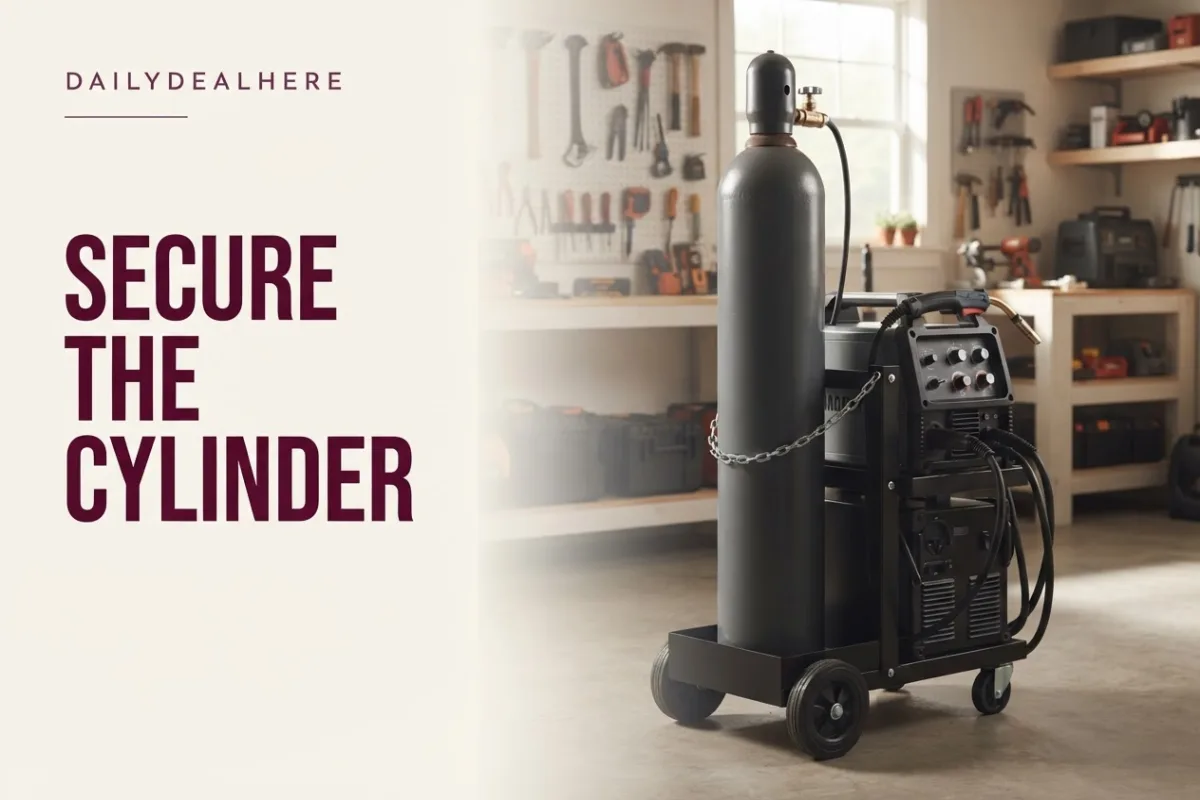
- Secure the cylinder upright, typically chained to a cart or wall, so it cannot fall.
- Before attaching the regulator, Miller recommends briefly opening and closing the cylinder valve to blow dust out of the connection.
- Attach the regulator as the owner’s manual instructs, and check for leaks at the connection.
- Open the cylinder valve slowly and set the flow rate for your process.
- Close the cylinder valve when you finish welding for the day.
A stable work surface makes every weld easier to control. Our guides to the best workbench with drawers and best trigger clamps cover gear for holding work steady, though for hot work a steel welding table is the safer surface.
Troubleshooting porosity and gas problems
If welds come out full of pinholes, Miller suggests working through a checklist before blaming the gas itself.
- Check connections on the back of the machine. Many multiprocess machines have separate MIG and TIG gas ports, so make sure you are on the right one.
- Check the flow rate, and consider an external flow meter at the gun to confirm what reaches the nozzle.
- Check the gun seating in the drive system. If it is not seated, gas leaks around the drive instead of reaching the gun.
- Clean the nozzle. Spatter buildup can disrupt gas coverage. Remove the nozzle and clear it with pliers.
- Hold the gun closer. Miller gives a standard contact tip to work distance of 1/4 to 5/8 inch. Too far and the gas disperses before reaching the puddle.
- Block the wind if you are working near an open door or outdoors.
Common shielding gas mistakes
- Using C25 on aluminum. Miller warns CO2 contaminates aluminum welds. Aluminum needs straight argon or an argon and helium blend.
- Using a steel mix on stainless. High CO2 can cause porosity and, per Lincoln, affects the corrosion resistance of multipass welds.
- Cranking up the flow. Too much gas causes turbulence and porosity, the same defect as too little, according to Miller.
- Welding in a draft. An open garage door or a fan can strip the gas shield. Miller recommends wind blocks outdoors.
- Ignoring the nozzle. Spatter buildup in the nozzle disrupts gas coverage, so clean it regularly.
- Holding the gun too far away. Miller suggests a contact tip to work distance of 1/4 to 5/8 inch.
Choosing gas for your project
- Auto body and thin sheet steel: C25, for lower spatter and a cleaner bead on thin metal.
- Farm repairs and heavy steel: C100 if cost matters, or C25 for a smoother arc. Consider C10 only if your machine can do spray transfer.
- Aluminum boats, trailers and parts: 100 percent argon with aluminum wire, typically using a spool gun or a machine set up for aluminum.
- Stainless exhaust and food equipment: a stainless blend matched to your machine, with stainless wire.
- Joining coated or dissimilar metals: silicon bronze wire with 100 percent argon.
Above all, Miller’s closing advice is to follow the filler metal manufacturer’s recommendations for the type and amount of shielding gas for a given wire and base metal. The wire spool or data sheet is the final word.
Frequently asked questions
What gas mixture is best for MIG welding?
For mild steel, 75 percent argon and 25 percent CO2 (C25) is the common all around choice, with low spatter and a good bead. Aluminum needs 100 percent argon, and stainless uses low CO2 blends such as a 90/7.5/2.5 helium tri-mix or 98 percent argon, 2 percent CO2.
Should I use argon or CO2 for MIG welding?
It depends on the metal. For steel, Miller lists C25 and straight CO2, both containing CO2. For aluminum, use 100 percent argon and avoid CO2 entirely, because it contaminates the weld.
Can you use 75/25 gas to weld stainless steel?
It is not recommended. Lincoln notes CO2 in the shielding gas affects the corrosion resistance of multipass short circuit welds, and Miller warns too much CO2 can cause porosity in stainless. Use a stainless blend such as 98 percent argon, 2 percent CO2 or a helium tri-mix.
Is 100 percent argon OK for MIG welding?
Yes for aluminum and silicon bronze, where Miller recommends it. For MIG welding mild steel, the sources we read recommend CO2 blends instead, such as C25, C100 or C10.
What is the difference between C25 and 100 percent CO2?
Miller says C25 gives minimal spatter, good arc characteristics and a good bead profile but costs more. Straight CO2 is cheaper but may produce a bit more spatter and a slightly erratic arc, though modern machines handle it better than older ones.
What flow rate should I set for MIG welding?
Miller recommends 25 to 35 cubic feet per hour for short circuit MIG welding, slightly higher for other transfer modes. Too little flow causes porosity, and too much wastes gas and causes turbulence that also creates porosity.
Can I MIG weld without gas?
With self shielded flux cored wire, yes, if your machine supports it. The flux in the wire provides the shielding, which is convenient outdoors, but expect slag and more spatter than gas shielded MIG.
What gas do I need to MIG weld aluminum?
100 percent argon is the most common choice, and Miller notes it allows easy spray or pulsed spray transfer. Argon and helium blends also work but cost more. Do not use any gas containing CO2 on aluminum.
Pick the gas by the metal: C25 or straight CO2 for steel, straight argon for aluminum, a low CO2 blend for stainless. Then set 25 to 35 cfh, keep the nozzle clean and the wind out, and let the wire maker’s data sheet settle any doubt.










Write Your Review
No reviews yet. Be the first to share your experience!