

The bathroom is where most falls at home happen, and the reason is mundane: a wet surface, a tight space, and a movement that asks you to stand on one leg for a moment. A shower seat for the elderly removes that moment. It is one of the least expensive changes you can make to a house, and it is also a category where the listings blur three genuinely different products together. We sorted 9 of them from DMI, Drive Medical, Medline and more by what actually decides which one fits your bathroom in September 2026: the shape of the space, how the person gets in, and what the floor is made of.
Our top pick is the Medline Shower Chair with Padded Armrests and Back for combining arms that give something to push up from with a back that makes a long shower comfortable. Below we group the field into the three real types so you can match one to the bathroom you have. For the rest of the room, our health and household section covers adjacent supplies.
One thing to say plainly first: nothing here is medical advice. If mobility is changing, an occupational therapist can assess the actual bathroom and recommend what fits, and that assessment is worth more than any list.

Pros
- Padded arms give something solid to push up from
- Backrest makes a long shower comfortable rather than a chore
- Height adjusts in steps to set knees at the right angle
- Drainage holes let the seat dry between uses
Cons
- Largest footprint here, needs a roomy shower or tub
- Padding takes longer to dry in a poorly ventilated room
This is the version of a shower chair that people actually keep using, and the reason is the arms. Pushing up from armrests recruits different muscles than pushing off a seat edge, and for many people that is the line between managing alone and needing help.
The back matters for a different reason. A shower with a back to lean on stops being a task to get through quickly, which means it gets done properly rather than rushed.
The trade is size. This needs a shower or tub with room around it, and the padding holds moisture longer than bare plastic. In a small bathroom with poor airflow, that is a real consideration.
Bottom line: the chair to buy when the shower has room for it, and the one most likely to stay in daily use.
- Type: shower chair with back and arms
- Arms: padded
- Height: adjustable legs
- Feet: rubber tips
- Seat: drainage holes
- Frame: heavy duty
- Assembly: tool free
- Not a medical device claim: follow the maker instructions
Buy this for a walk in shower or a roomy tub where the person can get in but cannot stand for the whole shower. The arms suit anyone who needs help rising. It is the wrong choice for a narrow stall, where a stool fits better, and for a bathtub where stepping over the wall is the hard part, which needs a transfer bench.
Set the height so feet are flat and knees sit at roughly a right angle, with every leg on the same hole and each pin clicked fully through. Test stability with the floor wet before the first real use. Add a handheld shower head if reaching a fixed head while seated is awkward, since that is often the missing half of the solution.

Pros
- Lowest cost route to a stable seat in the shower
- Suction feet grip properly on smooth tub floors
- Light enough to lift out for cleaning
- Height adjusts to suit the person
Cons
- No arms, so nothing to push up from
- Suction does little on textured or slip resistant surfaces
The value pick and the sensible first purchase when the need is new. It puts a stable, correctly heighted seat in the shower without committing to a large frame before you know which type suits.
Suction feet are the feature to check against your own floor rather than trusting the description. On smooth acrylic they seal well. On a textured slip resistant tub bottom they do almost nothing, and the chair then relies on the rubber alone.
Without arms there is nothing to push up from, so this suits someone steady enough to rise from a seat unaided. If that is in doubt, spend more on a chair with arms.
Bottom line: the low cost starting point, best on a smooth tub floor and for a person who only needs somewhere to sit.
- Type: bath and shower chair, backless
- Height: adjustable legs
- Feet: suction cups
- Seat: drainage holes
- Arms: none
- Frame: lightweight
- Assembly: tool free
- Best surface: smooth acrylic or tile
This suits a first purchase, a guest bathroom, or a person who is steady standing up but cannot stand for long. It also fits a shower too narrow for arms. Anyone who needs to push up from something, or whose tub floor is textured, should look at the chairs with arms and plain rubber feet instead.
Press each suction foot down firmly on a wet floor and try to slide the chair sideways before trusting it. If it moves, put a rubber mat under the legs. Clean the cups regularly, since soap film stops them sealing. Re-check the leg height every few months, as pins work loose when the chair is moved for cleaning.

Pros
- Backrest without the footprint of a chair with arms
- Suction feet for smooth tub floors
- Height adjustable frame
- Drained seat dries between uses
Cons
- No armrests to push up from
- Suction ineffective on textured tub bottoms
This is the middle option: a back to lean against, without the width that arms add. For a shower that cannot take a full chair but where the person wants support behind them, it is the right shape.
The aluminum frame is worth noting in a room that is wet daily. It does not rust, which is the failure mode that eventually retires coated steel frames.
Like every suction footed chair here, the grip depends entirely on what the floor is made of. Smooth acrylic seals; textured surfaces do not.
Bottom line: the pick when you want back support in a shower too tight for armrests, and the floor is smooth.
- Type: shower chair with back
- Arms: none
- Height: adjustable legs
- Feet: suction cups
- Frame: aluminum
- Seat: drainage holes
- Assembly: tool free
- Best surface: smooth acrylic or tile
Choose this for a medium sized shower where back support matters but arms will not fit, and where the floor is smooth enough for suction to work. It suits someone who rises unaided. If pushing up is the difficulty, the padded chair with arms is the one to buy.
Decide between this and the backless value pick on one question: does the person lean back while showering. If yes, the back is worth the extra width. Measure the shower floor at its narrowest before ordering, and check your tub surface for texture, since that decides whether the suction feet are a feature or decoration.
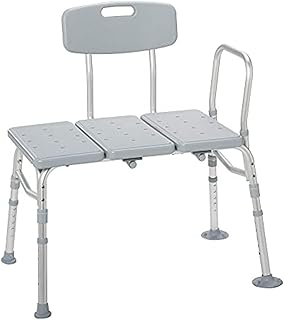
Pros
- Removes the hardest movement in the bathroom, stepping over a tub wall
- Height adjusts on both the inner and outer legs
- Aluminum frame will not rust
- Backrest gives support during the slide across
Cons
- Needs floor space outside the tub for the outer legs
- Breaks the shower curtain line, so water escapes without a workaround
A transfer bench solves a problem no chair inside the tub can touch. Stepping over a tub wall asks a person to stand on one leg on a wet surface, and that is where falls happen. With a bench, the person sits down outside, slides across, then brings their legs over.
Independently adjustable legs are the practical detail: bathroom floors are rarely level with tub bottoms, so the inner and outer pairs usually need different heights to keep the seat flat.
Two things to plan for. The outer legs need floor, which in a small bathroom is often occupied. And the curtain cannot close behind the bench, so water runs down the frame unless you use a split curtain or tuck a liner behind the seat.
Bottom line: the right answer when a bathtub wall is the obstacle, provided there is floor space outside it.
- Type: tub transfer bench
- Backrest: included, reversible
- Height: inner and outer legs adjust separately
- Frame: aluminum
- Seat: textured surface
- Assembly: tool free
- Requires: floor space outside the tub
- Curtain: needs a split curtain or inner liner
Buy this when the bathroom has a bathtub and stepping over the wall is the risky part, and when there is floor beside the tub for the outer legs. It suits people recovering from hip or knee surgery. It is unnecessary in a walk in shower, where a chair does the job in less space.
Set the inner legs so the seat sits level across the tub wall, not sloping inward. Have the person sit on the outer half first, then slide across before lifting their legs over, which is the whole point of the design. Sort the curtain arrangement before the first shower, and put a mat on the floor beside the tub for what still escapes.

Pros
- Arms and back with a wider seat than basic chairs
- Looks less clinical, which matters in a shared bathroom
- Height adjustable with tool free assembly
- Drainage holes keep the seat from pooling
Cons
- Wider seat needs a correspondingly wide shower
- Arms are fixed rather than removable
The Vaunn covers the same ground as the top pick with a wider seat and a softer visual style. In a bathroom shared with the rest of the household, looking less like hospital equipment is a genuine reason a chair stays in place rather than being moved out between uses.
The wider seat suits larger frames and anyone who finds a standard shower chair narrow. That width has to come from somewhere, so measure the shower before ordering.
Arms are fixed. That makes them solid to push against and awkward to clear if a stiff hip makes swinging a leg over difficult.
Bottom line: the comfort focused chair for a roomy bathroom, and the one that looks least like equipment.
- Type: shower chair with arms and back
- Seat: wide
- Arms: fixed
- Height: adjustable legs
- Feet: non slip rubber
- Seat: drainage holes
- Assembly: tool free
- Needs: a wide shower or tub
This suits a larger person, a shared family bathroom where appearance matters, and anyone who wants a wider seat than standard. Measure the space first. If the person needs arms that swing out of the way for transfers, look for a model with removable arms instead.
Check the fixed arms clear the tub rim if it is going into a bathtub rather than a stall. Wipe the seat rather than only rinsing, since soap film builds in textured surfaces and makes them slippery. Confirm all four legs are locked on the same setting after any move, and re-check every few months.

Pros
- Higher stated weight capacity than most chairs here
- Arms and back for support and pushing up
- Height adjustable frame
- Aluminum construction resists rust
Cons
- Larger frame needs a bigger footprint
- Less established brand than the medical supply names
The Dr Kays chair leads on capacity. Where several chairs here rate around 250 to 350 pounds, this sits higher, and that matters for two reasons: the person using it, and how the frame behaves when someone pushes hard on one armrest.
A frame loaded well below its rating flexes less, and less flex in a wet bathroom feels considerably more secure even when nothing is close to failing.
The brand is less established than the long standing medical supply names, so check warranty terms. The aluminum frame and the basic geometry are conventional.
Bottom line: the pick when capacity or frame rigidity is the deciding factor, in a bathroom with room for it.
- Type: shower chair with arms and back
- Capacity: higher rating than most chairs here
- Frame: aluminum
- Height: adjustable legs
- Feet: non slip
- Seat: drainage holes
- Assembly: tool free
- Footprint: larger
Choose this if weight capacity is a real constraint, or if the person leans heavily on one armrest when rising and you want the stiffest frame available here. It needs a shower with room. For a narrow stall or a light user, one of the smaller chairs is easier to live with.
Compare capacity ratings carefully and check what they apply to, since some makers rate the seat but describe the arms only as a steadying support. Ask about warranty length with a less established brand. Measure the shower floor before ordering, because the extra capacity comes with extra width.

Pros
- Established brand with wide parts availability
- Independently adjustable legs for uneven floors
- Backrest for support during the transfer
- Aluminum frame will not rust
Cons
- Requires floor space outside the tub
- Curtain arrangement needs solving separately
Medline is one of the names that turns up in hospitals and rehab settings, which in this category is worth something: parts, replacements and clear instructions are easier to find.
Functionally it is the same design as the other benches here. Sit outside, slide across, lift legs over. What differs between benches at this level is mostly build details and support rather than the geometry.
The same two constraints apply: floor space for the outer legs, and a curtain plan so the bathroom does not flood.
Bottom line: the transfer bench to choose if brand support and parts availability matter to you.
- Type: tub transfer bench
- Backrest: included
- Height: legs adjust on both sides
- Frame: aluminum
- Seat: textured surface
- Assembly: tool free
- Requires: floor space outside the tub
- Curtain: needs a split curtain or liner
This suits a household that wants an established medical supply brand, particularly where a clinician or therapist recommended a bench and parts may be needed later. Same requirements as any bench: a bathtub, floor space outside it, and a plan for the curtain.
Level the seat across the tub wall using the separate leg adjustments before anyone sits on it. Practice the transfer dry first so the sequence is familiar: sit outside, slide, then legs over. Keep the outer floor area clear of mats that can slide, and check the leg pins periodically.

Pros
- Non slip aluminum body resists rust and shifting
- Doubles as a seat once positioned
- Height adjustable legs
- Listed as FSA eligible, worth checking with your plan
Cons
- Needs floor space outside the tub like any bench
- Backrest support is basic compared with padded chairs
The DMI bench covers the standard transfer job and flags one thing worth acting on: it is listed as eligible for flexible spending accounts. Where a plan allows it, that changes the real cost, and it is worth a call to the plan before ordering anything in this category.
The frame is aluminum with a non slip finish, which is the right material for a room that is wet every day.
Support is functional rather than comfortable. For a short transfer that is all that is needed; for someone who will sit through a whole shower on it, a padded chair inside the tub may be the better second purchase.
Bottom line: a straightforward bench, and the one to look at first if your plan covers eligible equipment.
- Type: tub transfer bench
- Frame: non slip aluminum
- Height: adjustable legs
- Seat: textured
- Eligibility: listed as FSA eligible by the maker
- Assembly: tool free
- Requires: floor space outside the tub
- Curtain: needs a split curtain or liner
Buy this if you have a flexible spending account or a plan that covers eligible equipment, and a bathtub that needs a bench. It suits a straightforward transfer. Someone who will sit through the entire shower rather than just crossing the wall may want a padded chair as well.
Check eligibility with your own plan rather than relying on a product listing, since rules differ and change. Ask whether a clinician note is needed. Beyond that, compare benches on leg adjustment range and seat width, because the transfer geometry is the same across the category.

Pros
- Smallest footprint here, fits narrow stalls
- Height adjustable to set the knee angle
- Light enough to lift in and out easily
- Drainage keeps the seat from pooling
Cons
- No back or arms, so no support and nothing to push up from
- Suits only someone steady enough to rise unaided
Sometimes the shower simply will not take a chair, and a stool is the honest answer rather than a compromise. This one adjusts for height and takes up very little floor.
Being light is a practical advantage beyond the space it saves: it lifts out for cleaning without effort, and it can move between bathrooms if the household needs that.
What it does not offer is support. No back to lean on, nothing to push up from. That limits it to a person who can rise from a seat unaided, which is the honest boundary of this product.
Bottom line: the pick for a narrow shower, for someone who needs a seat rather than support.
- Type: backless shower stool
- Height: adjustable legs
- Feet: non slip
- Seat: drainage holes
- Frame: lightweight
- Footprint: compact
- Arms and back: none
- Assembly: tool free
Choose this for a narrow shower stall, a second bathroom, or a person who is steady standing but cannot stand for the length of a shower. If rising from a seat is the difficulty, a stool is the wrong product and a chair with arms is what to buy.
Because there is nothing to push against, pair it with a grab bar fixed into studs if the person needs help standing. Do not rely on suction mounted bars for body weight. Test the feet on a wet floor before first use, and set the height so the knees sit at roughly a right angle.
How to Choose a Shower Seat For The Elderly
The first question is not about the chair. It is about how the person gets into the shower, and the answer decides which of three products you are shopping for.
Chair, Stool, or Transfer Bench

A shower chair with a back and arms is for someone who can walk into the shower but cannot stand for the length of one. The arms matter more than they look: pushing up from armrests uses different muscles from pushing up from a seat edge, and it is often the difference between standing unaided and needing help.
A stool is the same idea stripped back. No arms, no back, smaller footprint. It suits a narrow shower where a full chair simply will not fit, and a person steady enough that they only need somewhere to sit rather than something to push against.
A transfer bench is a different product entirely. It spans the wall of a bathtub, with two legs outside the tub and two inside. The person sits down outside, then slides across and swings their legs over. It exists because stepping over a tub wall is the single hardest movement in a bathroom, and no chair inside the tub solves it.
Arms are worth a separate thought. Fixed arms are the sturdiest thing to push up from, but they also mean the person has to clear them when sitting down, which is its own hurdle for someone with a stiff hip. Some chairs use arms that swing back or lift off. If a caregiver helps with transfers, removable arms make that help far easier, and it is the detail worth checking before the frame material or the color.
Measure the Space Before Anything Else
Measure the inside of the shower or tub at the floor, not at the rim, because tubs taper. Then measure the seat width of anything you are considering and leave clearance on both sides. A chair that technically fits but touches both walls cannot be turned or lifted out to clean.
For a transfer bench, the measurement that matters is the space outside the tub. The outer legs need floor to stand on, and in a small bathroom that floor is often occupied by a toilet or a vanity. Measure that gap first, because it rules out the whole category faster than anything else.
Shower curtains are the detail everyone forgets. A bench crossing the tub wall breaks the curtain line, and water runs down the frame onto the floor unless you use a split curtain or tuck an inner liner behind the bench. Plan for it rather than discovering it.
Height Adjustment and Getting It Right
Almost everything here adjusts in one inch steps through a range of a few inches. The target is simple: feet flat on the floor, knees at roughly a right angle, hips level with or slightly above the knees. Sitting too low is what makes standing up hard, and it is the most common setup mistake.
Set the height with the person wearing what they normally wear on their feet in the bathroom, which is usually nothing. Check that every leg is locked into the same hole and that the push pins have clicked fully through, because an uneven leg turns a stable chair into a rocking one.
Re-check the setting every few months. Legs work loose, pins get bumped when the chair is moved for cleaning, and nobody notices a chair has dropped a notch until it feels wrong.
Feet, Grip, and the Floor Underneath

Suction feet grip smooth surfaces properly and do very little on textured ones. A molded acrylic tub floor or a smooth tiled base is where they work. A slip resistant tub bottom, a stone base or large grout lines mean the suction never seals, and the chair relies on the rubber alone.
Check the feet against your actual floor before deciding the chair is unsafe. Press each foot down and try to slide the chair sideways with the floor wet. If it moves, a rubber shower mat under the legs does more for stability than any feature on the chair.
Look at the frame material too. Aluminum frames do not rust, which matters in a room that is wet every day. Steel frames with a coating are fine until the coating chips, and then they mark. Our article archive covers more home safety kit.
Weight Capacity and How the Frame Behaves

Capacity figures here run from around 250 pounds to 500. Treat the number as a limit rather than a target: a frame loaded near its rating flexes, and flex in a wet bathroom feels alarming even when nothing is failing.
The load is also not static. Sitting down involves a moment of impact, and pushing up from armrests puts force through one side of the frame rather than down the middle. If the person uses the arms heavily, a heavier duty frame is worth the difference regardless of body weight.
Check what carries the rating. Some benches state a capacity for the bench and a lower one for the backrest, and some chairs rate the seat while the arms are described only as a support to steady yourself rather than to bear full weight.
Insurance and flexible spending accounts are worth checking before buying. Some of these are listed as eligible expenses, and a few are covered in part under durable medical equipment rules when a clinician documents the need. Rules differ by plan and country, so the useful step is asking the plan directly rather than assuming either way.
Cleaning, Drainage, and Living With It
A seat with drainage holes dries and stays cleaner than a solid one. Textured seats grip better when wet but hold soap film in the texture, so they need wiping rather than rinsing. Padded seats are more comfortable for long sits and take longer to dry, which in a small bathroom with poor ventilation matters.
Tool free assembly is standard now and worth confirming, because these often need taking apart to clean properly or to store between visits. A chair that requires a spanner to adjust is a chair that never gets adjusted.
Think about whether it lives there permanently. In a shared bathroom, a chair that folds or lifts out easily keeps the room usable for everyone else, and that practical detail decides whether the chair stays in place or ends up in a hallway.
Two accessories change how well any of these work and neither comes in the box. A handheld shower head lets the person wash while seated instead of standing to reach a fixed head, which is often the reason a chair alone does not solve the problem. A grab bar mounted into studs gives something solid to hold during the transfer itself. Suction mounted bars are not a substitute for a fixed one and should not be trusted with body weight.
| Type | Best at | Weak at |
|---|---|---|
| Chair with back and arms | Something to push up from, comfort for a long shower | Largest footprint, needs a roomy shower |
| Stool without back | Narrow showers, a person who only needs to sit | Nothing to push against, no back support |
| Transfer bench | Getting over a bathtub wall without standing on one leg | Needs floor space outside the tub, breaks the curtain line |
Assembly is worth doing with two people the first time. These arrive flat with legs, seat and back separate, and the awkward part is holding the frame square while the pins go in. Doing it in the room where the chair will live saves carrying an assembled frame through a doorway that turns out to be narrower than it looked.
Why You Should Trust Us
We build these lists from published specification and from the pattern of what long-term owners report rather than from marketing copy. For each seat here we checked which of the three types it actually is rather than trusting the words in the title, the stated weight capacity and what it applies to, the height adjustment range, the frame material, whether the feet are suction or plain rubber, and whether the seat drains.
We set aside a bedside commode that appears in this search but is a different product for a different purpose, and we say plainly which entries are benches rather than chairs. Nothing here is medical advice and none of it substitutes for an assessment of the actual bathroom by an occupational therapist, which is what we would suggest first where mobility is changing.
Final Thoughts
Best overall is the Medline Shower Chair with Padded Armrests and Back. The arms give something to push up from, the back makes a long shower comfortable rather than a task to be finished, and the padding is the detail that keeps it in use.
Best value is the Drive Medical Adjustable Shower and Bath Chair. It covers the core job at the lowest outlay here and is the sensible starting point when the need is new and you are not yet sure which type suits.
For specific needs, the Drive Medical Shower Chair with Back and Suction Feet suits a smooth tub floor where suction actually seals, the Drive Medical and DMI transfer benches are the answer when a bathtub wall is the obstacle, the Medline transfer bench is the alternative in that class, the Vaunn Deluxe Spa chair and the Dr Kays chair are the comfort focused options with arms, and the HOMLAND stool is the pick when the shower is too narrow for anything with arms. More picks are indexed across our category index.
Shower Seat For The Elderly FAQs
Do I need a chair or a transfer bench?
It depends on the bathroom, not on the person. If the shower is a walk in stall, a chair is what you want. If it is a bathtub and stepping over the wall is the hard part, a chair inside the tub does not help, because getting in is the risk rather than standing. A transfer bench lets the person sit down outside and slide across. Check there is floor space outside the tub for the outer legs before ordering one.
Will suction feet hold on my tub?
Only on a smooth surface. Suction seals against molded acrylic or smooth tile and does close to nothing on a textured slip resistant tub bottom, on stone, or across grout lines. Test it wet: press the feet down and try to slide the chair sideways. If it shifts, put a rubber mat under the legs, which grips the texture better than the suction cups can.
What height should the seat be set to?
Feet flat on the floor, knees at roughly a right angle, hips level with the knees or slightly higher. Sitting too low is the most common mistake and it makes standing up much harder than it needs to be. Set it with the person sitting normally, check every leg is on the same hole, and confirm each pin has clicked all the way through. Re-check every few months, since legs work loose over time.
How do I stop water going everywhere with a bench?
A bench crosses the tub wall, so the curtain cannot close behind it and water runs down the frame. The usual fixes are a split shower curtain designed for benches, or an inner liner tucked behind the seat while the outer curtain stays outside. A rubber mat on the floor beside the tub catches what still escapes. Plan this before installing rather than after the first shower. Our household archive covers more bathroom kit.
Is a padded seat worth it?
For long showers and for anyone who is thin or has sensitive skin, yes: an unpadded plastic seat becomes uncomfortable quickly and discomfort is why chairs stop being used. The trade is drying time and cleaning, since padding holds moisture in a room that is already damp. In a bathroom with poor ventilation, a drained plastic seat that dries between uses is the more practical choice.








Write Your Review
No reviews yet. Be the first to share your experience!