

A wasp nest under a soffit is not a bug problem, it is a timing problem. The spray you choose matters far less than how far it shoots, how fast it knocks down the guards, and whether you are standing under the nest at dusk or at two in the afternoon. We compared 7 cans from SpectracidePRO, Raid, Spectracide and more on jet distance, active ingredient, residual life, and whether the formula foams or runs, because those four things decide whether one trip up a ladder ends the problem.
Our top pick is SpectracidePRO Wasp and Hornet Killer for combining a long jet with a fast enough knockdown that returning foragers do not have time to organise. Below we sort the field by where the nest is, because a paper nest hanging in the open, a yellowjacket colony in the ground, and carpenter bees boring into a fascia board are three different jobs. For broader pest coverage, see our guide to general purpose pest control sprays.

Pros
- Long jet lets you treat from well outside the defended radius
- Fast knockdown stops guard wasps before they close distance
- Residual action handles foragers returning after treatment
- Generous can size so one nest does not empty it
Cons
- Residue is unsuitable on handrails, play equipment or over vegetables
- Straight stream runs off vertical surfaces rather than clinging
SpectracidePRO is the can to reach for when the nest is visible, reachable across open air and hanging somewhere you would rather not stand under. Its long straight jet is the entire point: the safety of this whole job comes down to delivering a lethal dose from outside the radius a colony will defend, and this one gives you the most room to work with.
The formula pairs a fast knockdown agent with a residual one, which is the combination that actually ends a colony. The knockdown protects you in the first ten seconds while the guards react. The residual handles the third of the workforce that was out foraging when you sprayed and lands on a treated surface hours later.
Can size matters more than people expect. Correct technique is a sustained burst of several seconds rather than a quick squirt, and eighteen ounces means one nest does not use most of the can. It also means the pressure stays high enough through the treatment that the jet does not shorten mid job.
The limitation is the residue itself. On a soffit it is exactly what you want, and on a handrail or above a vegetable bed it is the wrong tool. This is a can for structural surfaces, not for anywhere hands and pets go.
Bottom line: the most complete choice for an exposed nest, and the one to buy if you are only buying one.
- Delivery: straight jet stream
- Can size: 18 ounces
- Action: fast knockdown plus residual
- Labelled for: wasps, hornets, yellowjackets
- Best nest type: exposed paper and enclosed hanging nests
- Application: from ground level, after dark
Treat after dark or before dawn when the colony is home and less responsive. Stand on the ground, never on a ladder, and know your exit route before you spray. Do not use a white flashlight aimed at the nest: wasps orient toward light. Keep the spray away from ponds and off flowering plants, since pyrethroids are highly toxic to fish and to bees.
Fire a short test burst at the lawn first to see where the jet actually lands, then aim at the nest entrance and hold a sustained burst of several seconds rather than pulsing. Back away without turning your back on the nest. Leave the nest in place for a full day so returning foragers contact the treated surface, then remove it in the morning once there is no traffic.

Pros
- Available almost everywhere, easy to buy on short notice
- Strong immediate knockdown
- Good jet distance for ground level treatment
- Familiar and consistent formulation
Cons
- Shorter residual life than the professional grade options
- Liquid stream runs off vertical surfaces quickly
Raid Wasp and Hornet Killer is the can most people already know, and its main advantage is that you can buy it at nine in the evening from almost anywhere. When a nest turns up unexpectedly, availability is a real feature rather than a consolation.
The performance is solid where it matters. The jet reaches far enough to treat a typical eave nest from the ground, and the knockdown is fast enough that guards drop before they can organise. For an exposed paper wasp nest this handles the job without drama.
Where it sits behind the professional grade cans is residual life. It kills what it touches decisively, but the treated surface stops working sooner, which means more of the returning foragers survive. On a small nest that rarely matters. On a large colony it means checking the site again the next evening.
The can is a straight stream, so it runs off vertical surfaces within seconds. For a nest in a cavity you want a foam instead.
Bottom line: the dependable everyday choice, especially when you need something tonight.
- Delivery: straight jet stream
- Can size: 17.5 ounces
- Action: fast knockdown, moderate residual
- Labelled for: wasps and hornets
- Best nest type: exposed nests within jet range
- Availability: very widely stocked
Buy this for a single visible nest when you want something proven and available immediately. It is not the pick for a nest inside a wall, which needs foam, or for a ground colony, which needs a product labelled for ground nesting yellowjackets.
Wear long sleeves, closed shoes and eye protection even for a ninety second job. Treat at dusk or before dawn. Never treat from a ladder. If anyone in the household has a known sting allergy, hire a professional rather than doing this yourself.
Pros
- Two cans in the pack, so you always have a spare
- Lowest cost per can in this group
- Long enough jet for typical eave nests
- Fast contact kill
Cons
- Smaller can means a large nest can drain most of one
- Least residual staying power of the synthetic options
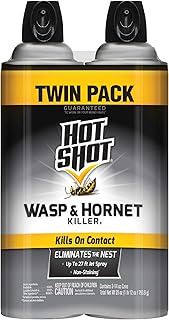
Hot Shot wins on the arithmetic that actually matters in this category. The worst position in wasp treatment is running out of product halfway through with an agitated colony above you, and a two pack removes that risk for less than the price of a single premium can.
The performance is straightforwardly adequate. The jet reaches far enough for a typical eave or fence nest, and the contact kill is fast. For a paper wasp comb under a rail this is all the product you need.
The cans are fourteen ounces rather than eighteen, and correct technique uses a lot of product, so a large enclosed hornet nest can drain most of one can. That is precisely why the two pack format suits this product better than a single can would.
Residual life is the weakest of the synthetic options here. Plan on watching the site for two evenings and treating again if there is still traffic, which the spare can makes painless.
Bottom line: the best value here, provided you accept that the strategy is two treatments rather than one perfect one.
- Delivery: straight jet stream
- Can size: 14 ounces, two cans per pack
- Action: fast contact kill
- Labelled for: wasps and hornets
- Best nest type: small to medium exposed nests
- Format: two pack
This is the right buy if you have more than one nest site, if you have had wasps in the same spot in previous summers, or if you simply want the insurance of a spare. For a single large hornet nest, a bigger can with stronger residual action is a better single purchase.
Aerosols lose pressure as they empty, and a part used can throws noticeably shorter than a fresh one. Keep the unopened can for anything high or exposed and use the opened one for low, close work. Store both away from heat and out of direct sun.

Pros
- Freezing action drops insects on contact with no delay
- Professional grade product used by pest control operators
- Labelled for spiders as well as wasps and hornets
- Very low risk of a defensive response reaching you
Cons
- Little to no residual action, so returners are not handled
- Harder to find than consumer shelf brands
PT Wasp-Freeze takes a different approach to everything else here. Rather than relying on a neurotoxin that takes seconds to act, it uses a freezing formulation that drops wasps on contact. In practice that means the guards never get a chance to mount a defence, which is the single biggest safety variable in this job.
It is a professional product and it behaves like one. Coverage is decisive, the label covers spiders as well as social wasps, and it works well at the cooler temperatures where you should be treating anyway.
The trade is residual action, of which there is essentially none. Foragers that were away when you sprayed will come home to an untreated surface and survive. On an active colony that means either a second treatment the following night or accepting that stragglers will hang around for a few days.
Availability is the other friction. This is not a product you find on a supermarket shelf next to the barbecue tools, so it is a plan-ahead purchase rather than an emergency one.
Bottom line: the safest knockdown here by a clear margin, best used when you can commit to a follow up treatment.
- Delivery: freezing contact aerosol
- Action: immediate knockdown by freezing
- Residual: minimal
- Labelled for: wasps, hornets, yellowjackets, spiders
- Grade: professional
- Temperature: effective in cool conditions
Choose this if the priority is not getting stung and you are willing to treat twice. It suits nests in awkward positions where you get one shot and want the response to be immediate. It is not the pick if you want a single application that also cleans up the returning workforce.
Freezing formulations can damage some painted and plastic surfaces on prolonged contact, so avoid holding a sustained blast on vinyl trim or a painted shutter. Wear gloves: the discharge is genuinely cold and skin contact is unpleasant. Standard precautions about treating after dark and staying off ladders apply as with any product here.

Pros
- Foam expands into voids that a jet cannot reach
- Clings to vertical surfaces for long contact time
- Visible coverage tells you exactly what you hit
- Good option for soffits, shutter boxes and wall gaps
Cons
- Shorter throw than the straight jet cans
- Foam residue is visible on the treated surface afterwards
Raid MAX Foaming exists for the case that defeats every straight jet product: a nest inside something. A liquid stream aimed at a soffit gap or a roller shutter box runs down the face and away from the colony. Foam expands, fills, and stays in contact with the comb while it slowly collapses.
The visible coverage is a genuinely useful secondary benefit. Treating at dusk with a clear liquid gives you no way to judge whether you hit the entrance. White foam on a dark gap tells you immediately whether to fire again or back off.
The cost of that behaviour is throw. Foam does not carry as far as a straight jet, so this is not the can for a hornet nest fifteen feet up in a tree. Use it where you can get reasonably close and the target is a cavity rather than an open nest.
Expect visible residue on the treated surface for a while afterward, which matters on a painted soffit facing the street and does not matter inside a shutter box.
Bottom line: the correct tool for void nests, and the wrong tool for anything high and exposed.
- Delivery: expanding foam
- Can size: 16.5 ounces
- Best nest type: cavity, soffit, wall void, shutter box
- Throw: shorter than a straight jet
- Labelled for: wasps and hornets
- Coverage: visible white foam
Buy this in addition to a long jet can rather than instead of one. The two products solve different problems, and a household that has had wasps in a soffit before will use both. If your nest is hanging in the open where you can see all of it, the straight jet is the better purchase.
Aim at the entry hole rather than at the surrounding surface and hold until foam backs out of the opening, which tells you the cavity is filling. Do not seal the hole immediately: workers still returning need to contact the treated entrance. Seal it a few days later once all traffic has stopped, or the colony rebuilds in the same void next season.

Pros
- Made for ground nests, where a surface spray does almost nothing
- Foam travels along a carpenter bee gallery
- Fills the tunnel rather than coating the entrance
- Solves two problems that general wasp cans do not
Cons
- Not the tool for an exposed hanging nest
- Requires getting close to a ground nest entrance
This is the specialist can, and buying it means you correctly identified your problem. Ground nesting yellowjackets live below a small hole with the colony well underneath, so a surface spray from a general wasp can reaches almost nothing and mostly announces your presence. Carpenter bees bore a clean round hole and tunnel along the grain, so again there is no nest surface to soak.
The foaming delivery is what makes this work for both. Foam expands down a tunnel and along a gallery, holding contact against surfaces a liquid would run past. On a carpenter bee hole in a fascia board, that is the difference between treating and pretending to treat.
The obvious caution is proximity. Treating a ground nest means getting close to the entrance, which is exactly where a yellowjacket colony is most dangerous. Do this after full dark, in cool conditions, with skin covered, and have a clear exit that does not run over the nest.
It is not a substitute for a long jet can. On an exposed paper nest under an eave it is the wrong shape of tool.
Bottom line: essential if your nest is in the ground or your problem is holes in wood, and irrelevant otherwise.
- Delivery: expanding foam
- Can size: 16 ounces
- Labelled for: carpenter bees, ground nesting yellowjackets
- Best nest type: underground colonies, wood galleries
- Application: at the entrance hole
- Throw: short, close range product
Buy this if you found the nest by mowing over it, or if you have neat round holes appearing in untreated wood on a deck, fascia or shed. Do not buy it as your only wasp product, because it does not do the job an exposed nest needs.
Ground nest treatment is the highest risk task in this category. Treat only after full dark, cover all skin, and walk your exit route in daylight first so you are not finding a hose in the dark. Do not stand directly over the entrance. For carpenter bees, wait several days after treatment before plugging the hole, then fill it and paint or seal the wood so a new female does not reuse the gallery.

Pros
- No lasting synthetic residue on treated surfaces
- Reasonable choice near vegetable beds and pet runs
- Two cans in the pack
- Cedarwood scent rather than solvent smell
Cons
- Kills only what it soaks, with no follow up action on returners
- Shorter throw than the synthetic long jet cans
Wondercide is the option for people whose real constraint is not the wasps but what the spray lands on. A cedarwood based contact formula leaves essentially no lasting residue, which makes it a defensible choice above a vegetable bed, near a dog run, or on a surface children touch. None of the pyrethroid cans here are appropriate in those places.
What you give up is everything that happens after the spray dries. There is no residual barrier, so foragers returning that night land on a clean surface and survive. Treating a colony with this means soaking it thoroughly and expecting to treat again.
Throw is shorter than the long jet synthetics, which compounds the problem: you need to be closer, and you need to deliver more product to be sure. The two can pack is not generosity, it is a reflection of how the product is used.
On a small paper wasp comb in an inconvenient location it works fine. On a mature hornet nest it is the wrong tool regardless of your preferences about residue.
Bottom line: the right answer to a specific constraint, and an honest trade rather than a free upgrade.
- Delivery: contact aerosol spray
- Active: cedarwood oil based formulation
- Can size: 10 ounces, two cans per pack
- Residual: essentially none
- Best nest type: small exposed nests near sensitive areas
- Scent: cedar rather than solvent
Choose this when the location rules out a residual pyrethroid: over food crops, near a pond, on surfaces pets or children contact. Do not choose it as a general purpose wasp can, and do not choose it for a large or aggressive colony where you need one decisive treatment from distance.
Plant oil formulations are lower risk to surfaces and soil but they are not harmless: keep the spray out of eyes and off skin, and keep pets away until the treated area has dried. Because there is no residual action, check the nest site on consecutive evenings and be ready to treat again rather than assuming one application finished the job.
How to Choose a Wasp And Hornet Killer
Everything below is about staying out of reach while the can does its work. Read the first three sections even if you skip the rest, because jet distance, nest type and timing account for almost every bad outcome in this category.
Jet Distance Is the Safety Feature
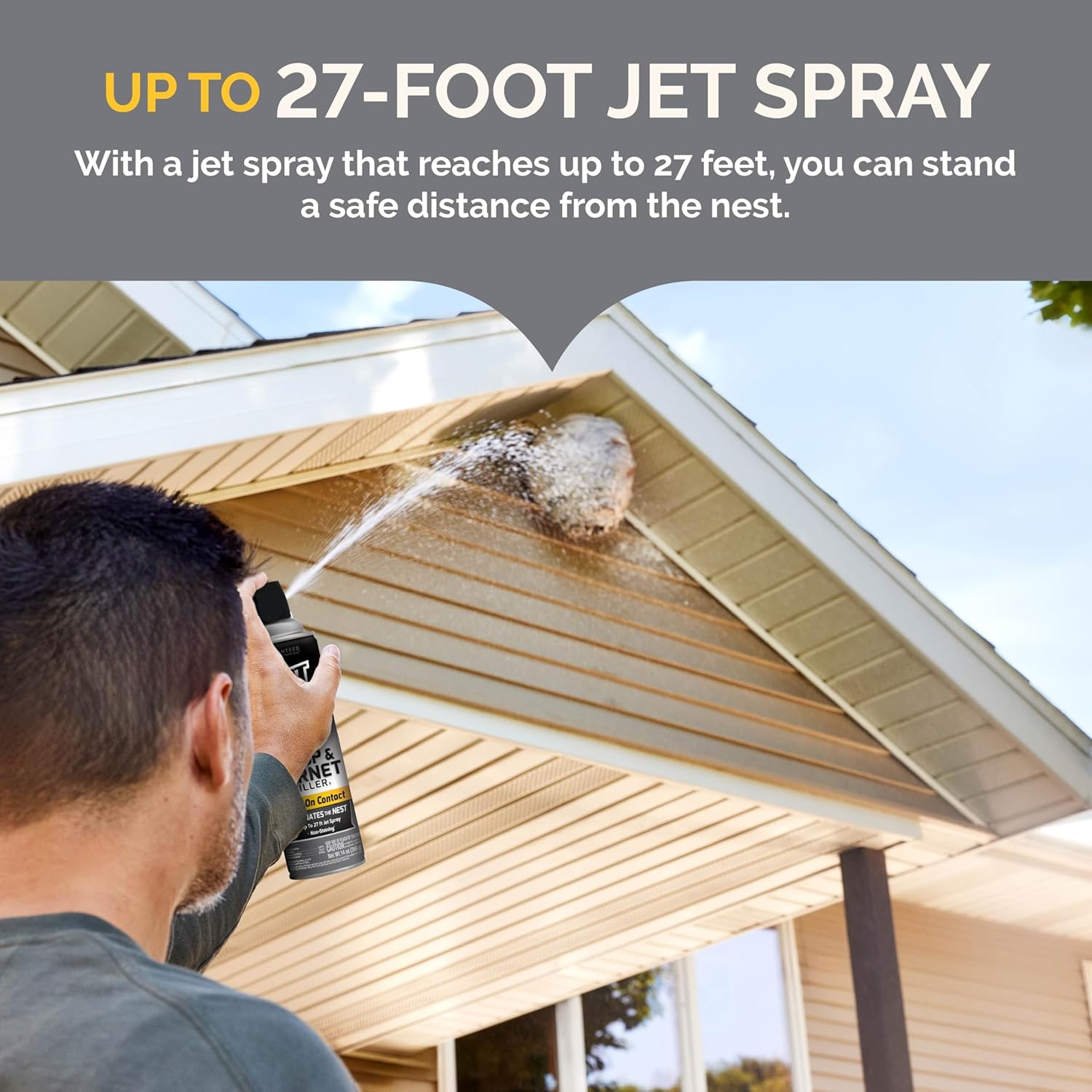
Every can in this category advertises a spray distance, usually somewhere between fifteen and twenty seven feet. That number is the single most important specification on the label, and it is not about convenience. A wasp colony defends a radius around the nest, and the whole strategy of treating from distance is to deliver a lethal dose before anything crosses that radius toward you.
Treat the advertised figure as a best case measured in still air with a full can. In real conditions you lose distance to wind, to a partially used can with lower pressure, and to any upward angle. If a nest is fifteen feet up, a can rated for fifteen feet is not enough, because you will be spraying at an angle and gravity is working against the stream the whole way.
The practical rule is to buy for at least half again the distance you think you need, and to test the stream on the lawn before you point it at anything. Knowing where the jet actually lands is worth more than any claim on the can, and it costs you two seconds of product.
Match the Product to Where the Nest Is

An exposed paper nest hanging from a branch or an eave is the easiest case. A straight jet formula soaks the envelope, penetrates the layers, and reaches the brood. This is what most cans in this category are designed for and most of them do it well.
A void nest inside a wall, a soffit cavity or a roller shutter box is a different problem. A liquid jet runs down the surface and away from the colony. What you want here is a foaming formula that expands into the cavity and holds contact against the comb, or a dust product applied at the entry point that workers then carry inside.
Ground nesting yellowjackets are the third case and the most dangerous to get wrong. The entrance is a small hole and the colony is below it, so a surface spray reaches almost nothing. Products sold specifically for ground nesting yellowjackets are formulated to flood the tunnel, and they are the correct purchase even though a general wasp can looks like it should work.
Foam Versus Straight Stream

A straight stream carries further and hits harder, which is why every long distance product uses one. It is the right choice for anything you can see and reach across open air. The downside is that a liquid stream runs off a vertical surface within seconds, so contact time on the nest is short.
Foam trades distance for dwell. It expands on contact, clings to a vertical surface, and keeps working while it slowly collapses. On a nest tucked into a corner or a gap where you cannot deliver a clean shot, foam covers a wider area and finds its way into places a stream would skip.
Foam also gives you a visual record of coverage, which sounds trivial and is not. In low light you can see exactly what you hit, and that tells you whether to fire again immediately or to back away. A clear liquid stream on a grey nest at dusk gives you nothing to judge by.
Active Ingredients and What They Do Differently
Most cans in this category use one or more pyrethroids: prallethrin, tetramethrin, cypermethrin, permethrin, lambda-cyhalothrin. Prallethrin and tetramethrin are fast knockdown agents that drop an insect quickly but do not persist. Cypermethrin, permethrin and lambda-cyhalothrin work more slowly and leave a residue that keeps killing for days or weeks.
The good formulas combine both types, which is why the ingredient panel usually lists two actives. Fast knockdown protects you in the first ten seconds. Residual action handles the foragers that were away from the nest when you sprayed and come back to a treated surface later that night. A can with only a knockdown agent leaves you dealing with returners the next day.
Botanical formulas built on cedarwood, peppermint or similar oils sit outside this system. They kill on direct contact and leave essentially no residue, which is exactly why people who want to avoid synthetic pyrethroids around a vegetable bed or a pet run choose them. They require more thorough soaking and they will not clean up the stragglers.
Residual Life, and When It Is a Liability
A residual product turns the treated surface into a barrier for a period after application, commonly quoted as up to four weeks. On a soffit that has been colonised three summers running, that residue is the feature you are buying: it discourages a new queen from rebuilding in the same spot.
Residual life becomes a liability wherever the treated surface is something people or animals touch. A railing, a play structure, a doorframe at hand height, or anything above a vegetable bed are all poor candidates for a long residual pyrethroid. In those places a knockdown-only or botanical product is the better tool even though it does less.
Pyrethroids are also highly toxic to fish and to bees. Nothing in this category should be sprayed where runoff reaches a pond, and nothing should be sprayed on flowering plants where pollinators are working. That is not a legal footnote, it is the main environmental risk of the whole product class.
Timing: Treat at Dusk or Before Dawn
Wasps and hornets return to the nest at night. Treating after dark or in the first light before foraging starts means the whole colony is home, which is both safer for you and far more effective, because a daytime treatment leaves a third of the workers out in the field to return and rebuild.
Cool temperatures help twice over. Wasps are less active and slower to respond below about sixty degrees, and the still air of early morning or late evening means your jet goes where you aim it. Midday heat gives you an alert colony and a stream that drifts.
Do not use a white flashlight to aim. Wasps orient toward light and a beam pointed at the nest is a marker pointing back at you. If you need light, use a red filter or position a lamp off to one side and away from where you are standing.
Have an Exit Before You Have a Can
The most common serious injury in this whole activity is not the sting, it is the fall. People treat a nest from a ladder, get hit, and come off the ladder. Plan the treatment so you are standing on the ground, which is the real reason jet distance matters, and never treat a nest while on a ladder if there is any way to reach it from below.
Know your route out before you spray, and make sure it does not run under the nest. Walk it once in daylight so you are not discovering a garden hose or a step in the dark. Leave doors unlocked behind you.
Cover skin. Long sleeves, long trousers, closed shoes, gloves and eye protection are all reasonable for a job that takes ninety seconds. If anyone in the household has a known sting allergy, this is not a job to do yourself at all, regardless of which can you buy.
Can Size and How Much You Actually Need
Fourteen to eighteen ounces is the standard range and a single nest treatment uses a surprising amount, because the correct technique is a sustained burst of several seconds rather than a quick squirt. Emptying a third of a can on one nest is normal, and stopping early to conserve product is how a treatment fails.
Buy two cans if you are treating anything larger than a golf ball sized nest or if you have more than one location. Running out halfway through, with an agitated colony and no product, is the worst position in this activity. The second can is cheap insurance and it keeps.
Aerosols lose pressure as they empty, and the last quarter of a can does not throw nearly as far as the first quarter. Treat a partly used can as a shorter range tool and keep a fresh one for anything high or exposed.
Wasps, Hornets, Yellowjackets and Carpenter Bees Are Not the Same
Paper wasps build an open comb with visible cells, usually under an eave or a rail, and their colonies are small. They are the least aggressive of the group and the easiest to treat. Bald faced hornets build the large enclosed grey football nest and defend it hard, so distance matters much more.
Yellowjackets nest in cavities and in the ground, which is why they surprise people mowing a lawn. They are the most aggressive of the common species and the most likely to sting repeatedly. Treat their nests only at night, from a distance, with a product made for the job.
Carpenter bees are not social wasps at all. They bore a clean round hole into untreated wood and tunnel along the grain. A general wasp spray does very little because there is no nest to soak, and the correct approach is a product designed to be delivered into the gallery, followed by plugging the hole once activity stops. Honeybees, by contrast, should never be treated: call a local beekeeper, who will usually collect a swarm at no charge.
After the Treatment
Do not knock the nest down the same night. Foragers that were away will return over the following twenty four hours and land on a treated surface, which is how the residual component finishes the job. Removing the nest immediately removes the thing they are coming back to.
Wait a full day, watch the entrance in daylight from a safe distance, and only remove the nest once there is no traffic at all. Bag it rather than dropping it, and do it in the morning when any survivor is slow.
Then close the opening. A void nest in a soffit or a shutter box will be recolonised next season unless the gap is sealed, and sealing costs less than treating every year. Our guide to window screens covers the related job of keeping flying insects out of the house itself.
| Nest situation | What to use | Why |
|---|---|---|
| Exposed paper nest under an eave | Long range straight stream | Treat from the ground, soak the comb in one burst |
| Nest inside a wall or soffit void | Foaming formula | Expands into the cavity and holds contact |
| Ground nesting yellowjackets | Product labelled for ground nests | Floods the tunnel rather than coating the surface |
| Carpenter bee galleries in wood | Carpenter bee specific product | Delivered into the bore hole, not onto a nest |
| Near vegetables, pets or a pond | Botanical contact formula | No lasting residue on surfaces or soil |
Why You Should Trust Us
We build these lists from label data and from the pattern of what long term users report. For each can here we read the registered active ingredients, the stated spray distance, whether the formula delivers as a stream or a foam, the claimed residual period, and which species and nest types the label actually covers. Label claims about species are a legal statement rather than marketing, so they are among the more reliable things printed on a pesticide can.
We set aside general flying insect sprays that happen to mention wasps, because a formula built for houseflies does not have the jet distance or the dose to end a colony. We also excluded duplicate listings that differ only in pack count, so every entry here is a genuinely different product.
Final Thoughts
Best overall is SpectracidePRO Wasp and Hornet Killer. It pairs a long straight jet with a knockdown that is fast enough to stop the guards before they close the distance, and it carries residual action for the foragers that come home later. If you are treating one nest under an eave and want a single can that does the whole job, this is it.
Best value is the Hot Shot Wasp and Hornet Killer aerosol. It delivers the same basic capability, a long jet and a fast contact kill, for meaningfully less, and buying two cans of it still costs less than one premium can. It gives up some residual life, so plan on watching the site for a couple of days.
For specific jobs, Raid MAX Foaming is the one to buy for a nest inside a wall or a shutter box because foam is the only delivery method that reliably finds a cavity. Spectracide Carpenter Bee and Ground Nesting Yellowjacket Killer is the correct product for a hole in the ground or a bore hole in a fascia board, where a standard wasp can does almost nothing. BASF PT Wasp-Freeze is the professional grade option that freezes on contact and drops a colony before it can respond. And Wondercide is the pick if the nest sits over a vegetable bed or a dog run and you want no lasting residue at all, accepting that it works only where you soak it. More home and outdoor guides are indexed in health and household and across our article archive.
Wasp And Hornet Killer FAQs
When should I spray a wasp and hornet killer for the best result?
After dark or in the first light before foraging begins. The whole colony is home at those hours, which makes the treatment far more complete, and cooler temperatures leave the wasps slower to respond. Avoid a white flashlight pointed at the nest: wasps orient toward light, and the beam points straight back at where you are standing.
How far does the spray really reach?
The stated figure, usually fifteen to twenty seven feet, is measured in still air with a full can and level aim. Wind, an upward angle and falling pressure in a partly used can all reduce it. Buy for at least half again the distance you think you need, and fire a test burst at the lawn first so you know where the stream actually lands.
Should I knock the nest down right after spraying?
No. Wait a full day. Workers that were away when you sprayed come home over the next twenty four hours and land on the treated surface, which is how the residual component finishes the colony. Remove the nest the following morning only once you have watched the entrance in daylight and seen no traffic at all.
Is there an option that is safe around pets and vegetables?
Botanical formulas built on cedarwood and similar oils kill on direct contact and leave essentially no residue, which makes them the sensible choice over a vegetable bed or a dog run. The trade is real: they need thorough soaking and they will not clean up foragers that return later, so expect to treat again. Keep any pyrethroid product away from ponds, because it is highly toxic to fish.
Will one can be enough in 2026?
For a single small nest, usually. Correct technique is a sustained burst of several seconds rather than a quick squirt, and a third of a can on one nest is normal. For anything larger than a golf ball, for multiple locations, or for a nest in a cavity, buy two. Running out mid treatment with an agitated colony is the worst position in this job, and an unopened can keeps for years.



Write Your Review
No reviews yet. Be the first to share your experience!