

A grab bar is one of the cheapest pieces of hardware you can put in a bathroom, and one of the very few that has to hold a person upright on a wet floor. That is why shopping for shower grab bars for seniors is far less about finish and style than about two things: how the bar attaches to the wall, and how much load the manufacturer is willing to put in writing. We gathered 7 options from Moen, Safe-er-Grip, Amazon Basics and more, then sorted them by mounting method rather than by looks.
Our top pick is the Amazon Basics 36-inch stainless steel grab bar for its published 500 pound rating when anchored into a wall stud and its ADA compliant 1.25 inch grip diameter. The screw-in bars appear first, followed by a clamp-on tub rail, then the suction models, because that order reflects how much weight each style can realistically carry. If you are working through a wider bathroom safety upgrade, our health and household guides cover the rest of the room. Customer ratings and stock move around, so this shortlist reflects what shoppers are rating highest as of September 2026.

Pros
- Publishes a 500 pound capacity when anchored into a stud
- Explicit ADA compliance claim from the manufacturer
- 1.25 inch diameter is the easiest size for a hand to close around
- 36 inch span covers a full alcove back wall with one bar
- Brushed stainless resists rust and hides water spots
Cons
- Exposed flange screws are visible after installation
- 36 inches is too long for a narrow entry wall or a short tub run
- Only a one year warranty, shorter than some competing bars
This is the plain, unglamorous stainless bar that does the job a grab bar exists to do. It is 36 inches long with a 1.25 inch outside diameter, made from stainless steel with a brushed finish, and Amazon states it meets the specifications of the Americans with Disabilities Act. For a household installing a single bar in a standard alcove shower, that length is the most useful choice available, because it gives a continuous hold across the entire back wall instead of one fixed grab point.
The number that matters is the published capacity: up to 500 pounds when the bar is installed in a wall stud or another secure mounting surface. That qualifier is doing real work and the listing does not hide it. Anchored into framing, this bar comfortably exceeds the 250 pound point load the ADA standard calls for. Fastened into tile and hollow drywall with the plugs that come in the bag, it is a towel bar with delusions of grandeur. Budget for a proper stud location or a heavy-duty grab bar anchor before you buy.
The compromises are minor and honest. The flanges use exposed screws, so this is not the bar to pick if you want the hardware invisible. The warranty is one year, which is short next to the lifetime coverage on premium bathroom brands. And 36 inches is genuinely long: measure the wall first, because it will not fit between a shower valve and a corner in a small stall.
Bottom line: the best combination of published capacity, correct grip geometry, ADA compliance, and useful length in this roundup. If you are installing exactly one grab bar and you can reach framing, buy this one.
- Mount type: screw-in, wall mounted
- Length: 36 inches
- Grip diameter: 1.25 inches
- Material: stainless steel, brushed finish
- Stated capacity: 500 pounds when installed in a wall stud or other secure mounting surface
- Standards: stated by the manufacturer to be ADA compliant
- Warranty: one year
Locate framing before anything else. Both flanges need to land on solid backing, either a stud, blocking installed behind the tile, or a heavy-duty grab bar anchor rated for the load. Mark both flange centers, check the span against your stud spacing, and shift the bar to a diagonal run if a horizontal line misses the studs.
Drill tile with a carbide or diamond bit at low speed with hammer action switched off, then run a bead of silicone around each hole and behind each flange before fastening. That seal keeps water out of the stud cavity for the life of the installation. Once mounted, pull hard on the bar from several angles before anyone relies on it.
Households fitting a permanent bar in a tiled alcove shower or over a bathtub, where framing can be reached and the full 36 inch span will fit. It suits someone who needs support across the whole width of the stall rather than a single grab point at the entry.
It is the wrong choice for renters, for one-piece fiberglass surrounds with no accessible framing, and for anyone who needs a no-drill solution. In those situations a clamp-on tub rail is the more realistic option.

Pros
- Concealed screw flanges give a finished, hardware-free look
- Listing states ADA compliance and a 500 pound figure with correct mounting
- Limited lifetime warranty from an established plumbing brand
- 24 inch length suits a diagonal or horizontal run beside a tub
- Finish coordinates with other Moen bathroom hardware
Cons
- SecureMount anchors are sold separately and are needed when no stud is available
- The listing text is inconsistent about the exact capacity figure
- Costs more than a plain stainless bar of the same length
Moen's Home Care line is what you buy when the bathroom should not look like a hospital room. This 24 inch bar uses the same 1.25 inch stainless tube as any serious grab bar, but the flanges hide their fasteners behind a cover, so the finished wall shows a clean disc rather than four screw heads. The lightly brushed warm grey finish is designed to sit alongside Moen faucets and accessories, which matters more than it sounds when the alternative is a bright industrial bar in an otherwise finished room.
On capacity, read the listing carefully. The specification bullet states support up to 500 pounds when installed in a stud or when using SecureMounts, while the longer product description elsewhere on the page mentions 300 pounds. We are reporting both rather than picking the flattering one. Either figure clears the 250 pound ADA point load, and either way the condition is the same: the bar is only as strong as what it is fastened to. The SecureMount anchors that make the higher number achievable without a stud are sold separately, so factor that into the purchase.
The 24 inch length is the versatile middle size. It runs horizontally along a tub wall, diagonally beside a shower entry, or vertically at a transfer point, and the SecureMount design is specifically built to allow any of those angles. Where it falls short of the 36 inch pick is simple coverage: it will not span a full alcove wall.
Bottom line: the premium pick. Buy it when appearance matters and you are willing to add the anchor kit, and it will outlast the bathroom around it.
- Mount type: screw-in, SecureMount flange system
- Length: 24 inches
- Grip diameter: 1.25 inches
- Material: stainless steel, brushed stainless finish
- Stated capacity: up to 500 pounds in the specification bullets when installed in a stud or with SecureMounts; the product description elsewhere cites 300 pounds
- Standards: stated by the manufacturer to comply with ADA specifications
- Warranty: Moen limited lifetime warranty
- Note: SecureMount anchors sold separately
Clean the bar with mild soap and water rather than abrasive powders or bleach-based sprays, which can dull a brushed stainless finish over time. Dry it occasionally to keep hard water scale from building up in the knurl-free areas where hands grip.
Twice a year, grip the bar and apply firm downward and outward pressure at both ends to confirm nothing has loosened. If a flange has any play at all, remove it, inspect the anchor, and reinstall properly. A grab bar that moves under load is more dangerous than no grab bar, because the user has already committed their weight to it.
Decide the mounting angle before ordering. A horizontal run beside a tub is the most common, a diagonal is easier for someone who needs to pull themselves up, and a vertical bar at the entry suits stepping over a curb. The SecureMount system handles all three, but the stud layout in your wall may not.
If a stud is not available where you need the bar, order the SecureMount anchors at the same time. Skipping them and using generic plastic wall plugs voids the entire capacity claim and is the single most common way a correctly chosen grab bar ends up unsafe.

Pros
- Two bars in one purchase covers the entry point and the wash wall
- Knurled surface holds a wet hand better than a polished tube
- Concealed screw covers hide the fasteners
- Listing publishes a 500 pound pulling force figure
- Stainless construction rated by the maker as waterproof and rustproof
Cons
- No explicit ADA compliance claim in the listing
- 16 inches is short for a back wall run and works best mounted vertically
- Lesser known brand with no stated warranty period
Two 16 inch stainless bars for the price most brands charge for one is the whole argument here, and it is a better argument than it first appears. Most bathrooms that need a grab bar need two: one vertical at the entry where the foot crosses the tub wall or curb, and one nearer the controls or the seat. Buying a pair in a single order also guarantees a matching finish, which sounds trivial until you try to source a second bar a year later.
The grip is the standout feature. Gotega uses a knurled, textured surface rather than a polished tube, and on a wet soapy hand that texture is the difference between holding and sliding. Anyone who has grabbed a mirror-finish rail with conditioner on their fingers understands why this matters. The flanges take concealed screw covers, so the installed result looks tidier than the price suggests.
Where it is thinner than the Amazon Basics and Moen picks is documentation. The listing states the bars handle up to 500 pounds of pulling force, but it makes no explicit ADA compliance claim, gives no stated warranty term, and the brand has no long track record in bathroom safety hardware. The 500 pound figure also carries the same unwritten condition as every other bar: it depends entirely on what the flanges are fastened to.
Bottom line: the best value in the roundup by a wide margin, and the knurled grip is genuinely better than that of some more expensive bars. Choose it when you need two mounting points and can verify your own anchoring.
- Mount type: screw-in, wall mounted
- Quantity: 2 bars per pack
- Length: 16 inches each
- Material: stainless steel
- Grip: knurled anti-slip textured surface
- Stated capacity: up to 500 pounds of pulling force
- Flange: concealed screw design with cover plates
- Mounting: any angle, including vertical, horizontal, and diagonal
The most useful layout for a 16 inch pair is one bar vertical just inside the entry, positioned so the hand can slide up or down while the foot crosses the threshold, and one bar horizontal or slightly angled on the wall nearest the controls at roughly 33 to 36 inches above the floor.
If the bathroom also has a toilet that is hard to rise from, the second bar is often better used there, mounted horizontally on the side wall. Both bars are short enough to land on a single stud with a little planning, which is a real advantage over longer bars that must span two studs or rely on anchors.
The knurled surface traps soap residue more readily than a smooth bar. Scrub it with a soft brush and mild cleaner every few weeks so the texture keeps working, because a knurl packed with soap film is no grippier than a polished tube.
Because the listing makes no ADA compliance claim, do not assume the 250 pound point load requirement is met by the product alone. Anchor both flanges into framing or into rated grab bar anchors, and confirm the installation holds firmly before anyone leans on it.

Pros
- No drilling required, so it suits renters and finished walls
- Publishes a 300 pound capacity, which clears the 250 pound ADA point load
- Mechanical clamp is far more secure than a suction cup
- Height adjustable and removable without leaving marks
- Tool-free assembly and setup
Cons
- Only works at the rim of a bathtub, not in a walk-in shower
- Tub wall must be within the clamp's thickness range
- Helps with getting in and out but not with standing under the water
This is the answer for anyone who cannot drill. A clamp-on tub rail bolts onto the wall of the bathtub itself, tightening a jaw against the inside and outside faces until the rail is locked to the tub. It leaves no holes, comes off in minutes, and transfers load into the tub structure rather than into a rubber seal, which puts it in a completely different reliability class from a suction bar.
Vaunn publishes a 300 pound capacity and describes the rail as ADA compliant. Three hundred pounds clears the 250 pound point load the ADA standard specifies, and unlike the suction products here, the figure is attached to a mechanical connection you can inspect with your own hands. The clamp is height adjustable and assembles without tools, so most people can set it up in a few minutes without any help.
The limitation is geometric, not structural. The rail lives at the tub rim, so it helps enormously with the single most dangerous moment in a bathroom, which is the step over the tub wall, and it does nothing at all once you are standing inside a walk-in shower. It also needs a tub wall thin enough for the clamp jaws to close on, which rules out some thick masonry and tiled-in surrounds. Check the tub wall thickness before ordering.
Bottom line: the strongest no-drill option in this roundup and the right first purchase for a rental bathroom with a standard bathtub. It is not a replacement for a wall mounted bar in a walk-in shower.
- Mount type: clamp-on tub rail, no drilling
- Stated capacity: 300 pounds
- Standards: described by the manufacturer as ADA compliant
- Adjustability: height adjustable
- Assembly: tool-free
- Fits: standard acrylic and steel bathtub walls within the clamp range
- Removable and repositionable
Renters, people in finished bathrooms where drilling tile is not an option, and anyone whose main difficulty is stepping over the side of a bathtub rather than balancing once inside. It is also a sensible temporary measure while recovering from surgery or an injury, since it comes off cleanly afterwards.
It is not the right product for a curbless or walk-in shower, for a tub with an unusually thick or tiled-in rim, or for someone who needs support at the far end of the enclosure. In those cases a wall mounted screw-in bar is the only real answer.
Measure the thickness of the tub wall at the point where the clamp will sit before ordering, and clean and dry that area so the clamp pads seat evenly. Tighten the clamp gradually and evenly rather than fully torquing one side first, which can mark or stress an acrylic tub.
Position the rail so the grip sits over the outside face of the tub where the hand naturally reaches while stepping in. Once tightened, push and pull the rail hard in every direction before it is relied on, and recheck the clamp tension every few weeks, since thermal cycling in a hot bathroom can loosen it slightly over time.

Pros
- Installs in seconds with no tools and no wall damage
- Locking latches give clear visual feedback on the seal
- Easy to reposition or pack for travel
- Textured contoured rubber grip is comfortable when wet
- Works on tile, glass, acrylic, and metal surfaces
Cons
- No published weight capacity and explicitly not for full body weight
- Will not hold on drywall, fiberglass, textured tile, or unfinished marble
- Suction cups cannot cross a grout line, so tiles must be at least four inches
Safe-er-Grip is the suction bar most people picture when they think of a no-drill handle, and it is worth being precise about what it is for. Two large vacuum cups, each 3.75 inches across, press onto a smooth surface and are locked down with flip latches. The whole installation takes seconds, moves to a different wall whenever you want, and comes off without leaving a mark. For a hotel bathroom or a rental, that is genuinely valuable.
The manufacturer is admirably direct about the limits, and we are repeating them because they matter more than any feature. The listing states that the bar is to be used only to assist and help balance a person's body and is not to hold full body weight. No pound rating is published anywhere on the listing. That is not an oversight; it reflects what a vacuum seal can honestly promise. Anyone who buys this expecting it to catch a fall has misunderstood the product.
Surface requirements are strict. The cups need a smooth, flat, non-porous surface such as glazed tile, glass, acrylic, or metal, and they will not work on drywall, fiberglass, or unfinished marble. Critically, a cup cannot overlap a grout line, which means the tile has to be at least four inches square and you have to measure before ordering. On the right surface the seal is strong; on the wrong one it will hold briefly and release without warning.
Bottom line: a good travel and rental balance aid within its stated limits, and a dangerous choice if it is treated as fall protection. Buy it as a supplement to a bolted bar, not as a substitute for one.
- Mount type: suction cup, tool-free with locking latches
- Overall bar length: 16.5 inches
- Suction cup diameter: 3.75 inches each
- Stated capacity: none published; the listing states it is for balance and not full body weight
- Suitable surfaces: smooth non-porous tile, glass, acrylic, metal
- Unsuitable surfaces: drywall, fiberglass, unfinished marble, textured or porous walls
- Minimum tile size: cups must not cross a grout line, so roughly four inch tiles or larger
Check the seal before every single use. Press the bar firmly and try to rock it; if either cup shifts or you hear air, unlatch, clean and dry both the cup and the wall, and reseat it. Soap film on the wall is the most common cause of a weak seal.
Reseat the bar at least daily even if it looks fine, since vacuum seals lose grip slowly as air migrates in. Replace the bar when the rubber cups feel stiff or glossy rather than soft and tacky, which typically happens after long exposure to heat. Never let anyone use it as the primary support while lowering themselves into a tub.
Travellers, hotel and holiday rental stays, renters who cannot drill, and households that already have a bolted bar and want an extra hand hold at a second position. It suits a person who is broadly steady on their feet and wants something to touch for reassurance while turning or stepping.
It is the wrong product for anyone with a real fall risk, anyone who needs to pull themselves up from a seated position, and any bathroom with textured tile, small mosaic tile, or a fiberglass surround.

Pros
- Two bars per pack allows a hold at the entry and inside the enclosure
- Anti-slip strip along the top of the grip adds friction for wet hands
- Latches lock in about five seconds with no tools
- Fully removable and reusable without marking the wall
- Curved wave profile underneath fits the fingers
Cons
- No published weight capacity anywhere in the listing
- Requires an airtight, smooth, non-porous wall to hold at all
- Manufacturer explicitly asks users not to rest their whole body on it
TAILI sells the same basic idea as Safe-er-Grip with two useful refinements. The first is quantity: you get two bars, which covers the entry and a second position inside the enclosure for roughly what a single bar costs elsewhere. The second is the grip itself. There is an anti-slip strip running along the top of the handle where the palm lands, and a curved wave profile underneath where the fingers wrap. Both details help on a wet hand, and both are easy to appreciate the first time you use it with soap on your fingers.
What TAILI does not publish is a weight rating. Nowhere in the listing is there a pound figure. What the listing does say, in its own safety note, is that users should not rest their whole body on the shower handle. Read that as the honest specification: this is a balance handle. It gives a steady point of contact while turning, stepping, or reaching, and it is not engineered to arrest a fall.
The wall requirement is spelled out clearly and is worth reading twice before buying. The cups hold on smooth, non-porous, airtight surfaces such as metal, glass, tile, marble, stainless steel, and acrylic, and they will not hold on uneven tile, unfinished marble, wallpaper, drywall, or any porous wall. Many modern bathrooms use textured or matte tile precisely because it is less slippery underfoot, and that same texture defeats a suction cup.
Bottom line: the best of the suction options if your walls qualify, mostly because you get two bars and a better grip surface. The same hard limit applies as to every suction product here: balance support only.
- Mount type: suction cup with locking latches, no tools
- Quantity: 2 bars per pack
- Length: 16 inches each
- Stated capacity: none published; listing asks users not to rest full body weight on it
- Grip: anti-slip strip on top, curved wave profile underneath
- Suitable surfaces: metal, glass, glazed tile, polished marble, stainless steel, acrylic
- Unsuitable surfaces: uneven or textured tile, unfinished marble, wallpaper, drywall, porous walls
- Removable and reusable
Clean and thoroughly dry both the wall and the cups first, since soap film and moisture are the two things that stop a seal from forming. Position the bar so neither cup sits over a grout line, press firmly for a few seconds, then pull both latches down to lock.
If a cup will not hold, TAILI suggests washing it, drying it with a hair dryer, and trying it on a smooth glass surface. If it grips glass but not your wall, the wall is the problem and no amount of retrying will fix it. Reseat both cups at the start of every day and check them again before any use where balance really matters.
Rinse the cups with clean water and dry them whenever the seal feels weaker than usual. Store the bars unlatched if they will sit unused for a long period, because keeping rubber compressed against a wall for months accelerates hardening.
Because there is no published load figure, do not let anyone treat these bars as their main support in the shower. Pair them with a bolted bar or a clamp-on rail if a member of the household has a genuine fall risk, and replace them as soon as the cups stop feeling soft and tacky.

Pros
- Longest grip in the suction group at 17 inches, enough for both hands
- Publishes a 240 pound per bar figure, unlike most suction rivals
- Anti-slip strip on top and finger-shaped wave profile beneath
- Five second latch-down installation with no tools or glue
- Unusually clear and honest wall compatibility guidance in the listing
Cons
- The 240 pound figure is paired with a balance assistance only warning
- Requires glazed or polished tile at least four inches square
- Lowest customer rating in this roundup
LEVERLOC does something the rest of the suction category mostly avoids, which is publish a number. Each bar is stated to support a maximum of 240 pounds. In the very same bullet, the listing states in capital letters that the bar is for balance assistance only and must not be used to support full body weight. That combination is more useful than it sounds, because it tells you the seal has been engineered to a figure while also making clear that a static rating and a dynamic fall are not the same event.
Physically these are the longest bars in the suction group at 17 inches, which is enough grip for two hands or for a hand to travel along while turning. The grip design follows the same pattern as the TAILI bars, with an anti-slip strip along the top and a wave profile underneath for the fingers, and it works well with wet hands. Installation is the familiar routine: clean, dry, press for five seconds, lock the latches.
The listing is also unusually honest about surfaces, and that honesty is a point in its favour. It specifies tiles larger than four by four inches and airtight, smooth, non-porous surfaces such as polished marble, standard ceramic tile, glass, and stainless steel, then states outright that rough, porous, or textured walls will cause suction failure. Its customer rating sits at the bottom of this roundup, and the pattern in that kind of feedback is almost always people fitting suction cups to walls that never qualified.
Bottom line: the suction bar with the clearest published specification, worth choosing if you want a number on paper. The 240 pound figure still describes a balance handle, not fall protection.
- Mount type: suction cup with locking latches, no tools
- Quantity: 2 bars per pack
- Length: 17 inches each
- Stated capacity: 240 pounds maximum per bar, described as balance assistance only
- Grip: anti-slip top strip, curved wave underside
- Minimum tile size: larger than 4 by 4 inches
- Suitable surfaces: polished marble, standard glazed ceramic tile, glass, stainless steel
- Unsuitable surfaces: rough, matte, textured, or porous walls
Before ordering, look closely at the shower wall. Run a palm across it: if it feels slick like glass, a suction cup has a chance. If it has any grain, stipple, stone texture, or a matte glaze, it does not, regardless of how the bar performs in the product video.
Then measure the tile. The cup has to sit entirely within one tile face without crossing a grout line, so anything under about four inches square is out. Fiberglass and acrylic one-piece surrounds are a mixed case: acrylic can work if it is genuinely smooth, while textured fiberglass will not. If any of these checks fail, a clamp-on tub rail is the correct no-drill alternative.
Wash the cups with clean water and dry them fully whenever the seal feels less firm. A cup that has picked up soap scum will hold at first and release later, which is the most dangerous failure mode a suction bar has.
Reseat both bars daily and confirm the latches are fully down before anyone leans on them. Treat the published 240 pound figure as a laboratory maximum on a perfect surface, not as a promise about your bathroom, and keep the bars as a supplement to a properly anchored grab bar wherever a real fall risk exists.
How to Choose Shower Grab Bars for Seniors
Grab bars look interchangeable in a product photo. They are not. A stainless bar bolted through tile into a framing stud and a plastic handle held on by two rubber cups are different categories of hardware that happen to share a shape. The six criteria below are the ones that decide whether a bar helps or gives way at the worst possible moment.
How the Bar Mounts: Screw-In, Suction, and Clamp-On

Screw-in bars are the only category built to carry a falling adult. The flange at each end is drilled through the tile and into a wood stud, into solid blocking behind the wall, or into a heavy-duty toggle anchor rated for the job. Everything about their published load numbers assumes that anchoring is done correctly. The Amazon Basics 36-inch bar and the Moen Home Care bar in this roundup both state their capacity only in the context of a stud or a proper anchor, and that qualifier is the whole story. A 500 pound bar screwed into nothing but tile and drywall is not a 500 pound bar.
Suction bars attach with two locking vacuum cups and no tools at all. They are genuinely useful for a specific job: giving a steady hand hold while stepping over a tub wall or turning around under the water. They are not fall protection, and the manufacturers say so themselves. The Safe-er-Grip listing states plainly that the bar is meant to assist and help balance a person’s body and is not to hold full body weight. The TAILI listing asks users not to rest their whole body on the handle. LEVERLOC publishes a 240 pound figure per bar and, in the same bullet, describes the product as being for balance assistance only. Treat every suction bar as a handrail for balance, never as something that will catch you.
Suction also depends on a wall surface most bathrooms only partly have. The cups need a smooth, airtight, non-porous surface such as glazed tile, glass, acrylic, or stainless. They fail on textured tile, matte tile, unfinished stone, fiberglass, and drywall, and they cannot straddle a grout line, which in practice rules out tile smaller than about four inches square. If the cup can only get a partial seal, it will hold at first and let go later.
Clamp-on tub rails are the middle ground. The Vaunn Medical rail in this roundup grips the wall of an acrylic or steel bathtub with a locking clamp, needs no drilling, and publishes a 300 pound figure. It transfers load into the tub itself rather than into a suction seal, so it is far sturdier than a suction cup, but it only works at the tub rim, only on a tub wall thin enough for the clamp jaws, and only for getting in and out. It does nothing for someone already standing in a walk-in shower.
Weight Ratings and What ADA Actually Requires
The reference number worth memorizing is 250 pounds. The 2010 ADA Standards for Accessible Design require that a grab bar and the wall assembly behind it resist a 250 pound point load applied in any direction at any point on the bar. Note what that sentence includes: the bar and the wall behind it. A bar that meets the spec on a bench in a factory does not meet it once it is fastened to a hollow tile wall with plastic wall plugs.
Published capacities in this roundup vary widely, and several products publish nothing at all. We are only repeating figures that appear in the listing itself, because an unpublished number is not a number. Where a listing is silent on capacity, that is worth knowing in its own right, and it is generally the case with suction models, which are not sold as load bearing hardware.
| Product | Mount type | Length | Load capacity stated by the listing |
|---|---|---|---|
| Amazon Basics Grab Bar | Screw-in | 36 in | 500 lb when installed in a wall stud or other secure mounting surface |
| Moen Home Care Grab Bar | Screw-in | 24 in | Up to 500 lb when installed in a stud or with SecureMount anchors, sold separately |
| Gotega Grab Bars, 2-Pack | Screw-in | 16 in | Up to 500 lb of pulling force |
| Vaunn Medical Bathtub Safety Rail | Clamp-on tub rail | Adjustable clamp | 300 lb |
| Safe-er-Grip Suction Grab Bar | Suction cup | 16.5 in | Not published; listing states it is for balance and not full body weight |
| TAILI Suction Grab Bars, 2-Pack | Suction cup | 16 in | Not published; listing asks users not to rest full body weight on it |
| LEVERLOC Suction Grab Bars, 2-Pack | Suction cup | 17 in | 240 lb per bar, described as balance assistance only |
Length, Diameter, and Grip Texture

Diameter matters more than most buyers expect. ADA specifies a circular grip between 1.25 and 2 inches across, and the reason is grip mechanics: a hand closing around a 1.25 inch tube can wrap far enough to lock on, while a fat 2.5 inch decorative rail leaves the fingers open and the hand able to slide. Both the Amazon Basics and Moen bars use a 1.25 inch tube, which is the low end of the range and the easiest size for a smaller or arthritic hand to hold.
The other ADA dimension worth copying is clearance: 1.5 inches of space between the bar and the finished wall. Less than that and knuckles jam against tile. More than that and a forearm can slide behind the bar during a fall, which is exactly the trapped arm scenario the standard exists to prevent.
Length should follow the job. A 16 inch bar, like the pair in the Gotega set, is a grab point: mount it vertically beside the shower entry so it can be gripped at whatever height a person happens to need. A 24 inch bar suits a diagonal or horizontal run beside a tub. A 36 inch bar, like the Amazon Basics pick, spans the back wall of a standard alcove and gives a continuous hold across the whole stall, which is what most people want if they can only install one bar. On texture, a knurled or peened surface, which the Gotega bars use, is meaningfully better wet than a polished mirror finish, and it is one of the few places where a cheaper bar can outperform a prettier one.
Where to Put a Grab Bar in the Shower
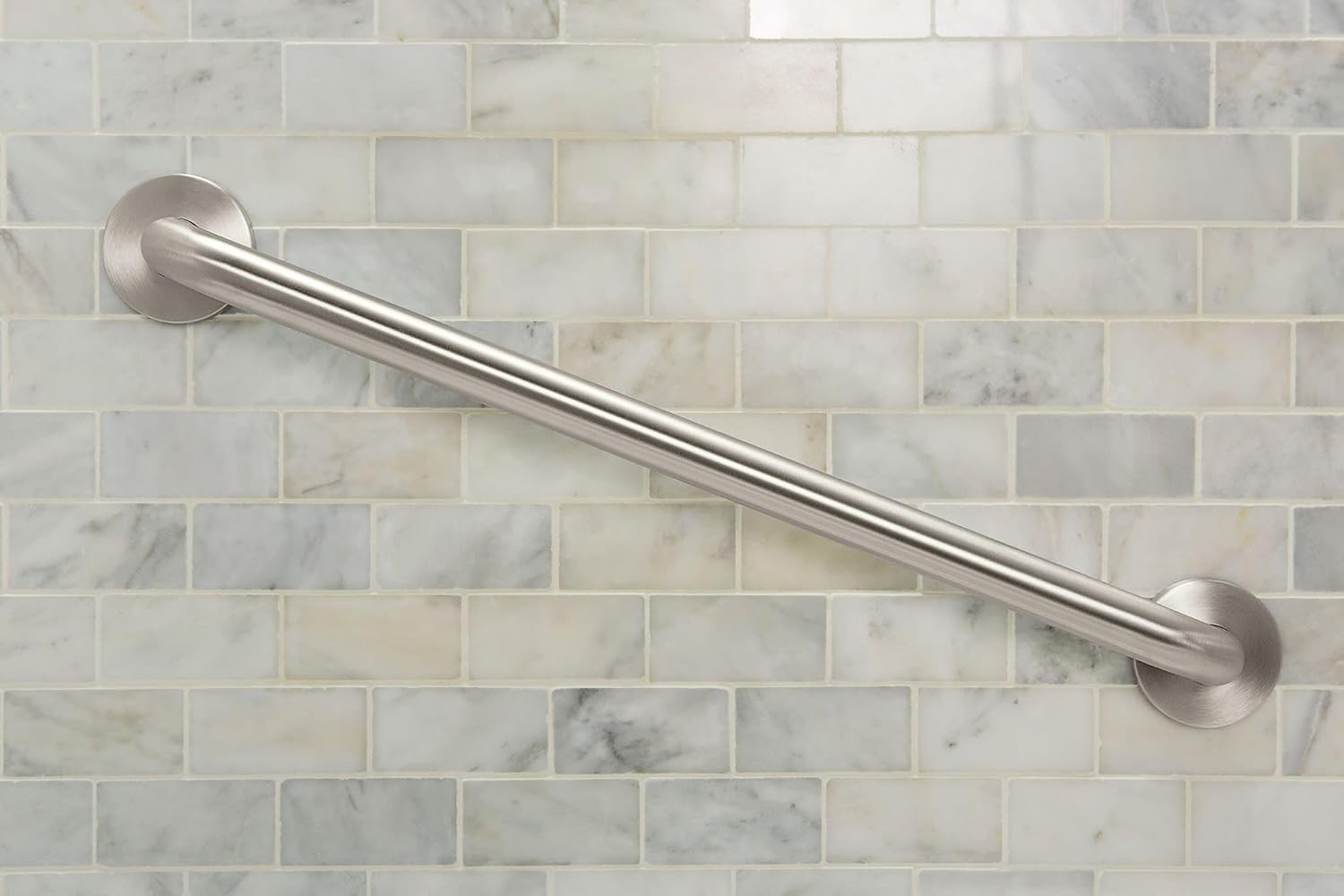
Placement usually decides whether the bar gets used. ADA puts horizontal grab bars 33 to 36 inches above the floor, and that band works well for most standing adults. Three positions cover almost every bathroom. A vertical bar just outside or just inside the entry gives something to hold while the foot crosses a tub wall or a curb, and vertical is the right orientation there because the hand can slide up or down to match the step. A horizontal bar on the long back wall supports side to side movement while washing. A short angled bar near the controls helps with the lean forward to reach a valve or a shelf.
Two placement mistakes come up again and again. The first is mounting the bar where the towel bar used to be, which is usually too high and too far from the water. The second is relying on the soap dish or the shower door frame as an informal handhold. Neither is anchored for load, and a glass door frame pulling out of the wall is a genuinely dangerous failure. If reaching the controls is part of the problem, a handheld shower head often removes the need to move around the stall in the first place.
Wall Structure, Studs, and Anchors
Behind the tile there is either wood framing, solid blocking installed for this purpose, or nothing structural at all. Finding out which one you have is the single most important step of the whole project, and it happens before any product is chosen. A magnetic or multi-sensor stud finder will read through tile on cement board in most cases, though thick mud beds and metal lath can confuse cheaper units.
When a stud does not land where the bar needs to go, the answer is a heavy-duty grab bar anchor rated for the load, not a plastic wall plug from the junk drawer. Moen sells SecureMount anchors separately for exactly this situation, and the listing’s capacity claim is written around them. Toggle style grab bar anchors from other makers do the same job. On a fiberglass or acrylic one-piece surround there may be no way to reach framing at all without opening the wall, which is the point at which a clamp-on rail or a professional installation becomes the sensible route.
One more practical note: drill tile with a carbide or diamond bit at low speed with no hammer action, and seal every penetration with silicone before the flange goes on. Water finding its way into a stud cavity through four unsealed screw holes is a slow and expensive problem.
Material, Finish, and Corrosion
A shower is a warm, wet, soapy environment, and hardware in it corrodes. Stainless steel, ideally 304 grade, is the default for good reason: it resists rust, it can be brushed or polished, and it holds up to daily contact with cleaning products. Every screw-in bar in this roundup is stainless. Brushed and satin finishes hide fingerprints and water spots better than a mirror polish, and they are slightly grippier when wet.
Avoid painted or powder-coated bars in a wet zone unless the coating is explicitly rated for it, because a chip in the coating starts rust underneath that spreads out of sight. For suction models, the failure point is not corrosion but the cup material itself, which hardens with age and heat. Plan on checking the seal before every use and replacing the bars long before the rubber looks tired. Keeping the enclosure clean helps everything last, and if hard water is leaving scale on your fixtures, a shower filter is worth a look.
Why You Should Trust Us
We build these roundups from live Amazon data rather than from press releases. Every product here was pulled from current search results, filtered to a minimum customer rating of 4.0 stars and a meaningful volume of verified customer ratings, then screened by hand to remove duplicate size and color variants so that seven genuinely different products remain rather than three products listed seven ways.
For a safety product, we hold ourselves to one extra rule: we repeat only the load figures the manufacturer publishes on the listing, we say so clearly when a listing publishes nothing, and we do not convert a marketing phrase such as heavy duty into an implied capacity. We have not physically loaded these bars to failure and we do not claim to have done so. What we can do is read every specification carefully, compare them against the published ADA requirements, and flag the gap between what a product looks like it can do and what its own maker says it can do. Nothing here is medical advice; if mobility or balance is changing, an occupational therapist can assess the specific bathroom and recommend placement.
Final Thoughts
The best overall choice is the Amazon Basics ADA compliant 36-inch stainless steel grab bar. It has the length to cover a whole alcove wall, the 1.25 inch diameter that hands actually close around, an explicit ADA compliance claim, and a published 500 pound capacity when anchored into a stud. It is the bar to buy if you are installing exactly one and want it to be the one that holds.
The best value is the Gotega stainless steel grab bar 2-pack in 16 inches. Two knurled bars with concealed screw flanges cover the entry point and the control wall in a single purchase, and the listing publishes a 500 pound pulling force figure. For a premium single bar, the Moen Home Care 24-inch model earns its place with concealed hardware, a matching accessory line, and a limited lifetime warranty, provided you buy the SecureMount anchors alongside it if no stud is available.
Among the no-drill options, the Vaunn Medical clamp-on bathtub rail is the one we would pick first, because a mechanical clamp on the tub wall with a published 300 pound figure is a fundamentally more solid arrangement than a vacuum seal. If you rent, travel, or simply cannot drill, the Safe-er-Grip, TAILI, and LEVERLOC suction bars all do a real job as balance handles on smooth glazed tile, as long as everyone using the bathroom understands that they are handholds and not fall protection. More comparisons like this one are in our articles archive.
Frequently Asked Questions
Do shower grab bars for seniors have to be screwed into a stud?
Any bar you intend to carry real weight does, or it needs a heavy-duty grab bar anchor specifically rated for the load. Every 500 pound claim in this roundup is written with that condition attached. Tile alone, drywall alone, and standard plastic wall plugs will not hold a bar under a falling adult. If framing cannot be reached, a clamp-on tub rail or a professionally installed backing plate is the safer answer.
Are suction grab bars safe for seniors?
They are safe for what they are sold as, which is balance assistance, and unsafe if anyone treats them as fall protection. The manufacturers are unusually direct about this: Safe-er-Grip states the bar is not to hold full body weight, and LEVERLOC pairs its 240 pound figure with the words balance assistance only. They also require a smooth, non-porous, airtight surface with no grout line under the cup. Used within those limits on the right tile, they are a genuine help. Used as a substitute for a bolted bar, they are a hazard.
How much weight should shower grab bars for seniors hold in 2026?
The benchmark has not changed: the 2010 ADA Standards call for the bar and the supporting wall to resist a 250 pound point load in any direction. Several screw-in bars in this roundup publish figures well above that, but the number only applies to the complete installation. The weakest link is almost always the anchor, not the steel.
What length grab bar works best in a shower?
If you install only one, a 36 inch horizontal bar on the back wall gives the most usable hold. Sixteen to eighteen inch bars are better mounted vertically at the entry, where the hand needs to slide up and down while stepping over a curb or tub wall. Twenty-four inch bars are a good compromise beside a bathtub. Many households end up with two bars in different orientations, which is why the two-packs in this list are popular.
Can grab bars be installed on a fiberglass shower surround?
Sometimes, but not casually. A one-piece fiberglass or acrylic surround flexes, and there is often an air gap between the shell and the framing, so a screw driven into the shell alone will pull straight out. The correct approach is to locate framing behind the shell and use fasteners long enough to reach it, or to add a backing plate. Suction cups do not work on fiberglass at all. Browse our full category index for related home safety and bathroom upgrades.




Write Your Review
No reviews yet. Be the first to share your experience!