

A cordless water flosser is the version of this tool most people can actually live with, because it fits a small bathroom, travels, and does not need a socket beside the sink. The trade is that everything happens in a handheld body: the tank is smaller, the battery has to last, and the pressure has to be generated without a countertop motor. We compared 10 cordless water flosser models from Waterpik, AquaSonic, H2ofloss and more on tank capacity, pressure settings, nozzle selection and battery type, updated for August 2026.
Our top pick is the COSLUS C20 for its larger three hundred millilitre tank and its acceptance by the American Dental Association, which is the only credibility marker in this category that is independently checked. The rest of the list splits by what you need it for, and the guide underneath explains which specification decides it. More bathroom and personal care comparisons sit in our health and household section.
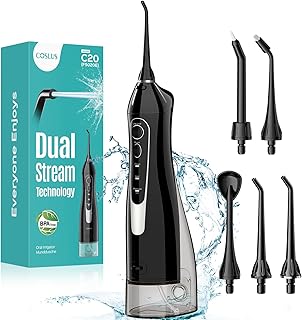
Pros
- Three hundred millilitre tank finishes a full mouth without refilling
- Carries American Dental Association acceptance, which is independently reviewed
- Multiple pressure modes so you can start gentle and build up
- Sealed body suits use at the basin or in the shower
Cons
- Larger tank makes the handset taller and heavier to hold at the back molars
- Bulkier in a travel bag than the compact models here
The reason this is the pick is unglamorous: the tank is big enough. A three hundred millilitre reservoir gets you around the whole mouth on a medium setting without stopping to refill, and stopping to refill is the friction that makes people abandon water flossing in the first fortnight.
The second reason is the acceptance mark. American Dental Association acceptance is granted after the association reviews evidence, so it is a claim with a gatekeeper, unlike the dentist recommended language that appears on almost everything in this category.
In daily use the multiple pressure modes matter more than any peak figure. Unaccustomed gums bleed on high pressure, and a genuinely soft setting is what lets you build up over a few weeks rather than giving up after three days.
The cost of the big tank is size. It is a taller handset than the compact models, which you notice when reaching behind the back teeth, and it takes up more room if it lives in a wash bag.
Bottom line: the model that solves the most common reason people quit, with an independently checked credential behind it.
- Type: cordless handheld irrigator
- Tank: 300 ml, detachable
- Credential: ADA Accepted
- Power: rechargeable
- Modes: multiple pressure settings including gentle
- Body: waterproof for basin and shower use
Buy this if you have braces, bridgework or implants and your sessions run long, or if a small tank has already put you off this kind of device. Skip it if the unit is mainly for travel and pack size is the priority, where a slimmer handset is easier to live with.
Empty the tank after every session and leave it open to dry, since warm water in a sealed plastic tank in a humid bathroom is how mould starts. In a hard water area, run diluted white vinegar through the unit every month or two, then a tank of clean water, because scale narrows the jet and looks exactly like a fading battery.

Pros
- From the brand that defined the category, with wide dental familiarity
- Compact handset that is comfortable at the back teeth
- Four tips supplied, enough for shared or specialised use
- Two settings keep operation simple
Cons
- Smaller tank than the large capacity models, so a thorough pass can need a refill
- Only two pressure steps, which is limiting if your gums need a slow build up
Waterpik is the name most dentists say out loud, and the Pearl is its compact cordless everyday model. The practical benefit of buying the category leader is not mystique, it is that replacement tips are easy to find for years, which is what determines whether a handset stays useful.
Two settings is a deliberate simplification. For a healthy mouth, soft and normal is genuinely all you need, and fewer choices means fewer excuses not to use it.
The compact body is the real advantage over the bigger tank units here. It is easier to angle behind the back molars and easier to store upright in a cup or drawer.
The trade is capacity. A smaller reservoir means a careful pass around a full mouth may need topping up, which is exactly the friction the larger tank models remove.
Bottom line: the safe compact choice, and the one to buy if long term tip availability matters to you.
- Type: cordless handheld irrigator
- Power: rechargeable
- Settings: 2 pressure levels
- Tips: 4 included
- Use: daily gum health
- Form: compact handset
For someone with a healthy mouth who wants a straightforward daily device from a brand their dentist will recognise. Less suitable if your gums are inflamed and you need many small pressure steps, or if you want to finish a long session without refilling.
When comparing cordless units, check tip availability as seriously as you check specifications, because tips wear out every few months and an orphaned handset is worthless. Then compare tank capacity against how long you spend, and count pressure steps rather than reading the maximum pressure figure.

Pros
- Three pressure settings give a usable middle step
- Travel bag included, so the maker expected it to move around
- Four tips cover shared use or a specialised nozzle
- Long standing model with widely stocked replacements
Cons
- Tank capacity still limits a very thorough single pass
- Bulkier than the compact Pearl once the bag is packed
This is the Waterpik cordless model to pick if you travel with it. The travel bag sounds like a throwaway inclusion and is not: a handset rattling loose in a suitcase switches itself on and leaks, and a bag solves both.
The third pressure setting is the other reason to choose this over the compact model. Two settings is soft and normal, three gives you a middle step, and that middle step is where most people settle once their gums have adapted.
Everything else follows the brand pattern: four tips in the box, a sensible charging routine that covers a week or more of daily use, and replacement tips you can still buy in a few years.
The limit is the same one every cordless model faces. The reservoir is smaller than a countertop unit, so a slow, careful pass can want a refill.
Bottom line: the travelling version of a proven design, and the better Waterpik pick if you want a mid pressure step.
- Type: cordless handheld irrigator
- Power: rechargeable
- Settings: 3 pressure levels
- Tips: 4 included
- Extras: travel bag
- Use: daily gum health, travel
For regular travellers, and for anyone who found a two setting device either too gentle or too harsh with nothing in between. Not the choice if pack size is critical, where the compact model is easier to carry.
Fill with warm water rather than cold, which is noticeably more comfortable on sensitive teeth. Lean over the basin with your mouth slightly open so water runs out instead of pooling, and trace the gum line rather than aiming straight into the gum. Charge fully before a trip, since a week of daily use per charge is the normal expectation.

Pros
- Five intensity steps, which is more graduation than most simple units offer
- IPX7 rating means it tolerates immersion and shower use
- Three modes including a gentler option for new users
- Covers the important specifications without paying for a brand name
Cons
- Replacement tip availability is less certain than with the established brands
- Tank is modest, so a slow pass may need a refill
This is the value pick because it does not skip the specifications that actually matter. Five intensity steps means you can start gentle and move up gradually, which is the single most important feature for anyone whose gums bleed in the first week.
The IPX7 rating is the other genuinely useful item. It means the handset tolerates immersion, so using it in the shower is fine, and the shower is the tidiest place to use a water flosser.
Build quality is entry level and honest about it. The plastics feel lighter than the established brands and the tank seal is less reassuring, but nothing here is missing that would stop it cleaning properly.
The thing to weigh is longevity. Tips wear out every few months, and with a less established brand there is more risk that replacements become hard to find in a couple of years.
Bottom line: the most specification for the least money here, with tip supply as the open question.
- Type: cordless handheld irrigator
- Modes: 3
- Intensity levels: 5
- Water resistance: IPX7
- Power: rechargeable
- Tank: detachable
For a first water flosser, and for anyone who needs many small pressure steps without paying premium prices. Less suitable if you want certainty that replacement tips will still be on sale in several years.
At the entry level, compare intensity steps and water resistance first, since those two decide comfort and where you can use the device. Ignore peak pressure claims, which are rarely comparable between brands, and check what tips are in the box against what you actually need rather than counting duplicates.

Pros
- Eleven pressure steps allow a genuinely slow build up
- Four modes cover normal, soft and pulse style cleaning
- IPX7 body suits shower use and rinsing under the tap
- Useful for inflamed gums that will tolerate more later
Cons
- Eleven steps is more granularity than a healthy mouth needs
- More settings means more menu to work through each session
Eleven pressure settings looks like a spec sheet arms race and is actually the most useful thing about this unit for one specific group: people whose gums are inflamed today. Being able to nudge pressure up one small step at a time, week by week, is how you get from bleeding to comfortable cleaning without quitting.
The four modes add a soft option and a pulse style setting, which stimulates the gum line rather than blasting debris. That is a comfort feature, and comfort is what determines whether the device gets used.
The IPX7 body means you can use it in the shower and rinse it properly, which keeps the mess out of the equation entirely.
For a healthy mouth, all this granularity is surplus. You will find your setting in the first week and never move it, in which case a simpler two or three setting unit is less to think about.
Bottom line: the pick for sensitive or recovering gums, and overkill for anyone else.
- Type: cordless handheld irrigator
- Pressure settings: 11
- Modes: 4
- Water resistance: IPX7
- Power: rechargeable
- Tank: detachable
For anyone starting with inflamed or bleeding gums, or recovering from dental work, who needs to raise pressure in small increments. Not the best pick for a healthy mouth that will settle on one setting immediately.
Start on the lowest step for the first week even if it feels ineffective, then raise it one step every few days. Aim along the gum line at a right angle to the tooth rather than directly into the gum pocket. If bleeding continues past a couple of weeks of gentle use, that is a reason to speak to a dentist rather than to increase pressure.

Pros
- Three hundred millilitre tank completes a long session without refilling
- Custom mode lets each user store a preferred pressure
- Four modes cover gentle through to thorough cleaning
- Suits a family sharing one device with separate tips
Cons
- Tall handset is less comfortable at the back molars than compact models
- Custom mode is a convenience rather than a cleaning improvement
The C30 takes the large tank formula and adds a custom mode, which is aimed squarely at households where two or three people use the same handset. Each user having a stored preference removes the small daily annoyance of resetting the pressure.
The three hundred millilitre reservoir does the same job it does on the C20: a full careful pass without a refill, which is what makes this a habit rather than a chore.
Four modes is the right number. There is a genuinely soft setting for someone starting out and a stronger one for an established user, and the two do not need to compromise on the same device.
The handset is tall, as any large tank model must be, and that is felt when reaching around back teeth. For shared use it is a fair trade, since the alternative is refilling between two people.
Bottom line: the family pick, and the one to choose when several people share one flosser at different pressures.
- Type: cordless handheld irrigator
- Tank: 300 ml
- Modes: 4 including a custom setting
- Power: rechargeable
- Body: waterproof
- Tank: detachable for filling and drying
For a household sharing one handset where people want different pressures, and for anyone whose sessions run long. Less suitable for a single user who wants the smallest possible device for travel.
Give every user their own tip and rinse the tank after each session rather than at the end of the day. Leave the tank open to dry, and in a hard water area flush the unit with diluted white vinegar periodically, since a shared device runs more cycles and scales up faster.

Pros
- Aimed at braces users, which is where these tools help most
- Portable format designed to travel
- Rechargeable, so no consumables to carry
- Straightforward operation with few settings to learn
Cons
- Braces cleaning depends on the tip supplied, so check the nozzle selection
- Smaller tank means a refill during a thorough orthodontic session
Braces are the clearest case for owning a water flosser at all, because string floss around brackets and wires is genuinely difficult and a jet of water is not. This model is built around that use, and it is the reason to consider it.
The portability is the second half of the pitch. Orthodontic patients tend to need to clean after meals rather than only at home, so a handset that travels is more useful than a better one that stays in the bathroom.
What decides whether it works for you is the tip. An orthodontic nozzle with a tapered brush clears around brackets far better than a plain jet tip, so check what is in the box and what replacements are available.
The tank is modest, which matters here more than usual: cleaning a full set of brackets carefully takes longer than a normal pass, and that is exactly when a small reservoir runs dry.
Bottom line: a sensible braces and travel pick, with the nozzle selection as the thing to verify before buying.
- Type: cordless handheld irrigator
- Power: rechargeable
- Focus: braces and orthodontic cleaning
- Form: portable travel body
- Tank: detachable
- Settings: multiple pressure options
For anyone in braces or a retainer who needs to clean away from home, and for travellers who want a simple device. Less suitable as a household's main unit if sessions are long, where a larger tank saves refilling.
With brackets, work along the wire and pause at each bracket rather than sweeping quickly across the arch. Use a moderate pressure setting instead of the highest, because force does not remove what a tapered tip reaches better. Clean after meals where you can, since trapped food around brackets is the actual problem.
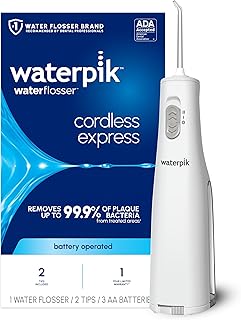
Pros
- Runs on AA cells, so there is no charger to pack or forget
- Ready to use after weeks in a bag, unlike a discharged rechargeable
- Simple two setting operation
- Brand with easy to find replacement tips
Cons
- Pressure fades as the cells drain, so cleaning weakens before it stops
- Batteries are an ongoing consumable
- Only two tips supplied
Battery power looks like a step backwards and solves a real problem. A rechargeable handset that has sat in a wash bag for a month is flat when you need it, whereas this one works as soon as you put fresh cells in, with no cable to have remembered.
That makes it the natural second unit: countertop or rechargeable at home, this in the travel bag. It also suits anyone who uses a flosser occasionally rather than daily, where keeping a rechargeable topped up is its own small chore.
Two settings and two tips is a deliberately basic package, and for occasional use that is enough. The Waterpik name matters here mainly because replacement tips remain easy to buy.
The honest weakness is the power curve. As the cells drain, pressure drops, and the clean gets quietly worse before you think to change them. Keep a spare set with the unit.
Bottom line: the travel and spare pick, and the answer for anyone tired of finding a dead handset.
- Type: cordless handheld irrigator
- Power: 3 AA batteries
- Settings: 2 pressure levels
- Tips: 2 included
- Use: travel and occasional use
- Charging: none required
Choose battery power when the device will sit unused for stretches, and rechargeable when it is used every day. If you buy this, buy cells at the same time and keep a spare set with the unit, because a fading clean caused by tired batteries is easy to mistake for a failing pump.
Change the batteries as soon as pressure feels weaker rather than waiting for the unit to stall, since a weak jet is doing much less work. Empty the tank before packing so nothing leaks in a bag, and pack the tips separately so the filaments are not crushed.

Pros
- Six tips supplied, enough for a family with one tip each
- Five modes cover gentle through to thorough
- Rechargeable cordless handset
- Good spread of nozzle options for different needs
Cons
- Count how many of the six tips are genuinely different rather than duplicates
- Modest tank capacity for a shared device
Six tips is the headline, and it is genuinely useful in the right household: one handset, one tip per person, no arguments and no hygiene problem. That is the practical way a family shares this kind of device.
Five modes gives a soft setting for a new user and stronger options for someone established, so two people at different stages can use the same unit without compromising.
The thing to check is what those six tips actually are. A set of colour coded standard tips serves a family, while a set including an orthodontic and a soft filament tip serves one person with specific needs. Both are worth having, and they are not the same purchase.
Tank capacity is the constraint on any shared cordless unit, since several passes back to back means several refills.
Bottom line: a good family choice for the tip count, provided you confirm the tips match your needs.
- Type: cordless handheld irrigator
- Modes: 5
- Tips: 6 replaceable
- Power: rechargeable
- Tank: detachable
- Use: shared household cleaning
For a household where several people will share one handset and each needs their own tip. Less suitable for a single user, who is paying for tips that will sit in a drawer.
Label or colour code tips per person and rinse each one after use. Empty and dry the tank between users rather than leaving standing water, and replace tips every few months once filaments splay, since a worn tip cleans noticeably worse than a new one.

Pros
- Waterproof body, so shower use and rinsing are fine
- Rechargeable with a portable handset
- Simple operation with few controls to learn
- From a brand focused on oral care products
Cons
- Fewer pressure steps than the models built for sensitive gums
- Tip selection is narrower than the family oriented sets here
This is the plain, get on with it option. A waterproof rechargeable handset, a detachable tank, and controls simple enough that nobody in the house needs instructions.
Waterproofing is the feature worth paying attention to. Using a water flosser in the shower removes the mess problem completely, and a body you can rinse under the tap stays cleaner over months of use.
What it does not offer is granularity. If your gums are inflamed and you need to raise pressure in small increments over weeks, the units with many steps are a better fit for that specific journey.
For an established user with a healthy mouth, none of that matters. You find your setting, you use it nightly, and the simplicity becomes the feature.
Bottom line: a competent, simple daily unit, and a reasonable pick if you want fewer decisions rather than more settings.
- Type: cordless handheld irrigator
- Power: rechargeable
- Body: waterproof
- Tank: detachable
- Form: portable handset
- Use: daily oral care
For an established user with a healthy mouth who wants a simple waterproof device, and for anyone who prefers to use it in the shower. Not the pick for recovering gums that need many small pressure steps.
Simplicity is a legitimate specification, so do not assume more modes is better. Decide first whether you need graduated pressure, then compare waterproof rating and tank size, and check tip availability last, because that is what determines how long the handset stays useful.
How to Choose Cordless Water Flosser
Tank Size Decides Whether You Finish in One Go
This is the specification that separates a tool you keep using from one that annoys you into giving up. Cordless tanks in this class run from roughly one hundred and fifty millilitres to three hundred, and a full pass around the mouth on a medium setting empties a small tank before you are done. Refilling mid session, with a wet handset and toothpaste in your mouth, is exactly the friction that kills a new habit.
Bigger tanks cost you bulk. A three hundred millilitre reservoir makes the handset taller and heavier, which is noticeable when you are reaching behind back molars, and it takes more room in a travel bag. That is a real trade rather than a marketing one.
The practical answer for most people is the largest tank you can hold comfortably. If you have braces or bridgework and spend longer on each session, treat tank size as the first filter rather than a nice extra, because those are the users who empty a small reservoir fastest.
Pressure Settings Matter More Than Maximum Pressure

Listings compete on top pressure, and top pressure is rarely the number that matters. What you need is a low setting gentle enough to use in the first week without your gums bleeding, and a usable middle setting for daily work. Nobody who starts on maximum keeps flossing this way.
Count the steps rather than reading the ceiling. A model with two settings gives you soft and normal, which is enough for a healthy mouth. Eleven steps sounds excessive and is genuinely useful if your gums are inflamed now and will tolerate more in a month, because you can move up gradually rather than jumping.
A pulse or massage mode is worth having and worth understanding: it alternates pressure to stimulate the gum line rather than blasting debris, so it is a comfort feature rather than a cleaning one. Start on the softest mode for a week, then work up until cleaning feels thorough without stinging.
ADA Acceptance Versus Dentist Approved Language

There is one credibility claim in this category that means something specific. The American Dental Association Seal of Acceptance is granted after the association reviews evidence that a product is safe and does what it claims, and a manufacturer cannot simply print it. When a listing says ADA Accepted, that is a checkable statement.
Everything else in this space is looser. Dentist recommended, clinically proven and dental grade are phrases with no gatekeeper, and they appear on products that have never been assessed by anyone outside the company. That does not make those products bad, it makes the claim uninformative.
Treat acceptance as a tiebreaker rather than a requirement. Plenty of unaccepted models here clean perfectly well, but when two units look similar on paper and one has been independently reviewed, that is a reasonable way to break the tie.
Rechargeable or AA Batteries
Most models here are rechargeable, usually over USB, and a full charge typically covers a week or more of daily use. That is the convenient path: no consumables, and a charge that outlasts a short trip. The catch is that a rechargeable cell is the part that eventually ends the product’s life, and it is not user replaceable in a sealed handset.
Battery powered models running on AA cells look old fashioned and solve a real problem. There is no charging cable to forget, no charge to plan around, and a dead unit is fixed in the time it takes to open a pack of batteries. For occasional travel use, or as a spare, that is genuinely better.
The compromise with AA power is that pressure tends to fade as the cells drain, and running costs continue forever. Buy rechargeable for daily home use, and consider AA if the unit will sit in a bag for weeks between uses.
Nozzles, Braces and Who Needs Which Tip
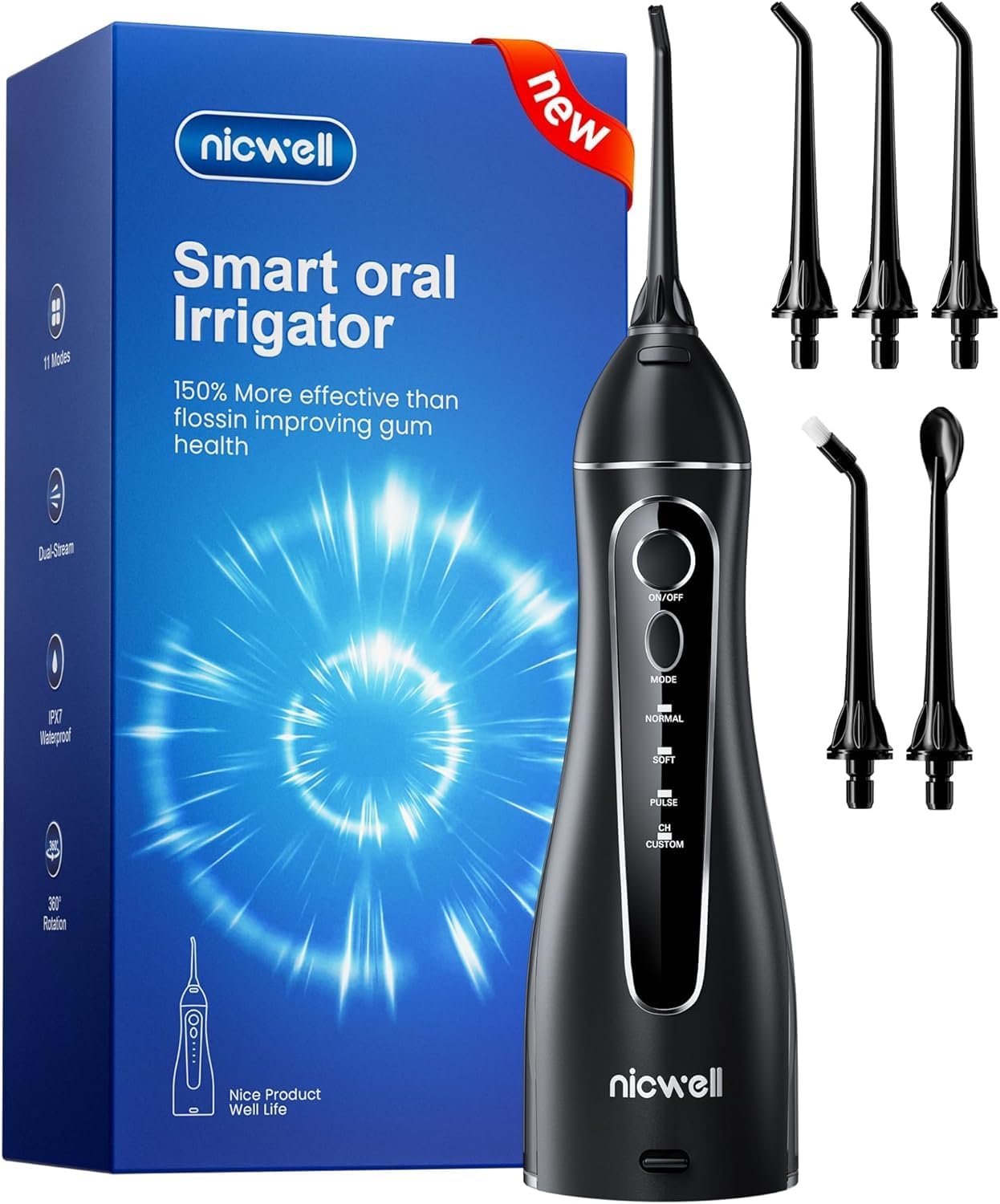
The standard jet tip suits most mouths, and the extras are where a model earns its place for specific users. An orthodontic tip has a tapered brush that clears around brackets and wires, which is the single strongest reason to own one of these tools at all. A periodontal or plaque seeker tip has a soft filament for deeper pockets and around implants and crowns.
Count the tips that are actually different rather than the number in the box. Four identical standard tips is a family pack, not a feature set, and a listing that advertises a high tip count is often counting colour coded duplicates for shared use. Both are useful, but they answer different questions.
Tips wear. The filaments splay and the jet opening distorts, so plan on replacing them every few months, and check that replacements for the model you buy are easy to find before you commit. That is a bigger long term consideration than any spec on the front of the box.
Waterproofing and Where You Will Actually Use It
An IPX7 rating means the handset tolerates immersion, which in practice means you can use it in the shower and rinse it under the tap without worrying. That matters more than it sounds, because the tidiest way to use a water flosser is standing in the shower where the mess does not matter.
The alternative is leaning over a sink with your mouth slightly open, letting water run out rather than swallowing it. It works, it is just less pleasant, and it is the reason a lot of these devices end up in a cupboard.
If you travel with it, look for a tank that seals and a body that does not switch itself on in a bag. A travel case or bag included in the box tells you the maker expected the product to move around. Our article archive has more on kit that has to survive a suitcase.
What a Cordless Model Gives Up to a Countertop One
It is worth being clear about the trade you are making, because the cordless format is a compromise and the compromise is fine. A countertop unit draws from a reservoir several times larger, runs from mains power so pressure never sags, and can hold a higher sustained output. If your bathroom has a free socket and space beside the basin, that is the more capable tool.
What the cordless format buys is the thing that actually determines whether you use it: convenience. No cable across the counter, no permanent footprint, and it can live in a drawer. A device you reach for every night beats a better device you find annoying to set up.
The practical middle ground, if you have both the space and the travel need, is a countertop unit at home and a cheap cordless one in the wash bag. That is a common setup among people who have used these tools for years, rather than a compromise either way.
Cleaning the Unit and Living With Hard Water
These devices hold warm water in a sealed plastic tank in a humid room, which is exactly the condition mould likes. Empty the tank after every session and leave it open to dry rather than clicking it shut wet. That single habit does more for the life of the unit than anything on the spec sheet.
If you live with hard water, scale builds up inside the pump and the jet narrows, which shows up as weaker pressure that people mistake for a failing battery. Running a diluted white vinegar solution through the unit every month or two clears it, followed by a tank of clean water to flush the line.
Tips need replacing every few months as filaments splay and the jet opening distorts. Before buying, check that replacement tips for that specific model are easy to find, because a cheap handset with no available spares becomes disposable in a year.
| Your situation | What to prioritise | Why |
|---|---|---|
| Braces or retainers | Orthodontic tip, larger tank | Longer sessions and brackets need a tapered brush tip |
| Sensitive or bleeding gums | Many pressure steps, soft mode | You need to start gentle and build up over weeks |
| Implants, crowns or bridges | Soft filament tip, mid pressure | Cleans around fixtures without stressing the margin |
| Travelling regularly | Sealed tank, case, or AA power | No charger to pack and nothing leaking in a bag |
| Shared family use | Multiple colour coded tips | One handset, one tip per person |
| Small bathroom, no free socket | Cordless with USB charging | Charges anywhere, stores upright in a cup |
Why You Should Trust Us
We build these lists from published specification and from the pattern of what long term owners report. For each model here we looked at stated tank capacity, the number of pressure steps rather than the peak figure, which nozzle types come in the box, battery type and charging method, the waterproof rating, and whether the product carries independently checked acceptance rather than in house marketing language.
We set aside listings that were the same unit in a different colour, so every entry is a genuinely different model. Where a brand appears more than once, the models differ in the way that matters here: tank size, power source, or the modes on offer.
Final Thoughts
Best overall is the COSLUS C20. The three hundred millilitre tank means a full pass without refilling, which is the difference between a habit and an abandoned gadget, and it is one of the few units here with American Dental Association acceptance behind it rather than a self awarded claim.
Best value is the Bitvae cordless flosser, which gives you three modes, five intensities and an IPX7 body, covering the specifications that matter for a first purchase. If you would rather buy the brand that defined the category, the Waterpik Cordless Pearl is the compact choice and the Waterpik Cordless Advanced adds a third setting and a travel bag.
For specific needs: the Nicwell with eleven pressure steps suits gums that need a slow build up, the COSLUS C30 adds a custom mode for a household sharing one handset, the Oralfree is aimed squarely at braces and travel, the Waterpik Cordless Express runs on AA batteries so nothing needs charging, and the H2ofloss and AquaSonic units cover five and six tip selections for families. Browse the rest of our comparisons through the category index.
Cordless Water Flosser FAQs
Does a cordless water flosser replace flossing in 2026?
Not entirely for most people. A water jet is very good at flushing debris and reaching places string cannot, which is why it is recommended so often for braces, bridges and implants, but string floss still scrapes the flat surfaces where plaque sticks. Dentists generally treat the two as complementary. If a water flosser is the only method you will use consistently, it is far better than the flossing you were not doing.
How much pressure do cordless water flosser need?
Less than the maximum on the dial. Start on the softest setting for the first week, because unaccustomed gums bleed and that puts people off permanently. Work up until the clean feels thorough without stinging, which for most healthy mouths lands in the middle of the range. High pressure is not more hygienic, and on inflamed gums it is counterproductive.
How long does the battery last on a cordless model?
Rechargeable models in this class typically cover a week or more of daily sessions per charge, which comfortably survives a short trip. Units running on AA cells last a similar span but tend to lose pressure as the cells drain, so the clean weakens before the unit stops. Charge fully before travelling either way, and expect the rechargeable cell rather than the pump to be what eventually ends the product’s life.
Can I put mouthwash in a cordless water flosser?
Diluted, and only if the maker allows it. Undiluted mouthwash and anything containing essential oils can degrade seals and internal parts, and it leaves residue that gums up the pump. If you do use it, run clean warm water through afterwards to flush the line. Warm water on its own is what most people should use daily, and it is noticeably more comfortable than cold.
Are cordless water flosser safe for braces and implants?
Yes, and those are the cases where they help most, provided you use the right tip and a moderate setting. An orthodontic tip clears around brackets and wires, while a soft filament tip is designed for implants, crowns and deeper pockets. Aim across the gum line rather than straight into it, and if you have recent dental work, ask the practice which setting they want you on before starting. More care guidance is in our health and household section.
Write Your Review
No reviews yet. Be the first to share your experience!