

Glare is the one problem an ordinary swim goggle cannot solve. Push off in an outdoor pool at noon, or start a lake swim in late morning, and the surface turns into a sheet of white light that hides the lane rope, the turn buoy, and the swimmer breathing beside you. A polarized lens attacks that light at its source by filtering out the horizontally aligned rays that bounce off flat water, which is why it behaves nothing like a plain dark tint. We pulled together 9 polarized swim goggles from Speedo, Arena, Aegend and more, ranked them by how they handle bright open air rather than by how they feel on a pool deck, and leaned on verified customer ratings instead of marketing copy. Our top pick is the ZIONOR G1 Polarized Swim Goggles for its true polarizing film paired with a wide, low distortion field of view.
This guide is organized around light and lens coatings, not around general fit advice. That means the questions we work through are the ones that decide whether a lens helps you outdoors: how polarization differs from a mirror finish, which tint suits which hour of the day, where the polarizing film sits in the coating stack, and how quickly that stack wears out in chlorine and salt. It also means being honest about the cases where polarization hurts. If you swim indoors under artificial light, or you pace yourself off the black line at the bottom of the pool, a polarized lens can work against you. Everything below comes out of our August 2026 sweep of swimming and outdoor training gear.

Pros
- True polarizing film rather than a mirror finish standing in for one
- Curved lens opens up peripheral vision for sighting
- Soft silicone gasket stays comfortable through long outdoor sessions
- Split strap holds position in chop and on turns
- Sold in several lens treatments for different light
Cons
- Dark polarized versions are too heavy for indoor lanes
- Wider profile catches more water at speed than a racing lens
The ZIONOR G1 is the model most outdoor swimmers land on when they go looking for polarization rather than a dark tint, and it earns that position honestly. The polarized lens option carries a real polarizing layer, so the sheen coming off a flat lake or a still outdoor pool drops away instead of the whole scene simply going dim. Contrast rises at the same time brightness falls, which is exactly the effect you are paying for.
The lens shape is the second reason it works outdoors. It is curved rather than flat, so peripheral vision opens up and you can pick up a buoy or a swimmer at your shoulder without lifting your head. Sighting strokes cost rhythm, and a goggle that lets you gather more per look is worth more than a sharper flat lens in this context. The soft silicone gasket spreads pressure widely, which matters once sessions run past the half hour mark.
The compromises are the ones any wide outdoor goggle carries. The profile sits further off the face than a racing lens, so it drags a little more at speed, and the darker polarized variants are the wrong tool under a roof or at dusk. It is also worth reading the variant label carefully, since the same shell is sold with mirrored and clear lenses that are not polarized at all.
Bottom line: for a swimmer whose problem is glare on open or outdoor water, this is the pick that needs the least qualification, provided you order the polarized variant and keep a lighter pair for indoor lanes.
- Lens: curved wide view, polarized option within the range
- UV: rated to block ultraviolet to 400 nanometers
- Anti-fog: coating applied to the inner lens surface
- Gasket: soft silicone
- Strap: adjustable split strap
- Fit: adult unisex
- Lens treatments offered: polarized, mirrored, clear
Best suited to swimmers who split their time between an outdoor pool and open water, and who want one pair that handles bright afternoons without going so dark it becomes useless in cloud. Triathletes and lake swimmers get the most from the curved lens, since sighting is where the wide field pays for itself.
It is a poor match for anyone training mainly indoors, or for a swimmer who paces strictly off the black line, since polarization softens that line by removing the surface reflection that makes it read sharply.
Rinse in cool fresh water after every swim and shake the water out rather than wiping the inside. The polarizing layer is durable, but the anti-fog coating on the inner face is not, and rubbing it dry is the fastest way to lose it.
Air dry fully before storing, keep the goggle out of a hot car since heat separates laminated lens layers over time, and use a hard case rather than letting the outer surface grind against gear in a kit bag.
Pros
- Polarized lens aimed squarely at surface glare
- Generous field of view for sighting on open water
- Soft silicone seal suited to longer sessions
- Anti-fog inner coating and UV blocking as standard
Cons
- Wide frame is more profile than a pool racing swimmer wants
- Darker lens finishes leave little margin on cloudy days
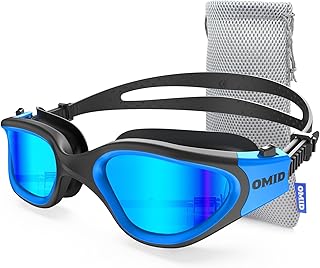
The OMID P2 makes the clearest case of any pair here for open water specifically. Its lens is shaped to gather as much of the scene as possible per sighting stroke, and when it is paired with the polarizing filter the result is a view where buoys and swimmers separate from the water instead of dissolving into a bright sheet. That combination of wide geometry and glare rejection is what open water swimming actually asks for.
Comfort holds up over distance thanks to a soft silicone gasket that spreads load across a broad contact area rather than pressing into a narrow ring around the eye socket. The inner anti-fog coating is conventional but effective, and it needs the same care as every other coated lens: rinse, shake, air dry, never wipe.
The trade offs follow from the shape. A wide frame sits further from the face and catches more water at pace, so pool swimmers chasing turn speed will find it bulkier than a low profile racing goggle. The darker lens finishes are also very much daylight tools and leave you short of light once the sky clouds over.
Bottom line: if your swimming is mostly open water and sighting is the thing that costs you time, this is the most focused pick on the list.
- Lens: polarized, wide curved profile
- UV: full ultraviolet blocking rating
- Anti-fog: inner surface coating
- Gasket: soft silicone
- Strap: adjustable, quick release style
- Fit: adult unisex
Sighting is a cost you pay in rhythm every time you lift your head, so the useful measure of an open water lens is how much information you collect per look. The wide curved lens here is built for that, and the polarizing filter removes the surface sheen that would otherwise hide the very landmark you lifted your head to find.
In choppy water, a seal that holds position matters as much as optics. Set the strap so the goggle sits firm without pressure on the eye socket, and check the seal again after the first few hundred metres once the silicone has warmed.
Fit the goggle dry before entering the water, then press gently to seat the gasket without creating suction. Suction is a sign the strap is too tight, and it leaves marks without improving the seal.
On bright days, the polarized lens is at its best when the sun is high and the water is flat. In early morning haze or under cloud, an amber tinted lens will serve you better than a dark polarized one.

Pros
- Mirror coating cuts raw brightness under a strong sky
- Low profile lens sits close to the eye with minimal distortion
- Interchangeable nose pieces cover a range of face widths
- A long standing fixture on outdoor pool decks
Cons
- Mirrored is not polarized, so surface sheen off flat water remains
- Narrow field of view limits peripheral awareness in open water
The mirrored Vanquisher is the answer to a different question than the polarized picks above it, and knowing which question you are asking is the whole point of this guide. A mirror coating reflects a share of all incoming light back off the lens surface before it enters, so it lowers total brightness without caring which direction that light was vibrating in. Under a punishing sky in an outdoor pool, that is often exactly what you need.
Physically it is a classic low profile design. The lens sits close to the eye, distortion is minimal, and the shape moves through water cleanly, which is why it has stayed on outdoor decks for so long. Several nose bridge sizes come in the box, so the gap between the lenses can be matched to your face rather than accepted as given.
What it does not do is remove the horizontal sheen bouncing off a flat surface. On a still lake at midday that sheen is the main obstacle, and a mirror finish will dim it along with everything else rather than filtering it out. The narrow field is also a real limit once you need to sight rather than follow a lane.
Bottom line: an excellent bright lane goggle and a poor substitute for polarization, so choose it when the sky is the problem and not the water surface.
- Lens: mirrored coating, low profile shape
- Polarized: no, mirror finish only
- UV: ultraviolet protection rated for outdoor use
- Anti-fog: treated inner lens
- Nose bridge: interchangeable pieces supplied
- Strap: adjustable split strap
Pick this when your outdoor swimming happens in a pool rather than open water, and when the complaint you are trying to fix is raw brightness. Mirror coatings excel at that job and cost less than a comparable polarized lens.
If you have been squinting at a sheet of white light on flat water, the mirror finish will not fix it. That is the specific failure a polarizing filter addresses, and it is worth paying for when open water is where you swim.
Mirror coatings live on the outside of the lens, which means they are exposed to sand, salt crystals, and the inside of a kit bag. Rinse after every swim and store in a case, since scratching the outer coating is what ages this style of goggle fastest.
Leave the inner surface alone when drying. The anti-fog layer there is the fragile part, and wiping it away turns a good lens into one that mists on every session.

Pros
- Swipe activated anti-fog system is rechargeable by hand
- Hard polycarbonate lens keeps optics sharp
- Low drag racing profile
- Mirrored options handle very bright outdoor light
Cons
- Mirror finish is not a polarizing filter
- Firm racing gasket suits shorter efforts more than long swims
The Cobra Ultra Swipe is a racing goggle first, and its headline feature addresses the single most annoying failure mode of coated lenses. The swipe anti-fog system lets you reactivate the inner treatment by hand during a session instead of watching it fade permanently, which changes the economics of a goggle you use outdoors several times a week.
Optically it is built around a hard polycarbonate lens rather than a soft one, and the difference shows in how clean the view stays over time. The profile is low and the shape is fast, so it suits swimmers who care about turn speed and drag. Mirrored lens options bring the intensity down when the sky is strong.
What it is not is a polarized lens. The mirror finish reduces total light without targeting the horizontal sheen coming off flat water, so open water swimmers fighting surface glare will still be fighting it. The racing gasket is also firmer than the soft seals used on open water designs, which is fine for a session of repeats and less comfortable across a long swim.
Bottom line: the strongest choice here for outdoor pool training where fogging has been the recurring problem, provided you understand you are buying a mirror rather than a filter.
- Lens: hard polycarbonate, mirrored options available
- Anti-fog: swipe activated inner treatment
- Polarized: no, mirror finish only
- UV: ultraviolet protection
- Profile: low drag racing shape
- Nose bridge: adjustable settings
Interval work outdoors is where this design pays off. A racing profile keeps drag low on repeats, the hard lens holds its clarity through a heavy training block, and the swipe system means a foggy lens midway through a session is a problem you can solve rather than endure.
Bear in mind that a polarizing filter can dim some digital pace clocks at certain head angles. That is one more reason a mirrored racing lens rather than a polarized one is the sensible pick for clock driven sets.
Reactivate the anti-fog treatment as directed rather than wiping the lens with a cloth, since abrasive drying defeats the system it is built around. Rinse in fresh water after chlorine and salt alike.
Store flat in a case. Hard lenses resist scratching better than soft ones, but a mirror coating on the outer face is still the most exposed surface on the goggle.

Pros
- Wider soft gasket spreads pressure comfortably
- Large lens area keeps peripheral view generous
- Sold across a broad range of lens finishes
- Anti-fog coating and ultraviolet blocking as standard
Cons
- Not every variant in the range is polarized, so the label matters
- Bulkier on the face than a low profile racing goggle
The G1 SE sits alongside the standard G1 as the wider, softer option in the same family, and it is the clearest example on this list of why the variant label matters more than the model name. The shell is sold across clear, tinted, and mirrored finishes, and only some of the options in the range carry a polarizing layer. Order by model name alone and you may well receive a plain tinted lens.
On its own merits the design is comfortable and easy to live with. The gasket is broader than the standard model, which spreads pressure over more skin and suits swimmers who find narrow seals leave marks. The lens area is generous, so peripheral view stays wide, and the coating package covers anti-fog and ultraviolet blocking as you would expect for an outdoor goggle.
The bulk that buys that comfort is also its limit. It sits further off the face than a racing goggle and moves more water at pace, so swimmers doing timed repeats will notice. As a comfortable everyday outdoor pair it is a sound choice.
Bottom line: a comfortable wide view goggle and a useful reminder to read the option text, since the polarized version and the tinted version look identical in a listing thumbnail.
- Lens: wide view, finishes vary by option including tinted and mirrored
- Polarized: available on selected variants only
- UV: ultraviolet blocking
- Anti-fog: inner surface coating
- Gasket: wide soft silicone
- Strap: adjustable
Read the variant name itself before ordering and look for the word polarized in that specific option rather than in the general product description. If the option lists only a color, treat it as a plain tinted lens.
This caution applies at reorder time too. Ranges are refreshed and option labels change, so the pair you loved a year ago may ship with a different lens treatment under the same familiar name.
A good fit for swimmers who want comfort over speed, and for anyone whose face has been marked by narrow racing gaskets. The wide seal is the main reason to choose it over the standard model.
Less suited to competitive lap swimmers focused on drag and turn speed, where a low profile lens will be the better tool.

Pros
- Covers the essential outdoor requirement of full UV blocking
- Wide view lens for the money
- Soft silicone gasket and simple adjustment
- Sensible starting point before committing to a specialist pair
Cons
- Tinted rather than polarized, so surface sheen is only dimmed
- Coating life is shorter than on higher specification lenses
Every list like this needs an honest entry point, and this is it. The specification covers what an outdoor swimmer genuinely cannot do without: a lens that blocks ultraviolet properly, an anti-fog treatment on the inner face, and a soft seal that does not cut into the eye socket. Those three things separate a usable outdoor goggle from a poor one, and none of them require a premium lens.
The view is wider than the shape suggests, which helps in an outdoor pool where you want some peripheral awareness without carrying a full open water frame. Adjustment is simple and quick, which matters more than it sounds when your hands are cold at the start of a morning session.
The honest limitation is the lens treatment. A tinted lens lowers brightness across the board but does not filter the horizontal glare coming off flat water, so it dims the problem rather than removing it. Coating life is also shorter here than on higher specification lenses, which is the usual trade at this level.
Bottom line: the right first pair for a swimmer who is not yet sure how much outdoor training they will do, and a sensible backup once they have bought a polarized pair.
- Lens: tinted wide view
- Polarized: no
- UV: ultraviolet blocking rating
- Anti-fog: inner surface coating
- Gasket: soft silicone
- Fit: adults and teenagers
Aimed at swimmers moving outdoors for the first time, at families who need several usable pairs rather than one specialist pair, and at anyone who wants a spare in the bag for the day the good pair floods.
Not the answer for a swimmer already frustrated by glare on open water, since that specific complaint needs a polarizing filter rather than a darker tint.
Budget coatings reward good habits more than premium ones do. Rinse in cool fresh water immediately, never store the goggle wet inside a sealed bag, and let it air dry fully.
Expect the anti-fog layer to be seasonal with heavy outdoor use. Keeping two pairs and rotating them so each dries completely between swims stretches the life of both.

Pros
- Low profile shape moves cleanly through water
- Sharp flat lens optics with minimal distortion
- Offered in tinted and mirrored finishes for outdoor light
- Nose bridge options cover a range of face widths
Cons
- Narrow field of view is limiting for open water sighting
- Racing gasket presses more firmly than a soft open water seal
Arena Tracks is a straightforward racing goggle that earns a place on an outdoor list because of its lens finishes rather than its shape. In a mirrored or darker tinted version it handles a strong sky in an outdoor pool well, and the flat lens keeps optics honest with almost no distortion at the edges.
The profile sits close to the face and moves cleanly through water, which is what you want for repeats and turns. Nose bridge options let you match the lens spacing to your face instead of accepting a single mold, and the split strap holds position through a push off.
The constraints are the ones every racing goggle carries. The field of view is narrow, so it is a poor tool the moment you need to sight in open water, and the gasket seals with a firmer, smaller contact area that suits shorter efforts more than a long swim in the sun.
Bottom line: a solid outdoor lane goggle for swimmers who train in sets, and the wrong shape for anyone whose main problem is finding a buoy on a bright lake.
- Lens: low profile, tinted and mirrored finishes offered
- Polarized: no
- UV: ultraviolet protection
- Anti-fog: inner lens treatment
- Nose bridge: adjustable or interchangeable depending on version
- Strap: split strap
Built for structured pool work outdoors: repeats, turns, and pace clock sets where drag and a stable seal matter more than peripheral view. A darker finish keeps the sky manageable through a midday session.
Because the lens is not polarized, the black line on the pool bottom stays as crisp as it looks through a plain tint, which is an advantage for swimmers who pace off it.
Rinse in fresh water after every swim and let the goggle dry with the inner surface untouched. Racing lenses are thin and the inner coating is the first thing to go if you wipe it.
Store in a case rather than loose in a bag, since a scratched lens on a low profile goggle is directly in your line of sight with no margin at the edges.

Pros
- Flexible soft seal adapts to a range of face shapes
- Comfortable through long continuous swims
- Anti-fog inner lens and ultraviolet protection
- Tinted and mirrored options available for outdoor use
Cons
- Soft seal is bulkier than a racing gasket
- No polarizing option, so flat water sheen remains
The Biofuse 2.0 is the comfort pick of the group. Its seal is soft and flexible enough to adapt to a wide range of face shapes, which is what makes the difference once a swim runs long and a firmer gasket starts to leave a ring around the eye socket. For outdoor swimmers who go continuous rather than in sets, that comfort is the whole argument.
The optics are conventional and effective, with anti-fog treatment inside and ultraviolet protection across the lens. Tinted and mirrored finishes exist within the range, so it can be specified for outdoor light rather than left as an indoor lens carried into the sun.
The limits are predictable. The soft seal adds bulk relative to a low profile racing goggle, and there is no polarizing option in the line, which means the surface sheen off flat water is dimmed rather than filtered. That keeps it in the outdoor pool category rather than the open water one.
Bottom line: the pair to choose when comfort over distance matters more than glare rejection, and a good companion to a polarized pair rather than a replacement for one.
- Lens: tinted and mirrored options within the range
- Polarized: no
- UV: ultraviolet protection
- Anti-fog: inner lens treatment
- Gasket: soft flexible seal
- Fit: adult unisex
Suited to swimmers logging long continuous distance outdoors, and to anyone who has abandoned racing goggles because of pressure marks. The soft seal is the reason to pick it.
Less suited to open water sighting, where a wider curved lens and a polarizing filter do more for you than a comfortable seal does.
Set the strap so the goggle rests firmly without suction. A soft seal works by conforming, not by clamping, and over tightening it distorts the gasket and causes leaks rather than preventing them.
Check the fit again after a few minutes in the water, since silicone softens as it warms and a seal that felt right on the deck often needs one small adjustment.

Pros
- Clear lens passes nearly all available light for indoor and dim conditions
- Comfortable silicone gasket at an accessible level
- Anti-fog inner coating and ultraviolet blocking
- Widely available in several lens colors
Cons
- Offers no glare rejection in bright outdoor conditions
- Coating durability is modest under heavy chlorine exposure
This pair is on the list deliberately, and it is not polarized. Every swimmer who buys a dark polarized goggle eventually runs into the evening session, the indoor pool, or the start that happens before sunrise, and a lens built to remove light is the wrong tool for all three. A clear lens passes nearly everything available, which is exactly what those conditions require.
As a product it is unremarkable in the best way. The gasket is soft, the strap adjusts easily, the inner surface is treated for fog, and the lens blocks ultraviolet. Nothing here is exotic, and nothing needs to be, because the job is to stay out of the way and let you see the wall.
The obvious limitation is that it does nothing about glare. Take it into a lake at midday and you will squint the whole way. Coating durability is also modest under heavy chlorine exposure, which is the usual trade at this level.
Bottom line: the second pair that makes a polarized first pair genuinely practical, covering indoor lanes and low light rather than competing with the dark lenses above it.
- Lens: clear, also offered in other colors
- Polarized: no
- UV: ultraviolet blocking
- Anti-fog: inner surface coating
- Gasket: soft silicone
- Fit: adult and youth
For indoor swimmers, early risers, evening lap swimmers, and anyone who paces off the black line and wants it as sharp as possible. It is also the sensible travel spare, since a clear lens is never the wrong lens indoors.
Not a choice for bright open water, where the absence of any filter leaves you facing the full surface sheen.
Chlorine is hard on inner coatings, so rinse in cool fresh water straight after a pool session rather than waiting until you get home.
Air dry with the inner face untouched and store in a case. A clear lens shows scratches and film more obviously than a dark one, so gentle handling keeps it looking right for longer.
How to Choose Polarized Swim Goggles
Almost every buying guide for swim eyewear starts with fit, straps, and nose bridges. That advice is fine, but it is not why anyone shops for a polarized pair. You are here because outdoor light is beating you, so the criteria below run along a single axis: what the lens does to the light before it reaches your eye, and how long that treatment survives real swimming.
What a Polarized Lens Actually Does on Open Water

Light that strikes a flat surface at a shallow angle comes off it strongly polarized in the horizontal plane. That is the physics behind the blinding sheen you see on a calm lake or a still outdoor pool at midday. A polarizing film is a grid of aligned molecules that blocks that horizontal component while letting vertically oriented light through, so the sheen drops away and what remains is the light reflected off objects you actually want to see.
The practical result is different from simply making the world darker. A plain smoke tint cuts every wavelength evenly, so the glare goes down but so does the contrast around it, and your pupils open back up to compensate. A polarizing film removes the glare selectively, which means contrast goes up at the same time brightness comes down. Buoys separate from the water behind them, the wake of the swimmer ahead becomes readable, and the shoreline stops dissolving into haze when you lift your head to sight.
Underwater the effect is smaller but still useful, because light scattering off suspended particles has a polarized component too. Swimmers in murky lakes often describe the water as looking slightly clearer with a polarized lens, and that is not imagination. What you should not expect is a dramatic gain in a clean indoor pool, where the light is diffuse, artificial, and largely unpolarized to begin with.
Polarized Versus Mirrored: Two Different Answers to the Same Glare
Mirrored and polarized are often listed side by side as if they were grades of the same feature, and that confusion sells a lot of the wrong goggles. A mirror coating is a thin reflective layer applied to the outside of the lens. It bounces a percentage of all incoming light back off the surface before it can enter, so it lowers total brightness without caring which direction that light was vibrating in. It is a blunt instrument, and it is very effective at cutting raw intensity.
Polarization is selective rather than blunt. It targets the reflected sheen specifically and leaves useful light alone. In practice a mirrored lens is the better choice when the sky itself is punishing and you mainly need less light overall, while a polarized lens wins when the water surface is the thing defeating you. The same logic applies to eyewear you wear on land, which is why serious runners and cyclists shop for polarization in performance sunglasses for the same reason open water swimmers do.
The two treatments are not mutually exclusive. Several models on this list carry a mirror finish over a polarizing layer, which stacks intensity reduction on top of glare rejection. That combination is superb on a bright lake and genuinely too dark for a cloudy morning, so pairs that are both mirrored and polarized should be thought of as a single condition tool rather than an everyday lens.
Matching Lens Tint to the Light You Swim In

Tint is a separate decision from polarization, and getting it wrong ruins an otherwise excellent lens. Smoke and grey tints are neutral, meaning they pull every color down by roughly the same amount, so the scene keeps its natural balance. That neutrality makes grey the safe default for high summer sun and for anyone who dislikes the way colored lenses shift the look of the water.
Amber, copper, and rose tints work the opposite way on purpose. They cut blue wavelengths harder than the rest, and because haze and scattered water glare skew blue, filtering that band raises apparent contrast. Detail in flat grey conditions pops, buoys separate from a grey sky, and depth perception sharpens. The trade is a warm color cast that some swimmers find distracting for the first few sessions. For overcast mornings, dawn starts, and anywhere the light is flat rather than fierce, an amber polarized lens usually beats a grey one.
Clear and very light blue lenses belong to a different job entirely. They exist to protect your eyes from chlorine and impact while passing nearly all available light, which is what you want indoors, at dusk, and in early morning sessions that start before sunrise. Buying a dark polarized pair as your only goggle means carrying the wrong tool the moment the sky changes, so many outdoor swimmers keep one dark pair and one clear pair rather than hunting for a single lens that covers both.
When a Polarized Lens Is the Wrong Choice
The most common complaint about polarized swim goggles is that the black line on the pool bottom looks faint, patchy, or oddly washed out. This is not a defect. Water above the tile reflects light, and part of what makes that line read clearly is exactly the surface reflection a polarizing film is designed to remove. In a shallow outdoor pool with sun overhead the effect is mild, but in some lighting the line loses definition and swimmers who pace off it lose their reference.
Indoor pools are the second case, and the reason is simple. Artificial ceiling light arrives diffuse and largely unpolarized, so a polarizing film has very little glare to remove and mainly just makes the lane darker. Add a dark tint and you get a lens that hides the wall on flip turns and dims the pace clock without offering anything back. Anyone training under a roof is better served by clear or lightly tinted optics, and the same is true for meet swimmers indoors, which is why our guide to swim goggles for competition weighs different criteria than this one.
There is a third case worth knowing. Polarizing films interact badly with some liquid crystal displays, so a poolside pace clock or a watch face can dim or blank out at certain head angles. It is a minor annoyance in a lake and a genuine problem for interval work off a digital clock. Tilt your head and the display returns, but if your session is built around reading numbers between repeats, factor that in before choosing polarization.
Where the Polarizing Film Sits Relative to the Anti-Fog Coating

A swim lens is a stack, not a single sheet, and the order of that stack drives how you have to care for it. Polarizing film is laminated inside the lens body or bonded to the outer face, while anti-fog is a hydrophilic layer applied to the inner surface where your warm breath and skin heat cause condensation. Those are two different layers on two different sides of the lens, and only one of them is fragile in normal use.
This matters because the single fastest way to destroy a good polarized goggle is to rub the inside dry after a swim. The polarizing layer will survive that, but the anti-fog film will not, and once it is gone the lens fogs on every session regardless of how good the optics are. The rule is the same on every model here: rinse in cool fresh water, shake the water out, and let the goggle air dry without touching the inner face.
UV Protection Is a Separate Spec From How Dark the Lens Looks
Darkness and ultraviolet blocking are unrelated properties, and confusing them is the one mistake in this category that can actually hurt you. Polarization does not imply UV protection, and a very dark lens with no UV filter is worse than no lens at all, because dim conditions behind the tint make your pupils open wider and let more ultraviolet reach the retina. Any goggle sold for outdoor use should state UV400 or full blocking to 400 nanometers, and every pick on this list does.
Outdoor swimmers take an unusually heavy ultraviolet dose because they get the sky directly and the reflection off the water at the same time. Open water sessions run long, often through the middle of the day, and the eye area is the one place sunscreen cannot go safely. That combination is why swimmers who train outdoors year after year care about the UV line on the specification sheet far more than casual pool users do.
Lens Curvature, Peripheral View, and Sighting in Open Water
Once you have the right filter, the shape of the lens decides how much of the world it applies to. Flat racing lenses sit close to the eye and give a narrow, sharp window with almost no optical distortion, which is ideal when your visual world is a lane and a wall. Curved lenses wrap around the eye socket and open up peripheral vision, so you can pick up a swimmer at your shoulder or a buoy off to the side without breaking stroke to look.
For any swim where you have to sight, curvature usually beats sharpness. Lifting the head to find a landmark costs speed and rhythm, so the fewer times you do it the better, and a wide lens lets you gather more information per look. The catch is that curved lenses with cheap optics introduce distortion near the edges, where the landmark you are trying to fix on can appear to shift. Good curved lenses are ground to keep the periphery honest, and that is where the price of a quality open water goggle actually goes.
Gasket Depth and Seal Material for Long Outdoor Sessions
Outdoor swimming asks more of a seal than pool swimming does, because sessions run longer and chop pushes water at the goggle from angles a pool never produces. Soft silicone gaskets spread pressure over a wider area of skin and stay comfortable through a long swim, which is why almost every open water design uses them. Firmer, thinner gaskets seal with less surface contact and suit shorter efforts where a small amount of pressure is acceptable.
Gasket depth also changes the optical picture in a way buyers rarely anticipate. A deep gasket holds the lens further off the eye and effectively narrows your usable field, because the frame edge starts to crop the view. A shallow gasket brings the lens closer and opens the field, but leaves less room for error if your face shape does not match the mold. On a polarized lens this matters more than usual, since part of what you paid for is the wide clean view the filter delivers.
Checking the Lens Variant Before You Add to Cart
This is the most practical warning in the guide. Many goggle models are sold as a single family with clear, smoke, mirrored, and polarized versions living under one listing, separated only by a color selector. The model name on the box does not tell you which filter you are buying, and a swimmer who orders by model name alone can easily end up with the mirrored version of a range they chose for its polarization.
Before ordering, read the variant name itself and look for the word polarized in that specific option rather than in the general product description. Where a maker offers a polarized version and a standard version of the same shell, the polarized one is usually flagged in the option label. If the variant name lists only a color, treat it as a plain tinted lens until something on the page says otherwise.
How Chlorine, Salt, and Storage Wear Down the Coating
Coatings are consumable. Chlorine attacks the anti-fog layer chemically, salt crystallizes on the lens as it dries and abrades the surface when you wipe it, and sunscreen residue transferred from your forehead leaves a film that resists rinsing. None of this destroys a polarizing layer laminated inside the lens body, but all of it degrades the surfaces that sit on either side of it, and the swimmer experiences that as a lens that has gone cloudy and foggy.
The habits that extend coating life are unglamorous and effective. Rinse in cool fresh water immediately after every swim, especially after salt. Never store a wet goggle sealed in a plastic bag, where heat and moisture accelerate breakdown. Keep the lenses out of a hot car, since heat is what separates laminated layers over time. Store them in a hard case rather than loose in a kit bag where the outer surface grinds against a water bottle for a week.
| Lens treatment | Light it suits | What it does to glare | Where it struggles |
|---|---|---|---|
| Clear or very light blue | Indoor pools, dawn, dusk | Almost nothing, passes light through | Bright open water, midday sun |
| Smoke or grey polarized | High summer sun, neutral colors | Removes surface sheen without shifting color | Flat overcast light, indoor lanes |
| Amber or copper polarized | Overcast mornings, hazy days | Cuts blue haze and lifts contrast | Warm color cast takes getting used to |
| Mirrored, not polarized | Very bright sky, high altitude | Reflects total light away, no selectivity | Surface sheen off flat water remains |
| Mirrored over polarized | Peak sun on open water | Cuts intensity and surface sheen together | Too dark for anything but full sun |
Why You Should Trust Us
Our shortlist starts from the same evidence an experienced outdoor swimmer would weigh before buying: verified customer ratings gathered across a large body of real buyers, the lens treatments each model is genuinely sold in, and the physical geometry of the gasket, frame, and strap. We read the published specifications for polarization, ultraviolet rating, coating type, and lens curvature, then cross checked the brand naming so that the model shown on each card is the model that arrives at your door.
Entries that turned out to be color variants of a goggle already on the list were removed, so every pick here represents a distinct answer to glare rather than a second listing for the same shell. We do not accept payment for placement, and no product earns a spot on brand recognition alone. Where a model ships in several lens treatments and only one of them is polarized, we say so on the card instead of assuming the polarized version is the default. That is also why the shortlist ends with a clear lens option, since the honest answer for indoor swimmers is that polarization is not what they need.
Final Thoughts
For most swimmers heading outdoors, the ZIONOR G1 Polarized Swim Goggles is the pick that needs the least qualification. It carries a genuine polarizing film rather than a mirror finish standing in for one, the curved lens delivers the wide peripheral view that makes sighting cheap, and the soft gasket holds up over the long sessions that outdoor swimming tends to produce. It is the pair we would hand to someone who swims in an outdoor pool in summer and takes a lake trip a few times a season.
If the swim is open water and nothing else, the OMID P2 Polarized Swim Goggles makes the strongest case, since its lens shape is built around gathering the widest possible view per sighting stroke. On the value side, the WIN.MAX Anti-Fog UV Swim Goggles cover the essential outdoor requirement of full ultraviolet blocking with a usable tint, which is the sensible starting point for a swimmer who is not yet sure how much outdoor training they will do. For bright lanes specifically, the mirrored Speedo Vanquisher remains a fixture on outdoor decks for good reason, and the Arena Cobra Ultra Swipe brings the same logic to a racing profile.
The one pick that is not polarized at all is deliberate. The Aegend clear lens pair is there for indoor lanes, early starts, and the evenings when a dark lens turns the pool into a cave, and pairing it with one polarized pair covers more real swimming than any single lens can. Whichever way you go, buy the tint for the light you actually swim in, confirm the variant says polarized before you order, and rinse them after every session. More gear breakdowns like this one live in our articles archive, and the full range of departments we cover sits on the categories page.
Frequently Asked Questions
Do polarized swim goggles work in an indoor pool?
They work in the sense that you can see through them, but they solve a problem indoor pools do not have. Overhead artificial light arrives diffuse and largely unpolarized, so the filter has very little surface sheen to remove and mainly darkens the lane. Combine that with a dark tint and you lose definition on the wall during flip turns while gaining nothing. Indoors, a clear or lightly tinted lens is the better tool, and many swimmers who own a polarized pair for outdoor sessions keep a clear pair for everything under a roof.
Can you still see the black line and lane markings with polarized swim goggles?
Usually yes, but the line often looks softer than it does through a clear lens, and that surprises swimmers the first time. Part of what makes the bottom line read sharply is light reflecting off the water above it, which is exactly the component a polarizing filter removes. In a sunlit outdoor pool the loss is normally minor, while in dimmer conditions it can be enough to matter. If you pace strictly off the line, try the goggle in the pool you actually use before committing to it as your only pair.
Are polarized lenses better than mirrored lenses for open water in 2026?
They answer different problems. A mirror coating reduces the total quantity of light reaching your eye, which helps under a punishing sky. A polarizing filter targets the horizontal glare bouncing off the water surface, which is what usually hides buoys and swimmers on a flat lake. For open water sighting, polarization tends to give the bigger practical gain, and pairs that combine both treatments are excellent in peak sun while being noticeably too dark for a grey morning.
Do polarized swim goggles still fog up?
Yes, because fogging comes from condensation on the inner surface and has nothing to do with the polarizing layer. What changes is how visible that fog is, since a light mist that you would look straight through on a clear lens becomes obvious behind a dark one. Every model on this list ships with an inner anti-fog coating, and the way to protect it is the same in each case: rinse in cool fresh water, never wipe the inside dry, and let the goggle air dry before storing it.
What lens tint should I choose for early morning outdoor swims?
For light that is flat rather than fierce, an amber, copper, or rose tint is the better answer, because filtering blue wavelengths lifts contrast when there is haze or cloud. Grey and smoke tints stay neutral and shine once the sun is high. If your session starts before sunrise, no polarized tint is the right call for the first stretch, and a clear pair will serve you better until the light comes up. Our wider comparison of racing swim goggles covers the indoor and clear lens side of that decision in more depth.
Write Your Review
No reviews yet. Be the first to share your experience!