

Racing goggles are a different piece of equipment from the pair you keep in your gym bag for an easy Sunday swim. A competition goggle is built to sit inside the bone of your eye socket rather than on the soft tissue around it, which is why the seal is thin or missing entirely and why the field of view is narrower than a training pair. That trade buys you a lower profile in the water, less drag off the wall, and a fit that survives a dive start. Our shortlist of 10 swim goggles for competition options for September 2026 pulls from Speedo, TYR, Arena and more, and every pair here is rated by real customers who swim in them week after week.
Our top pick is the Arena Cobra Ultra Swipe Racing Swim Goggles for its curved low drag lens and the refreshable anti fog layer that you can bring back to life with a swipe of your fingers between heats. Below that you will find low profile racers, a near Swedish minimalist option for sprinters, a narrower frame built for smaller faces, and one honest training pair for the days when you are just putting in yardage. We have flagged which models belong on the blocks and which ones only belong in a warm up lane, because buying the wrong category is the most common mistake swimmers make. If you want to browse further, our full sports and outdoors guides cover the rest of the kit bag.

Pros
- Curved lens keeps peripheral vision usable at racing speed
- Swipe anti-fog layer can be refreshed rather than only depleting
- Thin silicone gasket seats inside the eye socket for a low profile
- Multiple interchangeable nose bridges included
- Split silicone strap holds through dive starts
Cons
- Narrow field of view compared with a training goggle
- Thin seal can leave pressure marks after long sets
- Sits at the higher end of the racing goggle range
The Cobra Ultra Swipe is Arena's headline racing goggle and it is built around a curved polycarbonate lens rather than a flat one. That curvature is the reason the goggle can stay small and still give you enough peripheral vision to find the lane rope and the flags, which is the usual complaint about tiny racing frames.
The seal is a thin silicone gasket, not a padded one. It sits in the bone of the orbit rather than on the cheek, so the frame stands barely proud of your face and there is very little for the water to grab at speed or on entry. Several nose bridge sizes come in the box, and the split strap sits high and low on the skull so the goggle does not shift on a dive.
The Swipe system is the genuine differentiator. Conventional anti-fog films are removed by the exact action swimmers instinctively perform, which is wiping the inside of the lens. Arena's inner layer holds an anti-fog agent that a swipe redistributes instead of stripping, so the coating keeps working for far longer than a standard factory treatment.
The downsides are the ones that come with the category. The field of view is narrower than any training pair, the slim gasket will leave a ring on your face after a long session, and it costs more than a basic racing goggle. None of that is a flaw so much as the price of a competition fit.
Bottom line: if you race and you want one goggle that handles both the meet and the hard sets leading into it, this is the pair to buy first.
- Category: racing goggle, low profile
- Seal: thin silicone gasket
- Lens: curved polycarbonate, mirror and clear versions
- Anti-fog: Swipe reactivating inner layer
- Strap: split silicone double strap
- Nose bridge: multiple interchangeable sizes included
- UV protection: yes
- Fit: unisex adult
Swipe the inside of the lens with a clean fingertip when condensation starts to build, which reactivates the coating instead of removing it. Rinse the goggle in cool fresh water after every swim, never hot water, and shake the drops out rather than towelling the inside dry.
Store the goggles in the supplied case with the lenses apart so the gaskets keep their shape and the mirror surface does not rub against anything abrasive in your bag.
Club swimmers, high school and college racers, and masters competitors who want a genuine racing fit without dropping all the way to a gasketless Swedish goggle. It also suits triathletes who race in a pool leg or a calm open water swim and want reliable anti-fog performance.
Swimmers who only do easy lap sessions will find the slim seal tighter than they need and are better served by a wide-view training goggle.

Pros
- Very low frame profile for minimal drag
- Thin silicone seal fits inside the eye socket
- Simple one-piece construction with few failure points
- Split strap stays put through starts and turns
- Available in clear, tinted, and mirrored lenses
Cons
- Field of view is tight even by racing standards
- Slim seal is uncomfortable over an hour of continuous swimming
- Fewer nose bridge options than some rivals
The Speed Socket 2.0 is Speedo's answer to the swimmer who wants a racing goggle without any of the extras. The frame is one of the lowest profile options on this list, the seal is a thin band of silicone, and the whole unit weighs almost nothing on your face.
What that gets you is streamline. Off a dive or a push the goggle presents very little surface to the water, and because the seal sits in the socket rather than on the surrounding tissue, the pressure of entry pushes the lens into place instead of levering it off. The split strap holds the position through turns.
The compromise is comfort and vision. The eyeport is small, so your peripheral view is limited and you rely more on the black line and the flags. The thin seal will mark your face after a long session and it is less forgiving than a padded goggle if your orbit shape is unusual.
Bottom line: a straightforward, proven racing goggle for swimmers who value streamline over comfort and do not need the extra features of a flagship model.
- Category: racing goggle, very low profile
- Seal: thin silicone
- Lens: polycarbonate, clear, tinted and mirrored options
- Anti-fog: factory coating
- Strap: split silicone strap
- UV protection: yes
- Fit: unisex adult
Press the goggles into your sockets without the strap first. If they hold by suction for a few seconds the frame shape matches your face and the strap only needs light tension. Overtightening a low-profile goggle is the usual cause of headaches and deep pressure rings.
Set the upper band high on the crown and the lower band under the bump at the back of the skull, then check the seal with a short dive before the meet rather than on your first race.
Sprint and mid-distance racers, and swimmers who already know a low-profile goggle seals on their face. It is a strong second pair to keep in the bag purely for meet day.
Distance swimmers doing long continuous sets and anyone new to racing goggles should start with a thin-gasket training pair before going this minimal.

Pros
- Thin silicone gasket balances seal and comfort
- Mirror coating cuts surface glare in outdoor pools
- Interchangeable nose pieces cover a wide range of faces
- Proven design with a very large base of swimmer feedback
- Works for both hard training and club level racing
Cons
- Mirror coating scratches if stored loose in a bag
- Too dark for dim indoor pools
- Not as streamlined as a dedicated sprint goggle
The Vanquisher has been the default club goggle for years and the mirrored version is the one to buy if you swim outdoors. The gasket is thin enough to keep the frame close to the face but present enough that you can wear the goggle through a two hour practice without counting the minutes.
The mirror coating does the job sunglasses do on land. Long course swimming in the sun puts glare directly in your breathing line, and the coating takes the edge off it so you can still sight the lane rope and the wall. Indoors it is the wrong choice and the pool will look darker than it should.
Fit is where this model earns its reputation. Several nose pieces come in the box, so you can set the lens spacing to your face instead of accepting whatever the moulding gives you. That single feature is why the Vanquisher seals on a wider range of swimmers than most goggles in its class.
Bottom line: the safest buy on this list for a swimmer who trains outdoors and races at club or high school level, provided you keep it in a case.
- Category: thin-gasket training and racing goggle
- Seal: thin silicone gasket
- Lens: mirrored polycarbonate
- Anti-fog: factory coating
- Strap: split silicone strap
- Nose bridge: interchangeable pieces included
- UV protection: yes
- Fit: unisex adult
Mirrored is the right call for outdoor long course, summer league, and any pool where the sun sits low across the water during your set. It reduces glare without distorting the colour of the lane markings.
For indoor competition, the clear or lightly smoked version of the same frame is the better buy. Many swimmers own both and switch by season rather than trying to make one tint work everywhere.
The mirror layer is a surface coating and it will scratch against keys, kickboards, and zips. A hard case is not optional if you want the finish to last a full season.
Rinse in cool fresh water after every swim, air dry with the lenses separated, and never wipe the inside of the lens, which strips the anti-fog film faster than chlorine does.
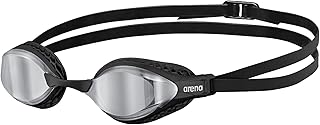
Pros
- Ultra-thin seals reduce pressure marks around the eye
- Curved lens preserves peripheral vision
- Low profile suited to dive starts
- Interchangeable nose bridges for fit tuning
- Mirror lens versions available for outdoor racing
Cons
- Very thin seals are less forgiving of a sloppy fit
- Smaller eyeport than a training goggle
- Anti-fog is a conventional coating rather than a refreshable layer
The Air-Speed sits between a conventional thin-gasket racer and a gasketless Swedish goggle. Arena's Air Seal gaskets are unusually thin and soft, so the frame gets very close to the face while still spreading the contact pressure a little more than bare polycarbonate would.
In practice that means fewer of the deep red rings that racing goggles are known for, without giving up much streamline. The lens is curved rather than flat, which keeps the useful field of view wider than the small eyeport suggests, and the split strap behaves well off the blocks.
The catch with a very thin seal is that it only works if the frame shape matches your orbit. Swap the nose bridge until the goggle holds by suction on its own, because tightening the strap to compensate for the wrong bridge will make it leak rather than seal.
Bottom line: the pick for a racer who finds standard competition goggles leave too much of a mark, and who is willing to spend a few minutes getting the bridge size right.
- Category: racing goggle, low profile
- Seal: Air Seal ultra-thin gaskets
- Lens: curved polycarbonate, mirror and tinted options
- Anti-fog: factory coating
- Strap: split silicone strap
- Nose bridge: interchangeable sizes included
- UV protection: yes
- Fit: unisex adult
Swimmers who race regularly and dislike the pressure rings left by hard-sealed goggles, and anyone with a shallow orbit who finds standard racing gaskets dig in.
It is also a reasonable choice for a triathlete doing a pool-based race series, where a comfortable seal matters across a longer swim than a sprint.
Choose the mirrored version for outdoor long course and the clear or smoke version for indoor meets. The frame is identical, so the tint is the only decision.
If you swim daily, buy a spare strap or a second pair. The seals are thin enough that they are the first component to soften after heavy chlorine exposure.

Pros
- Dual strap keeps the goggle stable on starts and turns
- Medium gasket is comfortable across long sets
- Good seal reliability for swimmers who leak in thinner goggles
- Anti-fog and UV treated lens
- Wide range of lens tints
Cons
- Bulkier than a dedicated sprint goggle
- Not the lowest drag option on this list
- Gasket softens with heavy chlorine exposure
The Python is the goggle for swimmers who want one pair that survives both a hard hour of training and a Saturday meet. The gasket is thicker than the Cobra or the Speed Socket, so the frame stands slightly further off the face, and in exchange the goggle is far more comfortable for continuous swimming.
The dual strap is the standout feature. Two bands hold the goggle down onto the socket from above and below the widest part of the skull, which is the arrangement that stops a goggle riding up on entry. That makes the Python noticeably more secure on dives than a single-strap training goggle with a similar gasket.
Where it gives ground is drag. The extra silicone means slightly more resistance than a true racing shell, which matters to a sprinter chasing tenths and matters very little to a club swimmer or a masters competitor.
Bottom line: the best all-rounder here, and the sensible single purchase if you are not going to own separate training and racing pairs.
- Category: training and racing crossover
- Seal: medium silicone gasket
- Lens: polycarbonate, several tints and mirror options
- Anti-fog: factory coating
- Strap: dual strap system
- UV protection: yes
- Fit: unisex adult
This is the pair to reach for on a long aerobic set, a distance session, or a masters practice where you are in the water for an hour or more. The gasket spreads pressure well enough that you stop noticing the goggle after the warm up.
It also handles kick sets and turn work without shifting, which is where thinner racing goggles start to fill with water.
Rinse the gaskets thoroughly after every swim. Chlorine residue trapped in a thicker seal is what makes silicone go sticky and lose its grip over a season.
Dry the goggle out of direct sunlight, since UV exposure on the deck degrades silicone faster than the pool water does.

Pros
- Streamlined frame designed to reduce drag
- Curved lens gives a wider view than the small eyeport suggests
- Thin silicone seal for a socket fit
- Several lens tints including mirrored
- Holds position well through dive starts
Cons
- Nose bridge is not adjustable on all versions
- Thin seal marks the face on long sessions
- Anti-fog coating is conventional and wears with use
The Blackhawk is TYR's mainstream racing goggle and it is built along the same lines as the Arena and Speedo racers: small eyeport, thin silicone seal, curved lens, low frame. It is a competition goggle in the proper sense and it behaves like one off the blocks.
The curved lens is worth calling out. Racing goggles get criticised for tunnel vision, and curvature is the design answer, bending the useful field of view outward so you can still see a swimmer in the next lane during a breath.
The seal is thin but not minimal, which puts the Blackhawk on the more wearable side of the racing category. Plenty of swimmers use it through full practices and not just for meets, though you will still feel it after a long set.
Bottom line: a solid, no-drama racing goggle and a good choice if you prefer TYR's frame shape or find Arena and Speedo racers sit wrong on your face.
- Category: racing goggle, low profile
- Seal: thin silicone
- Lens: curved polycarbonate, several tints
- Anti-fog: factory coating
- Strap: silicone racing strap
- UV protection: UVA and UVB
- Fit: adult unisex
Racers who want one goggle for both meets and hard training, and swimmers whose faces do not seal well in the Arena or Speedo frame shapes. It suits mid-distance and sprint work equally.
Swimmers who need an adjustable nose bridge should check the specific version before buying, since not every colourway ships with interchangeable pieces.
Fit the goggle before a race day by wearing it through a full practice including starts. A racing goggle that seals standing on deck can still leak on entry, and you want to find that out in training.
If water sneaks in at the outer corner, the frame is sitting too wide; if it comes in at the nose, the bridge is too narrow for your face.

Pros
- Minimal profile creates very little drag
- Seals against bone rather than soft tissue, so it rarely shifts on entry
- Adjustable nose bridge lets you set the exact lens spacing
- Metallized lens options for outdoor glare
- Compact enough to live in a suit bag permanently
Cons
- Leaves clear pressure rings around the eyes
- Uncomfortable for long continuous sets
- Takes trial and error to fit correctly
- Narrowest field of view here
Socket Rockets are what most swimmers buy when they want the Swedish goggle experience without assembling one from a kit. The shell is minimal, the seal is barely there, and the goggle holds by seating into the bone around the eye rather than cushioning against the skin.
The payoff is real. Nothing on this list sits closer to the face or grabs less water, and once fitted the goggle stays exactly where you put it through a racing dive. Sprinters gravitate to this style for that reason and have done for decades.
The cost is comfort and patience. You will have pressure rings after every swim, and the first few sessions involve adjusting the nose bridge repeatedly until you find the spacing that seals. Anyone doing long distance sets will find this pair miserable after twenty minutes.
Bottom line: buy it as a dedicated race day goggle for sprint events, not as your only pair.
- Category: minimal racing goggle, Swedish style
- Seal: minimal, seats on the orbital bone
- Lens: flat polycarbonate, clear and metallized options
- Anti-fog: factory coating
- Nose bridge: adjustable
- Strap: silicone
- UV protection: UVA and UVB
Start with the nose bridge slightly wider than you think you need, press the cups into your sockets without the strap, and see whether they hold by suction. Narrow the bridge one step at a time until they do.
Keep the strap tension low once the suction fit is right. Cranking a minimal goggle tight is what turns pressure rings into headaches, and it does not improve the seal.
Sprinters, swimmers who race fifties and hundreds, and anyone who has already found that gasketed goggles leak on them off the blocks.
It is the wrong purchase for distance swimmers, beginners, and anyone who wants to wear the same goggle through a full training session.

Pros
- Narrower frame seals on faces that leak in unisex goggles
- Mirrored lens handles outdoor glare
- Thin gasket keeps the profile low enough for club racing
- Interchangeable nose pieces included
- Same proven lens and strap design as the standard Vanquisher
Cons
- Too narrow for wider faces
- Mirror coating needs case storage to stay clear
- Small eyeport limits peripheral vision
Goggle fit is a bone geometry problem, not a preference, and a large share of leaking complaints come down to a frame that is simply too wide for the swimmer's orbital spacing. This version of the Vanquisher exists for that reason: same lens technology, same thin gasket, narrower moulding.
For swimmers with smaller faces the difference is immediate. The gasket lands on bone instead of straddling the outer corner of the eye, which is where wide frames start letting water in during freestyle breathing.
Everything else carries over from the standard Vanquisher, including the interchangeable nose pieces, the split strap, and the mirrored lens that makes it the right choice for outdoor pools. The same warning applies as well: the mirror is a surface coating and it scratches.
Bottom line: if unisex racing goggles have never sealed properly for you, try this before concluding that thin-gasket goggles do not work on your face.
- Category: thin-gasket training and racing goggle
- Seal: thin silicone gasket
- Lens: mirrored polycarbonate
- Frame: narrower fit moulding
- Anti-fog: factory coating
- Nose bridge: interchangeable pieces
- UV protection: yes
Swimmers with narrower faces or close-set eyes, including many junior competitors who have outgrown youth goggles but leak in adult unisex frames.
Anyone with a wider face should stay with the standard Vanquisher, since forcing a narrow frame outward with strap tension will only push the seal onto soft tissue.
The mirrored lens is built for outdoor swimming and summer long course. It cuts the glare that sits directly in your breathing line when the sun is low.
For winter indoor season, the clear version of the same narrow frame is the better pick, and many swimmers rotate between the two rather than compromising with a mid tint.

Pros
- Thick gasket is comfortable across very long sets
- Wide field of view helps in busy lanes and open water
- Seals easily on a broad range of face shapes
- Anti-fog and UV treated lens
- Forgiving fit for swimmers new to serious training
Cons
- Frame stands well off the face, so it is not a racing goggle
- Bulk catches water on dive starts
- Thicker gasket takes longer to dry between sessions
The One is Arena's comfort goggle and it belongs on this list precisely because it shows the other side of the trade. The gasket is thick, the seal is generous, and the eyeport is large, so you get a wide view and a fit that works on almost anyone.
For training volume that combination is hard to beat. Masters swimmers, adult fitness swimmers, and anyone grinding out distance sets will be far happier in this than in a thin racing shell, and the goggle seals reliably without careful bridge adjustment.
It is not a racing goggle and we are not going to present it as one. The frame stands proud of the face, which means more drag and more for the water to grab on entry, and a hard dive start is the situation where a thick-gasket goggle is most likely to shift.
Bottom line: an excellent training pair and a poor race pair, which is exactly what most swimmers need alongside a dedicated competition goggle.
- Category: training goggle, wide view
- Seal: thick watertight gasket
- Lens: wide-view polycarbonate, several tints
- Anti-fog: factory coating
- Strap: silicone strap
- UV protection: yes
- Fit: unisex adult
Use it for aerobic sets, technique work, and any session over about forty minutes where the thin seal of a racing goggle would start to hurt. The wide view also makes circle swimming in a crowded lane less stressful.
It works well for calm open water sessions too, where visibility matters more than streamline.
Pair it with a thin-gasket racer rather than treating it as a single solution. Most competitive swimmers end up owning both categories, and the combined cost is still modest.
Choose a clear or smoke tint for indoor training and a mirrored tint only if the majority of your yardage is outdoors.

Pros
- Two pairs in the box, so a spare is always in the bag
- Soft thick gasket is comfortable for casual and lap swimming
- Wide field of view
- Mirror coating helps in outdoor pools
- Very easy to seal without fit adjustment
Cons
- Not a racing goggle: the bulk shifts on dive starts
- Anti-fog coating is short lived compared with premium models
- Strap and gasket wear faster with daily chlorine exposure
The Aegend two-pack is the volume seller in this category and it is on this list as the value pick with a clear label attached. It is a training goggle. The gasket is thick and soft, the eyeport is wide, and it seals on almost any face with no fitting effort at all.
For lap swimming, warm ups, holiday pools, and the sort of session where you just want to see clearly and get in the water, that is exactly right. Getting two pairs means the spare is already in your bag on the day the first one fogs or the strap gives out.
Take it to a meet and the limits show up immediately. The frame stands off the face, so a dive start can push it out of position or fill it, and the extra bulk creates drag you would not accept in a race. The anti-fog coating is also the shortest lived here.
Bottom line: the best value pair on this list for training, and the wrong pair for the blocks. Buy it as your everyday goggle and keep a thin-sealed racer for competition.
- Category: training and recreational goggle
- Seal: thick soft gasket
- Lens: mirrored wide-view polycarbonate
- Anti-fog: factory coating
- Strap: adjustable silicone strap
- UV protection: yes
- Pack: two pairs
Two complete goggles ship together, usually in different lens or strap colours, which makes it easy to keep one pair for outdoor sessions and one for indoor use.
Rotating between the two pairs also gives each set of gaskets time to dry fully, which noticeably extends how long the silicone stays soft.
Because the anti-fog film on a value goggle is thinner to begin with, the no-wiping rule matters even more here. Rinse in cool fresh water, shake out the drops, and let the goggle dry with the cups apart.
Retire a pair once the gasket goes sticky or the strap loses tension rather than tightening it further, since an overtightened goggle presses on the orbital rim and can cause headaches.
How to Choose Swim Goggles For Competition
Swim goggle marketing leans hard on words like professional and racing, and those words mean very little on their own. What actually separates a competition goggle from a training goggle is measurable: how thick the seal is, how far the frame stands off your face, how the lens is shaped, and how the strap holds under the impact of a dive. Work through the six criteria below and you will be able to read any product page and place the goggle in the right category yourself.
Gasket or No Gasket: How Close the Frame Sits to Your Eye Socket

This is the single biggest fork in the road. A training goggle uses a thick silicone or foam gasket that spreads pressure over a wide ring of skin around the eye. It is comfortable for an hour of continuous swimming and it seals easily even on faces it was not designed for. The cost is bulk. The frame stands off your face, the goggle catches water at speed, and the extra silicone gives the goggle something to grab when you hit the water on a dive.
A racing goggle either uses a very thin silicone gasket or skips the gasket completely. Models like the Arena Cobra Ultra Swipe, the Speedo Speed Socket 2.0, and the TYR Blackhawk Racing sit close to the face with a slim seal. The TYR Socket Rockets 2.0 goes further toward the classic Swedish idea, where a hard shell seats directly against the bone of the orbit and the seal comes from suction rather than cushioning. Swedish style goggles leak the least at speed and create the least drag, but they can leave a pressure ring on your face and they are unforgiving if the nose bridge is even slightly off.
Practical rule: if you are racing anything from a fifty to a two hundred, go as thin as your face tolerates. If you are swimming distance sets or masters practice for an hour, a thin gasket like the Speedo Vanquisher or a medium one like the Arena Python will keep you far more comfortable without giving up much streamline.
Lens Tint and Mirror Coating for Pool and Open Air

Lens choice is about the water you actually swim in, not about looks. A clear or lightly smoked lens is correct for an indoor pool, where you need to pick out the backstroke flags, the T on the wall, and the hand of a coach on the deck under artificial light. Anything heavily mirrored indoors will make the turn end darker than it needs to be, and swimmers who wear a dark mirror in a dim natatorium often misjudge their flip.
A mirrored lens earns its keep outdoors. Long course meets in the sun put glare on the surface directly in your sight line during freestyle breathing, and a mirror coating cuts that down the way sunglasses do. The Speedo Vanquisher mirrored version and the mirrored Arena models are the obvious picks for outdoor summer league and long course season. Blue and smoke tints sit in between and work reasonably well in both settings, which is why they are the safe answer if you only want to own one pair.
One caution on mirror coatings: they are a thin surface layer, and they scratch. Keeping the goggle in a hard case rather than loose at the bottom of a mesh bag is the difference between a mirror that lasts a season and one that looks cloudy after a month. For more gear breakdowns in this style, browse our latest buying guides.
Anti-Fog Coatings and How Long They Actually Last
Every goggle on this list claims anti fog treatment, and every one of those claims has an expiry date. The standard approach is a hydrophilic film applied to the inside of the lens at the factory. It works well out of the box and then wears down, and the thing that wears it down fastest is your finger. Wiping the inside of the lens to clear condensation physically removes the coating, so the habit that seems to fix fogging is the habit that ends it. Most swimmers get somewhere between a few weeks and a few months of reliable performance out of a factory coating depending on how often they swim and how heavily chlorinated the pool is.
Arena took a different route with the Swipe system used on the Cobra Ultra Swipe. Instead of a film that only depletes, the inner layer holds an anti fog agent that is reactivated when you swipe a finger across the lens, which turns the usual failure mode into the maintenance step. It is not permanent, but it extends useful life considerably compared to a conventional coating, and it is the main reason that model sits at the top of this list.
Whatever you buy, rinse in cool fresh water after every swim, shake the water out instead of wiping, and let the goggle air dry with the lenses apart. Anti fog behaviour is also very different from what snow sports gear needs, where the enemy is a temperature gradient across a double lens rather than a chlorinated film. If that is the problem you are solving, that is a separate category and our guide to anti fog goggles for snowboarding covers it, but nothing in that guide belongs in a pool.
Strap Design, Nose Bridges, and Dialing In the Fit

A split or double strap is close to mandatory for competition. Two bands sitting above and below the widest part of the skull pull the goggle straight back into the socket and hold that position when you enter the water head first. A single strap tends to ride up over the crown, and once it has moved the seal breaks. The Arena Python, the Arena Cobra family, and the Speedo racing models all use split strap designs, and getting the top band high on the back of the head and the lower band under the occipital bump is the fitting detail most swimmers skip.
Nose bridges matter just as much. Interchangeable bridges, usually three to five sizes in the box, let you set the distance between the lenses to match your face. A bridge that is too wide puts the seal on soft tissue and the goggle leaks at the outer corner. Too narrow and the frame presses on the bridge of your nose and you will feel it after four hundred metres. Swedish style goggles take this to the extreme by shipping as a kit with a length of cord or tubing that you cut and tie yourself, which is fiddly the first time and perfect once you get it right.
Fit check before you swim: press the goggles into your eye sockets without the strap over your head. They should hold by suction for a few seconds. If they fall off immediately, the frame shape does not match your orbit and no amount of strap tension will fix it.
UV Protection and Lens Durability
UV protection is standard on the polycarbonate lenses used across all of these models and it costs the manufacturer almost nothing to include, so treat its absence as a warning sign rather than treating its presence as a feature. It matters most for outdoor training blocks and open water sessions, where you are looking at a reflective surface for a long time. Polycarbonate also handles impact well, which is what you want when a goggle spends its life being crammed into a bag next to a kickboard.
Where durability really varies is the strap and the clips. Silicone straps hold their elasticity in chlorine far better than rubber, and swimmers who swim daily should expect the strap to be the first component to go. Models with replaceable straps and spare nose bridges in the box extend the useful life of the goggle well past the point where a sealed unit would be finished.
Competition Approval Rules and What They Cover
World Aquatics, the governing body formerly known as FINA, maintains an approved list for swimwear, and the rules that draw the most attention concern suits rather than eyewear. Goggles are not subject to the same fabric and coverage restrictions, but sanctioned meets do have equipment rules and some brands publish approval information for individual models. None of the product listings in this roundup state a competition approval in their titles, so we have not attributed one to any pair here. If you are swimming at a level where the rule matters, check the current approved list published by the governing body for your meet and confirm the exact model code before you buy.
For club, masters, and high school swimming, no official approval is required for goggles and the practical constraints are simpler: the goggle has to stay on through a dive, it has to let you see the wall, and it cannot be so tinted that an official cannot see your eyes. Every model on this list clears that bar.
| Model | Seal profile | Lens style | Best suited to |
|---|---|---|---|
| Arena Cobra Ultra Swipe | Thin silicone, low profile | Curved, mirror and clear options | Racing at every distance |
| Speedo Speed Socket 2.0 | Thin silicone, very low profile | Flat, clear and mirror | Sprint racing and dive starts |
| Speedo Vanquisher Mirrored | Thin silicone gasket | Mirrored | Outdoor training and club racing |
| Arena Air-Speed | Ultra thin air seal | Curved, mirror options | Racing, swimmers who dislike pressure marks |
| Arena Python | Medium silicone, dual strap | Tinted and mirror | Long sets plus occasional racing |
| TYR Blackhawk Racing | Thin silicone, streamlined | Curved, several tints | Racing and hard training |
| TYR Socket Rockets 2.0 | Minimal, near Swedish | Flat, metallized options | Sprinters who want the lowest drag |
| Speedo Women’s Vanquisher Mirrored | Thin silicone, narrower frame | Mirrored | Smaller faces and narrower orbits |
| Arena The One | Thick watertight gasket | Wide view, several tints | Training, masters, comfort first |
| Aegend Mirrored 2-Pack | Thick soft gasket | Mirrored wide view | Training and recreational swimming only |
Why You Should Trust Us
We build these shortlists from the data swimmers leave behind. For this guide we pulled current listings for competition oriented swim goggles, filtered out anything below a four star average or without a meaningful base of customer ratings, and then removed the noise that clutters this category: snorkelling masks, children’s novelty pairs, and repeated colour variants of the same frame that would otherwise fill half the list. What remained was sorted by the strength of the customer record behind it.
From there we read the picks against the technical criteria above, so the ranking reflects how each goggle is actually built rather than how it is advertised. Where a product is a training goggle wearing racing language, we say so instead of ranking it as something it is not. We do not claim to have swum a meet in every pair, and we do not attribute governing body approvals that a listing does not publish. Prices and availability change constantly, so check the current listing before you buy.
Final Thoughts
Best overall goes to the Arena Cobra Ultra Swipe Racing Swim Goggles. It combines the three things a racing goggle has to get right: a curved low drag lens that keeps peripheral vision usable, a thin seal that seats in the socket instead of on the cheek, and an anti fog layer you can bring back rather than one that simply runs out. If you only race a few times a year, the Speedo Speed Socket 2.0 delivers most of that low profile feel in a simpler package, and the TYR Blackhawk Racing is the pick if you want a streamlined frame that you can also wear through a full training session.
Best value is the Aegend Swim Goggles 2-Pack, and we want to be direct about what it is. It is a comfortable, wide view training goggle with a thick gasket, sold in a pair, and it is a genuinely good buy for lap swimming and warm ups. It is not a racing goggle, and putting it on for a dive start will teach you why the rest of this list exists. Buy it as your everyday pair and keep a thin sealed model in the bag for meet day.
For specific situations: the Speedo Women’s Vanquisher Mirrored is the answer for narrower faces that never quite seal in a unisex frame, the TYR Socket Rockets 2.0 is the closest thing here to a true Swedish goggle for sprinters chasing the absolute lowest profile, and the Arena The One is the honest choice if comfort over an hour matters more to you than a tenth of a second off the wall. Whichever way you go, buy two pairs when you can, because the pair that fogs at the worst moment always seems to be the only one in the bag. You can find more gear guides across our shopping categories, and swimmers building toward a triathlon will want to read our running shoe roundup next.
Frequently Asked Questions
What makes swim goggles for competition different from regular training goggles?
Three things. The seal is thin or absent so the frame sits inside the bone of the eye socket rather than on the soft tissue around it, the lens is smaller and often curved so it creates less resistance in the water, and the strap is split into two bands that hold the goggle in place through a dive start. The trade off is a narrower field of view and less padding, which is why a racing pair feels tight and a training pair feels plush.
Are Swedish goggles still worth using in 2026?
Yes, for sprinters and for swimmers who have already found that thin gasket models leak on them at speed. Swedish goggles have no gasket at all and seal against bone, which gives the lowest drag and the most secure hold available. They take assembly and patience, they mark your face, and they are miserable for long distance sets. If you want most of that character without the do it yourself part, the TYR Socket Rockets 2.0 on this list is the mass market equivalent.
How long should the anti fog coating on swim goggles for competition last?
Plan on a few weeks to a few months of reliable performance from a factory coating, depending on how often you swim and how heavily treated the pool water is. The coating fails fastest when you wipe the inside of the lens, because wiping removes the film. Rinse in cool fresh water after each swim, shake rather than wipe, and store the goggle dry. Reactivating systems such as the Arena Swipe layer last noticeably longer because the coating is designed to be refreshed rather than only depleted.
Do I need mirrored lenses for indoor meets?
No. Mirrored lenses are built for outdoor glare and they make an indoor pool darker than it needs to be, which can cost you accuracy on turns and starts. Clear or lightly smoked lenses are the right call indoors, and a blue or smoke tint is the compromise if you swim in both settings and want one pair. Many swimmers keep a clear pair for indoor season and a mirrored pair for long course summer.
Are any of these goggles approved by World Aquatics?
None of the listings in this roundup publish a competition approval claim, so we have not credited any model with one. Goggle rules at sanctioned meets are far less restrictive than swimsuit rules, and for club, school, and masters swimming no approval is required. If you compete at a level where equipment is checked, verify the exact model against the current published list for your governing body before the meet. You can browse the rest of our sports gear guides while you decide.
Write Your Review
No reviews yet. Be the first to share your experience!