

Beach shades do not usually fail because the fabric tears. They fail because the wind gets underneath, lifts one corner, and the whole thing becomes a kite with your towels inside. Every shelter in this category is UPF 50+, so sun protection is not what separates them. What separates them is how they are held down, and that comes in three completely different forms.
For October 2026 we compared 8 sun shelter for windy beach from Neso, Venustas, SUN NINJA and more, sorted by anchoring method rather than by size or price. Our top pick is the Shibumi Shade for its pole-free canopy that uses the sea breeze to hold its own shape, which turns the thing that wrecks other shelters into the thing that makes this one work. If you are building out the rest of the kit, our guide to the best insulated backpack coolers covers what to carry under the shade.

Pros
- Uses wind to hold its shape instead of fighting it
- No rigid frame to kink in a gust
- Packs smaller than framed shelters
- One person can set it up
- Very little to break: no zips, no floor, no poles
Cons
- Hangs rather than flies on a dead calm day
- Open canopy gives shade but no privacy or wind break
This is the shelter that inverts the usual problem. Every other design on an open beach is trying to resist wind, and the Shibumi is designed to be filled by it. A flexible arc holds a sheet of fabric downwind, and the breeze pushes it into an aerofoil shape that stays up on its own.
The practical consequence is that a day which would send a pop-up dome cartwheeling down the sand is a good day for this. There is no rigid box presenting a flat face to the gust, and no closed back acting as a sail.
Setup is published at around three minutes and it is genuinely a one-person job, because there is no frame to assemble and hold at the same time. Packed size is the smallest group here for the same reason.
The limitation is honest and easy to state: on a still day there is nothing to inflate the canopy, so it hangs. It also gives you shade and nothing else, no walls, no floor, no privacy for changing. If those matter more than wind performance, this is not your shelter.
Bottom line: on an exposed, breezy shore this is the design that gets better as conditions get worse, and that is a rare thing to be able to say.
- Design: pole-free canopy, wind-supported
- Published coverage: around 150 square feet of shade
- Published setup: around three minutes
- Structure: flexible arc, no rigid frame
- Enclosure: open canopy, no walls or floor
- UPF: 50+ fabric
People whose regular beach has reliable onshore wind, and who have already lost or bent a pop-up shelter there. It is also the pick if you walk a long way from the car park, because it is the smallest and lightest thing here once packed.
It is the wrong choice for a sheltered lake shore with no breeze, and for families who need an enclosed space for naps and changing.
Set it with the open side facing away from the wind and let the breeze fill it before you tension the anchors. Fighting it into position first is the common mistake.
On a marginal day, angle the canopy lower to catch what breeze there is. On a very still day, accept that it will drape and treat it as a simple sunshade rather than a structure.

Pros
- Sand anchors let you add as much weight as the day needs
- Works on any sandy beach regardless of wind
- Several sizes from small groups to large
- Large body of positive owner feedback
- Simple canopy with few failure points
Cons
- Filling and emptying anchors adds real time at both ends
- Open canopy, no privacy or enclosure
This is the mainstream answer to a windy beach and the reason the design has become so common. Rather than trying to be clever about aerodynamics, it gives you bags you fill with sand, so the anchor is exactly as heavy as the conditions demand.
That is a genuinely robust approach. There is no wind speed at which the strategy stops working, only a point at which you decide to dig more. It also means the shelter travels light and gains its weight on arrival, which is the right way round.
The canopy is a simple fabric sheet on poles, UPF 50+, offered in sizes from small to large. Bigger versions cover a family with chairs and a cooler comfortably, though as with every shelter in this category the person rating assumes people sitting on the ground.
The cost is labour at both ends of the day. Filling anchors is slower than popping a frame, and emptying and shaking sand out at the end is slower still. A small folding shovel changes the experience.
Bottom line: the dependable pick that works on any beach, as long as you accept that you are trading setup time for wind security.
- Design: pole and fabric canopy
- Anchoring: sand-filled bags or pockets
- Sizes: options for roughly 3 to 8 people
- UPF: 50+ fabric
- Enclosure: open canopy
- Packing: carry bag included
Fill every anchor evenly rather than loading the two windward corners. Uneven loading is what tears the seam where an anchor pocket joins the fabric.
Bury the anchors rather than resting them on the surface where you can. Sand on top of a filled bag adds holding power for free.
Bring a folding shovel. It turns the slowest part of the job into a minute of work and is the single best accessory for this style of shelter.
Empty anchors fully before packing and rinse sand out of the seams when you get home. Grit trapped inside stitching cuts thread from the inside and is the usual cause of a torn anchor pocket.
Dry the fabric before storing. Packing a damp canopy in a bag is how a shelter develops mildew spots over a winter in the garage.

Pros
- Largest size options in this group
- Sand anchoring suits exposed beaches
- Very large base of owner feedback
- Covers a group with chairs and gear
Cons
- Big canopies catch more wind and need more anchoring
- Longer setup than a pop-up frame
Gorich competes on coverage. Where most shelters here top out around six people, this range extends further, which matters if your beach days involve extended family rather than a couple with a cooler.
The anchoring is the standard sand-filled approach, and on a large canopy it becomes more important rather than less. A bigger sheet of fabric catches proportionally more wind, so the number of anchors and how well you fill them is the difference between a stable shelter and a struggle.
Fabric is UPF 50+ like everything in this category. The useful comparison is not sun protection but shape: this is a broad flat canopy rather than an enclosed room, so it gives shade and airflow rather than privacy.
Setup scales with size. A ten person canopy is not a one person job in any breeze, and that is worth knowing before you buy the biggest option because it looked like better value.
Bottom line: the pick when the group is large, provided you commit to anchoring it properly.
- Design: pole and fabric canopy
- Anchoring: sand-filled pockets
- Sizes: options from roughly 3 to 10 people
- UPF: 50+ fabric
- Enclosure: open canopy
Groups and extended families who want everyone under one shade rather than two shelters side by side. It is also a reasonable pick for club or team days at the beach.
Solo beachgoers and couples are better served by a smaller canopy, which will be faster to set up and easier to hold in the wind.
On the larger sizes, set the windward edge first and anchor it before raising the rest. Trying to lift the whole canopy at once in a breeze is what turns setup into a two person wrestling match.
Add sand on top of buried anchors on the windward side specifically. The load is not evenly distributed and neither should the weight be.

Pros
- Sand-filled corners instead of stakes
- Light and compact for the coverage it gives
- Simple design with few parts to fail
- Open shape keeps the sea breeze flowing
Cons
- Lower average owner rating than others in this group
- Open canopy offers no privacy or wind break
The Neso is the design that made the sand-corner canopy popular, and it is still one of the lighter ways to get a large patch of shade onto a beach.
The idea is simple: four corners with pockets you fill, two poles, and a fabric sheet tensioned between them. No stakes, no frame, nothing that needs firm ground. It sets up quickly once you have the sand in and it packs down small enough to carry with a cooler in the other hand.
The open shape is deliberate. It gives shade with airflow underneath, which on a hot beach is more comfortable than an enclosed shelter even though it blocks less total sun.
It carries a lower average owner rating than several rivals here, and the recurring theme in feedback is tensioning: get the poles and corners balanced and it is stable, get it wrong and the canopy sags. It rewards a careful setup more than the heavier shelters do.
Bottom line: light, compact and effective when set up properly, with less margin for a rushed job than the bulkier options.
- Design: two-pole fabric canopy
- Anchoring: sand-filled corner pockets
- Stakes: not required
- Enclosure: open canopy
- Packing: compact carry bag
Fill all four corners before raising either pole, then tension diagonally rather than side to side. Getting the diagonals even is what stops the canopy sagging in the middle.
Set the poles at a slight lean away from the canopy rather than vertical. That puts the fabric under tension and keeps it taut as the sand settles.
Beachgoers who walk in and want the largest shade for the smallest packed size, and who do not mind spending an extra minute getting the tension right.
If you want to throw a shelter up in thirty seconds and sit down, a pop-up frame suits you better.

Pros
- Good middle ground on size and coverage
- Sand anchoring works on exposed beaches
- Strong average owner rating
- Straightforward canopy design
Cons
- Setup slower than a pop-up frame
- No enclosure for privacy or naps
Venustas sits in the middle of this group in almost every respect, which is not a criticism. It is a sand-anchored canopy in useful sizes with a strong average rating, and for many buyers that combination is the whole decision.
The anchoring is the proven approach: bags you fill on site, so the shelter is as heavy as it needs to be. That makes it a safe pick for a beach where you cannot predict the conditions week to week.
Coverage in the mid sizes suits a family of four with chairs, which is the most common real use of a beach shelter. The fabric is UPF 50+, standard across the category.
There is nothing unusual here and nothing to catch you out. The trade-offs are the ones every canopy of this type carries: slower setup than a frame, and no walls.
Bottom line: a dependable middle choice with no surprises, which is exactly what a lot of people want from beach gear.
- Design: pole and fabric canopy
- Anchoring: sand-filled bags
- Sizes: options for roughly 3 to 8 people
- UPF: 50+ fabric
- Enclosure: open canopy
Families who want one shelter that copes with whatever the day brings, without thinking hard about aerodynamics or buying for a specific beach.
It is less suited to people carrying gear a long way, where the lighter pole-free designs pull ahead.
Empty and rinse the anchor bags after each trip. Sand left inside grinds against stitching and shortens the life of the seam that carries the load.
Dry fully before storage, and store loosely rather than compressed, so the fabric does not hold creases that become weak lines.

Pros
- Fastest setup style in this guide
- Stands on its own without filling anchors
- Partial enclosure gives some privacy and wind break
- Compact flat packing
Cons
- A rigid shelter with a closed back acts as a sail in gusts
- Frame ribs are the part that kinks and cannot easily be replaced
The pop-up frame is the right answer to a different question. If your beach is a sheltered bay, a lake shore or a grassy picnic ground, the thing you care about is getting shade up in under a minute, and this design does that better than any canopy.
Standing on its own also means you can position it, move it and adjust it without dismantling anchors, which matters when the sun moves and you want to follow the shade.
The partial enclosure is a real advantage for families. Three sides gives somewhere to change, keeps toys from blowing away and cuts the wind at ground level in a way an open canopy cannot.
The weakness is the one you would expect. A rigid box with a closed back presents a flat face to a gust, and once wind gets underneath it lifts. It can be anchored, and it should be, but it starts from a worse position than a canopy on an exposed shore.
Bottom line: buy it for speed, privacy and calm conditions, and over-anchor it if you take it somewhere breezy.
- Design: pop-up frame shelter
- Capacity: 3 to 4 people
- Enclosure: partial, multiple sides
- Setup: pop-up, no assembly
- Packing: flat disc in carry bag
Lake shores, sheltered coves, grass and picnic grounds, plus families who value a private corner for changing more than they value wind performance.
Not the first pick for an open ocean beach with steady onshore wind, where a canopy design will give you a calmer afternoon.
Anchor it before you walk away from it, even on a calm day. Beach wind changes faster than people expect and an unanchored pop-up moves quickly.
Fold along the frame rather than forcing it. Most frame damage on pop-up shelters happens during packing rather than in use.

Pros
- Highest average owner rating in this group
- Generous shade footprint in the large size
- Simple canopy with few parts
- UPF 50+ fabric
Cons
- Smaller feedback base than the long-established shelters here
- Large canopies need careful anchoring in wind
CoolCabana carries the strongest average rating in this comparison, and the recurring theme in owner feedback is the amount of usable shade for the effort involved.
The design is a straightforward fabric canopy in two sizes. The large option is the one to look at if you regularly go out as a group, because the difference in covered area between the two is significant.
Fabric is UPF 50+, as everywhere here. What distinguishes it is shape and tension: a well tensioned canopy stays taut rather than flapping, and flapping is what makes a shelter tiring to sit under on a breezy day.
The caveat is history rather than quality. It has a smaller body of feedback than shelters that have been on sale for years, so the rating rests on fewer opinions. That is a reason to weigh it slightly differently, not a mark against it.
Bottom line: strong ratings and generous coverage, with the usual requirement that a big canopy gets anchored properly.
- Design: fabric canopy on poles
- Sizes: medium and large
- UPF: 50+ fabric
- Enclosure: open canopy
- Packing: carry bag
Choose the large size if you use beach chairs, and the medium if you sit on towels. Chairs consume shade far faster than bodies on the ground, and it is the most common sizing mistake in this category.
If you are choosing between this and a pop-up, ask whether your beach is windy. Canopies win on exposed shores, frames win on sheltered ones.
Keep the canopy under tension rather than letting it flap. Loose fabric wears at the attachment points and is noisy enough to spoil an afternoon.
Rinse and dry before storage. Salt left in fabric attracts moisture and shortens the life of coatings.

Pros
- Range of sizes for different group sizes
- Sand anchoring rather than stakes
- Simple canopy that packs small
- Reasonable coverage for the packed size
Cons
- Smallest feedback base in this comparison
- Setup slower than a pop-up frame
OutdoorMaster is the newest entry here and follows the established sand-anchored canopy formula rather than trying anything unusual.
That is a reasonable strategy in a category where the physics are settled. Sand weight works, and a canopy on poles with filled anchors will hold on almost any beach if you fill them properly.
Sizes span the useful range from a couple to a group. As with every shelter here, the person ratings assume people sitting on the ground rather than in chairs, so size up if you use chairs.
The honest caveat is the smallest feedback base in this comparison. There is simply less owner history to read than for the shelters that have been selling for years, so more of the assessment rests on the specification and less on accumulated experience.
Bottom line: a competent, conventional canopy worth considering, with less track record behind it than its rivals.
- Design: pole and fabric canopy
- Anchoring: sand-filled pockets
- Sizes: options for roughly 3 to 8 people
- Enclosure: open canopy
- Packing: carry bag included
Buyers who want the standard sand-anchored canopy and are comparing on size and coverage rather than on a distinctive design idea.
If you want the most owner history behind your purchase, the longer established shelters here give you more to read.
Fill anchors before raising poles, and set the windward side first. Both rules apply to every canopy of this type and both save a wrestling match.
Check the tension again after twenty minutes. Sand settles and the canopy loosens, and a quick re-tension keeps it quiet for the rest of the day.
How to Choose a Sun Shelter For Windy Beach
Anchoring: The Only Spec That Matters in Wind

Sand will not hold a stake. That single fact explains why beach shelters are built so differently from camping tents, and why a design that works in a park can be useless on an exposed shore. There are three answers on the market, and each one behaves differently once the breeze picks up.
The first is sand weight. Shelters like the Sun Ninja, Gorich, Venustas and OutdoorMaster models come with pockets, bags or sleeves that you fill on site, so the anchor is the beach itself. This is the most reliable approach because you can add as much weight as the day demands, and it is why these designs dominate the category. The cost is labour: you are digging and filling before you sit down, and a small folding shovel is worth having.
The second is the pole-free canopy. The Shibumi is the clearest example: a flexible arc holds a sheet of fabric that the wind pushes into shape, so a breeze that would flip a dome tent is what keeps this one open. The catch is the mirror image of the benefit. On a genuinely still day there is nothing to inflate the canopy, and it hangs.
The third is the rigid pop-up frame, which is what the WolfWise and CoolCabana style shelters use. These go up fastest and stand on their own, and they are the ones most likely to move in gusts, because a rigid box with a closed back is a sail. They are the right pick for sheltered coves, lakes and grass, and the wrong pick for an open beach on a windy afternoon.
Setup Time and How Many Hands It Takes
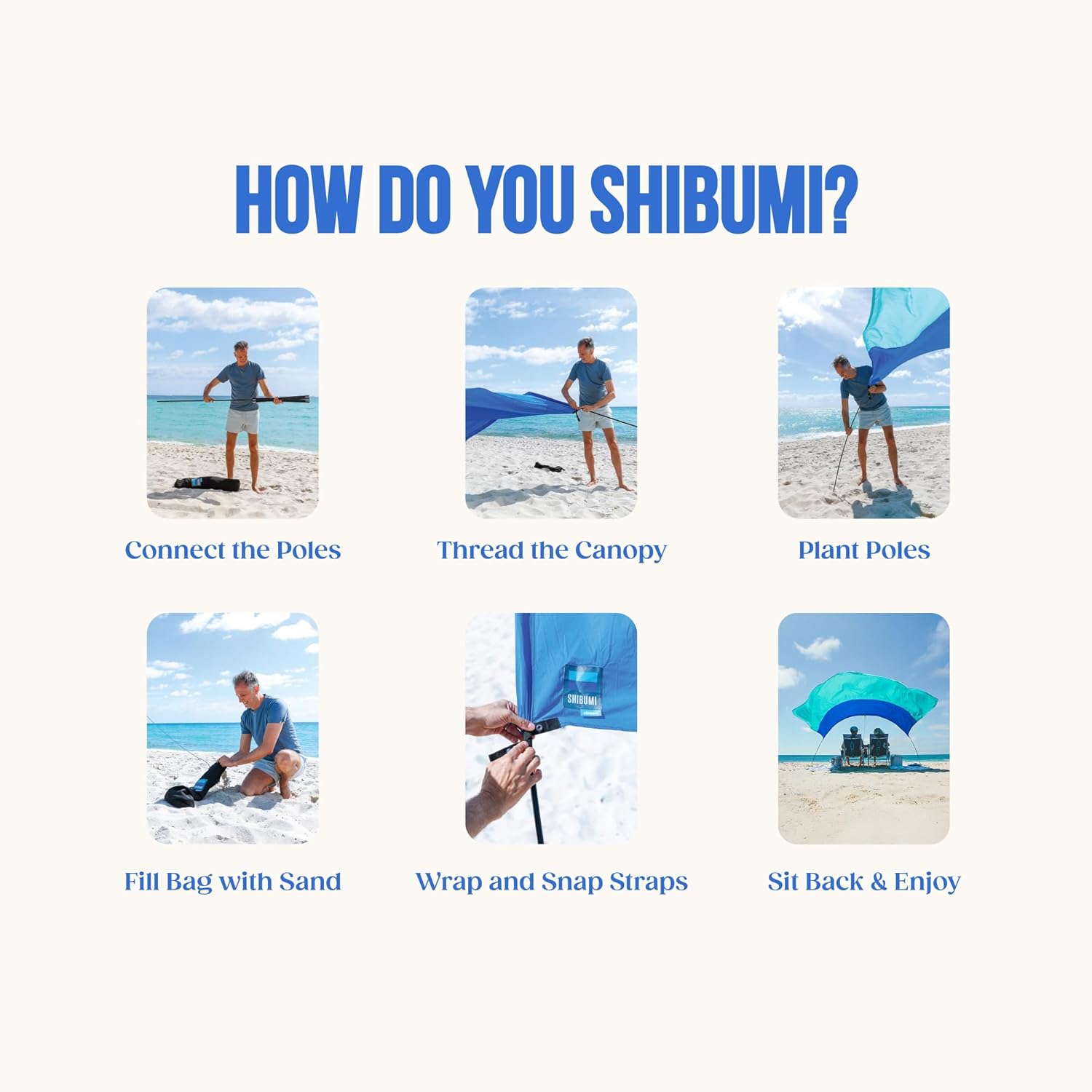
The number on the box usually assumes ideal conditions and two adults. Read it as a ranking rather than a promise. Pop-up frames are genuinely the fastest, often open in under a minute, because the structure does the work. Sand-anchored canopies take longer because filling the anchors is part of the job, and that is the step people underestimate.
The Shibumi publishes a setup around three minutes, which is realistic for one person because there is no frame to wrestle. The variable that matters more than the published figure is whether you can do it alone with a toddler on your hip, and that favours designs with fewer separate poles.
One practical note that no listing mentions: taking a sand-anchored shelter down is slower than putting it up, because you have to empty every anchor and shake the sand out before packing. Budget for that at the end of the day rather than being surprised by it.
Coverage, Headroom and the Shape of the Shade
Person ratings on beach shelters are optimistic in the same way tent ratings are. A shelter sold for 4 to 6 people is comfortable for a family of four with bags and a cooler, not for six adults in chairs. If you sit in chairs rather than on towels, drop the published rating by at least a third.
Shape matters more than square footage. A canopy that is high at the front and low at the back, like the Shibumi and the Neso, casts a long moving shadow and stays open to the sea view. A dome with three closed sides gives more total protection and better privacy for changing, but it traps warm air and blocks the breeze that makes the beach pleasant.
Headroom is the specification that decides whether adults can stand up under it. Very few shelters in this category let a standing adult in, and the pop-up styles are usually the tallest at the centre. If you want to change clothes or stand to eat, check the peak height rather than the footprint.
Fabric, UPF and What the Rating Does Not Cover
UPF 50+ is standard across the category and appears on every shelter in this guide. Treat it as an entry requirement rather than a differentiator. It describes the fabric directly overhead and says nothing about the sun that reaches you from the side in the late afternoon, which is when most sunburn happens under a shade.
What varies is the weave and how the fabric behaves in wind. A tighter weave blocks more light and catches more wind. A lighter, more open fabric lets a little light through and lets air pass, which is why some shelters feel cooler under them despite blocking marginally less sun. Neither is better in the abstract, they suit different beaches.
Sand resistance is the quiet durability question. Fine sand works into stitching and zips, so a shelter with fewer seams and no zips has less to fail. This is one of the arguments for the simple canopy designs over the pop-up rooms.
Packed Size and Carrying It From the Car
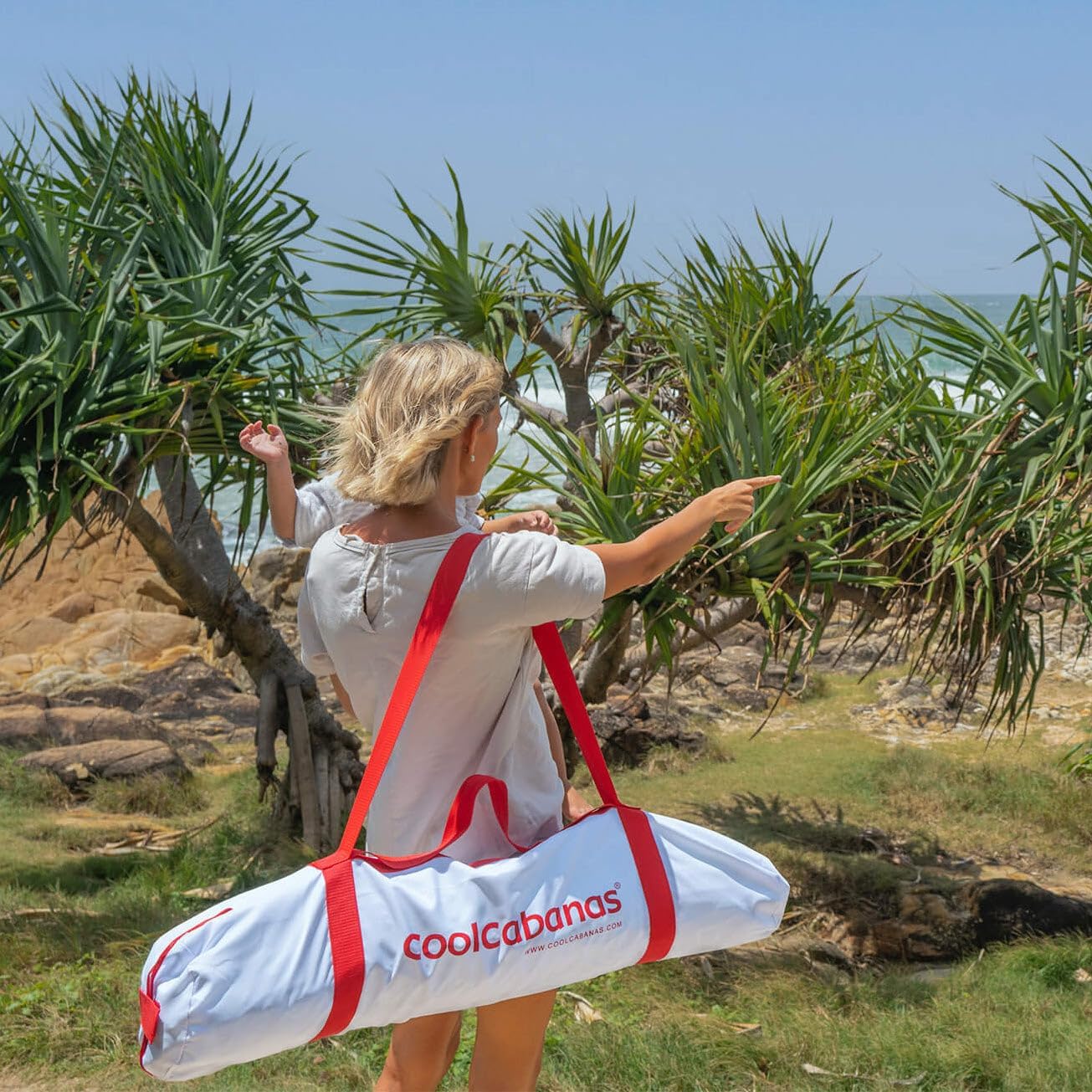
Every one of these packs into a bag, and every bag is heavier than it looks once the anchors are included. The distance from the car park to the sand is the specification nobody prints, and it decides which shelter you will actually take out of the cupboard next weekend.
Pole-free canopies pack smallest because there is no rigid frame, which is why they suit long walks and public transport. Pop-up frames pack into a flat disc that is awkward under one arm but light. Sand-anchored canopies sit between the two, and their weight rises with the number of anchor bags.
If you are walking more than a few hundred metres, the honest test is whether you can carry the shelter, a cooler and a chair in one trip. Anything that fails that test gets left at home, no matter how well it performs on the sand.
Where Each Design Actually Belongs
Match the shelter to the beach rather than to the review score. An exposed ocean beach with steady onshore wind is the natural home of the pole-free canopy and the heavily sand-anchored designs. A sheltered bay, a lake shore or a grassy picnic ground is where the pop-up frame shines, because setup speed matters and wind does not.
Families with small children usually want three sides and a floor for naps and changing, which points at the dome styles even on windier beaches, accepting that they will need more anchoring. Groups of adults who want a view and a breeze want the open canopy.
If you are shopping for a whole day out rather than one item, the rest of our outdoor coverage is in the sports and outdoors section.
What Breaks First
Beach shelters do not usually wear out evenly. They fail at one point, and knowing which point tells you what to inspect before a trip and what to ask about when a listing mentions replacement parts.
On pop-up frames the failure is the frame itself. A gust that lifts one side puts all the load on a single fibreglass or steel rib, and once a rib kinks the shelter never sits square again. Frames are also the hardest part to replace, because they are specific to the model. If you buy a pop-up for a windy beach, over-anchor it from the start rather than waiting to see whether it holds.
On sand-anchored canopies the failure is the seam where an anchor pocket joins the fabric. That joint carries the whole load of a filled bag every time the wind pulls, and it is the first place stitching gives. Fill anchors evenly rather than loading one corner, and rinse sand out of the seams, because grit inside stitching cuts thread from the inside.
On pole-free canopies there is very little to break, which is the quiet argument for them. No frame to kink, no zip to jam, no floor to tear. The wear point is the flexible arc and the cord that tensions it, both of which are simple and usually replaceable. Fewer parts is a durability strategy, not just a weight one.
Quick Comparison
| Design | How it holds | Best beach | Trade-off |
|---|---|---|---|
| Pole-free canopy | Wind inflates the fabric | Open, breezy shore | Hangs on a still day |
| Sand-anchored canopy | Pockets filled on site | Any beach with sand | Slow to set up and pack |
| Pop-up dome | Rigid frame plus stakes | Sheltered bay, lake, grass | Acts as a sail in gusts |
| Dome with floor | Frame, sand pockets, floor weight | Family days, naps, changing | Traps warm air, blocks breeze |
Why You Should Trust Us
We build these guides by starting with the shelters people actually buy and keep, then reading them against what each maker publishes. For this category we gathered current beach shelters, filtered them by verified customer ratings and the volume of that feedback, and then grouped the shortlist by anchoring method, because that is the axis that decides whether a shelter survives a windy afternoon.
Where a maker publishes a setup time or a coverage figure we use their number and say whose it is. Where nobody publishes a figure, such as peak height on several models, we say that too rather than estimating. More of our outdoor guides are in the articles library.
Final Thoughts
For an exposed, breezy beach the best overall choice is the Shibumi Shade. It is the one design here that gets stronger as the wind picks up rather than weaker, it packs down small enough to carry with everything else, and one person can put it up. Accept that on a dead calm day it will hang rather than fly.
The best value pick is the Sun Ninja, which takes the reliable route of sand-filled anchors and gives you the ability to add weight until it holds, on any beach, in any conditions. If your days out are at a sheltered bay or a lake and setup speed matters more than gusts, the WolfWise pop-up is the quicker, simpler answer, and the CoolCabana is the one to look at when you want more coverage for a group.
Whichever you pick, buy for the beach you actually go to. You can browse the rest of the department on our categories page.
FAQs
What holds a sun shelter for windy beach down when stakes will not grip?
Weight you create on site. Most shelters designed for sand come with pockets, bags or sleeves that you fill with sand once you arrive, so the anchor is as heavy as the day needs. Stakes are supplied on many models but they are for firm ground, not loose dry sand. If a shelter has no way to add sand weight, it is a park shelter that happens to be sold for the beach.
Can one person set one up alone in 2026?
Pole-free canopies and pop-up frames are the realistic single-person options. Sand-anchored canopies can be done alone but the filling step doubles the time, and holding fabric against a breeze while you dig is the part that goes wrong. If you often go out alone or with small children, weight setup convenience heavily and treat published setup times as best-case figures.
Does UPF 50+ mean I do not need sunscreen?
No. The rating describes the fabric above you and nothing else. Sun reaches you from the side, especially in the morning and late afternoon, and reflects off water and pale sand from below. A shelter reduces total exposure a great deal, which is the point, but it does not replace sunscreen on the parts of you that are not directly under the canopy.
Is a dome with a floor better for families?
For naps, nappy changes and keeping sand off a baby, yes. A floor plus three sides gives shade, privacy and a clean surface, and the enclosure keeps toys from blowing away. The trade is airflow: a closed shelter traps warm air, so on a hot still day it can be less comfortable than an open canopy. Many families end up owning one of each for that reason.
How many people does a four person shelter really fit?
Four people sitting on towels with a bag between them, or roughly two adults in chairs with a cooler. Person ratings across this category assume bodies on the ground and no gear. If you use beach chairs, plan for about two thirds of the published figure. Our outdoor section has more guides on kitting out a day at the coast.
Write Your Review
No reviews yet. Be the first to share your experience!