

A helmet with twenty vents can still cook your head. Vent count tells you how many holes were cut in the shell, not how much air actually crosses your scalp, and those are different questions. Airflow depends on where the openings sit, whether the foam underneath is channeled to carry air from front to back, and how the helmet sits on your head once the retention dial is snug. Our top pick is the Schwinn Thrasher for its deep front intakes paired with open rear exhaust ports, the layout that keeps air moving instead of trapping it. This shortlist of 8 ventilated bike helmet options covers road shells, hardshell commuter lids, and lightweight mountain designs from Schwinn, Bell, OutdoorMaster and more, chosen for how they handle heat rather than how many holes the marketing copy counts.
Every model here is a real listing with real customer ratings, and the picks below span everything from a bare-bones road shell to a lit-up commuter helmet. If you ride at dusk or want more coverage at the back of the head, browse our sports and outdoors picks for related gear.

Pros
- Deep low front intakes catch air at forehead height
- Open rear exhaust keeps air moving rather than trapping it
- Clearly stated size range instead of a vague adult label
- No rear light module blocking the exhaust area
- Light microshell construction for the category
Cons
- Single size range does not suit smaller heads
- No integrated lighting for night riding
The Thrasher is a conventional road shape done without compromises to its airflow path, which is exactly why it leads this shortlist. The intakes sit low and forward on the brow, at the height where a rider's forehead sweats most, and they feed channels that run back through the liner to exhaust ports that have not been shrunk to make room for hardware.
Fit is handled by a rear dial cradle, and the stated range of 58 to 62 centimeters is unusually specific for a helmet at this level. That matters more than it sounds, because a helmet described only as adult leaves you guessing whether your measurement sits at the loose end or the tight end of what the shell was designed around.
The limitations are the flip side of the same design. There is no built-in light, no rotational impact layer, and only the one size band, so riders with smaller heads or riders who finish rides after dark will want to look further down this list. The shell also scuffs more readily than a thick hardshell would in a low speed tip over.
Bottom line: if you are shopping specifically because your current helmet runs hot, this is the one to buy first. It spends its design budget on the airflow path rather than on features that sit in the way of it.
- Shell: in-mold microshell over expanded polystyrene
- Stated fit range: 58 to 62 centimeters
- Rider age guidance: 14 and up
- Retention: adjustable rear dial cradle
- Integrated lighting: none
- Padding: removable and washable
- Certification: meets the federal bicycle helmet standard
Riders on roads and paved paths in warm weather, where steady speed generates the airflow this shell is built to route. It suits anyone whose measured head circumference lands in the middle of the stated range rather than at either edge.
It is less suited to skate park use, to riders who need coverage low at the back of the head, or to anyone who wants lighting built into the helmet itself.
Pull the pads out and rinse them after hot rides, because dried sweat stiffens foam and turns it abrasive against the scalp. Let them dry fully before refitting to avoid holding moisture against the liner.
Replace the helmet after any impact, even one that leaves no visible crack, since the foam crushes once and will not absorb a second hit in the same spot. Keep it out of hot cars, as sustained heat degrades the liner over time.

Pros
- Thick hardshell resists repeated scrapes across pavement
- Two liners let you tune fit and padding thickness
- Rounder profile covers more of the rear of the head
- Works across cycling, skating, and scootering
- Very widely rated by buyers across all three uses
Cons
- Runs warmer than the road shells in this list
- Less open area means airflow is limited by design
This is the hardshell case in this shortlist, and it is here as a deliberate contrast rather than as an airflow champion. The thicker plastic outer resists the repeated low speed scrapes that come with skate parks and stop start commuting, and it holds its shape in a way that lets the helmet cover more of the back of the skull.
The two supplied liners are the standout practical feature. Being able to swap padding thickness after a few rides means you can correct a fit that is slightly loose or slightly tight without buying anything else, which also helps if more than one person shares the helmet.
What you give up is open area. A hardshell cannot have large sections removed without weakening it, so the vents here are smaller and fewer than on the in-mold shells elsewhere in this list. On a hot climb you will notice that, and no amount of counting openings changes the physics.
Bottom line: buy it for coverage and durability at low speeds, not for cooling. If your riding is fast and warm, one of the in-mold road shells here is the better match.
- Shell: hardshell outer over expanded polystyrene
- Liners: two removable sets included
- Intended uses: cycling, skateboarding, scootering
- Coverage: extended at the rear of the head
- Retention: adjustable strap and cradle system
- Padding: removable for washing
- Certification: meets applicable helmet standards for its stated uses
Skate park sessions and technical practice where falls are frequent, low speed, and often backwards. The extended rear coverage and thick shell are worth more in that setting than any amount of ventilation.
It also suits riders teaching younger family members, since the two liners let one shell fit a growing head across more than one season.
Inspect the hardshell for cracks after hard impacts, and check that the shell is still bonded to the foam at the edges. Separation between the two layers means the helmet should be retired.
Wash both liner sets and rotate them so one can dry fully between sessions. Store the helmet somewhere cool rather than in a car boot through summer.

Pros
- Fits a broad range of heads via the adjustable cradle
- Multi-sport design suits households sharing one helmet
- Durable outer handles commuting knocks
- Simple construction with little to go wrong
- Strong rating history across a wide user base
Cons
- Ventilation is modest next to a dedicated road shell
- Heavier than the lightweight climbing options here
The Dakota earns the value pick here by covering the most situations for the least money. It is a multi-sport hardshell, which means it is certified and shaped for skating and scootering as well as cycling, and that flexibility is worth real money in a household where one helmet gets shared or where a rider does more than one thing.
The adjustable cradle spans a wide size range, and combined with the interior padding it accommodates heads that fall between conventional sizes better than a fixed shell would. For a helmet passed between family members, that adjustability is the whole point.
Ventilation is the compromise, as it is with every hardshell. The openings are smaller than a road helmet's and the internal channeling is simpler, so on a long summer ride this will feel warmer than the Schwinn or the Exclusky. It is also heavier, which becomes noticeable on climbs rather than on flat commutes.
Bottom line: the sensible default when the helmet has to do several jobs, and the one to pick when you are not sure yet what kind of riding you will settle into.
- Shell: hardshell multi-sport construction
- Fit: adjustable rear cradle covering a wide range
- Intended uses: cycling, skateboarding, scootering
- Retention: dial cradle plus adjustable straps
- Padding: removable interior pads
- Integrated lighting: none
- Certification: meets the federal bicycle helmet standard
Households buying one helmet for several activities, commuters who park outdoors and expect knocks, and riders who want a helmet that does not need thinking about.
Riders chasing maximum cooling on long, hot rides will be happier with an in-mold road shell instead.
Measure head circumference with a tape just above the ears and eyebrows before ordering, and aim for the middle of a size range rather than its top edge. A helmet at the very limit of its adjustment feels tight in exactly the places that matter.
If the helmet will be shared, check that the cradle dial turns freely and that the pads are in good condition, since both are what make the shared fit work.

Pros
- Magnetic goggles attach and detach without tools
- Rear light adds visibility without a separate mount
- Detachable visor shades low sun and light rain
- In-mold shell keeps weight reasonable for the features
- Suits commuters riding in changeable light
Cons
- Rear light module reduces available exhaust area
- Goggles add bulk that not every rider wants
The Shinmax is a commuter helmet that bundles the accessories most riders end up buying separately. The magnetic goggles are the interesting part: they attach to the shell without straps and come away in one motion, which is far more practical than it sounds when you are stopping and starting through a city.
The rear light means one less thing to remember, and it sits high enough to stay in the eyeline of drivers behind you even when a backpack covers a seatpost light. The peak visor detaches too, so the helmet can be stripped back to a plain shell for summer.
The cost of all that hardware is exhaust area. Air enters through the front openings normally, but the rear of the shell is partly occupied by the light module, so the path out is narrower than on a helmet with an open tail. On a hot climb this helmet will feel warmer than the Schwinn or the Exclusky, and that is the trade you are making for the visibility.
Bottom line: a strong choice for commuting in changeable light, and a compromise if pure hot weather cooling is what you came for.
- Shell: in-mold construction with front intakes
- Goggles: magnetically attached, fully detachable
- Lighting: rear LED module built into the tail
- Visor: detachable peak
- Retention: adjustable rear dial
- Padding: removable interior pads
- Certification: meets the federal bicycle helmet standard
Fit the shell and set the dial first with the goggles removed, then attach them, since adding the goggle unit changes how the front of the helmet sits if the cradle is loose.
Charge the rear light on a schedule rather than when it dies, because a helmet light is easy to forget in a way a bike light taken indoors each night is not.
Clean the goggle lens with a soft cloth only, as grit dragged across the coating scratches it quickly. Store the goggles attached or in a pouch rather than loose in a bag.
Check the magnetic mounts periodically for play. Retire the helmet after any impact regardless of how the shell looks, since the foam does the work and it crushes only once.

Pros
- Rechargeable rear light with three selectable modes
- Light sits high in traffic sightlines
- Offered across several shell sizes
- In-mold shell with a full set of front intakes
- Strong rating history from commuting riders
Cons
- Light housing takes up rear exhaust area
- Needs charging on a schedule to stay useful
The VICTGOAL is the most focused commuter helmet in this shortlist. The rear light is rechargeable rather than battery fed, offers three modes so you can run steady or flashing depending on conditions, and sits at the top of the tail where it clears rack bags and rear panniers.
The rest of the shell is a conventional in-mold design with a proper set of front intakes, which puts it ahead of the hardshell options here for airflow even with the light fitted. It is offered across several shell sizes rather than one adjustable band, which usually produces a better fit than stretching one shell across every head.
The compromise is the same one every lit helmet makes. The module occupies the part of the shell where hot air wants to exit, so this will not cool like a helmet with a fully open tail. Charging discipline matters too, since a flat helmet light is worse than no helmet light because you stop carrying a backup.
Bottom line: the pick for riders who finish in traffic after dark, provided you are willing to keep it charged.
- Shell: in-mold construction
- Lighting: rechargeable rear LED, three modes
- Sizes: medium, large, and extra large shells
- Retention: adjustable dial cradle
- Padding: removable and washable
- Charging: rechargeable module in the tail
- Certification: meets the federal bicycle helmet standard
Commuters riding in traffic at dusk or after dark, especially those carrying bags that block a seatpost light. The high mounting position is the whole argument for a helmet light and this one uses it well.
Riders whose priority is hot weather cooling on long climbs should choose an unlit shell from this list instead.
Charge on a routine rather than on demand, and check the light works before setting off rather than discovering it at the first junction. Treat it as a supplement to bike mounted lighting, not a replacement.
Keep the charging port covered and dry. Replace the helmet after any impact, as the foam liner is single use by design.

Pros
- Among the lightest shells in this shortlist
- Large openings with little hardware in the way
- Weight kept over the crown rather than at the tail
- Suits long sustained climbing in heat
- Simple design with few failure points
Cons
- No integrated lighting for night riding
- Thin shell scuffs more easily than a hardshell
The Exclusky is the climbing helmet in this group. It is light, it has large openings, and crucially it has nothing bolted to the back of it, so the exhaust path stays clear and the mass that is there sits over the crown rather than out on the tail where your neck feels it.
That combination matters most on sustained climbs. When you are moving slowly uphill in heat, airflow is at its weakest and helmet weight acts on a tilted head for the longest stretch, which is exactly the situation this shell is shaped for.
The trade is durability and features. A thin in-mold shell scuffs where a hardshell would shrug the same knock off, and there is no light, no visor, and no accessory mounting. It is a purposeful helmet rather than a versatile one.
Bottom line: the one to pick if your rides are long, hot, and uphill, and you already have lighting sorted elsewhere.
- Shell: lightweight in-mold construction
- Openings: large front and crown vents
- Channeling: internal grooves front to back
- Retention: adjustable rear dial cradle
- Integrated lighting: none
- Padding: removable interior pads
- Certification: meets the federal bicycle helmet standard
Long climbs and sustained efforts in warm weather, where low weight and an unobstructed exhaust path both pay off at the same time.
Pair it with separate lighting if any of those rides finish near dusk, since there is nothing built in here.
Handle a light in-mold shell with a little more care than a hardshell, particularly when setting it down on rough surfaces. Surface scuffs are cosmetic, but cracks through the shell are not.
Retire it after any impact. Keep it out of prolonged direct sunlight, since ultraviolet exposure degrades the liner over time.

Pros
- Youth specific sizing rather than a shrunken adult shell
- Established brand with long helmet history
- Adjustable fit accommodates growth
- Vented in-mold shell for warm weather
- Lightweight enough for younger necks
Cons
- Outgrown within a season or two by fast growing riders
- No integrated lighting
The Richter is a youth helmet built as a youth helmet, which is not always the case in this category. Head shapes at that age are proportionally different from adult ones, and a shell designed around them fits without needing to be cranked tight at the cradle to stop it rocking.
Ventilation is proper rather than token. The in-mold shell carries real front openings and internal channeling, so it behaves like the adult road shells here rather than like a hardshell, which matters because younger riders often ride in the hottest part of the day.
The obvious limitation is time. A helmet that fits a growing head this year may not next year, and the adjustment range only stretches so far. There is no integrated lighting either, so evening rides need separate lights on the bike.
Bottom line: a straightforward, well ventilated youth helmet from a brand with a long record in the category.
- Shell: in-mold construction, youth sizing
- Retention: adjustable fit system
- Ventilation: front intakes with internal channeling
- Padding: removable interior pads
- Integrated lighting: none
- Weight: light, suited to younger riders
- Certification: meets the federal bicycle helmet standard
Younger riders who need a properly ventilated helmet rather than a heavy hardshell, and parents who want a shell shaped for a youth head instead of a small adult one.
Check the measurement against the stated range each season, since fit is the feature that expires first.
Re-check the cradle setting regularly as the rider grows, and confirm the helmet sits level with roughly two fingers of clearance above the eyebrows rather than tipped back.
Replace after any impact, and do not pass a helmet down to a second child if its history is unknown.

Pros
- Cradle designed to clear a ponytail at the rear
- Vented in-mold shell rather than a hardshell
- Established brand with a long helmet record
- Adjustable retention for a range of head sizes
- Light enough for longer rides
Cons
- No integrated lighting
- Rear opening for hair slightly reduces coverage area
The Thalia solves a fit problem rather than an airflow one, and it solves it properly. A conventional retention cradle presses exactly where a ponytail sits, which forces riders with longer hair to choose between an uncomfortable helmet and a hairstyle that does not work under it. The cradle here is shaped to leave that space clear.
Ventilation is standard in-mold road helmet fare, which is to say considerably better than the hardshells in this list. Front intakes feed channels through the liner, and the shell is light enough that it does not become a factor on longer rides.
The compromises are small. The rear opening that makes room for hair marginally reduces the coverage area at the back, and there is no lighting built in. Neither is a reason to avoid it, but both are worth knowing.
Bottom line: the obvious pick if a ponytail has been the thing making your current helmet uncomfortable, with ventilation that holds its own in this group.
- Shell: in-mold construction
- Retention: adjustable cradle with ponytail clearance
- Ventilation: front intakes with internal channels
- Padding: removable interior pads
- Integrated lighting: none
- Fit: adjustable across a range of sizes
- Certification: meets the federal bicycle helmet standard
Riders with longer hair who have been fighting a standard cradle, and anyone who wants a light, properly vented road shell without extra hardware.
Riders who need built-in lighting or maximum rear coverage should look at the commuter options in this list instead.
Measure head circumference above the ears and eyebrows and compare against the stated range before ordering. Fit the helmet with your hair arranged the way you actually ride, since tying it differently changes how the cradle sits.
Check that the helmet stays level when you shake your head gently with the dial snug. Movement means the size or shell shape is wrong rather than the dial.
How to Choose a Ventilated Bike Helmet
Ventilation is the one helmet feature that gets advertised with a number and delivered by geometry. The list below walks through what actually changes how hot you feel, in the order the decisions matter.
Vent Count Is a Headline Number, Not a Cooling Number

Manufacturers count every opening in the shell, including small slots near the ears and the thin gaps at the very back that sit against a rider’s hair. Two helmets can both claim eighteen vents while moving very different amounts of air, because one has large front openings feeding continuous internal channels and the other has many small holes that each stall against a solid block of foam.
The useful way to read the number is as a rough class rather than a rating. A road helmet in the high teens to low twenties is built around airflow. A hardshell commuter or skate style helmet with eight to eleven openings is built around coverage and impact surface, and it will feel warmer by design. When you compare two helmets in the same class, the vent count stops being informative and the layout takes over.
Look at the front of the shell first. Deep, tall intakes low on the brow scoop air at the height where your forehead sweats most. Shallow slots high on the crown catch less of the oncoming air and sit above the part of your head that gets hottest. The Schwinn Thrasher and the Exclusky mountain shell both put large openings low and forward, which is why they feel cooler than their vent counts alone would suggest.
Where the Air Goes Once It Is Inside

Air that enters the front has to leave somewhere, and the path between is the part nobody photographs. In-mold road helmets carve channels into the expanded polystyrene liner so incoming air runs along the scalp in defined lanes and exits through rear ports. Without those channels, air enters, hits a wall of foam, and swirls in place while your head keeps warming it.
You can check this yourself before buying by looking at the underside of the helmet in the product images. A well channeled liner shows grooves running front to back, deep enough to slide a finger along, connecting the intake openings to the exhaust ports. A liner that is mostly flat foam with holes punched through it will ventilate near each hole and nowhere else.
Exhaust matters as much as intake, and it is the more common shortcut. Some helmets look aggressive from the front and then close up at the rear to make room for a light mount or a taller retention cradle. The VICTGOAL and Shinmax models both carry rear hardware, so their exhaust area is smaller than a pure road shell, and that trade is worth knowing about before you buy rather than after.
Shell Construction Sets the Ceiling on Airflow
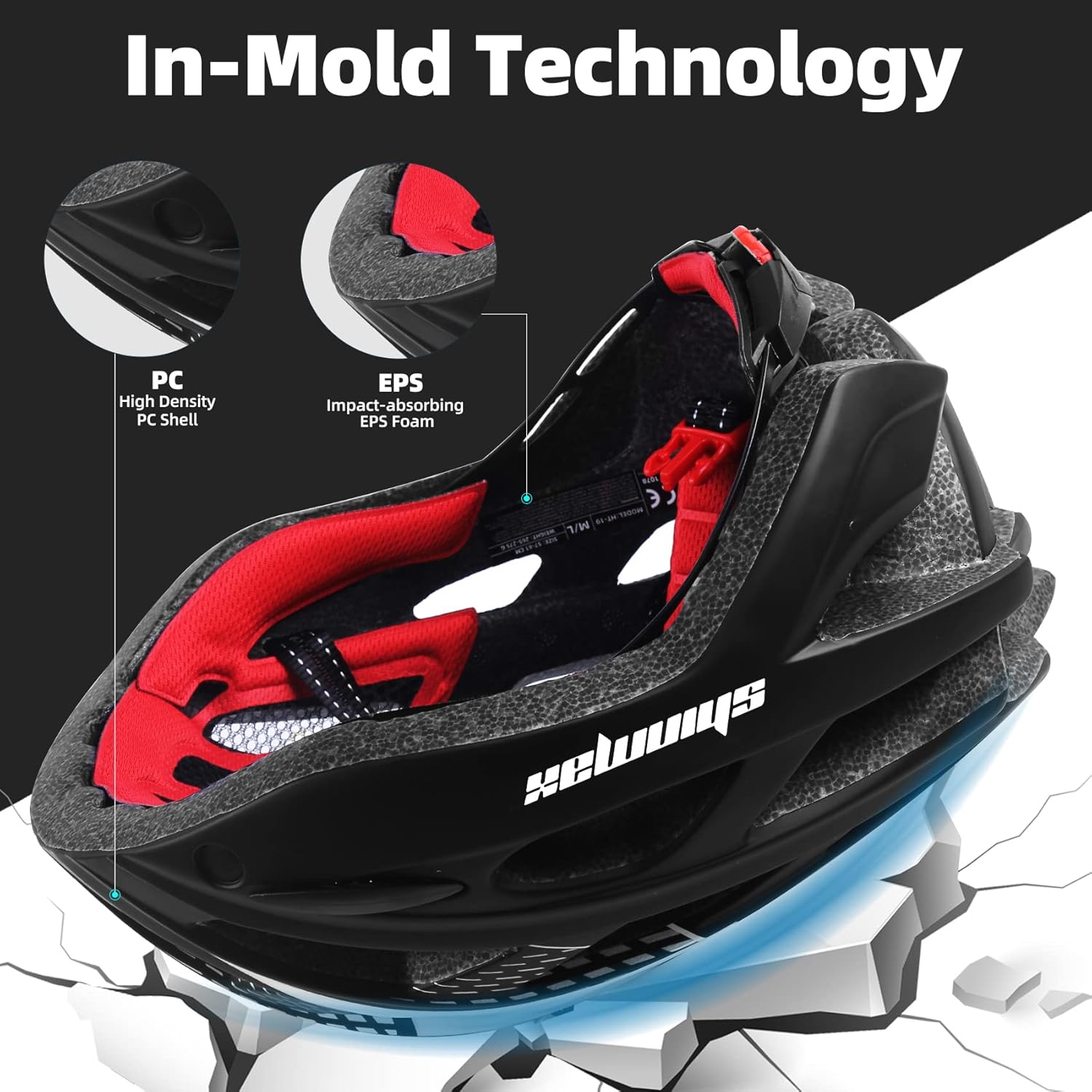
There are two constructions in this shortlist and they cool differently because they are built for different crashes. In-mold helmets fuse a thin polycarbonate skin directly to the foam liner, which lets designers cut large openings without the shell losing its shape. Hardshell helmets use a thicker plastic outer that is bonded or riveted over the foam, which resists scuffing across pavement much better and limits how much material can be removed.
The OutdoorMaster in this list is the hardshell case. It carries two removable liners and a rounder profile that covers more of the back of the head, and it is the helmet you would pick for a skatepark or a commute with frequent low speed spills. It also runs warmer than the road shells here, and no amount of vent counting changes that, because the shell simply has less open area.
The road and mountain shells go the other way. The Bell Thalia, the Bell Richter, and the Retrospec Dakota all use lighter constructions with wider openings, which is the right choice if your riding is on roads and paths at steady speeds where airflow does the cooling work for you.
Fit Systems, and Why a Loose Helmet Feels Hotter
A helmet that shifts around does not ventilate properly. When the shell sits too low at the front, the intake openings point at your eyebrows instead of at oncoming air. When it perches too high, the channels lift away from the scalp and the air runs over an empty gap rather than across skin. Both feel like poor ventilation and both are fit problems.
Dial retention systems, the plastic wheel at the back of the cradle, are the reason modern helmets stay put. Turn the dial and a band tightens around the base of the skull just above the neck, which holds the helmet level without needing the chin strap to do that job. Every model in this shortlist has some form of adjustable cradle, but the range of adjustment varies, and a cradle with vertical height adjustment lets you tune how the front sits over your brow.
Straps deserve a moment too. The junction where the front and rear straps meet should sit just below the ear, and helmets with fixed splitters rather than sliding ones can put that junction in an awkward spot for some head shapes. It is a small detail that decides whether the strap rubs on every ride.
Padding Thickness Cuts Both Ways
The pads inside a helmet do two jobs that fight each other. They take up the space between the foam and your head so the fit is comfortable, and they soak up sweat before it runs into your eyes. Thick, plush padding does both well and blocks the internal channels while doing it. Thin padding leaves the channels open and transmits every ridge of the liner to your scalp.
Most riders end up preferring a middle path, with pads at the brow where sweat collects and thinner or absent padding across the crown where the channels need to stay clear. Helmets that ship with two pad sets, as the OutdoorMaster does, let you make that call after a few rides instead of at the checkout page.
Whatever thickness you land on, the pads should be removable and washable. Salt from dried sweat stiffens foam pads and makes them abrasive, and a helmet with glued-in padding gives you no way to fix that.
Weight, and Where It Sits
Helmet weight is usually discussed as a total, but the number that your neck notices is how that mass is distributed. Weight concentrated at the rear of the shell, which is what happens when a battery light is built into the tail, acts on a longer lever than the same weight sitting over the crown. On a short commute this is invisible. On a long climb where your head is tilted up, it is not.
Lighter shells also tend to ventilate better as a side effect, because the material that was removed to save weight was usually removed from around the vents. The Exclusky mountain helmet is the clearest example of that relationship in this shortlist, and the hardshell OutdoorMaster is the opposite end of it.
If you are choosing between two helmets that fit equally well, the lighter one will almost always be the cooler one. That correlation is not a law, but it holds often enough to be a useful tiebreaker.
Certification Is the Floor Everyone Meets
Bicycle helmets sold in the United States must meet the Consumer Product Safety Commission standard, and every helmet in this shortlist carries that certification. This is worth understanding clearly, because it means certification is not a differentiator between these models. A budget helmet that meets the standard has passed the same impact and retention tests as an expensive one.
What certification does not measure is rotational impact, the twisting force that comes from hitting the ground at an angle rather than straight on. Some helmets add a low friction layer inside the shell to address this, and that layer is a genuine addition rather than a marketing one. None of the shells in this shortlist are built around that feature, so if it is a priority for you, treat it as a separate search.
The other thing the standard does not cover is age. Expanded polystyrene degrades slowly with heat and ultraviolet exposure, and a helmet left on a hot dashboard through a summer is not the helmet it was when it was new. Replacement after any real impact is not optional, because the foam crushes once and does not recover.
Lights and Reflectors, and What They Cost in Airflow
Integrated rear lights have become common on commuter helmets, and they solve a real problem: a light mounted on the helmet sits higher than one on the seatpost, which puts it in the eyeline of drivers behind you and keeps working when a bag covers your bike-mounted light. The VICTGOAL and Shinmax models in this shortlist both build a light into the tail.
The trade is exhaust area. A light housing occupies the rear of the shell, which is exactly where hot air needs to escape, so a lit helmet with the same intake area as an unlit one will move less air overall. For riding at dusk in traffic, that trade is usually worth taking. For a midday climb in summer, it is not.
Remember that integrated lights need charging, and a helmet is easier to forget than a bike light you take inside with you. Reflective strips and bright shell colors need no charging at all, and they are the reason a plain white or high visibility shell remains a sensible default.
Sizing Ranges and the Gaps Between Them
Helmet sizing is quoted as a head circumference range, measured with a tape just above the ears and eyebrows. The catch is that a single shell often covers a wide range using padding and the retention dial, so two helmets that both claim to fit a 58 centimeter head can sit very differently on it. Being at the very top of one size range usually feels worse than being in the middle of the next size up.
The Schwinn Thrasher states its range plainly at 58 to 62 centimeters for riders aged fourteen and up, which is the kind of specificity worth looking for. Helmets described only as adult or youth without a measurement leave you guessing, and a helmet that does not fit is one you will wear loose or leave at home.
Head shape matters alongside circumference. Some riders have longer, narrower skulls and find round helmets rock side to side even when the dial is tight. If a helmet fits front to back but wobbles laterally, the shell shape is wrong for you and no amount of padding fixes it properly.
What Gets Into Open Vents
Large intakes let in air, and air carries things. Insects are the common complaint on summer evening rides, and a bee that gets trapped against the scalp inside a channel is a genuine hazard rather than an annoyance. Some helmets fit fine mesh across the front openings, which costs a small amount of airflow and solves the problem entirely.
Rain is the other one. Open vents mean water reaches your head immediately, which is refreshing in warm weather and miserable in cold. Riders in wet climates often keep a thin cap to wear under the helmet in winter, which is a better answer than choosing a warmer helmet you will regret every summer.
Sun is worth a mention as well. A helmet with very large openings will let you burn through the gaps on a long day out, particularly if your hair is short or thinning. Sunscreen on the scalp sounds fussy until the first time it is needed.
| Model | Shell type | Built-in light | Best suited to |
|---|---|---|---|
| Schwinn Thrasher | In-mold microshell | No | Road and path riding in heat |
| OutdoorMaster | Hardshell, two liners | No | Skate parks, low speed commuting |
| Retrospec Dakota | Hardshell multi-sport | No | Shared use across riders |
| Shinmax | In-mold with rear module | Yes | Dusk commuting, detachable visor |
| VICTGOAL | In-mold with rear module | Yes, rechargeable | Traffic visibility |
| Exclusky | Lightweight in-mold | No | Long climbs, mountain use |
| Bell Richter | In-mold youth fit | No | Younger riders |
| Bell Thalia | In-mold, ponytail port | No | Riders with longer hair |
If you ride at night regularly, pair whichever helmet you choose with proper bike lighting rather than relying on a helmet module alone. Our outdoor gear guides cover the rest of the kit.
Why You Should Trust Us
We build these shortlists from listings that real buyers have used and rated, and we read what those buyers say about heat, fit, and durability rather than repeating the specification sheet back to you. Every helmet here carries current certification and has enough rating history to show how it holds up beyond the first week.
We do not accept payment for placement, and when a product has a real drawback we say so in its entry. Where a helmet trades ventilation for coverage or for a built-in light, that trade is stated plainly, because the right helmet depends on which side of it you want to be on.
Final Thoughts
The Schwinn Thrasher is our best overall pick because it does the simple things correctly: large low intakes, open rear exhaust, a clearly stated size range, and no rear hardware blocking the airflow path. It is the helmet to buy if staying cool is the reason you are shopping.
The Retrospec Dakota is our best value choice, a multi-sport hardshell that fits a wide range of heads and shrugs off the scrapes that come with commuting and shared use. For riders who finish in the dark, the VICTGOAL earns its place with a rechargeable rear light that sits high in traffic sightlines, and the Exclusky is the one to take up long climbs where every gram and every open channel counts.
Whichever you choose, buy the size that matches your measured head circumference rather than the one that looks right, and replace any helmet that takes a real impact. For more riding and outdoor equipment, see our latest guides.
Frequently Asked Questions
Does a ventilated bike helmet really run cooler than a regular one?
Yes, but the difference comes from the internal channels rather than the number of holes. A helmet with deep front intakes connected by grooves in the liner to open rear ports will move noticeably more air across your scalp than a shell with the same number of openings punched into flat foam. At low speeds the gap narrows, since airflow depends on how fast you are moving.
How many vents should I look for in 2026?
Treat vent count as a category signal rather than a target. Road oriented shells generally sit in the high teens or low twenties, while hardshell commuter and skate styles run closer to ten. Once you have picked a category, compare intake size and internal channeling instead, because within a category the counts stop being meaningful.
Do built-in lights make a helmet less ventilated?
They can, because the light housing usually occupies the rear of the shell where hot air needs to exit. That does not make lit helmets a bad choice, it just means a helmet with a rear module and a plain road shell with the same intake area will not cool the same. If you ride in traffic at dusk, the visibility is generally the better trade.
Are more expensive helmets safer?
Not in terms of the certification they carry. Every bicycle helmet sold legally in the United States meets the same federal impact standard, so a budget model has passed the same tests as a premium one. What you gain higher up the range is lighter construction, better ventilation, more refined fit systems, and sometimes a rotational impact layer.
When should I replace a bike helmet?
Immediately after any impact, even one that leaves no visible mark, because the foam liner crushes once and cannot absorb a second hit in the same place. Without an impact, replace it when the shell is cracked, the straps or retention cradle are damaged, or the foam has been exposed to heat and sunlight for years. Browse more gear in our category directory.



Write Your Review
No reviews yet. Be the first to share your experience!