

A bathroom is the hardest room in the house to keep smelling clean, and the reason is not exotic. It is a small, humid box lined with soft towels that hold onto odor, often with no window and an extractor fan that runs for a few minutes a day. Whatever you put in there is working against damp, still air in a confined space rather than against open volume, which is why a product that performs well in a living room can vanish in a bathroom. We sorted 8 bathroom air fresheners from Mrs. Meyer’s Clean Day, Febreze, Renuzit and more by delivery mechanism, coverage and how long each one keeps working before it needs attention.
Our top pick is the Febreze Plug-In Scented Oil Air Freshener for its continuous adjustable output, which is the format that suits a small humid room between cleanings. Below we group the field by how each product actually delivers scent, because that decision matters far more than the fragrance name on the box. For the rest of the cupboard, our health and household section covers the adjacent supplies.

Pros
- Runs continuously so the room is covered between visits
- Intensity dial lets you keep output sensible in a small bathroom
- Refills are the easiest in this category to keep stocked
- Label carries an explicit odor-fighting claim rather than fragrance only
Cons
- Occupies an outlet that a bathroom may not have spare
- Oil keeps evaporating whether anyone is home or not
- Stated duration assumes the lowest dial setting
The Febreze Plug-In is the default answer for a bathroom that smells stale rather than a bathroom that smells of one specific thing. A warmer heats the scented oil so fragrance leaves the wick constantly, which means the room is being managed while nobody is in it. That is the whole argument for the format, and this is the most widely supported version of it.
The intensity dial is the feature that matters most in a small room. Coverage numbers on packaging are written for open living spaces, so a bathroom usually wants the lower half of the range. Being able to sit at a soft setting is also what lets a refill reach its stated lifespan, since duration is always quoted at the gentlest position.
Refill supply is an underrated advantage. This warmer takes a refill line that is stocked almost everywhere and sold in multipacks, so the ongoing commitment is easy to keep up with. A plug-in you cannot conveniently refill turns into a dead unit on the wall within a couple of months.
The honest limitations are structural rather than product faults. It needs a free outlet, ideally low and clear of towels or curtains, and it consumes oil at the same rate whether the house is occupied or empty. Households that want zero outlet use should look at the gel and passive options further down this list.
Bottom line: the format that solves the everyday problem, in the version with the best refill support and the most usable strength control.
- Format: warmed scented oil plug-in
- Output: adjustable intensity dial
- Claim on label: odor-fighting
- Refills: sold separately and in multipacks
- Placement: upright outlet, clear of fabric and furniture
- Suited to: bathroom, kitchen, hallway, bedroom
Buy this if the complaint is that the bathroom smells neglected whenever someone walks in, and if there is an outlet you can spare at a low, clear position. It suits busy family bathrooms where showers run daily and a baseline needs to hold all day. Skip it if the only socket sits above a basin, if the room is used twice a week, or if anyone in the household reacts to continuous synthetic fragrance, in which case a gel or a plant-based option is the better fit.
Fit the warmer upright exactly as the packaging specifies so oil cannot leak, and never plug it in behind a towel, a curtain or furniture where warm air cannot rise away. Keep it clear of direct splashes from a shower or basin, and do not stack it under an outlet already carrying a heavy adapter. Wipe the plug contacts if a refill has weeped, replace refills rather than topping them up, and follow the keep-out-of-reach guidance on the pack in homes with young children or pets.

Pros
- Ten-count pack covers a bathroom for a long stretch
- Essential-oil blend reads lighter than heavy synthetic fragrance
- Works with the adjustable Air Wick warmer range
- Fresh tropical profile suits confined rooms
Cons
- Refills only, so you need a compatible warmer already
- A tropical profile is divisive in a household with mixed tastes
This is a refill pack rather than a starter unit, which is exactly what most people should be buying once a warmer is on the wall. The ongoing cost and hassle in this category is refills, not hardware, and a ten-count pack turns that into a once-a-year task instead of a monthly one.
The essential-oil blend is the reason to pick this line over a purely synthetic one. It reads lighter in a small room, which matters in a bathroom where packaging coverage figures are wildly generous compared with the actual volume of air. On a warmer with a dial, the lower half of the range is usually enough.
The Hawaii profile is tropical and fruity rather than clean and linen-like. That is a genuine preference split: some households find it cheerful, others find anything sweet becomes cloying in a confined space. If your instinct is towards fresh and citrus rather than fruit, the lavender option in this same range is the safer buy.
The obvious catch is compatibility. These are refills for an Air Wick warmer, so they are the wrong purchase if you have no plug-in yet or you own a different brand of warmer. Check what is on your wall before ordering the pack.
Bottom line: the sensible way to run a plug-in long term, provided you already own the warmer and like a tropical scent.
- Format: scented oil refills for plug-in warmers
- Pack: ten refills
- Fragrance: Hawaii, tropical profile
- Formulation: scented oil with essential oils
- Compatibility: Air Wick plug-in warmers
- Not included: warmer unit
Fit a refill upright into the warmer, wait for the wick to draw before judging strength, and give it a full day at a low setting before deciding whether to turn it up. In a bathroom, start at the bottom of the dial: scent fatigue sets in within days, so the setting that feels right after a week is usually stronger than visitors would choose. Store spare refills upright in a cool cupboard, and swap rather than refill when a bottle runs dry.
Buy the refill multipack only if you already have a compatible warmer, otherwise start with a warmer and a single refill to confirm you like the profile. Consider how many plug-ins are running in the house: a household with three units gets through a ten-count pack roughly three times faster than a household with one. If several people share the bathroom, a lighter essential-oil profile at a low setting causes fewer complaints than a strong fragrance at any setting.

Pros
- Immediate response when you actually need it
- Costs nothing while it sits in the cupboard
- Odor-fighting claim rather than fragrance only
- Fine mist disperses without wetting surfaces
Cons
- Does nothing between uses
- Very easy to overdo a single spray in a small bathroom
- Aerosol cans need sensible storage away from heat
A spray is not competing with a plug-in, it is the other half of the same job. Continuous products hold a baseline so a room never smells neglected, and a spray handles the specific moments a baseline was never going to cover. Judged on that role, this is the standard against which the others in the category are measured.
The mist is fine enough to hang and disperse rather than land wet on a mirror or a cistern lid, which is the practical difference between a room spray and a general household aerosol. That matters in a bathroom, where every surface is either glass, tile or fabric.
The label carries an odor-fighting claim rather than being sold as fragrance alone, which is worth reading precisely: the maker states the formula acts on odor rather than only adding scent on top. That is a stronger position than a purely fragranced spray, and it is why this can be used sparingly rather than heavily.
The discipline needed is restraint. A bathroom is a fraction of the volume the packaging is written for, so a short press from the doorway is usually enough and two full presses is too much. Over-spraying is the most common complaint about this format, and it is a user habit rather than a product flaw.
Bottom line: the on-demand half of a proper bathroom setup, and the product to keep in the cabinet alongside whatever runs continuously.
- Format: aerosol room spray
- Claim on label: odor-fighting
- Delivery: fine mist, on demand
- Use: short press, room air rather than surfaces
- Storage: cool cupboard away from heat sources
- Role: companion to a continuous product
Spray upward into the air from the doorway rather than downward at surfaces, and use one short press to begin with. In a small bathroom the mist needs a moment to spread, so wait before deciding it was not enough, since the second press is where most people overshoot. Run the extractor fan at the same time rather than instead, because moving humid air out is what stops odor returning. Keep the can upright in a cupboard away from heat.
Aerosols need to be stored away from heat and direct sunlight, which in a bathroom means a cabinet rather than a window ledge or a shelf above a radiator. Do not spray towards an open flame such as a candle, and do not spray directly onto fabric, polished surfaces or anyone's skin. Follow the ventilation guidance printed on the can, and in homes with children keep it in a closed cupboard rather than on an open shelf.

Pros
- Bright garden-fresh profile rather than a laundry scent
- Pump bottle avoids aerosol storage constraints
- Matches the wider Clean Day cleaning range
- Presentable enough to leave on a shelf
Cons
- Pump droplets are heavier than an aerosol mist
- Sold as fragrance rather than carrying an odor-fighting claim
This is the alternative for anyone who finds mainstream air freshener profiles too close to laundry detergent. Lemon Verbena is a bright, herbal, garden-leaning scent, and it is the reason this line has a following that has little to do with air freshening technology.
It is a pump spray rather than an aerosol, which changes how it behaves. Droplets are heavier and travel less far, so it works best sprayed into the middle of the room rather than from a doorway, and it is worth keeping it away from mirrors and polished surfaces where heavier droplets can spot.
Positioning matters when you read the label. This is sold as a fragrance product rather than carrying an odor-fighting claim, so treat it as something that adds a scent rather than something that acts on odor. In a bathroom that is genuinely clean and ventilated, that is often all that is wanted.
The bottle is also the most presentable in this list, which is a real consideration in a guest bathroom where a plastic plug-in on the wall looks out of place. If the room needs to look tidy as well as smell fresh, that counts for something.
Bottom line: the pick for a garden-fresh scent and a bottle you are happy to leave on show, not the pick for tackling stubborn odor.
- Format: pump room spray
- Size: eight fluid ounces
- Fragrance: Lemon Verbena
- Range: Mrs. Meyer's Clean Day
- Positioning: fragrance product
- Use: on demand, no outlet required
This suits households that already use the Clean Day cleaning range and want the bathroom to smell consistent with the rest of the house, and anyone who dislikes the sweet or linen profiles that dominate this category. It is a good guest bathroom choice because the bottle looks intentional on a shelf. It is the wrong choice if the bathroom has a persistent odor problem, where a continuous format with an odor-fighting claim does more useful work.
Spray upward into the centre of the room rather than at surfaces, since pump droplets are heavier than aerosol mist and can spot glass or polished wood. Two light presses is usually enough in a bathroom. Keep the bottle upright, prime the pump if it has stood unused for weeks, and wipe the nozzle if it starts to spit. Store it out of direct sunlight, which dulls citrus and herbal profiles faster than most fragrance families.

Pros
- Lavender and chamomile is a calmer profile for confined rooms
- Ten refills per pack keeps restocking rare
- Essential-oil blend rather than fragrance alone
- Works across the Air Wick warmer range
Cons
- Refills only, a compatible warmer is required
- Lavender is a strong preference and not universally liked
Lavender and chamomile is the profile to pick when a household cannot agree on fragrance. It reads as calm and soft rather than sweet, which is what makes it one of the few scents that works in both a bathroom and an adjoining bedroom without clashing.
Like the tropical option, this is a refill pack for an existing warmer rather than a starter kit, and buying refills in tens is how anyone running a plug-in long term should be doing it. The hardware lasts, the oil does not, and a large pack turns a recurring errand into an occasional one.
The essential-oil formulation runs lighter than a purely synthetic fragrance at the same dial setting. In a small bathroom that is an advantage rather than a weakness, because packaging coverage figures assume rooms several times the size and the usual mistake here is running things too strong.
The caution is preference rather than performance. Lavender divides people more sharply than fresh or citrus profiles, and a scent nobody in the house likes ends up unplugged regardless of how well it works. If the household is undecided, buy a single refill before committing to a pack of ten.
Bottom line: the calm, low-conflict profile in this range, and a sensible bulk buy once you know lavender suits the household.
- Format: scented oil refills for plug-in warmers
- Pack: ten refills
- Fragrance: lavender and chamomile
- Formulation: scented oil with essential oils
- Compatibility: Air Wick plug-in warmers
- Not included: warmer unit
This is for households already running an Air Wick warmer who want a softer, calmer scent than the fruity and tropical options, and for bathrooms that open directly onto a bedroom where a loud fragrance would carry. It also suits anyone buying for a rental or a guest room, where a neutral profile is safer than a distinctive one. Skip it if anyone in the house dislikes lavender, because a ten-count pack is a long commitment to a scent you will not use.
Check the warmer on your wall before ordering, since refills are brand-specific and a mismatched bottle simply will not seat. Work out your consumption honestly: one plug-in on a low setting stretches a ten-count pack across a long period, while three units running hard will get through it quickly. If you want to hedge, split the household between this and a fresher profile rather than buying two packs of the same scent.

Pros
- No outlet, battery or spray needed
- Twisting cone gives real control over strength and lifespan
- Remaining gel is visible so you know when to replace
- Twelve-pack covers a bathroom for a long stretch
Cons
- Softer output than a warmed plug-in
- Strength tapers as the gel shrinks
- Needs a stable shelf out of reach of children and pets
The gel cone is the answer for the very common bathroom that has no outlet to spare. It works by exposing a block of scented gel to the air, so the only thing controlling strength is how much surface you uncover, and the twisting shell makes that adjustment genuinely useful rather than decorative.
That mechanism also gives the clearest feedback in this whole category. You can see the gel shrinking, which means you know where you are in its life without guessing, and a household where nobody notices a dead plug-in for a fortnight will find that visibility worth more than raw output.
Output is softer than a warmed oil, and that is a fair criticism only in a large room. A bathroom is small enough that a fully opened cone is usually plenty, and running it half open extends the useful life considerably. The pattern is strong at first and gentler as the gel shrinks, which is the trade-off against a warmer holding a steadier level.
Buying in a twelve-pack is what turns this from a stopgap into a plan. One cone in the bathroom, one in a cloakroom and one in a laundry area still leaves a long supply on the shelf, and there is no hardware to break or replace along the way.
Bottom line: the most practical continuous option when there is no spare socket, and the easiest one to keep running without thinking about it.
- Format: adjustable gel cone
- Size: seven ounce cone
- Pack: twelve cones
- Control: twist shell to expose more or less gel
- Power: none required
- Fragrance: After the Rain
This is the pick for bathrooms with no free outlet, for rented homes where you would rather not commit a socket, and for guest bathrooms used a couple of times a week where continuous warmed output would mostly be wasted. It also suits anyone who wants to see how much life is left rather than discovering a dead unit weeks later. Skip it if the room is large or heavily used and you want a strong, steady level all day, which is what a warmer does better.
Place the cone on a stable shelf with air circulating around it rather than inside a closed cabinet, where the fragrance simply stays put. Keep it clear of shelf edges and out of reach in homes with young children or pets, since a gel block at grabbing height is the obvious hazard with this format. Do not sit it in direct sun or on a warm surface, which accelerates shrinkage, and follow the handling guidance printed on the pack.

Pros
- Designed specifically for small rooms rather than open plan
- No outlet, cord or battery
- Discreet enough to sit out of sight
- Set and forget until it needs replacing
Cons
- Fixed output with no strength adjustment
- Limited coverage if the room is larger than a bathroom
This is the third Febreze mechanism on the list and it is genuinely a different product rather than another scent of the same thing. There is no plug and no spray button: a scented core sits behind a vented shell and releases fragrance passively, sized deliberately for a room the size of a bathroom.
The appeal is that it asks nothing of you. There is no outlet to give up, no dial to get wrong and nothing to press, which makes it the easiest thing on this list to live with in a small guest bathroom or a cloakroom that nobody thinks about between visits.
The cost of that simplicity is control. Output is fixed, so if it reads too strong or too soft for your room your only options are placement and airflow, and there is no equivalent of turning a dial down. Tucking it lower or further from the door softens the effect noticeably.
Coverage is the other boundary. It is sized for small spaces and it behaves accordingly, so a large family bathroom with a window open will stretch it. In the confined windowless rooms it is aimed at, that sizing is the point rather than a shortfall.
Bottom line: the least demanding way to keep a small bathroom covered, provided you accept a fixed output.
- Format: passive vented unit
- Power: none required
- Output: fixed, not adjustable
- Claim on label: odor-fighting
- Sizing: designed for small spaces
- Placement: shelf, ledge or behind a cistern
Open the unit as the pack directs and place it low and clear rather than high on a shelf, since warm air rises and a unit near the ceiling scents mostly the ceiling. If it reads too strong in the first days, move it away from the door or behind an object to slow the airflow across it rather than covering the vents. Replace on the schedule the packaging gives, because a passive core fades gradually and is easy to stop noticing.
Choose this when the room is genuinely small and there is no outlet you want to give up, and choose a warmer instead when the room is busy and you want a steady, adjustable level. It is a good second unit for a cloakroom or an en suite where a full plug-in would be overkill. Buy a single one first to see how the fixed strength lands in your room, because unlike a dial there is no way to correct it afterwards.

Pros
- Plant-based formulation with essential oils
- Sold as an odor eliminator rather than fragrance alone
- No outlet, battery or spray required
- Softer profile suits fragrance-sensitive households
Cons
- Lower and softer output than a warmed plug-in
- Working life shortens noticeably in warm rooms
This is the option for the household where conventional air fresheners are the problem rather than the solution. It is a plant-based gel built around essential oils, and it is deliberately quieter than anything warmed, so the right way to judge it is whether the room smells neutral rather than whether the fragrance is obvious from the doorway.
The label position is worth reading carefully. It is sold as an odor eliminator rather than as fragrance alone, which means the maker states it acts on odor rather than covering it. That is the same distinction that separates the odor-fighting products in this list from the pure fragrance sprays.
Working life is stated as a window rather than a fixed figure, and the reason is airflow and temperature. A jar in a warm, well ventilated bathroom will finish towards the short end of that window, one in a cool cloakroom towards the long end. As with any gel, the level in the jar tells you where you are.
Buying three at once is the sensible unit here, because these suit distributed use: one in the bathroom, one in a laundry basket area, one near a litter tray or a bin. That is a different pattern from a plug-in, which concentrates everything at one outlet.
Bottom line: the plant-based, low-key pick for fragrance-sensitive homes and for spreading around several small problem spots.
- Format: passive gel jar
- Size: seven ounces per jar
- Pack: three jars
- Formulation: plant-based with essential oils
- Positioning: odor eliminator
- Power: none required
This suits anyone who finds warmed synthetic fragrance overwhelming, households with a preference for plant-based products, and anybody who wants to place several small units around a home rather than one strong one. It is also a reasonable choice for a bathroom that is already clean and ventilated and simply needs the last step. It is not the pick for a large, heavily used bathroom that needs a firm baseline, where a warmer with a dial does more.
Open the jar as the pack directs and leave it somewhere with air moving around it, not sealed inside a cabinet where the gel will simply dry out unnoticed. Keep it off warm surfaces and out of direct sunlight, both of which shorten its life, and place it out of reach in homes with young children or pets. Do not decant the gel into another container, and follow the disposal guidance on the pack when the jar is spent.
How to Choose a Bathroom Air Freshener
Four delivery formats, four different jobs. Read the first section even if you skip the rest, because choosing the wrong format is the mistake that leaves a bathroom smelling the same as it did before.
Plug-In, Aerosol, Gel, or Passive Vent

A plug-in warms a scented oil refill so fragrance leaves the wick constantly. It is the only format that keeps a room covered while nobody is in it, which is what most people are really asking for in a bathroom, and the better units let you turn the output up or down. The trade-off is that it needs a free outlet at a sensible height, and the oil keeps evaporating whether you want it to or not.
An aerosol or pump spray is the opposite: nothing happens until you press the button, then a lot happens at once. It is the strongest immediate response available and it costs nothing when it sits idle, which makes it the natural companion product rather than a competitor. What it will not do is manage the room between visits, and in a small bathroom it is very easy to overdo a single spray.
Gel cones and gel jars sit somewhere in between. They release scent passively as the gel shrinks, they need no outlet and no battery, and the adjustable cone designs let you expose more or less surface area to control strength. They are the format for a bathroom with no free socket, and the visible shrinking gel is the clearest indicator of remaining life in this whole category. Passive vented units are a fourth option built specifically for small spaces, using a scented core behind a vented shell.
Continuous Coverage Versus On Demand
Decide which problem you are solving before you look at fragrances. If the complaint is that the bathroom smells stale whenever anyone walks in, you need something running all the time, which means a plug-in, a gel or a passive vent. If the complaint is a specific event, a spray is the honest answer and no amount of continuous fragrance replaces it.
Most households end up with both, and that is not a failure of the continuous product. A plug-in holds the baseline so the room never smells neglected, and a spray handles the moments that a baseline cannot cover. Buying one of each is a more useful pair than buying two plug-ins in different scents.
Guest bathrooms and main bathrooms have different needs too. A guest bathroom used twice a week is a good candidate for a gel or a passive vent, because continuous output in a rarely used room is mostly wasted. A family bathroom running showers twice a day is where an adjustable plug-in earns its outlet.
How Long a Refill Really Lasts
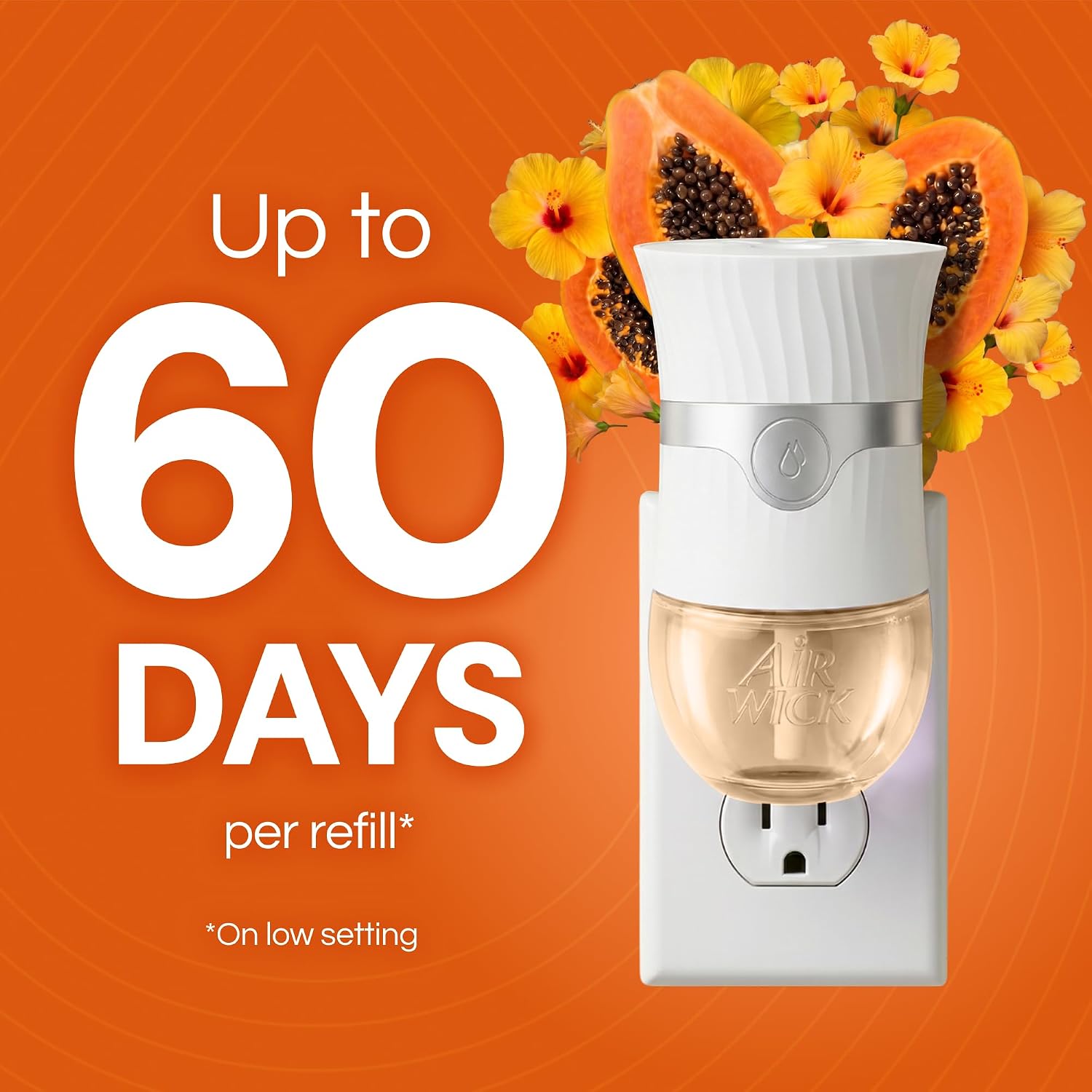
Stated duration is always given at the lowest setting. A plug-in advertised at fifty days on the dial is quoting the gentlest position, and running the same refill at maximum can cut that lifespan by more than half. That is not a defect, it is arithmetic: the same volume of oil leaving faster runs out sooner, and it is worth knowing before you judge a product by how quickly the bottle empties.
Gel products are more honest about it because you can see the level. An adjustable cone twisted fully open runs strong and short, twisted down it runs soft and long, and the remaining gel tells you where you are without guesswork. That visibility is a genuine reason to prefer gel in a room where nobody notices a dead plug-in for a fortnight.
Multi-count refill packs change the calculation more than the headline duration does. A plug-in bought as a single unit is one purchase, but the refill cadence is the ongoing commitment, and packs that arrive in tens exist because that is how this category is actually consumed. Check that the refill you like is sold in a multipack before you commit to a warmer.
Odor Fighting Claims Versus Fragrance
Products in this category split into two label positions. Some are sold purely as fragrance, which means they add a scent and nothing more. Others carry an odor-fighting or odor-eliminating claim on the label, meaning the maker states the formula acts on the odor molecules rather than only covering them. Read the label wording rather than the marketing image, and treat the claim as exactly what it says, no more.
Plant-based and essential-oil formulations are the third position, and they attract buyers who are sensitive to heavy synthetic fragrance. These generally run softer than a conventional plug-in at the same setting, so judge them on whether the room smells neutral rather than on whether the fragrance is obvious from the doorway. A softer product that leaves a room smelling clean is doing the job.
None of this replaces ventilation. Every product here works better in a bathroom where the fan runs long enough to pull the humidity out, because damp fabric is the reservoir that keeps releasing odor after the source is gone. Fragrance is the last step in that chain, not a substitute for the first one.
Scent Strength in a Small Room
Coverage figures on packaging are written for open-plan rooms, and a bathroom is a fraction of that volume with far less air movement. The practical consequence is that a plug-in set to the middle of its dial in a bathroom is often as strong as the same unit at maximum in a bedroom. Start low and work up rather than the reverse, because a room that has been over-scented takes days to settle.
Scent fatigue makes this harder to judge. After a few days your nose stops registering a fragrance you live with, which tempts people into turning the dial up for a room that visitors already find strong. Ask someone who does not live there, or judge it when you come back from a day out rather than after a shower.
Fragrance family matters here more than in a larger room. Fresh, citrus and linen profiles read as clean in a confined space, while heavy sweet or gourmand profiles can turn cloying quickly. If a household includes anyone sensitive to fragrance, a lighter profile at a lower setting is the difference between a product that stays plugged in and one that gets unplugged.
Placement, Sockets and Household Safety

Bathroom sockets are frequently in awkward places, and plug-in warmers have real placement rules. Keep the unit upright as the maker specifies so the oil cannot leak, avoid outlets directly behind a towel, curtain or furniture where warm air cannot rise away, and do not fit one below an outlet already carrying a heavy adapter. If the only socket is above a basin, a gel or passive unit is the better answer.
Height changes the result as well as the safety. Warm air rises, so a unit fitted low distributes through more of the room than one plugged in at shoulder height, where the scent tends to hang around the ceiling. Aim for the lowest safe outlet away from splashes, and keep the wall around it clear.
Households with young children or pets should follow the label rather than general advice. Scented oils, gels and sprays all carry their own handling instructions and keep-out-of-reach guidance, and gel cones in particular are at a height a curious toddler can reach if they sit on a shelf edge. Read the packaging on the specific product you buy and place it accordingly.
| Format | Best at | Weak at |
|---|---|---|
| Plug-in scented oil | Constant baseline coverage, adjustable output | Needs a free outlet, runs whether you are home or not |
| Aerosol or pump spray | Immediate response, costs nothing when idle | Does nothing between uses, easy to overdo |
| Adjustable gel cone | No outlet needed, remaining life is visible | Softer output, needs a shelf away from reach |
| Passive vented unit | Built for small spaces, nothing to plug in | Fixed strength, limited coverage in a larger room |
If you are refreshing the whole room rather than only the air, the cleaning and laundry picks in our home and kitchen section pair naturally with anything on this list.
Why You Should Trust Us
We build these lists from published specification and from the pattern of what long-term owners report, rather than from marketing copy. For every product here we looked at the delivery format, whether output is adjustable, the stated duration and the setting that duration assumes, refill availability and pack size, and the exact wording of any odor-fighting claim printed on the label.
We set aside near-identical listings that differ only in fragrance name or bundle size, so each entry is a genuinely different product rather than the same unit in another scent. Where a brand appears more than once, the entries are different mechanisms: a plug-in, a spray and a passive small-space unit are three different answers, not three versions of one. We also avoid repeating any health claim a label does not make.
Final Thoughts
Best overall is the Febreze Plug-In Scented Oil Air Freshener. It covers the baseline problem most people actually have, it lets you dial the strength down to something a small room can live with, and the refill supply is the easiest to keep stocked of anything here.
Best value is the Renuzit Adjustable Gel Air Freshener Cone. It needs no outlet, the adjustable cone gives you real control over strength and lifespan, the remaining gel tells you when to swap it, and it arrives in a multipack that covers a bathroom for the better part of a year.
For specific situations, the Febreze Air Mist Odor-Fighting Room Spray is the on-demand answer that belongs alongside a continuous product, the Air Wick Plug-In Scented Oil Refills with Essential Oils are the pick if you want a lighter essential-oil profile on a warmer, the Mrs. Meyer’s Clean Day Room Spray suits anyone who wants a garden-fresh scent rather than a laundry one, the Febreze Small Spaces unit is the choice for a bathroom with no free socket, and the Fresh Wave Lavender Odor Eliminator Gel is the plant-based option for fragrance-sensitive households. More picks for the rest of the house are indexed in our article archive and the category index.
Bathroom Air Freshener FAQs
Which type of bathroom air freshener works best in a windowless bathroom?
A continuous format, because a windowless room has no passive air exchange to reset it between uses. A plug-in scented oil is the strongest continuous option and the adjustable ones let you keep output sensible in a small space. If there is no free outlet, an adjustable gel cone or a passive vented unit does the same job more softly. Whichever you choose, run the extractor fan for longer than feels necessary, since damp air is what makes a windowless bathroom hold odor in the first place.
How long does a plug-in refill actually last?
Roughly a month to a month and a half at the lowest setting, and considerably less at the highest. Duration on the packaging is always quoted at the gentlest dial position, so a refill that seems to empty early is usually being run hard rather than failing. In a bathroom the low settings are generally enough anyway, which means most people can hit the stated figure comfortably if they resist turning the dial up during the first week.
Do gel cones work as well as plug-ins?
In a bathroom, close enough to matter. A bathroom is small, so the lower output of a gel is spread across far less volume than it would be in a living room, and the adjustable cone designs let you open them fully when you want more. What gel gives up is a constant level: it starts strong and tapers as it shrinks, whereas a warmer holds a steadier output until the refill is done. Gel wins on placement freedom, since it needs no outlet at all.
Does a bathroom air freshener remove odor or only cover it?
It depends entirely on what the label claims. Some products in this category are sold as fragrance only, and those add a scent on top of whatever is already there. Others carry an explicit odor-fighting or odor-eliminating claim, meaning the maker states the formula acts on odor molecules rather than masking them. Neither type substitutes for ventilation and cleaning, because soft furnishings hold odor and keep releasing it. Our health and household picks cover the cleaning side of that job.
Where should I place a bathroom air freshener in 2026?
Low and clear. Warm air rises, so a plug-in fitted at the lowest safe outlet spreads through more of the room than one at shoulder height, and it should never sit behind a towel, a curtain or furniture where warm air cannot escape. Keep any unit away from direct splashes and follow the upright orientation the maker specifies so oil cannot leak. Gels and passive units want a shelf with air around them rather than a closed cabinet, and in homes with children or pets both belong out of reach.







Write Your Review
No reviews yet. Be the first to share your experience!