

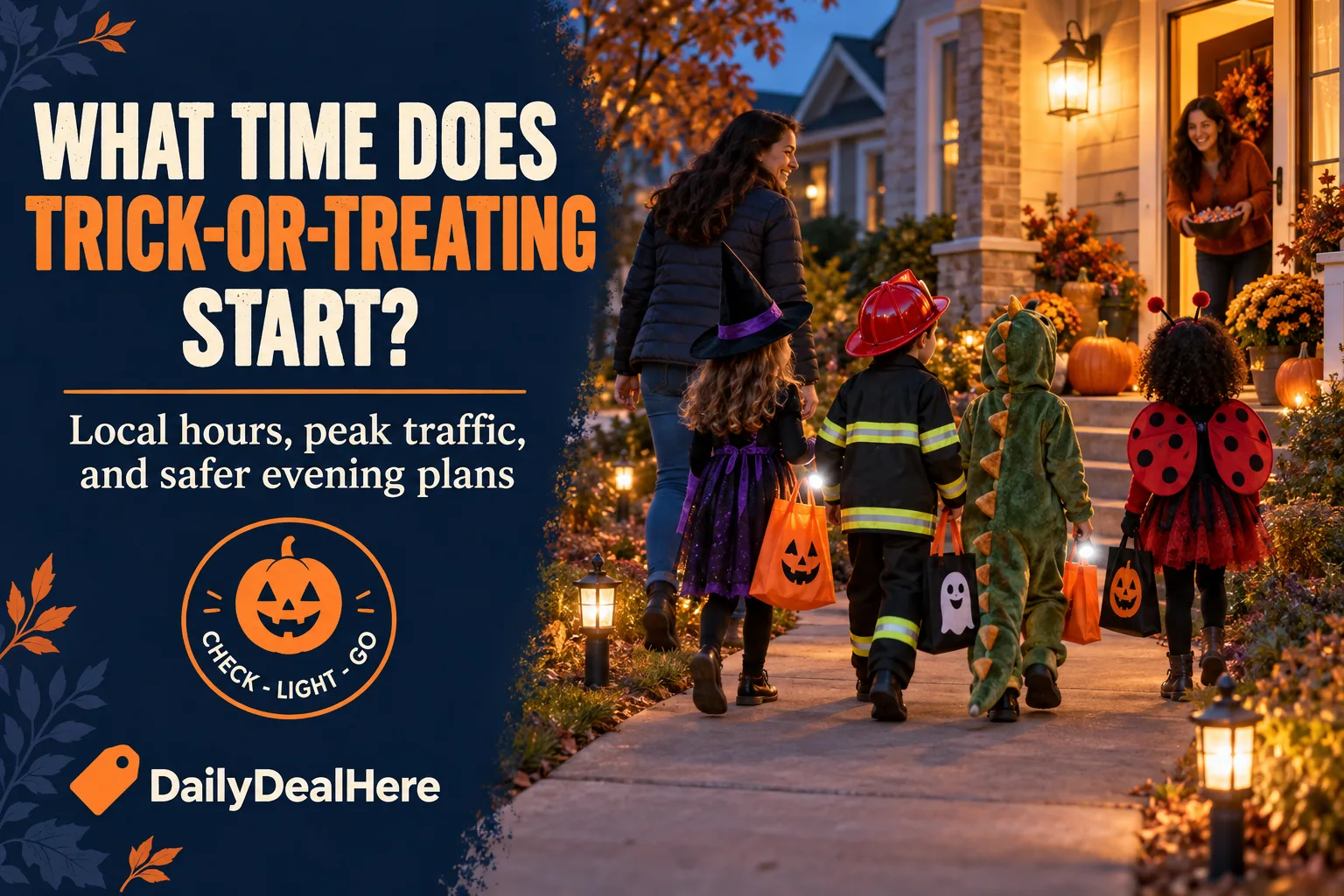
Trick or treating usually starts between 5:30 and 6:30 in the evening and winds down by 8:00 to 8:30, with the heaviest traffic in the two hours after sunset. Halloween is always October 31, and in 2026 that falls on a Saturday, which tends to push start times slightly earlier and end times later than a school night would.
Those are the national patterns. The number that actually governs your street is local, because thousands of towns publish official hours, some move the event to a nearby evening entirely, and neighbourhoods develop habits that no city hall ever wrote down. Below is how to find your real start time, what the traffic curve looks like hour by hour, how much candy each part of the evening consumes, and the practical points that make the night go smoothly at the door and on the sidewalk.
How to find your town’s actual hours
Four sources answer this faster than a general search, in descending order of reliability.
- The city or township website. Many publish official hours in the second half of October, often on the parks and recreation page rather than the front page.
- The police or sheriff social account. Local law enforcement posts hours and safety notes every year, and they are usually the first to announce a weather change.
- The school district calendar. Districts often list the community event time, and they are the authority people actually follow in practice.
- A neighbourhood group. The least official and often the most accurate, because it reflects what the street really does rather than what the ordinance says.
Where official hours exist they are usually advisory rather than enforced, but they shape behaviour strongly, because everyone who checked is working from the same window.
The evening hour by hour
| Time | Who is out | Share of the night’s candy |
|---|---|---|
| Before 5:30 | Very small children, often in daylight with parents | A small fraction |
| 5:30 to 6:30 | Preschool and early elementary, the first real wave | Roughly a quarter |
| 6:30 to 7:30 | The peak, mixed ages, most groups on the street | Close to half |
| 7:30 to 8:30 | Older children and teenagers, faster and in bigger groups | Most of the remainder |
| After 8:30 | Stragglers, thinning quickly | Very little |
The practical read on that table: if you are handing out, the bowl needs to be strongest between 6:30 and 7:30, and whatever is left at 8:00 will not last if the street is busy. If you are walking with small children, going out at 5:30 gets you the quiet, well lit portion of the evening and gets you home before the peak.
Why sunset matters more than the clock
The start time tracks daylight rather than the hour. In late October most of the continental United States sees sunset somewhere between about 5:45 and 6:20 in the evening, and the first groups tend to appear as the light goes rather than at a specific minute.
Two details follow from that. Households on the eastern edge of a time zone get dark earlier and start earlier, and households on the western edge of the same zone can still have usable light at 6:30. And the clock change matters: daylight saving time in 2026 does not end until the first Sunday in November, so Halloween still has the later evening light, and the following weekend will feel dramatically darker at the same hour.
If you want one rule rather than a range, plan to be ready fifteen minutes before local sunset. That is early enough to catch the first small children and late enough that you are not standing at the door in full daylight.
When towns move the date entirely
A meaningful number of communities do not use October 31 at all. Some move trick or treating to the preceding Saturday when the holiday falls midweek, some run it on a Sunday afternoon, and some hold a downtown or school event in place of a residential evening.
This is most common in smaller towns and in areas where a regional tradition has been in place for decades. It is also why asking a neighbour is more reliable than reading a national article, including this one. In 2026 the holiday lands on a Saturday, which reduces the number of places that shift it, since the main reason to move it is a school night.
If you have recently moved, the question worth asking is not what time it starts but whether the street participates at all. Some blocks have almost no traffic because families drive to a busier neighbourhood, and knowing that before buying candy saves a cupboard full of leftovers.
The porch light rule
The convention across most of the country is simple and worth honouring in both directions: a lit porch light means the household is handing out, and a dark one means it is not. Nobody polices it, and it prevents almost every awkward moment of the evening.
If you are participating, light the path as well as the door. The walkway is where people actually trip, and a dark step with a decoration on it is the classic hazard of the night. Battery pathway markers and battery operated candles handle this without running a cord across a wet lawn, which is the arrangement worth avoiding entirely.
If you are not participating, turn the light off before the first group arrives rather than partway through the evening, and consider a small sign if you are home with the lights on for other reasons. Older children read the signals correctly almost every time.
Walking with small children
The early window exists for a reason. Between 5:30 and 6:30 the light is usable, the streets are calmer, the groups are smaller and the pace suits short legs. Most households with children under six are home before the peak arrives, and that is the plan rather than a compromise.
A few things make that hour work. Feed them before you go, because the whole event runs on the assumption that nobody is hungry. Agree the route in advance and make it a loop rather than a line, so the walk home is not an extra mile at the end. Carry a bag that is bigger than they need, since a full small bag becomes a dropped small bag. And plan for the costume to be abandoned partway, which means a layer underneath that is warm enough to be seen in.
Temperature is the underrated variable. Late October evenings drop quickly once the sun is down, and a costume designed to look good in a photograph is rarely designed for standing on a sidewalk for two hours.
Visibility, which is the whole safety story
Halloween puts an unusual number of pedestrians on residential streets in the dark, many of them small, many in dark clothing, and many crossing between parked cars. Everything else about the night is minor by comparison.
- Add reflective material to the costume, ideally on the front, back and the bag. Reflective tape on a dark cape costs almost nothing and works from a long way off.
- Give every child a light they carry themselves. A glow stick is fine for being seen, a small flashlight is better for seeing the ground, and a rechargeable pen light clips to a pocket and does both.
- Adults should carry the brighter light. One good beam at the back of a group is what makes a driver slow down, and an everyday carry flashlight is the tool most households already own for outages.
- Cross at corners and cross together. Most incidents involve a child emerging mid block between vehicles.
- Choose makeup over a full mask for young children, since masks cut peripheral vision exactly when it matters.
- Check costume length. A hem that drags is the most common cause of a fall on an unfamiliar step.
If you are driving that evening
The other half of the safety equation gets less attention. Between about 5:30 and 8:30 on Halloween, residential streets behave differently from any other night of the year, and the assumption that pedestrians will use crossings does not hold.
Slow to a speed where stopping for a child stepping out from between two parked cars is genuinely possible, which on most residential streets is well below the posted limit. Reverse out of the driveway before the light fades rather than during the peak, or better, park facing out earlier in the day. And treat the two hours after sunset as a period to avoid driving at all if the trip can wait.
Weather changes everything
Rain is the single biggest variable in how much candy leaves your bowl. A wet evening can cut traffic by more than half, and a cold, dry one barely dents it. Wind matters for anything you have set up outside, and an early freeze shortens the evening at both ends.
When rain is forecast, some towns formally move the event and many families simply go out earlier, compressing the whole evening into the driest ninety minutes. Watch the local police account rather than a weather app for that decision, since it is the account everyone else is watching.
For the household handing out, a wet forecast is the argument for buying candy that keeps rather than perishable treats, and for holding back part of the supply unopened so it can go into December baking. The timing side of that is covered in the guide on when to buy Halloween candy.
How much candy the evening actually consumes
Traffic is decided by three things: how walkable the street is, whether other nearby streets are participating, and the weather. Neighbourhood size barely matters by comparison, and a short well lit block with sidewalks will out draw a long dark one every year.
Two practical planning notes. Give a fixed number of pieces per visitor rather than letting people take handfuls, and the total becomes predictable rather than a guess. And expect the last hour to move faster than the first, because older groups cover more houses in less time and travel in larger numbers.
The full estimate, including how to adjust for a first year in a new house, is worked through in the guide to how much Halloween candy to buy per trick or treater.
Older children, and when it stops
There is no age at which trick or treating officially ends, and a small number of towns have ordinances that suggest one. In practice the late window belongs to older children, and the reasonable position at the door is to hand out candy to anyone who turns up in the hours the street is active.
Two things make the late visits go well. Keep something in reserve so the bowl is not visibly scraped, since arriving last to an empty bowl is the part people remember. And close the door on your own schedule: when you are finished, turn the light off and stop, which is the recognised signal and needs no explanation.
Setting up the door so the night is easy
- Keep the main supply indoors and refill a shallow bowl from it, rather than putting everything out at once.
- Move the doormat if it slides, and clear the path of cords, hoses and low decorations.
- Put pets in another room before the first knock. A doorbell every ninety seconds for two hours is genuinely hard on an animal.
- Keep a second bowl of non food treats for children with allergies, marked with a teal pumpkin if you want families to know from the sidewalk.
- Have a chair and a light near the door if you plan to sit outside, which is far easier than answering the bell two hundred times.
- Decide your finish time in advance and stop then, rather than drifting into an evening of occasional knocks.
A simple timeline for the evening
Two days before. Check the local hours, look at the forecast, and put fresh batteries in the lights you plan to use outside.
Late afternoon. Clear the walkway, park facing out, feed everyone, and add reflective tape to costumes and bags.
Fifteen minutes before sunset. Porch light on, path lit, bowl filled to about a third, non food bowl beside it.
Peak, roughly 6:30 to 7:30. Refill more often than feels necessary and keep the reserve bag closed.
After 8:30. Hand out what is left in larger amounts, then turn the light off and bring everything in before the dew does it for you.
Costumes judged by the walk, not the photograph
Almost every costume problem shows up in the first twenty minutes on the sidewalk, and almost none of them are visible in the living room beforehand. The evening is two hours of walking in the dark in falling temperatures, which is a different job from looking good in a photograph.
| Costume type | Warmth | Visibility | Watch out for |
|---|---|---|---|
| Full body suit or onesie | Good | Poor if dark | Overheating early, then chilling once damp |
| Cape and layered outfit | Adjustable, the most practical | Poor without reflective tape | Hem length on steps |
| Inflatable costume | Poor, fan pulls in cold air | Good, usually bright | Battery life and doorways |
| Princess or thin fabric dress | Poor | Poor | Needs a warm layer underneath from the start |
| Store bought character kit | Varies | Varies | Full masks cut peripheral vision badly |
| Homemade cardboard build | Depends on layers | Can be excellent with tape | Arm movement and getting through doorways |
Two habits fix most of it. Build the costume over normal warm clothing rather than instead of it, so nothing has to be abandoned when the temperature drops. And carry a spare bag, because the moment a costume element is discarded it goes into the candy bag and the candy ends up in a pocket.
Apartment buildings and rural roads work differently
The whole national pattern assumes a residential street with sidewalks, and a large share of households do not have one.
In apartment buildings the event often runs earlier and shorter, frequently between about five and seven, and it is usually organised rather than spontaneous. Many buildings ask participating residents to mark the door, since knocking on every door in a corridor is intrusive in a way that walking past a dark porch is not. If your building does nothing formally, the honest answer is that traffic will be very light and you should buy accordingly.
On rural roads without sidewalks or street lighting, driving between houses is common and the evening is built around a handful of participating properties rather than a route. Lighting matters far more here than anywhere else, high visibility clothing is worth more than a costume, and walking on the left facing traffic is the standard advice where there is no shoulder.
Trunk or treat and organised events
A growing share of the evening happens in parking lots rather than on streets. Schools, churches and community groups run events where cars park in a circle and hand out candy from decorated trunks, and shopping districts often run an afternoon version for younger children.
These almost always run earlier than residential trick or treating, frequently in the late afternoon, which makes it possible to do both in one evening. They also concentrate a lot of children into a small area, so if you are handing out at one, expect to go through candy several times faster than you would at a front door, and expect the whole supply to be gone well before the advertised finish.
For families, the appeal is a contained, well lit space with no road crossings, which is why it has become the default for preschool age children in many areas. The tradeoff is that it removes the part of the evening that makes a neighbourhood feel like one, so plenty of households do the event first and then walk their own street afterwards.
If this is your first Halloween on the street
A first year in a new house is the hardest one to plan, because none of the local patterns are visible yet. Two questions settle most of it, and both are best asked of a neighbour rather than searched for. Does this street get trick or treaters at all, and roughly what time do people start turning their lights on.
Until you know, buy modestly and choose candy that keeps rather than perishable treats, so a quiet evening leaves you with baking stock instead of waste. Sitting outside for the first hour is also worth doing once, since you learn more about how the street behaves in twenty minutes on the porch than from any amount of research.
Frequently asked questions
What time does trick or treating start?
Most areas see the first groups between 5:30 and 6:30 in the evening, tracking local sunset rather than a fixed hour. Many towns publish official hours, and where they exist those are the times most families follow.
What time does trick or treating end?
Traffic usually thins after 8:00 and is largely finished by 8:30. Older children make up most of the last hour, and households commonly signal they are done by turning the porch light off.
What day is Halloween in 2026?
October 31, which falls on a Saturday in 2026. A weekend date tends to bring slightly earlier starts and later finishes than a school night, and fewer towns move the event to another evening.
How do I find the official trick or treating hours where I live?
Check the city or township website, the local police or sheriff social account, the school district calendar and a neighbourhood group, in that order. Some communities move the event to a different evening entirely, so a local source beats a national one.
When is the busiest hour for trick or treaters?
Roughly 6:30 to 7:30, which typically accounts for close to half the evening’s traffic. Plan for the bowl to be strongest then, and expect whatever is left at 8:00 to go quickly on a busy street.
Does a porch light really mean anything?
Yes. Across most of the country a lit porch light means the household is handing out and a dark one means it is not. Turn it off before the evening starts rather than partway through if you are not participating.
What is the most important safety measure?
Being seen. Add reflective material to the costume and the bag, give every child a light to carry, keep a brighter light with the adult at the back of the group, cross at corners, and choose face paint over a full mask for young children.
Is there an age limit for trick or treating?
There is no general rule, and a small number of towns suggest one in local ordinance. In practice the later window belongs to older children, and the straightforward approach is to hand out candy to anyone who comes while your light is on.
Check your town’s hours, be ready fifteen minutes before sunset, keep the bowl strongest through the 6:30 hour, and make sure everyone walking is carrying a light.










Write Your Review
No reviews yet. Be the first to share your experience!