

Nobody buys their second set of battery operated candles for the same reason they bought their first. The first set gets picked from a thumbnail. The second set gets picked after a holiday season spent prying open nine little battery doors with a coin, discovering that three candles take AAA cells and the rest take AA, and finding the whole mantel dark on the one evening guests were coming. Power source and daily operation are what separate a set you enjoy from a set that lives in a drawer, and almost no listing puts that information where you can compare it.
So that is the angle we took for this shortlist of 9 battery operated candles from Homemory, Hanzim, TECHLONG and more. We sorted the field by what powers each candle, how long a set of cells really lasts, whether the timer runs on its own schedule, and how much of the group a single remote can reach. Our top pick is the Artmarry Flameless Outdoor Pillar Candles 3-Pack for its plain AA cells, its 400 hour rating per set, and a 10-key remote that handles the timer for all three at once. If your priority is how convincing the flame looks rather than how the candle is powered, our companion guide to flickering flameless candles ranks the field on flame movement and body material instead. Everything below is judged on power and operation, in September 2026, using real customer ratings and published specifications.
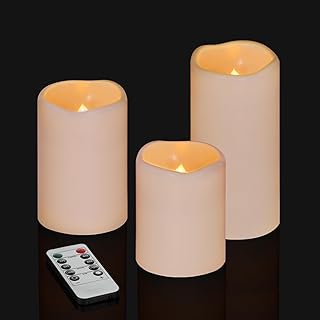
Pros
- Runs on two ordinary AA cells per candle
- Rated past 400 hours, or roughly two months on the timer cycle
- One 10-key remote covers timer, brightness and flicker mode for all three
- Silicone ring under the base cover keeps rain and damp out
- Three staggered heights group well on a single surface
Cons
- Moulded plastic body rather than real wax
- Only three candles, so a long mantel needs a second set
- Infrared remote needs line of sight to reach each candle
This is the set to buy when you want flameless candles that behave like an appliance rather than a decoration. Each of the three pillars takes two AA cells, which is the format most households already keep, and the published rating sits past 400 hours of continuous light. Run them on the timer instead and Artmarry puts real life closer to two months per set of cells.
The 10-key remote is the reason this one lands at the top. It addresses all three candles at once for on, off, brightness, steady or flickering mode and the timer, so a cluster on a mantel becomes a single control rather than three reaches behind the furniture. The candles come in 4, 5 and 6 inch heights, which is exactly the arrangement most people want on one surface.
The trade is the body. This is moulded plastic with a printed wax texture, not real wax, so it will not survive close inspection at a dining table the way a paraffin pillar does. What the plastic buys you is a sealed base with a silicone ring, which means the same three candles can move out to a porch or a lantern without being ruined by rain.
Bottom line: the most versatile power and control package here. Standard cells, a long runtime rating, group control from one handset and a body that works indoors or out.
- Set of 3 pillars, 3 inch diameter, heights of 4, 5 and 6 inches
- Power: 2 AA cells per candle, not included
- Runtime: rated 400 hours and up on continuous use
- Timer: daily cycle set from the remote
- Remote: 10-key infrared, one per set
- Body: moulded plastic with silicone seal at the base cover
- Light: warm white, flicker or steady, dimmable
- Placement: indoor or covered outdoor
Six AA cells power the full set. On continuous use the published figure is 400 hours and up, which works out near 20 days of round the clock light. Switch to the daily timer cycle and Artmarry quotes more than two months from the same cells.
Rechargeable AA cells work here and are worth the swap if these will be lit most evenings. Expect shorter numbers in cold weather, since alkaline capacity drops as the temperature falls.
The plastic shell will not slump in summer heat and the base cover carries a silicone ring that keeps rain and morning damp away from the contacts. That makes the set suitable for a covered porch, a patio table or a glass lantern.
It is water resistant rather than submersible, so bring the candles under cover in a storm and dry the base before changing cells.

Pros
- Coin cells included in every light
- Rated around 200 hours per cell
- Standard tea light size fits ordinary votive holders
- Enough lights to cover several surfaces in one order
- Simple base switch, nothing to configure
Cons
- No timer and no remote, so each light is switched by hand
- All 24 cells fade at roughly the same time
- Coin cells are a swallowing hazard around children and pets
Bulk tea lights are the cheapest way to fill a room with candlelight and this pack is a clean example of the format. Each light is standard tea light size, drops into an ordinary votive holder, and runs on a CR2032 coin cell that Hanzim includes in the box and rates near 200 hours.
What you give up at this level is operation. There is a switch on the base and nothing else, so 24 lights means 24 switches twice an evening, and there is no timer to stretch the cells across a season. That is the honest reason bulk tea lights belong to the event layer of a room rather than the everyday layer.
The other practical point is that they age together. Lights bought and started at the same time will fade within days of each other, so plan on replacing coin cells in batches and keep a strip of spares before a holiday rather than after.
Bottom line: unbeatable coverage for the money and no operating features at all. Use them to scatter light around pillar candles that do carry timers.
- Pack of 24 flameless tea lights
- Power: 1 CR2032 coin cell per light, included
- Runtime: around 200 hours per cell
- Controls: on and off switch on the base
- Timer: none
- Remote: none
- Light: warm white with a flicker effect
- Size: standard tea light, fits common votive holders
These are the filler layer. Scatter them down the length of a table, along a windowsill, up a staircase or inside small glass holders where a pillar would be too large.
They also suit one off occasions such as a party or a wedding reception, where the candles only need to run for one evening and nobody is going to miss a timer.
Coin cells are a serious swallowing hazard for small children and for pets. Keep the lights on surfaces out of reach and store spare cells in a closed container rather than loose in a drawer.
To change a cell, twist the base cover off, match the plus side of the coin cell to the marking inside and twist it back until it seats. Pull the cells if the lights are going into storage for a season.

Pros
- Automatic 6 hour on and 18 hour off daily cycle
- Rated past 400 hours per cell
- Real wax body with a melted edge and a black wick
- CR2450 cells included
- No remote needed for the schedule to work
Cons
- CR2450 cells are harder to find locally than CR2032
- No remote, so brightness is fixed
- Real wax means indoor use only
This is the set for anyone who wants candlelight on a schedule without owning another remote. Each votive carries a fixed 24 hour cycle: switch it to timer mode at the hour you want light, and from then on it comes on at that time every evening, runs for six hours and shuts itself off for 18.
The bodies are real wax with a melted top edge and a black wick, so at 2 by 2 inches they read convincingly on a table or in a glass holder. Power comes from a CR2450 coin cell, thicker than the CR2032 used in tea lights, which is where the 400 hour and up rating comes from.
The limitation is control. There is no remote in the box, so brightness is whatever the factory chose and rearranging the schedule means switching each of the six candles again by hand. In exchange the schedule lives in the candle rather than in a handset you can lose.
Bottom line: the least demanding candles here to live with day to day, provided you keep a few CR2450 cells in the house.
- Set of 6 votives, 2 inches wide by 2 inches tall
- Body: real wax with a melted edge and black wick
- Power: 1 CR2450 coin cell per candle, included
- Runtime: 400 hours and up per cell
- Timer: automatic 6 hours on, 18 hours off, repeating every 24 hours
- Remote: none
- Light: warm white flickering flame effect
- Placement: indoor only
Move the switch under the base to the timer position at the hour you want the candles lit. The candle runs six hours, shuts off for 18, then repeats at the same hour the following day with no further input.
Because the cycle starts from the moment you flip the switch, set all six at the same time or they will drift out of step with each other. To change the schedule, switch them off and start again at the new hour.
Buy these for the surfaces you want lit every evening without thinking about it: a bathroom shelf, a hallway console, a bedroom dresser or a dining table in daily use.
They are less suited to occasions where you need to dim or switch the room from a seat, since there is no remote in the range for this model.

Pros
- Rated past 1000 hours of continuous light
- Around 200 days of use on the five hour timer cycle
- Moving wick flame rather than a static LED glow
- Thick real wax body that resists heat
- Three way base switch keeps operation simple
Cons
- C cells are bulky and few households stock them
- Cells are not included
- Sold as a single candle, so a group is several orders
If your objection to flameless candles is the battery routine, this is the answer. The pillar takes two C cells, a format with far more capacity than AA, and TECHLONG rates it past a thousand hours of continuous light or around 200 days on the five hour timer cycle. That is close to a full season and a half from one change.
The flame is the other reason to pick it. Instead of a fixed LED behind wax, a small pendulum wick moves inside the top of the candle, so the flame swings and casts changing shadows from any angle. Combined with a thick real wax body it holds up at conversational distance.
Operation is deliberately basic. A three way switch under the base selects off, on, or the timer that runs five hours and returns at the same hour the next day. There is no remote in the box, and the C cells themselves are not included, so add a pack to the order.
Bottom line: buy it when runtime and flame quality matter more than group control, and accept that C cells are a trip to the shop.
- Single pillar candle, 3 inches wide by 5 inches tall
- Body: thick real wax, ivory
- Power: 2 C cells, not included
- Runtime: 1000 hours and up continuous, around 200 days on the timer
- Timer: 5 hours on with an automatic 24 hour cycle
- Controls: three way switch under the base
- Flame: 3D moving wick
- Placement: indoor only
C cells hold several times the capacity of an AA, which is the entire reason this candle can quote four figures of runtime. Fresh alkaline cells give the published number, and rechargeable C cells work if you can find them.
Using the five hour cycle rather than leaving the candle on is what turns a thousand hours into roughly 200 evenings, so switch to timer mode on the first day rather than later.
Twist off the base, seat both C cells to the markings, then choose off, on, or timer with the same switch. Start it at the hour you want the candle to light each evening, because the cycle counts from that moment.
Keep the candle out of direct sun even indoors. Real wax tolerates warm rooms but a sunny windowsill in summer will soften the top edge over time.

Pros
- One AA cell per candle, so nine candles need nine cells
- Remote offers 2, 4, 6 and 8 hour timer options
- Nine pieces in three heights fill a mantel in one order
- Acrylic body will not melt or slump
- Moving wick effect at the top of each candle
Cons
- Cells are not included
- Acrylic reads less convincingly than real wax up close
- Slim 2.3 inch diameter looks lost inside large lanterns
Nine candles, one remote and one AA cell each. That combination is what makes this set the practical choice for a long mantel, a fireplace surround or a wedding table where you want a wall of light without nine different battery formats in the drawer.
The remote is the better than average part. Rather than a single fixed cycle it offers four timer lengths at two, four, six and eight hours, so the same set can run a short evening indoors or a long one at a party, and the choice applies to all nine candles at once.
The bodies are acrylic with a moving wick at the top. That keeps them light and impossible to melt, but acrylic catches the light differently from wax and gives the group away at close range. At the 2.3 inch diameter they are also slim, so they suit clusters and shelves more than they suit big glass lanterns.
Bottom line: the most candles per order with proper timer control, and the compromise is body material rather than operation.
- Set of 9 pillars, roughly 2.3 inch diameter
- Heights: approximately 5.5, 6.5 and 7.5 inches
- Power: 1 AA cell per candle, not included
- Timer: 2, 4, 6 or 8 hours, selected from the remote
- Remote: infrared, one per set
- Body: acrylic with a moving wick
- Light: warm white, flicker or steady, dimmable
- Placement: indoor
Pick the run length on the remote and every candle in the set adopts it, returning at the same hour the following day. Four lengths mean you can match the schedule to the room rather than accepting whatever cycle the factory chose.
The remote is infrared, so keep a clear path to the candles. Ones tucked behind a closed cabinet door or deep inside a metal lantern will not hear the signal.
This set suits anyone furnishing a long surface at once: a mantel, a fireplace hearth, a sideboard or a row of tables at an event.
It is the wrong buy if the candles will sit at eye level on a dining table, where the acrylic finish is noticeable. Choose a real wax pillar for those spots and use these behind them.

Pros
- Tall enough to fill a large outdoor lantern
- Weatherproof plastic body with a sealed base
- Rated 500 hours and up, or around 45 days on a six hour cycle
- Remote offers 2, 4, 6 and 8 hour timer options
- Works in cold conditions where wax candles cannot
Cons
- Three AA cells per candle, so six per set
- Cells are not included
- Plastic body is obvious at close range
Most flameless candles look lost in a large lantern. This pair exists to solve that, at 10 inches tall and 4 inches across, which fills the glass on a porch lantern or a garden floor lantern the way a real church pillar would.
Feeding a larger LED takes more power, so each candle carries three AA cells rather than the usual two. Homemory rates the pair at 500 hours and up on continuous use, or roughly 45 days when the six hour daily cycle is doing the work, and the 10-key remote also offers two, four and eight hour options.
The body is weatherproof plastic that will not soften in summer sun, with a sealed base cover keeping rain out of the compartment. Expect the winter figures to fall short of the published ones, since alkaline cells lose capacity in cold air, and expect the plastic to be visible at arm's length. Neither matters much on a porch at night.
Bottom line: the specialist buy for tall outdoor lanterns, with the battery count as the price of the size.
- Set of 2 pillars, 10 inches tall by 4 inches wide
- Power: 3 AA cells per candle, not included
- Runtime: 500 hours and up continuous, around 45 days on the 6 hour timer
- Timer: 2, 4, 6 or 8 hours from the remote
- Remote: 10-key infrared, one per set
- Body: weatherproof plastic, sealed base cover
- Light: warm yellow, flicker or steady, dimmable
- Placement: indoor or outdoor
The shell is rated against rain and sunlight and stays rigid in heat that would slump a wax candle. The seal sits on the base cover, so make sure it is fully closed and seated after every cell change.
Water resistant is not waterproof in the submersible sense. Keep the candles upright, avoid standing water on a deck, and bring them in during a storm.
Six AA cells run the set. That is the largest cell count per candle in this guide and the reason the light carries across a garden rather than glowing quietly.
Cold cuts capacity, so budget for more frequent changes in winter, and consider rechargeable AA cells if the lantern is lit most evenings through a season.

Pros
- Real wax body with a dripless finish
- 3D flickering flame at the top of the taper
- Remote and timer included in the range
- Fits standard candlesticks and window sills
- Height matches an ordinary dinner candle
Cons
- AAA cells give the lowest runtime of the common formats
- Cells are not included
- Narrow body means the compartment is fiddly to open
Tapers are the hardest shape to do with batteries, because a candle under an inch across has almost no room for cells. Homemory solves it with AAA cells in the base and a real wax exterior, so from across a room these read as ordinary dinner candles in a candlestick.
The flame is a moving 3D wick rather than a glow through the wax, which is what sells the effect on a shape this slim. The dripless finish keeps the sides clean, which matters more on a taper than on a pillar since the whole body is on show.
The cost of the format is runtime. AAA cells drain quickest of the common sizes, so expect to change them more often than on any pillar in this guide, and note that they are not included. The narrow compartment is also the fiddliest to open of the group.
Bottom line: the right shape for windows and candlesticks, chosen in full knowledge that AAA cells mean a shorter interval between changes.
- Taper candles, 9.6 inches tall
- Body: real wax, dripless, ivory
- Power: 2 AAA cells per candle, not included
- Runtime: lowest of the common formats, plan on frequent changes
- Timer: daily cycle via the remote
- Remote: infrared, included in the range
- Flame: 3D flickering wick
- Placement: indoor
A pair of tapers in a window is the classic use, and the battery version removes the two problems of the real thing: a flame next to a curtain and wax down the sill.
Because the remote timer brings them back at the same hour each evening, a row of windows lights itself on schedule through a holiday season with no daily routine.
Real wax dislikes heat and direct sun, so keep tapers out of a south facing window in summer and away from a radiator, or the body will bow.
Wipe the wax with a dry cloth only. Pull the AAA cells before storing them for a season so a leaking cell cannot spoil the contacts.

Pros
- Real wax poured into a glass jar, so the light glows through the sides
- Remote with 2, 4, 6 and 8 hour timer options
- Brightness and flicker mode adjustable
- Glass does not block the infrared remote
- Three jars in one order
Cons
- Three AAA cells per candle means nine for the set
- Around 150 hours per set of cells
- Glass jars are heavier and more fragile than plastic pillars
Jar candles are the format most people already own in scented form, and this trio brings the same look with no flame. Real wax is poured into gold glass, so the light comes through the sides as well as the top and the group throws more ambient glow than a bare pillar of the same height.
Control is generous for the format. The included remote handles on, off, brightness, flicker or steady mode and four timer lengths at two, four, six and eight hours, applying to all three jars at once. Glass is transparent to infrared, so unlike candles hidden in metal lanterns these answer the remote reliably.
Power is the compromise. Each jar takes three AAA cells and the published figure is around 150 hours, the lowest in this guide, so nine cells go into the set and they will not last a whole season on daily use. Rechargeable AAA cells make a real difference here.
Bottom line: the best looking option on a shelf or a bathroom counter, bought with the understanding that AAA cells need changing often.
- Pack of 3 glass jar candles, gold finish
- Body: real wax poured into glass
- Power: 3 AAA cells per candle, not included
- Runtime: around 150 hours per set of cells
- Timer: 2, 4, 6 or 8 hours from the remote
- Remote: infrared, one per set
- Light: warm, flicker or steady, dimmable
- Placement: indoor
Choose one of four run lengths and all three jars follow it, returning at the same hour the next day. The same handset dims the light, which is useful in a bathroom or a bedroom where full brightness is too much.
Glass passes infrared, so the jars respond even when they sit inside a display cabinet with a glass door.
These suit surfaces where the candle itself is part of the decoration: a bathroom counter, a bedside table, a coffee table or a bar cart, where the gold glass catches light during the day as well.
They are less practical outdoors or in high traffic spots, since glass is heavier and easier to break than the plastic pillars in this guide.

Pros
- Moving flame that holds up to close inspection
- Real paraffin wax body
- Runs on two ordinary AA cells
- Five hour timer that returns automatically each day
- Works with the remotes sold across the range
Cons
- No remote in the box, it has to be bought separately
- Sold as a single candle
- Around 200 hours per set of cells, below the AA pillar average
Luminara is the name people cite when they say a flameless candle fooled them, and this pillar is the standard size in that range. A pendulum wick moves inside a real paraffin body, so the flame leans and recovers the way a real one does in a draught rather than pulsing on a fixed pattern.
Power is straightforward: two AA cells in the base, published at around 200 hours. A switch underneath selects off, on, or the timer, which runs five hours and brings the candle back 19 hours later at the same time each day.
The catch is control. No remote is supplied, although the candle is built to answer the remotes sold separately across the range, so a group of them can eventually be run from one handset if you buy the accessory. Sold singly, furnishing a mantel means several orders.
Bottom line: pick it for the surface where the flame is inspected closely, and budget for the remote if you want anything beyond the base switch.
- Single pillar candle, 3 inches wide by 4.5 inches tall
- Body: real paraffin wax, ivory, unscented
- Power: 2 AA cells, not included
- Runtime: around 200 hours
- Timer: 5 hours on, returns 19 hours later
- Controls: switch under the base, remote sold separately
- Flame: patented moving wick
- Placement: indoor
The candle ships without a handset but is designed to accept the remotes sold across this range, which cover on, off, brightness and the timer for every compatible candle at once.
If you plan to own several, buy one remote with the first candle. Without it every change means reaching under the base of each pillar.
Two AA cells give around 200 hours, which is lower than plastic AA pillars because the moving wick uses a small motor as well as an LED. Using the five hour timer rather than leaving it on is what turns that figure into a season.
Rechargeable AA cells work and are worth it here, since the motor makes this one of the hungrier candles in the guide.
How to Choose Battery Operated Candles by Power and Runtime
Six questions decide whether a set of flameless candles becomes part of the household routine or a seasonal chore. None of them are about how the candle looks. Work through them in order and the shortlist above sorts itself.
Match the Battery Format to the Job

Five formats cover almost the entire category, and each one exists for a physical reason. Tea lights are too shallow for anything but a coin cell, so they run on a CR2032 under a twist-off base. Real wax votives have a little more depth and usually take the thicker CR2450, which is why a votive can be rated for twice the hours of a tea light in the same footprint. Slim tapers and glass jar candles fall back on AAA cells because the body is narrow. Pillars wide enough to hold a proper compartment take AA, and the largest outdoor pillars take three of them. Only the heaviest real wax pillars have room for C cells, which is where the very long runtime claims come from.
The practical consequence is stocking. A house that mixes tea lights, tapers and pillars needs coin cells, AAA and AA on hand at once, and coin cells are the ones nobody has in the drawer. If you would rather keep one format, build around AA pillars such as the Artmarry set or the Kakoya nine-piece group, which uses a single AA per candle. If you want the fewest battery changes of anyone on this list, the TECHLONG pillar takes two C cells and is rated past a thousand hours of continuous light.
Coin cells deserve one safety note that has nothing to do with lighting. They are a swallowing hazard for small children and for pets, so tea lights and votives belong on high surfaces in a house with either, and spare cells belong in a closed container rather than a kitchen drawer.
Read the Runtime Claim Correctly
Manufacturers publish runtime two different ways and the numbers are not comparable. The first is continuous hours, meaning the candle is left switched on until the light fades. The second is days on a timer, which assumes the candle runs a fixed number of hours each evening and sits idle the rest of the day. Homemory quotes its large outdoor pillar both ways, at 500 or more continuous hours or roughly 45 days on a six hour daily cycle, and that single listing explains the whole convention. TECHLONG does the same thing with a thousand continuous hours or around 200 days on a five hour cycle.
Two things shorten every published figure. Brightness is one, since most remotes offer a dimming range and the top setting draws the most current. Cold is the other, because alkaline cells lose usable capacity as the temperature drops, so a porch candle in winter will not match its indoor rating no matter which brand made it. Treat published hours as a ranking tool between products rather than a promise about your own mantel, and assume the honest figure sits somewhere below the label.
Timers Are the Feature That Pays for Itself

A timer is not a convenience feature here, it is the single biggest lever on battery cost. A candle left switched on burns its cells in a few weeks. The same candle on a six hour evening cycle stretches the same cells across a whole season, which is why the runtime-in-days figures look so different from the continuous ones.
There are three implementations in this roundup and the difference matters. Fixed cycle timers are set once and repeat forever: the Homemory real wax votive runs six hours on and 18 hours off, and the Luminara pillar runs five hours on and comes back 19 hours later. You switch it on at the hour you want the light and the candle keeps that schedule by itself. Selectable timers let you pick the run length from the remote, usually two, four, six or eight hours, which is how the Kakoya group, the Tyawon glass set and the large Homemory outdoor candles work. The third pattern is a plain on and off switch with no timer at all, which is what you get on most bulk tea light packs including the Hanzim set, and it is the reason bulk tea lights are best kept for a single evening rather than a whole season.
One habit saves a lot of confusion. A cycle timer counts from the moment you start it, so start the candles at the hour you actually want them lit, not at whatever time the box arrives.
Remotes, Range and Group Control

A remote earns its place the moment you own more than three candles. Reaching behind each one twice a day gets old inside a week, and on tapers in a window it means leaning over furniture. The common design is a 10-key infrared remote covering on, off, brightness, steady or flickering mode and the timer, and it addresses every candle in the set at once rather than one at a time. The Artmarry pillars, the Homemory outdoor pair, the Tyawon glass trio and the Kakoya nine-piece set all ship with one.
Two limits are worth knowing before you plan a room. Infrared needs a reasonable line of sight, so a candle deep inside a solid lantern, behind a closed cabinet door or around a corner may ignore the remote entirely, and glass is fine while opaque metal is not. And a remote is usually not brand specific in the way people expect: candles that share a receiver design often answer the same handset, which is handy when you buy a second set and a nuisance when you wanted two zones to behave differently. The Luminara pillar takes the opposite approach and ships with no remote at all, since it is built to accept the remotes sold separately in that range, so budget for one if you plan to control it from a chair.
Outdoors Means a Sealed Base, Not Just Plastic
Any candle can sit on a covered porch for an evening. Staying out through a season is a different specification, and it comes down to the battery compartment rather than the body. The outdoor sets here use a moulded plastic shell that will not soften in summer heat plus a silicone gasket around the base cover, which is what keeps rain and morning damp away from the contacts. Real wax candles are indoor products by construction, because wax slumps in direct sun and the seam around the base is not designed to keep water out.
Size is the other outdoor variable. A four inch pillar disappears inside a large lantern, so the 10 inch Homemory pair exists specifically to fill tall glass, and it carries three AA cells per candle to feed the bigger LED. If your candles will live on a patio, a deck rail or a garden table, our patio, lawn and garden picks cover the lanterns and holders that go around them.
Do the Battery Arithmetic Before You Buy
This is the step almost everyone skips. Count the cells the whole plan needs, not the cells one candle needs. A nine piece pillar set on one AA each is nine cells. Two large outdoor pillars at three AA each is six more. A pair of window tapers at two AAA each adds four. A 24 pack of tea lights is 24 coin cells, and they will all fade within days of each other because they started together. Suddenly a decorating idea has a running cost attached to it.
Two moves keep that cost sane. Rechargeable AA and AAA cells work normally in these candles and pay for themselves quickly on anything you light most evenings, which is a strong argument for standardising on AA pillars wherever the look allows. Coin cell candles are the exception, since rechargeable coin cells are not worth the trouble, so treat tea lights as the seasonal or party layer and let timers on the larger candles carry the everyday duty.
| Power source | Typical runtime claim | Where it fits | Watch out for |
|---|---|---|---|
| CR2032 coin cell | Around 200 hours | Bulk tea lights, votive holders | Rarely has a timer, many cells to swap at once |
| CR2450 coin cell | 400 hours and up | Real wax votives with a fixed cycle timer | Less common in stores than CR2032 |
| 2 to 3 AAA cells | Roughly 150 hours | Tapers, candlesticks, slim glass jars | Shorter runtime than the other standard formats |
| 1 to 3 AA cells | 400 to 500 hours | Pillars indoors and out, most remote sets | Three cells per candle adds up across a set |
| 2 C cells | 1000 hours and up | Large real wax pillars meant to stay lit | Bulky cells that few households stock |
| Built-in rechargeable pack | Recharges in a few hours | Premium glass and moving wick candles | Cell cannot be replaced, so the candle has a fixed life |
Why You Should Trust Us
We build these shortlists from the evidence a shopper can verify. For this category that meant reading published specifications for the battery format, the cell count per candle and both versions of the runtime claim, then setting those figures side by side so that a 200 hour tea light and a 45 day outdoor pillar could be compared honestly. We also read customer feedback in volume, with an eye on the complaints that only appear after a season of use, which in this category are dead cells, timers that drift and remotes that stop reaching a candle once it moves inside a lantern.
We do not accept payment for placement, and we leave a product off the list when the specification sheet and the feedback disagree. Where a figure comes from the manufacturer rather than from independent measurement, we say so, which is why the runtime section above is written as a ranking tool rather than a guarantee. You can browse the rest of our work in home and kitchen or across all of our guides.
Final Thoughts
Best overall goes to the Artmarry Flameless Outdoor Pillar Candles 3-Pack. It hits the middle of every axis that matters here: two ordinary AA cells per candle, a 400 hour rating, a 10-key remote that covers timing and brightness for the group, a sealed base that lets the set move outside, and three heights that work as a cluster on one surface. Nothing about owning it is fussy, which is the whole point.
Best value is the Hanzim Battery Operated LED Tea Lights 24-Pack. Cells are included, each light is rated around 200 hours, and 24 of them cover a table, a bathroom shelf and a staircase in a single order. Accept the trade you are making: a switch on the base and no timer, so these are the layer you light for an evening rather than the layer that runs itself all season.
For everything else, pick by the job. The Homemory Flameless Votive Candles with Timer are the easiest set to live with indoors thanks to the six hour on and 18 hour off cycle that needs no remote at all. The Homemory 10 inch Outdoor Waterproof Pillars are the ones to buy for tall lanterns and exposed porches. The TECHLONG 3D Moving Flame Pillar is for anyone who would rather buy C cells once than think about batteries again, and the Luminara Ivory Pillar Candle is the choice when the flame has to hold up to close inspection on a dining table, with the caveat that its remote is a separate purchase. Set the timer on the day the box arrives, and the rest of the season takes care of itself.
Frequently Asked Questions
How long do battery operated candles really last on one set of batteries?
It depends entirely on the cell format and on whether you use the timer. Coin cell tea lights are generally rated near 200 hours, AAA tapers closer to 150, AA pillars in the 400 to 500 hour range, and large C cell pillars past a thousand. Those are continuous figures. Run the same candle on a six hour evening cycle and a set of cells stretches across a season instead of a few weeks, so the timer changes the answer more than the brand does.
Can I use rechargeable batteries in battery operated candles?
Yes, for anything that takes AA or AAA cells. Rechargeable cells sit at a slightly lower voltage than alkaline, so the light can look a touch dimmer at the top brightness setting, but the candles work normally and the savings are real once you are running nine or more of them most evenings. Coin cell candles are the exception, since rechargeable coin cells are awkward to source and to charge. If a candle has a built-in rechargeable pack with a charging base, you are on the maker’s schedule and the pack usually cannot be swapped when it eventually wears out.
Do the timers keep running if I switch the candles off with the remote?
On most sets the remote off command cancels the cycle, and you re-arm the timer the next time you switch the candles on, which resets the schedule to that new hour. Fixed cycle candles such as a six hour on and 18 hour off votive behave the most predictably here because the schedule lives in the candle rather than in the handset. If you want a schedule you never think about again, choose a fixed cycle model and leave the remote for brightness.
Can battery operated candles stay outside all year?
Only the ones built for it, and even then with two caveats. Look for a moulded plastic body plus a gasket on the battery cover, which is the combination the outdoor sets in this guide use. Real wax candles should stay indoors because wax slumps in direct sun. The caveats are cold, which cuts usable battery capacity and shortens every published runtime figure through winter, and standing water, since a sealed base resists rain but is not meant to be submerged. Bring them under cover for storms and expect to change cells more often than you would indoors.
How many battery operated candles do I need for a table or a mantel in 2026?
For a dining table, three pillars of staggered height in the centre plus a scattering of tea lights along the length reads as generous without crowding the plates. A mantel usually wants three to five candles grouped off centre rather than a symmetrical row. A pair of tapers is the standard for a window. Count the cells that plan needs before you order, because a 24 pack of tea lights means 24 coin cells fading at the same time. If you are decorating a whole room rather than one surface, our category directory is a good place to keep going.










Write Your Review
No reviews yet. Be the first to share your experience!