

Most handheld games are designed for a twelve year old with sharp eyes and quick thumbs, which is why so many of them end up in a drawer after a week. The ones that get played regularly by an older adult share a short list of qualities: a display you can read from arm’s length, buttons that respond without force, rules that do not need re-learning every time, and a game that works perfectly well with nobody else in the room. We compared 7 handheld games from Mega Screen, Trademark Poker, YoYa Toys and more, split into electronic units and screen free sets, and sorted by how easy each one is to see, hold and follow.
Our top pick is the Hasbro Gaming Simon Handheld Electronic Memory Game for its four oversized light up panels and rules that take about ten seconds to explain. Below we look at the electronic handhelds first and the no battery sets second, because those two groups suit very different people and very different rooms. This roundup is current for September 2026, and more gift ideas sit in our toys and games section.

Pros
- Four oversized illuminated panels are easy to see and easy to hit
- Feedback arrives as light and sound together, so a missed tone is still visible
- Rules take about ten seconds to explain and are not forgotten
- Single player by design, with difficulty that rises on its own
Cons
- Listed for ages eight and up, so the packaging is aimed at children
- Sound is a fixed part of the feedback and cannot always be reduced
- Runs on batteries, so spares are worth keeping in the box
Simon has been sold in one form or another for decades because the design is close to perfect for this purpose. The unit plays a sequence of lit panels with a tone attached to each, and you press them back in the same order. That is the entire rule set.
The panels are the reason it works so well for an older player. They are large, they are widely spaced, and they need a tap rather than a precise press, so it can be played without looking at your hands and without much finger strength.
Feedback through two senses is the other quiet advantage. The tone and the light happen together, so someone who does not hear the beep still sees the flash, and someone not looking at the unit still hears it. Very few games are built that way.
Two honest caveats. It is listed for ages eight and up, so the box is aimed at children even though the play is age neutral. And the sound is integral to the game rather than optional, which is worth knowing if it will be played in a shared room.
Bottom line: the easiest game here to pick up and start playing, and the safest choice if you are buying without knowing much about the person's preferences.
- Type: electronic handheld memory game
- Controls: four large illuminated panels
- Feedback: lights and sounds
- Players: one or more, taking turns
- Listed age: 8 and up
- Power: battery operated
Buy this if you want a game that can be understood immediately, played alone, and used from an armchair without a table. It suits anyone who finds small screens difficult, since there is nothing to read at all. Look at a quiet puzzle set instead if the sound would be a problem in a shared room, or a card game if the person you are buying for prefers cards to patterns.
Set it on a lap or a table rather than holding it, which frees the hand entirely and makes long sessions comfortable. Start a round, watch the sequence through once, then repeat it. Play in a room with the television off the first few times, since the tones are part of how you remember the pattern. Keep a set of spare batteries taped inside the box so a flat unit never becomes a reason to stop playing.

Pros
- The large display is the entire point and it solves the main complaint
- Solitaire rules are already familiar, so there is nothing to learn
- Plays alone by definition, with no setup and no cards to shuffle
- Simple segment display gives strong contrast without visual clutter
Cons
- One game only, so it does not offer variety
- Battery powered, and it forgets progress when it is switched off
- Build is basic rather than premium
This one exists to answer a single complaint, and it answers it directly. Electronic card games are usually pocket sized, which puts a full solitaire layout onto a display a few inches across, and that is exactly what makes them unreadable for a lot of people. Here the screen is the feature.
Solitaire is also the right game for this treatment. Almost everyone already knows the rules, so there is no instruction card and no learning curve, and the pace is entirely yours; you can put it down mid game and nobody is waiting.
A simple segment display has an underrated advantage over a modern color screen. There is no background, no animation and no color contrast problem, just the cards, which is easier to read in a dim room than a phone app.
The limitations are what you would expect from a single purpose device. It plays one game, the build is functional rather than refined, and it runs on batteries and does not remember where you were once it is off. For someone who plays solitaire and nothing else, none of that matters much.
Bottom line: the pick when the person already plays cards and the problem is purely that everything else is too small to see.
- Type: electronic handheld card game
- Game: solitaire
- Display: oversized for the format
- Players: one
- Power: battery operated
- Format: light handheld unit
Buy this for a solitaire player who has given up on small handheld units or on playing with real cards because dealing and holding them has become awkward. It is not the right choice for someone who wants variety, since it plays one game, or for someone who dislikes screens entirely, where a physical puzzle set is the better direction.
Choose this over a pocket multi game unit if display size is the deciding factor, and choose the multi game unit if variety matters more than screen size. If the recipient plays cards socially rather than alone, a physical deck with large print faces may serve better. Check the battery format and include spares, since a card game that dies mid hand is the fastest route back to the drawer.

Pros
- No batteries, no screen and effectively silent
- Graded challenge book means the difficulty rises at your own pace
- Solves alone at a table, and can be left part finished
- Physical pieces are satisfying to handle in a way a screen is not
Cons
- Pieces need a precise pinch, which suits some hands better than others
- Small pieces can be lost if it travels loose in a bag
- Challenge book print is on the small side
Kanoodle is a spatial logic puzzle rather than a game in the electronic sense. You are given a board, a set of interlocking pieces and a book of challenges that show a partial layout, and the job is to fit every remaining piece into the space that is left.
The graded challenge book is what makes it work over months rather than an afternoon. Early puzzles are approachable, later ones are genuinely hard, and the progression happens at whatever pace the solver sets, with no timer and nothing telling you to hurry up.
Being silent and battery free puts it in a different category from everything electronic here. It suits a bedside table, a shared living room and a long wait somewhere, and it can be left half solved and returned to later, which is not true of most handheld games.
The physical demands are the thing to check. The pieces are small and need a precise pinch to lift and place, so it is the wrong choice for someone with significant hand tremor or reduced fine motor control, and the challenge book print is small enough to want good light.
Bottom line: the quiet, thoughtful option, best for someone who enjoys puzzles and has the hands for small pieces.
- Type: physical logic and spatial puzzle
- Contents: puzzle pieces, board and graded challenge book
- Players: one
- Power: none required
- Sound: silent
- Storage: self contained case
Start at the first challenge rather than jumping ahead, since the early ones teach how the pieces relate to each other. Work on a tray or a placemat rather than a bare table so nothing rolls off, and count the pieces back into the case at the end of every session. Good light and reading glasses make the challenge book far easier to follow, and there is no penalty for leaving a puzzle half done.
Keep the set in its case rather than loose in a bag, because a missing piece makes the later challenges unsolvable. Small parts should be kept away from young children and from pets. If the pieces become hard to grip, a slightly tacky puzzle mat helps more than anything else, and working at a table rather than on a lap removes most of the risk of dropping them.

Pros
- Five poker variants in one unit, so it does not get repetitive
- Genuinely pocket sized for a coat, a bag or a car
- Familiar card rules for anyone who has played video poker
- No setup, no cards and no second player needed
Cons
- Small screen, which is the main drawback for older eyes
- Buttons are close together at this size
- Battery powered with no memory of where you were
This is the classic travel casino format: a small slab with a display, a row of buttons and five variations of video poker. For a card player it is immediately familiar, and there is nothing to set up before you start playing.
Variety is the strength. Five modes means the unit does not become the same hand over and over, and Deuces and the bonus variants play differently enough to keep the interest going. It is a real advantage over single game devices.
The size cuts both ways and it needs stating clearly. At under four inches across it fits a coat pocket and travels anywhere, which is genuinely useful for appointments and journeys. That same size means the screen and the buttons are small, and for someone whose near vision has changed, that is the thing most likely to make it frustrating.
Treat it as a travel companion rather than the main game. Anyone who finds phone text hard to read without glasses will find this hard too, in which case a large display unit is the better primary choice with this kept for the bag.
Bottom line: good variety in a pocket, held back by a small screen, so match it to eyes that are still comfortable with fine detail.
- Type: electronic handheld video poker
- Games: Draw, Deuces, Bonus, 2X and 2x2 Bonus
- Size: approximately 3.9 x 3.4 inches
- Players: one
- Power: battery operated
- Use: travel and pocket play
Buy this for a card player who travels, waits at appointments, or wants something small enough to live in a coat pocket, and whose eyesight is comfortable with a small display. If reading a small screen is already an effort, choose the large display solitaire unit instead and keep this as a secondary option for the bag.
Choose it for variety and portability. Choose a larger unit for readability. If you are unsure which matters more to the person you are buying for, hold your phone at arm's length and see whether they read a text message comfortably from where they sit; that is a fair proxy for how this display will feel. Include spare batteries either way.

Pros
- No batteries, no screen and almost no noise
- Six interchangeable back panels change the game rather than repeating it
- Nothing electronic to break or run out mid use
- Genuinely nostalgic for anyone who had one decades ago
Cons
- Needs a steady press and a little patience, which is part of the game
- Marketed as a children's retro toy on the packaging
- Play sessions are short by nature rather than absorbing for an hour
The water game is one of the oldest handheld formats there is, and it survives because it needs nothing. A sealed chamber of water, a button that fires a jet, and a set of rings or hoops to land on pegs. No power, no screen, no sound.
The interchangeable panels are what lifts this above the single scene versions. Six backs mean six different targets and layouts, so the unit stays interesting for far longer than one that only ever shows the same picture.
Its real strength is where it can be used. It is quiet enough for a bedside table, a shared room or a car with someone dozing, and there is nothing that can stop working at the wrong moment. It also travels without any thought at all.
Two honest points. It is packaged as a retro children's toy, so the box is not aimed at adults even though the appeal to anyone who grew up with one is obvious. And the press needs a certain steadiness, which is part of the challenge rather than an accessibility problem, but worth knowing for hands with a tremor.
Bottom line: the best value here and the most relaxed thing on the list, ideal as a side table game that never needs anything.
- Type: sealed water game, screen free
- Panels: 6 interchangeable backs
- Players: one
- Power: none required
- Sound: near silent
- Format: light handheld unit
Hold it flat rather than tilted so the rings float where you can aim at them, and press in short bursts rather than holding the button down, which just churns the water. Swap the back panel when the layout stops being interesting. Keep it out of strong sunlight on a windowsill, since prolonged heat is the one thing that ages a sealed water toy.
Buy this as the low commitment option, the one that lives on a side table and gets picked up for five minutes at a time. Pair it with something more absorbing, a memory game or a puzzle set, rather than expecting it to be the only game. If you want two of this kind of thing for a bag, the Aqua Rings twin set covers the same idea in a different shape.
Pros
- Bright lit tiles are high contrast and easy to see
- Level and memory modes exist alongside the timed speed mode
- Nothing to read, since the whole game is color matching
- Passing the unit around makes it work as a two player game
Cons
- The headline speed mode rewards fast reactions rather than thought
- Flipping and sliding needs more wrist movement than a simple press
- Listed for ages eight to thirteen, so the packaging is aimed at children
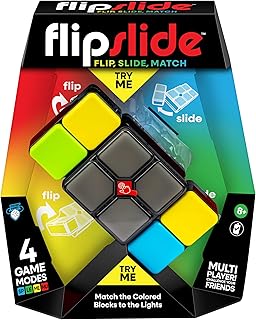
Flipslide is a bar with four lit tiles on it. The unit shows a color, and you flip or slide the tiles until the matching color faces up. Everything is done with color and light, so there is no text anywhere in the game.
That makes it unusually readable. The tiles are bright, the contrast is strong, and someone who struggles with a small display will have no trouble seeing what the game is asking for.
The four modes matter for who this suits. Speed is the mode the box leads with and it rewards quick reactions, but Level and Memory play at a much more measured pace, and those are the ones to start with. A pass the unit format also turns it into something two people can do together.
Two honest caveats. The physical action involves flipping and sliding rather than pressing, which needs more wrist rotation than a simple tap and will not suit every pair of hands. And it is listed for ages eight to thirteen, so it is packaged for children even though the play works for any age.
Bottom line: the choice for someone who wants a quick, bright reaction challenge, and worth skipping if wrist movement is a limitation.
- Type: electronic handheld puzzle game
- Modes: Speed, Multiplayer, Level, Memory
- Controls: flip and slide illuminated tiles
- Listed age: 8 to 13
- Players: one, or two by passing the unit
- Power: battery operated
Buy this for someone who enjoys a quick challenge and has good wrist mobility, or as a game a visiting grandchild and a grandparent can play together by passing it back and forth. Choose Simon instead if a broad tap is easier than a flip, or a puzzle set if a timer of any kind sounds unwelcome.
Start in Level or Memory mode rather than Speed, since those set the pace to your own. Hold the unit in both hands with the tiles facing you and use your thumbs, which needs less wrist rotation than holding it one handed. Play seated with elbows supported for longer sessions, and keep the sound on at first, since the tones confirm a correct match before you see the score.

Pros
- Two different games in one pack for very little outlay
- No batteries, no screen and nothing that can break
- Silent enough for a bedside table or a shared room
- Small and light enough to keep in a bag permanently
Cons
- Marketed for young children, so the packaging is unambiguous about it
- Short bursts of play rather than an absorbing session
- Requires a steady, sustained press on a small button
Aqua Rings is the same idea as the classic water game in a twin pack, with a ring toss in one unit and a basketball hoop in the other. Press the button, the jet of water moves the pieces, and you try to land them.
Getting two variants is the appeal. Two different targets means two different techniques, and having a spare in a bag means one can live in the car and one by a chair without any planning.
Everything good about the format applies here. There is no power, no sound worth mentioning, nothing to charge and nothing that can fail. It is the most portable thing in this list by a distance and it is completely undemanding.
The caveats are the honest ones. This is packaged for young children in a way that is not subtle, so it works best as a nostalgic keep in the bag item rather than a gift presented as a serious game. The button press is small and needs to be held steady, which is fine for most hands but not all.
Bottom line: the cheapest way to have a silent, battery free game within reach in two places at once.
- Type: sealed water games, screen free
- Pack: 2 units, ring toss and basketball
- Players: one per unit
- Power: none required
- Sound: near silent
- Listed age: young children upward
Hold the unit level so the rings float freely, and use short repeated presses rather than one long push. Rest your elbow on a chair arm for a steadier aim, which makes the game noticeably easier. Keep one in a bag and one where the person sits, and keep both out of direct sunlight, since heat is what shortens the life of a sealed water toy.
Take the twin pack if you want a silent, battery free game in more than one place, or as a small extra alongside a main gift. If you only want one water game and would rather have variety within it, the Waterfuls unit with six interchangeable panels is the better single purchase. Neither is intended to be the absorbing game of the collection.
How to Choose a Handheld Game for Seniors
Six things decide whether a game gets picked up a second time. None of them is about the game being easy, and all of them are about the game being usable.
Display Size and Contrast
Screen size is the single most common reason a handheld game gets abandoned. Pocket sized units squeeze a full card layout into a display a few inches across, and that is genuinely hard to read for anyone whose near vision has changed, especially in a dim living room. Look for the largest display the format allows, and read the stated dimensions rather than judging by the product photo, which is always shot close up.
Contrast matters as much as size. A simple black on grey segment display is far easier to read than a color screen with a busy background, because there is nothing competing with the information. This is one area where old fashioned electronics beat modern ones outright.
Games that use light rather than text sidestep the problem entirely. A unit built around four large illuminated panels, or a set of physical puzzle pieces, has nothing small to read at all, which makes it the safer choice if reading a display is already an effort with glasses on.
Buttons You Can Actually Press

Button size, spacing and travel decide whether a game feels responsive or frustrating. Small buttons set close together mean mis-presses, and a stiff button needs force from fingers that may not have much to spare. Large panels or widely spaced keys let someone play without looking at their hands, which is a bigger deal than it sounds.
Weight and grip come with this. A unit that needs two hands to hold and a third to press is not going to work in an armchair, so look for something that either sits on a lap or a table, or is light enough to hold one handed for a long stretch.
For anyone with arthritis or reduced grip strength, prefer games where the input is a broad tap rather than a pinch or a twist. Sliding and flipping mechanisms look accessible but often need more wrist rotation than a simple press, so check what the hands have to do before you buy.
Sound, and Whether It Can Be Turned Down
Electronic games use sound for feedback, which is helpful when it is loud enough to hear and irritating when it cannot be reduced. The best designs pair every tone with a light, so the feedback arrives through two senses and a missed beep is still visible on the panel.
Check whether the unit has a volume control or a mute, since not all of them do. In a shared room, a game with no way to quiet it becomes a game that only gets played when nobody else is around, which sharply reduces how often it comes out.
Screen free sets avoid the question completely. A puzzle or a water game makes almost no noise, which makes them the natural choice for a bedside table, a shared living room or a long journey with someone dozing next to you.
How Long the Rules Take to Explain
The rule of thumb worth using is whether the game can be explained in one sentence and remembered a week later without the manual. Repeat the sequence of lights. Move the cards onto the piles. Get the rings onto the pegs. Games at that level of clarity get picked up again; games with mode buttons, sub menus and printed instruction cards usually do not.
Difficulty is a separate question from complexity, and it is worth keeping them apart. A game can be very simple to understand and still get hard, which is exactly what a memory sequence game does as the pattern lengthens. That combination, simple rules with rising challenge, is the one that holds attention longest.
Timed modes deserve a specific look. Anything built around beating a clock rewards fast reactions rather than thought, and while some people enjoy exactly that, it is the feature most likely to make a game feel unwelcoming. Prefer units that offer an untimed or level based mode alongside the speed run.
Solo Play, and Playing With a Visitor

Most of these games will be played alone, so single player has to be the default rather than an afterthought. Card games, memory sequences and puzzle challenges all work solo by design, and that is why they dominate this category.
A two player option is still worth having, because these games are often bought as a way for a visitor to sit and do something together rather than making conversation for an hour. A pass the unit format works for that without needing two of anything.
Portability matters for the same reason. Something that travels to a waiting room, a car journey or a family visit gets far more use than something that lives on one table. Small and light beats large and impressive here, as long as it does not compromise the display.
Batteries, or None at All

Battery type is a quiet accessibility issue. A compartment held by a small screw needs a screwdriver and steady hands, and a coin cell is fiddly to seat correctly, while an AA or AAA door that opens with a thumb can be changed by anyone. If you are buying for someone who lives alone, check the battery format before you buy and put spares in the box.
Consider also whether the game holds its state. Electronic handhelds forget where you were as soon as the batteries die or the unit is switched off, which is mildly annoying midway through a hand of cards, so the ones that resume are worth preferring.
The no battery group sidesteps all of this. Puzzle sets and water games have nothing to charge, nothing to replace and nothing that can stop working at the wrong moment, which is why they remain popular long after electronics have taken over the rest of the toy aisle.
| Type | Best at | Watch out for |
|---|---|---|
| Light and sound memory unit | Big panels, one sentence rules, solo play | Sound may not be adjustable |
| Large screen card game | Readable display, familiar card rules | Needs batteries, display quality varies |
| Pocket electronic card game | Travel size, several game variants | Small screen and small buttons |
| Physical puzzle set | No batteries, silent, rising difficulty | Small pieces need a steady pinch |
| Screen free water game | Silent, nothing to break, nostalgic | Needs a light press and a steady hand |
Two practical notes for anyone buying this as a gift. First, the games that get used are the ones left within reach, on the arm of a chair or a side table, rather than put away in a cupboard with the boxes; where the thing lives matters as much as which one you chose. Second, play a round of it together the first time rather than handing it over with the instructions, because a game learned in company is a game that gets picked up alone afterward, and it also tells you within minutes whether the buttons and the display are right for that person. If they are not, that is worth knowing while the packaging is still in the house. The category index covers the rest of the departments we write about.
Why You Should Trust Us
We build these lists from published specification and from the pattern of what long term owners report, rather than from marketing copy. For every game here we looked at the stated size of the unit and its display, the number and layout of the controls, whether play is single player, what the battery format is, and what the maker says about the modes and the rules. Where a game is aimed at children in its listing, we say so plainly rather than pretending otherwise.
We also read owner feedback specifically from people buying for a parent or grandparent, because that is where the practical problems surface: displays that turned out to be smaller than expected, sound that could not be turned down, battery doors that needed a screwdriver, and rules that were harder to follow than the box suggested. We describe how each game plays and what it demands of the eyes and hands, and we make no claims about health outcomes of any kind.
Final Thoughts
Best overall is the Hasbro Gaming Simon Handheld Electronic Memory Game. Four large illuminated panels, one rule to remember, feedback delivered as both light and sound, and a challenge that grows on its own as the sequence lengthens. Nothing else here is as easy to start playing within seconds of opening the box.
Best value is the Original Waterfuls Handheld Game. It needs no batteries, makes almost no noise, comes with interchangeable back panels so it is not the same game every time, and it is the kind of thing that can sit on a side table for months and still get picked up.
For specific needs, the Mega Screen Solitaire is the pick if the person you are buying for already plays cards and struggles with small displays, the Educational Insights Kanoodle Ultimate Champion is the choice for quiet puzzle solving with no electronics involved, and the Trademark Poker 5-in-1 Hand Held Poker Game suits a card player who wants variety in a pocket format, with the caveat that its screen is small. The Moose Games Flipslide is the one for someone who wants a quick reaction challenge, and the YoYa Toys Aqua Rings set is the low key screen free option to keep in a bag. More gift guides are indexed in our article archive.
Handheld Game FAQs
What makes a good handheld game for seniors?
A display or set of panels that can be read at arm’s length, controls large enough to press without looking, rules that fit in one sentence, and a game that works with nobody else in the room. Everything else is preference. If you can only check one thing before buying, check the physical size of the unit and its screen against the photo, because the most common disappointment in this category is a game that turned out to be far smaller than it looked online.
Are these games too childish for an adult?
Some are packaged for children and some are not, and the packaging is not the same thing as the game. A memory sequence game and a logic puzzle are age neutral in play even when the box shows a child, while a water ring toss is unashamedly nostalgic and that is precisely its appeal for anyone who had one decades ago. Card based games avoid the question entirely. Buy for the play, and if the box is the issue, most of these are perfectly presentable out of the packaging.
Which handheld games work without batteries?
The physical ones. Puzzle sets like Kanoodle use pieces and a challenge book, and water games like Waterfuls and Aqua Rings work by pressing a button that pushes water around a sealed chamber. Neither needs power, neither makes noise, and neither can stop working at an inconvenient moment. That makes them the practical choice for travel, for bedside use and for anyone who would rather not deal with battery compartments at all.
What suits someone with limited hand strength?
Look for broad panels and light presses rather than small buttons, pinches or twists. A unit with four large illuminated pads is the easiest input in this group, and a game that rests on a lap or a table removes the need to grip anything at all. Be cautious with sliding and flipping mechanisms, which need more wrist movement than they appear to, and with small puzzle pieces, which require a precise pinch to place.
Which of these is best for travel in 2026?
Anything silent and battery free travels best, which puts the water games and the puzzle set at the top for a car, a plane or a long appointment. If the traveler prefers cards, a pocket electronic card game fits in a coat pocket, though the small display is a real trade for the size. Pack spare batteries for any electronic unit, since a game that dies on the second day of a trip is worse than no game at all. For more gift ideas, browse the toys and games archive.



Write Your Review
No reviews yet. Be the first to share your experience!