

Middle school is the age where board games either stick for life or get abandoned in a closet. Eleven to fourteen year olds have outgrown roll-and-move games with no decisions in them, but most of them will not sit through a three hour war game either. The sweet spot is narrow and specific: a game they can learn in five minutes, finish in forty, and immediately want to play again. Our top pick is Ticket to Ride for hitting that window exactly, with rules a group picks up in one round and route planning that rewards thinking ahead.
This shortlist of 10 board games for middle schoolers comes from Days of Wonder, Bananagrams, SET Enterprises and more, and it deliberately mixes formats. Some are boards, some are card games, one is a bag of letter tiles. What they share is that they work at a kitchen table with four to eight players, they do not eliminate anyone in the first ten minutes, and they hold up when a parent joins in. The buying guide below explains the three things that decide whether a game gets played twice or once. For younger siblings in the house, our list of magnetic speed cubes covers a different kind of puzzle entirely.

Pros
- Rules explained in roughly five minutes
- No player elimination, everyone plays to the end
- Route planning gives real strategic depth
- Large map and chunky components read well across a table
Cons
- Caps at five players, which is limiting for a big group
- Blocking a route can feel personal in a competitive group
Ticket to Ride is the game most likely to turn a middle schooler who tolerates board games into one who requests them. You collect coloured train cards, spend matching sets to claim routes between cities, and try to complete secret destination tickets before the trains run out. That is the whole rule set, and it can be taught while dealing the first hand.
What makes it work at this age is the shape of the decisions. Every turn offers a simple choice between drawing cards and claiming a route, but the consequences stretch across the whole game, so a thirteen year old who plans ahead genuinely beats one who does not. That is a satisfying thing to be good at, and it is why the game holds up as players get older.
The main constraint is the player cap. Five is the maximum, so a large gathering needs something else. There is also a social wrinkle worth knowing: claiming a route someone else needed is a legal and often optimal move, and in a competitive group that can raise the temperature.
Bottom line: the strongest single purchase here, and the one most likely to still be played in three years.
- Players: 2 to 5
- Age: 8 and up
- Playing time: 30 to 60 minutes
- Type: route building strategy
- Elimination: none
- Teach time: roughly 5 minutes
The family that wants one real board game rather than a shelf of party boxes, and the eleven to fourteen year old who is ready for decisions that matter beyond the current turn. Also a strong pick for mixed tables, since an adult playing seriously and a child playing casually can share a game without either being bored.
Deal destination tickets, then on each turn either draw two train cards, spend a matching set to claim a route, or draw new tickets. The game ends when a player is nearly out of train pieces. Completed tickets score, incomplete ones subtract. Teach it by playing the first round openly rather than explaining scoring in advance, which is faster than any rulebook reading.

Pros
- Rules fit on a single page
- Excellent as a two player game
- Tactile tiles that make the game feel substantial
- Denying a rival a tile is a real strategic lever
Cons
- Four player cap
- Abstract theme appeals less to players who want a story
Azul asks one question every turn: which tiles do you take, and what do you leave behind. You draft coloured tiles from shared factory displays, place them on your player board, and score for completed rows and patterns. Tiles you cannot place cost you points, which is where the game gets sharp.
The reason it suits this age group is the gap between how simple it looks and how much thought it rewards. Nobody needs a rulebook after the first round, but a player who watches what their neighbour is collecting starts winning consistently, and noticing that shift is genuinely satisfying.
Two players is where Azul is at its most pointed, since every tile you take is one your opponent wanted. That makes it one of the few games here that works on a quiet weeknight rather than only at a gathering.
Bottom line: the best two player game on the list and the one most likely to be played by adults after the kids have gone to bed.
- Players: 2 to 4
- Age: 8 and up
- Playing time: 30 to 45 minutes
- Type: abstract tile drafting
- Components: 100 resin tiles, 4 player boards, 9 factory displays, linen bag
- Elimination: none
Players who like puzzles and pattern building more than storytelling, and any household that needs a game that works well with exactly two people. Less suited to a group that wants theme and narrative, since Azul is deliberately abstract.
On your turn take all tiles of one colour from a factory display and move the rest to the centre, or take all tiles of one colour from the centre. Place them in a pattern line, then at the end of the round move completed lines onto your wall and score. Overflow tiles cost points. Teach the scoring after the first round rather than before it.

Pros
- Handles up to twelve players in teams
- Rules taught in under five minutes
- Team play keeps everyone involved
- Folding board stores compactly
Cons
- Luck of the draw can decide close games
- Board layout takes a moment to read at first
Sequence is the answer to the question every parent eventually faces: what do we play when nine people want to join. Teams take turns playing a card from hand and placing a chip on the matching board space, racing to build rows of five. It is the rare game where a crowd is an advantage rather than a problem.
The strategy is board control rather than card management. Blocking a rival team's developing row is often worth more than extending your own, and that trade-off is easy enough for a ten year old to grasp and interesting enough that adults keep arguing about it.
Because the board is fixed and the cards are dealt, luck plays a real part. In a close game the right card at the right moment decides it, which some competitive players dislike and which keeps mixed-ability tables fair.
Bottom line: the best choice on this list when the player count is unpredictable or large.
- Players: 2 to 12, teams for larger counts
- Playing time: around 30 minutes
- Type: board and card hybrid
- Included: folding board, cards, chips
- Board size: roughly 10.3 x 8.1 in folded box
- Elimination: none
Large gatherings, sleepovers, and multi-generational tables where ages range widely. The team structure means a younger player can be paired with an older one, which solves a problem most games in this category ignore.
Play a card from your hand, place a chip on a matching space on the board, and draw a replacement. Build rows of five chips to score a sequence. Jacks act as wild or removal cards depending on the design on them. Teams must alternate seating so play passes between teams around the table.

Pros
- Takes up to eight players
- Teaches in under five minutes
- Fixed rounds mean nobody is knocked out
- Compact box travels easily
Cons
- Scoring requires adding numbers between rounds
- Repetitive for players who want narrative or theme
Skyjo is a deck of numbered cards and a scoring pad, and it does more work in a middle school household than most boxes three times its size. Each player lays out a grid of face down cards and, over a series of rounds, swaps and flips them trying to end with the lowest total.
The structure is what makes it valuable here. Rounds are fixed length and everyone plays every round, so a player having a bad game still has decisions to make and a chance to recover. Compare that to games where an early mistake means twenty minutes of watching.
The cost is arithmetic. Somebody adds up columns between rounds, which is trivial at this age but does slow the pace slightly, and a group that wants pure momentum may prefer a reflex game instead.
Bottom line: the best value on this list and the game most likely to get played on an ordinary Tuesday.
- Players: 2 to 8
- Playing time: around 30 minutes
- Type: card game, fixed rounds
- Scoring: lowest total wins
- Elimination: none
- Format: compact box
Households that want one card game to cover most occasions, groups of five to eight, and anyone who travels and wants a game that fits in a bag. Also a sensible first purchase if you are not yet sure the group will commit to a longer strategy game.
Each player arranges twelve cards face down in a grid and flips two. On your turn draw from the deck or discard and either swap a card into your grid or flip one over. A column of three matching values is removed entirely, which is the main way to cut your score. A round ends when one player has flipped their whole grid, and everyone totals up.

Pros
- Teach time under two minutes
- Rounds last ten to fifteen minutes
- Reflexes matter more than age or vocabulary
- Takes up to eight players
Cons
- Physical slapping can get boisterous
- Not a game for a quiet table or a long evening
Players go around the circle saying taco, cat, goat, cheese, pizza in order while flipping a card each. When the word matches the card, everyone slaps the pile and the slowest player takes it. That is the entire game, and it can be taught while shuffling.
Its real value in this age group is social rather than strategic. Nothing about age, reading level, or game experience helps you win, so a nine year old and a fifteen year old are genuinely even. That makes it the game to reach for when a mixed group has just arrived and nobody has settled yet.
The obvious caveat is noise and hands. A table of eight slapping a deck is loud, and it is not the game to start when someone is trying to work in the next room. Rounds are short by design, which is a feature rather than a limitation.
Bottom line: the icebreaker of the list, and the one that works when concentration is in short supply.
- Players: 2 to 8
- Age: 7 and up
- Round length: 10 to 15 minutes
- Type: reflex and pattern matching
- Teach time: about 2 minutes
- Includes action cards for variation
Mixed age groups, sleepovers, and the first twenty minutes of any gathering. Also the right pick for a younger sibling who would be outmatched at anything strategic, since reaction speed is the only skill in play.
Deal the deck evenly. Players take turns flipping a card while saying the next word in the sequence. When word and card match, everyone slaps the pile and the last hand down collects it. Special action cards add gorilla, groundhog and narwhal gestures that must be performed before slapping. The player who runs out of cards first wins.

Pros
- Familiar rummy rules learn quickly
- Eleven rounds give everyone a chance to recover
- Five suits add a twist without new complexity
- Screen free family game night staple
Cons
- Eleven rounds can run long for an impatient group
- Scoring between rounds needs a pencil
Five Crowns takes rummy, adds a fifth suit, and changes which card is wild every round. Round one is played with three cards and threes wild, round two with four cards and fours wild, and so on up to kings. That escalating structure is the whole design and it works.
For a middle school group the appeal is familiarity. Anyone who has played rummy or gin can start immediately, and the shifting wild card keeps a familiar game from feeling like a repeat. Because there are eleven rounds, an early bad hand costs very little.
The trade-off is length. A full eleven round game is a real commitment, closer to an hour than to thirty minutes, and it needs someone to keep score. Many groups play the first five or six rounds and stop, which works perfectly well.
Bottom line: the traditional card game of the list, and the one that will still make sense to a player in twenty years.
- Type: rummy style card game
- Deck: five suits
- Structure: eleven rounds, wild card increases each round
- Scoring: lowest total wins
- Elimination: none
- Format: compact box, travel friendly
Families that already play cards and want something with a twist rather than a whole new system. Also good for a long car journey or a holiday, where the round structure lets you stop and resume without ruining the game.
If your group tends to lose interest after thirty minutes, agree in advance to play a set number of rounds rather than the full eleven. The scores still work and the game ends while everyone is still enjoying it. Groups that prefer a fixed short session are usually better served by Skyjo.

Pros
- Simultaneous play means no waiting
- Packs into a small pouch for travel
- Works solo as well as with a group
- No board or pencil required
Cons
- Rewards strong spellers and can frustrate weaker ones
- Needs table space for every player
Bananagrams removes the two things that slow word games down: the board and the turn order. Every player builds their own crossword grid at the same time from a shared pool of tiles, and the round ends when someone uses all of theirs. A game takes about as long as it takes to think.
The lack of turns is the reason it belongs on a list for this age group. Nobody waits, so nobody drifts. It also scales down to a single player, which makes it one of the few boxes here that gets used when nobody else is available.
The honest limitation is that it rewards vocabulary. A confident speller will win consistently, and a player who struggles with spelling will feel that within one round. In a group of similar ability it is excellent, and in a mixed one it can sting.
Bottom line: the best travel game here, and the only one that works with one player.
- Players: 1 to 8
- Tiles: 144 letters
- Playing time: 15 to 20 minutes
- Type: anagram and word building
- Format: zip pouch, no board
- Turns: simultaneous, no turn order
Strong readers and spellers, families that travel, and anyone who wants a game that fits in a coat pocket. Not the right pick as the only game in a house with a wide spread of reading confidence.
Each player takes a set number of tiles and builds a personal crossword grid. When a player uses all their tiles they call peel and everyone takes another tile. Unwanted tiles can be traded back at a cost of three. The first player to use every tile when the pool is empty wins the round.

Pros
- Rules known by most adults already
- Every player gets the same thirteen turns
- Fast turns keep the table engaged
- Very inexpensive entry to game night
Cons
- Heavy element of luck
- Score sheet needed for every game
Yahtzee endures because the decision it offers is clean. You roll five dice up to three times and choose which scoring category to spend the result on, knowing each category can only be used once. Chasing a big score in one category means leaving another empty.
For a middle school table its strengths are speed and familiarity. Turns take under a minute, a parent almost certainly already knows the rules, and the fixed thirteen turn structure means nobody can be knocked out. It is the least demanding game here in terms of setup and attention.
Luck plays a much larger role than in anything else on this list, which cuts both ways. A younger player can beat an older one on a good night, and a strategic player has limited ability to reverse a bad run of dice.
Bottom line: the cheapest way to start a game night habit, and a reliable filler rather than the centrepiece.
- Players: 2 or more
- Components: 5 dice, shaker, score pads
- Playing time: around 30 minutes
- Structure: 13 fixed turns per player
- Type: dice and set collection
- Elimination: none
Families starting from nothing, and tables that include a grandparent or anyone who wants to play without learning something new. Also a good travel option, since dice and a pad take almost no space.
Roll all five dice, then re-roll any number of them up to twice more. Assign the final result to one of thirteen categories on the score sheet. Each category is used once per game. Five matching dice is a Yahtzee and scores the maximum. After thirteen turns each, totals decide the winner.

Pros
- Works with large groups
- No strategy to learn, anyone can join mid game
- Rounds are short and self contained
- Content filtered for family play
Cons
- Humour dates as references age
- Needs a group to work at all
One player judges, everyone else plays a caption card against a photo, and the judge picks the funniest pairing. The format is familiar from a dozen party games and it works for the same reason each time: no strategy, no learning curve, and a new judge every round.
The family edition matters here. Content in the standard version is aimed at adults, and the family filtered deck is what makes this appropriate for a middle school group. Even so, a parent buying for a sleepover should read a handful of cards first, which is good practice with any party game rather than a criticism of this one.
The limitation is structural. Party games need a crowd, they produce no tension when played by three people, and their humour is tied to references that will feel dated in a few years. Treat it as a consumable rather than a keepsake.
Bottom line: a good filler for a full room, and not the game to build a collection around.
- Age: 8 and up
- Type: caption matching party game
- Best with: larger groups
- Content: family filtered deck
- Round structure: rotating judge
- Teach time: about 2 minutes
Birthday parties, sleepovers, and any evening where the group is larger than five and nobody wants to learn rules. Not suited to two or three players, where the judging format falls flat.
Read through a sample of the caption cards before handing the box to a younger group, since humour standards vary between families even within a filtered deck. Keep the cards in the box rather than loose, as caption cards are the part most likely to go missing and the deck loses variety quickly without them.

Pros
- General knowledge rather than pop culture, so it dates slowly
- Compact box suits travel and small tables
- Works as a filler between longer games
- Questions suit a mixed age table
Cons
- Trivia rewards existing knowledge, which favours adults
- Depends on reading questions aloud
The premise is in the name. Questions cover the kind of general knowledge people assume they already have, and the fun comes from discovering how much of it nobody actually remembers. It is a lighter format than a full quiz game and it plays in whatever time you have.
Because the questions lean on general knowledge rather than current pop culture, it ages more slowly than most party games. That is a genuine advantage over meme and reference based boxes, which have a short shelf life by design.
Trivia does have an inherent fairness problem across ages, since an adult has simply been alive longer. Teams are the standard fix and they work well here, pairing an adult with a younger player so knowledge is pooled rather than compared.
Bottom line: a solid filler with a longer shelf life than most party games, best played in teams at a mixed table.
- Type: general knowledge trivia
- Format: compact box, question cards
- Players: flexible, teams recommended
- Round length: as long as you want
- Content: family friendly
- Teach time: under 2 minutes
Mixed age tables where teams can pair adults with younger players, and families who want a trivia game that will not feel dated in two years. A good travel box for the same reason as Bananagrams: it takes almost no space.
Play in teams rather than individually if the age range at the table is wide. Straight trivia between an adult and a twelve year old is not a contest, and pairing them turns the same questions into a conversation instead.
How to Choose Board Games For Middle Schoolers
Age recommendations on the box are close to useless for this group. A game rated eight and up can be far too simple for a thirteen year old, and a game rated twelve and up is often just a longer game rather than a harder one. These are the factors that actually predict whether a game survives past its first evening.
Playing Time Is the Real Age Rating
Attention at this age is not short, it is conditional. A middle schooler will happily spend two hours on something they chose, and fifteen minutes feels endless on something they did not. The practical consequence is that a first game should land between fifteen and forty five minutes. Under fifteen and it reads as a warm-up rather than an event. Over an hour and you need the group already sold on the game before you start.
Look for a game where the length scales with player count in a predictable way. Ticket to Ride runs roughly thirty to sixty minutes whether you have three players or five, because turns are short and simultaneous thinking happens while others act. Compare that to games where each additional player adds ten minutes of waiting, which is where a group starts drifting toward phones.
Nobody Should Be Out Early
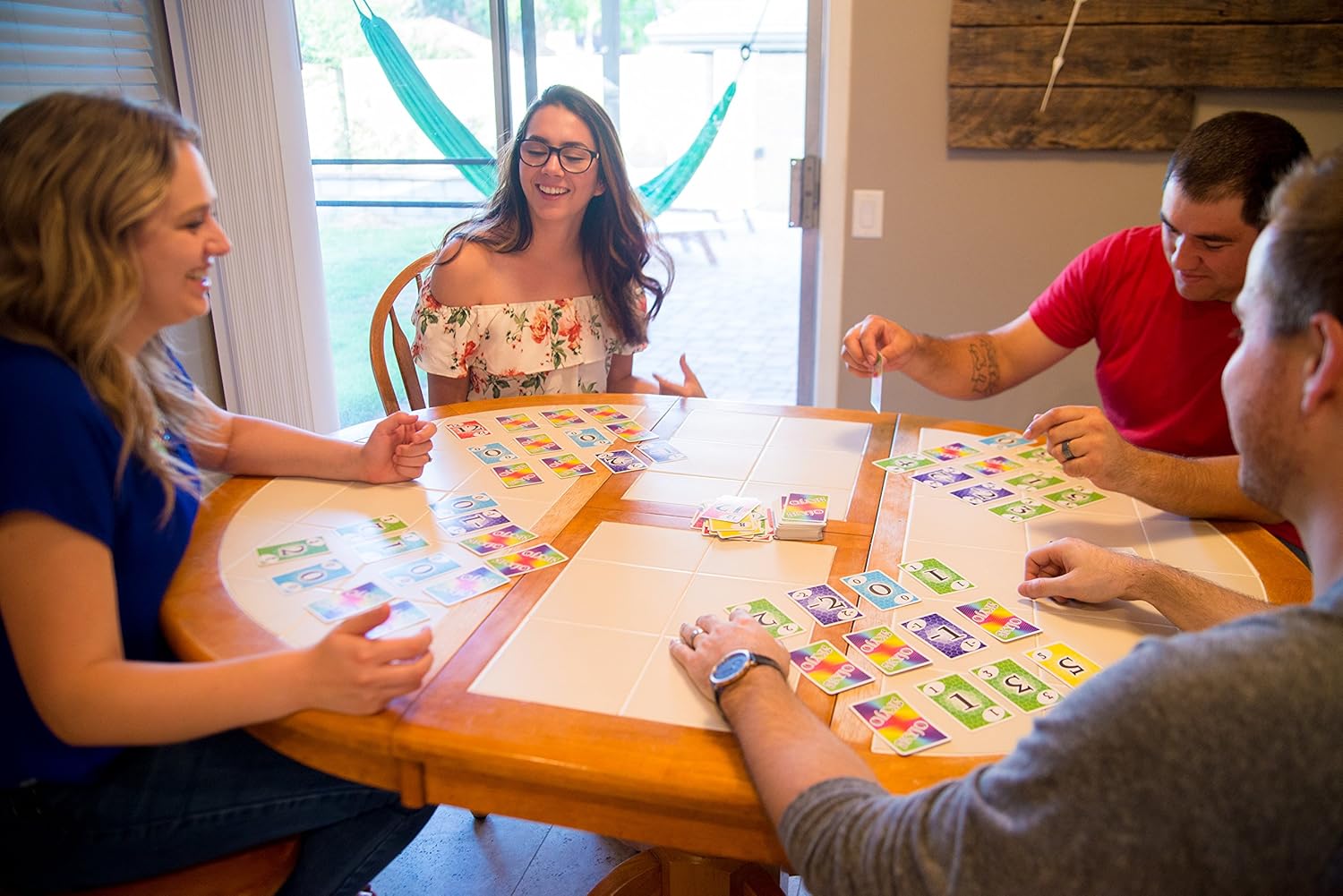
Player elimination is the single fastest way to kill a game night for this age group. When one player is knocked out twenty minutes into a forty minute game, they do not sit patiently and watch. They leave the table, and often take another player with them. Every game on this list either has no elimination at all or ends the round quickly enough that nobody waits long.
There is a related design detail worth knowing: the difference between a game that ends when someone wins and a game that ends after a fixed number of rounds. Fixed-length games like Skyjo and Five Crowns give everyone the same number of turns, so a player who falls behind still has something to do. That structure matters more than it sounds when the group includes a competitive twelve year old and a younger sibling.
Rules Weight and the Five Minute Test

The useful measure is not complexity but teach time. If one person can explain the rules in five minutes and the group can start playing before anyone has fully understood the strategy, the game will get played. If teaching requires reading a rulebook aloud, it will get played once by an enthusiastic parent and then shelved.
The trick is finding games where teach time is short but the decisions still have depth. Azul is the clearest example on this list: the rules fit on one page, and the tension of taking tiles you need while denying tiles your neighbour needs takes several games to feel out. Sequence works the same way, pairing a trivially simple rule set with genuinely strategic board control.
| Game | Type | Players | Typical length | Teach time |
|---|---|---|---|---|
| Ticket to Ride | Strategy board | 2 to 5 | 30 to 60 min | Around 5 min |
| Azul | Abstract strategy | 2 to 4 | 30 to 45 min | Around 5 min |
| Sequence | Board and cards | 2 to 12 | 30 min | Under 5 min |
| Skyjo | Card, fixed rounds | 2 to 8 | 30 min | Under 5 min |
| Taco Cat Goat Cheese Pizza | Reflex card | 2 to 8 | 10 to 15 min | Under 2 min |
| Bananagrams | Word tiles | 1 to 8 | 15 to 20 min | Under 5 min |
Player Count Is a Constraint, Not a Suggestion
Middle school gatherings are unpredictable. Four kids become seven when siblings appear, and a game rated for two to four players suddenly excludes half the room. This is the strongest practical argument for keeping at least one high-count game in the cupboard. Sequence handles up to twelve players in teams, Skyjo and Taco Cat Goat Cheese Pizza both take eight, and Bananagrams stretches to eight without the game slowing down.
The opposite case matters too. Some of the best games at this age are two player games, played by one kid and one parent on a weeknight. Azul is excellent at two, where the tile denial becomes sharper and more personal. A collection with only party games leaves nothing to play on a quiet evening.
Reading Load, Math Load, and the Mixed Table
Two hidden barriers decide whether a game works across a mixed age table. The first is reading load: trivia and party games depend on reading cards aloud, which is fine for a group of thirteen year olds and awkward when a younger sibling is at the table. The second is math load. Skyjo and Five Crowns both require scoring at the end of each round, which is trivial for this age but does mean somebody is adding numbers between rounds.
Neither is a reason to avoid a game, but both are reasons to own more than one. A word game like Bananagrams rewards a strong speller and quietly frustrates a weaker one. A reflex game like Taco Cat Goat Cheese Pizza flattens everything: age, vocabulary, and strategy count for almost nothing next to reaction speed, which is exactly why it works when the group is mixed. Games that need nothing but attention are the ones that pull a distracted table back together.
Which Games Grow With the Player

Middle school lasts three years. A game bought for an eleven year old that still gets played at fifteen has done four times the work of one that peaks in a single summer, and the difference between the two is usually visible before you buy. Three signals predict a long life. The first is whether the game has a published expansion or alternative version, which tells you the design has depth the publisher thought worth extending. Ticket to Ride is the obvious case here, with a family of map versions that change the strategy rather than just the artwork.
The second is whether adults choose to play it when no child is present. Azul and Sequence both pass that test, which is why they hold up as a player gets more competitive rather than becoming something they have outgrown. Bananagrams belongs in the same group for a different reason: word games do not have a ceiling, they simply get faster.
The third signal is the one people ignore. Games built on a joke, a meme, or a pop culture reference age at the speed of the reference. That is not an argument against buying one, since they are genuinely fun in their moment and cheap enough to treat as consumable, but it is an argument against treating one as the centrepiece of a collection. Buy the reference-based party game knowing it has a season, and put the money you would spend on a second one into a strategy game instead. Five Crowns sits in an interesting middle position: it is a straightforward rummy variant, and rummy has outlived every game on this list by about a century.
Party Games Need a Different Judgment
Party and trivia games are the category where a parent should look past the age rating on the box and check the actual content. Humour aimed at adults slips into family editions more often than the packaging suggests. What Do You Meme? Family Edition and I Should Have Known That both sit at the safer end, but the general rule holds: read a handful of cards before handing the box to a group of twelve year olds at a sleepover.
Content aside, party games serve a different function than strategy games. They fill the first twenty minutes while people arrive and the last twenty when concentration has gone. They are not the backbone of a collection, and buying three of them instead of one strategy game is the most common mistake in this category. One party game, one fast card game, one real strategy game is a better shape than three of any single type.
Why You Should Trust Us
We selected these games from current Amazon listings, filtering first on verified customer ratings and review volume and then narrowing by hand against the criteria above: teach time, playing time, player count, and whether anyone gets eliminated early. Games with strong sales but a structure that punishes the weakest player at the table were left off deliberately, because a game that makes one kid sit out is a game that does not get a second night.
We also kept the list format-diverse on purpose rather than filling it with ten strategy boards. A collection needs range, and a middle school group will use a fast card game far more often than the prestige board game they asked for. Our editorial picks are independent. More of our family picks are in the toys and games section.
Final Thoughts
Ticket to Ride is our best overall for this age because it is the game most likely to convert a casual player into someone who asks for the next one. Route planning gives a thirteen year old something to be good at, the map is readable, and a full game fits inside an evening without anyone being knocked out.
Skyjo takes best value. It is a deck of numbered cards, it teaches in under five minutes, it handles up to eight players, and its fixed round structure keeps everyone involved to the end. For the money it does more work in a middle school house than anything else here.
Round out the shelf by function rather than by title. Azul is the two player game for a quiet evening. Taco Cat Goat Cheese Pizza is the icebreaker when a group has just arrived and nobody has settled. Sequence is the one that scales to a crowd in teams. Bananagrams travels. Buy one of each type rather than four of your favourite type, and the collection will survive middle school. You can browse the rest of our buying guides for gift ideas across other categories.
Frequently Asked Questions
What are the best board games for middle schoolers for a group of six or more?
Sequence is the strongest option at high player counts because it plays in teams and handles up to twelve, so nobody sits out. Skyjo takes eight and keeps rounds short. Taco Cat Goat Cheese Pizza also takes eight and needs almost no explanation, which matters when a group has already arrived and you are trying to start something quickly. Avoid strategy boards capped at four players when the group size is uncertain.
Are these games too young or too old for a thirteen year old?
Box age ratings mark the youngest player who can follow the rules, not the ideal player. A game rated eight and up can suit a thirteen year old perfectly if the decisions have depth, which is why Ticket to Ride and Azul both carry low age ratings and are played seriously by adults. The better question is teach time and game length rather than the number printed on the corner of the box.
Which game should I buy first?
If the household owns nothing, start with a fast card game rather than a strategy board. It gets played on weeknights, it survives a mixed group, and it costs little enough that a wrong guess does not matter. Skyjo or Taco Cat Goat Cheese Pizza both fill that role. Add one strategy board next, once you know the group will sit down for forty minutes together.
Do board games still work when everyone has a phone?
The games that hold a distracted table are the ones with short turns and constant involvement. If a player waits three minutes between decisions, the phone comes out. That is why reflex and simultaneous-play games do so well with this age group, and why turn length is worth checking before player count or theme. A game where you are doing something every twenty seconds does not leave a gap for anything else.
What makes a good gift game in 2026?
For a gift, weight teach time above everything. A recipient who cannot start playing within ten minutes of opening the box usually does not come back to it. Pick something that plays at the number of people actually in their house, not the maximum on the box, and prefer a game that works at two players if you do not know their group. A compact box also travels, which quietly doubles how often a game gets used.

Write Your Review
No reviews yet. Be the first to share your experience!