

A desktop organizer only earns its place if it hands back more desk than it takes up. That single trade runs through this shortlist of 10 picks from Simple Trending, Marbrasse, Blu Monaco and more, pulled together for August 2026 and sorted by how much each one actually holds per square inch of surface it sits on. Our top pick is the Simple Trending 7 Tier Desk File Organizer for the way it turns one letter tray footprint into seven separate paper levels plus a pen cup and a side basket.
The rest of the list covers the situations a single product cannot. Some desks need height because the surface is small. Some need a drawer that closes so the clutter disappears instead of moving. Some need a riser because the monitor sits too low and the space underneath is dead anyway. We also flagged which picks suit a sit stand setup, since anything that lives on a moving surface has to survive being raised and lowered several times a day. If you are still shopping for the desk itself, our roundup of standing desks covers that side of the setup.

Pros
- Seven separate paper levels inside one letter tray footprint
- Steel frame is heavy enough empty to stay planted when loaded
- Integrated pen holder keeps writing tools off the paper stacks
- Removable hanging basket puts daily items within seated reach
- Open mesh drains rather than pools if a drink goes over
Cons
- Top tiers sit above comfortable seated reach for most desks
- Needs vertical clearance, so it will not fit under a low hutch
- Corner bolts must be tightened evenly or the frame racks slightly
The Simple Trending 7 Tier is a steel mesh file sorter that stacks seven letter trays into the space one tray would normally take. It is built for a desk that genuinely processes paper, where the problem is not a lack of compartments but a lack of surface to put them on.
The strength here is geometry. By going upward it leaves the desk area beside the monitor almost untouched, and the steel frame carries enough weight empty that a fully loaded unit does not shift when you pull a sheet from a middle tier. The pen holder and the removable side basket handle the two categories that tiered sorters usually leave homeless, namely writing tools and the odd items that arrive during the day.
The honest limitation is height. At seven tiers the top levels sit above comfortable seated reach for most people, so they become archive space rather than working space. That is fine if you plan for it, but it means the effective daily capacity is closer to four or five tiers. It also rules the unit out under a desk hutch or overhead shelf unless you measure the clearance first.
Bottom line: if your desk handles real paper volume and you have a spare vertical strip beside the monitor, this is the most storage you can buy for the least surface area, and the steel build backs it up.
- Seven tier open steel mesh construction
- Powder coated finish in black
- Fits standard letter size paper stacks
- Integrated upright pen holder
- Removable metal hanging side basket
- Flat pack assembly with corner bolts
This suits anyone whose desk is narrow rather than empty. Students with several active subjects, home office workers who print and file, and anyone running a small business from a corner of a room all get more out of a tall sorter than a wide caddy.
It is the wrong pick if your desk sits under a shelf, if you barely touch paper, or if you want everything hidden. This is an open format, so whatever you put in it stays visible.
Tighten every corner bolt finger tight first, sit the assembled frame on a flat surface, then go round again and tighten fully. Doing one side at a time is what leaves the frame slightly racked.
Load the bottom tiers with the heaviest material and keep the upper levels light. Treat the top two tiers as archive and the lower ones as the tiers you actually reach into during the day.

Pros
- Reclaims dead space under the monitor instead of taking new surface
- Metal frame supports a monitor or laptop without flexing
- Drawer plus two pen holders cover writing tools and flat items
- Open gap underneath doubles as a natural cable channel
- Raises screen height, which helps neck posture at a desk
Cons
- Only useful if your monitor currently sits too low
- Drawer depth is shallow, so it suits flat items rather than bulk
- Fixed width means it does not span two monitors
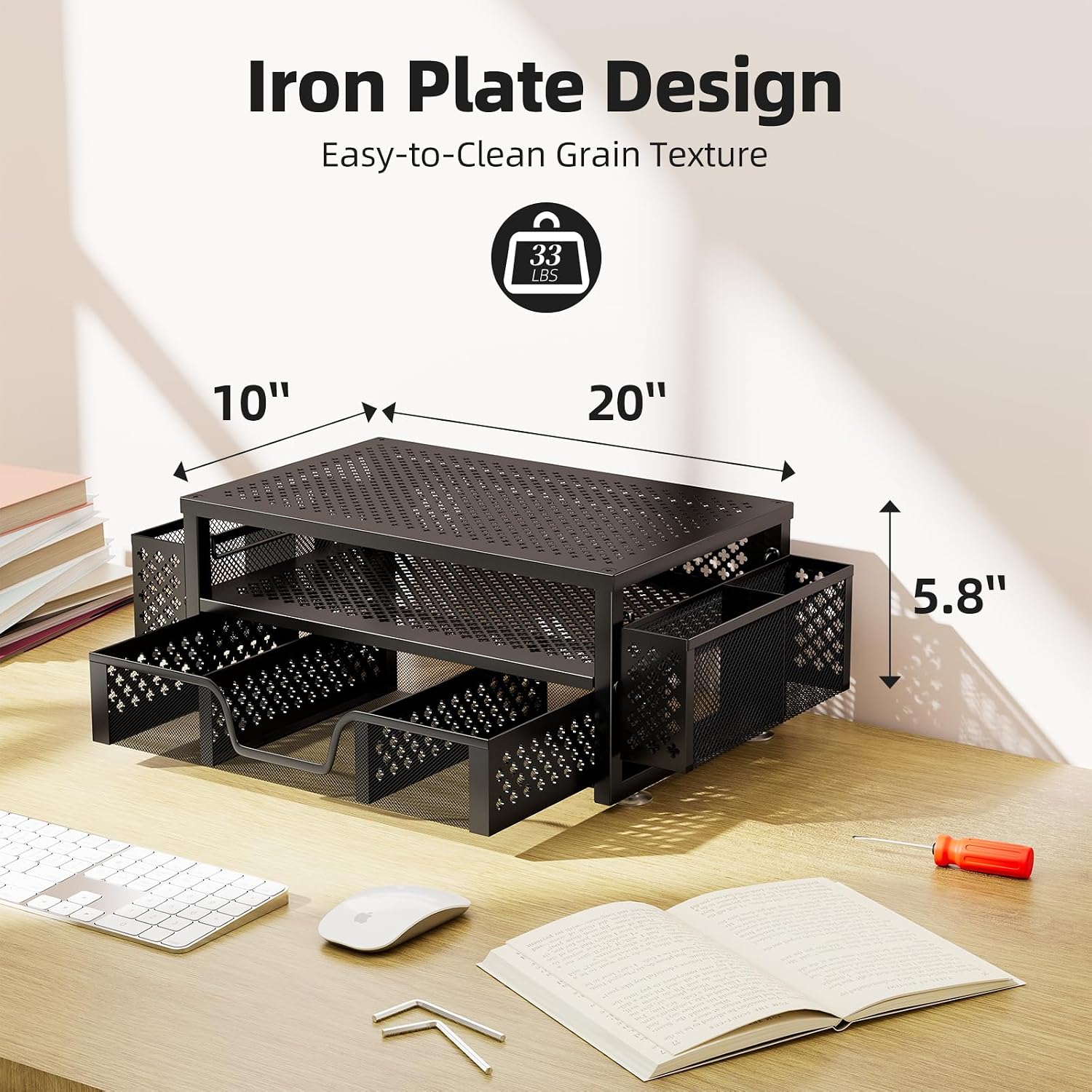
The Simple Trending Monitor Stand is a metal riser rather than a conventional organizer, and that is the point. It uses the volume of air under your screen, which almost every desk wastes, and converts it into a drawer, two pen holders and a cable channel.
Because it adds storage without claiming new surface, it is the strongest answer on this list for a desk that has no free strip beside the monitor. The metal frame handles the weight of a monitor or a laptop without the sag you get from thin fibreboard risers, and raising the screen usually improves seated neck posture as a side benefit.
The obvious limitation is that it only makes sense if your screen currently sits too low. If you already use a monitor arm, the riser has no job to do. The drawer is also shallow by design, so it suits pens, cables, sticky pads and cards rather than anything with bulk, and the fixed width will not span a dual monitor setup.
Bottom line: for a single screen desk with no spare surface, this is free storage in the truest sense, since the space it occupies was doing nothing before.
- Two tier metal riser construction
- Approximately twenty inches wide and ten inches deep
- Roughly six inches of lift at the screen shelf
- One pull out drawer
- Two integrated pen holders
- Open cable gap under the platform
The usual target is to have the top of the screen roughly level with your eyes when you are sitting upright. Measure the gap between your current screen top and eye level before buying, because a riser that overshoots will make you look up.
If the gap you need is larger than the lift this provides, a monitor arm gives continuous adjustment instead of a fixed step.
Check your monitor weight against the platform rating before loading it, and centre the base on the shelf rather than letting it overhang the front edge.
Keep liquids off the top platform. Anything spilled there runs straight down into the drawer and onto the cable run underneath.

Pros
- Six paper tiers inside a single letter tray footprint
- Open mesh sides show fill level at a glance
- Carry handle lets you move the whole stack in one trip
- Sized for letter and A4 folders rather than letter only
- Mesh drains instead of pooling if liquid reaches it
Cons
- No drawer or pen holder, so it handles paper only
- Open format keeps contents permanently visible
- Light when empty, so the bottom tier should carry the weight
The Marbrasse 6 Tier is the purest expression of the tiered sorter idea. It does one job, which is holding paper in visible separated layers, and it does not dilute that with drawers or cups.
The open mesh construction is doing more work than it looks. Because you can see the sides of every tier, you know at a glance which stack is growing and which has been cleared, which is the thing that keeps a filing habit alive. The carry handle is the other quietly useful detail: it lets you lift the entire sorted stack and take it somewhere, which a fixed tray cannot do.
What you give up is versatility. There is no drawer, no pen holder and no closed compartment, so pens, cables and small items need a home elsewhere. It is also light when empty, so the bottom tier should carry the heaviest material to keep the centre of gravity low.
Bottom line: if paper is the actual problem on your desk and you already have somewhere for pens, this is the cleanest way to sort six streams of it without spreading sideways.
- Six tier mesh steel construction
- Black powder coated finish
- Accepts US letter and A4 sheets and folders
- Integrated top carry handle
- Open sides on every tier
- Flat pack assembly
The trays take both US letter and A4, which matters because A4 is the taller of the two and a letter only tray leaves the top edge exposed and prone to curling.
Folders and document wallets fit as well as loose sheets, though a very thick ring binder is beyond what a tier of this depth will hold flat.
Best for anyone running a paper heavy workflow: invoices, school subjects, client files, or anything with a weekly cycle of arrive, action and file.
Skip it if your desk clutter is mostly cables, chargers and small objects, since none of those belong in an open paper tray.

Pros
- Four tiers stay within comfortable seated reach
- Upright file holder built into the same frame
- Drawer hides the small clutter that trays leave visible
- Two pen holders keep writing tools separated from paper
- Available in finishes that suit a room shared with living space
Cons
- Less total capacity than the six and seven tier sorters
- Drawer rides on the frame rather than dedicated rails
- Wider footprint than a pure vertical sorter
The Gianotter 4 Tier is the configuration most home desks actually need. Four paper tiers, an upright file holder, a drawer and two pen holders means every common desk item has somewhere obvious to go without you buying two separate products.
Keeping it to four tiers is a deliberate trade. Every level stays within comfortable seated reach, and the whole unit clears the underside of most overhead shelves, which the taller sorters do not. The upright file holder is the detail that separates it from a plain tray stack, since standing documents and folders are awkward to store flat.
The compromises are real but modest. Total capacity is lower than a six or seven tier unit, the drawer slides on the frame rather than on dedicated rails so it can tip forward when fully extended and loaded, and the combined layout is wider than a pure vertical sorter. It also comes in decorative finishes that show scuffs more than plain black does.
Bottom line: the safest all round pick if you want one unit to handle everything and your desk sits under a shelf or you simply do not want to reach above eye level.
- Four tier desk organizer frame
- Integrated upright file holder
- One pull out drawer
- Two separate pen holders
- Available in colour finishes including rose gold
- Flat pack assembly
The colour finishes are the reason many people choose this over plain black mesh. A desk in a bedroom or living room reads better with a warmer finish than with office grey.
The trade is that light and metallic finishes show scuffs and fingerprints more than a matte black powder coat, so it wants an occasional wipe.
Ideal for a home desk that mixes paper, stationery and small items in roughly equal measure, and for desks with an overhead shelf where a tall sorter will not fit.
Look elsewhere if you file large volumes of paper daily, since four tiers will fill faster than you clear them.

Pros
- Covers paper, pens and small items in one compact frame
- All four tiers stay within easy seated reach
- Steel construction gives useful dead weight at the base
- Drawer provides one closed compartment for clutter
- Straightforward assembly with few parts
Cons
- Four tiers fill quickly on a paper heavy desk
- Drawer is shallow and suits flat items only
- No file holder for upright standing documents
The WALI 4 Tier is the no nonsense version of the multi tier desk organizer. Four letter trays, one drawer, two pen holders, and nothing you did not ask for.
Its strength is that it matches how most people actually work. Very few home desks need seven tiers, and the ones above eye level go unused anyway, so a four tier unit puts every level in the zone you can reach without standing up. The steel frame also gives it useful dead weight low down, which is what stops a tall organizer tipping when the drawer is out and full.
The limits are the flip side of the same decision. On a genuinely paper heavy desk the four tiers fill faster than you clear them, the drawer is shallow enough that it suits pens, cards and cables rather than anything with bulk, and there is no upright file holder for standing documents.
Bottom line: the best value pick here, because it covers the common case completely and does not charge you for capacity that would sit above your head.
- Four tier desktop letter tray frame
- Steel construction with black finish
- Fits standard letter size paper
- One pull out drawer
- Two integrated pen holders
- Flat pack assembly
Best for a typical home or dorm desk with a moderate paper flow, where the main goal is getting pens, mail and printouts off the surface.
If you process paper in volume every day, step up to a six or seven tier sorter instead and keep this as the pen and small item unit.
Measure the strip of desk beside your monitor before ordering, including depth, since a unit that overhangs the front edge catches your sleeve.
If your desk sits under a hutch, check the clearance from the surface to the underside of the shelf. Four tiers usually fit where six will not.

Pros
- Wide enough to carry two monitors on one platform
- Built in phone and tablet slot keeps a charging device upright
- Drawer and side storage add capacity without new desk area
- Open span underneath is a clean route for cables
- Rustic wood finish suits desks in shared rooms
Cons
- Wide format is wasted on a single monitor desk
- Wood finish is vulnerable to standing liquid
- Needs a desk deep enough to take the full platform
The Simple Houseware dual riser is the wide format answer for desks running two screens. Instead of two separate stands at slightly different heights, it puts both monitors on one platform and turns the whole span underneath into storage.
The detail that sets it apart is the built in phone and tablet slot. A charging phone is one of the most persistent sources of desk clutter because it has no natural upright home, and a slot in the riser body gives it one while the cable runs out of sight underneath. Combined with the drawer and the side storage, the unit covers cables, small items and devices in one move.
The trade offs follow from the format. On a single monitor desk the extra width is dead space you have paid for, the rustic wood finish is the wrong material near a mug since standing liquid can lift or swell the surface, and the platform needs a desk with enough depth to take it without overhanging.
Bottom line: the pick for a two screen desk where cables and a charging phone are as much of a problem as paper, and where the organizer needs to look like furniture.
- Dual monitor width riser platform
- Rustic brown wood finish
- One pull out drawer
- Configurable organizer tray section
- Built in phone and tablet slot
- Open side storage compartments
Measure the combined width of both monitor bases plus the gap you keep between the screens, and compare that against the platform width before ordering.
Check the platform depth against your monitor stand depth too. A base that overhangs the back edge is stable but a base that overhangs the front is not.
Run the charging cable up through the back of the riser and leave the connector resting in the phone slot, so the phone drops into place without you rethreading it each time.
Keep the power strip behind or beside the desk rather than under the riser, so the span underneath stays clear for cable routing rather than becoming a box store.

Pros
- Wood finish suits a desk in a bedroom or living room
- Four tiers plus drawer covers paper and small items
- Pen holders keep writing tools upright and separate
- Warmer look than office grey mesh
- Height clears most overhead desk shelves
Cons
- Wood finish is the wrong material near drinks
- Solid panels hide the fill level that mesh shows
- Heavier to move once assembled and loaded
The OPNICE 4 Tier takes the standard multi tier desk organizer layout and puts it in a brown wood finish. Functionally it lines up with the mesh units on this list, but it is aimed at a desk that shares a room with furniture rather than sitting in a dedicated office.
The four tier height is the sensible part of the design. Every level stays reachable from a seated position and the unit clears the underside of most desk hutches, which the six and seven tier sorters do not. The drawer and pen holders handle the items that open trays leave homeless, so it works as a single unit rather than needing a companion caddy.
The material is where you need to be honest with yourself. Wood and wood finish surfaces do not cope with standing liquid the way mesh steel does, and a knocked mug can lift a veneer or swell a board edge rather than simply draining through. The solid panels also hide how full each tier is, which mesh sides make obvious at a glance.
Bottom line: choose this when the desk is on display and the organizer has to read as furniture, and keep the drinks on the other side of the keyboard.
- Four tier desktop file organizer
- Brown wood finish panels
- One pull out drawer
- Integrated pen holders
- Sized for standard letter paper
- Flat pack assembly
Wipe spills off a wood finish immediately rather than letting them sit. Standing liquid is what lifts a veneer or swells a fibreboard edge.
Lift the unit rather than dragging it when you rearrange the desk, since dragging is what chips the finish at the base corners.
Best for a desk in a bedroom, living room or studio where matching the room matters as much as the storage itself.
Not the pick for a workshop desk, a kitchen counter or any surface where drinks and liquids are routinely present.

Pros
- Six upright slots keep mail visible rather than stacked
- Drawer holds stamps, keys and small flat items
- Narrow upright footprint suits a desk edge or console
- White wood finish works on a desk or an entryway table
- Compartment dividers stop envelopes sliding into one pile
Cons
- Built for envelopes, so it will not hold letter paper stacks
- Wood finish should be kept away from drinks
- Small drawer capacity by design
The Blu Monaco sorter is the one product here built around a job the others treat as an afterthought, which is mail. Six upright compartments hold envelopes on edge so you can see the whole batch, and a drawer underneath takes stamps, keys and the small flat items that come with post.
Keeping mail upright and visible is the entire point. Mail that goes into a closed drawer or the bottom of a tray stops registering, and that is how something ends up overdue. Six separate slots also let you split by action rather than by date, so bills, personal post and outgoing sit apart from each other.
It is deliberately not a general purpose organizer. The compartments are sized for envelopes rather than letter paper stacks, so it will not replace a file tray, and the drawer is small by design. The white wood finish also needs the same care as any wood on a desk, which means keeping it clear of the drinks zone.
Bottom line: pair it with a paper tray rather than choosing between them. It solves the mail problem properly and leaves the filing to something else.
- Six upright compartments
- One drawer with a gold finish handle
- White painted wood construction
- Sized for standard envelope formats
- Narrow upright footprint
- Suits a desk or an entryway console
Split the compartments by action rather than by date: one for bills, one for anything needing a reply, one for outgoing and the rest for filing.
Keep the outgoing slot nearest the edge you walk past, so post leaves the house instead of circulating back into the pile.
Painted wood marks if liquid sits on it, so site the unit away from the mug zone or keep it on a console rather than the working desk.
Clean with a barely damp cloth rather than a wet one, and dry the surface afterwards so water does not settle in the joints.

Pros
- Five compartments sized differently rather than all identical
- Drawers give a closed home for flat clutter
- Small footprint fits beside a keyboard or a monitor base
- Keeps markers and scissors upright instead of loose in a bin
- Neutral finish suits both office and home desks
Cons
- Holds no paper, so it needs a tray alongside it
- Plastic construction is light and can slide when empty
- Drawer depth suits flat items only
The Marbrasse Pen Organizer is the companion piece rather than the centrepiece. It handles the category that tiered paper sorters consistently leave unsolved, which is writing tools and the small flat oddments that accumulate on a desk.
The useful design decision is that the five compartments are not all the same size. A single sized slot array is fine for pens and useless for a highlighter, a small pair of scissors or a phone, so having sections of different widths is what keeps everything upright and findable. The drawers underneath then take the flat items, business cards, sticky pads and cables, that have no natural upright home.
The limitations are simply the boundaries of what it is. It holds no paper at all, so it needs a tray or sorter alongside it to cover a desk properly. The plastic construction is light, which means it can slide if the desk is smooth and the unit is close to empty, and the drawers are shallow enough to suit flat items only.
Bottom line: the right second unit for a desk that already has paper storage, and the fastest way to stop pens migrating across the surface.
- Five upright compartments of differing widths
- Two pull out drawers
- Plastic construction in white
- Compact desktop footprint
- Suits pens, markers, scissors and small tools
- No assembly required
The narrow sections take pens and pencils, the wider ones take markers, glue sticks and small scissors, and the largest will hold a phone upright if you need it to.
The drawers are for flat items: business cards, sticky pads, spare cables, memory cards and paper clips. Anything with bulk will stop the drawer closing.
Best for anyone who writes, sketches or annotates by hand and currently keeps everything in one universal cup where they have to fish for the right item.
Skip it if paper is your actual problem, since this unit does nothing for sheets, folders or mail.

Pros
- Rotating base keeps every slot reachable from one side
- Smallest desk footprint on this list
- Five sections separate writing tools by type
- Plastic wipes clean and is unaffected by spills
- Light enough to move aside instantly when the desk is needed
Cons
- Holds pens and small tools only, no paper capacity
- Circular shape cannot use corner space efficiently
- Light build means it can be knocked if the desk is bumped
The SKYDUE rotating organizer solves one specific problem very well. On a desk pushed against a wall you cannot walk around your storage, so the back sections of any fixed caddy quietly turn into a place things go to be forgotten. A rotating base brings all five slots to the front.
The other thing it has going for it is footprint. This is the smallest unit on the list by a wide margin, taking up less surface than a coffee mug base while still keeping five categories of small item separated and upright. The plastic construction shrugs off ink, glue and spills, which matters if it is holding art supplies rather than office pens.
It is important to be clear about what it is not. There is no paper capacity of any kind, so it cannot be the only organizer on a working desk. The circular shape also cannot use corner space, so it holds less than a rectangular caddy of similar diameter, and the light build means a knocked desk can shift it.
Bottom line: the best value addition to a wall facing desk, and the right pick when the surface you have free is measured in inches rather than feet.
- Five slot rotating caddy
- Three hundred and sixty degree spinning base
- Plastic construction
- Compact circular footprint
- Suits pens, pencils, brushes and small tools
- No assembly required
If your desk backs onto a wall and you reach everything from one side, this is the format that keeps all five sections usable rather than just the front two.
On an island desk you can reach from both sides, a fixed rectangular caddy will hold more in the same diameter, so the rotation earns less there.
Group by how often you reach for something rather than by type. Put the daily pens in one section and rotate the occasional tools to the back, since bringing them forward takes a second.
Keep it beside the keyboard rather than behind it. The whole benefit is one handed access without leaning across the desk.
How to Choose a Desktop Organizer That Earns Its Footprint
Desk organizers look interchangeable in photos because most of them are shot on an empty white surface with three pens in them. The differences show up on a real desk that already has a monitor, a keyboard, a mug and a stack of paper on it. The ten points below are the ones that decide whether a unit gets used or gets pushed into a corner after two weeks.
Desk Footprint Versus Real Capacity
The first number to work out is not how many compartments a unit has but how many square inches of desk it claims. A wide flat organizer with eight shallow bays can eat a foot of surface and still hold less paper than a narrow tiered sorter that occupies the space of a single letter tray. Measure the free patch of desk you actually have, usually the strip to the left or right of the monitor, and treat that as a hard limit before you look at anything else.
Capacity per footprint is where the tiered sorters win outright. The Simple Trending 7 Tier and the Marbrasse 6 Tier both sit inside a standard letter tray outline yet hold six or seven separate stacks. Compare that with a single wide caddy that spreads across the same width and offers one paper bay. If your desk is deep but narrow, favour anything that grows upward. If your desk is shallow, watch the depth figure instead, because a unit that overhangs the front edge will catch your sleeve every time you reach for the keyboard.
Building Upward Instead of Outward on a Small Desk
Small desks fail at organization for a simple reason. The usable surface is the part in front of the keyboard and the part beside the monitor, and both are shallow. Spreading trays sideways consumes exactly the area you need for writing. Stacking them vertically consumes air, which nothing else was using. This is why tier count matters more than compartment count once your desk drops below about four feet wide.
There is a ceiling to this, though. Past roughly six or seven tiers the top shelf sits above eye level for a seated user and you stop putting anything in it. The Simple Trending 7 Tier handles this by making the top levels the ones you file into rather than the ones you grab from, and by hanging a basket off the side so the daily items stay low. Look for a unit where the tiers you reach for hourly land between desk height and shoulder height, and treat anything higher as archive space.
Dedicated Pen and Notebook Slots Versus One Universal Bin
Universal bins are honest about what they are. They are a box, and everything you drop in ends up at the bottom in a tangle. That is fine for cables and sticky note pads and terrible for pens, because you end up fishing. Dedicated slots solve the fishing problem but create a different one, which is that a slot sized for a pen will not take a highlighter, a small pair of scissors or a phone.
The practical answer is a unit that offers both. The Gianotter 4 Tier and the WALI 4 Tier both pair paper trays with two separate pen holders, which keeps writing tools upright and out of the paper stacks. The Marbrasse Pen Organizer goes further with five compartments sized differently plus a drawer underneath for the flat items that have no natural home. If you write by hand a lot, count the upright slots and make sure at least one is wide enough for a marker rather than assuming all of them are.
Routing Charging Cables and Reaching a Power Strip
Almost no desk organizer is sold as a cable product, and almost every desk has a cable problem. A phone charger, a headset cable and a laptop brick all have to reach the surface from somewhere, and an organizer that blocks that path makes the desk worse rather than better. Before buying, look at where your power strip lives and whether the unit you are considering will sit on top of the run.
Risers are the strongest option here because the space they create underneath is a natural cable channel. The Simple Houseware dual monitor riser leans into this with a built in phone and tablet slot and side storage, so a charging phone stands upright in the gap instead of lying flat on the desk taking up room. The nightstand charging stations we covered separately solve the same problem for a bedside table. If you run several screens off one laptop, plan the organizer around the cable run and not the other way round, and see our guide to USB C hubs for multiple monitors for the docking side of that setup.
Material: Wood, Mesh Steel, Plastic and Fabric

Material decides three things at once: how heavy the unit is empty, how it copes with a spill, and how much it visually intrudes. Mesh steel is the workhorse. It is light, it does not hold water, and a knocked over mug drains straight through rather than pooling around your paper. Powder coated steel resists scuffing but the coating chips at the corners if you drag the unit across a desk repeatedly.
Wood and wood finish units, like the OPNICE 4 Tier in brown and the Blu Monaco white wooden sorter, look far better in a room that doubles as a living space, but they are the ones to keep away from a drinks zone. Water sits on a wood surface long enough to lift a veneer or swell a fibreboard edge. Plastic sits in the middle: it shrugs off water completely and wipes clean, but thin plastic flexes when a tray is loaded. Fabric bins are the cheapest way to hide clutter and the worst choice near liquid, since they soak and hold a stain.
Drawers on Rails Versus a Tray That Slides on the Frame
The word drawer covers two very different mechanisms on desk organizers. A true drawer runs on rails or moulded channels and stays level as it comes out. A sliding tray simply rests on the frame and slides on bare metal or plastic. The second kind is much more common at this end of the market and it is not automatically bad, but it behaves differently once it is loaded.
A frame slider will tip forward as the centre of gravity passes the front edge, which is when a drawer full of paper clips goes on the floor. It also tends to bind if the unit is not sitting on a level surface. Rails and moulded channels cost more to make but they hold the tray flat through the full travel. If a listing does not say which one it uses, look at the product photos from the side: visible side channels usually mean a guided drawer, while a plain open frame under the tray means it is riding on the frame itself.
Rotating Caddies Versus Fixed Trays Against a Wall

A desk pushed against a wall changes the geometry of everything on it. The back half of a fixed organizer becomes hard to reach because you cannot walk around it, so the rear compartments quietly turn into a place where things go to be forgotten. This is the single most common reason a caddy with lots of sections gets abandoned.
A rotating base fixes it. The SKYDUE 360 rotating organizer spins so every one of its five slots comes to the front, which means the back sections stay in circulation. The trade is capacity, because a rotating unit has to be roughly circular and cannot use corners, so it holds pens and small tools rather than paper. Fixed trays are the better call on an island desk you can reach from both sides, or when the unit sits to the side of the monitor rather than behind the keyboard. On a wall desk, rotate what you touch daily and leave the fixed tiers for filing.
Room for Letter and A4 Paper Plus Incoming Mail
Paper is the item most likely to defeat an organizer, because a tray that is a centimetre too short turns every sheet into a curled corner. Letter size and A4 are not the same size, and A4 is the taller of the two, so a tray built to letter dimensions will let A4 stick out at the top. If you print on A4 at all, check the internal tray depth rather than trusting the word letter in the title.
Incoming mail is a separate job from filing. Mail arrives in small awkward batches and needs a visible holding spot, not a closed drawer, otherwise it gets forgotten until something goes overdue. The Blu Monaco wooden sorter is built exactly for this with six upright compartments plus a drawer for stamps and small items, and the Marbrasse 6 Tier handles the same job through its open mesh sides so you can see how much has piled up. If you handle both, keep one open slot for mail and dedicate the closed tiers to paper you have already dealt with.
Assembly and How It Holds Up With a Full Drawer Pulled Out
Most of these units arrive flat and go together with a small bag of screws, and the assembly step matters more than it sounds. Metal mesh organizers usually bolt together at the corners, and if you tighten one side fully before the other the frame ends up slightly racked, which is what makes a drawer bind later. Tighten everything finger tight first, sit the unit on a flat surface, then go round again.
The real strength question is what happens when the bottom drawer is full and pulled all the way out. A tall organizer with a loaded drawer extended has its weight forward of the base, and a light unit will tip. Weight low down is your friend here: the steel framed picks such as the Simple Trending and WALI units are heavier empty than the plastic ones, and that dead weight is what keeps them planted. If a unit feels light enough to lift with two fingers when it is empty, load the bottom tier with the heaviest items and keep the top tiers light.
Standing Desks and Desks With a Hutch
A sit stand desk moves its whole surface several times a day, and everything on it moves with it. Tall narrow organizers are the ones that walk, especially if the desk has a bit of wobble at full height. Anything on a sit stand surface wants a wide base relative to its height, some grip on the feet, and preferably no loose lids that can slide off during travel. Open mesh tiers cope well because nothing in them can roll.
Desks with an overhead hutch or shelf have the opposite constraint: vertical clearance. Measure from the desk surface to the underside of the shelf before you look at anything with six or seven tiers, because a tall sorter that does not fit is a return. Risers are the natural fit under a hutch since they use only a few inches of height and reclaim the space under the monitor. If your screen height is the real problem, monitor arms free the surface completely and pair well with a low profile tray. Anything you put on a moving desk should also clear your knees and your chair armrests at the lowest position.
| Organizer type | Desk area used | Holds best | Watch out for |
|---|---|---|---|
| Tiered mesh sorter | One letter tray outline | Paper you file and revisit | Top tiers go above eye level |
| Multi tier with drawer | One letter tray outline | Paper plus pens and small items | Check if the drawer runs on rails |
| Monitor riser with storage | Under the screen, no new area | Cables, phone, flat items | Needs a monitor that sits low |
| Wooden mail sorter | Narrow and upright | Incoming mail and stationery | Keep it away from drinks |
| Pen organizer with drawer | Smaller than a coffee mug base | Writing tools and desk oddments | No room for paper |
| Rotating caddy | Circular, very small | Daily grab items on a wall desk | Cannot use corner space |
Read the table as a shortlist filter rather than a ranking. Most desks end up wanting two of these categories rather than one, usually a tiered sorter for paper and something small and upright for pens, and the pairing costs less surface than a single sprawling all in one unit.
Why You Should Trust Us
We build these shortlists from real customer ratings on Amazon rather than from brand marketing copy, and we read the listings closely enough to catch the products that only look like they belong. For this guide that mattered twice. Several high volume results for this search are in drawer divider sets sold for bathroom vanities and makeup, which organize a drawer rather than a desk surface, so they are not here. We also removed duplicate listings for the same unit in a different colour, which inflate a category and make a shortlist look deeper than it is.
Every brand name on this page was checked against the manufacturer rather than taken from the raw scrape, because product feeds routinely mangle them into things like OPNICE Desk or Marbrasse Pen. Where a listing gave us no way to confirm who actually makes the item, we left it off rather than guess. The picks are then judged on the criteria above, weighted toward capacity per square inch of desk, since that is the measure that decides whether a desktop organizer keeps being used six months later. You can see how we approach other office products categories across the site.
Final Thoughts
If you want one unit to do the most work in the least space, the Simple Trending 7 Tier Desk File Organizer is the pick. Seven paper levels, a pen holder and a hanging side basket inside a single letter tray outline is the best capacity to footprint ratio here, and the steel frame gives it enough dead weight to stay put when the basket is loaded. It suits a desk that handles real paper volume and has a spare vertical strip beside the monitor.
For the best value, the WALI 4 Tier Desk File Organizer covers the common case without overreaching. Four paper tiers, a drawer and two pen holders is the configuration most home desks actually need, and at four tiers everything stays within easy seated reach. The Gianotter 4 Tier is the near equivalent if you want a file holder built into the same frame. If your problem is a monitor that sits too low rather than paper that has nowhere to go, the Simple Trending Monitor Stand with Drawer reclaims dead space under the screen, and the Simple Houseware dual riser does the same across two monitors while giving a charging phone somewhere to stand.
For the smaller jobs, the Marbrasse Pen Organizer keeps writing tools sorted with a drawer underneath for the flat items, and the SKYDUE rotating caddy is the one to pick when the desk sits against a wall and the back of a fixed tray would go unused. The OPNICE 4 Tier in brown wood and the Blu Monaco white wooden sorter are for desks in shared rooms where the organizer has to look like furniture, with the Blu Monaco specifically built around incoming mail. Whichever direction you go, measure the free surface first and pair it with the right standing desks and seating so the whole setup works together.
Frequently Asked Questions
What size desktop organizer should I get for a small desk?
Measure the free strip of surface you have, usually the area to one side of the monitor, and treat both its width and its depth as hard limits. On a desk under about four feet wide, choose height over width: a tiered sorter that occupies a single letter tray outline will hold several times what a wide flat caddy holds across the same width. Leave at least a hand width between the organizer and the keyboard so your wrist has somewhere to go.
Will a desktop organizer fit A4 paper or only letter size?
A4 is taller than US letter, so a tray built to letter dimensions will let A4 sheets stick out at the top and curl at the corners. Check the stated internal tray depth rather than the word letter in the product title. Mesh sorters with open sides are the more forgiving option because a slightly oversized sheet can lean without being crushed, while closed drawers are the strictest fit.
Are mesh steel organizers better than wooden ones?
They serve different rooms. Mesh steel is lighter, drains rather than pools if a drink goes over, and takes rough handling without marking, which makes it the safer choice for a working desk. Wood and wood finish units look far better in a bedroom or living room desk setup but water sitting on them can lift a veneer or swell a board edge. Pick steel where drinks are present and wood where the desk is on display.
Can I use a desktop organizer on a standing desk?
Yes, with two conditions. The unit needs a wide base relative to its height so it does not walk when the desk rises, and nothing on it should be loose enough to slide off during travel. Open tiers work well because their contents cannot roll. Tall narrow sorters are the risky shape on a sit stand surface, especially if the desk has any wobble at full extension.
How many desktop organizer units does one desk actually need in 2026?
Most desks land on two rather than one. A tiered sorter or riser handles paper and bulk, and a small upright holder handles pens and daily grab items, which together take less surface than a single sprawling all in one unit. Adding a third usually means the first two were the wrong shape for the desk. Our other buying guides cover the surrounding gear if the desk itself is the bottleneck.
Write Your Review
No reviews yet. Be the first to share your experience!