

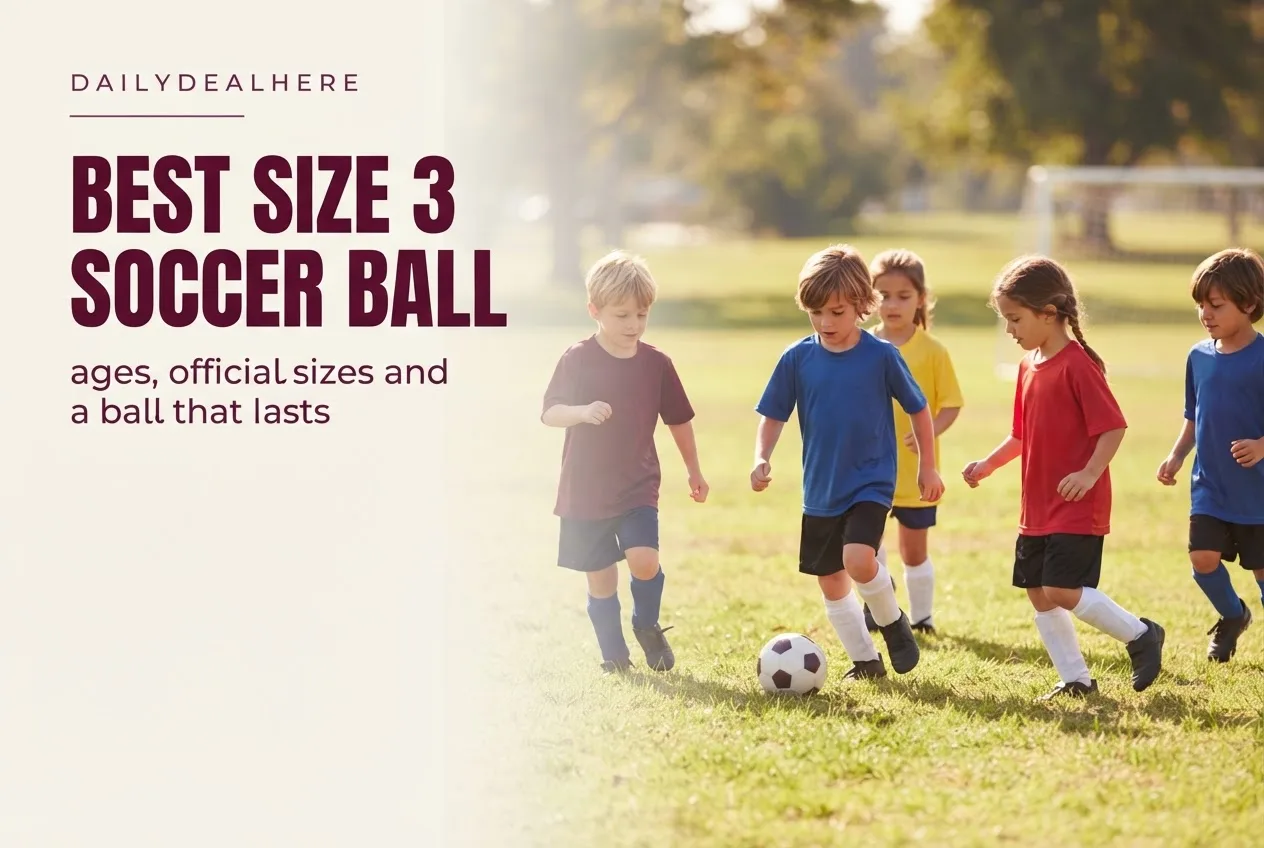
The best size 3 soccer ball is a well built ball in the right size for your child’s league, usually players around 8 and under, that holds its shape and air, feels soft enough for young feet, and survives being kicked against walls and fences. AYSO, the American Youth Soccer Organization, specifies a size 3 ball for its 6U and 8U divisions, with a circumference of 23 to 25 inches and a weight of 10 to 12 ounces. Within that size, construction matters more than the logo: look at how the panels are joined, what the cover is made of, and whether the ball carries a recognized quality mark.
This guide explains what size 3 means, which ages it suits, how soccer balls are built, what FIFA quality marks do and do not tell you, how to choose between match, training and recreational balls, and how to inflate and care for a youth ball so it lasts. It draws on the AYSO ball and field size rules, FIFA’s Quality Programme for Footballs and Wikipedia’s entry on the association football.
The short answer
- Who it is for: young players, typically about age 8 and under. AYSO uses size 3 for its 6U and 8U divisions.
- Official size: AYSO lists 23 to 25 inches around and 10 to 12 ounces.
- What to look for: a durable cover, a bladder that holds air, neat seams or bonded panels, and a quality mark if the model has one.
- Check your league: leagues set their own ball sizes by age, so confirm before you buy.
- Inflate correctly: use the pressure printed on the ball and a gauge, not a squeeze.
What “size 3” actually means
Soccer balls are numbered by size. Wikipedia explains that the Laws of the Game specify the regulation ball, known as size 5, with a circumference of 68 to 70 centimeters, about 27 to 28 inches, and a mass of 410 to 450 grams, about 14 to 16 ounces. Smaller balls, sizes 1, 2, 3 and 4, are produced for younger players or as training tools.
Wikipedia also notes that FIFA, after consulting football associations, clubs and manufacturers, has developed non-compulsory recommendations for ball sizes, circumferences and weights for different youth age groups. In the US, youth organizations publish their own rules, and those are what your child’s games will use.
Soccer ball size by age
AYSO publishes a clear chart of ball sizes by age division.
| AYSO division | Ball size | Circumference | Weight |
|---|---|---|---|
| Schoolyard Soccer, 6U and 8U | 3 | 23.0 to 25.0 inches | 10 to 12 oz |
| 10U and 12U | 4 | 25.0 to 26.5 inches | 12 to 14 oz |
| 14U, 16U and 18U | 5 | 26.5 to 28.0 inches | 14 to 16 oz |
The “U” means under: 8U covers players in the under 8 age group. Because age cutoffs can depend on birth year and league, a child who is 8 may play in a division that uses a size 3 or a size 4 ball. The simplest rule is to ask the coach or check the league handbook.
What age is a size 3 soccer ball for?
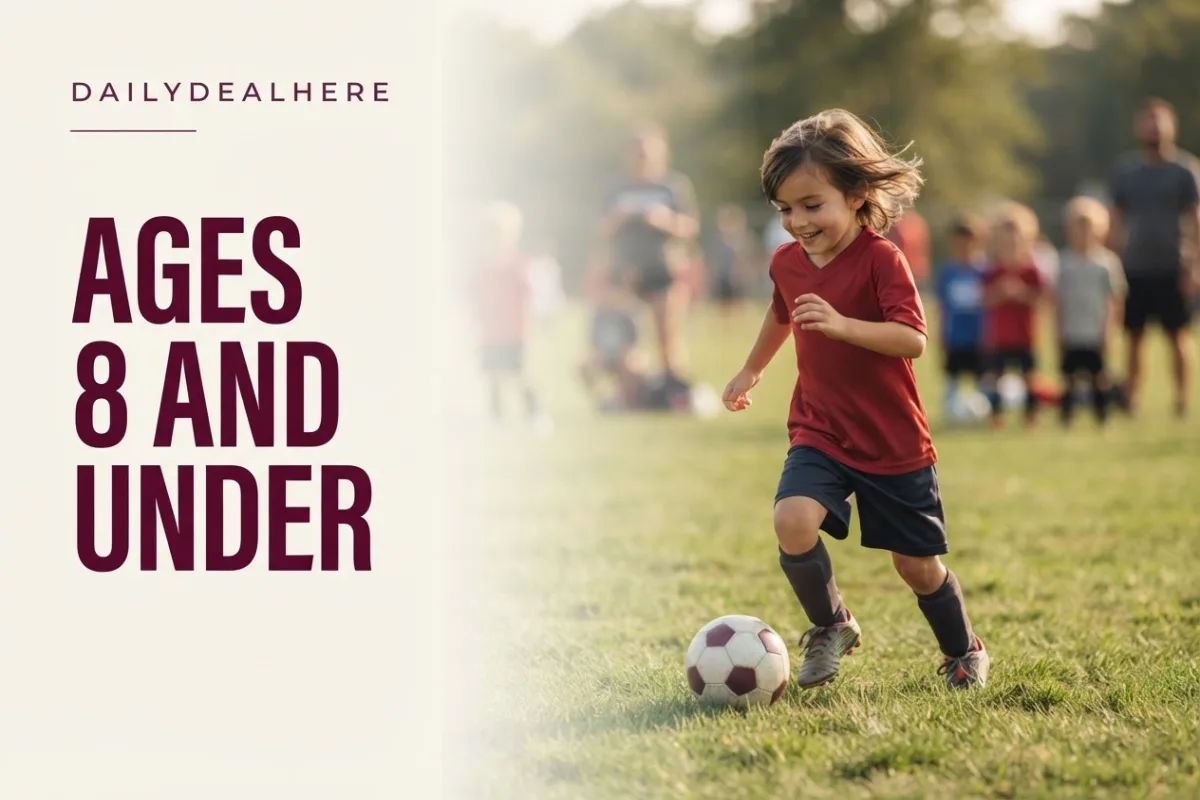
Under AYSO rules, size 3 covers the 6U and 8U divisions, so roughly players aged 8 and under. Other youth organizations use similar breakpoints, but they can differ. If your child is at the upper edge of the range and will move up a division soon, it may be worth checking whether the next season will switch to a size 4 before buying a premium ball.
For toddlers and very young children just learning to kick, some families start with an even smaller ball at home. For organized play, match the ball to the league so practice at home feels the same as games.
Why the right size matters
A ball that is too big and heavy is harder for small legs to control, pass accurately and shoot with confidence. That is the reasoning behind scaled youth equipment, and it is why governing bodies publish age based size recommendations rather than handing every child a full size ball. Practicing with the same size ball used in games also means touches and passes at home carry straight over to matches.
Weight matters as much as circumference. The AYSO range for size 3, 10 to 12 ounces, is noticeably lighter than the 14 to 16 ounces of a full size ball. A size 3 ball that is overinflated or waterlogged can feel heavier and harder than it should, which is one more reason to care about construction and pressure.
How a soccer ball is built
Every soccer ball has the same basic parts, and differences in each explain most of the gap between a ball that lasts a season and one that goes soft in a month. Wikipedia describes them.
- Bladder: the inner part, made of latex or butyl rubber, which lets the ball be pressurized.
- Cover panels: the outside, made of leather, synthetic leather, polyurethane or PVC. The surface can be textured, woven or embossed for better control and touch.
- Panel joins: machine stitched, hand stitched, or thermo bonded, meaning glued and bonded by heat along the edges.
- Water resistance: balls may be specially coated, or the stitches bonded with glue, to prevent water absorption.
Wikipedia adds that the classic 32 panel design dates from 1962 and that many modern balls use far fewer panels, some as few as four.
Construction options compared
| Feature | Options | What to consider for a young player |
|---|---|---|
| Bladder | Latex or butyl rubber | Check reviews and the maker’s claims on air retention. A ball that constantly goes soft is frustrating for kids |
| Cover | Leather, synthetic leather, polyurethane or PVC | Synthetic covers dominate youth balls. A softer surface is friendlier on small feet, a tougher one lasts longer on concrete |
| Panel joins | Machine stitched, hand stitched or thermo bonded | Bonded seams and coated or glued stitching help keep water out |
| Surface | Smooth, textured, woven or embossed | Texture can improve grip and touch |
For most families, the practical question is where the ball will be used. A ball kicked mostly on grass can prioritize feel. A ball that will spend its life on driveways, blacktop and against garage doors should prioritize a tough cover.
Stitched versus bonded balls
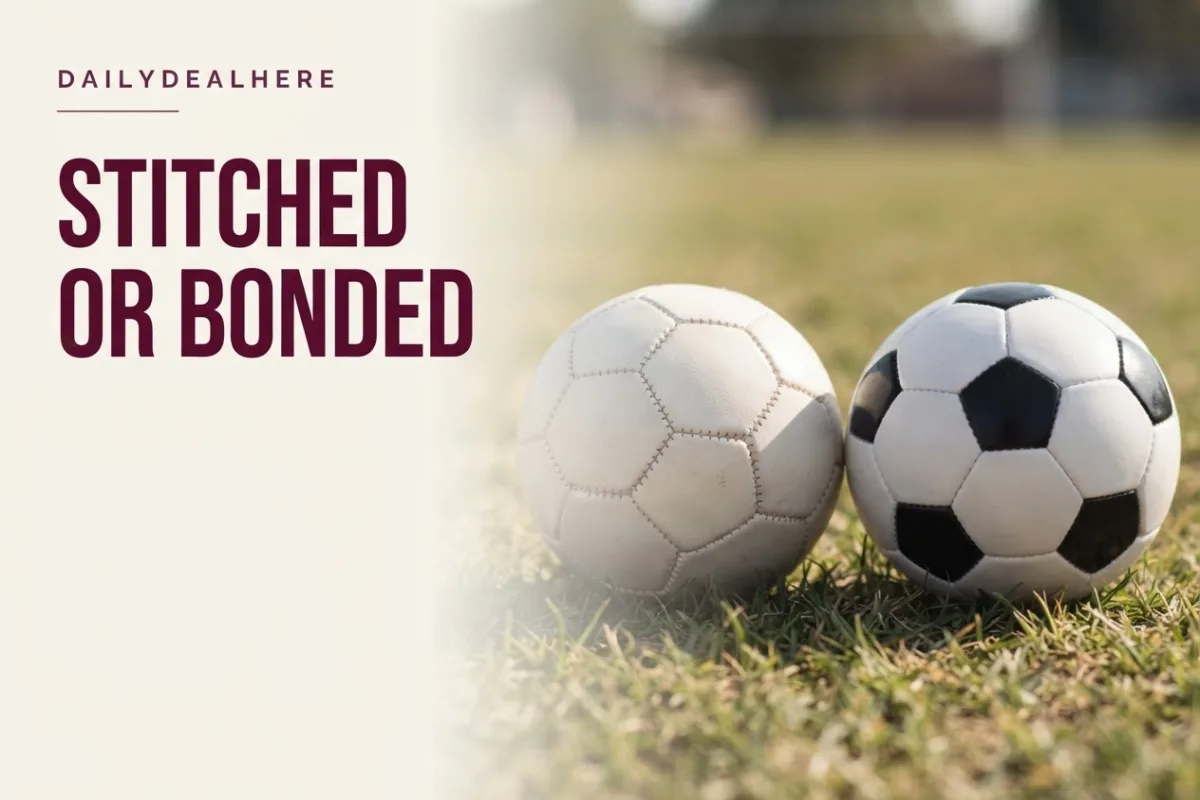
Both methods produce good balls. Thermo bonded panels, glued and heat sealed, leave no stitch holes for water to enter, which is why Wikipedia mentions bonding and glued stitches in the context of preventing water absorption. Stitched balls are the traditional construction and are widely used at every price level.
Water matters because a ball that absorbs water gets heavier. Wikipedia notes that old leather balls absorbed water in the rain, which significantly increased their mass. Modern synthetic covers and sealed seams largely solve this, but a cheap ball with open stitching can still soak up water on a wet field.
What FIFA quality marks mean
FIFA runs a Quality Programme for Footballs, introduced in 1996, that covers outdoor, futsal and beach soccer balls. Balls that pass its laboratory procedure can carry the FIFA Quality or the higher FIFA Quality Pro mark, and FIFA Basic is a third mark referenced in the Laws of the Game. FIFA says a ball must pass seven checks to earn the FIFA Quality mark, covering weight, circumference, roundness, bounce, water absorption, loss of pressure and shape and size retention, and must pass them under even more demanding conditions for FIFA Quality Pro.
FIFA frames the marks around match balls. Under Law 2, balls used in international matches organized by FIFA or the confederations must carry one of the marks, and member associations may require them in their own competitions. FIFA also notes that anyone, from professionals to schoolchildren, can look for the marks when buying a ball.
For a size 3 youth ball, a FIFA mark is a useful sign of consistent construction where a model carries one, but many good youth and training balls do not. If a ball you are considering lacks a mark, judge it on construction and on how well it holds air and shape.
The seven FIFA checks in plain language
Even if the ball you buy carries no mark, the seven properties FIFA checks are a good framework for judging any youth ball.
- Weight: the ball should sit inside the range for its size. For size 3, AYSO lists 10 to 12 ounces.
- Circumference: the ball should match the size it claims, 23 to 25 inches for an AYSO size 3.
- Roundness: a ball that is slightly egg shaped wobbles in flight and bounces unpredictably, which is confusing for a young player.
- Bounce: consistent rebound means passes and first touches behave the same every time.
- Water absorption: a ball that soaks up water gets heavier and harder to kick on wet grass.
- Loss of pressure: a ball that leaks air needs constant pumping and plays dead when soft.
- Shape and size retention: after hundreds of hard kicks, a good ball stays round and the right size.
You can check some of these at home. Measure the circumference with a soft tape, weigh the ball on a kitchen scale, drop it from the same height a few times on a hard floor to see whether the bounce is consistent, and see whether it holds pressure for a week.
Which size 3 ball is the best quality?
Rather than one model, look for the qualities that separate a good youth ball from a disappointing one.
- Correct size and weight, within the league’s range, which AYSO sets at 23 to 25 inches and 10 to 12 ounces for size 3.
- Air retention, so the ball stays properly inflated between sessions.
- Shape retention, so it stays round after hard kicks. FIFA’s program measures roundness and shape retention for this reason.
- Water resistance, through bonded panels or sealed stitching.
- A cover suited to the surface, soft for grass play, tougher for pavement.
- A quality mark, where available, as extra reassurance.
What about brands?
Most major soccer brands make size 3 versions of their training and replica balls, and FIFA says its program has more than 70 licensees. FIFA’s website lets you look up current balls that carry its quality marks, which is a more objective starting point than brand reputation alone. Within any brand, the difference between an inexpensive recreational ball and a better training ball is usually the construction features above, not the logo.
If your child’s team uses a particular ball in games, buying the same model in size 3 for home practice is a simple way to keep the feel consistent.
Match ball, training ball or recreational ball?
- Match balls are built for consistency in games and often carry quality marks. They are overkill for backyard play but make sense for team captains or clubs.
- Training balls balance durability and feel, and are the best fit for most young players practicing several times a week.
- Recreational balls are the most affordable and fine for casual play, parties and very young beginners, though they may not hold air or shape as well.
For a child in their first season or two, a solid training ball in the right size is usually the best value.
Size 3 versus size 4
The jump from size 3 to size 4 is smaller than it sounds but noticeable to a young player. Using AYSO’s figures, size 3 runs 23 to 25 inches and 10 to 12 ounces, while size 4 runs 25 to 26.5 inches and 12 to 14 ounces. So the top of the size 3 range touches the bottom of the size 4 range, and the heaviest size 3 is as heavy as the lightest size 4.
That overlap is why a child near the end of the 8U years may cope fine with either, and why buying ahead is tempting. For games, though, the league decides. For home practice, most coaches would rather a child master control of the ball they use on game day than struggle early with a bigger one.
Simple ways to practice with a size 3 ball
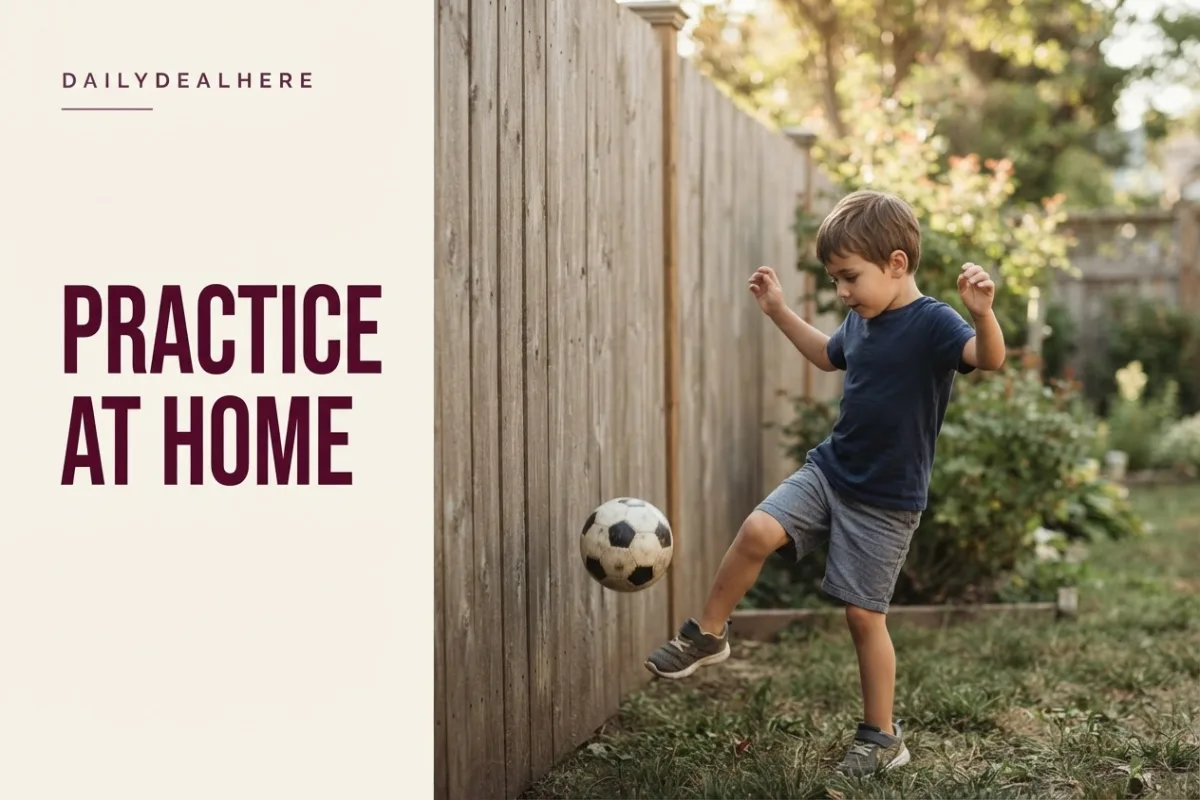
- Wall passes: pass against a wall or fence and control the rebound, alternating feet.
- Dribbling gates: set a few markers and dribble through them using both feet and different parts of the foot.
- Toe taps: tap the top of the ball lightly with alternating feet to build touch and balance.
- Target shooting: aim for a small target rather than an empty net, to reward accuracy over power.
A ball that bounces consistently and holds its pressure makes all of these more rewarding, which is the real payoff of choosing a well made ball.
When to replace a youth ball
Replace a ball when it will not hold air even after the valve is checked, when it has become visibly lopsided, when panels are peeling or seams are opening, or when a bulge shows the bladder is failing. Worn balls bounce unpredictably and can make practice frustrating, and a child who has moved up a division will need the next size anyway.
Inflating a size 3 ball correctly
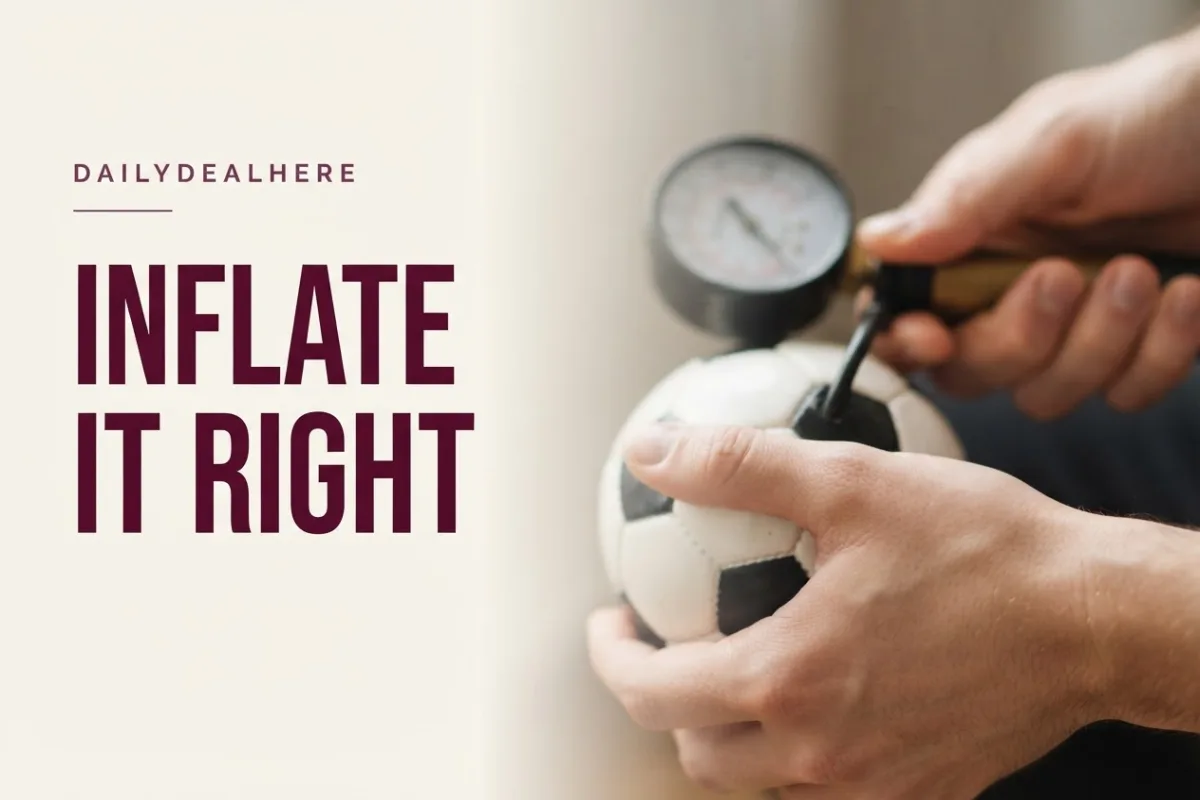
Pressure changes how a ball feels and how long it lasts. Wikipedia gives the regulation range for a full size ball as 0.6 to 1.1 kilograms of force per square centimeter, about 8.5 to 15.6 psi. Youth balls usually print their own recommended pressure near the valve, and that is the number to follow.
- Use a pump with a gauge, or a separate gauge, rather than judging by squeeze.
- Moisten the inflation needle before inserting it to protect the valve.
- Do not overinflate. An overinflated ball feels hard, bounces unpredictably and puts extra strain on the seams.
- Check pressure before practice, since balls lose some air over time.
Caring for a youth soccer ball
- Wipe off mud and let the ball dry at room temperature after wet sessions.
- Store it away from direct heat, such as a hot car trunk, which can stress the bladder and cover.
- Discourage sitting or standing on the ball, which distorts its shape.
- Keep it off sharp surfaces and thorny hedges where possible.
- Reduce pressure slightly for long storage, then reinflate to the printed value before use.
Indoor, futsal and other variants
FIFA’s quality program covers futsal and beach soccer balls as separate categories from outdoor balls, which reflects how different they are. If your child plays indoor or futsal as well as outdoor soccer, check which ball that program uses rather than assuming the outdoor size 3 will do. For backyard play, a regular outdoor size 3 is the most versatile choice.
Grass, turf and pavement
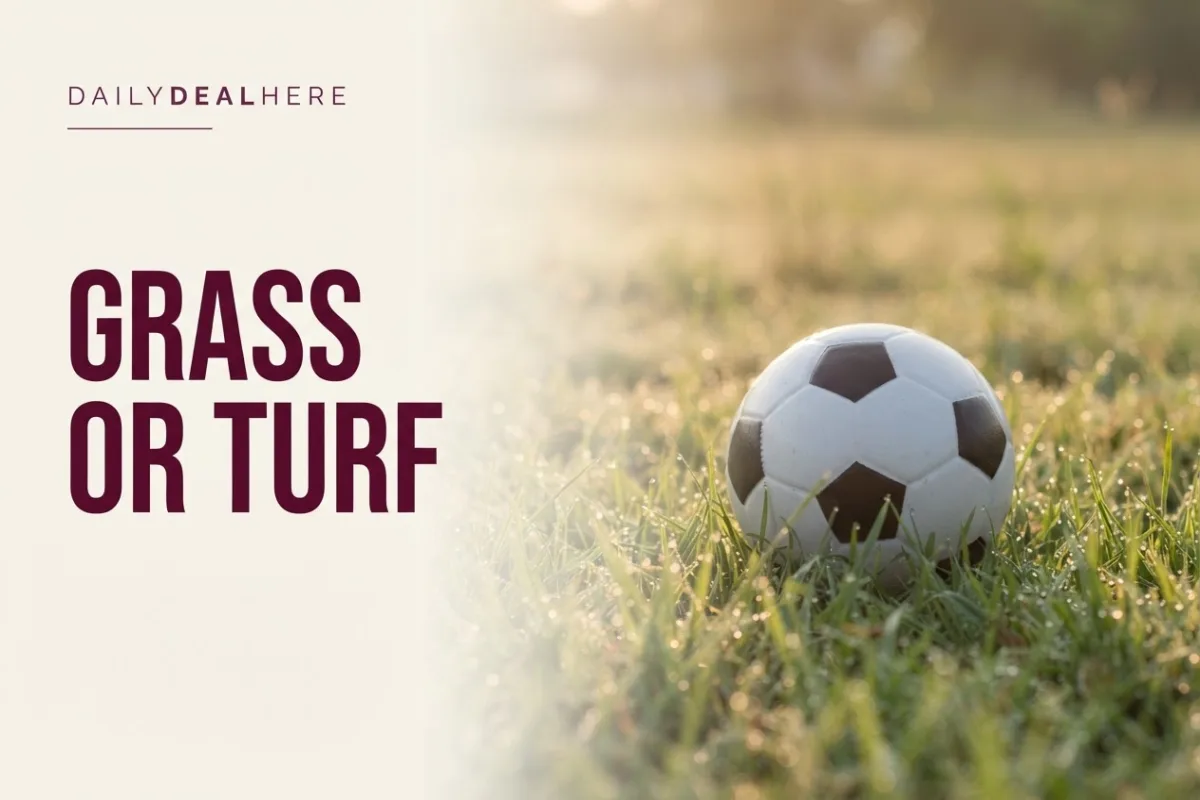
Where the ball is used shapes which cover makes sense. On natural grass, water resistance matters most, because morning dew and wet fields are where a poorly sealed ball picks up weight. On artificial turf, the surface is abrasive and warms up in the sun, so a tough cover and sensible storage out of a hot car help. On driveways, playgrounds and blacktop, abrasion is the main enemy, and a durable cover will outlast a softer premium one by a wide margin.
Many families end up with two balls: a better one for practice on grass and a cheaper, tougher one for street play. That keeps the good ball round and grippy for the sessions that matter, and means a lost ball in the neighbor’s yard is less of a loss.
Buying for a team versus for home
Coaches and team parents buying a bag of balls face a different trade-off from a family buying one. For a team, consistency across balls and durability matter most, since the balls will be kicked hard and often and shared by many players. For home, one good training ball in the correct size, plus a pump and gauge, covers nearly every need.
Young keepers need more than a ball. Our guide to fingersave goalkeeper gloves covers protective options for players who want to try goal. For children who play several sports, our guide to the best 12 inch youth baseball gloves covers another staple. If the ball is a gift, our list of last minute gifts that still arrive on time has more ideas.
A quick buying checklist
- Confirm your child’s division uses size 3.
- Check the ball’s stated circumference and weight against your league’s range.
- Choose training quality for regular practice, recreational for casual play.
- Prefer bonded panels or sealed stitching if the ball will see wet grass.
- Look for a quality mark where available, and check air retention in reviews.
- Buy a pump with a gauge and inflate to the printed pressure.
Frequently asked questions
What is the best size 3 soccer ball?
A well built ball in the correct size for your child’s league that holds air and shape, resists water and has a cover suited to where it will be played. A FIFA quality mark, where a model has one, is extra reassurance of consistent construction.
What age is a size 3 soccer ball for?
Young players, typically about 8 and under. AYSO uses size 3 for its 6U and 8U divisions. Leagues set their own sizes by age, so check with your child’s coach or league.
How big is a size 3 soccer ball?
AYSO specifies 23 to 25 inches in circumference and 10 to 12 ounces for size 3. A full size 5 ball is about 27 to 28 inches around and 14 to 16 ounces.
What brand of soccer ball is the best?
No single brand is best at every price. Most major brands make size 3 training balls, and FIFA’s website lists balls that carry its quality marks, which is a more objective guide than brand reputation. Compare construction, air retention and fit to your league.
What does FIFA Quality Pro mean on a soccer ball?
It means the ball passed FIFA’s laboratory program under its most demanding conditions. FIFA says the checks cover weight, circumference, roundness, bounce, water absorption, loss of pressure and shape and size retention.
Are stitched or bonded soccer balls better?
Both can be good. Thermo bonded panels are glued and heat sealed, which helps keep water out, and stitched balls are the traditional construction. Coated or glue sealed stitching also reduces water absorption.
How much air should a size 3 ball have?
Follow the pressure printed near the valve and use a gauge. For reference, Wikipedia gives the regulation range for a full size ball as about 8.5 to 15.6 psi. Avoid overinflating, which makes the ball hard and strains the seams.
When should my child move up to a size 4 ball?
When their league moves them into a division that uses it. In AYSO, that happens at 10U, where size 4 balls of 25 to 26.5 inches and 12 to 14 ounces are used.
Match the ball to the league, pick a training ball with sound construction, and keep it at the printed pressure. For a young player, a ball that feels right and stays round does more for their game than any logo.








Write Your Review
No reviews yet. Be the first to share your experience!