

There is no single best motorcycle helmet brand, because safety is rated model by model, not brand by brand. But the independent data does separate the field. Using the UK government’s SHARP impact ratings, which we checked for ten major brands on September 19, 2026, AGV, Shoei and Bell have the highest average scores and the most 5-star models, with Shark close behind. Arai, HJC, LS2, Scorpion, Schuberth and Icon all make well rated helmets too, but with a wider spread between their best and weakest models. Whatever brand you choose, the helmet also has to carry the DOT certification label to be legal and meaningful on US roads, and it has to fit your head shape.
This guide explains what each safety certification actually tells you, how SHARP rates helmets, how the ten brands compare on the published numbers, which recent models scored best, why fit matters as much as the logo, and how to spot a helmet that is not safe at all. The data comes from the SHARP helmet safety scheme run by the UK Department for Transport, the NHTSA guide to choosing a motorcycle helmet and the Snell Memorial Foundation standards list.
The short answer
- Best overall SHARP record: AGV, with 14 of 35 rated models at 5 stars and an average of 4.3.
- Strongest recent results: Shoei, whose four models rated to the newer ECE 22.06 standard all scored 5 stars.
- Highest share of 5-star models: Bell, with 10 of 19 rated models at 5 stars, most of them older designs.
- Most consistent 4-star performer: Shark, with 37 of 38 rated models at 4 or 5 stars.
- Widest range: HJC, with 41 rated models spanning 1 to 5 stars, which is why checking the individual model matters.
- Non-negotiable in the US: the DOT label on the back of the helmet, meaning it is certified to Federal Motor Vehicle Safety Standard No. 218.
Why “best brand” is the wrong question
Helmet brands make dozens of models at very different price points, often with different shell constructions, and each one performs differently when it is struck. In the SHARP data, a single brand can have helmets at both ends of the scale. HJC, for example, has models rated 5 stars and a model rated 1 star. LS2 ranges from 1 to 4 stars. Arai runs from 2 to 5.
So the useful way to think about brands is as a starting point. A brand with a high average and many top-rated models is more likely to produce a well performing helmet across its range. But the rating that actually protects you belongs to the specific model on your head, and brand reputation is no substitute for checking it.
What the safety labels actually mean
Four names come up in almost every helmet discussion. They do different jobs.
| Label or rating | Who is behind it | What it tells you |
|---|---|---|
| DOT (FMVSS No. 218) | US Department of Transportation, NHTSA | The legal minimum for helmets sold in the US. Manufacturers self-certify, and NHTSA checks some helmets and can order recalls. |
| ECE 22.06 | UN Economic Commission for Europe regulation | The current European type approval standard used in the UK and Europe. It replaced ECE 22.05. |
| Snell M2025D and M2025R | Snell Memorial Foundation, a private nonprofit | A voluntary certification. Snell’s current motorcycle standards are listed as M2025D and M2025R, with M2020 before them. |
| SHARP star rating | UK Department for Transport | Not a pass or fail standard but a 1 to 5 star comparison of how much protection a helmet offers, based on its own impact program. |
The practical takeaway is that DOT is the minimum you must have in the US, ECE 22.06 and Snell are additional certifications some helmets carry, and SHARP is the most useful tool for comparing how different certified helmets perform relative to each other.
How DOT certification works
NHTSA explains that a DOT symbol on the outside back of a helmet means it meets Federal Motor Vehicle Safety Standard No. 218. Importantly, NHTSA does not approve helmets. It relies on self-certification by manufacturers, then conducts compliance checks on some helmets each year, chosen mostly at random but taking consumer complaints into account. If a helmet fails, NHTSA can issue a formal recall requiring it to be removed from stores, and it posts its findings in an online database.
NHTSA also spells out what a genuine label looks like. Helmets sold in the US must carry a label on the back with the manufacturer or brand, the model designation, and the words DOT, FMVSS No. 218 and CERTIFIED. Labels on helmets made before May 13, 2013 simply read DOT. A bare DOT sticker on a recent helmet with no model name is a warning sign, especially because NHTSA notes that fake DOT labels are sold to put on unsafe helmets.
How SHARP rates helmets
SHARP was launched by the UK Department for Transport in 2007 after research found real differences in the safety performance of helmets on sale. According to SHARP, each model undergoes 30 linear and 2 oblique impacts, using at least seven helmet samples in a range of sizes. Linear impacts hit the front, sides, crown and rear against both flat and kerb shaped anvils, at 6, 7.5 and 8.5 meters per second.
That top speed matters. SHARP says it deliberately impacts at 8.5 meters per second, faster than the 7.5 required by ECE 22.05 and the 8.2 required by ECE 22.06, following European crash research that found better energy absorption could turn many unsurvivable injuries into survivable ones. The results are then weighted by real world crash data on where and how hard heads are struck, with the side and rear commonly impacted and the side of the head particularly vulnerable.
SHARP describes a 5-star helmet as offering good levels of protection right around the helmet. It is careful to add that a lower rated helmet still provides protection, since every helmet on sale in the UK must meet at least one regulatory standard. The stars measure how much protection, not whether there is any.
One important limit: SHARP rates helmets sold in the UK, which are certified to the European standard. Helmets sold in the US carry DOT certification and may not be built identically to the UK version of the same model. A SHARP score is a strong guide to a brand’s engineering and to a model’s design, but it is not a guarantee for the US version.
The brand scorecard: SHARP ratings for ten brands
We collected every rating SHARP lists for ten brands commonly sold in the US, as published on September 19, 2026. The counts include older models SHARP has rated since 2007, so they describe each brand’s track record rather than only its current range. Our AGV figures match the summary SHARP itself publishes on the AGV brand page: 35 models and an average of 4.3 stars.
| Brand | Models rated | 5-star models | 4-star models | Lowest rating | Average stars |
|---|---|---|---|---|---|
| AGV | 35 | 14 | 19 | 3 | 4.3 |
| Shoei | 19 | 9 | 7 | 3 | 4.3 |
| Bell | 19 | 10 | 4 | 3 | 4.3 |
| Shark | 38 | 7 | 30 | 3 | 4.2 |
| Arai | 21 | 4 | 8 | 2 | 3.7 |
| HJC | 41 | 4 | 15 | 1 | 3.4 |
| LS2 | 30 | 0 | 18 | 1 | 3.4 |
| Scorpion | 25 | 0 | 11 | 2 | 3.4 |
| Schuberth | 14 | 0 | 5 | 2 | 3.2 |
| Icon | 5 | 0 | 2 | 2 | 3.2 |
Two cautions when reading this table. First, a brand’s average is pulled around by how many budget and older models it has had rated, so a brand with a large, wide ranging catalog will naturally sit lower than a brand with a narrow, premium one. Second, averages hide the individual model. A 3-star helmet from a top-scoring brand is still a 3-star helmet.
The current generation: ECE 22.06 results
Because ECE 22.06 is the newer standard, the helmets SHARP has rated under it are the most relevant guide to what brands are building now. Here is how each brand’s 22.06 models scored as of September 19, 2026.
| Brand | 22.06 models rated | Results |
|---|---|---|
| Shoei | 4 | All 5 stars: Glamster 06, GT Air3, Neotec 3, NXR 2 |
| AGV | 3 | All 5 stars: K7, K1-S, K6-S |
| Arai | 4 | RX7 V EVO 5 stars. Concept XE, Quantic and Tour X5 at 4 stars |
| Shark | 4 | All 4 stars: Aeron GP, Oxo, Ridill 2, Spartan RS |
| HJC | 5 | All 4 stars: F100, I80, I71, C10, RPHA 91 |
| LS2 | 6 | All 4 stars, including Strobe 2, Advant X, Stream 2 and Vector 2 |
| Scorpion | 6 | Four at 4 stars, including Exo R1 Evo and Exo GT-SP Air. Exo 491 and Exo 930 Evo at 3 stars |
| Bell | 1 | Lithium at 4 stars |
| Schuberth | 1 | E2 at 4 stars |
| Icon | 1 | Ultraflite at 4 stars |
The picture is encouraging for buyers on a budget. Under the newer standard, the mid priced brands are clustering at 4 stars, which is a solid result, while the 5-star scores are concentrated in a handful of premium models from Shoei, AGV and Arai.
AGV
AGV has the strongest overall SHARP record in our group: 35 rated models, 14 of them at 5 stars and none below 3. Its 5-star list spans racing and road helmets, including the K7, K1-S, K6-S, K6, Pista GP R, Corsa R, Veloce S and several older models. All three of its 22.06 rated models scored 5 stars.
Its modular helmets are a different story. The six AGV system helmets SHARP has rated, including the Sport Modular and the Compact ST, all scored 4 stars. That is a good result, but if you want AGV’s top rated protection, it is in the full face range.
Shoei
Shoei has 19 rated models, 9 at 5 stars and none below 3. Its recent record is the standout: every Shoei model SHARP has rated under ECE 22.06, the Glamster 06, GT Air3, Neotec 3 and NXR 2, scored 5 stars. That run covers both full face and modular designs.
The Neotec 3 is worth highlighting. Across all ten brands in our scorecard, only two modular helmets have a 5-star SHARP rating, the Shoei Neotec 3 and the Shark Evoline 3. If you want a flip up helmet with top rated impact protection, that is a very short list.
Bell
Bell has 19 rated models with 10 at 5 stars, the highest share of 5-star ratings in our group. Most of those 5-star ratings belong to earlier designs, including the Star, Race Star, Eliminator and a series of M-line helmets. Bell’s only 22.06 rated model so far, the Lithium, scored 4 stars, and its one rated modular, the M10, scored 3.
Bell’s track record is strong, but because so few of its current helmets have been through SHARP’s newer program, it is especially worth checking the specific model and its certifications before relying on the brand’s past scores.
Shark
Shark is the most consistent brand in the data. Of 38 rated models, 30 scored 4 stars and 7 scored 5, with just one at 3 stars. Its 5-star models include the Race R Pro and Race R Pro Carbon, the RSR2 and the Evoline 3 modular. All four of its 22.06 rated helmets scored 4 stars.
That consistency is useful if you are choosing between models on comfort, features or budget. With Shark, the floor is unusually high, so the risk of accidentally picking a weak performer is lower than with brands whose ratings spread further.
Arai
Arai has 21 rated models, 4 at 5 stars: the RX7 V EVO, RX-7V, QV Pro and GP5X. Its average of 3.7 is lower than the top group, partly because 8 models scored 3 stars and one scored 2. Every Arai helmet SHARP lists is a full face design.
Under ECE 22.06, Arai’s flagship RX7 V EVO scored 5 stars, and the Concept XE, Quantic and Tour X5 each scored 4. If you are set on Arai, the flagship sport model has the strongest published result.
HJC
HJC has more rated models than any other brand in our group, 41, and the widest spread, from 1 star to 5. Its 5-star models are the C70, FG ST, IS-17 and HQ1, and 15 more models scored 4 stars. It also has 14 rated modular helmets, more than any other brand here.
The encouraging sign is its recent work. All five HJC models rated under ECE 22.06, the F100, I80, I71, C10 and RPHA 91, scored 4 stars. With HJC, checking the individual model is essential, but its current range looks solid.
LS2, Scorpion and other value brands
LS2 and Scorpion both have large SHARP records. LS2 has 30 rated models with 18 at 4 stars and none at 5. All six of its 22.06 rated helmets scored 4 stars, including the Strobe 2 and Advant X modulars and the Stream 2 and Vector 2 full face models.
Scorpion has 25 rated models, 11 at 4 stars and none at 5. Under 22.06, four of its six rated helmets scored 4 stars, including the Exo R1 Evo and Exo GT-SP Air, while the Exo 491 and the Exo 930 Evo modular scored 3.
Neither brand has a 5-star model in the SHARP data, but on SHARP’s scale a 4-star helmet is a solid performer, and both brands’ recent 4-star models are worth a look alongside the premium names.
Schuberth and Icon
Schuberth’s SHARP record is dominated by modular helmets: 8 of its 14 rated models are system helmets. None scored 5 stars. Five scored 4 stars, including the C5, the C4 Pro and the newer E2, which is its only 22.06 rated model so far.
Icon has only five rated models in SHARP’s database, too few to draw strong brand level conclusions. Its best results are 4 stars, including the Ultraflite under ECE 22.06. With brands that have few ratings, the individual model’s certifications are the main thing to go on.
So which is the No. 1 helmet brand?
On the SHARP evidence, AGV has the best combined record: the most 5-star models, no model below 3 stars and a 4.3 average. Shoei matches that average and has the most impressive recent run, with every 22.06 rated model at 5 stars. Bell has a strong historical record, and Shark is the most consistent across a large range.
If you want a ranking of the top five on this data alone, it would be AGV, Shoei, Bell, Shark and Arai. But the honest answer is that the No. 1 brand for you is the one that makes a well rated model in your head shape, for your style of riding. A 5-star helmet that presses on your forehead is one you will be tempted not to wear.
Modular helmets and the latch score
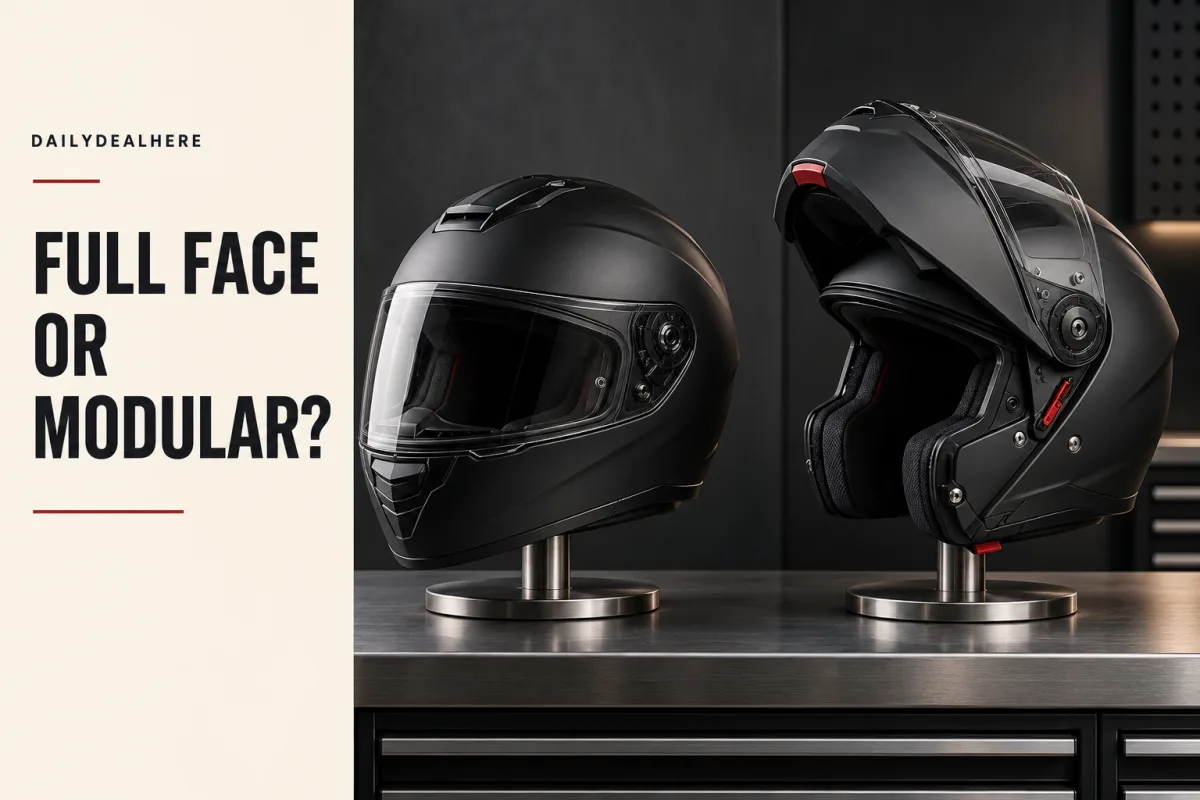
Modular, or flip up, helmets add a hinge and lock to the chin bar, and SHARP publishes an extra figure for them. The latch score is the percentage of the 30 linear impacts in which the chin bar stays fully locked. SHARP gives the example that a chin bar that opens on 9 of 30 impacts scores 70 percent.
SHARP does not fold the latch score into the star rating, because it cannot objectively quantify the safety effect of a latch failure. But it states plainly that the risk of injury increases with lower latch reliability. If you are shopping for a modular helmet, look up both numbers. Riders who spend long days touring often pair a modular with an intercom, and our guide to the best Bluetooth motorcycle intercoms covers that side of the setup.
Fit matters as much as the brand
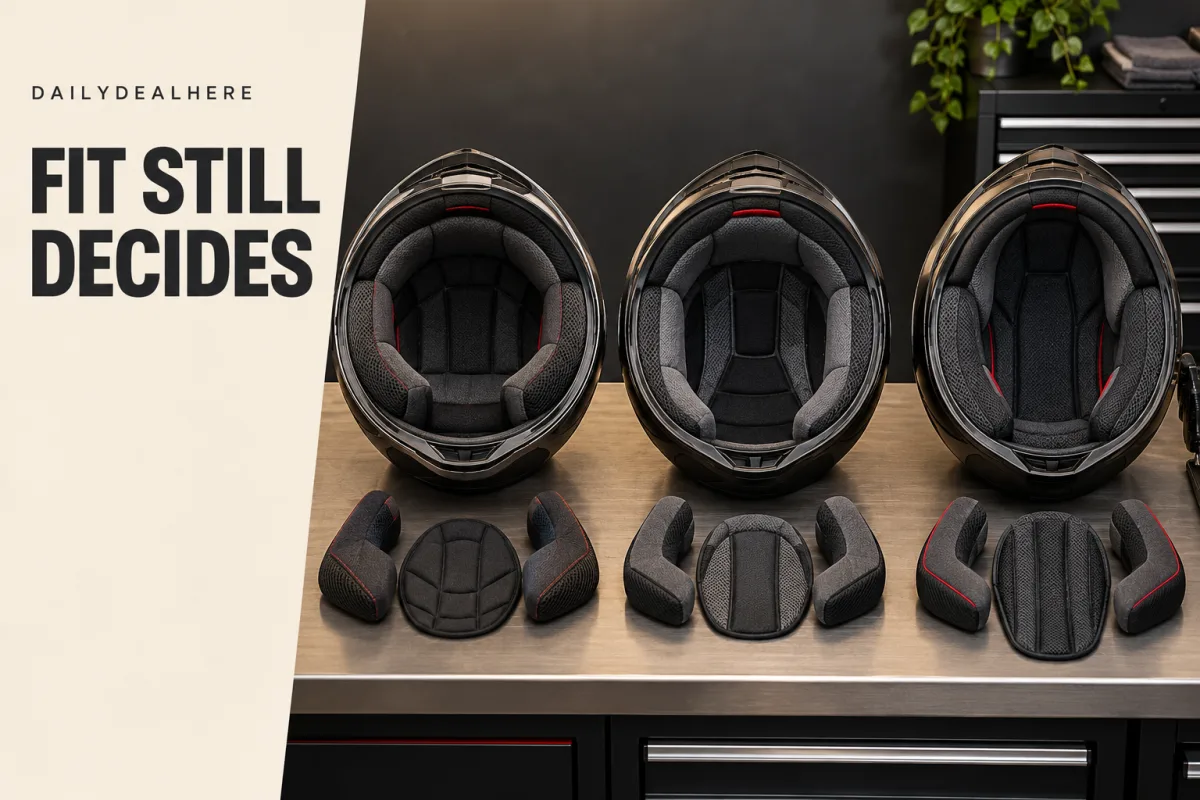
NHTSA puts fit at the center of choosing a helmet. It explains that helmets come in different internal shapes, round oval, intermediate oval (the most common) and long oval, and that you should identify your own head shape, not your face shape, by looking down on your head in a mirror or having a friend do it.
- Measure correctly. NHTSA says to use a cloth tape just above the eyebrows and around the thickest point at the back of the head, then compare with the maker’s size chart.
- Read pressure points. Pressure on the forehead suggests the helmet is too round for you. Pressure on the sides suggests it is too oval.
- Expect snug. A correctly sized helmet feels a little tight with even pressure, and it should not move when you shake your head.
- Wear it before riding. NHTSA suggests wearing a new helmet for 30 to 45 minutes to find hot spots that are not obvious at first.
- Do not modify it. Swapping manufacturer cheek pads and liners is fine, but NHTSA warns other alterations can void the warranty and compromise the helmet.
Head shape can be a reason to stay with a brand. Once a brand’s shape fits you, its other models may fit well too. If you have a smaller head, our guide to the best motorcycle helmet for a small head covers models that come in smaller shells.
How to spot an unsafe or novelty helmet
NHTSA warns that some online and physical stores sell so called novelty helmets that do not meet federal safety standards, and that fake DOT labels exist. Its signs of an unsafe helmet are specific.
- The helmet is less than 1 inch thick and usually lacks a stiff foam inner liner.
- It has flimsy plastic buckles rather than sturdy chin straps with solid rivets.
- It weighs a pound or less. NHTSA says helmets meeting the federal standard generally weigh about 3 pounds.
- It is advertised as the “thinnest” or “lightest” helmet available.
- It has spikes or rigid decorations. The DOT standard does not allow anything to extend more than two tenths of an inch from the surface.
- It is noticeably smaller in diameter and thinner than certified helmets, as with many skullcap and German Army styles, though NHTSA notes some German Army style helmets do meet the standard.
A known brand on a marketplace listing is not proof of authenticity either. Buy from an authorized dealer where you can, and check the label details NHTSA describes.
Choosing the right style of helmet
NHTSA groups helmets into several styles, each suited to different riding.
- Full face: aerodynamic, comfortable and well ventilated, with the most coverage.
- Modular: can be worn full face or open face, common with adventure and dual sport riders.
- Dual sport: an extended chin bar and visor, with newer models adding an integrated face shield.
- Off-road: an extended chin bar and visor designed for goggles, for motocross and trail riding.
- Hi-viz: available across styles, and NHTSA notes it significantly increases your ability to be seen.
- Half and open face: NHTSA says these provide only some level of protection, have no chin guard, which increases safety risk, and suffer significant wind noise.
SHARP’s data points the same way. Nearly all of the helmets in our scorecard are full face or system designs, and every brand’s top scores come from those styles. If you ride long distances with luggage, our guide to the best motorcycle panniers covers the rest of a touring setup.
A helmet buying checklist
- Choose a style that matches your riding. Full face offers the most coverage.
- Shortlist brands with strong SHARP records, then look up the SHARP rating of each specific model, and the latch score for any modular.
- Prefer models rated under ECE 22.06 when comparing current designs, and remember US versions may differ from UK versions.
- Confirm the US version carries a proper DOT label with the brand, model, DOT, FMVSS No. 218 and CERTIFIED.
- Identify your head shape and measure your head, then try helmets from brands whose shape suits you.
- Wear the helmet indoors for 30 to 45 minutes before riding to check for pressure points.
- Buy from an authorized dealer, and avoid anything that looks thin, light or decorated with spikes.
Frequently asked questions
What are the best motorcycle helmet brands?
On the UK government’s SHARP impact ratings for ten major brands, checked on September 19, 2026, AGV, Shoei and Bell have the highest averages and the most 5-star models, with Shark the most consistent across a large range. Safety is rated per model, so always check the specific helmet.
Which is the No. 1 helmet brand?
There is no official No. 1. On SHARP data, AGV has the strongest combined record, with 14 of 35 rated models at 5 stars and a 4.3 average, while Shoei matches that average and every Shoei model rated under the newer ECE 22.06 standard scored 5 stars.
What are the top 5 helmet brands?
Ranked on SHARP safety ratings alone among ten major brands, the top five are AGV, Shoei, Bell, Shark and Arai. This ranking reflects impact ratings only, not fit, comfort, noise or features, and individual models within each brand vary.
What does the DOT label on a helmet mean?
It means the manufacturer certifies the helmet meets Federal Motor Vehicle Safety Standard No. 218. NHTSA relies on self-certification and checks some helmets each year. A genuine label shows the brand, model, DOT, FMVSS No. 218 and CERTIFIED.
Is a Snell or ECE helmet safer than a DOT helmet?
They are different standards with different procedures. DOT is the legal minimum in the US, ECE 22.06 is the European standard and Snell is a voluntary certification. SHARP ratings are more useful for comparing how much protection certified helmets actually offer.
Are modular helmets as safe as full face helmets?
Some are well rated, but in our ten brand scorecard only two modular helmets have 5-star SHARP ratings, the Shoei Neotec 3 and the Shark Evoline 3. SHARP also publishes a latch score showing how often the chin bar stays locked during its impacts.
How do I know if a helmet is a fake or novelty helmet?
NHTSA says unsafe helmets are often less than 1 inch thick, lack a stiff foam liner, weigh a pound or less, use flimsy plastic buckles, or have spikes or decorations. Certified helmets generally weigh about 3 pounds and carry a full DOT label.
Do more expensive helmets always score better?
Not always. Under the newer ECE 22.06 standard, many mid priced models from HJC, LS2, Shark and Scorpion scored 4 stars, and several models from well known brands scored 2 or 3 stars. Check the SHARP rating of the specific model rather than relying on price or brand.
Start with a brand that has a strong record, confirm the specific model’s rating and DOT label, and let your head shape make the final call. The best helmet brand is the one whose well rated helmet fits you well enough to wear every ride.










Write Your Review
No reviews yet. Be the first to share your experience!