

Bolting a set of motorcycle panniers onto a bike quietly changes what that bike is for. A commuter turns into a grocery hauler, a mid-size adventure machine turns into a weekend camper, and a cruiser stops forcing you to ride three hours with a backpack digging into your shoulders. The catch is that the word “pannier” covers at least four very different products, and the wrong one either will not mount to your frame at all or will soak your spare gloves the first time you ride into weather.
For October 2026 we lined up 9 side bag sets from Milwaukee Leather, Nomad USA, Kemimoto and more, then sorted them by mounting style and shell material rather than by capacity alone, because that split is what actually decides whether a bag works on your machine. Our top pick is the Rhinowalk 48L Waterproof Motorcycle Panniers for its sealed roll-top closure and anti-vibration mounting that suits most adventure and sport racks. Ratings and review counts below come from real Amazon customers, not from sponsored placement. If you are still filling out the rest of the garage, our automotive guides cover the smaller upgrades that ride along with a luggage setup.

Pros
- Sealed waterproof body rather than a bolt-on rain cover
- 24L per side covers commuting through to light camping
- Anti-vibration mounting reduces rattle on rough surfaces
- Shoulder strap lets each bag carry like normal luggage
- Fits the common adventure and sport rack layouts
Cons
- Requires side racks that you buy separately
- Full 48L load makes the bike noticeably wider in traffic
- No published list of specific compatible motorcycle models
This is the Rhinowalk set aimed at riders who already run side racks and want one pair of bags that handles everything from a wet commute to a weekend under canvas. Each side carries 24L, which is the volume where a compact tent fits on one side and clothing fits on the other without the bags looking absurd on a mid-size machine.
The strongest argument for it is the closure. Rather than treating waterproofing as an accessory you strap on when the rain starts, the body is built to keep water out on its own. That matters most when the bike sits outside overnight and you are not there to fit a cover. The anti-vibration mounting is the second real benefit, keeping the bags from drumming against the rack over broken pavement.
The compromise is fitment. Rhinowalk specifies this set against adventure and sport motorcycle racks rather than against a list of bikes, so the rack is a prerequisite and confirming clearance is your job before ordering. At full capacity the pair also adds meaningful width, which is worth remembering when filtering between lanes or parking in a tight garage.
Bottom line: if you have racks and want one set of panniers that does not need a second product to survive weather, this is the most complete package in the roundup and the reason it takes best overall.
- Total capacity: 48L, split as 24L per side
- Configuration: matched pair
- Mounting: rack mounted, side racks required and sold separately
- Weather protection: waterproof body construction
- Closure: roll and buckle rather than exposed zipper
- Carry: detachable shoulder strap per bag
- Vehicle compatibility: specified against most adventure and sport motorcycle racks, no published model list
Rhinowalk lists this set as fitting most adventure and sport motorcycle racks, which is a statement about rack geometry, not about your specific bike. Before ordering, measure the platform width of your side rack, the vertical clearance to the exhaust, and the gap between the rack and the rear turn signal.
If your bike does not currently wear side racks, budget for those separately and buy them first. A rack that is model specific will always give a cleaner result than trying to improvise a mounting point with straps alone.
Twenty-four litres per side is roughly one compact tent and a sleeping pad on the left, with clothing, tools, and a rain suit on the right. Keep the heavier side toward whichever side you are more comfortable holding the bike on at a stop.
Pack dense items low and pressed against the bike so the mass sits close to the centreline. Soft and squashable items belong on the outer face where they act as padding. Line anything electronic with a separate dry bag regardless of how well the pannier seals.
Pros
- Comes from a brand with a long track record in motorcycle luggage
- Built specifically for adventure and dual sport use
- Rack-mounted design keeps the passenger seat clear
- Construction aimed at repeated off-pavement loading
Cons
- Sits at the premium end of this roundup
- No published list of specific compatible motorcycle models
- Needs side racks that are not part of the kit
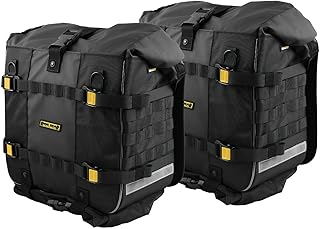
Nelson-Rigg is one of the few names in this roundup that exists purely to build motorcycle luggage, and the Trails End Adventure Saddlebags are its answer for riders who leave pavement on purpose. The set mounts to side racks rather than draping over the seat, which is the correct approach once a bike is going to see ruts and standing-up riding.
What you are paying for here is longevity and reputation rather than a headline capacity figure. Adventure luggage lives a harder life than cruiser luggage: it gets loaded and unloaded daily on a trip, it gets dragged against branches, and it occasionally takes the weight of a bike lying on its side. Purpose-built sets are engineered around that reality in a way that generic universal bags are not.
The obvious drawback is cost. This is the most expensive option in the roundup by a clear margin, and for a rider who only ever carries a laptop to the office that premium buys nothing useful. Nelson-Rigg also does not publish a model compatibility list for this set, so the rack you already own is the deciding factor.
Bottom line: the pick for genuine off-pavement touring, and overkill for a commuter who never leaves tarmac.
- Configuration: matched pair of saddlebags
- Mounting: rack mounted, side racks required
- Intended use: adventure and dual sport riding
- Brand focus: dedicated motorcycle luggage manufacturer
- Weather protection: adventure-grade construction
- Vehicle compatibility: no published model list, verify against your rack
Adventure luggage has a different job description from touring luggage. It has to survive being loaded while the bike is on a side stand on soft ground, it has to shrug off dust, and it has to stay attached over surfaces that would shake a seat-mounted bag loose.
If your riding involves fire roads, gravel, or multi-day trips away from paved services, that specialisation is what you are buying. If your riding is highway miles and hotel stops, a cheaper rack-mounted pair will serve you just as well.
Rinse dust and grit out of the closures after off-pavement days, since abrasive dust is what wears zips and buckles out early. Check rack bolts at the start of every riding day on a trip, because vibration loosens hardware faster than most riders expect.
Respect the rack load rating rather than the bag capacity when packing. A bag that physically holds more than your subframe is rated to carry is an invitation to a rack failure at the worst possible moment.

Pros
- Publishes an explicit list of compatible cruiser models
- Anti-scalding base addresses the classic exhaust heat problem
- Traditional leather look suits cruiser styling
- Throw-over design needs no rack and no tools
- 15L per side handles a rain suit and a day of errands
Cons
- Yoke sits across the passenger seat area
- Synthetic leather stiffens in cold weather
- Needs tie-down straps to stop the bags swinging into the wheel
This is the cruiser answer in the roundup. A yoke drapes across the seat area, a bag hangs on each side, and nothing needs to be drilled or bolted. For a Sportster or a Shadow owner who wants luggage this weekend rather than after a rack order arrives, that simplicity is the whole point.
Two things lift it above the generic leather-look sets. The first is the reinforced base, which exists because throw-over bags on a cruiser sit uncomfortably close to the exhaust and heat damage is the most common way these bags die. The second is that Kemimoto publishes an actual compatibility list naming Sportster, Softail, Dyna, V-Star, and Shadow platforms, which removes most of the guesswork that plagues this category.
The compromises are inherent to the throw-over format rather than to this product. The yoke occupies the passenger seat, so two-up riding and a full load do not coexist comfortably. The bags also need their tie-down straps properly tensioned, because a loose throw-over bag will swing toward the rear wheel over bumps. Synthetic leather also goes stiff in genuinely cold weather.
Bottom line: the best-documented fitment in the roundup and the sensible default for a cruiser owner who does not want to add hardware.
- Total capacity: 30L, split as 15L per side
- Configuration: matched pair on a connecting yoke
- Material: PU synthetic leather
- Mounting: throw-over, no rack required
- Heat protection: upgraded anti-scalding base
- Published compatibility: Sportster, Softail, Dyna, V-Star, Shadow
Kemimoto names Sportster, Softail, Dyna, V-Star, and Shadow platforms directly in the listing, which is unusually specific for universal-style luggage. If your bike appears on that list, you are in far safer territory than with a set sold only as one size.
If your bike is not on the list, the set may still fit, but you are back to measuring. Check the seat-to-exhaust gap, the distance from the yoke position to the top of the rear tire, and whether your rear turn signals sit where a bag wants to be.
This suits the cruiser rider who wants classic styling, has no side racks, and does not want to add any. It is a good match for solo commuting and day trips where 15L a side is plenty for a jacket, a lock, and shopping.
It is a poor match for regular two-up riding, since the yoke competes with your passenger, and for anyone planning multi-day camping where 15L a side runs out fast.

Pros
- Integrated lock deters casual theft at fuel and lunch stops
- Hard shell holds its shape even when the bags are empty
- Quick-release buckles make removal genuinely fast
- Publishes a compatibility list covering common cruiser platforms
- Compact width keeps the bike easy to filter and park
Cons
- 7.5L per side is the smallest capacity in this roundup
- A lock on a shell like this is a deterrent, not real security
- Rigid body cannot be squashed to fit an awkward load
Where most throw-over sets are soft bags that sag when empty, this Kemimoto set builds a rigid shell underneath the leather finish. The practical result is that the bike looks the same whether the bags are full or empty, which is a bigger deal on a cruiser than the spec sheet suggests.
The lock is the second reason to pick it. No soft luggage is theft proof, but a lock plus a hard shell changes the calculation for a fuel stop or a lunch break, where the alternative is carrying a helmet and a jacket into every cafe. Quick-release buckles then make it easy to take the bags inside overnight, which remains the only real security.
The limitation is capacity. At 7.5L per side this is the smallest set here, comfortably enough for gloves, a lock, documents, and a light rain layer, and nowhere near enough for camping. The rigid body also cannot flex to swallow an odd-shaped item the way a soft bag can.
Bottom line: the pick for a cruiser rider who values a clean look and a lockable compartment over outright volume.
- Total capacity: 15L, split as 7.5L per side
- Configuration: matched pair
- Construction: hard-shell body with PU leather outer
- Security: integrated lock
- Mounting: throw-over with quick-release buckles
- Published compatibility: Sportster, Softail, Rebel, Dyna and cruiser platforms
Treat the lock the way you would treat a cable lock on a bicycle. It stops an opportunist reaching in while you queue for coffee, and it does nothing against someone who arrived with tools and intent.
The habit that actually protects your belongings is simple: nothing of value stays in the bags overnight. The quick-release buckles exist to make that habit painless, so use them rather than trusting the lock at a motel car park.
Kemimoto names Sportster, Softail, Rebel, Dyna, and general cruiser platforms for this set. That is a useful shortlist, and the compact footprint means it clears rear signals and exhausts on more bikes than a bulkier set would.
If your machine is not named, measure the seat-to-exhaust gap and the clearance from the mounting position to the top of the rear tire before ordering. Do not infer fitment from a photo of a similar looking bike.

Pros
- Zip-off outer bags detach for carrying gear indoors
- Double pocket layout separates small items from bulk
- Classic cruiser look from a brand known for riding gear
- No rack or tools needed to fit
Cons
- Sold as one size with no published model compatibility list
- PVC is water resistant rather than sealed
- Yoke takes up the passenger seat area
Milwaukee Leather builds riding gear first and luggage second, and this set reflects that. It is a straightforward PVC throw-over pair with the traditional cruiser silhouette, and the standout feature is that the outer bags zip off so you can carry your gear inside without wrestling the whole yoke off the bike.
The double pocket layout is more useful day to day than the capacity number suggests. Small items live in the outer pocket instead of migrating to the bottom of a single cavern, which is the usual failing of cheap throw-over bags. PVC also wipes clean easily, which matters on a bike that gets ridden in traffic rather than polished on weekends.
Two caveats. It is sold as one size with no published vehicle list, so the measuring work falls entirely to you. And PVC with a zip is water resistant, not sealed, so a long motorway run in heavy rain will find its way in around the closure. Carry a dry bag for anything that must stay dry.
Bottom line: a solid classic-look choice if you value detachable outer bags and organisation, provided you measure your bike first.
- Configuration: throw-over pair, one size
- Material: PVC outer
- Feature: zip-off outer bags
- Layout: double pocket per side
- Mounting: throw-over, no rack required
- Vehicle compatibility: no published model list, measure before ordering
Drape the yoke across the seat with the bike upright, not on the side stand, so both sides hang evenly. Set the height so the bag bottoms clear the exhaust and the rear turn signals, then tension the tie-down straps at the front and rear of each bag.
Check the straps again after the first twenty miles. Throw-over sets settle as the load shifts, and a bag that has crept downward toward the wheel is the single most common failure in this category.
This suits a cruiser owner who wants the traditional studded look, values being able to unzip a bag and carry it inside, and rides mostly in dry or mixed conditions.
Look elsewhere if you need documented fitment for an unusual bike, if you regularly ride long distances in heavy rain, or if you need to carry camping volume.

Pros
- Quick release makes it easy to take the bag indoors
- Waterproof construction rather than a bolt-on cover
- Single bag keeps the bike narrower than a full pair
- Fits the common adventure and sport rack layouts
Cons
- Loading it heavily puts the weight on one side only
- Requires a side rack that is sold separately
- No published list of specific compatible motorcycle models
Most pannier listings assume you want two. This Rhinowalk bag assumes you want one, and for a lot of riders that is the honest answer. A daily commute rarely needs 48L, and a single bag keeps the bike narrow enough to filter and park normally.
The quick-release mounting is what makes the single-bag approach work. Because it comes off in seconds, the bag ends up going into the office or the flat with you rather than sitting on the bike, which is both more secure and more convenient than a bolted-on box. The waterproof body means you are not chasing a rain cover when the forecast turns.
The tradeoff is asymmetry. Twenty litres of dense cargo on one side is noticeable when the bike is being pushed around a car park, and it is worth loading with that in mind rather than filling it with tools. As with the larger Rhinowalk set, a compatible side rack is a prerequisite and no model list is published.
Bottom line: the smart pick for a commuter who wants one weatherproof bag that lifts off in seconds, rather than a full touring set.
- Capacity: 20L
- Configuration: single bag
- Mounting: quick release onto a side rack, rack sold separately
- Weather protection: waterproof body construction
- Vehicle compatibility: specified against most adventure and sport motorcycle racks, no published model list
Put the bag on whichever side you do not lean the bike toward on the side stand, so the load is not adding leverage while it is parked. Keep the heaviest items low and pressed against the bike rather than out at the outer face.
If you later want a matched pair, buying a second identical bag is usually cheaper and always tidier than mixing brands, since the mounting hardware and shape will match on both sides.
Like the larger Rhinowalk set, this bag is specified against adventure and sport motorcycle racks rather than a list of bikes. The rack is the component that must match your machine, and it is not included.
Measure your rack platform, the clearance to the exhaust, and the gap to the rear signal before ordering. If you do not have racks yet, buy a model-specific rack first and fit the bag to it.

Pros
- 20L per side is genuine touring capacity
- Bags detach rather than being permanently strapped on
- Protective cover included in the box
- Universal mounting rather than a single-platform design
Cons
- Rated slightly lower by customers than the other picks here
- Relies on a cover for rain rather than a sealed body
- No published list of specific compatible motorcycle models
This Kemimoto pair sits in the space between the cruiser leather sets and the adventure roll-tops. It offers 20L a side, which is real touring capacity, and the bags detach so they are not a permanent fixture on the bike.
The value proposition is capacity for the money. Very little else in the roundup gives you 40L across a pair while remaining a universal-fit product rather than a rack-specific one. If you need volume and do not want to commit to a rack system, this is the direct route there.
Two honest caveats. Customer ratings sit a little below the other picks here, which usually points at fitment friction on some bikes rather than at outright failure. And weather protection comes from the supplied cover rather than from a sealed body, so heavy sustained rain means stopping to fit the cover or accepting damp contents.
Bottom line: the capacity-per-cost pick, best suited to riders who want volume without buying into a rack ecosystem, and who accept a cover as their rain plan.
- Total capacity: 40L, split as 20L per side
- Configuration: matched pair
- Mounting: detachable, universal fit approach
- Weather protection: protective cover included
- Finish: black
- Vehicle compatibility: no published model list, measure before ordering
The cover is the primary defence here, which means it only works if you can fit it before the rain arrives. Keep it somewhere reachable rather than buried at the bottom of a bag, and practise fitting it once in the driveway so you are not learning at a wet lay-by.
For anything that genuinely cannot get damp, use a roll-top dry bag inside the pannier. That combination is more reliable than any cover and costs very little.
This suits a rider who needs a lot of space, wants the bags to come off between trips, and does not want to buy a bike-specific rack system first.
It is less suited to riders who ride year round in wet climates, or to anyone who wants a documented fitment list before they commit.

Pros
- Expands from 24L to 30L so one set covers commuting and trips
- Publishes an unusually specific list of compatible small bikes
- Rain cover supplied in the box
- Scaled for smaller machines rather than full-size tourers
- Highest customer rating of the sets in this roundup
Cons
- Too small for full touring loads on a large motorcycle
- Rain cover approach rather than a sealed body
- Expanded shape is bulkier than the compact setting
Almost every pannier on the market is drawn around a full-size motorcycle, which leaves Grom, Z125, and scooter riders trying to hang luggage that visually and physically overwhelms the bike. This Kemimoto set is built the other way around, scaled for small displacement machines, and that alone makes it the obvious pick for that group.
The expandable panel is the genuinely useful feature. At the compact setting the bags stay narrow enough for daily filtering and parking. Open them up and you gain enough volume for a weekend away without owning a second set. That flexibility is worth more on a small bike than raw capacity, because the bike is width sensitive in a way a big adventure machine is not.
Kemimoto also publishes an unusually specific fitment list here, naming ADV160, Ruckus, Grom, Z125, Ninja 400 and 500, GSX-R600, and YZF-R6. That is far more useful than a generic universal claim, and it is the strongest signal in this roundup that the seller has actually checked.
Bottom line: the correct answer for small bikes, scooters, and dual sport riders, and the wrong one for anybody loading a full-size tourer.
- Capacity: expandable from 24L to 30L total
- Standard configuration: 15L per side
- Configuration: matched pair
- Weather protection: rain cover included
- Intended platforms: sport bikes, scooters and dual sport machines
- Published compatibility: ADV160, Ruckus, Grom, Z125, Ninja 400 and 500, GSX-R600, YZF-R6
The named list covers ADV160, Ruckus, Grom, Z125, Ninja 400 and 500, GSX-R600, and YZF-R6. If your bike is on that list, this is about as close to a guaranteed fit as this category offers.
Owners of other small machines should still measure. The relevant numbers are the width of the rear subframe or rack, the clearance from the mounting point to the exhaust, and the gap to the rear turn signal.
Run the bags in the compact setting for daily riding. The narrower profile makes filtering and parking easier, and it stops the bags catching wind on a light bike where crosswinds already matter.
Open the expansion only for trips, and load the extra volume with light and bulky items such as clothing rather than with tools. Keeping the added mass low protects the handling of a small bike that has less weight to absorb it.

Pros
- Least expensive route to having luggage on the bike
- No rack, no tools and no hardware required
- Canvas construction takes knocks without cracking
- Universal shape suits a wide range of cruisers
Cons
- Canvas is water resistant at best, not sealed
- No published list of specific compatible motorcycle models
- Basic construction with little organisation inside
This is the simplest product in the roundup and it earns its place by being honest about it. A canvas yoke goes over the seat, a bag hangs on each side, and you are carrying luggage within a few minutes of opening the box. No rack, no bolts, no bike-specific hardware.
For a large number of riders that is genuinely all that is required. If the job is somewhere to put a jacket, a chain lock, a bottle of water, and whatever you picked up on the way home, this does it for a fraction of what a rack-mounted system costs once you count the rack itself.
Set expectations correctly, though. Canvas is water resistant, not waterproof, so anything that must stay dry belongs in a bag inside the bag. There is little internal organisation, and Nomad USA sells the set as a universal fit without a published vehicle list, which puts the measuring work on you. It is also not the set for camping loads or for daily riding in a wet climate.
Bottom line: best value in the roundup, and the right first set of saddlebags for a rider who does not want to spend on hardware before finding out whether they use luggage at all.
- Configuration: throw-over pair
- Material: canvas
- Mounting: throw-over, no rack or tools required
- Fit: universal, one size
- Weather protection: water resistant canvas, no sealed closure
- Vehicle compatibility: no published model list, measure before ordering
This is for the rider adding luggage to a bike for the first time, for anyone who wants a spare set for occasional use, and for riders whose carrying needs stop at a jacket and a lock.
It is not for touring, not for camping, and not for a commuter who rides through winter in a wet climate. Those riders should move up to a sealed rack-mounted set.
Let canvas dry fully before storing it, since damp canvas left folded will mildew. Brush off road grime rather than soaking the bags, and re-tension the tie-down straps after the first ride with a load in them.
Check clearance to the exhaust every time you refit the set. Canvas will scorch against a hot pipe, and a bag that has slipped down toward the rear wheel is a safety problem, not just a cosmetic one.
How to Choose the Right Motorcycle Panniers
Luggage shopping for a motorcycle runs backwards compared with luggage shopping for a car. You do not start with how much you want to carry. You start with what your bike will physically accept, then work down to volume, material, and closure. Get that order wrong and you end up returning a very nice set of bags that simply cannot hang where you need them to hang.
Mounting Style Decides Almost Everything

There are three common ways a pannier attaches. Throw-over sets use a connecting yoke or strap that drapes across the rear seat or fender, with a bag hanging on each side. They need almost no hardware, which makes them the default choice for cruisers and for riders who do not want to drill anything. The tradeoff is that the yoke occupies the passenger seat and the bags rely on friction plus tie-down straps to stay off the exhaust and the rear wheel.
Rack-mounted or frame-mounted bags clip, strap, or bolt to tubular side racks. Adventure and sport-touring riders lean this way because the load hangs off the chassis instead of the seat, weight sits lower, and the passenger seat stays usable. This is also the category where you must own the rack first. Several of the sets in this roundup, including both Rhinowalk options, state plainly that they fit “most adventure and sport motorcycle racks,” which is another way of saying the rack is your problem, not theirs.
The third style is the hard side case, a rigid shell in aluminum or molded plastic that locks onto a dedicated mount. Hard cases are the most secure and the most weatherproof, and they are also the least forgiving about fitment and the heaviest thing you can hang on a subframe. Worth noting for anyone comparing listings: mounting racks and hardware are frequently sold separately from the case, so read the box contents before assuming a kit is complete.
Shell Material: Soft Fabric, Leather, or Hard Case

Soft fabric bags, usually a coated nylon or polyester over a semi-rigid liner, dominate the adventure segment. They absorb a tip-over instead of cracking, they compress when empty, and roll-top versions seal against water without a zipper to fail. Rhinowalk and Nelson-Rigg both build in this style, and both use a roll or flap closure rather than relying on an exposed zip.
PU leather and PVC bags own the cruiser look. Kemimoto and Milwaukee Leather both build throw-over sets in this material, and the appeal is obvious on a Sportster or a Shadow, where a technical nylon bag looks out of place. Synthetic leather holds shape better than plain canvas and wipes clean, but it does stiffen in cold weather and it will fade if the bike lives outside year round.
Hard-shell construction sits at the top for security and shape retention. The Kemimoto 15L set splits the difference with a hard-shell body wrapped in PU leather plus a built in lock, which is a reasonable answer for riders who want cruiser styling and a bag that does not slump when it is half empty. Full aluminum boxes exist further up the price ladder, but they are almost always sold as a case plus a bike-specific mounting system rather than as a universal kit.
Waterproofing Is a System, Not a Label
Manufacturers use “waterproof” loosely. In practice there are three tiers. A rain cover is a separate sheet you pull over the bag when the sky opens, which works if you notice the weather in time and stop to fit it. A water resistant bag has coated fabric and a flap, and it handles spray and light rain but leaks at the seams and the zipper during a sustained downpour. A genuinely sealed bag uses welded seams and a roll-top or dry-bag closure, so water has no path in even when the bike sits out overnight.
For a daily commuter, a rain cover is usually enough. For anyone crossing a mountain pass with a sleeping bag inside, pay for welded seams. Notice which sets in the list ship a rain cover as the primary defense versus which ones seal at the closure itself, because that distinction matters far more than the fabric denier number printed in the listing. The same logic applies to keeping clothes dry off the bike, which is why compression and sealing come up in our guide to vacuum storage bags for clothes as well.
Capacity, Balance, and What You Actually Carry
Pannier volume is quoted as a pair total or per side, and the listings are not consistent about it. A “48L” set is usually 24L on each side, while a single bag sold on its own might be 20L total. Read the parenthetical numbers carefully before you assume one set is twice the size of another.
More useful than raw litres is honest packing math. Around 15L per side swallows a rain suit, a laptop sleeve, and a day of groceries. Around 24L per side reaches camping territory, meaning a compact tent on one side and clothing on the other. Anything larger tends to run into the rear turn signals or push your pillion’s heels outward, and it makes the bike noticeably lazy in quick direction changes.
Balance matters more than most first-time buyers expect. Load both sides to similar weight, keep heavy items low and forward against the bike, and remember that a loaded pair of bags changes braking distance. Expandable sets, such as the Kemimoto 24L to 30L option built for smaller bikes, let you run slim during the week and open up for a weekend without owning two sets.
Fitment: Check Your Bike Before You Order

This is the step people skip and then regret. Panniers are not universal, whatever the listing title says, and “universal fit” usually means “universal among bikes shaped like the one in the photo.” Some sets publish an explicit compatibility list and some do not, and the difference should change how you shop.
Among the picks here, the Kemimoto 30L leather set names Sportster, Softail, Dyna, V-Star, and Shadow models directly. The Kemimoto hard-shell 15L set names Sportster, Softail, Rebel, Dyna, and cruiser platforms. The Kemimoto expandable set for smaller machines names ADV160, Ruckus, Grom, Z125, Ninja 400 and 500, GSX-R600, and YZF-R6. Those lists are published by the seller and are the closest thing to a guarantee you will get.
The rest do not publish a model list. The Rhinowalk sets and the Nelson-Rigg Trails End are specified against racks and general bike types rather than a catalogue of machines, and the Milwaukee Leather and Nomad USA throw-overs are sold as one size for a broad cruiser shape. For those, measure before you buy: the gap between your seat and the exhaust, the width of your rack platform, the clearance to the rear turn signal, and the distance from the mounting point to the top of the rear tire. Do not assume compatibility from a photo of a bike that resembles yours. If a seller has not published a fitment list, treat verification as your job.
Security, Locks, and Quick Release
No soft bag is theft proof. A zipper and a strap slow down a casual grab and nothing more, which means the practical rule is simple: nothing stays in the bags overnight. Quick-release designs turn that rule into a habit worth keeping, because a bag that pops off in a few seconds actually comes inside with you instead of staying on the bike at the motel.
Locking hardware still earns its keep for lunch stops and fuel breaks. The Kemimoto 15L set includes an integrated lock, and hard cases generally key to the ignition or to a barrel lock. Treat any lock as a deterrent against the opportunist rather than as real security, the same way you treat a cable lock on a bicycle.
| Mounting style | Typical material | Best suited to | Main tradeoff |
|---|---|---|---|
| Throw-over yoke | PU leather, PVC, canvas | Cruisers, no-hardware installs | Occupies passenger seat, needs tie-downs |
| Rack mounted | Coated nylon, roll-top | Adventure and sport-touring | Requires side racks you buy separately |
| Frame mounted hard case | Aluminum or molded plastic | Long distance touring, security | Heaviest, strictest fitment, priciest |
| Single quick-release bag | Coated nylon | Commuting, one-sided loads | Asymmetric weight if packed heavy |
One more practical note on packing. Panniers reward soft, squashable contents on the outside edges and dense items pressed against the bike. If you already pack efficiently for flights, the same discipline transfers directly, and our guide to carry-on luggage covers the compartment logic that makes a small bag hold more than it looks like it should.
Why You Should Trust Us
We build these roundups from published specifications, seller fitment documentation, and verified customer ratings on Amazon rather than from press releases. Every product here cleared a rating and review-volume threshold before it was considered, which filters out listings with too little feedback to judge. We then read through the listing details for mounting method, closure type, published compatibility, and what actually ships in the box, since that last point is where pannier listings most often mislead.
We deliberately excluded categories that get filed under “pannier” in search results but are not panniers: tank bags, tail bags and rear seat packs, motorcycle backpacks, saddlebag liners and organizers that go inside hard cases you already own, and mounting racks sold on their own. We also collapsed near-identical capacity variants of the same product line down to a single representative pick, because listing three sizes of one bag as three separate recommendations would pad the count without helping anyone choose. Where a seller does not publish a vehicle compatibility list, we say so instead of guessing on your behalf. See more of our buying research on the articles page.
Final Thoughts
Best overall goes to the Rhinowalk 48L Waterproof Motorcycle Panniers. The combination of a sealed waterproof body, anti-vibration mounting, and 24L on each side covers commuting, weekend touring, and light camping on the same hardware, and the shoulder strap means the bags come off and carry like ordinary luggage. It expects you to already have side racks, so confirm that before ordering.
Best value goes to the Nomad USA Quick-Easy Throw Over Canvas Saddlebags. It is the simplest product in this roundup, a canvas throw-over that needs no rack and no tools, and for a rider who mainly wants somewhere to stash a jacket and a lock it does the job without asking for a hardware budget first. For cruiser owners who want the traditional look with a published fitment list, the Kemimoto 30L PU Leather Saddlebags name their supported models outright, and for genuine off-pavement use the Nelson-Rigg Trails End Adventure Saddlebags carry the strongest reputation of anything here.
Whichever way you go, measure your bike first and treat any “universal fit” claim as a starting point rather than a promise. Browse the rest of our automotive coverage for the tires, mirrors, and cleaning gear that round out a touring setup.
Frequently Asked Questions
What is the difference between motorcycle panniers and saddlebags?
In everyday use the two words describe the same thing, a pair of bags that hang on either side of the rear wheel. The habit in the market is that “saddlebags” leans toward cruiser throw-over sets in leather or canvas, while “panniers” leans toward rack-mounted or frame-mounted bags on adventure and touring machines. Sellers mix the terms freely, so read the mounting method rather than the noun in the title.
Do I need a rack to fit motorcycle panniers in 2026?
It depends entirely on the mounting style. Throw-over sets need no rack at all, which is why they remain popular on cruisers. Rack-mounted and hard-case systems do need side racks or a frame-mounted subframe, and that hardware is usually sold separately and is specific to your make and model. If a listing mentions fitting “adventure and sport motorcycle racks,” assume the rack is not included.
How much can I safely carry in a pair of panniers?
Check two limits: the load rating printed for the bag itself and the load rating for your rack or subframe, then respect the lower of the two. Keep the two sides within a few pounds of each other, put the densest items low and closest to the bike, and take the first few miles gently while you learn how the extra mass changes braking and cornering. Overloading one side is the most common cause of a rack failing.
Are waterproof panniers actually waterproof?
Only if the closure is sealed. A bag with a roll-top and welded seams keeps water out on its own. A bag described as waterproof but shipped with a separate rain cover is really water resistant, and the cover is what does the work in heavy rain. Zippers are the usual leak point even on well-made bags, so line the contents with a dry bag if you are carrying electronics or a sleeping bag.
Will panniers fit my specific motorcycle?
Some sellers publish an explicit model list and some do not. When the list exists, as it does for several Kemimoto sets here, match your model to it directly. When it does not, measure the clearance between your seat and exhaust, the width and rating of your rack, and the gap to the rear turn signal, then compare those numbers against the bag dimensions in the listing. Never infer fitment from a product photo. You can browse related gear by department on our categories page.



Write Your Review
No reviews yet. Be the first to share your experience!