

Children have been building forts out of sofa cushions and dining chairs for as long as there have been sofas, and the reason a kit sells at all is that the cushion version collapses. What a fort building kit adds is a frame that stands up on its own, so the blanket has something to hang from and the whole thing survives more than one enthusiastic entrance. We compared 7 of them from Tote a Fort, Obuby, Tiny Land and more, sorted by what the child actually has to do to build one, how many pieces are in the box, and whether the set packs away or ends up under the sofa. This is what is on the shelf for September 2026.
Our top pick is the Obuby Kids Fort Building Kit for pairing a generous rod count with a storage bag, which is the combination that decides whether a kit gets used twice or twenty times. Below, the field splits into three quite different things sold under the same search term: rod and connector frames, blanket anchoring kits, and ready made pop up tents that involve no building at all. Knowing which one you are buying is most of the decision. More ideas for the playroom are indexed in our toys and games section.

Pros
- Sensible ratio of rods to connectors, so nothing sits unused in the bag
- Storage bag included, which is what keeps a kit in circulation
- Enough pieces for a den a child can sit inside
- Rods around fifteen inches build at a useful scale
- Pieces push together firmly enough to hold a standing structure
Cons
- No cover or sheet included, so fabric has to be supplied
- Stiff joints mean younger children need help building upward
- Connector balls loosen after heavy repeat use
The Obuby is the kit that gets the boring things right, and in this category the boring things are what decide whether a box gets opened again in April. The piece split matters most: 75 rods to 45 balls means the rods run out at roughly the same time as the connectors, so nothing sits in the bag unused.
At 120 pieces there is enough here for a den a child can sit inside properly, with pieces left for a short tunnel. Rods at around fifteen inches build at a scale that suits a living room rather than a whole room, which is the right choice for most households.
The storage bag sounds like packaging and is actually the most important accessory in the box. A hundred and twenty small parts on a carpet is how these kits die, and a drawstring bag turns tidying into one action a child can do without supervision.
Two honest gaps. There is no cover, so the fabric that makes it a fort has to come from your linen cupboard, and a light flat sheet works far better than a blanket. And like every kit of this type the joints stiffen and then loosen with use, so younger children will need a hand with anything that has to stand up.
Bottom line: the best all round fort kit here, and the one to buy if you only want to buy one.
- Pieces: 120 total
- Split: 75 rods and 45 connector balls
- Rod length: approximately fifteen inches
- Included: drawstring storage bag
- Age range on box: 3 years and up
- Cover: not included
For households with a child from around five upward who wants to build rather than be given something already built, and for families who need the pieces to pack away rather than live on the floor. It also works well for two children sharing if the builds stay modest. Skip it for a child under three, where a ready made tent is the sensible alternative.
Check the cut ends of the rods when the box arrives and set aside any with a rough moulding line. Build on carpet rather than a hard floor, and clear loose rods before anyone crawls inside, since landing on a scattered pile is the realistic hazard here. Count the pieces the first time and write the number on the bag so a shortfall is noticed early rather than months later.

Pros
- Smaller count is less overwhelming for a first kit
- 53 rods to 28 spheres builds one good sized den
- Quick to tidy compared with a 140 piece set
- Bright colours make missing pieces easier to spot
- Works indoors and outdoors
Cons
- Not enough pieces for two children building at once
- No cover or sheet supplied
- Fewer spheres limits how many corners a build can have
The Power Your Fun set is the smallest kit here and that is its argument rather than its weakness. Eighty one pieces is enough for one good sized den and not so many that a five year old looks at the pile and gives up, which is a real failure mode with the larger sets.
The split of 53 rods to 28 spheres favours long runs over complicated corners. In practice that means it builds simple cubes and tunnels well and struggles with elaborate multi room structures, which is the right balance for the age it suits.
Bright red and blue parts are more useful than they look. Missing pieces get spotted against a carpet far more easily than muted colours do, and given that lost connectors are what eventually stop a kit working, that is worth something.
The limits are the count and the cover. Two children building simultaneously will run out of parts and start negotiating, and as with almost every kit of this type the fabric is not included. A light flat sheet and a handful of clothes pegs finish the job.
Bottom line: the right first kit for a younger child, and the quickest of these to tidy away.
- Pieces: 81 total
- Split: 53 rods and 28 spheres
- Colours: red and blue
- Use: indoor and outdoor
- Builds: tents, dens, tunnels and playhouses
- Cover: not included
For a first fort kit, for a younger builder around four to six, and for households where tidy up time is a real consideration. It also suits a smaller living room where a 140 piece build would take over. Less suitable if two children will be building at the same time or if you want elaborate multi room structures.
Start with a flat square on the carpet and build upward from it rather than trying to assemble a cube in the air, which is where younger children get stuck. Push rods fully into the spheres until they seat, since a partly seated joint is what makes a wall lean. Drape a light sheet over the finished frame and hold it with clothes pegs rather than tucking it under the rods.
Pros
- Clear stated age range rather than a vague one
- 86 rods and 44 balls give plenty of building scope
- Storage bag included
- Builds forts, tunnels and castles at a useful scale
- Established name with consistent parts quality
Cons
- No cover included despite the box imagery
- Joints are stiff for the younger end of the stated range
- Plain colours make lost pieces harder to spot on a patterned carpet
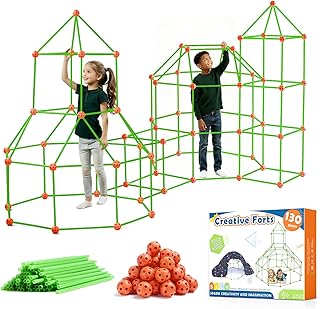
Tiny Land takes a more careful approach to the age question than most, giving a stated four to twelve range rather than the sprawling three to twelve that appears on nearly every box. The honest reading is still that the lower end needs help, but the narrower claim is a good sign.
With 86 rods and 44 balls there is scope here for structures with real corners: a den with a tunnel, or a taller build with a proper roof rather than a draped sheet resting on a frame. The rod to ball ratio leaves neither part sitting unused.
The storage bag is included, which matters as much here as anywhere. A hundred and thirty pieces is a lot to lose track of, and the difference between a kit that keeps working and one that quietly stops being able to build a cube is usually a handful of missing connectors.
Two small criticisms. The plain colour scheme looks better in a living room and is harder to spot against a patterned carpet, and the joints are firm enough that a four year old will need an adult for anything vertical. Neither is a reason to avoid it, but both are worth knowing.
Bottom line: a well made kit with an honest age range, and the pick if you want the storage sorted and the parts consistent.
- Pieces: 86 rods and 44 balls
- Stated age range: 4 to 12 years
- Included: storage bag
- Builds: forts, tunnels and castles
- Use: indoor and outdoor
- Cover: not included
Compare this against the Obuby on two points: piece split and colour. Both include a storage bag and both build at a similar scale, so the deciding questions are whether the plainer colours suit your living room and whether the stated age range matches your child. If glow in the dark play is what you actually want, the Tiny Land Glow version is the same kit with different rods.
Inspect rod ends on arrival and put aside any with a sharp moulding line. Keep builds on carpet, and clear loose pieces from the floor before a child crawls inside. Wipe pieces with a damp cloth rather than putting them through a dishwasher, which can distort thin plastic tubing and loosen the fit at the joints.

Pros
- Largest piece count here, enough for two children to build at once
- Builds a den with a tunnel attached rather than a single room
- Suits a wide age span from four upward
- Indoor and outdoor use
- Plenty of spare parts if a few go missing
Cons
- 140 loose pieces take real effort to tidy
- No cover supplied
- Fewer long term parent reports than the established names
The SpringFlower is the biggest kit here and the count changes what children do with it. At around eighty pieces they build a room; at a hundred and forty they start building routes, joining a den to a tunnel and then to another den, which is a different and longer lasting kind of play.
It is also the practical answer for two children. Sharing an eighty piece kit means negotiating over parts within ten minutes, while a set this size lets both build at once and then connect what they have made, which tends to go a great deal better.
The stated four to twelve range is the usual claim and carries the usual caveat: the lower end will need help with anything vertical because the joints are firm by design. From around six the child is on their own.
The two drawbacks are tidying and track record. A hundred and forty loose pieces spread across a floor is a genuine task, so establishing the counting habit from day one matters more with this kit than with the smaller ones. It is also a less established name than Tiny Land, so there is a shorter history of reports about how the parts hold up.
Bottom line: the most kit for the money here, and the right choice if two children will be building together.
- Pieces: 140 total
- Stated age range: 4 to 12 years
- Builds: forts, castles, tunnels and play tents
- Use: indoor and outdoor
- Presentation: Christmas and birthday gift packaging
- Cover: not included
For households with two children who build together, and for anyone who wants the largest structures a rod kit can make. It is also a sensible choice as a main gift rather than a small one. Less suitable if floor space is limited or if tidying a large number of small parts is going to be a recurring argument.
Split the set into two piles before handing it over if two children are building, which prevents most of the disputes. Build low and wide before building tall, since tall narrow structures fold sideways. When joining a den to a tunnel, build both separately and connect them last rather than trying to extend an existing structure, which usually pulls the first one apart.

Pros
- Fabric supplied, which is the step most other kits leave out
- Up in seconds using furniture already in the room
- No small parts to lose under the sofa
- Packs away as a bundle into a linen cupboard
- Portable enough to take to a grandparent's house
Cons
- Depends entirely on the furniture available in the room
- Nothing to build, so it will not satisfy a child who wants to construct
- Fewer configurations than a rod kit once the novelty passes
The Tote a Fort takes the opposite approach to every rod kit here. Instead of supplying a frame and leaving you to find the fabric, it supplies the fabric and uses the frame you already have, which is the sofa, the chairs and the table.
That solves the problem that quietly stops many forts getting built. Rod kits arrive without a cover, and if there is no spare light sheet in the house the box sits unopened. Here the sheets come in the bag and the fort goes up in under a minute.
The absence of small parts is the second advantage and it is a real one. Nothing rolls under the sofa, nothing disappears into a cushion, and the whole kit goes back into a bundle that stores in a linen cupboard rather than needing a toy box.
What it does not do is satisfy the child who asked for a building kit. There is no construction here, only draping and clipping, and a seven year old who wanted to make something will notice within a minute. It also depends on the room: a den needs two anchor points, and a bare room does not offer them.
Bottom line: the practical choice if supplying your own sheets is the obstacle, and not a substitute for a rod kit if building is the point.
- Contents: three blankets with fixings
- Type: blanket fort kit, no frame
- Setup: attaches to existing furniture
- Small parts: none
- Storage: folds into a portable bundle
- Use: indoor and outdoor
For households without a spare light sheet, for younger children who want a den rather than a construction project, and for taking to a grandparent's house where a box of rods would be unwelcome. It also suits families who have lost patience with small parts. Skip it if the child specifically wants to build something.
Pick two solid anchor points at different heights, such as a sofa back and a dining chair, which gives the sheet a slope rather than a sag. Weight the low edges with cushions so the whole thing does not lift when a child crawls in. Avoid anchoring to anything that can topple, including floor lamps and unweighted chairs.

Pros
- Glow rods make the frame visible in a darkened room
- Same piece count and build scope as the standard Tiny Land kit
- Storage bag included
- Glow makes stray pieces easier to find at bedtime
- Stated for ages four to twelve
Cons
- Glow needs charging under light and fades within the hour
- Only worth choosing over the standard kit for evening play
- Same stiff joints, so younger builders still need help
This is the standard Tiny Land kit with glow in the dark rods, and it is worth being clear about that rather than presenting it as a different product. The piece count, the build scope, the age range and the storage bag are all the same. The rods glow; everything else is identical.
Whether that is worth the swap comes down to one question: will the fort be used in a darkened room in the evening? If bedtime dens with the light off are a regular thing in your house, a glowing frame turns it into a different experience and children find it genuinely exciting.
Set expectations about the glow itself. Glow in the dark plastic charges under light and then fades, brightly for a few minutes and faintly for perhaps an hour. It is not a light source and it will not illuminate the inside of a fort, which occasionally disappoints.
One unexpected practical benefit: glowing rods are far easier to find under a sofa at the end of the day. For a kit with a hundred and thirty pieces, that is not nothing.
Bottom line: choose it over the standard kit only if evening play in the dark is specifically what you want, since everything else is the same.
- Pieces: 86 glow rods and 44 balls
- Stated age range: 4 to 12 years
- Included: storage bag
- Glow: charges under room light, fades over about an hour
- Builds: forts, tunnels and castles
- Cover: not included
The only question worth asking is whether the fort will be used with the lights off. If yes, the glow rods are a real upgrade and cost nothing in build quality. If the fort lives in a bright playroom during the day, the standard Tiny Land kit does exactly the same job and the glow is wasted. Everything else about the two kits is identical.
Charge the rods under a bright room light or near a window for a few minutes before turning the lights off, since glow plastic needs light input to work. Build the structure while the room is still lit rather than in the dark, then switch off. Expect a bright first few minutes and a faint glow afterwards rather than a steady light.

Pros
- Ready to use in seconds with no building required
- Fixed shape suits very young children who cannot build yet
- Folds flat into a disc for storage
- No small parts to lose
- Works indoors and outdoors
Cons
- Nothing to build, so it will disappoint a child who wanted a construction kit
- One fixed shape forever, with a shorter play life than a rod kit
- Fabric and poles are lighter duty than a camping tent
The JOYIN rocket tent is in this roundup as the honest alternative rather than as a rival to the building kits, because it is a different product doing a different job. It springs open into a fixed rocket shape and is ready to play in immediately.
For a two or three year old that is exactly right. Children at that age cannot push a rod into a stiff connector and will not enjoy watching an adult build for twenty minutes, and a den that already exists is far more use to them than a kit they cannot operate.
Storage is the other advantage. It twists and folds flat into a disc, which is tidier than any bag of rods, and there is nothing small enough to vanish into a sofa.
The limitation is permanent. It makes one shape and it will always make that shape, so the play life is shorter than a rod kit where the same pieces build something new each time. A child who asked for a fort building kit and receives this will spot the difference immediately, and that expectation gap is the main thing to avoid.
Bottom line: the right choice for a child too young to build, and the wrong one for a child who wanted to construct something.
- Type: pop up play tent, no assembly
- Design: rocket ship playhouse
- Storage: twists and folds flat
- Small parts: none
- Use: indoor and outdoor
- Building required: none
For toddlers and pre school children who want a den rather than a project, and for households that want the tidiest possible storage. It is also a reasonable second item alongside a rod kit for a younger sibling. Skip it entirely if the child asked for a building kit, since there is nothing here to build.
Follow the folding instructions rather than forcing the frame flat, since sprung wire frames kink permanently when twisted the wrong way. Keep it out of prolonged direct sun outdoors, which weakens light tent fabric over a season. Set it up on grass or carpet rather than a hard floor, and keep it clear of stairs and fireplaces as with any indoor play structure.
How to Choose a Fort Building Kit
Six questions decide whether the box gets opened every wet Saturday or goes into a cupboard in March. The first one is the big one, because the three kinds of kit on sale are not variations on a theme.
Rods and Connectors, Blanket Anchors, or a Ready Made Tent

A rod and connector kit is a bag of hollow plastic tubes and multi hole balls. The child pushes rods into the balls to make cubes, domes, tunnels and whatever else occurs to them, then throws a blanket over the top. This is the type most people mean by a fort kit, and it is the one with the longest play life because the same pieces make a different thing every time.
A blanket kit is a different idea: rather than building a frame, it supplies the sheets and the clips or anchors to attach them to furniture you already own. It uses the sofa and the chairs the way children do anyway, and it takes seconds to put up. The trade is that it depends entirely on what furniture is in the room.
A pop up tent is not a building kit at all. It springs open into a fixed shape, which is exactly right for a two or three year old who cannot yet build anything, and exactly wrong for a seven year old who wanted to make something. If a child asked for a fort kit and receives a tent, the difference will be noticed within a minute of opening it.
Age: Who Can Actually Build It Without Help
Manufacturers print wide age ranges, commonly three to twelve, and the wide end is honest only for simple shapes. Pushing a rod into a ball takes reasonable hand strength, and the joints are deliberately stiff so the structure holds together, which means a three year old will manage a flat square on the carpet but not a standing cube.
Around five or six is where children start building upward on their own, because that is when they work out that a wall needs corners and a roof needs support underneath. Before that, the realistic pattern is an adult building the frame and the child playing in it, which is fine but worth knowing before you imagine an afternoon of independent construction.
These sets are sold as STEM toys, and the useful version of that claim is simply that a fort falls down when it is built badly and stands up when it is not, so children adjust. Treat the label as a description of the activity rather than a promise about anything else. The play is the point.
Piece Count and What It Really Builds

Piece counts run from roughly eighty to around a hundred and forty, and the headline number always combines rods and connectors. What matters is the ratio, because rods are the limiting part. A kit with more balls than it has rods to fill them leaves connectors sitting in the bag, and a kit with plenty of rods and few balls runs out of corners.
As a rough guide, a simple standing cube big enough for one child takes something like twelve rods and eight connectors. A set of around eighty pieces therefore builds one good sized den or two small ones. A hundred and forty piece set builds a den with a tunnel attached, which is usually the point at which children stop building rooms and start building routes.
Rod length also decides scale. Most kits use rods around fifteen inches, and it takes several joined end to end to make a wall an adult can crawl through. Kits with longer rods build bigger structures from fewer pieces but are less stable at height, which is the trade behind the different piece counts. Other family buying guides are collected in our article archive.
Sheets, Covers and the Part Most Kits Leave Out
Almost no rod and connector kit includes a cover. The photographs on the box show a finished fort draped in fabric, and the fabric is not in the box. That catches people out constantly, and it matters because a bedsheet is heavy enough to bow a plastic frame while a lightweight throw is not.
The practical answer is a light single flat sheet or a thin fleece throw rather than a duvet cover or a blanket. Clothes pegs hold fabric to the rods far better than tucking does, and a couple of dozen pegs turn a sagging drape into something that keeps its shape while children crawl in and out.
If supplying fabric sounds like one job too many, a blanket kit solves it directly by including the sheets and the fixings. That is the entire proposition of the Tote a Fort set here, and for a household without a spare light sheet it removes the step that most often stops a fort getting built at all.
Edges, Joints and How the Structure Fails
Rods are hollow plastic tubing cut to length, and the cut ends are the part to look at. Well made kits round or cap the ends; cheaper ones leave a moulding line that can be sharp enough to notice, and a rod that cracks lengthways under a hard knock leaves a genuinely sharp edge. Checking the ends when the box arrives takes a minute and is worth doing.
Joints fail before rods do. A connector ball that has been pushed and pulled a hundred times loosens, and a loose joint at the base of a wall is what makes a fort lean and then fold. This is normal wear rather than a defect, and it is a reason to prefer kits from sellers who supply replacement pieces.
Structures fail predictably, which is useful to know. Tall narrow builds fold sideways, wide low builds sag in the middle, and both are safe failures because the whole thing weighs very little. What genuinely hurts is a child landing on a scattered pile of rods, so the sensible house rule is building on carpet and clearing loose pieces before anyone climbs in.
Storage, Tidy Up and Where the Pieces Go

A hundred and twenty small parts spread across a living room floor is the reason many of these kits get quietly retired. A drawstring storage bag included in the box is a small feature with a large effect, because tidying becomes one action a child can do rather than a hunt for a container.
Count the pieces the first time and write the number on the bag. Rods roll under furniture and connectors vanish into sofa cushions, and knowing the target number is the difference between finding the missing ones that evening and discovering months later that the kit no longer makes a cube.
Consider where the built fort will live as well. Rod frames are light enough to lift and move in one piece, which means a den can migrate to a bedroom rather than being dismantled at bedtime. A pop up tent folds flat into a disc, which is the tidiest of all, and a blanket kit stores as a bundle of fabric that goes in the linen cupboard.
| Kit type | Strong at | Weak at |
|---|---|---|
| Rods and connectors | Builds something different every time, long play life | No cover included, many small pieces to lose |
| Blanket kit with anchors | Fabric supplied, up in seconds, no small parts | Depends on the furniture in the room |
| Ready made pop up tent | Instant, tidy, works for very young children | Nothing to build, one fixed shape forever |
Why You Should Trust Us
We build these lists from published manufacturer specification and from the pattern of what parents report after months of use rather than from marketing copy. For each kit here we checked the stated piece count and how it splits between rods and connectors, the rod length where the maker gives it, the age range on the box, whether a storage bag or a cover is included, and whether replacement pieces are offered.
We also set the boundaries of the category deliberately. Several products that surface under this search are not fort kits at all, including marble runs and magnetic tile sets, so those were left out. Where two listings from the same brand were the same kit in a different finish, we kept the one that offers something genuinely different rather than counting both.
Final Thoughts
Best overall is the Obuby Kids Fort Building Kit. It has a sensible ratio of rods to connectors, enough pieces to build a den a child can actually sit inside, and a storage bag in the box, which is the single feature that most reliably decides whether a kit survives its first month. It is also the one with the broadest base of long term parent feedback in this group.
Best value is the SpringFlower Fort Building Kit. It has the largest piece count here at a hundred and forty, which is the point where children stop building single rooms and start joining a den to a tunnel, and it is the kit to buy if two children will be building at once rather than taking turns.
For specific needs, the Power Your Fun Fun Forts set is the pick as a first kit for a younger child, since a smaller piece count is less overwhelming and quicker to tidy, the Tiny Land kit is the choice if you want a storage bag and a clearly stated age range, and the Tiny Land Glow version is the same idea with glow in the dark rods, which is worth the swap only if evening play in a darkened room is the specific thing you want. The Tote a Fort blanket kit is the answer if supplying your own sheets is the step that would stop a fort ever getting built, and the JOYIN rocket ship play tent is for a child too young to build anything, where a ready made shape is the honest choice. More categories to browse sit on our category index.
Fort Building Kit FAQs
What age is a fort building kit actually for?
Boxes usually say three to twelve, and the honest reading is narrower. Pushing a rod into a connector takes real hand strength because the joints are stiff by design, so a three or four year old will manage flat shapes on the carpet while an adult builds anything that has to stand up. Around five or six, children start building upward on their own. From about seven onward they build things nobody suggested, which is when these kits earn their keep. Below three, a pop up tent is the sensible alternative.
How many pieces do I actually need?
A standing cube large enough for one child takes roughly twelve rods and eight connectors, so a kit of around eighty pieces builds one good den or two small ones. A hundred and forty piece kit builds a den with a tunnel attached, or lets two children build at the same time without negotiating over parts. Look at the split rather than the headline number, because rods are the limiting part and a kit heavy on connectors leaves balls unused in the bag. More family guides are in our toys and games archive.
Do fort building kits come with a sheet or cover?
Almost never, despite the box photograph showing one. Rod and connector kits supply the frame and you supply the fabric, and the choice of fabric matters more than people expect: a light flat sheet or a thin fleece throw drapes well, while a duvet or a heavy blanket bows the frame and pulls joints apart. A couple of dozen clothes pegs hold fabric to the rods far better than tucking it in. If supplying fabric is a problem, a blanket kit that includes its own sheets solves it outright.
Are the rods and connectors safe for younger children?
For the stated age ranges they generally are, with two things worth checking yourself. Look at the cut ends of the rods when the box arrives, since a rough moulding line can be sharp and a rod that later cracks lengthways definitely is. Then set a house rule about clearing loose pieces before anyone crawls in, because landing on a scattered pile of rods is the realistic injury here rather than the fort itself falling, which it does gently and without weight behind it.
How do you stop losing pieces in 2026?
Count the set the first time and write the number on the storage bag, then treat tidying as counting back to that number. Rods roll under sofas and connectors disappear into cushions, and a kit that is missing eight connectors quietly stops being able to build a cube, which is usually when children lose interest. A drawstring bag in the box makes an enormous difference because tidying becomes a single action, and it is worth choosing a kit that includes one over an otherwise identical set that does not.







Write Your Review
No reviews yet. Be the first to share your experience!