

A selectable dumbbell replaces a rack. Instead of ten pairs of fixed weights consuming a wall of your garage, one pair sits in a cradle and changes load with a dial, a pin, or a twist collar. That is the whole pitch, and it is a good one, but the category hides a lot of variation behind a similar-looking product photo. This roundup covers the 7 best selectable dumbbell sets for August 2026 from Amazon Basics, NordicTrack, Lifepro and more, and the differences that matter are mechanical: how the mechanism engages, how big the jump between settings is, how long a change takes, and how well the locking system holds up after a few thousand cycles.
Our top pick is the Amazon Basics Adjustable Dumbbell Hand Weight Set, because its simple secure locking design and included storage case cover the most common home use case at the lowest risk of mechanism failure. Below you will find seven sets ordered by customer rating and review volume, spanning quick-adjust dial systems, all-in-one convertible kits, and traditional spinlock bars, followed by a buying guide built around the mechanism rather than the marketing. If you are assembling a wider home setup, our sports and outdoors category has the rest of the equipment that usually shares the same corner of a room.

Pros
- Secure locking design with few parts that can fail
- Storage case keeps all components together between sessions
- Compact block layout keeps the dumbbell short
- Simple enough that anyone can use it without instruction
- Sensible range for general home strength work
Cons
- Slower to change than a dial selector system
- Tops out too low for heavy pressing progression
- No cradle, so plates must be handled directly
The Amazon Basics Adjustable Dumbbell Hand Weight Set is the most conventional product in this roundup, and that is the point. It uses a captive plate arrangement with a secure lock rather than a dial mechanism, which means there are very few parts that can crack, misalign, or seize after a year of use. For a first adjustable pair in a home that is not a dedicated gym, that reliability matters more than shaving seconds off a weight change.
The block layout also keeps the dumbbell shorter than a full tray system at comparable loads, which makes chest pressing and lateral raises feel closer to a fixed dumbbell. The included storage case is genuinely useful rather than packaging, because it keeps loose plates and collars together and slides onto a shelf or under a bed when the session ends.
The limits are honest ones. Changing weight takes longer than turning a dial, so dense circuit work is less practical, and the total range tops out well below what a committed lifter will eventually press. If you are progressing quickly on compound lifts, you will outgrow it.
Bottom line: the lowest risk choice for most home trainers, and the set to buy if you want something that simply keeps working.
- Type: adjustable dumbbell pair
- Mechanism: captive plates with secure lock
- Total set weight: 38 pounds
- Storage: hard case included
- Handle: standard diameter with textured grip
- Change speed: moderate
- Best use: general home strength and conditioning
This is the set for people setting up a first home gym in a shared living space. It stores away neatly, it is simple enough that a partner or a teenager can use it without a lesson, and the mechanism does not punish occasional rough handling.
It is not the set for someone already pressing heavy. If your working sets are near the top of this range today, buy something with more headroom rather than planning to add a second pair later.
Set the dumbbell on a flat surface before changing plates, and confirm the lock is fully engaged with a gentle test lift before any overhead movement. That habit takes two seconds and eliminates the category's worst failure mode.
Store the set in its case rather than leaving plates loose on the floor. Loose plates get kicked, chipped, and lost, and a missing small plate turns a working set into an awkward one.

Pros
- Quick-adjust mechanism makes circuits and drop sets practical
- Wide weight range covers beginners through experienced lifters
- Available in single, pair, and multi-mode configurations
- Compact cradle design saves floor space
- Fine setting spacing supports gradual progression
Cons
- Selector mechanism has more parts than a plate system
- Requires the cradle to be accessible to change weight
- Heavier per dumbbell than a simple block design
The Lifepro adjustable dumbbell system is built around change speed. A quick-adjust selector lets you set the load in a few seconds without touching individual plates, which is the feature that makes supersets, drop sets, and circuit training realistic in a home setting. If your training is dense and metabolic rather than heavy and slow, this is the mechanism you want.
The range is the other strength here. Rather than a narrow band aimed at beginners, the system spans from light conditioning loads up through weights that will keep an experienced lifter working, and the settings are spaced closely enough to progress gradually rather than in jumps that stall your pressing.
The costs are the usual ones for selector systems. There are more moving parts than in a plate and collar design, the cradle has to stay accessible because you cannot change weight without it, and each dumbbell is heavier at a given setting than a simple block would be because the unused plates still live in the tray.
Bottom line: the pick when training density matters and you want one system to carry you from light work to heavy sets.
- Type: quick-adjust dumbbell system
- Mechanism: selector with cradle
- Configurations: single, pair, or three in one
- Range: light conditioning through heavy settings
- Change speed: fast, a few seconds per change
- Increments: closely spaced across the range
- Best use: circuits, supersets, and shared home gyms
Circuit and interval work is where this system earns its price. Moving from a heavy press to a lighter raise without leaving the mat keeps heart rate up and removes the excuse that resets a home session. Drop sets become genuinely practical rather than theoretical.
It also suits households where two people train back to back at different loads. A few seconds per change stops the session turning into an equipment negotiation, which is a real reason home gyms go unused.
Always set the dumbbell fully into its cradle before turning the selector, and lift straight up rather than at an angle. Partly engaged selectors are the cause of nearly every plate release incident in this category.
Train on a mat and lower the dumbbells under control. Selector components dislike hard impact far more than they dislike heavy static load, and a single drop onto tile can end a mechanism that would otherwise last years.

Pros
- Soft TPU handle is comfortable for high rep work
- Small steps suit toning, mobility, and rehabilitation
- Compact and easy to store anywhere in a home
- Simple assembly with no complex mechanism
- Approachable for complete beginners
Cons
- Top weight is far too light for strength progression
- Coated handle can feel slippery once hands sweat
- Not intended for compound barbell style lifts
The EQUIPRO four in one set is deliberately light, and judging it as a failed heavy set misses who it is for. It steps through small weights aimed at toning, mobility work, rehabilitation, and the accessory movements that fill out a programme rather than the compound lifts that anchor one. For that buyer it is well matched.
The soft TPU coated handle is the standout detail. It is far gentler on bare palms than knurled steel, which matters enormously during the high repetition work these weights are designed for. Beginners and anyone training without gloves will find it more comfortable than a conventional bar.
The limits are clear. The top setting will not challenge anyone doing progressive strength work, and the coated grip becomes slippery once sweat builds, so it is less suited to heavy pulling than a knurled handle would be. This is a complement to a training setup rather than the foundation of one.
Bottom line: the right light set for toning, mobility, and beginners, and the wrong set for anyone planning to press heavy.
- Type: four in one adjustable dumbbell set
- Settings: two, three, four, and five pounds
- Handle: soft TPU rubber coating
- Mechanism: stacked light plates
- Change speed: moderate
- Storage: very compact footprint
- Best use: toning, mobility, rehabilitation, beginners
Buy this set for accessory work rather than main lifts. Shoulder rehabilitation, rotator cuff work, barre and pilates style sessions, and light conditioning all call for small weights with fine steps, and this set covers exactly that band.
It also suits households where the weights need to disappear between sessions. The footprint is small enough to live in a cupboard, which is often the difference between training regularly and not training at all.
Use these weights for higher repetitions with controlled tempo rather than trying to make small loads feel heavy through momentum. Slow eccentrics and pauses generate far more stimulus at light loads than swinging does.
Keep the coated handle clean and dry. Sweat and skin oil build up on TPU surfaces and make them slippery, and a quick wipe after each session keeps the grip predictable.
Pros
- Dial selector changes weight in a few seconds
- Fine increments across a wide range
- Established fitness brand with a long product history
- Cradle keeps unused plates contained and tidy
- Well suited to pressing progression
Cons
- Dial mechanisms are the least tolerant of being dropped
- Cradle must stay accessible, increasing the real footprint
- Longer than a block-style dumbbell at the same weight
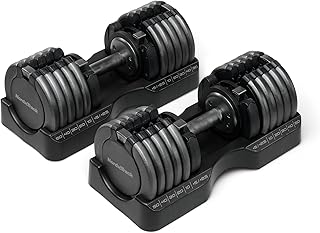
The NordicTrack Select-a-Weight is a dial system in the classic mould. Set the dumbbell into its cradle, turn the dial to the number you want, and lift out only the plates you selected while the rest stay behind. Changes take a few seconds, which is what makes structured progression and dense training realistic at home.
Its real advantage over tiered designs is increment spacing. Many closely spaced settings mean you can add a small amount of load rather than jumping to a weight that breaks your form on shoulder and arm work, and that gradual progression is how strength actually accumulates over months.
The tradeoffs are inherent to dial mechanisms. They contain more components than a plate and collar system and are the least tolerant of impact, so training on a hard floor without a mat is asking for trouble. The cradle also has to stay accessible at all times, which means the real footprint is larger than the dumbbells alone.
Bottom line: the pick when fine increments and fast changes across a wide range matter most, provided you treat the mechanism with care.
- Type: dial-selector adjustable dumbbell pair
- Mechanism: dial with cradle tray
- Increments: fine spacing across the range
- Change speed: fast, a few seconds
- Storage: cradle must remain accessible
- Length: longer than block designs at equal load
- Best use: structured strength progression at home
Programmes built on progressive overload benefit most. Being able to add a small step rather than the next big jump keeps pressing and rowing moving forward for months longer than a coarse tiered set would allow.
The speed also opens up density work. Supersets between a heavy compound and a lighter accessory movement stop being a chore, which tends to improve session quality more than any single piece of equipment.
Put a mat under the training area and lower the dumbbells rather than dropping them. Impact damage is the leading cause of dial system failure, and the damage is often invisible until a plate releases mid-set.
Turn the dial only when the dumbbell is fully seated in its cradle, and test lift before pressing overhead. If adjustment starts to feel gritty or vague, stop and inspect the mechanism rather than forcing it.
Pros
- Three clear tiers remove guesswork from load selection
- Safe locking system is a design priority rather than an afterthought
- Anti-slip handle holds up during sweaty sessions
- Space saving storage tray included
- Sold as a pair rather than a single dumbbell
Cons
- Tiered steps are coarse compared with a dial system
- Fewer settings limit gradual progression
- Tray still needs dedicated floor space
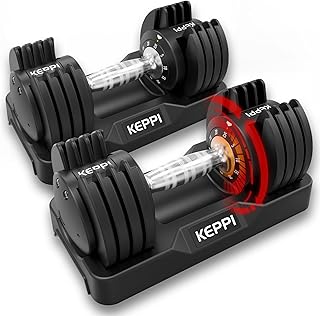
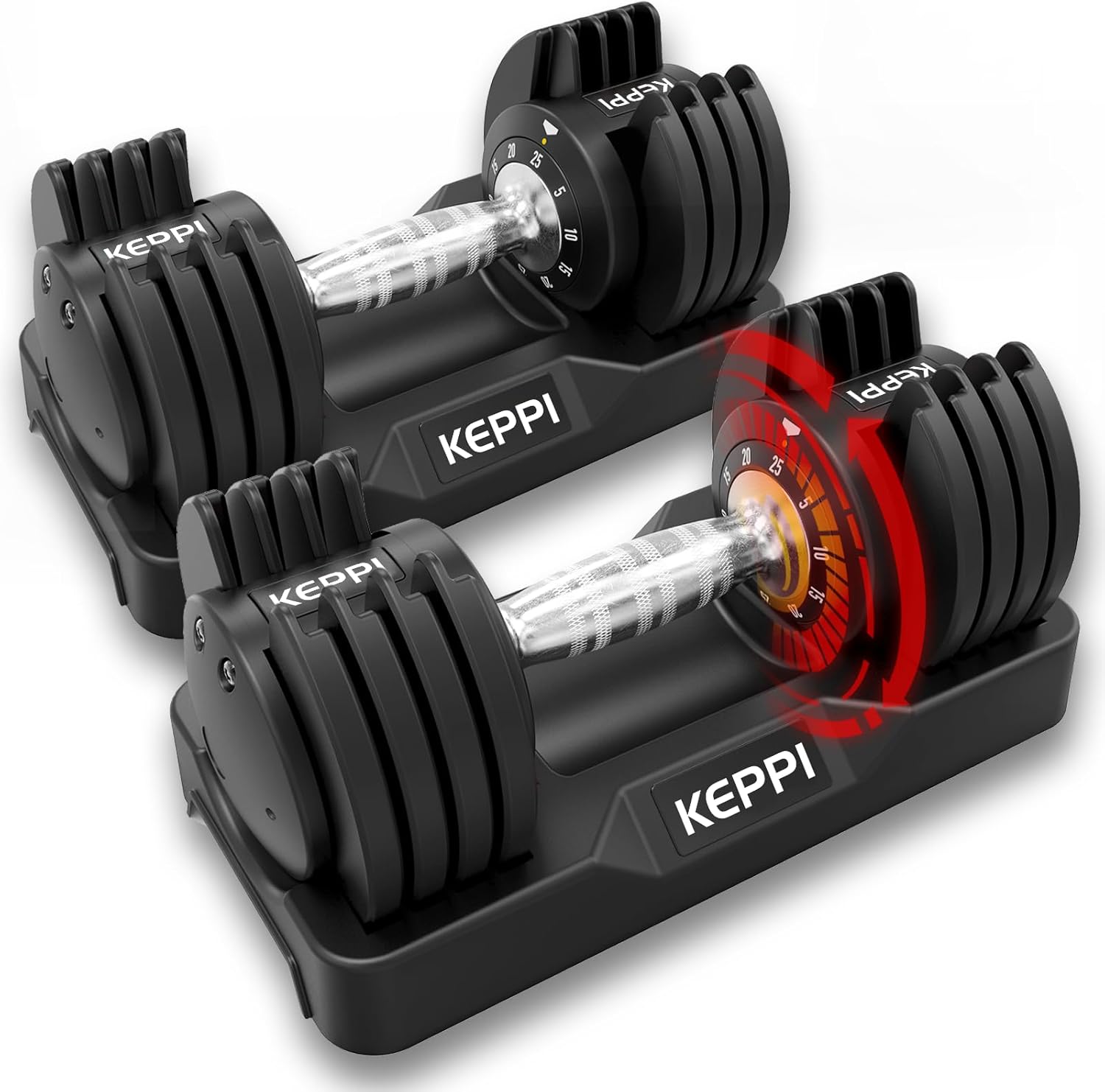
The Keppi adjustable dumbbell pair takes a different approach from continuous dial systems. Instead of many closely spaced settings, it offers three defined tiers, which removes decision fatigue and makes the load unambiguous. For a lot of home trainers that is genuinely easier to live with than twelve options they never use.
Two design choices stand out. The locking system is presented as a safety feature rather than a convenience one, which is the right emphasis in a category whose worst failure mode is a plate leaving the bar mid-rep. The anti-slip handle also holds up better than smooth coated grips once a session gets sweaty.
What you give up is granularity. Three tiers means the jump between settings is large, which is manageable on rows and squats and awkward on shoulder work where a smaller step would let you add reps cleanly. The storage tray also occupies floor space that a simple case would not.
Bottom line: a solid quick-adjust pair for people who prefer three clear choices over a dial full of numbers.
- Type: quick-adjust dumbbell pair
- Tiers: three defined weight settings
- Locking: dedicated safe locking system
- Handle: anti-slip textured grip
- Storage: space saving tray included
- Change speed: fast between tiers
- Best use: general home strength training
This suits trainers who want speed without complexity. If you rotate between a light, medium, and heavy load across a session and rarely need anything in between, three tiers cover your training completely and there is less mechanism to worry about.
Lifters running a programme with small weekly increases will find the steps too coarse. A dial system with fine spacing is the better tool for that job.
Plan your session around the three tiers rather than fighting them. Use the top tier for compound pressing and rowing, the middle for accessory work, and the lightest for finishers, and the coarse steps stop being a limitation.
Confirm the locking system is fully engaged after every change. Set the dumbbell down, adjust, then test lift before the first rep, and keep the tray clear of other equipment so seating the dumbbell is never awkward.

Pros
- Connector converts the pair into a short barbell
- Covers several training roles from one purchase
- Reaches into heavy territory when fully loaded
- Very efficient use of limited floor space
- Plates can be used independently
Cons
- Plate changes are slow compared with any selector system
- Connector barbell is short, limiting squats and bench work
- Boxy shape is a poor substitute for a real kettlebell
The FEIERDUN DS2 is a convertible kit rather than a pure dumbbell set. A connector joins the two handles into a short barbell, the plates can be used loose, and the assembled units serve as push up stands. In a small apartment where floor area is the binding constraint, that genuinely replaces several separate purchases.
The loaded range is the other selling point. Configured as a single implement the set reaches well into heavy territory, which is far more headroom than most convertible kits offer and enough to keep a home trainer progressing for a long time.
The honest caveats are about compromise. Changing weight means handling plates, so it is slow and unsuited to circuit work. The connector barbell is short, which limits back squats and bench pressing compared with a real bar, and the boxy handle geometry makes it a poor kettlebell substitute for swings. Buy it for flexibility, not because you expect it to match dedicated equipment.
Bottom line: the answer when space is the real constraint and one kit has to cover several jobs.
- Type: convertible dumbbell and barbell kit
- Configurations: dumbbells, barbell, push up stand, loose plates
- Range: up to heavy settings when fully loaded
- Mechanism: plates with connector and collars
- Change speed: slow, plates handled directly
- Storage: compact for the range offered
- Best use: very small home gyms
Compare this kit against buying a dumbbell pair and a separate short bar. If you would genuinely use both, the convertible kit saves money and space. If you would only ever use the dumbbells, a dedicated pair with a faster mechanism will serve you better day to day.
Check what is included before ordering, since convertible kits vary in whether connectors, collars, and storage are supplied. A kit missing the connector is just a plate set with extra steps.
Preload the configuration you plan to start with before the session begins. Because plate changes are slow, planning your lift order around one or two load changes turns the main weakness of the system into a non-issue.
Tighten collars firmly on every plate change and check them between sets, especially in barbell configuration where an uneven plate shift is more dangerous than on a dumbbell.

Pros
- Cheapest route to a real range of loads
- Almost nothing in the mechanism that can fail
- Plates can be replaced individually
- Screw collars make lock security easy to verify
- Non-slip grip on the bar
Cons
- Weight changes take a minute or more per side
- Concrete filled plastic plates are bulkier than iron
- Plate shells can crack if dropped on a hard edge
The Yaheetech adjustable dumbbell set is the traditional answer: a threaded iron bar, loose plates, and screw collars. Changing weight means unscrewing a collar, sliding plates on or off, and screwing it back down. It is slow, it is unglamorous, and it is the most durable arrangement in this roundup because there is almost nothing in it that can break.
That simplicity is why experienced lifters keep buying spinlock sets. Collar tightness is visible and felt rather than trusted to a hidden mechanism, plates can be replaced individually if one cracks, and the cost per pound of load is far below any selector system. For a programme built on a few heavy sets with long rests, the slow change costs nothing.
The compromises are real. Concrete filled plastic plates are physically larger than iron for the same weight, which makes the loaded dumbbell bulkier, and the shells can crack if dropped on a hard edge. Circuit training and drop sets are effectively off the table.
Bottom line: the best value here, and the right choice for slow heavy training and low maintenance.
- Type: spinlock adjustable dumbbell set
- Mechanism: threaded bar with screw collars
- Plates: concrete filled plastic
- Bar: iron with non-slip grip
- Change speed: slow, a minute or more per side
- Maintenance: minimal, no selector components
- Best use: heavy sets with long rest periods
Choose this set if your training style tolerates slow changes. Strength work with three minute rests loses nothing to a plate swap, and the money saved buys a bench or more plates, which will do more for your results than a faster mechanism would.
If you want the durability of spinlock with faster changes, consider buying two bars and preloading them. It is a workaround experienced home lifters use often and it costs far less than a selector system.
Tighten both collars firmly and check them between sets, since threads can loosen under repeated load. A collar that is finger tight rather than firmly tight is the most common cause of a plate shifting mid-rep on spinlock bars.
Avoid dropping the plates on concrete or tile, because concrete filled shells crack at the edge rather than bouncing. Keep the threaded bar clean and lightly oiled if it lives in a damp garage, and store plates flat rather than stacked on their rims.
How to Choose a Selectable Dumbbell Set
Adjustable dumbbells are bought on convenience and kept or abandoned on mechanism quality. The criteria below start with the adjustment system itself, because everything else follows from it, then work through weight range, increments, handle design, footprint, and the durability questions that decide whether a set is still working in three years. Read the first four sections carefully even if you skim the rest.
The Adjustment Mechanism and What Can Go Wrong

There are three broad mechanisms in this category and they behave very differently. Dial and selector systems, represented here by the NordicTrack Select-a-Weight and the quick-adjust designs from Lifepro and Keppi, use a cradle. You set the dumbbell down, turn a dial or move a selector, and lift out only the plates you asked for. The remaining plates stay in the tray. Change time is a few seconds, which is the entire appeal, and it is what makes drop sets and circuits practical at home.
Spinlock systems are the opposite philosophy. A threaded bar takes loose plates held by a screw collar, as on the Yaheetech adjustable set. Changing weight means unscrewing a collar, sliding plates on or off, and screwing it back down, which takes a minute or more per side. In exchange you get almost nothing to break, plates you can replace individually, and a much lower cost per pound. Serious lifters often prefer them precisely because the failure modes are trivial.
Between those sit block and pin designs like the Amazon Basics set and the convertible FEIERDUN kit, which use captive plates with a locking pin or a secure clamp. They change faster than spinlock and slower than a dial, and they tend to be more tolerant of being dropped than a dial system. The thing to understand is that dial systems fail in the mechanism while spinlock systems fail almost nowhere, and that difference should weigh heavily if the set will be used hard.
Weight Range and Whether You Will Outgrow It
The published range is the first thing people check and the thing they most often get wrong. A set that tops out low is fine for conditioning, rehabilitation, and higher rep training, but it becomes a ceiling within months if you are progressively loading heavy compound movements. The Lifepro quick-adjust range extends well up the scale, the FEIERDUN convertible reaches into the ninety pound territory when configured as a single loaded implement, and the Keppi set steps through three defined tiers.
At the other end, the EQUIPRO four in one set is deliberately light, stepping through small weights aimed at toning, mobility work, and beginners. That is a legitimate product for a legitimate buyer, and treating it as a failed heavy set misreads what it is for. The mistake is buying a light set when you intend to press and row seriously, then needing a second purchase within a year.
Be realistic about your trajectory rather than your ambition. Most home trainers plateau well below what they expect, but the ones who do progress consistently find that a set topping out too low becomes dead weight in a corner. If in doubt, buy the range above the one you think you need, because the extra cost is almost always less than buying twice.
Increment Size and the Jumps Between Settings
Increment size is the criterion buyers overlook and then complain about. A set that jumps in large steps is fine for legs and back, where a substantial change is manageable, and awkward for shoulders and arms, where the difference between one setting and the next can be the difference between eight clean reps and four ugly ones. Small increments let you progress gradually, which is how strength actually accumulates.
Dial systems typically offer many closely spaced settings across their range, which is one of their genuine advantages over tiered designs. Tiered sets that offer three defined weights, like the Keppi arrangement, give you fewer choices but make each one unambiguous. Spinlock bars sit at the extreme of flexibility, because your increment is whatever your smallest plate happens to be, and adding a pair of small plates costs very little.
Think about the lifts you do most. If your programme is dominated by pressing and lateral work, prioritise fine increments. If you mostly do rows, goblet squats, and carries, coarse steps will not hold you back and you can choose on other criteria instead.
Change Time and How It Shapes Your Training

The gap between a three second dial turn and a ninety second plate swap changes what workouts are realistic. Supersets, drop sets, and circuit training all depend on moving between loads quickly, and they simply do not work with a spinlock bar unless you own two bars and preload them. If your training style is dense and metabolic, a quick-adjust mechanism is not a luxury, it is a requirement.
Conversely, a strength programme built around a few heavy sets with long rests barely notices the difference. Changing plates during a three minute rest costs nothing, and the money saved on a simpler mechanism can go toward a bench or more plates. The Yaheetech spinlock set makes complete sense for that buyer and would frustrate the circuit trainer enormously.
There is also a household factor. If two people train back to back at different loads, quick adjustment stops the session becoming an equipment negotiation. Shared home gyms lean toward dial systems for exactly this reason, and our health and household guides cover more of the equipment that ends up in a shared training space.
Handle Diameter, Knurl, and Grip Comfort
The handle is where your entire experience of a dumbbell is transmitted, and it varies more than any other component. Some adjustable sets use thick handles because the mechanism forces a wide diameter, which taxes grip strength disproportionately and can limit what you lift on rows and carries. Others use a slimmer bar closer to a fixed dumbbell, which feels far more natural.
Surface treatment matters as much as diameter. Aggressive knurling grips well with dry hands and shreds soft palms during high rep work. Rubber or TPU coated handles, as on the EQUIPRO set, are gentler and better for beginners or anyone training without gloves, but they can feel slippery once sweat builds up. Neither is objectively better and the right answer depends on your hands and your rep ranges.
Handle length is worth a glance too. A short handle in a wide mechanism means your hand sits close to the plates, which changes how the weight balances and can catch your forearm during curls. This is one of the differences that never appears on a spec sheet and is obvious within one session.
Balance, Length, and How the Weight Sits
Adjustable dumbbells are longer than fixed ones because the mechanism has to hold every plate whether it is selected or not. That extra length changes the movement path on chest presses, where the ends can clip your torso, and on lateral raises, where a long implement feels heavier at the same load because of the leverage.
Some designs handle this better than others by keeping the loaded plates close to the center. Block-style sets like the Amazon Basics arrangement tend to be more compact than a full tray system at comparable weights. Convertible kits such as the FEIERDUN, which can be assembled as a barbell or used with a connector, are inherently longer because they are built to serve several roles.
If you train in a tight space or press on a narrow bench, treat overall length as a real specification rather than a detail. Clipping a doorframe or a bench upright during a set is both annoying and a genuine safety issue.
Storage Footprint, Trays, and Where the Set Lives
The reason to buy adjustable dumbbells is space, so it is odd how rarely people measure the footprint before ordering. Dial systems require their cradle to be accessible at all times, because you cannot change weight without it, so the tray is not optional storage but part of the product. Add clearance around it for lifting the dumbbell in and out and the real footprint grows.
Block and pin sets are more forgiving. The Amazon Basics set ships with a storage case that keeps loose components together and can go on a shelf or under a bed between sessions. The Keppi set includes a storage tray designed to be space saving, and spinlock plates can be stacked wherever there is a gap.
Floor protection deserves a mention here. Adjustable dumbbells are heavier per unit than most people expect and their corners concentrate load. A mat under the training area protects both the floor and the mechanism, since a dropped dial system that lands on tile is far more likely to break than one that lands on rubber.
Locking Security and What Happens If It Slips
Every adjustable dumbbell has one job above all others: hold the plates. A plate leaving the bar mid-rep is the category’s worst failure mode, and it is the reason locking design should outrank convenience in your priorities. Screw collars on spinlock bars are the most transparent system, because you can see and feel whether they are tight, and the Keppi set makes a point of its safe locking arrangement.
Dial and selector systems are secure when fully engaged and unpredictable when partly engaged. The common cause of trouble is lifting the dumbbell out of the cradle before the mechanism has fully seated, usually because the dial was turned while the handle was slightly lifted. Building the habit of setting the dumbbell down flat, turning the dial completely, and giving a gentle test lift before pressing overhead eliminates most incidents.
Inspect the locking components periodically. Threads wear, pins bend, and plastic selector parts crack, and all three give warning signs before they fail outright. A set that has started to feel vague or gritty when adjusting is telling you something worth acting on.
Build Materials and Plate Construction
Plate construction separates sets that last from sets that chip. Solid cast iron plates, coated or bare, are dense and durable, which keeps the dumbbell compact and tolerates knocks. Concrete filled plastic plates, used on the Yaheetech set among many value designs, are cheaper and lighter per unit of volume, meaning the dumbbell is physically larger for the same weight and the shells can crack if dropped on a hard edge.
Coatings matter for both noise and floors. Rubber or vinyl coated plates are quieter, kinder to flooring, and less likely to rust in a humid garage. Bare iron is the most durable surface of all but will develop surface rust in damp conditions and will mark a wooden floor the first time it touches down.
Mechanism materials deserve the same scrutiny. Metal selector components in a dial system generally outlast plastic ones, and this is a large part of what separates premium sets from budget copies that look identical in photographs.
Versatility, Connectors, and Multi-Use Kits
Some sets in this roundup are not purely dumbbells. The FEIERDUN convertible kit includes a connector that joins the two handles into a short barbell and supports use as a kettlebell substitute, a push up stand, and loose weight plates. For a small home space that genuinely replaces several purchases, which is a strong argument when floor area is the binding constraint.
The counterargument is that multi-use equipment is rarely as good as the dedicated version of any single role. A connector barbell is short, which limits back squats and bench pressing, and a boxy dumbbell used as a kettlebell has the wrong handle geometry for swings. Buy a convertible kit because you want the flexibility, not because you expect it to match a real barbell.
Also consider what comes in the box. A storage case, a tray, or a set of connectors adds real value if you would otherwise buy them separately, and adds clutter if you would not. Read the included items list rather than assuming.
| Set | Mechanism | Change speed | Best suited to |
|---|---|---|---|
| Amazon Basics Adjustable Dumbbell Set | Secure captive plate lock | Moderate | General home training with a storage case |
| Lifepro Quick-Adjust Dumbbells | Quick-adjust selector | Fast | Circuits, drop sets, and shared households |
| EQUIPRO 4 in 1 Set | Stacked light plates | Moderate | Toning, mobility, and beginners |
| NordicTrack Select-a-Weight | Dial selector with cradle | Fast | Fine increments across a wide range |
| Keppi Adjustable Dumbbells | Tiered quick adjust with locking system | Fast | Three defined tiers with a storage tray |
| FEIERDUN DS2 Convertible Set | Plate and connector system | Slow | Multi-use kits in very small spaces |
| Yaheetech Spinlock Set | Threaded bar with screw collars | Slow | Budget buyers and low-maintenance durability |
Why You Should Trust Us
We build these roundups from verified customer ratings and review volume on Amazon rather than from manufacturer claims, and we read the recurring complaint patterns in that feedback because in this category the complaints are unusually informative. Mechanism reliability, plate rattle, and handle comfort are things owners report consistently after months of use, and those signals shape the ordering here far more than any spec sheet does.
We also curate against duplicates and unverifiable listings. Where a brand sells the same set under several listings with different weight labels, we keep one entry rather than padding the list, and we exclude generic listings with no identifiable manufacturer because there is no way to judge whether the mechanism inside is the one pictured. You can browse the rest of our buying guides on the articles page.
Final Thoughts
The best overall pick is the Amazon Basics Adjustable Dumbbell Hand Weight Set. It is not the fastest to change and it is not the heaviest, but it hits the combination that suits the most home trainers: a secure locking design with few parts to fail, a compact block layout, and a storage case that keeps the components together in a room that is not a dedicated gym. For most people buying their first adjustable pair, it is the lowest risk choice in the roundup.
For best value, the Yaheetech Adjustable Dumbbell Set with spinlock collars is the honest answer. You give up change speed entirely and get, in return, the cheapest route to a real range of loads, plates you can replace individually, and a mechanism with essentially nothing to break. If your training runs on heavy sets and long rests, this set will still be working long after several dial systems have been replaced.
Beyond those two, choose by mechanism and range. The NordicTrack Select-a-Weight is the pick when fine increments across a wide range matter most, the Lifepro quick-adjust suits dense circuit work and shared households, and the Keppi set gives you three clear tiers with a space saving tray. The FEIERDUN DS2 is the answer when floor space is the real constraint and you want one kit to cover several roles, and the EQUIPRO four in one set is the right light option for toning and mobility work rather than a compromised heavy set. Whichever you choose, our full category list covers the mats, benches, and accessories that go around it.
Frequently Asked Questions
Is a selectable dumbbell set worth it compared with fixed dumbbells?
For home training, almost always. A single adjustable pair replaces most of a rack in a fraction of the space, which is the difference between training at home and not training at home for a lot of people. Fixed dumbbells remain better in a commercial setting where many people train at once and equipment gets treated roughly, but that is not the situation most buyers are in.
How fast can you change weight on a selectable dumbbell?
It depends entirely on the mechanism. Dial and selector systems change in a few seconds because you set the dumbbell in its cradle and turn a control. Block and pin designs take a bit longer. Spinlock bars with screw collars take a minute or more per side because you physically unscrew a collar and slide plates on or off. Match this to your training style before you compare anything else.
What weight range should a beginner buy in 2026?
Buy a range wider than you currently need. Beginners progress fastest in the first six months, and a set that tops out too low becomes a ceiling right when you are gaining momentum. If your training is genuinely focused on toning, mobility, and rehabilitation, a light set like the EQUIPRO four in one is appropriate and there is no point buying heavy plates you will never load.
Are dial adjustable dumbbells safe to drop?
Treat them as though they are not. Dial mechanisms contain selector components that can crack or misalign on impact, and a hard landing on tile or concrete is the most common cause of a set failing early. Train on a mat, lower the dumbbells under control rather than dropping them, and confirm the mechanism is fully seated before every set.
Do adjustable dumbbells feel different from fixed ones?
Yes, mainly in length and balance. Adjustable dumbbells carry every plate whether it is selected or not, so they are longer than a fixed dumbbell of the same weight, which changes the movement path on chest presses and makes lateral raises feel harder at the same load. Most people adapt within a few sessions. If space and budget allow, browsing our sports and outdoors selection for a bench will do more for your training than chasing a perfect handle feel.





Write Your Review
No reviews yet. Be the first to share your experience!