

Rolling a set of kitchen cabinets leaves brush marks. Spraying them does not. A handheld HVLP paint sprayer moves a high volume of air at low pressure, so the coating lands soft and even instead of blasting past the workpiece in a cloud of wasted paint. Our top pick is the HomeRight Super Finish Max for its three brass tips, three spray patterns, and the widest material range in this group, covering thin stains and sealers as well as latex wall paint that has been cut with a little water.
The 8 sprayers below come from Wagner Spraytech, HomeRight, Tilswall and more, and they fall into two camps. All in one guns carry the motor, the cup, and the trigger in a single hand, which makes setup fast and storage easy. Turbine units park a canister on the floor and feed the gun through a hose, which takes weight off your wrist during long sessions. We weighed motor wattage, cup capacity, nozzle sizes in millimeters, and the one spec that settles most purchases: whether the unit can move unthinned latex or needs paint thinned first. For more project gear, browse our tools and home improvement guides. Rankings reflect ratings left by verified Amazon buyers as of September 2026.

Pros
- Three brass tips cover thin stains through to thinned latex
- Three spray patterns rotate without tools
- 27 ounce cup keeps the gun light through a long session
- Adjustable material flow dial helps prevent runs
- Strips down quickly for cleaning
Cons
- Latex still needs thinning before it atomizes cleanly
- Cup empties fast on large surfaces such as fences
- Loud enough that hearing protection makes sense indoors
The HomeRight Super Finish Max is the handheld HVLP sprayer most people should look at first. It is a self contained gun: the 450 watt turbine, the trigger and the 27 ounce cup all live in one hand, so setup takes about a minute and storage takes a shelf rather than a corner of the garage. The kit ships with three brass tips at 1.5, 1.8 and 2.0 millimeters, which is exactly the span that covers stain and sealer at one end and thinned latex at the other.
What makes it feel refined rather than just powerful is the control. A material flow dial meters how much paint reaches the air stream, and the air cap rotates by hand between horizontal fan, vertical fan and round pattern. On cabinet doors that combination lets you lay a thin wet coat, move to the rails with the round pattern, and come back without changing tips. Brass tips also survive solvent and a nylon brush, so the orifices stay round after repeated cleaning.
The honest limitations are the ones that apply to almost every handheld unit. Latex wall paint has to be thinned with water and checked against the viscosity cup, and the 27 ounce container will need refilling several times across a fence or a full room. It is also not quiet. Reviewers who use it indoors consistently mention wearing ear protection, and that is sensible advice.
Bottom line: the widest material range of any all in one gun here, with the flow and pattern control to use it. If you refinish furniture, cabinets and trim rather than painting whole houses, this is the sprayer to buy.
- Type: all in one handheld HVLP
- Motor: 450 watts
- Container: 27 ounce detachable cup
- Tips included: 3 brass, 1.5 mm, 1.8 mm and 2.0 mm
- Spray patterns: horizontal, vertical, round
- Flow control: adjustable material dial
- Materials: stains, sealers, chalk paint, milk paint, thinned latex
- Power: corded electric
This is the sprayer for the homeowner who has a list rather than a single job: a dresser this month, kitchen cabinets next, shutters in the spring. The three tip range means you are not buying a second gun when the material changes from stain to enamel.
It is less suited to someone whose only goal is painting interior walls quickly. For that work, a unit that sprays unthinned latex saves more time than any amount of tip flexibility.
Start by matching the tip to the material: 1.5 millimeters for stains and clear coats, 1.8 for chalk paint and primers, 2.0 for thinned latex. Strain the paint before it goes into the cup, because a single lump will interrupt a pass and force you to sand it back.
Set the flow dial low and open it up gradually while spraying a scrap panel. Hold the gun about 15 to 20 centimeters from the surface, keep it parallel rather than arcing your wrist, and overlap each pass by roughly half. Flush the gun with warm soapy water while the paint is still wet, then dismantle the air cap and needle and brush the passages before storing it.

Pros
- Sprays most latex straight from the can with no thinning
- Two nozzles cover broad walls and fine detail work
- X-Boost turbine holds a steady pattern on vertical surfaces
- Adjustable air power, flow and pattern width
- Light in the hand for a unit with this output
Cons
- Two nozzle assemblies mean more parts to clean
- Overspray is higher than a fine finish turbine on cabinet work
- Cup capacity still forces refills on a full room
The FLEXiO 595 exists to solve one problem: thinning. Wagner's X-Boost turbine generates enough air to atomize most latex wall paint straight from the can, which removes the stir, pour, measure and retest loop that every other handheld gun in this roundup demands. On an interior repaint that difference is measured in hours, not minutes.
It arrives with two nozzle assemblies rather than a set of tips. The iSpray nozzle throws a wide pattern for walls, ceilings and fence panels. The Detail Finish nozzle narrows things down for cabinet faces, doors and furniture where a soft edge matters more than coverage speed. Swapping between them takes seconds and does not need tools, and both offer adjustable pattern width plus a material flow dial.
The compromises are real but predictable. Two nozzle bodies mean twice the cleaning surfaces, and reviewers who neglect that step are the ones reporting spitting a season later. Fine finish purists will also note that a floor mounted turbine still produces a softer result on a cabinet door than any handheld unit, this one included. And because the paint rides in a handheld cup, a full room still means several refills.
Bottom line: the fastest route from an unopened can of latex to a painted wall. Buy it for interior repaints and fence work, and accept a little extra cleanup as the price of skipping the thinning step.
- Type: all in one handheld HVLP
- Turbine: Wagner X-Boost with variable air power
- Nozzles: iSpray and Detail Finish included
- Pattern: adjustable width, horizontal and vertical
- Flow control: adjustable material dial
- Materials: most unthinned latex, stains, sealers, enamels
- Container: handheld detachable cup
- Power: corded electric
The iSpray nozzle is the wide one. It moves the most material per pass and is the right choice for walls, ceilings, fence panels and siding, where speed matters more than a glass smooth edge.
The Detail Finish nozzle atomizes more finely and lays down a thinner film. Use it on cabinet doors, interior trim, furniture and anything where you will be looking at the surface from close range. Running the wrong nozzle is the single most common reason a FLEXiO owner reports an orange peel texture.
Built for the homeowner repainting rooms. If your project list is dominated by walls, ceilings and fence panels in standard latex, the no thinning capability outweighs every other spec on this page.
If you almost never spray latex and mostly work with stain, sealer or lacquer on furniture, you are paying for a capability you will not use. A simpler tipped gun will serve you better and cost less to run.

Pros
- Four nozzle sizes cover a wide material range
- 700 watt motor handles thicker material than entry level guns
- Cleaning and blowing joints shorten the worst part of the job
- Three patterns switch by hand for corners and rails
- Detachable container refills without tools
Cons
- Latex needs thinning before it will spray evenly
- Body is bulkier than a slim stain gun for overhead work
- Instructions are brief, so expect some trial passes
The VONFORN VF803 is the value benchmark in this category. A 700 watt motor puts it above the entry level 400 to 500 watt class, and the kit includes four nozzle sizes rather than the usual three, so the same gun covers thin stain, chalk paint, primer and thinned latex without a second purchase.
The details that stand out are practical rather than glamorous. A cleaning joint and a blowing joint ship in the box, which means you can push air and water through the passages instead of poking at them with a brush. That matters because clogged passages are the reason most cheap sprayers end up in a cupboard after one summer. The container detaches by hand, the pattern rotates between horizontal, vertical and round, and the flow dial sits where your fingers already are.
Expect the usual handheld compromises. Latex must be thinned and checked before it will atomize evenly, and the body is chunky enough that overhead work gets tiring faster than with a slim stain gun. The printed instructions are thin, so plan on a few passes over scrap cardboard while you find the right flow setting for your material.
Bottom line: the most capability per dollar in this roundup. If you want one sprayer for fences, furniture and the occasional interior door, and you do not mind thinning paint, start here.
- Type: all in one handheld HVLP
- Motor: 700 watts
- Nozzles: 4 sizes included
- Spray patterns: horizontal, vertical, round
- Attachments: cleaning joint and blowing joint
- Container: detachable
- Materials: stains, sealers, chalk paint, thinned latex
- Power: corded electric
Choose this one if your budget is the binding constraint and your projects vary. Four nozzles plus 700 watts means you are unlikely to hit a material this gun simply cannot handle, provided you are willing to thin.
Skip it if the bulk of your work is interior walls in unthinned latex, or if you need the softest possible finish on high visibility cabinet faces. Those two jobs are better served by a dedicated latex capable turbine and a fine finish system respectively.
Use the blowing joint before the paint has a chance to set. Run warm soapy water through the gun until it comes out clear, then fit the blowing attachment and push air through the same passages to clear what water leaves behind.
Remove the nozzle and the needle every session rather than every few sessions. Dried paint at the orifice is what turns a clean fan into a spitting one, and once it hardens inside the air cap it is very difficult to remove without damaging the seat.

Pros
- Floor mounted turbine takes weight off your wrist
- Fine atomization suits cabinet and door finishes
- High airflow at low pressure limits bounce back
- Gun stays light and manoeuvrable all session
- Adjustable pattern and material flow at the gun
Cons
- Two piece system takes longer to set up and pack away
- Hose snags on ladders and trestle legs
- Latex still needs thinning for a clean fan
The Control Spray Max is the fine finish option in this roundup. Rather than packing everything into one handheld body, Wagner puts a 510 watt turbine in a canister that sits on the floor and feeds a lightweight gun through a flexible hose. The published numbers, 80 CFM at 2.7 PSI, describe HVLP working the way it is supposed to: a lot of air moving gently, carrying paint to the surface instead of driving it there.
The practical payoff is twofold. First, atomization is finer than any all in one gun here, which shows up on cabinet faces and interior doors as a smoother film with less texture. Second, your wrist only carries the gun and a small cup, so a three hour session with doors on trestles does not end with a sore forearm. The gun offers adjustable pattern and flow, so you can dial back for detail work and open up for panels.
The costs are setup and mobility. There are two pieces to carry, a hose to uncoil and re-coil, and the hose will find every ladder leg and trestle foot in the room. Latex also still needs thinning here, because fine atomization and thick paint pull in opposite directions.
Bottom line: the best finish quality on the page, and the most comfortable tool for long sessions, as long as you accept a two piece system and a hose across the floor.
- Type: two piece HVLP turbine with hose fed gun
- Power: 510 watts, 120 VAC, 5 A
- Airflow: 80 CFM
- Pressure: 2.7 PSI
- Spray patterns: adjustable at the gun
- Flow control: adjustable material dial
- Materials: stains, sealers, lacquers, thinned latex
- Base unit: floor standing turbine
Fine finishing means the surface will be looked at from close range under decent light: cabinet doors, furniture tops, interior doors, painted panelling. That work rewards fine atomization and punishes a heavy handed pass.
Set the gun to its narrower pattern, thin the material a little more than you would for a fence, and build two or three light coats instead of one heavy one. The floor turbine keeps output steady while you do it, which is exactly what a clean finish needs.
Position the turbine where the hose reaches the far corner of the work without dragging, then run a scrap pass to set flow before touching the workpiece. Keep the gun perpendicular to the surface and move at a steady pace rather than pausing at the end of each stroke.
At the end of the session, flush the gun and hose with the appropriate cleaner, strip the air cap and needle, and stand the parts on a clean rag to dry. Coil the hose loosely rather than tight, because kinks become permanent and interrupt airflow.
Pros
- 1300 millilitre container reduces refill stops
- 800 watt motor copes with thicker material
- 2.5 metre hose keeps the weight off your hand
- Three nozzle sizes plus three patterns included
- Flow rate up to 1200 millilitres per minute for fast coverage
Cons
- Full container makes the gun noticeably heavy
- Latex needs thinning for a consistent fan
- Hose adds a piece to manage on ladders
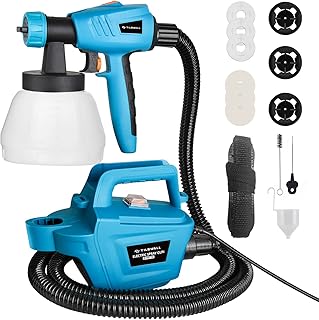
The Tilswall sits in the middle ground between a compact handheld gun and a full turbine system. The 800 watt motor is strong enough for primers and enamels, the container holds 1300 millilitres so you stop far less often, and the 2.5 metre hose means the motor unit can rest on the ground while you carry only the gun.
Coverage is where it earns its place. A rated output of up to 1200 millilitres per minute is a lot of material, which makes short work of fence panels, garage doors and exterior trim. Three nozzle sizes and three patterns cover most household jobs, and the container detaches for filling and flushing without tools.
The tradeoffs follow directly from the specification. A 1300 millilitre cup full of paint is heavy on the wrist if you hold the gun overhead, and the high flow rate makes it easy to lay paint on too thick until you learn where the dial should sit. Latex still needs thinning, and the hose adds one more thing to route around a ladder.
Bottom line: the right pick when the surfaces are large and the sessions are long. For small detail work, a lighter gun with a smaller cup is easier to control.
- Type: handheld HVLP with hose
- Motor: 800 watts
- Output: up to 1200 millilitres per minute
- Container: 1300 millilitres, detachable
- Hose: 2.5 metres
- Nozzles: 3 sizes
- Spray patterns: horizontal, vertical, round
- Materials: stains, primers, enamels, thinned latex
Aimed at the owner with square metres to cover: fence panels, garage doors, shed cladding, exterior trim. The large container and high output turn what would be an afternoon of refills into a continuous run.
Less appropriate for small, precise jobs. Spraying a jewellery box or a set of picture frames with this much output is possible, but a lighter gun with a smaller cup will feel far more controllable.
The large container is a blessing while spraying and a chore afterwards, because there is more surface area holding wet paint. Empty any leftover material back into the can immediately, then part fill the container with the appropriate cleaner and spray it through until it runs clear.
Detach the hose and check both couplings for paint that has crept past the seal. Wipe the outside of the gun before the residue sets, because a rough, paint caked body makes every future cleanup harder.

Pros
- Sprays unthinned latex straight from the can
- Single nozzle design keeps cleaning simple
- Light in the hand for extended wall work
- Adjustable air power, flow and pattern
- All in one body with nothing to trip over
Cons
- One nozzle only, so fine detail work is limited
- Wider pattern produces more overspray indoors
- Handheld cup means regular refills on a full room
The FLEXiO 1500 is the stripped down version of Wagner's no thinning promise. It keeps the X-Boost turbine and the ability to spray most latex straight from the can, but ships with the iSpray nozzle alone rather than the two nozzle set. For a lot of buyers that is the right trade, because the second nozzle is only useful if you actually do fine detail work.
In the hand it is light and simple. Air power, material flow and pattern are all adjustable, so you can tune it down for a hallway and open it up for fence panels. Because there is no floor unit and no hose, setup is genuinely a one minute job and there is nothing to snag on a ladder while you are working at height.
The limitations are the flip side of that simplicity. The iSpray nozzle throws a broad pattern, which is exactly wrong for a cabinet face viewed from arm's length, and a broad pattern indoors means more masking. The cup rides in your hand, so a full room still means several stops to refill.
Bottom line: choose this over the two nozzle model if your work is walls, ceilings and fences and you want the shortest possible cleaning routine. Choose the 595 instead if cabinets and furniture are on the list.
- Type: all in one handheld HVLP
- Turbine: Wagner X-Boost
- Nozzle: iSpray included
- Adjustability: air power, material flow, pattern width
- Materials: most unthinned latex, stains, sealers
- Container: handheld detachable cup
- Design: lightweight, no floor unit
- Power: corded electric
Mask further than you think you need to, because the iSpray pattern is wide. Set air power to the lowest level that still gives a clean fan on scrap, then keep the gun about 25 centimeters from the wall and move at a steady walking pace.
Work in sections roughly one metre wide, overlapping each pass by half, and finish a full wall before stopping so the edges stay wet. Refill before the cup runs dry rather than after, because an empty cup mid pass leaves a visible dry band.
The decision between this and the two nozzle FLEXiO comes down to one question: will you spray anything that someone will look at from close range? If the answer is no, the single nozzle saves you money and cleaning time.
If cabinets, interior doors or furniture are anywhere on your list, spend the difference on the model that includes the Detail Finish nozzle. Retrofitting the right nozzle later costs more than buying it in the box.

Pros
- 1000 watt motor is the strongest in this roundup
- Six nozzles cover an unusually wide material range
- 47 ounce container is the largest here
- Variable patterns and adjustable flow control
- Container detaches for straightforward filling
Cons
- Heaviest gun here once the container is full
- High output makes runs easy until the dial is set
- Lowest average rating among the picks on this page
The PICKITOLES is the brute of this group. A 1000 watt motor and a 1400 millilitre container put it at the top of the range on both power and capacity, and the six nozzle set is the widest supplied by any sprayer here. On paper it is built for the job nobody enjoys: a long run of fence, siding or garage doors where stopping to refill breaks the rhythm.
In use, the power is genuinely useful on heavier material. Thicker primers and enamels that make a 450 watt gun cough will atomize here, and the variable pattern plus flow dial give you room to tune. The container releases quickly, which matters when there is that much paint to empty and flush.
Two cautions are worth taking seriously. A full 1400 millilitre cup is heavy, and holding it above shoulder height for any length of time is tiring. High output also means the surface floods faster if you dwell, so the first ten minutes should be spent on scrap dialling the flow down rather than up. Its average rating sits at the bottom of this shortlist, which reflects a less polished build than the established brands even though the specification is strong.
Bottom line: maximum capacity and power for large exterior jobs, with a weight penalty and a learning curve. Choose it for coverage, not for finesse.
- Type: all in one handheld HVLP
- Motor: 1000 watts
- Container: 47 ounces, 1400 millilitres, detachable
- Nozzles: 6 supplied
- Spray patterns: variable
- Flow control: adjustable
- Materials: primers, enamels, thinned latex, stains
- Power: corded electric
Six nozzles sounds like marketing until you spray three different materials in a week. Smaller orifices suit stains, sealers and clear coats where a thin film is the goal. Larger ones carry primer and properly thinned latex without starving the fan.
Keep the nozzles in the case with a note of which material each one was used for. Mixing a stain nozzle into latex work and back again is how orifices end up part blocked and fans end up lopsided.
With this much output, ventilation is not optional. Work outdoors or with steady cross ventilation, wear a respirator rated for paint mist, and keep the cord clear of the spray zone so it does not collect overspray.
Empty and flush the large container as soon as you finish. Paint left standing in a 1400 millilitre cup takes far longer to remove once it starts to skin, and residue around the wide lid seal is a common source of drips on the next job.

Pros
- Compact and light for overhead and awkward angles
- Simple controls make it easy for a first time user
- Excellent on stains, sealers and clear coats
- Quick to set up and quick to clean
- Backed by widely available Wagner support and parts
Cons
- Not intended for heavy unthinned latex work
- Smaller cup means frequent refills on large areas
- Fewer nozzle options than the multi tip kits here
The Control Painter is Wagner's simplest handheld HVLP unit, and simplicity is the point. There is no nozzle library to manage and no floor turbine to position: you fill the cup, set the pattern, set the flow and start spraying. For deck stain, fence sealer, shed treatment and clear coats on furniture, that is all the tool needs to do.
Its real strength is comfort on awkward work. A compact body and a modest cup keep the gun light, so railings, spindles, lattice and the underside of a bench stay manageable rather than becoming a wrist exercise. Setup and pack away take a couple of minutes at each end, which lowers the barrier to picking it up for a thirty minute job.
The boundaries are clear. This is not the gun for spraying an interior in unthinned latex, and the smaller cup means more refills across a large surface. It also offers fewer tip options than the multi nozzle kits on this page, so its comfortable material range is narrower.
Bottom line: the easiest sprayer here to pick up and use, and an excellent match for thin materials on outdoor timber. Look elsewhere if wall paint is your main job.
- Type: all in one handheld HVLP
- Design: compact corded turbine
- Spray pattern: adjustable
- Flow control: adjustable material dial
- Materials: stains, sealers, clear coats, thinned paints
- Container: handheld cup
- Setup: single piece, no hose
- Power: corded electric
The right pick for the person whose spraying happens outdoors on timber: decks, fences, garden furniture, sheds and railings, mostly in stain or sealer. Light weight and quick setup matter more than raw output for that work.
It is the wrong pick if you bought a sprayer specifically to repaint interior walls. Latex is not this gun's natural material, and forcing it will produce a patchy fan and a frustrating afternoon.
Stains and sealers usually spray straight from the container with no adjustment at all, which is why this unit suits them so well. Anything thicker should be checked with a viscosity cup before it goes anywhere near the gun.
Add thinner in small increments, stir thoroughly, and retest rather than pouring by eye. Over thinned paint runs and loses coverage, which costs more time in extra coats than the thinning step ever saves.
How to Choose a Handheld HVLP Paint Sprayer
Handheld HVLP units look interchangeable on a shelf. They are not. Two sprayers with the same body shape can behave completely differently once thick paint hits the nozzle, and the gap usually traces back to four or five specs that manufacturers print in small type. Here is what actually changes the result on your cabinets, fence, or trim.
Motor Power and Airflow

Wattage is the closest thing this category has to a horsepower rating. Entry level handheld guns sit in the 400 to 550 watt range, which is plenty for stains, sealers, clear coats, chalk paint, and milk paint. Step up to 700 or 800 watts and the turbine can atomize heavier material without spitting, which matters the moment you switch from stain to a satin enamel. The 1000 watt units at the top of the range push the most air of all, and they hold their pattern longer when you are covering a full fence line rather than a single dresser.
More watts is not automatically better, though. A high output motor sprays faster, which means it also lays paint on thicker and creates runs faster if you rush the pass. Every sprayer worth owning has a material flow dial, and on a powerful gun you will spend the first few minutes of every project turning that dial down rather than up. If most of your work is furniture and cabinet doors, a mid range motor with fine flow control will give you a cleaner result than a big turbine run wide open.
Turbine style systems such as the Wagner Control Spray Max publish airflow and pressure numbers instead of leaning on wattage alone. Higher airflow at low pressure is the whole point of HVLP: the paint gets carried to the surface rather than driven at it, so transfer efficiency climbs and the cloud of bounce back drops. That is why a modest 510 watt turbine can outperform a louder handheld gun on fine finish work.
Cup Capacity and Where the Weight Sits

Cup size decides how often you stop. A 27 ounce container is fine for a bathroom vanity or a set of shutters, and it keeps the gun light enough to hold at odd angles for a full hour. Jump to a 1300 or 1400 millilitre container and you can coat an interior door, both sides, without a refill, but you are also holding roughly a kilogram of extra paint at arm’s length. Wrist fatigue is the single most common complaint in this category, and it is almost always a cup capacity decision in disguise.
Hose fed turbine units sidestep the problem entirely. The canister and motor stay on the floor while a light gun rides on the end of a flexible hose, so the only weight in your hand is the gun and a small cup. The tradeoff is a hose that snags on scaffold legs and a two piece system that takes longer to set up and pack away. If your typical project runs over two hours, that tradeoff usually pays for itself.
Check how the container detaches, too. A cup that twists off in one motion and has a wide mouth is far easier to fill from a paint can and far quicker to flush at the end of the day than a narrow bottle with a threaded collar full of dried paint.
Nozzle Sizes and Spray Patterns

Nozzle diameter is measured in millimeters and it needs to match the material, not the project. A 1.0 to 1.5 millimeter tip suits thin liquids: stains, sanding sealers, lacquers, and clear polyurethane. A 1.8 to 2.0 millimeter tip is the sweet spot for primers, chalk paint, and properly thinned latex. Tips at 2.5 millimeters and above exist for the thickest material, and using one on a thin stain will simply flood the surface. Most kits ship with three or four tips precisely because one size cannot cover the range.
Brass tips hold their edge longer than plastic and they survive solvent cleaning without swelling, which is why the better kits advertise the material. Copper and brass nozzles also tolerate a nylon brush during cleanup, so you are less likely to ruin the orifice while clearing dried paint from around it.
Spray patterns matter almost as much. Nearly every unit here offers three: a horizontal fan for moving across a wide surface, a vertical fan for moving up and down a tall panel, and a round pattern for corners, spindles, and narrow rails. Being able to rotate the air cap without tools, mid project, is the difference between a clean fence rail and a striped one.
Latex, Stain, and How Much Thinning You Will Do
This is the spec that decides whether you enjoy the tool or resent it. Most handheld HVLP sprayers cannot atomize latex wall paint straight from the can. They need it thinned, typically with water at somewhere between five and twenty percent by volume, checked with the little viscosity cup included in the box. That is a genuine extra step: you stir, you pour, you time the drain, you adjust, and only then do you spray.
A small number of models are engineered to skip it. Wagner builds its FLEXiO line around a turbine strong enough to handle most unthinned latex, which is why those units keep showing up on interior wall projects where a homeowner wants to open the can, pour, and start. If your plan is a living room in a single weekend, that capability is worth more than any other spec on the page.
If you mostly spray stain, sealer, chalk paint, or oil based enamel on furniture, thinning barely registers as a chore because those materials are already close to spray viscosity. In that case you should pick on nozzle quality and flow control instead, and let the latex question go.
Overspray, Masking, and Cleanup
HVLP produces far less airborne waste than a high pressure airless rig, but it still produces some. Indoors that means masking further than feels necessary: floor, baseboards, light switches, and anything within about two metres downwind of the gun. Outdoors it means watching the breeze, because a light crosswind will carry a fine mist onto a car two driveways away. A cheap plastic sheet tears at the first snag, so it is worth using a proper cover, and our roundup of the best waterproof tarps covers options that survive being dragged around a job site.
Surface preparation drives the finish more than the sprayer does. Paint sprayed over chalky siding or a greasy cabinet door will fail no matter how good the atomization is, so exterior work usually starts with a wash and a full dry out. If you are prepping siding, decking, or a fence before painting, our guide to the best pressure washers is a useful companion read.
Finally, budget fifteen to twenty minutes for cleanup every single session. Water based paint flushes with warm soapy water; oil based material needs the appropriate solvent. Several models now ship with a blowing attachment that pushes air through the passages to clear residue, and a few include a dedicated cleaning brush set. Skipping cleanup once is how a good sprayer becomes a clogged paperweight.
| Sprayer | Rated power | Container | Nozzles and patterns | Unthinned latex |
|---|---|---|---|---|
| HomeRight Super Finish Max | 450 W | 27 oz cup | 3 brass tips, 3 patterns | Thin first |
| Wagner FLEXiO 595 | X-Boost turbine | Handheld cup | iSpray plus Detail Finish nozzle | Yes, most latex |
| VONFORN VF803 | 700 W | Detachable cup | 4 nozzles, 3 patterns | Thin first |
| Wagner Control Spray Max | 510 W turbine | Floor canister, hose fed | Adjustable gun, 3 patterns | Thin first |
| Tilswall 800W | 800 W | 1300 ml detachable | 3 nozzles, 3 patterns | Thin first |
| Wagner FLEXiO 1500 | X-Boost turbine | Handheld cup | iSpray nozzle, adjustable | Yes, most latex |
| PICKITOLES 1000W | 1000 W | 1400 ml detachable | 6 nozzles, variable patterns | Thin first |
| Wagner Control Painter | Corded turbine | Handheld cup | Adjustable pattern and flow | Thin first |
Why You Should Trust Us
We build these roundups from the same evidence a careful shopper would gather, only faster and across a much wider pool. For this guide we pulled the current handheld HVLP listings on Amazon, filtered out anything sitting below a 4.0 star average or carrying too few ratings to be meaningful, and then read through the specification sheets line by line. Motor wattage, container volume, nozzle diameters, included patterns, hose length, and the manufacturer’s own statement about latex handling all went into the comparison before any ranking happened.
We also read the critical reviews, not just the glowing ones, because in this category the complaints are remarkably consistent and remarkably useful. Spitting at the start of a pass, cups that leak when tilted, motors that whine after a season, and cleanup that takes longer than the job all show up again and again, and those patterns shaped both the pros and the cons on every card above. We do not accept payment for placement, and when a sprayer has a real weakness we name it. Variants that were simply a different colour of the same machine were removed so that every entry on this page represents a genuinely different tool.
Final Thoughts
The HomeRight Super Finish Max earns best overall because it does the most jobs well. Three brass tips cover everything from thin stain to thinned latex, the three patterns rotate without tools, and the 27 ounce cup keeps the gun manageable through a long session on cabinet doors. It is the sprayer we would hand to someone refinishing furniture, shutters, and trim in the same month.
The VONFORN VF803 is the best value pick. A 700 watt motor with four nozzle sizes and three patterns covers the same core work as units costing considerably more, and the cleaning and blowing attachments take real time out of the part of the job everyone dreads. If this is your first sprayer and you are not sure how often you will reach for it, this is the low risk way in.
For specific jobs, the picture narrows nicely. Spraying interior walls and ceilings without thinning anything points straight at the Wagner FLEXiO 595, with the FLEXiO 1500 as the lighter single nozzle alternative. Fine finish work on doors, cabinet faces, and furniture belongs to the Wagner Control Spray Max, whose floor mounted turbine keeps your wrist fresh through a long session. Long fence and deck runs favour the Tilswall 800W or the PICKITOLES 1000W and their larger containers, while the Wagner Control Painter is the compact choice for stains and sealers on smaller outdoor jobs. If your projects live mostly in the yard, our patio, lawn and garden guides cover the rest of the kit.
Frequently Asked Questions
Can a handheld HVLP paint sprayer spray latex without thinning it?
Some can, most cannot. Wagner’s FLEXiO models are built around a turbine strong enough to atomize most unthinned latex straight from the can, which is why they dominate interior wall projects. Almost every other handheld unit, including the HomeRight, VONFORN, Tilswall, and PICKITOLES guns here, will want latex thinned with water first. Use the viscosity cup that came in the box, add water in small increments, and stop as soon as the paint drains freely rather than guessing at a percentage.
What nozzle size should I use for cabinets and trim?
For cabinet doors and trim, a 1.5 millimeter tip handles most water based enamels and chalk paints cleanly, while a 1.8 to 2.0 millimeter tip is better for thicker primers. Drop to 1.0 or 1.3 millimeters for stains, sealers, and clear coats where you want the thinnest possible film. If the finish comes out pebbly, the tip is usually too small for the material or the flow is set too low, not the other way around.
How much overspray should I expect indoors?
Far less than an airless rig, but enough that masking is not optional. Expect a light mist to settle within roughly two metres of the gun, further if a fan or an open window is moving air through the room. Cover floors, tape off adjacent surfaces, wear a respirator rated for paint mist, and ventilate steadily rather than blasting air across the workpiece. Spraying cabinet doors flat on a bench outdoors, then rehanging them, removes most of the indoor mess entirely.
How long does cleanup actually take?
Plan on fifteen to twenty minutes at the end of every session. Flush water based paint with warm soapy water pushed through the gun until it runs clear, then strip the nozzle and air cap and brush the passages. Oil based material needs the matching solvent and a little more patience. Models with a blowing attachment shorten the process because compressed air clears the internal channels that a brush cannot reach. Note that a paint sprayer is a different animal from a garden sprayer, so if you are spraying liquids on plants rather than paint, see our guide to the best pump sprayers for distance instead.
Is a handheld HVLP sprayer worth buying for a single room in 2026?
For one small room with simple flat walls, a roller is faster once you count masking and cleanup. The maths flips as soon as the surfaces get complicated: louvered doors, spindled railings, shutters, wicker furniture, and full cabinet sets take a fraction of the time with a sprayer and come out without brush marks. If you own a house, the tool tends to justify itself by the second or third project. Browse more buying guides in our articles library before you decide.


Write Your Review
No reviews yet. Be the first to share your experience!