

Cured concrete is the hardest thing most people will ever ask a small power tool to do. It is abrasive rather than merely tough, it loads the motor continuously instead of in bursts, and it throws off a fine dust that is a genuine health hazard rather than a nuisance. That combination is why a grinder that is perfectly happy deburring steel can bog down, overheat and die on a masonry job. We looked at 7 corded grinders from Makita, SKIL, DEWALT and more, sorted by motor amps, disc size, switch design and how well each one accepts dust control.
Our top pick is the DEWALT DWE402 for its eleven amp motor and paddle switch, the pairing that holds disc speed through a cut and shuts the tool off the instant you let go. Below we sort the field by the specifications that actually decide whether a grinder survives concrete work, and we are blunt about which features you do not get at this size. If you are filling out a workshop for September 2026, our tools and home improvement section covers what sits alongside it.

Pros
- Eleven amp motor is the largest here and holds speed under load
- Paddle switch stops the tool the moment your hand opens
- One-touch guard rotates without a wrench
- Dust ejection system clears debris that gets into the motor housing
Cons
- Heavier in one hand than the six amp tools in this list
- No electric brake, so the wheel coasts after release
- Larger body is less comfortable for long overhead work
The DWE402 is the tool in this list that treats concrete as a normal job rather than an unusual demand. Eleven amps is a clear step above everything else here, and on masonry that shows up as wheel speed held through the length of a cut instead of sagging halfway along it.
The paddle switch is the second reason it belongs at the top. On a grinder cutting concrete, the failure mode that matters is the wheel snatching and twisting the tool out of your hand, and a switch that dies when your grip opens is the simplest answer to that. It also means the grinder cannot restart on its own when a tripped breaker is reset.
Details around the wheel are handled properly. The guard rotates by hand rather than needing a wrench, which matters because a guard that is awkward to move is a guard people leave in the wrong place, and the side handle mounts on either side for vertical cuts and left handed users. The dust ejection system is aimed squarely at this kind of work, since abrasive masonry dust is what kills grinder motors.
What you do not get is a brake. The wheel coasts after you release the paddle, which is normal for this class but worth knowing. It is also the bulkiest tool here, and that weight is felt on overhead work even though it is exactly what makes the tool comfortable on a floor.
Bottom line: the grinder to buy when concrete is the point rather than an occasional job, and the one least likely to be the limiting factor.
- Disc size: 4.5 inch
- Motor: 11 amp
- No load speed: 11,000 rpm
- Switch: paddle with lock-off
- Guard: one-touch tool-free adjustment
- Side handle: two positions
- Motor protection: dust ejection system
- Power: corded
Buy this if masonry is a regular part of your work: cutting pavers, scoring slab, running a diamond cup wheel across a floor, or raking out mortar over a whole wall. It is also the right pick for anyone who wants a paddle switch as a safety requirement rather than a preference.
It is more tool than someone needs for a single weekend project or for light deburring, and the extra weight is real. For occasional work, a lighter body is easier to live with.
Check the maximum rpm printed on every wheel before fitting it, and never run a wheel rated below the grinder speed. Keep the guard fitted and rotated so it sits between the wheel and your body, which is exactly what it exists for.
Dry cutting concrete releases respirable crystalline silica, and the warning is on the tool and the wheel for a reason. Plan on a dust shroud connected to a vacuum with a fine particulate filter, plus a properly fitted respirator, before starting masonry work. Let the motor idle at no load for a minute after long cuts rather than switching straight off, and keep the vents clear of packed dust.
Pros
- Paddle switch in one of the lighter bodies in this list
- Labyrinth construction seals the motor and bearings against abrasive dust
- 7.5 amps is comfortable for most homeowner masonry
- Slim body is easy to hold square on a scoring line
Cons
- Less motor than the eleven amp tools when cutting sustained lines
- No electric brake
- Paddle switch is more tiring than a slide switch over long grinding sessions
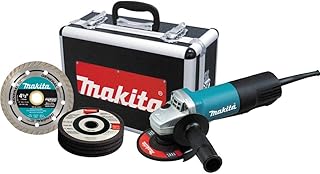
The Makita 9557PBX1 is the grinder for people who want a paddle switch without carrying eleven amps around all day. At 7.5 amps it sits comfortably in the middle of this field, which is enough for pavers, mortar work and moderate cutting, and it is noticeably easier to handle than the larger tools here.
Makita's labyrinth construction is the specification worth understanding on a concrete tool. It is a set of internal barriers that keep abrasive dust out of the motor and bearings, and abrasive dust is precisely what ends the life of a grinder used on masonry. Pair that with the protective varnish on the armature and you have a tool built with this failure mode in mind.
The body is slim enough to wrap a hand around properly, which sounds trivial until you are trying to hold a cut-off wheel square on a scoring line. A tool you can control accurately binds its wheel less often than a powerful tool you are wrestling.
The honest limitation is the motor when the cuts get long. On a continuous run through concrete, 7.5 amps will slow more than eleven will, and the fix is patience rather than pressure. There is no brake, and the paddle switch that makes it safer also makes long grinding sessions more tiring than a slide switch would.
Bottom line: the balanced choice, and the one to pick if you want paddle switch safety in a tool that stays comfortable.
- Disc size: 4.5 inch
- Motor: 7.5 amp
- No load speed: 11,000 rpm
- Switch: paddle with lock-off, AC and DC operation
- Motor protection: labyrinth construction sealing motor and bearings
- Armature: protective zig-zag varnish
- Spindle lock: yes
- Power: corded
This suits homeowners and remodelers who do masonry several times a year and want a tool that will still be alive in a decade. The dust sealing is the reason it lasts, and the paddle switch is the reason it is a sensible pick for someone new to grinders.
If your work is a full floor of surface grinding rather than cuts and edges, buy more amps. This is a tool for jobs measured in feet, not in rooms.
Before ordering, confirm the guard style will take a dust shroud if you plan to grind rather than cut, since shroud availability depends on how the guard clamps rather than on the motor.
Match wheels carefully. A 4.5 inch diamond cut-off wheel is the right disc for scoring pavers and slab, a cup wheel is for surface work, and both must carry a maximum rpm at or above 11,000. If you expect to run cup wheels for long stretches, the eleven amp tools in this list will finish sooner and run cooler.

Pros
- 8.5 amps sits just below the largest motors here with less bulk
- Service Minder brushes stop the tool before the armature is damaged
- Two-position auxiliary handle covers vertical and horizontal work
- Epoxy coated field windings resist abrasive dust and debris
Cons
- Slide switch will restart the tool if power returns while it is left on
- No electric brake
- Lock-on switch is less forgiving than a paddle if the wheel snatches
The Bosch GWS8-45 is the durability pick in this group. At 8.5 amps it has real power for masonry without the bulk of an eleven amp tool, and the engineering that matters here is aimed at surviving dust rather than at winning a specification comparison.
The Service Minder brush system is the standout. When the carbon brushes wear to the point where they would start damaging the armature, the tool stops running rather than quietly destroying itself. On a grinder used in concrete dust, where brushes wear faster than they do in clean work, that is a genuine life extender and it turns an expensive failure into a cheap part replacement.
Epoxy coated field windings serve the same purpose from the other direction, resisting the abrasive particles that get past every seal eventually. Together with a burst resistant guard and a solid two-position handle, this is a tool that reads as built for site work rather than for a display shelf.
The switch is the compromise. It is a slide switch with a lock-on, which is more comfortable across a long grinding session and less forgiving in every other respect. Left in the on position when a breaker trips, the grinder will start again by itself when power returns, and it does not cut out if the wheel snatches the tool out of your hand. There is no brake either.
Bottom line: the one to buy for longevity in dusty work, provided you are disciplined about the switch.
- Disc size: 4.5 inch
- Motor: 8.5 amp
- No load speed: 11,000 rpm
- Switch: slide switch with lock-on
- Brush system: Service Minder, stops the tool at brush wear limit
- Windings: epoxy coated field
- Auxiliary handle: two positions
- Power: corded
This is the pick for someone who grinds more than they cut, since a lock-on switch is far more comfortable over a long session of surface work, and for anyone who expects the tool to live in a dusty environment for years.
Skip it if you want a dead man switch. On cut-off work in concrete, where a bound wheel can wrench the tool sideways, a paddle switch is the safer arrangement.
Get into the habit of switching the slide off before unplugging and before setting the tool down. A grinder left switched on will start by itself when power is restored, and that is the one hazard this switch style adds.
Blow the vents clear after masonry sessions so packed dust does not trap heat, and treat the Service Minder shutdown as a service call rather than a fault. As with every tool here, dry concrete work releases respirable silica, so a shroud with vacuum extraction and a fitted respirator belong in the plan before the first cut.

Pros
- Arrives with five grinding wheels and a hard case
- Compact and light, which helps on edges and vertical cuts
- Side handle mounts in three positions
- Simple design with few things to go wrong
Cons
- 6.2 amps is the wrong end of the range for sustained concrete cutting
- Slide switch restarts if left on when power returns
- Included wheels are for grinding, so masonry discs are a separate purchase
The Metabo HPT G12SR4 is the kit buy in this list. Five grinding wheels and a hard case come in the box, which is the difference between owning a grinder and owning a grinder plus a shopping trip, and the tool itself is light and compact enough to be pleasant on edge work.
At 6.2 amps it sits at the modest end of the field, and it is honest about that. For cleaning up a rough concrete edge, raking a short run of mortar or cutting the occasional paver, it is enough. For running a diamond cup wheel across a floor, it is not, and pushing it into that job is how small grinders die.
The three-position side handle is a nicer feature than the price suggests. Vertical cuts, horizontal grinding and left handed use all want the handle somewhere different, and plenty of more expensive tools offer only two positions.
The switch is a slide, so it will restart if power returns while it is left on, and there is no brake. Note also that the included wheels are grinding discs for metal, so the diamond cut-off wheel or cup wheel you need for concrete is still a separate purchase.
Bottom line: the sensible pick for occasional masonry and general shop work, provided you match the job to the motor.
- Disc size: 4.5 inch
- Motor: 6.2 amp
- No load speed: 10,000 rpm
- Switch: slide switch
- Side handle: three positions
- Included: five grinding wheels and a hard case
- Spindle lock: yes
- Power: corded
Buy this if the grinder will spend most of its life on metal with occasional concrete work, and budget separately for masonry discs. The included wheels are abrasive grinding discs and will not do what a diamond wheel does on cured concrete.
If your list of jobs is mostly concrete, spend the difference on more amps instead. A hard case and a stack of wheels is poor compensation for a motor that runs hot on every cut.
Set the guard so it sits between the wheel and your body before you plug the tool in, and fit the side handle in the position that lets you hold the tool square to the line. Let the wheel reach full speed before touching the work.
On concrete, let the wheel do the cutting rather than leaning on it. Extra pressure slows the wheel, and a slowed diamond wheel burnishes the surface and overheats instead of cutting. Take short passes, let the tool run at no load between them, and switch the slide off before setting the grinder down.

Pros
- One-touch guard rotates without tools
- Compact body reaches into tight spaces the bigger tools cannot
- 12,000 rpm no load speed suits abrasive work
- Dust ejection system helps the motor survive masonry debris
Cons
- 7 amps limits it on long concrete cuts
- Slide switch will restart when power returns if left on
- No electric brake
The DWE4011 is the compact DEWALT, and it is a genuinely different proposition to the DWE402 rather than a cheaper version of it. Seven amps and a small body make it the tool you reach for when access is the problem: between joists, up against a wall, or in a corner where a full size grinder simply will not fit.
The one-touch guard is the feature that carries over from the bigger tool and it is worth having. Rotating the guard by hand means it ends up where it should be for the cut rather than wherever it was left, and on masonry the guard is doing real work deflecting a continuous stream of hot particles.
The 12,000 rpm no load speed reads well on paper, and it does suit abrasive work, but read it alongside the motor. A fast small motor drops further under load than a slower large one, so on a long concrete cut this tool will lose more speed than the eleven amp option even though it starts higher.
The switch is a slide rather than a paddle, which means the same restart caution applies as with the other slide switch tools here, and there is no brake. Treat it as a precision and access tool rather than a production cutter.
Bottom line: the pick when the constraint is space rather than power, and a poor choice for grinding a whole floor.
- Disc size: 4.5 inch
- Motor: 7 amp
- No load speed: 12,000 rpm
- Switch: slide switch
- Guard: one-touch tool-free adjustment
- Motor protection: dust ejection system
- Side handle: two positions
- Power: corded
This suits remodelers and homeowners whose concrete work is short, awkward and in tight places: cutting back a protruding bolt, scoring a small patch, opening up a channel where a big tool cannot reach.
Anyone planning sustained cutting or floor grinding should buy amps instead of speed. This tool is compact by design, and the motor size is part of that design rather than an oversight.
Rotate the guard to cover the side of the wheel facing you before plugging in, and fit the side handle on whichever side lets you keep the tool square. Bring the wheel to full speed clear of the work.
On concrete, work in short passes and keep the wheel moving rather than dwelling in one spot, which builds heat in the segments. Because the switch is a slide, get into the habit of switching off before you set the tool down and before unplugging it, so it cannot start on its own when power comes back.

Pros
- Grinding wheels, cutting wheels and a flap disc included
- 7.5 amps sits in the comfortable middle of this field
- Auxiliary handle mounts in three positions
- Complete starter package for someone with no consumables
Cons
- Shorter brand track record than the established tool makers here
- Included discs are for metal, so concrete still needs a diamond wheel
- No electric brake and no dedicated restart protection
The AVID POWER grinder is the value entry here and it earns that label on completeness rather than on any single specification. Grinding wheels, cutting wheels and a flap disc arrive in the box, which is a real saving for someone who owns no consumables and is buying a grinder for a specific project.
The motor is the part that keeps it from being a token inclusion. At 7.5 amps it matches the Makita on paper and sits well above the six amp tools, which puts it in genuinely usable territory for pavers, edges and moderate masonry rather than in the light duty bracket its position in the market suggests.
The three-position auxiliary handle is a pleasant surprise at this level, and it matters more on concrete than on metal because you change grip position between scoring a vertical line and grinding a horizontal surface.
Two cautions are worth stating plainly. The brand has a shorter track record than DEWALT, Makita or Bosch, so the long term durability picture is thinner. And the included discs are metal working abrasives: the diamond cut-off wheel or cup wheel you need for cured concrete is still a separate purchase, whatever the box says about cutting.
Bottom line: the most tool and the most consumables for the money, and a sound choice for a defined project rather than a decade of daily work.
- Disc size: 4.5 inch
- Motor: 7.5 amp
- Switch: corded electric with adjustable guard
- Auxiliary handle: three positions
- Included: grinding wheels, cutting wheels and a flap disc
- Intended uses: cutting, grinding, polishing and rust removal
- Finish: red
- Power: corded
This is the pick for a first grinder bought for a specific job, and for anyone who wants the consumables included rather than a bare tool. It handles occasional masonry perfectly well alongside general metal work.
Trade professionals and anyone planning daily use should buy on brand track record instead. The value here is in what comes in the box, not in a decade of service history.
Add a diamond wheel to the order. Whatever the included cutting discs are rated for, cured concrete needs a diamond cut-off wheel for scoring and a diamond cup wheel for surface work, and both must be rated at or above the tool speed.
If dust extraction matters to you, check shroud availability for this guard style before buying rather than after. Established brands have far more aftermarket shroud options, and that is a real argument for spending more when the work is mostly concrete.

Pros
- Light and easy to control on edges and small cuts
- Simple design with few failure points
- Six amps is enough for occasional masonry touch-ups
- Spindle lock makes wheel changes quick
Cons
- Smallest motor here, and it will heat on sustained concrete cuts
- Slide switch restarts if left on when power returns
- No brake and no dust ejection features
The SKIL 9295-01 is the light duty option in this list and it is worth being clear about what that means. Six amps will rake mortar from a short run of brick, clean up a rough concrete edge and cut the occasional paver, and it will do those jobs comfortably because the tool is light and easy to hold square.
What it will not do is sustained work. Concrete loads a motor continuously, and a six amp grinder pushed through a long cut gets hot and stays hot. The tool is not badly made, it is simply the wrong size for that job, and the correct response is a bigger motor rather than more pressure on this one.
Within its limits the basics are right. The spindle lock makes wheel changes quick, the side handle moves between positions, and the guard adjusts to cover the wheel where you need it. At 11,000 rpm it spins fast enough for standard 4.5 inch abrasive and diamond wheels.
The switch is a slide, so the restart caution applies: switch it off before setting it down and before unplugging. There is no brake and none of the dust management features the more expensive tools here advertise, which matters over years of masonry work rather than over a weekend.
Bottom line: the pick for a homeowner whose concrete work is occasional and small, and the wrong tool for anything sustained.
- Disc size: 4.5 inch
- Motor: 6 amp
- No load speed: 11,000 rpm
- Switch: slide switch
- Spindle lock: yes
- Side handle: two positions
- Guard: adjustable
- Power: corded
This suits a homeowner whose masonry work amounts to a few cuts a year: trimming a paver, cleaning an edge, raking a short mortar joint. The low weight also makes it the easiest tool here to hold overhead.
Anyone planning a floor, a wall of tuckpointing, or repeated cutting should start at seven amps and preferably higher. This tool will do the job once and complain about the third time.
Give the motor rest periods on masonry work. Running at no load for a minute after each cut moves air through the tool and cools the windings, which is what keeps a small grinder alive.
Check the maximum rpm on every wheel against the 11,000 rpm tool speed before fitting it, keep the guard between the wheel and your body, and remember that dry concrete work releases respirable silica. A dust shroud with vacuum extraction and a properly fitted respirator are the controls the labels call for, not a paper mask.
How to Choose an Angle Grinder for Concrete
Six specifications separate a grinder that will handle masonry from one that will only pretend to. Read the dust section even if you skip the rest, because it is the part of this job that can hurt you years after the work is finished.
Disc Size: 4.5 Inch or 5 Inch

Almost every compact grinder sold for home use takes a 4.5 inch or 5 inch wheel, and the difference is depth of cut. A 4.5 inch cut-off wheel gives you a little over an inch of usable depth once the guard and arbor are accounted for, and a 5 inch wheel adds roughly a quarter inch on top of that. Neither will cut through a standard patio slab in one pass.
That depth limit shapes the job rather than ruling it out. Scoring both faces of a paver and snapping it is normal practice, as is scoring a slab to a controlled depth and breaking out the waste. If you genuinely need to cut through thick concrete in one pass, the tool for that is a dedicated cut-off saw and not a 4.5 inch grinder at any amperage.
Where 4.5 inch wins is control and access. It is lighter in one hand, it fits between joists and up against walls, and the wheels are cheaper and sold everywhere. Buying a 5 inch tool to run 4.5 inch wheels also works, since most 5 inch grinders accept the smaller disc, but check the guard actually adjusts down to cover it properly.
Motor Amps and Why Concrete Punishes Small Motors

Amperage is the closest thing to a real power figure on a corded grinder, and on concrete it matters more than on any other material. Steel work is intermittent: you touch the wheel down, dress an edge, and lift off. A masonry cut is a continuous load for the length of the line, and that is what heats a small motor until the windings give up.
Six amps is enough for occasional mortar raking, cleaning up a rough edge or the odd paver. Seven to eight amps is the comfortable middle ground for a homeowner who does masonry a few times a year. Eleven amps is where the tool stops caring: it holds speed under load, it recovers quickly when the wheel binds slightly, and it will take a diamond cup wheel across a floor without complaining.
Watch the duty cycle as much as the number. A grinder that gets hot enough to be uncomfortable to hold is telling you to stop, and letting it idle at no load for a minute cools the windings far faster than putting it on a bench. Undersized tools fail on concrete not because they cannot start the cut but because nobody lets them rest.
No Load Speed and What It Does With a Diamond Wheel
Compact grinders run somewhere between 10,000 and 12,000 rpm with no load. Higher is not automatically better. What you actually care about is the speed under load, because a diamond wheel cuts by abrading, and a wheel that slows down in the material stops cutting and starts polishing while heat builds in the segments.
This is where amps and rpm interact. A twelve thousand rpm tool with a small motor can drop further under load than a slower eleven thousand rpm tool with a bigger one, and the second tool will finish the cut sooner. Read the two figures together rather than treating the larger rpm as a headline.
Always check the wheel is rated at or above the grinder speed. Every abrasive and diamond wheel carries a maximum rpm printed on the label, and matching it to the tool is the most basic safety check in this category. A wheel spun faster than its rating can come apart, which is exactly the failure the guard exists to contain.
Paddle Switch, Slide Switch, Brake and Restart Protection

A paddle switch runs only while you are squeezing it. Let go, drop the tool, or have the wheel snatch and pull it out of your grip, and the motor cuts. A slide switch stays where you left it, which is more comfortable for long grinding sessions and less forgiving in every other situation.
That difference also decides what happens after a power cut. A grinder with a slide switch left in the on position will restart the moment the breaker is reset or the cord is plugged back in, and a tool that jumps to life on the floor is a real hazard. Paddle switch tools give you that protection as a side effect of the design. Dedicated no-volt release circuits exist, but they are a professional tier feature rather than something you will find in this class.
The same goes for an electric brake, which stops a spinning wheel in a couple of seconds instead of thirty. None of the compact corded grinders here advertise one, and that is normal at this size and price. If a brake is a firm requirement for the work you do, that is a reason to shop a tier up rather than a reason to reject any of these tools.
Silica Dust, Shrouds and What the Labels Say
Dry cutting or grinding concrete releases respirable crystalline silica, and every wheel and tool label in this category carries a warning about it. Unlike sawdust, the particles that matter are too fine to see and too fine to feel, they stay in the air long after the tool stops, and the harm they do is cumulative. This is the one part of choosing a concrete grinder that is not about convenience.
The control the manufacturers point to is a dust shroud: a collar that replaces the standard guard, surrounds the wheel and connects to a vacuum. Very few grinders include one, so what you should check before buying is whether shrouds are made for that tool and how the guard mounts, since a tool-free clamping collar accepts far more aftermarket shrouds than a bolted guard does. The vacuum matters too, because a shop vacuum without a fine particulate filter simply blows the smallest particles back into the room.
Respiratory protection sits alongside extraction rather than replacing it. A loose paper nuisance mask is not what the labels call for, and the fit is as important as the rating, which is why a properly fitted respirator is the item to plan for. Eye protection and hearing protection are the other two the labels list, and a face shield over safety glasses is a sensible read of that when a wheel is cutting masonry. Our health and household section is where that protective kit lives.
Guards, Side Handles and Handling Under Load
The guard is not optional on concrete and it is not a formality. It sits between you and a wheel that is spinning fast enough to become dangerous if it fractures, and on masonry work it also deflects a continuous stream of hot particles away from your hands and face. Look for a guard you can rotate without a wrench, because a guard that is awkward to move is a guard people leave in the wrong position.
The side handle should thread into at least two positions, and three is better. Cutting a vertical line, grinding a floor and dressing an edge all want the handle somewhere different, and left handed users need the option on the other side. A handle that only mounts on top is a sign of a tool designed to a price.
Weight and body diameter decide how the tool feels after twenty minutes. A slim body you can wrap a hand around gives better control on a scoring line than a fat one, and a lighter tool is easier to hold square, which is what stops a cut-off wheel binding. Grinder weight is a fair trade against motor size, and it is worth handling the tradeoff deliberately rather than buying the biggest motor by default.
| Concrete job | Wheel to fit | What the grinder needs |
|---|---|---|
| Scoring and cutting pavers or slab | Diamond cut-off wheel, dry rated | High amps, paddle switch, guard that takes a shroud |
| Surface grinding and levelling | Diamond cup wheel | Highest amps you can get, shroud and vacuum |
| Mortar raking and tuckpointing | Diamond tuckpointing blade | Mid amps, good guard control, dust extraction |
| Removing thinset or paint from concrete | Turbo cup or coating removal wheel | Mid to high amps, shroud, patience with the duty cycle |
Match the wheel to the job before you match the tool to the wheel. More concrete work goes wrong because of the wrong disc than because of the wrong grinder, and our article archive covers the rest of the workshop.
Why You Should Trust Us
We build these lists from published specification and from the pattern of what long term owners report rather than from marketing copy. For each grinder here we looked at rated amperage, no load speed, disc size, switch type, how the guard adjusts and how many positions the side handle offers, and we checked what the maker actually says about dust and wheel ratings rather than assuming.
We set aside the diamond wheels and cup wheels that surface under the same search terms, because a blade is not a grinder and mixing the two makes a list look longer than it is. Owner reports were read for repeated themes rather than one off complaints, since the failures that matter in this category, motors cooking on long masonry cuts, guards that will not stay put, side handle threads stripping, show up again and again once you look for them.
Final Thoughts
Best overall is the DEWALT DWE402. Eleven amps is the largest motor in this group by a clear margin, and on concrete that shows up as speed held through the cut rather than as a number on the box. The paddle switch means the tool stops when your hand opens and cannot restart on its own after a power cut, the guard adjusts without tools, and the side handle moves to either side. It is the one tool here that will not be the limiting factor on a masonry job.
Best value is the AVID POWER Angle Grinder. It arrives with grinding and cutting wheels and a flap disc in the box, which is a real saving when you are starting from nothing, and 7.5 amps puts it in the comfortable middle of this field rather than at the bottom. The auxiliary handle mounts in three positions, which is more than some tools twice its size offer.
For specific needs, the Makita 9557PBX1 is the pick if you want a paddle switch in one of the lighter bodies here, the Bosch GWS8-45 suits anyone who values the Service Minder brush system and a solidly built slide switch tool, and the Metabo HPT G12SR4 is the choice if you want a hard case and a stack of wheels included. The DEWALT DWE4011 is the compact one-touch guard option for tight access, and the SKIL 9295-01 is the light duty pick for occasional mortar work rather than sustained cutting. More workshop picks are indexed in our category index and the tools archive.
Angle Grinder FAQs
How many amps do I need in an angle grinder for concrete?
Six amps handles occasional mortar raking and the odd paver, seven to eight amps covers most homeowner masonry, and eleven amps is where the tool stops being the limiting factor. Concrete loads a motor continuously rather than in bursts, which is why undersized grinders that feel fine on steel run hot on a long cut. If you plan to run a diamond cup wheel across a floor rather than making short cuts, buy the biggest motor you can and still expect to give it rest periods.
Can a 4.5 inch grinder cut all the way through a concrete slab?
Not in one pass. A 4.5 inch wheel gives you a little over an inch of usable depth after the guard and arbor take their share, and a 5 inch wheel adds around a quarter inch. The normal approach is to score both faces and break the piece, or to score to a controlled depth and remove the waste. Anything thicker than that is a job for a dedicated concrete cut-off saw, and no amount of motor amperage changes the geometry.
What protection does cutting concrete actually require?
The labels on these tools and wheels are consistent about it. Dry cutting concrete releases respirable crystalline silica, so the first control is a dust shroud connected to a vacuum with a fine particulate filter, and the second is a properly fitted respirator rather than a loose paper mask. Eye protection is listed on every wheel, and a face shield over safety glasses is the sensible reading when a wheel is cutting masonry. Hearing protection completes the set. You can find that protective kit through our health and household archive.
Is a paddle switch worth choosing over a slide switch?
For concrete, yes. A paddle switch cuts the motor the moment your hand opens, which covers the case where the wheel snatches and pulls the tool out of your grip. It also means the grinder cannot restart by itself when power returns, because a slide switch left in the on position will do exactly that when the breaker is reset. The trade is comfort: holding a paddle down through a long grinding session is more tiring than flicking a slide switch and forgetting about it.
Are corded grinders still the right choice in 2026?
For sustained concrete work, corded remains the straightforward answer. Masonry is a continuous load, and a continuous load is what empties batteries fastest, so a cordless tool that is excellent for cutting bolts can turn into a battery swapping exercise on a slab. Corded grinders also cost less for the same power and never run out mid cut. Cordless makes sense when there is no power on site or when the cuts are short and scattered, which is a different job to the one this list is about.




Write Your Review
No reviews yet. Be the first to share your experience!