

A reciprocating saw does not care what it is cutting, and that is exactly the problem. Put a coarse wood blade against a length of galvanized conduit and you get a shower of sparks, a row of stripped teeth and a cut that never finishes. In this tool class the machine is rarely the limiting factor. The consumable is, which is why the same saw feels unstoppable on one job and useless on the next. We sorted 8 blade options from DEWALT, Bosch, EZARC and more by tooth pitch, tooth material and the stock thickness each one is built for. If you are still filling out the kit around the saw, our tools and home improvement section covers the rest of the bench.
Our top pick is the DEWALT DW4892 Bi-Metal Reciprocating Saw Blade Set for covering thin sheet, pipe and nail-embedded stock in one case without asking you to guess a tooth count first. Everything below is sorted so you can match a blade to a material rather than to the badge on your saw, and the September 2026 shortlist mixes dedicated metal blades with the assorted sets most people start from.

Pros
- Covers thin sheet, pipe and nail-embedded stock without guessing a pitch
- Bi-metal construction flexes in tight spaces instead of snapping
- Mixed lengths let you pick stiffness or reach for the cut
- Case keeps the pitches sorted and the teeth protected
Cons
- Assortment means fewer spares of the one pitch you use most
- Not the right choice for cast iron or rebar, where carbide is needed
The DW4892 is the set most people should start from, because it answers the question that trips up new reciprocating saw owners: which pitch do I actually need. Instead of committing to one tooth count, you get a spread of bi-metal blades across metal and demolition pitches, in lengths from six to nine inches.
Bi-metal is the right default here. A high speed steel tooth strip welded to a spring steel body gives you teeth hard enough for pipe and conduit on a back that tolerates being bent in a joist bay, which is where a rigid blade would break.
The mixed lengths matter more than the piece count. Six inch blades are stiff and controllable for conduit, bolts and small pipe, while nine inch blades buy reach into a cavity at the cost of flex, and having both means you stop forcing one to do the other job.
The honest limitation is depth of spares. An assortment gives you one or two of each pitch, so once you find the one you use most you will be buying that pitch separately anyway. It also stops well short of cast iron and rebar, where a carbide tipped blade is the only sensible answer.
Bottom line: the set that covers the widest range of everyday metal work and stops you buying the wrong pitch twice.
- Blade construction: bi-metal, high speed steel teeth on spring steel body
- Pieces: twelve blades
- Lengths: six to nine inches
- Materials: metal, wood, nail-embedded stock
- Shank: half inch universal tang
- Storage: hard case
Buy this if you own a reciprocating saw and no blades, or if the material changes several times in a working day. It suits maintenance work, remodels and general metal jobs on conduit, pipe and light section. Skip it if you already know your pitch and want a deep stack of one blade, or if your work is rebar and cast iron, where carbide is the better spend.
Pick the shortest blade that clears the material plus the stroke of your saw, since a shorter blade wanders less. Run the lower half of the speed range on metal and switch orbital action off. Keep the shoe pressed to the work so the blade cannot bounce, and let the stroke remove material rather than leaning on the tool.

Pros
- Variable 14/18 pitch copes with changing wall thickness in one cut
- Six inch length stays stiff and cuts square
- Bulk pack keeps a fresh blade on hand for dirty work
- Aimed squarely at medium metal rather than sold as a general assortment
Cons
- A twenty five pack is far more than an occasional user needs
- Bi-metal still gives up on cast iron and hardened section
Steel Demon is Diablo's metal cutting line, and this six inch variable pitch blade is the one that earns the name. The 14/18 tooth spacing changes along the edge, which lets a single blade handle a pipe wall that thickens partway through the cut instead of stalling or hooking.
Variable pitch does something else that is easy to miss. Uniform teeth set up a harmonic that makes a blade chatter in thin material, and staggering the spacing breaks it up, so the cut is quieter and the shoe stays planted more easily.
The six inch length is the right call for this pitch. Stiffness is what keeps a metal cut square, and the shorter body resists the flex that turns a straight line into a curve at the far side of a pipe.
The pack size is the thing to think about. Twenty five blades is a professional quantity aimed at auto dismantling and repetitive metal work, so a homeowner cutting the occasional bolt will still be working through it years from now.
Bottom line: the metal blade to buy in bulk if you cut steel regularly and want one pitch that copes with most of it.
- Tooth pitch: 14/18 TPI variable
- Length: six inches
- Construction: bi-metal
- Rated stock: roughly one sixteenth to five sixteenths of an inch
- Pack: twenty five blades
- Shank: half inch universal tang
This is for people who cut metal often enough that running out is the real problem: auto dismantling, appliance breaking, maintenance crews and anyone stripping steel section. It is over-buying for a single project, and it is the wrong tool entirely for cast iron or rebar, where a carbide tipped blade will finish cuts this one cannot.
Keep the stroke rate low and use a wax stick or cutting oil on longer cuts, since heat is what draws the temper out of the teeth. Let blades cool in air rather than quenching them, which makes the body brittle. Store the pack flat so the blades cannot take a set, and retire a blade when swarf comes off as dust rather than curls.

Pros
- Carbide teeth cut material that destroys high speed steel
- Coarse 8 TPI pitch clears chip from thick sections
- Long service life on abrasive and hardened stock
- Three pack is a realistic quantity for occasional heavy cuts
Cons
- Carbide teeth chip if the blade binds, twists or is dropped
- Coarse pitch is wrong for sheet metal and thin tube
- Costs more per blade than bi-metal, so it is wasted on mild steel
This is the blade you reach for when bi-metal has already failed. Carbide teeth are brazed to the body rather than welded as a strip, and they keep an edge in cast iron, alloy steel, stainless section and rebar, all of which round off high speed steel in a matter of cuts.
The 8 TPI pitch is deliberate. Thick material needs each tooth to take a bigger bite and to have somewhere to put the chip, and a fine pitch in heavy section simply packs its gullets and starts rubbing instead of cutting.
Life expectancy is the reason to buy it. Makers quote large multiples over bi-metal on hard materials, and that claim holds when the blade is used for what it was built for rather than as a general purpose blade.
The trade-off is brittleness and pitch. Carbide chips rather than dulls, so a bind or a drop can take teeth off, and the same coarse spacing that helps in thick steel will hook and tear thin sheet. This is a specialist, not an all-rounder.
Bottom line: the right blade for cast iron, rebar and hardened stock, and the wrong one for everything thin.
- Tooth material: carbide tipped
- Tooth pitch: 8 TPI
- Length: six inches
- Target materials: cast iron, alloy steel, stainless, rebar
- Pack: three blades
- Shank: half inch universal tang
For anyone whose problem is a material rather than a quantity: cutting rebar on site, breaking cast iron waste pipe, trimming hardened bolts or working stainless section. If your list is conduit, sheet and light tube, a bi-metal blade will do the job for less and will not chip if it binds.
Plant the shoe firmly and start slowly so the teeth bite rather than skate. Keep the blade square, because twisting is what chips carbide, and never pry with the saw. Use a slow stroke rate with steady pressure and let the blade work: heat and chatter kill carbide faster than cutting does.

Pros
- M42 cobalt teeth hold hardness at cutting temperature
- 14 TPI suits most everyday pipe and section work
- Five pack is a sensible quantity for a toolbox
- Published stock thickness range makes matching easy
Cons
- Single pitch, so very thin sheet still wants a finer blade
- Bi-metal will not survive cast iron or rebar
M42 is the specification worth understanding here. The tooth strip carries roughly eight percent cobalt, which lets the edge stay hard at the temperature a real cut reaches rather than the temperature of the workshop. That is what stops teeth rounding over halfway down a long cut in section or stainless.
At 14 TPI this sits in the everyday middle of metal work. Angle iron, bolts, pipe wall and heavier tube are all comfortable, and the maker publishes the stock range it is designed for, which is more useful than a vague material list.
Six inches keeps it stiff. In a category where wander and flex cause most of the ruined cuts, a shorter body pressed against a planted shoe is the simplest way to keep the line square.
Where it runs out is at both ends of the thickness scale. Thin sheet wants a finer pitch so three teeth stay engaged, and cast iron or rebar want carbide. Within its band, though, this is a lot of blade for a five pack.
Bottom line: the sensible single pitch bi-metal blade for general metal, with a cobalt edge that survives longer cuts.
- Tooth steel: M42 with about eight percent cobalt
- Tooth pitch: 14 TPI
- Length: six inches
- Rated sheet thickness: about three to ten millimeters
- Rated pipe: under about one hundred millimeters
- Pack: five blades
Buy this if you want one metal pitch in the box and your work is pipe, tube, angle and bolts. It suits maintenance, plumbing and general fabrication tidy-up. Look elsewhere if you mostly cut thin ductwork, where a finer pitch is safer, or if you are cutting rebar and cast iron, which need carbide.
Use cutting fluid on longer cuts and let the blade cool between them, because cobalt tolerates heat better but is not immune to it. Support thin stock from behind so it cannot flex with the stroke. Wear eye protection: at this pitch the swarf comes off hot and fine, and a blade that snaps under a pry will throw.

Pros
- 18 TPI is the right pitch for conduit, tube and light section
- No assortment or accessory count to decode
- Six inch length keeps cuts square
- Major maker quality in a basic five pack
Cons
- Single pitch, so thick section will be slow
- No case, so the blades rattle loose in a bag
There is nothing clever about this pack, and that is the point. Five six inch bi-metal blades at 18 TPI cover the material most people are actually cutting: electrical conduit, small tube, threaded rod, bolts and light section.
The 18 TPI pitch is the safe choice for thin wall. It keeps at least three teeth in contact on a conduit wall, which is the rule that decides whether a blade shears the metal or hooks it and strips teeth.
Six inches is deliberate too. The stiffer body is what keeps a cut square when you are working one handed against a wall, and it is far less likely to fold in a bind than a nine inch blade.
The limitations are honest ones. One pitch means thick section is slow going, and there is no case, so these end up loose in a bag unless you keep the sleeve. Neither matters much for the work it is aimed at.
Bottom line: the least complicated way to keep sharp metal blades on hand, and the pack to leave in the van.
- Tooth pitch: 18 TPI
- Length: six inches
- Construction: bi-metal
- Target materials: conduit, tube, bolts, light section
- Pack: five blades
- Shank: half inch universal tang
Ideal for electricians, plumbers and homeowners whose metal cutting is conduit, tube and fasteners. If you regularly cut thick structural steel, step down to a coarser pitch, and if the job is rebar or cast iron you want carbide instead. For everything in between, this is the pack that gets used.
Judge a metal blade by pitch first and everything else second. At 18 TPI you are buying for thin wall, so check your material: under about an eighth of an inch is comfortable, thicker section will cut but slowly. Buying two packs rather than one assortment is usually the better call once you know your pitch, because you stop running out of the only blade you use.
Pros
- 24 TPI keeps three teeth engaged on thin wall
- Straight back sits flat for flush and controlled cuts
- Bi-metal body tolerates flex without snapping
- Fine finish on sheet and tube compared with coarser blades
Cons
- Too fine for thick section, where the gullets pack with chip
- Slow going on anything above light gauge
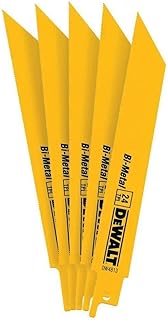
This is the thin metal specialist in the DEWALT line. At 24 TPI the teeth are close enough that several stay in contact across a duct wall or a length of thin tube, which is the difference between a clean shear and a blade that hooks the material and tears it.
The straight back profile is worth noting. Without the taper of a demolition blade, the body sits flat against the work, which helps when you are cutting flush or need the shoe hard against a panel.
Bi-metal construction gives it the flex tolerance that thin work demands, because sheet metal jobs usually involve awkward angles and a blade that cannot bend a little is a blade that snaps.
The pitch that makes it good on thin stock makes it poor on thick. Put it into heavy section and the gullets fill, the blade rubs, and heat does the damage instead of the teeth. Match it to the material and it does one job very well.
Bottom line: the blade for sheet, ductwork and thin tube, and the one to leave in the case when the section gets heavy.
- Tooth pitch: 24 TPI
- Length: six inches
- Profile: straight back
- Construction: bi-metal
- Target materials: sheet, thin tube, light gauge metal
- Pack: five blades
For HVAC work, ductwork, auto panel cuts, thin tube and anything under roughly an eighth of an inch. It is also the blade to grab when a coarse pitch keeps grabbing and jerking the saw. It is the wrong choice for structural steel, rebar or cast iron, all of which want fewer teeth or carbide.
Support thin sheet from behind with a scrap of timber so it cannot flutter with the stroke, which is the main cause of ragged cuts and lost teeth. Run a slow stroke rate, keep the shoe pressed flat, and let the blade travel rather than pushing. A little cutting wax stops the fine gullets loading up.

Pros
- Nine inch length reaches into cavities and around obstructions
- Variable 14/18 pitch handles changing wall thickness
- Coated body reduces friction and heat build-up in deep cuts
- Bulk pack suits repetitive dismantling work
Cons
- Nine inch blades flex, so cuts wander more than with a six inch
- Bulk quantity is more than an occasional user will get through
This is the long version of the metal blade most people want, and length is the whole argument. Nine inches gets you into a wall cavity, under a vehicle or around an obstruction where a six inch blade simply cannot reach the far side of the material.
The variable 14/18 pitch is what makes it usable across mixed metal. Wall thickness rarely stays constant on a real job, and a changing tooth spacing keeps the cut moving instead of stalling when the section thickens.
The Perma-Shield coating on the body is not marketing filler. A deep cut buries the blade in its own kerf, and a lower friction surface means less heat and less binding, which matters more at this length than at six inches.
The cost of length is flex. A nine inch blade bends under side load, so cuts wander more and a bind is more likely to fold the body or break the tang. Use it when you need the reach, and keep a six inch blade for everything else.
Bottom line: the blade to have when the cut is out of reach, bought in a quantity that suits people who dismantle for a living.
- Tooth pitch: 14/18 TPI variable
- Length: nine inches
- Construction: bi-metal with coated body
- Target work: auto dismantling and medium metal
- Pack: twenty five blades
- Shank: half inch universal tang
For dismantlers, recovery yards, remodelers cutting pipe inside walls and anyone whose problem is reach rather than pitch. If your cuts are all on a bench or at arm's length, a six inch blade will cut straighter and last longer, and a smaller pack will be plenty.
Never pry with a long blade: the tang is the weakest point and this is the length most likely to snap and throw. Keep the shoe against the work throughout the stroke, watch for blind services before plunging into a cavity, and let the blade cool between deep cuts rather than quenching it.
Pros
- Cobalt edge holds hardness through longer cuts
- Nine inch reach in a five pack rather than a bulk box
- 14 TPI covers most everyday pipe and profile
- Thin body kerf removes less material per stroke
Cons
- Nine inch length flexes and wanders under side load
- Thin body is more prone to bending in a bind
- Single pitch, so very thin sheet still wants a finer blade
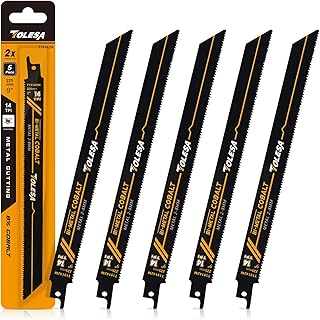
TOLESA is the challenger option here, and the specification is more interesting than the name suggests. An eight percent cobalt tooth edge at 14 TPI is the same broad recipe used by the premium metal blades, offered in a five pack rather than a professional bulk box.
The nine inch length is the reason to choose it over a six inch blade. Reaching past an obstruction, through a stud bay or under a vehicle is a real constraint, and buying reach in a small pack suits people who need it occasionally.
The thin body is a genuine design choice rather than a corner cut. A narrow kerf removes less metal per stroke, so the saw works less for the same cut, which shows up as a cooler blade on longer work.
That same thinness is the weakness. Under side load a thin nine inch blade bends before a thicker one does, so keep the shoe planted, avoid twisting the saw, and do not use it to lever a cut open.
Bottom line: a cobalt edged long blade in a small pack, best treated gently and kept for the cuts that need reach.
- Tooth pitch: 14 TPI set teeth
- Tooth edge: about eight percent cobalt
- Length: nine inches
- Body: thin wall, around nine tenths of a millimeter
- Target materials: sheet, pipe, profile, rebar
- Pack: five blades
For someone who needs a long metal blade now and then and does not want a box of twenty five. It suits maintenance work, occasional dismantling and pipe cuts inside walls. Anyone cutting long sections daily should look at a bulk pack, and anyone cutting cast iron should be looking at carbide instead.
Length and body thickness are the two numbers to weigh against each other. A longer blade reaches further but flexes more, and a thinner body cuts with less effort but bends sooner. If most of your work is within arm's reach, a stiffer six inch blade will give you straighter cuts, so buy the nine inch length for the jobs that genuinely need it.
How to Choose Reciprocating Saw Blades for Metal
Six things decide whether a blade cuts cleanly or cooks itself in twenty seconds. Read the first one even if you skip everything else, because tooth pitch is where most metal cutting goes wrong.
Teeth Per Inch Decides Almost Everything

Teeth per inch, written TPI, is the single number that separates a metal blade from a wood blade. The working rule is that at least three teeth should be in contact with the material at any point in the stroke. Thin stock such as sheet metal, tubing and electrical conduit needs a fine pitch around 18 to 24 TPI. General purpose metal work on angle iron, bolts and thicker pipe wall sits around 14 TPI. Heavy sections and cast material drop as low as 8 TPI, where each tooth takes a bigger bite and clears more chip.
Get it wrong in the coarse direction and the teeth straddle the wall of the material instead of shearing it. The blade hooks, the saw jumps, and teeth snap off in pairs. Get it wrong in the fine direction and the gullets between teeth pack with chip, the blade stops clearing swarf, and friction rather than cutting is what removes the metal. That is the burnt smell and the blue blade that so many people mistake for a defective product.
Variable pitch blades marked 14/18 TPI exist to cover the awkward middle. The tooth spacing changes along the blade, so the same edge can handle a pipe wall that changes thickness partway through the cut, and the varying pitch also breaks up the harmonic that makes a single pitch blade chatter. If you buy one pitch for unknown metal, that is the one to buy.
Bi-Metal, Cobalt Edge, or Carbide Teeth

A bi-metal blade is two steels welded together: a high speed steel strip carrying the teeth, electron beam welded to a spring steel body that can flex without snapping. That construction is why bi-metal became the default: the teeth stay hard enough to cut steel while the back survives being bent in a tight space. Almost everything here is bi-metal, and for most work it is the correct answer.
Cobalt content is the upgrade inside that category. M42 grade tooth steel carries roughly eight percent cobalt, which lets the edge keep its hardness at the temperature a cut actually reaches rather than the temperature the workshop is at. On stainless, hardened fasteners and long continuous cuts, a cobalt edge is what stops the teeth going soft and rounding over halfway down the workpiece.
Carbide tipped blades are a different proposition. Individual carbide teeth are brazed to the body, and they cut material that destroys high speed steel outright: cast iron, alloy steel, stainless section and rebar. Makers claim many times the life of bi-metal on those materials, and that holds up when the blade is used for what it was made for. The trade-off is brittleness. Carbide teeth chip if the blade binds, twists or gets dropped, so carbide rewards a planted shoe and a steady hand more than bi-metal does.
Blade Length, Reach, and Stroke Clearance

Length is not about how deep you can cut. It is about clearance. The blade has to be long enough that the teeth pass completely through the material at the bottom of the stroke and still have somewhere to go, otherwise the tip buries itself and the saw hammers instead of cutting. As a rule the blade should exceed the thickness of the stock plus the stroke length of the saw, which on most full size units is around an inch and an eighth.
Six inch blades are the stiffest and the most controllable, and they are what you want for conduit, bolts, small pipe and anything where the shoe can sit flat against the work. Nine inch blades buy reach into a wall cavity or around an obstruction, at the cost of noticeable flex. That flex produces a cut that wanders off square and, in the worst case, a blade that snaps where it bends most.
Working overhead or through a floor, the extra length also changes how the saw handles. A long blade acts as a lever on the tool, and a bind at the tip transmits into your wrists. Buying both lengths is not extravagance, because they solve different problems.
Shank Fit, Tang Strength, and Body Thickness
Shank compatibility is the one thing you rarely have to worry about. The half inch universal tang has been standard for decades, and every blade here drops into any modern keyless clamp regardless of which brand made the saw. Older tools with a set screw clamp accept the same blades. This is a category where you buy on quality rather than on system lock-in.
What does vary is the body. Blade thickness runs from about thirty five thousandths of an inch up to fifty, and thicker bodies resist the bending that causes wandering cuts and tang failures. A thin blade in a nine inch length is the combination most likely to fold. If a maker publishes body thickness, that number tells you more about how the blade behaves in a bind than any marketing description does.
Tangs break for one reason more than any other: prying. The moment you use the saw to lever a cut open, the entire load lands on the narrowest part of the steel. Some blades add a reinforced tang or a thicker heel for exactly this abuse. Look for that if you cut in demolition conditions, and change the habit anyway.
Matching the Blade to the Metal in Front of You
Thin sheet, ductwork and light tubing are the fussiest materials here despite feeling like the easiest. Anything under about an eighth of an inch needs the finest pitch available, and it needs support underneath, because unsupported sheet flexes with the stroke and the blade rides rather than cuts. Clamping a sacrificial piece of wood behind thin sheet is the oldest fix in the trade and still the best one.
Pipe and structural steel sit in the comfortable middle where a 14 TPI or variable pitch bi-metal blade does the work without drama. Rebar, cast iron and hardened fasteners are where bi-metal starts losing badly, and where carbide earns its keep. Stainless is its own category: it work hardens as you cut, so a slow steady stroke with continuous pressure beats a fast one, and stopping partway through a cut is the surest way to create a hardened patch that the next pass cannot get through.
Nail-embedded wood deserves a mention because it is what most people are cutting when they think they are cutting wood. A demolition blade with a metal capable pitch gets through studs with buried nails all day, whereas a fine metal blade is slow in the timber and a coarse wood blade loses teeth on the first nail. The combination sets exist for this mixed reality.
Speed, Feed Pressure, and Heat
Metal wants a slower stroke rate than wood. If your saw has variable speed, use the lower half of the range, and if it has orbital action, switch it off for metal entirely. Orbital motion swings the blade forward into the cut, which is superb in timber and destructive on a metal tooth that is only designed to shear on the straight pull.
Pressure should be firm and constant rather than heavy. Leaning on the saw does not make the blade cut faster, it makes the teeth rub, and rubbing generates the heat that draws the temper out of the edge. Keep the shoe pressed against the work so the blade cannot bounce, let the stroke do the removal, and the cut runs cooler and quieter.
Cutting fluid is the cheapest life extension available. A stick of wax or a squirt of cutting oil at the start of a cut, reapplied when the swarf stops curling, makes a real difference on stainless and thick sections. Let the blade cool between cuts rather than dunking it in water, since quenching a hot blade makes the body brittle where it needs to flex.
| Material | Tooth pitch to look for | Blade type |
|---|---|---|
| Sheet metal, ductwork, thin tube | 18 to 24 TPI | Bi-metal, short length, backed by scrap wood |
| Conduit, small pipe, angle iron | 14 to 18 TPI | Bi-metal or variable pitch |
| Thick pipe wall, structural steel | 10 to 14 TPI | Bi-metal with cobalt edge |
| Rebar, cast iron, alloy steel | 8 to 10 TPI | Carbide tipped |
| Stainless section | 14 TPI variable | Cobalt bi-metal or carbide, slow stroke |
| Nail-embedded timber | 10 to 14 TPI | Demolition bi-metal combination |
Why You Should Trust Us
We build these shortlists from published specification and from the pattern of what long-term owners report, not from marketing copy. For every blade here we checked the stated tooth pitch against the stock thickness the maker recommends, the tooth material and cobalt grade where it is disclosed, blade length and body construction, and whether the pack is a single pitch or an assortment. Where a listing counts wood and pruning blades toward a headline piece count, we say so instead of repeating the number.
We also set aside near-identical listings from the same maker that differ only in pack size or case color, so every entry is a genuinely different blade rather than another way to buy the same one. Owner feedback here is unusually useful because failure is obvious and quick: reports of stripped teeth, bent bodies and snapped tangs cluster in ways that line up with tooth pitch and body thickness rather than with brand reputation. Our article archive collects the rest of our tool coverage.
Final Thoughts
Best overall is the DEWALT DW4892 Bi-Metal Reciprocating Saw Blade Set. It gives you a spread of lengths and pitches in a case, which is what you actually need when the material changes three times in an afternoon, and the bi-metal construction is the right default for pipe, sheet and nail-embedded stock alike. If you own no metal blades at all, this is the purchase that stops you buying the wrong one twice.
Best value is the Bosch RM618 Metal Cutting Blades. It is a plain five pack of 18 TPI six inch bi-metal blades from a maker with nothing to prove, and for conduit, bolts, tube and light section that is the entire job description. There is no case and no accessory count to decode, which is why it is the pack to keep in the van.
For specific jobs, the EZARC Carbide Reciprocating Saw Blades are the pick when the material is cast iron, alloy or rebar and bi-metal keeps giving up, the Diablo Steel Demon 6-Inch 14/18 TPI Bi-Metal Blades are the ones to buy in bulk if you dismantle vehicles or appliances regularly, and the DEWALT DW4813 24 TPI Straight Back Blades are the answer for thin sheet and tube where a coarse pitch would simply hook and tear. In a wall cavity or under a vehicle, the Diablo 9-Inch Bi-Metal Blades with Perma-Shield and the TOLESA 9-Inch Bi-Metal Blades earn their length, and the EZARC Bi-Metal 14 TPI M42 Cobalt Blades are the middle ground if you want one pitch for most of a punch list. More of our buying guides are indexed in the category directory.
Reciprocating Saw Blade FAQs
What TPI should I use to cut metal with a reciprocating saw blade?
Match the pitch to the wall thickness, not to the metal type. Thin material such as sheet, ductwork, tubing and electrical conduit wants 18 to 24 TPI so that at least three teeth stay in contact through the stroke. General work on angle iron, bolts and heavier pipe sits at 14 TPI, and thick sections or cast material drop toward 8 to 10 TPI so each tooth takes a bigger bite and clears its chip. If you cannot judge the thickness, a variable pitch blade marked 14/18 TPI is the safest single choice.
Can I use a wood blade on metal if it is all I have?
You can start the cut, but you will not finish many of them. A wood blade typically runs 6 to 10 TPI with deep gullets and aggressive set, so on a thin wall the teeth straddle the material, hook, and shear off in groups. Even on thick steel the tooth steel is usually not hard enough to survive the heat. The one honest exception is a demolition blade rated for nail-embedded timber, which is built with a pitch and a tooth material that tolerates occasional metal.
Why do my blades keep breaking at the tang?
Almost always because the saw is being used as a lever. When you twist or pry to open a cut, the whole load concentrates at the narrowest point of the blade, which is the tang. The other common cause is a blade that is too long and too thin for the job, flexing on every stroke until the steel fatigues. Keep the shoe planted so the blade cannot bounce, choose a shorter blade when the work allows it, and prefer blades with a reinforced heel if you work in demolition conditions.
Are carbide blades worth it over bi-metal?
Only for the materials that defeat high speed steel. On cast iron, alloy steel, stainless section and rebar, a carbide tipped blade will outlast a stack of bi-metal blades and finish cuts that bi-metal cannot start. On ordinary mild steel, conduit and sheet, it is an expensive way to do a job that a 14 or 18 TPI bi-metal blade does perfectly well. Carbide is also more brittle, so a bind or a drop can chip teeth that would only have dulled on a bi-metal edge. Our tools and home improvement archive has more on building out a cutting kit.
How long should a metal blade last in 2026?
There is no useful hour figure, because life here is measured in inches of material and how hot the edge got. A bi-metal blade run at a sensible stroke rate with a little cutting fluid gets through a surprising amount of conduit and light section, while the same blade run flat out with heavy pressure can glaze in a single cut. The signs of a finished blade are a cut that takes longer for the same pressure, a blued tooth line, and swarf that comes off as dust instead of curls. Retire it at that point rather than pushing it, because a dull blade loads the tang and the saw far harder than a fresh one.
Write Your Review
No reviews yet. Be the first to share your experience!