

A portable drill guide is a jig, not a tool. It does not cut anything on its own: it holds the bit perpendicular to the work, or at a set angle to it, so the hole ends up where you meant it to go. Anyone who has drilled a shelf pin hole that came out four degrees off, or a dowel hole that pushed a joint out of alignment on assembly, already knows why this category exists. We sorted 7 guides from Richelieu, Big Gator Tools, Milescraft and more by how the angle is held, how the guide sits on the workpiece, which bit sizes it accepts and what it is made of. The wider tools and home improvement section covers the rest of the workshop.
Our top pick is the Milescraft DrillMate Portable Drill Guide for combining an adjustable angle head, a depth stop and a standard chuck in one handheld unit, which is the only arrangement here that takes any bit size at any angle. Below we split the field by mechanism, because a bushing block and a drill press attachment solve related problems in completely different ways, and buying the wrong one is the mistake that sends these back.
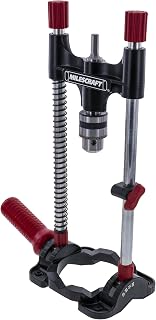
Pros
- Takes any bit the 3/8 inch chuck holds, so bit size stops being a constraint
- Adjustable head handles angled holes as well as square ones
- Depth stop makes blind holes repeatable
- All metal construction keeps its alignment over time
- Self centering base helps locate the bit accurately
Cons
- Far bulkier than a pocket block, so it is a workshop tool rather than a ladder tool
- Setup takes longer than sitting a block on the work
- The 3/8 inch chuck caps the shank size you can fit
The DrillMate is the most capable jig in this list because it removes the two limits every bushing block imposes. Your own drill mounts into the guide, so bit size is whatever the chuck accepts rather than whatever the maker bored, and the head adjusts, so angled holes need no separate jig.
The depth stop is the feature people underestimate until they need it. Shelf pins, blind dowel holes and hardware mortises all have to stop at the same depth across a whole run, and a physical stop does that where masking tape on a bit does not.
All metal construction is what keeps this accurate over years. Alignment in an attachment depends on the columns staying parallel to the base, and a moulded body loses that relationship long before a metal one does.
The trade is size. This is a two hand tool that lives on a bench and gets carried to a job, not something to slip in an apron pocket, and setting it up takes longer than dropping a block onto the work.
Bottom line: the guide to own if you only own one, and the only entry here with no restriction on bit size, angle or depth.
- Type: handheld drill press attachment
- Chuck: 3/8 inch
- Body: all metal
- Angles: adjustable head for straight and angled holes
- Depth control: adjustable depth stop
- Base: self centering
- Model: Milescraft 1318
Buy this if your drilling varies: different bit sizes, occasional angles, blind holes that need a consistent depth. It suits a workshop or a van rather than a tool belt. Skip it if all you want is square dowel or shelf pin holes in a couple of standard sizes, where a bushing block does the same job in a fraction of the space and with no setup at all.
Mount the drill and check that it runs true before touching the workpiece, since a chuck seated crooked defeats the whole jig. Set the depth stop against the actual bit you are using rather than a nominal length. Clamp the workpiece so only the guide is in your hands, start slow so the bit locates, then let the springs control the travel rather than forcing it down.

Pros
- V groove base centres itself on dowels, pipe and rod
- Solid steel body, so the bores keep their dimension
- Works on flat stock as well as round
- No setup at all, sit it down and drill
Cons
- Bit range stops at 3/8 inch
- No depth stop of any kind
- Held by hand only, so a grabbing bit can twist it
The V-Drill Guide solves one problem better than anything else here: putting a hole through the centre of something round. The V groove seats on a dowel or a pipe and puts the bore over the axis automatically, which is otherwise a matter of marking, guessing and hoping.
Because it is solid steel, the bores stay the size they were machined at. That matters more than it sounds, since a worn bore is a guide that no longer guides, and soft materials open up quickly under drill flutes.
On flat stock it behaves like any other bushing block, giving you square holes in the covered sizes with no setup. The range tops out at 3/8 inch, which covers most joinery but rules out larger auger and spade work.
What you do not get is depth control or any way to clamp it down. On small bits neither matters. On the largest bits in the range, hold it firmly and let the drill do the work rather than leaning on it.
Bottom line: the specialist to own for dowels, pipe and rod, and a perfectly good general block on flat work.
- Type: bushing block with V groove base
- Bit range: 1/8 inch to 3/8 inch
- Material: steel
- Origin: made in the USA
- Self centering: yes, on round stock
- Depth stop: none
- Model: STD1000DGNP
Compare this against a flat block on one question: how much round stock do you drill? If the answer is any, the V groove pays for itself the first time. If the answer is none, a flat block with the same bores does the same job. Compare it against an attachment on bit range and depth control, because those are the two things a block of any kind cannot offer.
Keep swarf and sawdust out of the V groove and off the base, since anything trapped underneath tilts the hole. Wipe the steel occasionally with a light oil if it lives in a damp shed. Clamp the round stock itself before drilling, because a dowel that rolls under load is more dangerous than a bit that binds.

Pros
- Hardened bores resist wear from repeated drilling
- Six sizes cover most carpentry work
- Small enough to carry in a pocket or apron
- Nothing to set up or lock
Cons
- Fixed bit sizes only
- No depth stop
- Flat base, so it is not made for round stock
Kreg builds jigs for people who repeat the same operation many times, and this guide follows that logic. Six hardened bores, no adjustment and a body small enough to keep in an apron means the fastest possible path from marking a hole to drilling it square.
Hardening is the specification that matters on a block. An unhardened bore is reamed slightly larger by the flutes of every bit that passes through, and after enough holes the guide allows exactly the wander it was bought to stop.
The six size selection is a deliberate limit rather than an omission. Most carpentry lives in a narrow band of bit sizes, and covering that band in a body you will actually carry beats covering everything in a body you leave on the bench.
What it will not do is angles, depth or round stock. Those are separate jobs and this guide does not pretend otherwise.
Bottom line: the carpentry block to keep in the apron, and the right answer when speed matters more than range.
- Type: bushing block
- Bores: 6, hardened
- Sizes: common imperial carpentry bits
- Angles: 90 degrees only
- Depth stop: none
- Format: compact handheld
Buy this if you work on site, drill the same handful of sizes and want the guide in a pocket rather than a case. Skip it if you need angled holes, blind holes at a set depth, or bits outside the common carpentry range, all of which point to a chuck mounted attachment instead.
Mark the hole, sit the block flat with the bore over the mark, and press it down with the heel of your hand at the widest point rather than an edge. Start the drill slowly until the bit is fully engaged in the bore, then bring it up to speed. Blow dust off the base between holes, because a chip under the block is the most common cause of a hole that comes out crooked.

Pros
- Six of the most used imperial sizes in one small body
- Nothing to adjust, lock or align
- Small enough to keep permanently in a drawer or apron
- Simplest way to stop a dowel hole wandering
Cons
- Only the six bored sizes, and imperial only
- No depth stop, so tape or a collar does that job
- Flat base, so round stock needs a V groove guide instead
The 1312 Drill Block is the simplest useful thing in this category. It is a body with six bores in it, sized for the drill bits most people already own, and its entire job is to hold those bits square to the work.
Simplicity is why it gets used. A jig that needs setting up gets left in a drawer for small jobs, while a block that sits on the work and needs nothing done to it comes out for a single hole.
The six size limit is real and worth checking against your own bits. These are imperial fractions, so a metric set will either not enter the bore or will rattle in it, and a rattling bit is a bit that wanders.
There is no depth control here, so blind holes need tape on the shank or a separate stop collar. For through holes, which is most of what a block gets used for, that is not a limitation at all.
Bottom line: the least fussy route to square holes, and the best starting point for anyone who has never used a guide.
- Type: bushing block
- Bores: 6 common imperial sizes
- Angles: 90 degrees only
- Depth stop: none
- Format: pocket sized handheld
- Model: Milescraft 1312
Choose between this and a chuck mounted attachment on three questions. Do you need bits outside six common imperial sizes? Do you need angled holes? Do you need holes to stop at a consistent depth? If the answer to all three is no, a block is the better tool because it is faster and there is nothing to misalign. If any answer is yes, an attachment is the correct purchase.
Keep the bores clear and the base clean, since dust under a block tilts the hole in a way that is hard to diagnose afterwards. Do not force an oversized or damaged bit through a bore, because that is what opens it up. Clamp the workpiece rather than holding it, and keep your free hand behind the block rather than beside the bit.
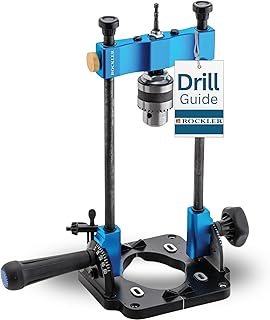
Pros
- Continuous 0 to 60 degree scale rather than fixed detents
- Angle scale is readable, so setting a specific angle is straightforward
- Chuck key supplied
- Handles angles that detent jigs simply do not offer
Cons
- A scale needs reading and locking carefully every time, unlike a detent
- Bulkier than a block and slower to set up
- Angle head must be locked firmly or it can creep under load
Most angled drilling jigs give you three fixed positions. The Rockler guide gives you a continuous scale from 0 to 60 degrees instead, which is the difference between drilling the angle you need and drilling the nearest one available.
That flexibility comes with an obligation. A detent cannot be set slightly wrong, while a scale can, so every setup needs a careful read and a firm lock before the bit touches wood.
Supplying the chuck key with the jig is a small detail that shows the design has been used. Mounting a drill into a guide and then hunting for a key is exactly the friction that makes people give up and drill freehand.
As with every chuck mounted guide, this is bulkier and slower than a block, and it asks you to check that the head is locked before each hole rather than trusting it from the last one.
Bottom line: the pick when the angle matters and it is not 30, 45 or 90 degrees.
- Type: portable drill guide, drill mounts to the jig
- Angle range: 0 to 60 degrees, continuous scale
- Included: chuck key
- Use: straight and angled holes
- Format: portable, brought to the work
Set the angle, lock it, then push sideways on the head to confirm it does not move before you start. Mark the entry point and align the guide to the mark rather than to the edge of the workpiece. On steep angles the bit wants to skate at the start, so a brad point bit and a slow first second of drilling make a large difference to where the hole actually begins.
Buy this if angled holes are a regular part of your work and the angles vary, for instance in furniture with splayed legs, angled dowels, or repairs where the geometry is dictated by something already built. Skip it if all your angled work is at 30, 45 or 90 degrees, where a detent jig is faster and impossible to set wrong.

Pros
- Exactly the three angles cable railing work needs
- Four track sizes cover common post and hardware combinations
- Dual direction scales make it easy to mirror a layout
- Fits both 1/8 inch and 3/16 inch cable railing hardware
Cons
- Built for railing work, so it is not a general purpose guide
- No depth stop
- Only the three angles it was designed around
Cable railing is one of the few jobs where a general purpose drill guide is genuinely awkward. Posts need square holes on level runs, angled holes on the stair sections, and everything has to line up down the length of a deck or the fittings will not sit flat.
The CT24 handles that by offering exactly three positions, 30, 45 and 90 degrees, which is what stairs and level runs actually require. Because they are fixed positions rather than a scale, every post gets drilled identically without a reading step.
The dual direction scales are the detail that saves time on a real deck. Runs mirror around corners, and a scale that reads both ways lets you set the same offset from either side of a post without doing arithmetic on site.
Four track sizes cover the usual combinations of post material and hardware, and the jig is sized for both 1/8 inch and 3/16 inch cable fittings, which between them account for most residential railing.
Bottom line: buy it for cable railing and nothing else, where it beats every general purpose guide here.
- Type: multi angle railing drill guide jig
- Angles: 30, 45 and 90 degrees
- Track sizes: 4
- Scales: dual direction
- Cable hardware: 1/8 inch and 3/16 inch
- Use: level runs, stairs and corners
- Model: Muzata CT24
Buy this if you are building or repairing a cable railing, on a deck, a staircase or a balcony. It is the right jig for anyone drilling a run of posts that all have to match. Skip it if you want a general workshop guide, because outside railing work its three fixed angles and railing specific tracks are a limitation rather than a feature.
Set out the whole run first and drill one post as a reference before committing to the rest. Use the dual direction scale to mirror the layout around corners rather than measuring each side separately. Clamp or strap the jig to the post, since a post offers nothing to brace against, and drill the level sections and the stair sections as two separate passes so the angle setting only changes once.
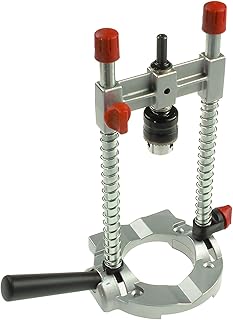
Pros
- Straight and angled holes from one small jig
- Preset positions remove the need to read a scale
- Compact and quick to deploy
- Long standing product from a hardware supplier
Cons
- Limited to the angles it was built around
- No depth stop
- Lighter build than the all metal jigs here
The Richelieu guide is the basic multi angle jig in this list, and its appeal is that it does two jobs in a body you can hold in one hand. Square holes and preset angled holes cover a surprising amount of hardware fitting without asking you to own two tools.
Preset positions rather than a scale is the right choice for a jig of this size. There is nothing to read and nothing to set slightly wrong, which is what you want when the jig comes out once a month rather than every day.
The build is lighter than the all metal blocks and attachments here, and that shows in how it feels rather than in whether it works. For occasional holes it is entirely adequate; for daily production work the heavier jigs will outlast it.
There is no depth stop, so blind holes need tape or a stop collar on the bit, and there is no provision for clamping it down, so larger bits want a firm hand.
Bottom line: a sensible compact jig for occasional angled work, and the simplest entry into angled drilling here.
- Type: multi angle drill guide
- Angles: preset positions for straight and angled holes
- Depth stop: none
- Clamping: hand held
- Format: compact handheld
Weigh this against a chuck mounted attachment on frequency rather than capability. If angled holes are occasional, a small preset jig is quicker to reach for and takes no bench space. If they are frequent, or if the angles vary beyond the presets, a guide with a proper scale and a depth stop earns its bulk. Bit range is the other deciding question, since presets and bores both cap what you can fit.
Keep the base and the guide bores free of dust, because debris underneath tilts the hole and debris inside binds the bit. Check that any angle position is fully seated before drilling rather than partly engaged. Clamp the workpiece, keep the free hand behind the jig, and let the bit cut rather than leaning on a lightweight body.
How to Choose a Portable Drill Guide
Read the mechanism section first. Both families promise square holes and both deliver them, but one is a pocket sized block with fixed bit sizes and the other is a small machine you attach a drill to. Nothing further down the list matters if you pick the wrong family.
Bushing Block or Drill Press Attachment

A bushing block is a solid body with hardened steel sleeves bored through it at fixed sizes. You sit it on the work, push your own bit down through the appropriate sleeve, and the sleeve holds the bit square. Setup is instant because there is nothing to adjust, and the block is small enough to live in an apron pocket. What you give up is choice: only the sizes bored into the block, and no built in control over how deep you go.
A drill press attachment works from the other direction. Your drill mounts into the guide by its chuck or its collar, and spring loaded columns keep the bit travelling parallel to a base plate as you push down. Because the bit is held in your own chuck, any size the chuck accepts will work, and the head usually tilts to a set angle. The costs are bulk, a slower setup, and more parts that can drift out of alignment over time.
Match the family to the work rather than to the specification. Repeat holes in a handful of common sizes, dowel joints, shelf pins, cable railing posts, all favour a block, and a block is also the only thing you will carry up a ladder. Varied work, larger bits, blind holes that need a depth stop and any job where the angle changes all favour an attachment.
How Square Is Square: Base Contact and Self Centering
A guide is only as accurate as the contact between its base and the workpiece. If the base rocks, the hole tilts, and no amount of care with the drill fixes it. Broad flat bases beat narrow ones on flat stock, and a base with a machined face beats a moulded one that is only nominally flat. This is also why sawdust under the base ruins a hole nobody can explain afterwards.
Round stock is a different problem entirely and the reason V grooves exist. A guide with a V shaped base seats itself on a dowel, a pipe or a rod and centres the bushing over the axis automatically. Without one, drilling through the middle of a dowel is guesswork, and the bit tends to skate off the curve and start its own hole at an angle.
The length of the bushing is what actually holds the angle, and it is easy to overlook. A shallow sleeve gives the bit very little to reference against, so it can wander once the tip bites. A thick block with a long bore keeps the shank constrained for most of its travel, which is why heavier blocks tend to drill straighter than thin ones with identical bushing sizes.
Angled Drilling and How the Angle Is Set

There are two ways to set an angle and they suit different people. Preset detents give you fixed positions, most commonly 30, 45 and 90 degrees, and they are fast, repeatable and impossible to get slightly wrong. A continuous scale, such as a head that swings anywhere from 0 to 60 degrees, gives you any angle you like but asks you to read and lock it accurately every time.
Whether the angle locks matters more than how many angles are offered. A head that creeps under drilling pressure produces a hole that starts at one angle and finishes at another, which is worse than not using a guide at all because you trusted it. Look for a positive lock, a lever or a knob that clamps rather than a friction fit, and test it by pushing sideways on the head before you commit to a workpiece.
Angled work is where these jigs earn their place. Cable railing runs need holes through posts at the stair angle as well as square through level sections, toe screwing needs a consistent lean, and angled dowels need repeatability across every joint. Guides sold specifically for railing work usually offer exactly the three angles that job needs and nothing else, which is a feature rather than a limitation, and deck hardware to match sits in our patio, lawn and garden section.
Depth Stops and Holes That All Finish Together

A depth stop is a collar or rod that physically prevents the bit going deeper than a set distance. Attachments have real ones built into the column, adjustable and repeatable, and that is the single feature that makes blind holes practical. Shelf pin holes, dowel holes and hardware mortises all need to stop at the same depth every time, and eye judgement will not do it across twenty holes.
With a bushing block you improvise. Masking tape wrapped around the bit is the classic method and it works until the tape shifts or you lose sight of it in the dust. A separate stop collar clamped to the shank is more reliable, and collars are sold in the common shank sizes, though the setting resets every time you change bits.
Depth matters most where breaking through would be visible or dangerous. Drilling into a hollow core door, a cabinet side with a finished face, or a post with a cable fitting on the far side all punish a bit that travels an extra quarter inch. If most of your work is through holes, this feature costs you nothing to skip; if any of it is blind, it decides the purchase.
Clamping Versus Holding It by Hand
Most guides in this category are held in place by hand, which is fine until torque enters the picture. A bit that grabs will try to spin the whole jig, and the larger the bit the harder it pulls. On small bits in softwood you will never notice. On a half inch bit in oak you will notice immediately, and usually at the moment the hole goes wrong.
Guides that clamp to the work, or that provide holes for screwing a temporary fence down, remove that problem entirely. Railing jigs often include a way to strap or clamp them to a post, because a post is round or square and offers nothing to brace against. If your work involves larger bits, look for a guide that can be secured rather than one you have to fight.
Where no clamp exists, technique compensates. Clamp the workpiece itself so only one thing is moving, use a brad point bit so the tip locates before the flutes engage, start slow to let the bushing establish the line, and keep both hands on the drill with the guide held down by its widest point rather than by an edge.
Bit Sizes and What the Guide Is Made Of
On a bushing block, count the sizes and check the units. Blocks are usually bored in imperial fractions, commonly six of the most used sizes between an eighth and a half inch, and a metric bit set will not fit them properly. Check that the bushings are hardened as well: a soft bushing gets reamed out by the first few holes and then the block guides nothing.
On an attachment, the chuck capacity sets the ceiling. A three eighths inch chuck covers most joinery and cabinet work, while a half inch chuck takes larger shanks and heavier auger and spade bits. That difference is the main reason the same maker sells two versions of an otherwise identical guide, and it is worth matching to the drill you already own.
Material decides how long the accuracy lasts. Hardened steel is heavy and effectively permanent, which is why all steel blocks are the ones people still use after a decade. Aluminium bodies are lighter and pleasant to carry, but the bushing bores wear faster unless they carry steel inserts. Plastic bodies with pressed steel inserts are fine for occasional work, though the insert can spin loose in the body and once it does the guide is finished.
| Guide type | Best at | Weak at |
|---|---|---|
| Flat bushing block | Fast repeat holes in common sizes, pocket portability | Fixed bit sizes, no depth stop |
| V groove block | Dowels, pipe and round stock, self centering | Limited bit range, hand pressure only |
| Angle jig with detents | Cable railing, stair angles, repeatable set angles | Only the angles it was built for |
| Drill press attachment | Any bit the chuck takes, depth stop, variable angles | Bulkier, slower setup, more to keep aligned |
Why You Should Trust Us
We build these lists from published specification and from the pattern of what long term owners consistently report, rather than from marketing copy. For each guide here we looked at the mechanism, the number and size of bushings and whether they are hardened, chuck capacity where a drill mounts to the jig, the angles offered and how they lock, whether a depth stop is included, whether the guide can be clamped to the work, and what the body is made of.
We also set aside near identical listings that differ only in bundled bits or colour, so every entry is a genuinely different jig rather than a variant of one already on the list. Where a listing advertises a bit count that includes loose drill bits supplied in the box rather than guide bores in the body, we count the bores, because those are what determine what the tool can actually do.
Final Thoughts
Best overall is the Milescraft DrillMate Portable Drill Guide. It is the one guide here that removes every restriction at once: any bit the three eighths inch chuck holds, straight or angled holes from an adjustable head, a depth stop for blind work and an all metal body that keeps its alignment. If you only own one drilling jig, that combination is worth the extra bulk over a pocket block.
Best value is the Milescraft 1312 Drill Block. It bores six of the most common imperial sizes through a compact body, it needs no setup at all, and for the person who mainly wants square dowel and shelf pin holes it does that job with nothing to adjust, nothing to lock and nothing to fall out of alignment.
For specific needs, the Big Gator Tools V-Drill Guide is the pick for round stock and pipe because the V groove centres itself, the Kreg Portable Drilling Guide is the carpentry choice with hardened bores across the common sizes, the Rockler Portable Drill Guide is the one for variable angles thanks to its 0 to 60 degree scale, and the Muzata CT24 is the jig to buy if the job is cable railing through level and stair sections. The Richelieu Multi Angled Drill Guide covers straight and preset angled holes in a compact form. More workshop picks sit in our article archive, and the full category index covers everything else.
Portable Drill Guide FAQs
Does a portable drill guide replace a drill press?
For accuracy on small and medium holes, it gets close enough that most home workshops never miss the bench machine. What it does not replace is rigidity and repeatable table work: a bench press holds the workpiece against a fence and takes the pushing force out of your arms, which matters with large bits, metal and long production runs. What a portable guide does instead is go to the work, which a bench press never will, and that is why people who own both still reach for the jig on a door or a deck post.
How accurate is a portable drill guide really?
Accurate enough that the error comes from the setup rather than the jig. A well made steel bushing holds a bit within a fraction of a degree, so the practical variables are whether the base is sitting flat, whether sawdust is under it, and whether the guide moved during the cut. Longer bushings hold better than shallow ones, and clamping the workpiece removes the biggest single source of error. Expect visibly better results than freehand drilling from the first hole.
Can I use one on a dowel or a pipe?
Only if the base is designed for it. A flat based guide will rock on anything round and the bit will skate off the curve, usually starting its own hole at an angle you did not choose. What you want is a V groove base, which seats on round stock and centres the bushing over the axis automatically. That single feature is the reason V guides exist as a separate product rather than a variation, and it works on dowels, tube and solid rod alike.
Which bit sizes should I look for?
Six common imperial sizes covers the overwhelming majority of woodworking, which is why so many blocks are bored that way. Confirm the units before buying, because a metric bit will either not enter an imperial bore or will rattle in one, and neither produces a square hole. If your work spans a wider range, or involves auger and spade bits, a chuck mounted attachment removes the question entirely since it takes whatever the chuck holds. Related jigs and fittings turn up across our tools and home improvement pages.
Is a steel guide worth it over plastic in 2026?
If you drill more than occasionally, yes, and the reason is the bushing rather than the body. A hardened steel bore keeps its dimension for years, while a soft bore opens up under the flutes and starts allowing the wander it was bought to prevent. Plastic bodies with pressed steel inserts work well until the insert spins in its housing, at which point the guide is finished and cannot be repaired. For deck and railing work outdoors, where jigs get dropped, all metal construction is the safer choice.




Write Your Review
No reviews yet. Be the first to share your experience!