

A dust separator is the accessory that makes a shop vacuum behave like a real dust collector. It sits between the tool and the vacuum and spins the incoming air so that chips, sawdust and most of the fine powder drop into a bucket before they ever reach the filter. The result is a vacuum that keeps its suction for an entire project instead of choking after twenty minutes, and a filter that lasts months instead of days. We looked at 9 separators from Oneida Air Systems, Rockler, Festool and more, sorted by design, hose size, the container they sit on and the vacuum they are built to pair with.
Our top pick is the Oneida Air Systems Dust Deputy DIY Anti-Static Cyclone Separator for delivering the true cyclone design that the whole category imitates, in a kit that bolts to a bucket you already own and works with almost any shop vacuum. Below we sort the field by cyclone versus lid-style baffle, by hose diameter and by which vacuum each one is made for, so you can match a separator to the tools on your bench. For the vacuums, sanders and saws that feed it, our tools and home improvement section covers the rest of the shop.

Pros
- True cyclone captures fine sanding dust as well as chips
- Anti-static resin cuts dust cling and shocks
- Fits any bucket and nearly any vacuum
- Keeps filters clean for months
Cons
- You supply the bucket and do the assembly
- Tall on a bucket, needs headroom
The Dust Deputy DIY is the cyclone that every other separator on this list is measured against. Air enters the cone tangentially, spins down, and drops chips and fine dust into whatever bucket you bolt it to, while clean air carries on to the vacuum.
The anti-static resin is a real feature: fine dust clings less to the walls and the hose stops delivering shocks in a dry shop. Owners report vacuum filters going months between cleanings, which is the whole point.
It is a kit. You provide a stiff bucket, drill the lid, fit the gasket and hardware, and connect hoses with the included adapters. That takes a few minutes and lets you size the container to your work.
The only practical drawback is height; a cone on a bucket does not fit under a low bench.
Bottom line: the best separator here for anyone willing to supply a bucket, and the one to buy if you sand.
- Design: cyclone cone, anti-static resin
- Container: user supplied bucket, 5 gallon or larger
- Inlet and outlet: 2 inch with adapters
- Compatible: most wet/dry shop vacuums
- Includes: cone, gasket, hardware, adapters
- Assembly: required
Woodworkers and DIYers with any shop vacuum who want the best fine-dust separation and are happy to mount it on their own bucket.
Use a heavy-duty bucket or stiffen a plastic one. Keep hoses short between cone and vacuum. Empty before the bucket is two thirds full so the cyclone keeps working.

Pros
- Clear body shows the dust spinning and the fill level
- 2.5 inch ports suit high-flow vacuums
- Same proven cyclone geometry
- Adapters included
Cons
- Not anti-static like the DIY version
- Still needs your own bucket
The Dust Deputy 2.5 keeps the cyclone shape and scales the ports up to two and a half inches, which suits larger shop vacuums and the bigger hoses that come with them. The clear body is the standout: you can watch the dust spin and see when the bucket is full without lifting the lid.
It is not moulded in the anti-static resin of the DIY unit, so static cling and hose shocks are possible in a dry shop. Grounding the hose solves it.
As with all Oneida DIY units you supply the bucket. Owners on larger vacuums prefer it for the airflow.
Bottom line: the Dust Deputy for high-flow vacuums and for people who want to see the fill level.
- Design: clear cyclone cone
- Ports: 2.5 inch inlet and outlet
- Container: user supplied bucket
- Adapters: included for wet and dry vacuums
- Anti-static: no
- Assembly: required
Owners of larger shop vacuums with 2.5 inch hoses who want maximum airflow and a visible fill level.
Ground the hose if static becomes a nuisance. Use a stiff bucket and check the gasket seal after each emptying.

Pros
- Barely taller than the bucket, fits under benches
- Excellent on chips and sawdust
- Sweep elbows keep airflow up
- Quick to empty
Cons
- Lets more fine sanding dust through than a cyclone
- Wants a powerful vacuum behind it
The Dustopper PRO solves the height problem. Instead of a cone, it is a lid with an internal baffle that swirls the air and drops the heavy material into the bucket below. On a five gallon bucket it stands only a few inches taller than the bucket, so it lives under a bench where a cyclone cannot.
It handles chips, planer shavings and saw dust extremely well, and the included sweep elbows are a thoughtful touch that keeps airflow up. It gives ground on the finest sanding dust, more of which reaches the filter than with a cone.
It also wants a strong vacuum; the maker specifies at least five peak horsepower to pull through the baffle.
Owners in small shops rate it very highly for the money.
Bottom line: the best value here, and the right separator when headroom is tight and the work is chips rather than sanding.
- Design: low-profile baffle lid
- Container: standard 5 gallon bucket, user supplied
- Includes: 2 high-flow sweep elbows and connectors
- Minimum vacuum: 5 peak HP
- Height added: a few inches
- Emptying: lift lid
Small-shop woodworkers whose vacuum lives under a bench, and anyone whose dust is mostly chips from saws, routers and planers.
If you sand a lot, choose a cyclone instead. If height is the constraint, this is the one. Check your vacuum's power rating first.

Pros
- Drum, lid and casters included, no bucket to source
- Ten gallon capacity suits chip-heavy work
- Cyclone design for fine dust
- Rolls with the vacuum
Cons
- Larger footprint
- Adapters may be needed for non-DEWALT hoses
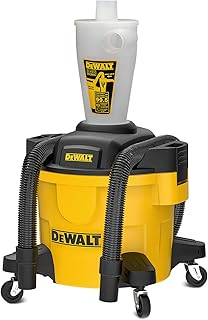
DEWALT's ten gallon separator is the buy-it-and-go option: cyclone, drum, lid and casters in one box. The drum is stiff enough to hold vacuum without collapsing, which removes the most common bucket-based headache, and ten gallons takes a long time to fill.
The cyclone handles fine dust well, and the casters let the drum follow the vacuum around the shop. It is built around DEWALT's own vacuums but adapts to others.
Owners like the convenience and the capacity; the trade is floor space.
Bottom line: the best complete package here for a shop that makes chips by the bagful.
- Design: cyclone
- Drum: 10 gallon, included
- Lid: latching
- Mobility: casters
- Compatible: DEWALT and other wet/dry vacuums with adapters
- Assembly: minimal
Woodworkers who want a ready-made separator with real capacity and do not want to source a bucket.
Keep the hose between drum and vacuum short. Empty when the drum is two thirds full. Check the lid latches before each use for a tight seal.
Pros
- Complete package with drum and lid
- Smaller footprint than the 10 gallon
- Cyclone separation
Cons
- Fills quickly under a planer
- Adapters may be needed for other brands
The six gallon DEWALT is the same idea as its larger sibling in a smaller footprint. The drum is included and holds vacuum well, the cyclone does the separating, and the whole thing takes up little more room than a bucket.
Six gallons is fine for sanding, routing and general cleanup and fills fast under a planer or table saw, so match it to the work.
Owners with small shops and lighter loads are happy with it.
Bottom line: the compact DEWALT for light to medium dust loads.
- Design: cyclone
- Drum: 6 gallon, included
- Lid: latching
- Compatible: DEWALT and other wet/dry vacuums
- Adapters: included
- Footprint: compact
Hobbyists and small shops with light to moderate dust who want a drum included.
If you run a planer or table saw regularly, step up to the 10 gallon. For sanders and routers this size is enough.

Pros
- Cut-to-fit PVC adapts to any hose size
- High-speed cyclone separates fine dust well
- Simple, robust construction
Cons
- You supply the bucket
- Cutting PVC to fit takes a little work
The Mullet takes a slightly different approach to fitment: instead of a bag of adapters, it uses PVC stubs you cut to fit your hose, which means it connects to any vacuum with a clean, tight joint. The cyclone itself is a high-speed design that owners report separating fine dust very well.
It mounts to your own bucket like the Oneida units, with the same advice about bucket stiffness.
Owners like the fit and the separation and mention the cut-to-fit step as a minor chore.
Bottom line: a strong cyclone for anyone with an unusual hose size.
- Design: high-speed cyclone
- Connections: cut-to-fit PVC
- Container: user supplied bucket
- Compatible: any shop vacuum
- Assembly: required
- Separation: fine and coarse dust
Woodworkers with non-standard hoses who want a cyclone that fits cleanly without adapter stacks.
Deburr the cut PVC ends for a good seal. Use a stiff bucket and empty before it fills.

Pros
- Steel bucket cannot collapse under vacuum
- Hose included
- Low profile for tight spaces
- Complete kit
Cons
- Baffle design passes more fine dust than a cyclone
- Steel bucket is heavy to empty
Rockler's Dust Right kit answers the collapsing-bucket problem with a heavy steel bucket that will not flex under suction, and it includes a hose so you can connect it out of the box. The lid-style baffle keeps the whole unit low.
Like other lid designs it excels on chips and passes more fine dust than a cyclone. The steel bucket is durable and a little heavy when full.
Owners value the sturdiness and the complete kit.
Bottom line: the lid-style separator with the toughest container.
- Design: lid baffle
- Bucket: 10 gauge steel, included
- Hose: 36 inch, included
- Compatible: shop vacuums
- Profile: low
- Assembly: minimal
Woodworkers who want a low-profile separator with a bucket that will never collapse.
Connect the included hose to the vacuum inlet and the tool hose to the separator. Empty regularly since the steel bucket hides the fill level.

Pros
- Stacks and locks onto Festool CT extractors
- Cyclone separation protects expensive Festool filters and bags
- Integrates with the Festool hose system
Cons
- Only for Festool CT extractors
- Priced for the Festool ecosystem
The CT Cyclone exists for one reason: Festool CT extractors use filter bags that are expensive to replace, and a cyclone on top of the extractor keeps most of the dust out of them. It locks onto the extractor, connects to the standard Festool hose, and drops dust into its own bin.
It is an excellent separator with a premium build, and it is useless with any other vacuum.
Festool owners consistently report longer bag life and steady suction.
Bottom line: the separator for Festool CT owners, and only for them.
- Design: cyclone
- Compatible: Festool CT extractors only
- Mounting: stacks and locks on the extractor
- Hose: Festool standard
- Bin: integrated
- Build: premium
Owners of Festool CT dust extractors who want to stretch bag and filter life.
If you do not own a Festool CT, choose any other separator here. If you do, this is the one that fits.

Pros
- Turns a bag collector into a two-stage system
- Keeps fine dust out of the filter bag
- Sized for 4 and 5 inch ducting
Cons
- Not for shop vacuums
- Needs its own drum and some plumbing
This Oneida unit is for a different machine. A single-stage dust collector pulls everything into its bag and filter; adding this cyclone in front of it drops chips and fine dust into a separate drum first, so the filter stays clean and airflow holds up.
It is sized for four and five inch ducting and half to three horsepower collectors, and you supply the drum. It is not a shop vacuum accessory.
Owners who upgraded their bag collectors describe the difference in filter life as dramatic.
Bottom line: the right separator for a bag-style dust collector, and the wrong one for a shop vac.
- Design: cyclone
- Compatible: 0.5 to 3 HP single-stage dust collectors
- Ports: 4 and 5 inch
- Container: user supplied drum
- Assembly: required
- Not for shop vacuums
Woodworkers running a bag-style dust collector who want two-stage separation without buying a new machine.
Seal the drum lid well; leaks kill separation. Empty the drum before it fills and check the collector's bag less often than you used to.
How to Choose a Dust Separator
Every separator here does the same basic job, but they do it in two different ways, on different containers, with different hoses, and some are built for a specific vacuum. Start with the design, because it decides how much fine dust actually gets separated.
True Cyclone or Lid-Style Baffle

A true cyclone is a cone: air enters tangentially at the top, spirals down, slows as the cone narrows, and drops its load out the bottom while clean air exits through the centre. The Oneida Dust Deputy, the DEWALT cyclone separators, the Mullet and the Festool CT Cyclone all use this shape, and it is the design that captures fine sanding dust as well as coarse chips. A good cyclone keeps well over ninety percent of what passes through it out of the vacuum.
A lid-style separator like the Dustopper or the Rockler Dust Right is a low baffle that sits on a bucket. Air enters, swirls around a chamber, and the heavier material falls out before the air exits. It is far shorter than a cyclone, which matters if your vacuum lives under a bench, and it handles chips and coarse sawdust very well. Where it gives ground is the finest dust from sanders, more of which reaches the filter than with a cone.
Choose a cyclone if you sand a lot or want the longest filter life; choose a lid-style unit if height is the constraint and most of your dust is from saws, routers and planers. Owners who moved from a lid to a cone almost always report cleaner filters; owners who went the other way usually did it for headroom.
The Bucket, the Drum and How Much It Holds

Most separators here are sold as the cyclone or lid only, and you supply the container. The Dust Deputy DIY kit, the Mullet and the Dustopper all mount to a standard five gallon bucket, which is cheap, easy to empty and easy to replace when it cracks. A bucket also has to be stiff enough not to collapse under suction; a thin bucket will pull inward and leak, which is the most common complaint in this category.
DEWALT sells its separators with the drum included, in six and ten gallon sizes, which removes the guesswork about bucket strength and gives you a container with a latching lid and casters. The Rockler Dust Right includes a heavy ten gauge steel bucket for the same reason. Festool’s CT Cyclone is built to sit on top of a Festool extractor and uses a bin sized to that system.
Size the container to your work. A five gallon bucket fills fast under a planer or a table saw and is fine for hand sanding and general cleanup; ten gallons is the sensible minimum for a shop that generates chips by the bagful.
Hose Diameter and Why It Decides Airflow

The inlet and outlet size of the separator sets how much air can move through it, and that has to match both the vacuum and the tool. Standard shop vacuum hoses run around one and seven eighths to two and a half inches, and the Dust Deputy, the Dustopper, the DEWALT units and the Rockler are all sized for that range with adapters. The Dust Deputy 2.5 is specifically built around a two and a half inch hose for higher-flow vacuums.
The Oneida Cyclone Attachment for single-stage dust collectors is a different animal: it is sized for four and five inch ducting on a half to three horsepower dust collector, not a shop vacuum. If you own a bag-style dust collector and want to stop filling the bag with fine dust, that is the product; do not buy it for a shop vac.
Keep the hose short and straight between the separator and the vacuum. Every foot of hose and every tight elbow costs airflow, and a separator adds resistance of its own. The Dustopper ships with wide sweep elbows for exactly this reason.
Static, Fine Dust and the Anti-Static Question
Fine dust moving fast through plastic builds static charge, and in a dry shop that means dust clinging to the cyclone walls and the occasional sharp zap from the hose. The Dust Deputy DIY is moulded in an anti-static resin, which is why it carries that name, and it noticeably reduces both problems. Several other units are plain plastic and rely on you to ground the hose if static becomes a nuisance.
Clear cyclones like the Dust Deputy 2.5 let you see the material spinning and tell at a glance when the bucket is full, which is more useful than it sounds because a full bucket sends everything straight to the filter. Opaque units need a habit of checking.
No separator removes the need for a good filter. Treat the separator as the thing that keeps the filter clean for months rather than the thing that replaces it, and keep a HEPA or fine-dust filter in the vacuum for what gets through.
Matching the Separator to Your Vacuum
Most of these units are universal, with adapters for the common shop vacuum brands, and the Dust Deputy and Dustopper in particular have owner-documented setups for almost every vacuum sold. The DEWALT separators are designed around DEWALT’s own wet/dry vacuums but work with others via the included adapters.
The Festool CT Cyclone is the exception: it is built to stack on a Festool CT extractor and integrate with that system’s hose and bin. It is an excellent separator, but only for Festool owners, and it is priced accordingly.
Check your vacuum’s power before buying a lid-style unit. The Dustopper PRO states it wants a vacuum of at least five peak horsepower to keep airflow up through the baffle; a small vacuum will feel starved behind it.
Mobility, Height and Living With It Daily
A separator on a bucket next to a vacuum is two things to drag around the shop, and the two hoses between them tangle. The DEWALT drums come on casters, and many owners of bucket-mounted units build a simple dolly that carries the vacuum and the bucket together, which is the single best improvement you can make to any of these setups.
Height matters under a bench or in a small shop. A cyclone on a bucket stands tall; the Dustopper on a bucket is barely taller than the bucket itself, and the Rockler is similar. If the vacuum lives under a workbench, measure before buying a cone.
Emptying should be quick. Bucket units lift off; the DEWALT drums unlatch. A separator that is a chore to empty gets emptied late, and a full separator does nothing. The appliances section covers the vacuums themselves.
| Separator | Design | Container | Built for |
|---|---|---|---|
| Oneida Dust Deputy DIY | Cyclone, anti-static | Your bucket | Any shop vacuum |
| Oneida Dust Deputy 2.5 | Clear cyclone | Your bucket | 2.5 inch hose shop vacuums |
| Dustopper PRO | Low-profile baffle | Your bucket | 5 HP and up shop vacuums |
| DEWALT DXVCS003 | Cyclone | 10 gal drum included | Wet/dry shop vacuums |
| DEWALT DXVCS002 | Cyclone | 6 gal drum included | Wet/dry shop vacuums |
| Mullet Cyclone | High-speed cyclone | Your bucket, cut-to-fit PVC | Any shop vacuum |
| Rockler Dust Right | Lid baffle | Steel bucket included | Shop vacuums |
| Festool CT Cyclone | Cyclone | Festool bin | Festool CT extractors |
| Oneida Cyclone Attachment | Cyclone | Your drum | 0.5 to 3 HP dust collectors |
Our full article index lists every guide we publish, and the category directory covers the rest of the workshop.
Why You Should Trust Us
We assembled this list by comparing the published specifications for each separator, including design type, inlet and outlet sizes, container, anti-static properties, included adapters and the vacuum or collector each is made for, against the way owners describe using them over months of shop work. We looked for the patterns that repeat across thousands of owner reports: which units keep filters clean, which buckets collapse, which hoses tangle and which setups people are still using a year later.
We weighted separation performance on fine dust, compatibility and ease of emptying above price and packaging, and we were careful to flag the units that are built for a specific system rather than a generic shop vacuum. Where a maker’s claims and owner experience diverged, we said so in the individual reviews.
Final Thoughts
The Oneida Air Systems Dust Deputy DIY is our best overall because it is the original cyclone that the rest of the category copies, it is moulded in anti-static resin, it fits any bucket and any vacuum, and its owners report filters staying clean for months. It asks you to supply a bucket and a few minutes of assembly, and in return it delivers real separation of the fine dust that lid-style units let through.
The Dustopper PRO is the best value for a low-profile separator that handles chips and sawdust extremely well on a bucket you already own, provided your vacuum has the power to pull through it. For a complete package, the DEWALT 10 Gallon Cyclone Dust Separator is the best for anyone who wants the drum, casters and lid in one box, and the Festool CT Cyclone is the pick for Festool extractor owners. If you run a bag-style dust collector rather than a shop vacuum, the Oneida Cyclone Attachment is the product built for that.
Whichever you choose, use a stiff bucket, keep the hoses short and empty it before it fills. The store list shows where each brand is currently discounted.
Dust Separator FAQs
What does a dust separator actually do?
It sits between your tool and your shop vacuum and drops most of the dust and chips into its own container before the air reaches the vacuum. That keeps the vacuum’s filter clean, so suction stays strong for the whole job and the filter lasts months instead of clogging in an afternoon. A cyclone-style separator also captures a large share of fine sanding dust; a lid-style baffle captures chips and coarse sawdust and lets more fine dust through.
Will a dust separator work with any shop vacuum?
Most will. The Oneida Dust Deputy, Dustopper, Mullet and Rockler units are universal and ship with adapters for common hose sizes, and owners have documented setups for nearly every vacuum brand. The DEWALT separators are built around DEWALT vacuums but adapt to others. The Festool CT Cyclone only fits Festool extractors, and the Oneida Cyclone Attachment is for bag-style dust collectors, not shop vacuums. Check hose diameter and, for lid-style units, that your vacuum has enough power.
Why does my bucket collapse when the vacuum runs?
Because the separator puts the bucket under vacuum, and a thin bucket cannot resist it. Use a heavy-duty bucket, or a steel one like the Rockler kit includes, or a drum designed for the job like DEWALT’s. A partial collapse also breaks the seal at the lid and lets dust bypass the separator, so a bucket that flexes is not just noisy, it is not working. Some owners add a plywood ring inside the rim to stiffen a plastic bucket.
Do I still need a HEPA filter if I use a separator?
Yes. A separator removes most of the dust, but the finest particles, the ones that matter most for your lungs, are the ones most likely to get through, especially with a lid-style unit. Keep a fine-dust or HEPA filter in the vacuum. The separator’s job is to keep that filter clean and working, not to replace it. The tools section covers the vacuums and filters that pair with these.
Cyclone or lid-style: which should I buy?
If you sand a lot or want the cleanest filter, buy a cyclone like the Dust Deputy or the DEWALT units. If your vacuum has to fit under a bench, or your dust is mostly chips from saws, routers and planers, a lid-style unit like the Dustopper or Rockler Dust Right does the job in a fraction of the height. Many woodworkers with both say the cyclone is the better separator and the lid is the better fit for a small shop.



Write Your Review
No reviews yet. Be the first to share your experience!