

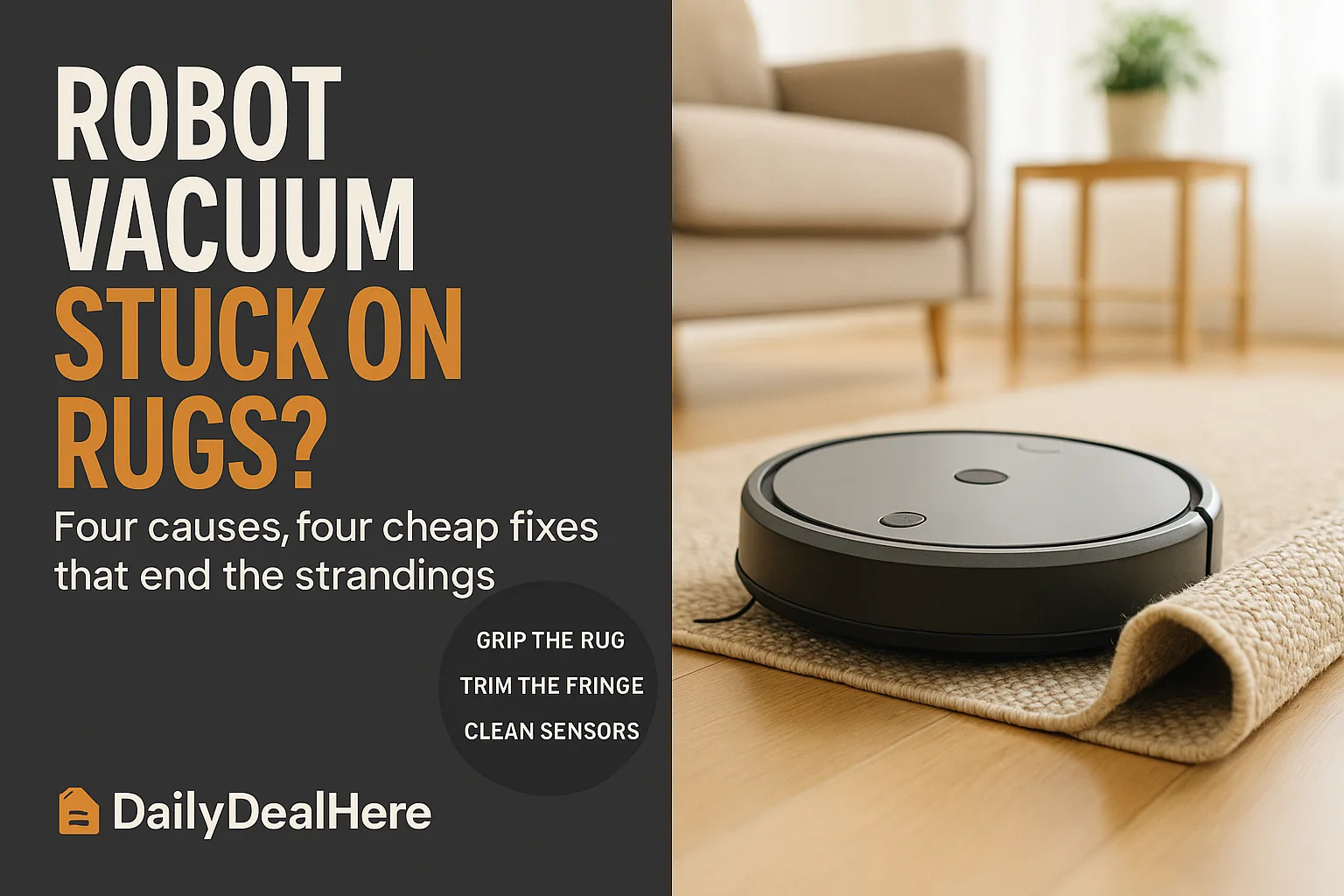
Robot vacuums get stuck on rug edges for four fixable reasons: the rug is too light and slides into a wave, the edge is too tall or curls upward, fringe and tassels wrap the brush, or the robot’s wheels and sensors are dirty enough that it can no longer judge the climb. Most cases are solved with gripper pads under the corners, a trim or tuck of the fringe, ten minutes of maintenance, and a no-go zone around the one rug that refuses to cooperate.
This guide covers how to identify which of the four you have from the way the robot fails, the fixes in order from free to worth-buying, the maintenance that quietly restores climbing ability, the settings that prevent repeat strandings, and the point at which the honest answer is a different robot rather than another accessory.
Diagnose the problem from how it fails
Robots fail on rugs in distinct, repeatable ways, and the pattern tells you the cause. Watch one full run, or check the app’s map for where the errors cluster, before buying anything.
| What you see | Likely cause | First fix |
|---|---|---|
| Rug bunches into a wave and the robot beaches on it | Rug too light, no grip against the floor | Gripper pads or a full rug pad underneath |
| Climbs halfway, wheels spin, backs off and retries | Edge taller than the robot’s climbing clearance | Transition ramp strip, or exclude the rug |
| Stops with a brush error at the rug edge | Fringe or tassels wrapped in the brush or side brush | Trim, tuck under, or bind the fringe |
| Refuses to cross a dark rug entirely | Cliff sensors reading dark as a drop | Clean sensors, lower sensitivity if available |
| Gets stuck in the same spot on every run | Map or furniture geometry, not the rug itself | Check for a low overhang or trapped cable |
| Used to climb fine, now cannot | Hair wrapped on wheel axles, worn tires | Maintenance, then replacement parts |
The last row deserves emphasis because it is the most common cause of a robot that suddenly develops rug problems after months of working fine. Nothing about the rug changed; the robot’s traction did.
Start with maintenance, because it costs nothing
Before buying grippers or ramps, flip the robot over and give it fifteen minutes. This single session solves a surprising share of rug complaints.
The drive wheels
Hair and thread wrap around the axles where the wheels meet the body, and enough of it stops the wheels turning freely or holds them partially retracted. Cut the wrap away with scissors or a seam ripper, working carefully so you do not nick the rubber. Then check the tread: wheels that have gone smooth and shiny have lost the grip that climbing depends on, and replacements are inexpensive for most mainstream models.
The front caster
That small swiveling wheel at the front is the part that has to ride up onto the rug first. It collects a dense felt of hair in its housing, and a caster that no longer spins acts like a brake exactly at the moment the robot needs to climb. Pop it out if the design allows, clear everything, and refit it.
The brush and side brush
Wrapped hair on the main roller increases drag and can trigger brush errors that read as rug problems. Side brushes bent out of shape catch fringe more readily than straight ones. Both are consumables and both are cheap.
The sensors
Wipe every sensor window with a dry microfiber cloth: the cliff sensors on the underside, the bumper sensors at the front, the wall-following sensor on the side, and the camera or lidar turret on top. Dust on a cliff sensor is a leading cause of a robot that suddenly refuses to cross dark surfaces, because a dirty sensor reads even less reflected light than the dark rug already returns.
Fixing the rug itself
Once the robot is in good condition, turn to the rug. Work in this order, since each step is cheaper and less permanent than the next.
Anchor the corners. Nonslip gripper pads at each corner, or double sided carpet tape for a rug that will stay put long term, stop the two most common failures at once: the rug sliding into a wave and the corner lifting into the brush. This is the highest-value fix in the whole article and costs very little.
Add a rug pad. A full nonslip pad underneath does what corner grippers do, but across the whole surface, and it has the side benefit of making the rug feel better underfoot and wear more slowly. For larger rugs this is the more durable answer.
Deal with the fringe. Tassels are the enemy of every rotating brush ever made. The options, in order of reversibility: tuck the fringe under the rug edge, bind it with a fabric strip or fringe guard, or trim it off. Many people discover they never liked the tassels anyway once the robot stops eating them weekly.
Flatten curled edges. A rug that has been rolled in storage keeps a memory in its corners. Reverse-roll it for a few days, weight the corners with books, or use carpet tape to hold them flat. A curled edge is a ramp pointing the wrong way, and no robot climbs it gracefully.
Consider a transition strip. For a thick rug in a doorway or a high-traffic path, a low profile transition ramp gives the robot a gradual slope instead of a wall. These are sold for accessibility and for exactly this purpose, and they solve the tall-edge problem permanently where excluding the rug is not acceptable.
Using the app instead of fighting the physics
Modern robots with mapping give you tools that cost nothing and work immediately, and there is no shame in using them. A no-go zone drawn around one troublesome rug keeps the rest of the schedule reliable, and running a stick vacuum over that rug once a week is a perfectly adult compromise.
Other settings worth checking: carpet boost, which raises suction on carpet and on some models also affects how the robot approaches transitions; mop avoidance, which tells hybrid models to route around carpet entirely when the mop pad is fitted, preventing a wet pad from being dragged across a rug; and scheduling, which matters more than people expect for camera-navigating robots because dim rooms degrade their obstacle judgment.
Take the time to name rooms and check the map after any furniture change. A robot working from a stale map plans routes that no longer make sense, and repeated strandings in a newly rearranged room are usually a mapping problem rather than a rug problem.
Dark rugs and the cliff sensor problem
Cliff sensors work by bouncing infrared light off the floor and measuring what comes back. A very dark, matte or high-pile surface absorbs most of that light, so the sensor sees almost nothing returning and concludes there is a drop ahead. The robot then does exactly what it should do at the top of a staircase: it refuses to proceed.
Cleaning the sensor windows is the first fix, since dust compounds the problem. Some manufacturers offer a carpet or dark-surface setting that reduces cliff sensitivity, which is worth looking for in the app before anything else. Beyond that, the widely shared advice of taping over cliff sensors should be treated as a last resort in a single-level home with no stairs and no drop-offs, because disabling a safety sensor is exactly as risky as it sounds. In a house with stairs, do not do it at all; draw a no-go zone instead.
Rug types ranked by how well robots handle them
| Rug type | How robots cope | Notes |
|---|---|---|
| Low pile, rubber backed | Excellent | The ideal case, stays put and easy to climb |
| Flatweave without backing | Good with grippers | Light enough to slide, so anchor it |
| Medium pile area rug | Usually fine | Watch the edges for curling |
| High pile or shag | Poor | Brushes bog down, exclude it |
| Fringed or tasseled | Poor until modified | Trim, tuck or bind the fringe |
| Very dark or black | Variable | Cliff sensors may refuse to cross |
| Layered rugs | Poor | Double the edge height in one step |
Shag deserves a plain verdict: no consumer robot vacuum handles deep shag well. The fibers wrap the brush, the drive wheels lose traction in the pile, and the robot works hard for a poor clean. Exclude shag rugs and vacuum them manually. That is not a failure of your particular model.
Environment changes that prevent strandings
A few habits reduce stuck alerts across the whole house, not just on rugs.
- Manage cables. Charging cables on the floor cause more strandings than every rug problem combined. Velcro ties and a cable box cost almost nothing.
- Clear the dock surroundings. A robot that gets confused needs a clean path home; a blocked dock turns a minor error into a dead battery in the middle of the floor.
- Lift light objects. Pet bowls, shoes, toy baskets and rug corners all move when pushed, and a robot that moves an object usually gets trapped by it.
- Run in daylight for camera models. Obstacle recognition works better with light, which reduces both strandings and accidents.
- Watch the first run after an app update. Firmware updates occasionally reset behavior or redraw boundaries you had tuned.
When it is the robot, not the rug
There is a limit to what accessories can fix. Budget robots with low ground clearance, simple bump navigation and no mapping will always struggle in a home layered with rugs, because they cannot learn where the hard parts are and cannot be told to avoid them. If every run needs a rescue, the machine is mismatched to the house.
The features that matter when upgrading, in rough order of importance for rug-heavy homes: climbing clearance, listed in the specifications as the threshold height the robot can cross; lidar or camera mapping, which lets you draw no-go zones; anti-tangle rubber rollers, which shrug off fringe and long hair far better than bristles; and enough suction that carpet cleaning is worth doing at all. Our robot vacuum guide weighs those against each other.
Homes where the rugs come with pets on top have an additional feature list, since hair volume and obstacle avoidance become the dominant concerns; we cover that separately in our guide to running a robot vacuum with dogs. And if the reason you are chasing floor coverage in the first place is dust that keeps coming back, the source hunt in our guide to dusty apartments is the companion read.
A maintenance schedule that keeps climbing ability
| How often | What to do |
|---|---|
| Weekly | Empty the bin, clear hair from the main brush |
| Every two weeks | Wipe all sensor windows, clear the side brush |
| Monthly | Cut hair from wheel axles and the front caster, check tread |
| Every few months | Wash or replace filters, inspect brush for wear |
| Yearly | Replace side brushes, consider new wheels if tread is smooth |
Robots that mysteriously get worse over time are almost always suffering from the monthly row of that table. Wheels and casters are the parts nobody thinks to clean, and they are exactly the parts that decide whether a rug edge is a small bump or an insurmountable wall.
The rescue routine when it is already stuck
When the app reports a stranding, resist the urge to simply carry the robot back to its dock. Where and how it got stuck is diagnostic information, and picking it up without looking throws that away. Go to the spot, look at the position, and note whether it beached on a wave, hung on an edge, or wrapped something.
Free it by lifting straight up rather than dragging it across the rug, since dragging can pull fibers into the brush and make the next run worse. Clear whatever it caught, then place it back on the dock rather than on the floor mid-room; a robot returned to the middle of a room often cannot find its way home and simply runs its battery flat looking.
Then fix the cause the same day. Stuck alerts that get rescued but never addressed train a household to distrust the robot, and an untrusted robot ends up running only when someone is home to babysit, which defeats the point of owning one.
Mopping robots and rugs: a separate problem
Hybrid robots that vacuum and mop introduce a second rug issue that has nothing to do with climbing. A wet mop pad dragged across an area rug leaves it damp, dirty and sometimes stained, which is worse than any stranding.
Most current hybrids handle this with carpet detection, either lifting the pad automatically or routing around carpet entirely when the pad is attached. Check that the feature exists and is switched on before running a mop cycle in a room with rugs, and verify it once by watching a run rather than assuming.
Models without pad lifting need a different workflow: mop hard-floor rooms with the pad fitted, then remove the pad and run the carpeted rooms separately. It is a small inconvenience, but discovering the alternative on a wool rug is an expensive way to learn.
Hard floor and rug transitions in doorways
Doorway transitions concentrate every rug problem into one narrow strip. The rug edge sits where traffic is heaviest, so it curls faster; the doorway is usually where the robot must cross to reach another room, so a failure there blocks the whole run rather than one area; and thresholds add their own height to the climb.
Two practical answers. Either anchor the rug edge firmly with carpet tape so it presents a flat, gradual profile, or move the rug back from the doorway so the robot crosses bare floor at the pinch point and meets the rug in open space where it has room to approach squarely. Robots climb much better when they hit an edge head on rather than at an angle, and open floor gives them that chance.
What each fix costs and what it solves
Free
Maintenance, sensor cleaning, tucking fringe under, moving cables, adjusting schedules and drawing no-go zones cost nothing and solve the majority of cases. Always exhaust this tier first.
Inexpensive
Gripper pads, carpet tape, a rug pad, replacement side brushes and new wheels are all modest purchases that address the specific mechanical causes. This tier fixes almost everything the free tier does not.
Worth considering
Transition ramp strips for one problem threshold, or a replacement rug with a rubber backing if an old lightweight rug is the permanent culprit in a high traffic room.
Last resort
A different robot, chosen for climbing clearance, mapping and anti-tangle rollers. This is the right answer when the house has many rugs and the current machine has no mapping at all, since no accessory can give a bump-navigating robot the ability to be told where not to go.
Setting expectations for a rug-heavy home
One honest framing helps more than any accessory: a robot vacuum is a maintenance tool, not a replacement for every cleaning task in the house. In a home with several area rugs, the realistic outcome is that the robot handles hard floors and low pile rugs daily and reliably, while one or two difficult rugs stay on a manual schedule. That division of labour still removes the large majority of the work, and it removes the part nobody enjoys, which is the daily sweep of crumbs and hair across open floor.
Households that fight this tend to end up with a robot they distrust, because they keep asking it to do the one job it is worst at and judging it on those failures. Households that accept the division get a machine that quietly runs while they are out and a five minute manual pass on the shag once a week.
The upgrade path exists when that compromise stops being acceptable. Mapping, climbing clearance and anti-tangle rollers genuinely widen the range of rugs a robot handles, and those are the specifications to compare rather than raw suction figures, which say nothing about whether the machine can reach the carpet in the first place. Suction matters once the robot is on the rug; everything in this article is about getting it there.
Frequently asked questions
Why does my robot vacuum push my rug around?
The rug is too light to stay put when the robot drives onto it. Nonslip gripper pads at the corners or a full rug pad underneath anchor it, and carpet tape on the corners stops the edge lifting into the brush.
Can robot vacuums handle rug tassels and fringe?
Mostly no. Fringe wraps around the side brush and main roller and triggers stuck errors. Tuck it under the rug, bind it with a fringe guard, or trim it. Excluding that rug with a no-go zone is the alternative.
Why does my robot vacuum stop on dark rugs?
Cliff sensors bounce infrared light off the floor, and very dark or high pile surfaces absorb it, so the sensor reads a drop. Clean the sensor windows first, look for a dark-surface or reduced sensitivity setting in the app, and otherwise use a no-go zone.
Is it safe to tape over cliff sensors?
Only in a single level home with no stairs or drop-offs, and even then it is a last resort. Those sensors exist to stop the robot falling. In any home with stairs, draw a no-go zone around the dark rug instead.
How thick a rug can a robot vacuum climb?
It varies by model and is listed in the specifications as threshold or climbing height. Low pile transitions suit almost every robot, while tall or plush edges stall many of them. If your home is rug heavy, check that figure before buying.
My robot used to climb the rug and now it cannot. What changed?
Almost always traction. Hair wrapped around the wheel axles, a clogged front caster, or worn smooth tread all reduce climbing ability gradually. Fifteen minutes of maintenance restores it, and wheels are inexpensive replacement parts.
Do robot vacuums work on shag or high pile rugs?
Not well. Fibers wrap the brush, wheels lose traction in the pile, and cleaning quality is poor even when the robot manages to stay on. Exclude shag rugs and vacuum them manually rather than blaming the model.
Should I just block the robot from one problem rug?
Often yes. A no-go zone around a single troublesome rug keeps the rest of the schedule reliable, and a quick manual pass covers the excluded area. It is the pragmatic answer when the rug is thick, fringed or valuable.










Write Your Review
No reviews yet. Be the first to share your experience!