

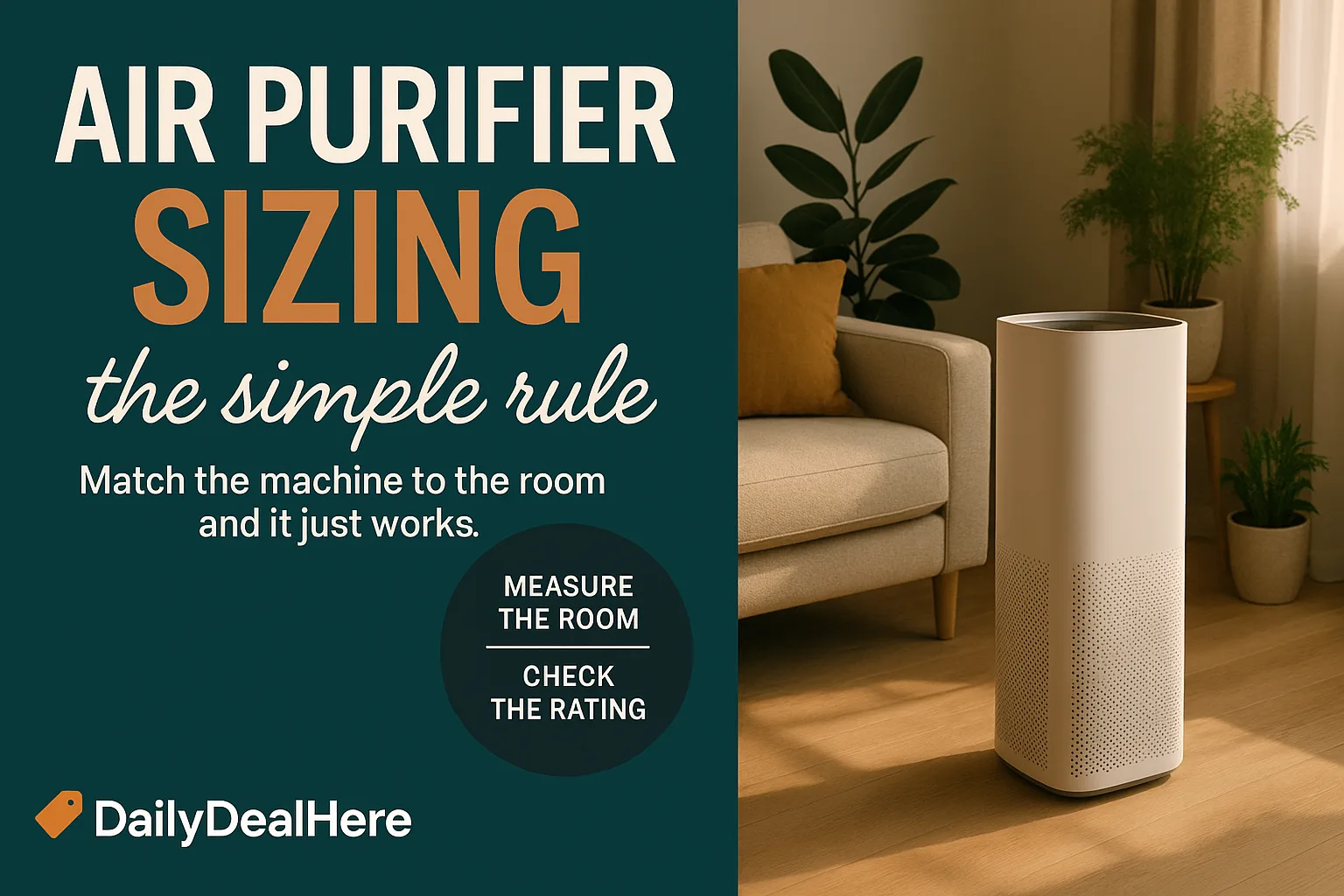
For a 300 square foot room you want a smoke CADR of at least 200, following the industry two thirds rule: the Association of Home Appliance Manufacturers recommends a Clean Air Delivery Rate of at least two thirds of the room’s floor area in square feet. That assumes standard eight foot ceilings. For wildfire smoke conditions, AHAM’s stricter guidance is a smoke CADR equal to the full room area, so 300 for a 300 square foot space.
That is the whole formula, and everything else in this guide exists to help you apply it honestly: what CADR actually measures, why the room size printed on the box is usually larger than the real one, how ceiling height and open floor plans change the arithmetic, why sizing up buys quiet as well as clean air, and what the number cannot tell you.
What CADR actually measures
CADR is the volume of thoroughly cleaned air a purifier delivers per minute, expressed in cubic feet per minute, measured under a standardized AHAM procedure in a sealed chamber. Three separate figures are reported, for smoke, dust and pollen, because those particle sizes behave differently and a machine can perform unevenly across them.
Smoke uses the smallest particles of the three and is therefore the hardest number to score well on. That makes it the figure to size by: a machine honest about smoke handles dust and pollen comfortably, while a machine chosen on its pollen rating may disappoint on everything finer.
Look for the AHAM Verifide seal on the box or listing. It means the figures come from the standardized measurement rather than from the manufacturer’s own claims, and it is the single most useful mark in a category full of unregulated language. A purifier with no CADR figure at all is asking you to trust adjectives.
The sizing math for common rooms
| Room size | Minimum smoke CADR | For smoke events |
|---|---|---|
| 100 sq ft small bedroom | 67 | 100 |
| 150 sq ft bedroom | 100 | 150 |
| 200 sq ft office | 135 | 200 |
| 250 sq ft den | 167 | 250 |
| 300 sq ft living room | 200 | 300 |
| 400 sq ft open area | 267 | 400 |
| 500 sq ft great room | 335 | 500 |
To use the table, measure the floor rather than estimating. Length times width in feet gives the area, and most rooms turn out to be smaller than people guess. Then read across, and treat the middle column as your minimum rather than your target.
Why the room size on the box overpromises
Manufacturers frequently print a coverage figure calculated at one air change per hour, meaning the machine cycles the room’s air volume once every sixty minutes. That is a defensible number for marketing and a poor one for living, because a single air change per hour does very little against a source that keeps producing particles: cooking, pets, an open window, a person moving around.
The two thirds rule corresponds to roughly four to five air changes per hour, which is the pace at which a purifier visibly wins. That is the difference between a machine that makes a measurable dent during a smoky evening and one that produces a comforting hum.
The practical consequence: a unit advertised for very large spaces may be honest only at its highest fan speed and only at one air change per hour. Compare CADR numbers directly between machines and ignore the coverage claims, which are interpretation rather than measurement.
Ceiling height, open plans and other adjustments
The AHAM rule assumes eight foot ceilings, because CADR is about air volume and floor area is only a proxy for it. Rooms with taller ceilings hold proportionally more air, so scale the requirement up: a ten foot ceiling needs roughly a quarter more CADR, and a vaulted ceiling considerably more than that.
Open plans are the bigger trap. A purifier sized for a 300 square foot living room is undersized the moment that room opens into a dining area and kitchen without a door between them, because air moves freely across the whole space. Either size for the combined area or accept that you are cleaning the immediate vicinity of the machine rather than the room.
Doors are therefore a tool. Closing a bedroom door turns a difficult open-plan problem into a simple sealed-room problem, which is why bedroom purifiers punch above their weight and why the bedroom is usually the smartest place to put the first machine you buy.
Why sizing up is usually the better purchase
Meeting the minimum is not the same as choosing well. A machine comfortably larger than the room delivers the same clean air at a lower fan speed, and that single fact produces three benefits that matter more day to day than the raw number.
Noise is the first. Purifiers are quiet on low and intrusive on high, and a unit that spends its life on low is one you will actually leave running overnight. An undersized machine lives at full speed, which is why so many purifiers end up switched off in bedrooms.
Filter life is the second. Media loads according to how much air passes through it, but a strained machine running constantly at maximum works through filters noticeably faster than a larger one idling. Third is headroom: when a smoky week arrives, the oversized machine has somewhere to go, while the correctly sized one is already at its limit.
What CADR does not tell you
The rating is a good measure of one thing and silent about several others, which is why two machines with identical CADR can be very different products.
It says nothing about noise at a given speed, nothing about how much electricity the machine uses, nothing about filter cost or availability, and nothing about gases and odors, since CADR measures particles rather than volatile compounds. A machine with excellent CADR and no meaningful carbon layer will not touch cooking smells.
It also says nothing about how the machine performs in your actual room, which is never a sealed chamber. Furniture blocks airflow, doors open, and pollution enters continuously. The two thirds buffer exists precisely to absorb that gap between chamber and home.
Placement: getting the rating you paid for
A correctly sized purifier in a bad position underperforms a smaller one placed well. Give it clearance on all sides so intake and outlet can breathe, which usually means a foot or more from walls and well clear of curtains and furniture backs.
Put it where you spend hours rather than in a hallway or a corner nobody occupies. In a bedroom that means within a few feet of the bed; in a living room, near the seating rather than tucked behind a sofa. Purifiers clean the air around themselves fastest, and proximity to the person breathing is worth more than tidy placement.
Run it continuously on a low or automatic setting rather than in bursts. Particle levels rebound quickly after a machine stops, and steady low-speed operation beats intermittent blasting on every measure including noise, filter life and electricity.
One machine or several?
For a whole home, several right-sized machines beat one large unit trying to cover everything, because air does not travel efficiently between rooms and a closed door defeats even a very powerful purifier two rooms away.
The sensible order is to start with the bedroom, since that is where you spend the most consecutive hours breathing the same air. Add the main living space next, then any room with a specific problem such as a home office facing a busy road or a room with a litter tray.
Buying two mid-sized machines rather than one large one also introduces redundancy: filters can be replaced on staggered schedules, and a failure leaves you with something rather than nothing.
Running costs the CADR figure hides
Two purifiers with the same rating can differ substantially in what they cost to keep running, and filters are the larger half of that. Check how many filter sets a year your usage implies, whether the machine uses a combined cartridge or separate layers, and whether replacements are stocked by more than one seller.
Combined cartridges are simpler but force you to discard a serviceable HEPA layer whenever the carbon saturates, which for a cooking-heavy household means throwing away good media several times a year. Separate layers cost more attention and less waste.
Electricity is the smaller line but not nothing for a machine running continuously. This is where sizing up pays again, since a larger unit on low draws less power than a small one at maximum for the same result. The models in our air purifier guide list their smoke CADR figures so you can run the two thirds rule before buying, and our filter replacement guide covers how to judge when media is genuinely spent.
When sizing is not the problem
If a correctly sized machine still leaves a room feeling dusty or stale, the fault usually lies outside the purifier. An active source overwhelms any filtration: an open window during pollen season, a humidifier running dirty water, unsealed gaps pulling in outdoor air, or a pet bed sitting at the intake.
Settled dust is also outside a purifier’s job description entirely, since it cannot pull particles off surfaces. That work belongs to a vacuum and a damp cloth, and the two approaches are complementary rather than interchangeable. Our guide to chronically dusty apartments walks through finding the source before spending more on machines.
Air changes per hour, and why that number is the real target
CADR is a rate, and the two thirds rule is a shortcut for turning that rate into something meaningful for your room. Underneath both sits the figure professionals actually work with: air changes per hour, meaning how many times the machine processes a volume equal to the whole room every sixty minutes.
Two air changes an hour is barely adequate for a room with no active pollution source. Four to five is the range where a purifier keeps up with cooking, pets, an occupied room and ordinary outdoor infiltration, and it is what the two thirds rule delivers. Six or more is the territory of allergy management and smoke events, and it is why the stricter smoke guidance exists.
To calculate it yourself: multiply CADR by 60 to get cubic feet per hour, then divide by the room volume in cubic feet, which is floor area times ceiling height. A machine with 200 smoke CADR in a 300 square foot room with eight foot ceilings delivers 12,000 cubic feet per hour into a 2,400 cubic foot room, which is five air changes. That is exactly the target, and it is why the rule works.
Sizing for specific problems
Allergies
Allergy households should size toward the upper end rather than the minimum, because the goal is not merely reducing particles but holding them low continuously through a night of sleep. The bedroom is the priority room, the door should be closed, and continuous low speed operation beats intermittent high speed.
Wildfire smoke
Smoke is the case that breaks ordinary sizing, which is why AHAM publishes stricter guidance for it. Particles are extremely fine, they arrive continuously while the event lasts, and they penetrate a house through gaps you never notice otherwise. Size to the full room area rather than two thirds, seal what you can, and expect filters to age dramatically faster during a smoke week.
Pets
Dander is fine and persistent, and pet hair clogs pre-filters quickly. The sizing rule is unchanged, but the maintenance rhythm is not: rinse pre-filters far more often, and expect the main media to load faster than the manual predicts.
Cooking odors and volatile compounds
This is the case sizing cannot solve, because CADR measures particles rather than gases. What matters here is the mass and quality of activated carbon, which is rarely specified in any comparable way. A thin carbon-impregnated mesh is not the same as a substantial carbon layer, and only the latter meaningfully addresses smells.
How to check whether your current machine is right
If you already own a purifier and are unsure whether it fits the room, three checks settle it without buying anything.
First, find the smoke CADR in the manual or on the manufacturer’s specification page, not the coverage claim on the box. Second, measure the room and apply the two thirds rule. Third, watch the machine’s own behavior for a week: a unit that sits on low most of the time in auto mode is comfortably sized, while one that lives on high is either undersized or overdue for a filter.
If the numbers say it is undersized, you have three options in ascending cost: close the door and reduce the space it has to cover, move it into a smaller room where it is correctly sized and buy a larger unit for the big room, or add a second machine. The second option is the one people overlook, and it often solves two rooms at once.
Common sizing mistakes
The most frequent error is buying by price tier rather than by measurement, assuming a more expensive machine must be adequate. Price correlates with features, build quality and brand rather than with CADR, and inexpensive machines with strong ratings exist alongside premium ones with modest ones.
The second is sizing for the room you are standing in while ignoring the doorway to the next one. The third is choosing based on the pollen figure because it is the largest of the three printed numbers, which produces a machine that looks impressive and underperforms on the particles that matter most.
The fourth, and the one that quietly wastes the most money, is buying a correctly sized machine and then running it only when the air already seems bad. Purifiers work by maintaining a low baseline, and a machine switched on in response to a problem spends its life catching up.
Reading a spec sheet without being misled
Listings in this category use several numbers that look comparable and are not, so it helps to know which is which. CADR is a measured rate and the only figure directly comparable between machines. Coverage area is a calculation derived from CADR using an assumption the manufacturer chooses, which is why it varies so much between brands offering similar performance.
Airflow in cubic feet per minute is a fan specification rather than a cleaning specification: it tells you how much air moves, not how much of it comes out clean. A machine can move a great deal of air through mediocre filtration and post an impressive airflow figure. Filtration percentage claims, such as capturing a very high share of particles at a stated size, describe the media in isolation rather than the assembled machine, and say nothing about the rate at which it works.
Put simply: compare CADR to CADR, treat coverage claims as marketing, and read airflow and filtration percentages as supporting detail rather than as the headline. If a listing omits CADR entirely, that omission is itself information.
A worked example, start to finish
Take a living room measuring fifteen by twenty feet with standard ceilings, opening through a wide archway into a dining area of ten by twelve. Measured properly that is 300 square feet plus 120, so 420 in total, because the archway means both spaces share air.
Two thirds of 420 is 280, so the minimum smoke CADR for the combined space is 280 rather than the 200 the living room alone would suggest. If the household cooks often, has a pet, or lives somewhere with smoke seasons, sizing to the full 420 gives headroom and lets the machine run quietly most of the time.
The alternative, and often the better one, is two machines: one sized for the living room at 200 and a smaller one for the dining area. That arrangement cleans both spaces closer to their sources, costs about the same, and leaves you with something working if one unit fails or sits waiting for a filter.
Whichever route you take, write the target figure down before you start shopping. Walking into a comparison with a number in mind turns a confusing category into a filter: anything below your figure is out, and everything above it is a question of noise, filter cost and size rather than of whether it will work at all.
That single habit prevents the most expensive mistake in this category, which is buying an attractive machine that was never going to be adequate for the room it was bought for, and then concluding that purifiers do not work.
Frequently asked questions
What CADR do I need for a 300 square foot room?
At least 200 smoke CADR by the AHAM two thirds rule, assuming eight foot ceilings. For wildfire smoke conditions, AHAM’s stricter guidance is a smoke CADR equal to the room area, so 300 for that space.
Which CADR number matters most: smoke, dust or pollen?
Smoke. It is measured with the smallest particles and is the hardest rating to score well on, so a machine sized by its smoke CADR handles dust and pollen comfortably.
Is a higher CADR always better?
Within reason, yes. A larger machine cleans the same room at lower fan speeds, which means less noise, slower filter loading and headroom for smoky days. The trade is upfront cost and physical size.
Why does the box claim a bigger room than the two thirds rule allows?
Coverage claims are often computed at one air change per hour, which is too slow to keep up with an ongoing source. The two thirds rule targets roughly four to five air changes per hour, which is where a purifier makes a visible difference.
Does ceiling height change the CADR I need?
Yes. The rule assumes eight foot ceilings, and CADR is really about air volume. A ten foot ceiling needs about a quarter more, and a vaulted ceiling considerably more.
Do I need a bigger purifier for an open plan space?
Yes, or you accept cleaning only the area near the machine. Air moves freely between connected spaces, so size for the combined area. Closing a door is the cheapest way to make a room match its rating.
Does CADR measure odors and gases?
No. CADR covers particles only. Odors and volatile compounds are handled by an activated carbon layer, which is rated separately or not at all, so a high CADR machine with minimal carbon will not clear cooking smells.
Is one large purifier better than two smaller ones?
For a whole home, several right-sized machines beat one large unit, because air does not travel efficiently between rooms and closed doors block it entirely. Start with the bedroom, then the main living space.










Write Your Review
No reviews yet. Be the first to share your experience!