

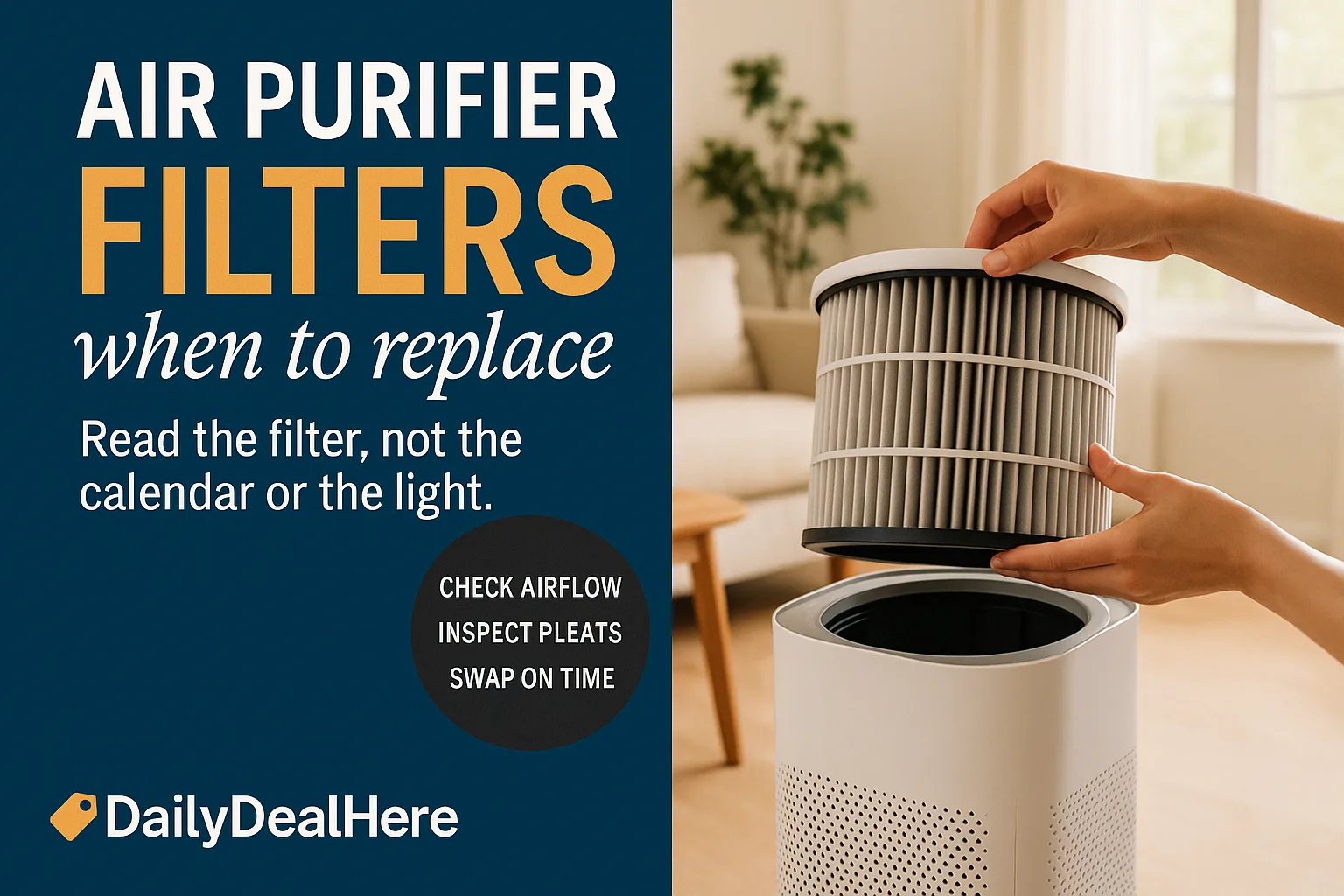
Replace a true HEPA filter every six to twelve months, an activated carbon filter every three to six, and rinse a washable pre-filter every two to four weeks. Those are the manufacturer baselines, and they are a starting point rather than a verdict: wildfire smoke, pets, cooking, construction dust and simply running the machine around the clock all shorten filter life, sometimes by half. The reliable signal is not the calendar and not the indicator light, it is the filter itself, plus how the machine behaves.
This guide covers what each filter layer does, how to read the real signs of exhaustion, why the change light usually knows less than you do, the genuine differences between brand and third party replacements, what happens if you keep running a spent filter, and how to make a set of filters last as long as it honestly can.
The three layers, and why they wear at different rates
Nearly every consumer air purifier stacks three stages, and treating them as one unit is the source of most confusion about replacement intervals.
The pre-filter is a coarse mesh or fabric screen that catches hair, lint and large dust before they reach the expensive layer behind it. On many machines it is washable and permanent. It is also the layer people forget entirely, which is unfortunate because every gram it captures is load the HEPA layer never has to carry.
The true HEPA layer is the pleated media that does the actual air cleaning, capturing very fine particles including smoke, pollen and dander. It is a physical trap, so it fills up. Once loaded, airflow drops and capture efficiency falls off, and there is no way to unload it.
The activated carbon layer handles odors and gases by adsorption, meaning molecules stick to an enormous internal surface area. Carbon does not clog the way HEPA does; it saturates. When every site is occupied, the layer stops working, and in a warm room a saturated carbon filter can even release some of what it holds. This is why carbon usually needs replacing sooner than HEPA, and why an odor that returns is such a useful signal.
| Layer | Typical interval | Shorten it when | Washable? |
|---|---|---|---|
| Pre-filter | Rinse every two to four weeks | Pets in the home, heavy shedding season | Usually yes |
| True HEPA | Six to twelve months | Smoke events, allergies, construction, constant running | No |
| Activated carbon | Three to six months | Cooking odors, smoking household, pets | No |
| Combined cartridge | Follow the shortest layer inside | Usually the carbon gives out first | No |
The signs that beat the calendar
Trust these over any printed schedule, because they describe your air rather than an average customer’s.
Airflow feels weaker at the same setting
Hold a hand over the outlet on a fixed fan speed and compare it to how it felt when the filter was new. A loaded filter chokes the machine, and reduced output at a given speed is the clearest mechanical evidence that the media is full.
The machine lives on high
On auto mode, a purifier that used to settle to low and now runs high most of the day is working harder for the same result. That is either an exhausted filter or a machine undersized for the room, and checking the filter is the cheaper diagnosis.
Odors come back
Cooking smells that used to fade in twenty minutes now linger for an hour. That is carbon saturation, and it usually arrives well before the HEPA layer is finished.
Symptoms creep back
For allergy households this is often the first signal. Rooms that had become comfortable start provoking symptoms again, especially overnight in a bedroom where the machine runs while you sleep.
The filter looks finished
The bluntest check of all. Pull the filter and look at it in daylight. New media is white or off-white. A pleat pack that has gone uniformly gray or brown, with visible packing in the folds, is done regardless of how many months it has been. Also smell it: a filter that smells musty rather than neutral has held moisture and organic matter and should be replaced rather than aired out.
Why the filter change light is not the authority
Almost every filter indicator on consumer purifiers is an hour counter. It starts when you reset it and lights up after a preset number of run hours, typically corresponding to the manufacturer’s average interval. It has no idea whether those hours were spent in clean spring air or in a August of wildfire haze, and it does not measure pressure drop across the media.
That produces two failure modes. In a clean, lightly used home the light nags long before the filter is truly spent, which wastes money. In a smoky season or a pet-heavy home the filter is finished months before the light says a word, which wastes clean air. Treat the light as a prompt to open the machine and inspect, then decide with your eyes.
One practical note: reset the counter every time you change a filter. The reset is usually a long press on the filter or check button, and skipping it means the light keeps reporting the previous cycle and you lose even the rough guidance it offers.
Can you wash or vacuum a HEPA filter?
No, unless the manufacturer explicitly marks that layer washable, which is generally true only for pre-filters and for a small number of purpose-built washable media. This comes up constantly because a dirty filter looks like something a rinse should fix, so it is worth being precise about why it does not.
HEPA media is a dense mat of fine fibers arranged to trap particles by interception, impaction and diffusion. Water disrupts the fiber structure and can distort the pleats, and once dry the media rarely returns to its original performance. Worse, a filter that stays even slightly damp inside becomes a growth surface, so a washed HEPA filter can end up putting more into the air than it removes.
Vacuuming is gentler but still counterproductive. It pulls at fibers, can drive fine dust deeper into the mat, and releases a plume of the exact particles you installed the machine to capture. If you must knock loose surface fluff from a pleat pack, do it outdoors with a soft brush and accept that it buys days, not months.
The pre-filter, by contrast, genuinely wants washing. Rinse it under lukewarm water, let it dry completely before reinstalling, and never run the machine with a damp pre-filter in place.
Brand filters versus third party replacements
Third party filters commonly cost less than the manufacturer’s own, and some are perfectly good. The risk is not usually the media quality but the frame: a filter that does not seal tightly against the housing lets air take the easy path around the media instead of through it. A HEPA layer that air bypasses is decoration, and the leak is invisible because the machine still hums and still moves air.
If you go third party, favor sellers with long review histories in that specific model, check that the frame depth and gasket match the original, and inspect the fit when you install it. A filter that drops in loosely, rocks in its seat, or leaves a visible gap at any edge should go back.
Compatibility across a brand’s own lineup is another trap, because model families share naming but not parts. Levoit is the clearest example, since it dominates this category: the Core 300 replacement filter fits the Core 300 family, including the 300-P, 300S and 300S-P, and it does not fit the Core 400S, which takes its own filter. Buying by product family name rather than by the exact filter part number is how people end up with a filter that will not seat.
The practical rule: buy by the filter’s part number printed on the old filter or in the manual, not by the machine’s marketing name. The models in our air purifier guide all have widely available replacements, which is part of why they made the list; a purifier whose filters are scarce or discontinued is a machine with an expiry date.
What happens if you never replace the filter
Nothing dramatic, which is precisely the problem. The machine keeps running, the lights stay on, and the room slowly goes back to the air quality it had before you bought it. The decline is gradual enough that most people do not notice until allergies return or a guest mentions the cooking smell.
Three concrete consequences are worth naming. Clean air delivery drops, so the machine no longer keeps pace with the room even at full speed. Electricity use rises for less benefit, since the fan works against resistance. And a saturated carbon layer in a warm room can give back some of the odor compounds it captured, which is why a very old filter sometimes seems to make a room smell worse rather than better.
There is also a wear angle: a fan forced to work against a clogged filter runs hotter and longer than designed. Filters are the cheapest part of owning a purifier, and skipping them to save money mostly buys a slower, noisier machine that has stopped doing its job.
How to make a filter last as long as it honestly can
You cannot revive HEPA media, but you can slow how fast it loads, and the difference between a careless setup and a thoughtful one is often months.
- Rinse the pre-filter on schedule. This is the single highest-value habit, because the pre-filter is protecting the layer that costs money.
- Run auto rather than permanent high. The machine then works hard only when the air needs it, which stretches media life without sacrificing results.
- Keep it out of the kitchen. Cooking grease coats filter fibers far faster than ordinary dust and shortens both HEPA and carbon life.
- Vacuum and dust the room regularly. Every particle a vacuum removes from the floor is one the filter never has to trap. The two machines are teammates.
- Close windows during smoke and pollen peaks. Running a purifier with a window open is an expensive way to filter the outdoors.
- Give it clearance. Intake and outlet blocked by furniture makes the machine work harder for the same cleaning.
If the machine seems to eat filters no matter what you do, the room may simply be generating more dust than the setup can handle, which is a different problem with different fixes; our guide to chronically dusty apartments walks through finding the source.
Budgeting for filters before you buy the machine
Filters are the running cost of clean air, and they deserve a place in the buying decision rather than a surprise six months later. Work out how many filter sets a year your usage implies, check that replacements are stocked by more than one seller, and note whether the model uses a combined cartridge or separate layers. Combined cartridges are simpler but force you to discard a serviceable HEPA layer when the carbon saturates; separate layers cost more attention and less waste.
An oversized machine is quietly cheaper to run here as well. A purifier comfortably larger than the room cleans it at low speed, and low speed loads media more slowly than a smaller unit straining at maximum. Our CADR sizing guide gives the arithmetic for matching machine to room, and getting that right is the difference between a filter that lasts a year and one that gives up in five months.
Replacing a filter, step by step
The job takes five minutes and is worth doing properly, because a badly seated filter undoes the purchase.
Unplug the machine first. Open the housing, usually a twist-off base or a clip-on back panel, and note the orientation of the old filter before removing it, since many have a marked airflow direction. Slide the old filter into a bag as you remove it rather than carrying it across the room, because a loaded filter sheds what it has captured when handled.
Take the plastic wrap off the new filter, a step people genuinely forget, and seat it in the same orientation with the gasket flush against the housing. Wipe the inside of the housing and the fan grille with a dry cloth while it is open. Close it, plug it back in, and reset the filter indicator. Run it on high for a few minutes and confirm the airflow feels stronger than it did before, which is your evidence that the change was needed and correctly done.
How filter needs change with machine style
Filter behavior is not uniform across form factors, and knowing your machine’s style sets realistic expectations. Compact desktop units use small filters with limited media area, so they load faster and need replacing more often even in ordinary air. They are excellent for a bedside or a small office and frustrating if you ask them to cover a living room, because the filter takes the punishment for the size mismatch.
Tall tower units carry substantially more media, which is why they can hold their intervals in dustier homes. Their filters cost more per unit but often less per month of clean air, and they run at lower speeds for the same result, which loads the media more slowly. Machines with separate pre-filter, HEPA and carbon stages let you replace only what is spent, while combined cartridges are simpler at the price of discarding serviceable media when one layer gives out.
Whole-house solutions and HVAC filters follow their own schedules entirely and are not interchangeable with portable purifier guidance. If you run both, keep the schedules separate in your notes, because a furnace filter changed on a portable purifier’s schedule will be badly overdue.
A seasonal approach to filters
Air quality is seasonal in most of the country, and filter planning benefits from following that rhythm rather than a flat calendar. Spring brings pollen, which loads pre-filters and HEPA media quickly in homes that ventilate on mild days. Late summer and autumn bring wildfire smoke in much of the west, which is the single fastest way to exhaust a filter; a machine that runs through a serious smoke week can lose months of expected life in days.
Winter concentrates indoor pollution instead. Closed windows, running heat, cooking indoors and dry air that keeps particles aloft all mean the machine works steadily even though the outdoor air looks clean. Spring cleaning season adds dust from disturbed surfaces and stored textiles.
A practical routine: inspect at the change of each season rather than waiting for an indicator, keep one spare set in the closet during smoke season so a bad week does not leave you running spent media, and note the install date on the filter frame with a marker. That last habit costs nothing and removes the guesswork entirely.
New filter installed and performance is still poor
If you have replaced the media and the machine still underperforms, work through these in order before concluding the unit is failing.
Check the wrapper and the seal
The plastic sleeve left on a new filter is the most common cause of a purifier that suddenly moves almost no air. After that, check the seat: a filter installed upside down, or one whose gasket is not flush, lets air bypass the media even though everything looks assembled.
Check placement and clearance
Intake or outlet against a wall, behind a sofa, or under a shelf strangles airflow regardless of filter condition. Most machines want clearance on all sides, and moving a unit thirty centimeters into the room often produces a bigger improvement than a new filter.
Check whether the room outgrew the machine
Opening a door to an adjoining space effectively doubles the room, and a unit sized for a bedroom cannot hold an open-plan floor. If performance dropped when a layout changed rather than when the filter aged, sizing is the problem and no filter will fix it.
Check the source
A purifier cannot outrun an active source. A humidifier running dirty water, a smoking indoor candle habit, unsealed gaps pulling in outdoor air, or a pet bed at the intake will each keep readings high with a brand new filter installed. Removing the source is cheaper than any consumable.
Frequently asked questions
How often should I replace a HEPA filter?
Every six to twelve months for most true HEPA filters under normal conditions. Smoke, pets, construction dust, allergy season and running the machine around the clock can cut that significantly, so inspect the pleats rather than trusting the calendar alone.
Can I wash a HEPA filter and reuse it?
No, unless the manufacturer explicitly marks that layer washable. Water disrupts the fiber structure and distorts the pleats, and a filter that stays damp becomes a growth surface. Only pre-filters and layers marked washable should be rinsed, and they must dry completely before reinstalling.
Is the filter change light on my air purifier accurate?
It is almost always an hour counter rather than a sensor, so it cannot tell clean months from smoky ones. Use it as a prompt to open the machine and inspect, then decide based on airflow, odors and the color of the media. Remember to reset it after each change.
Do cheap third party air purifier filters work?
Some are fine, and the usual failure is fit rather than media. A frame that does not seal lets air bypass the media entirely. Buy from sellers with long histories for your exact model, match the filter part number rather than the machine name, and reject any filter that rocks or leaves a visible gap.
Do Levoit filters fit different models?
Only within the same family. The Core 300 replacement filter fits the Core 300, 300-P, 300S and 300S-P, and it does not fit the Core 400S, which uses its own filter. Always order by the part number printed on the filter or listed in the manual.
What happens if I never change the air purifier filter?
Clean air delivery falls off gradually, the fan works harder for less benefit, and a saturated carbon layer can release some captured odors back into a warm room. The machine keeps running and looking normal, which is why the decline usually goes unnoticed until symptoms or smells return.
Why does my air purifier run on high all the time?
Either the filter is exhausted or the unit is undersized for the room. Check and inspect the filter first, then compare the machine’s CADR against the room size using the two thirds rule.
Why does my new filter smell strange?
A faint carbon or plastic odor for the first day or two is normal as a new filter airs out. A musty or sour smell is not, and points to moisture or storage problems; that filter should be replaced rather than run in.







Write Your Review
No reviews yet. Be the first to share your experience!