

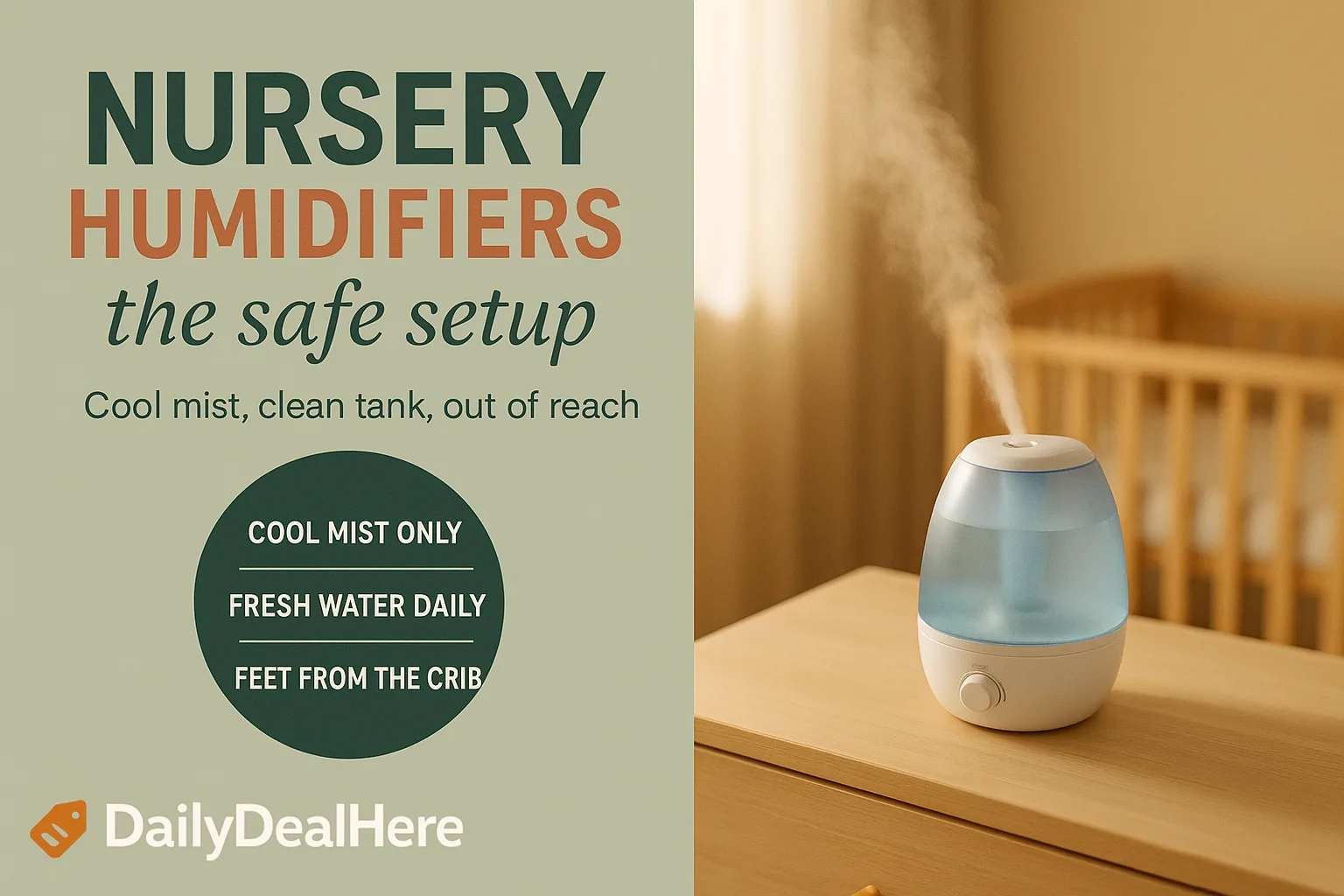
Yes, a humidifier is safe for a newborn’s room when it is the right type, placed correctly and kept genuinely clean. The American Academy of Pediatrics recommends cool mist humidifiers for children’s rooms, because warm mist units and steam vaporizers hold hot water that can scald a child who pulls or tips them over. The two rules that matter are cool mist only, and a cleaning routine strict enough that the machine never mists anything but water. This article is general information rather than medical advice; ask your pediatrician about your own baby.
Below is why pediatric guidance favors cool mist, how to set the machine up safely in a nursery, the humidity range to aim for and how to know you are in it, the cleaning standard a nursery deserves, what should never go in the tank, and the signs that tell you a humidifier is not the answer to what is going on.
Why cool mist rather than warm
The reasoning is burn prevention rather than any difference in effectiveness. Warm mist humidifiers and steam vaporizers heat water to produce their output, which means they contain hot water and a hot surface for as long as they run. A curious toddler pulling on a cord, or an adult knocking a unit while carrying a baby in the dark, is exactly the accident a nursery does not need.
Cool mist adds moisture to the air just as effectively for the purposes parents care about, which are dry winter air, stuffy noses and the barking cough of croup. Pediatric sources note that cool mist may help soothe croup symptoms while you follow up with a doctor, and there is no meaningful advantage to warm mist that would justify the burn risk in a child’s room.
The one argument sometimes made for warm mist, that boiling produces cleaner output, does not hold up in practice. A warm mist unit still needs the same cleaning routine, still grows biofilm in a neglected tank, and adds a hazard that a cool mist unit does not have.
Setting it up safely in a nursery
| Rule | Why |
|---|---|
| Cool mist only | No hot water to scald, per pediatric guidance |
| Raised, water resistant surface | Out of reach and protects furniture from stray mist |
| Several feet from the crib | Mist disperses before it reaches bedding |
| Cord routed out of reach and out of the walking path | Removes both a pull hazard and a trip hazard |
| Aimed into open room, not at the crib or a wall | Prevents damp bedding and damp wall patches |
| Fresh water every day | Standing water grows microbes quickly |
| Nothing added to the water | Infant airways are sensitive; additives need a doctor’s approval |
The placement rules deserve a little expansion because they interact. A machine on the floor is within reach of a crawling baby and sits in the dustiest layer of the room, which is exactly what you do not want being drawn through a humidifier. A machine on a dresser is out of reach but needs a tray or a water resistant surface, because even a well aimed unit leaves some moisture on nearby surfaces over months of use.
Aiming matters as much as distance. Mist directed at a wall produces a damp patch that grows mold on the wall itself, which is a problem no amount of tank cleaning addresses. Directed at the crib, it dampens bedding. Directed up and into the open room, it does what it is supposed to do.
The humidity range to aim for, and how to know
Roughly 40 to 60 percent relative humidity is the comfortable band, and staying inside it matters in both directions. Below the low thirties, dry air irritates airways and skin and makes congestion feel worse. Above about sixty, condensation forms on cold surfaces such as windows and exterior walls, and sustained damp is exactly what mold needs.
Guessing is unreliable, so use a hygrometer. Many humidifiers and several baby monitors include one, and a standalone unit costs very little. Place it across the room from the humidifier rather than beside it, since the reading next to the outlet is always higher than the room’s actual level.
Watch the windows as a free secondary check. Condensation on the inside of the glass on a cold morning means the room is running wetter than it should. That signal appears before mold does, and turning the output down in response is a much easier fix than dealing with what comes later.
The cleaning standard a nursery deserves
This is the part that decides whether a humidifier helps or harms, and it is stricter than the routine most people apply to a machine in their own bedroom. A dirty tank does not simply stay dirty; it aerosolizes what grows in it into the air an infant breathes for twelve hours a night.
Every day of use: empty any water left in the tank, rinse it, and refill with fresh water. Never top up old water, because adding fresh water to a colony feeds it rather than diluting it. This single habit does more than everything else combined.
Weekly: a vinegar clean. Fill the tank with white vinegar and warm water, let it sit about thirty minutes, and pour vinegar into the base so it covers the transducer or heating plate. Scrub gently with a soft brush, rinse until no vinegar smell remains, and dry every part fully before reassembly.
Every few weeks: the disinfecting step your manual specifies, followed by a thorough rinse. And whenever the machine sits unused for more than a day or two, empty and dry it rather than leaving water standing in a warm room.
If a musty smell ever appears, stop and deep clean before running it again, since that smell means the biology is already established. Our guide to mildew smells in humidifiers covers the full rescue routine step by step.
Water choice and the white dust question
Ultrasonic humidifiers, which are the most common cool mist type, break water into droplets mechanically. Every dissolved mineral in the tank goes into the air with those droplets and settles as fine white powder on nearby surfaces, which is where the white dust complaint comes from.
In a nursery this is worth avoiding, not because the dust is known to be harmful at these levels but because a room where you can see deposits accumulating is a room where an infant is inhaling something other than water vapor. Distilled or demineralized water removes the problem entirely, and it slows scale in the machine, which in turn slows microbial growth.
Evaporative humidifiers avoid the issue by design, since minerals stay behind in the wick rather than becoming airborne. Their trade is the wick itself, which is a consumable that must be replaced on schedule and which becomes the smelliest part of a neglected machine.
What should never go in the tank
Nothing but water, unless a pediatrician has specifically approved something and the machine is designed to accept it. That covers three categories parents ask about.
Essential oils are the most common. Beyond the question of whether they are appropriate for infant airways at all, most tanks are not designed for oils: they degrade plastics, leave films that trap residue, and clog the fine passages in ultrasonic units. If a machine has a separate aroma tray, that tray exists precisely because the tank is the wrong place.
Medicated inhalants and vapor liquids belong only in vaporizers built with a compartment for them, and even then are adult products by default in a nursery context. Additives marketed as antibacterial tank treatments are a third category, and the honest position is that a properly cleaned tank does not need one.
Households with cats have an additional reason to keep oils out of any diffusing device, since several common oils are flagged as dangerous to them; our guide to diffusers and cats covers which and why.
Noise, sleep and choosing a machine that gets used
A nursery humidifier runs all night, so noise is a genuine specification rather than a nicety. Ultrasonic units are inherently quieter than evaporative ones, which use a fan to pull air through the wick. Some parents prefer the steady low hum of an evaporative model as white noise; others find any fan noise wakes a light sleeper.
Two features matter more than they sound. A tank opening wide enough to fit a hand into makes the daily cleaning routine practical rather than a chore, and machines that are annoying to clean are machines that stop being cleaned. A night light that can be switched off separately, or no light at all, avoids the common problem of a glowing tank keeping a baby awake.
Run time per fill matters less than people expect. A machine that runs eight hours and needs a daily refill fits the daily-fresh-water rule perfectly, while a large tank that runs for two days tempts you into topping up rather than emptying, which is the habit this whole article argues against. Our humidifier guide weights tank access and cleaning practicality heavily for exactly this reason.
When a humidifier is not the answer
A humidifier is comfort infrastructure rather than treatment, and it helps with dryness rather than with illness itself. If a baby has a fever, is breathing rapidly or with visible effort, is feeding poorly, is unusually lethargic, or has a cough that concerns you, that is a call to your pediatrician rather than a reason to add moisture to the room.
It is also the wrong tool for a room that is already humid. Running one in a damp basement bedroom or during a humid summer creates condensation and mold risk while solving nothing, which is why the hygrometer matters more than the season.
For congestion specifically, the boring toolkit is the one pediatricians endorse: cool mist for the room, saline drops and a bulb syringe for the nose, upright holding time, and a call to the doctor when symptoms escalate. A humidifier does one job well and should not be asked to do more. Pairing the nursery with a baby monitor that reports room temperature and humidity closes the loop, since it turns both numbers into something you can see from another room.
Humidifier types, and which suit a nursery
Ultrasonic cool mist
A vibrating plate breaks water into a fine mist with almost no noise, which makes these the most popular nursery choice. They are silent enough for a light sleeper and produce visible output that reassures parents the machine is working. The trade is white mineral dust with hard tap water, solved by using distilled water, and a transducer that needs gentle descaling rather than scrubbing.
Evaporative cool mist
A fan draws air through a damp wick, so moisture enters the room as vapor rather than as visible mist. Minerals stay in the wick instead of becoming airborne, which eliminates white dust entirely. Two trade-offs: the fan makes noise, which some parents value as white noise and others do not, and the wick is a consumable that becomes the smelliest part of a neglected machine.
Warm mist and steam vaporizers
Not recommended for a room a child sleeps in, for the burn reasons covered above. They exist and they work, and there are adult contexts where they are fine, but a nursery is not one of them.
Hybrid and smart models
Machines that offer both mist types, or that connect to an app with a built-in hygrometer and automatic shutoff, can be genuinely useful because they hold a target humidity without you watching. Just make sure any hybrid is set to cool mist in a nursery, and remember that a smart machine still needs the same daily rinse as a simple one.
Seasonal use: when to run it and when to put it away
A nursery humidifier is a winter appliance in most of the country. Heating dries indoor air sharply, and that is the stretch when a machine earns its counter space. Outside the heating season, running one by default is how rooms end up too damp, which trades a dry-air problem for a mold problem.
Let the hygrometer decide rather than the calendar. If the room reads comfortably inside the band without help, the machine can sit idle, empty and dry, until it is needed. Dry storage is the important part: a humidifier put away with water in it in April is the one that smells like a pond in October.
At the start of each season, clean it before first use rather than sniffing it and hoping, replace the wick if it takes one, and run a tank of plain water for a few minutes before putting it back in the nursery. Whatever survived storage is about to be aerosolized into a closed winter room, which is exactly the situation worth ten minutes of preparation.
Sharing a room, and other real-world arrangements
Plenty of newborns share a room with parents or with an older sibling, and that changes the placement calculation rather than the rules. In a shared room, distance from the crib still applies, and so does distance from an older child’s bed and from anywhere a toddler can climb.
If a machine has to sit somewhere less than ideal because the room is small, prioritize in this order: out of reach first, aimed into open space second, distance third. A unit on a high shelf aimed at the ceiling in a small room is better than one on a low table with a clear three feet of separation from the crib.
For travel and grandparent visits, a small portable model is genuinely useful, but the same rules travel with it. The improvised setups that cause problems are usually holiday ones: a machine on a hotel nightstand next to a travel cot, or one balanced on a suitcase.
Signs the humidifier itself has become the problem
Three symptoms mean stop and address the machine rather than adjusting the settings. A musty or sour smell from the output means microbial growth is established and the machine should be deep cleaned before it runs again in a child’s room. Visible film, slime or discoloration inside the tank means the same thing, and it means the daily rinse has been skipped.
Condensation on windows, damp patches on the wall nearest the machine, or bedding that feels cool and slightly damp in the morning all mean output is too high for the room. Turn it down, move it further away, or run it for part of the night rather than all of it.
Finally, a machine several years old that smells within days of a genuinely thorough clean has usually reached the end of its serviceable life. Plastic that has crazed or cracked shelters microbes below the reach of any brush, and in a nursery that is a good enough reason to replace rather than keep scrubbing.
A first-week checklist for new parents
If a humidifier has just arrived and the nursery is being set up, running through this once saves working it out at two in the morning. Wash every removable part before first use, since manufacturing residue and packing dust are both worth rinsing away. Fill with distilled water if your tap water is hard. Place the unit on a raised, water resistant surface several feet from the crib with the cord routed out of reach.
Put a hygrometer across the room and note the reading before switching anything on, because knowing the baseline tells you whether the room needs help at all. Run the machine on low for an evening, check the reading again, then adjust output rather than leaving it wherever the box suggested.
Finally, decide where the daily rinse fits in your routine and attach it to something you already do, such as the evening tidy or the morning feed. A humidifier routine that depends on remembering is one that lapses in week three, and the daily rinse is the habit this entire article rests on.
Cost of ownership over a winter
The machine itself is the smallest part of the cost for most households. Distilled water bought weekly through a heating season adds up, and evaporative wicks are a recurring purchase replaced several times across a winter. Neither is large, but both are worth knowing before choosing a model, because a cheap evaporative unit with expensive proprietary wicks can cost more across two winters than a pricier ultrasonic one.
Electricity is minor for cool mist models, since ultrasonic units draw very little and evaporative ones only run a small fan. Warm mist units are the exception, because heating water uses meaningfully more power, which is one more reason they are the wrong fit for a machine running all night.
The hidden cost worth avoiding entirely is replacing a machine early because it was never cleaned. A humidifier maintained properly lasts many seasons; one that grows a colony every winter gets thrown away and repurchased, which is by far the most expensive way to own one.
Frequently asked questions
Should I use a cool mist or warm mist humidifier for a baby?
Cool mist. The American Academy of Pediatrics recommends cool mist for children’s rooms because warm mist units and vaporizers hold hot water that can burn a child who tips them over. Cool mist adds moisture just as effectively. This is general information, not medical advice.
Where should a humidifier go in a nursery?
On a raised, water resistant surface several feet from the crib, with the cord routed out of reach and out of the walking path, and the mist aimed into open air rather than at the crib or a wall.
What humidity level is right for a baby’s room?
Roughly 40 to 60 percent. Below the low thirties, dry air irritates airways; above sixty, condensation and mold risk grow. Use a hygrometer placed across the room from the humidifier rather than next to it.
How often should a nursery humidifier be cleaned?
Empty, rinse and refill with fresh water every day of use without topping up old water, do a vinegar clean weekly, and follow the manual’s disinfecting step every few weeks. Any musty smell means deep clean before running it again.
Can I add essential oils or menthol to a baby’s humidifier?
Not unless your pediatrician specifically approves it and the machine has a compartment designed for it. Oils degrade tank plastics, leave residue films and clog ultrasonic passages, and infant airways are sensitive.
What is the white dust from my humidifier?
Minerals from tap water, launched into the air by ultrasonic models and settling on nearby surfaces. Distilled or demineralized water eliminates it and also slows scale inside the machine. Evaporative models do not produce it.
Can a humidifier help with croup or a stuffy nose?
Cool mist may help soothe croup symptoms and eases the discomfort of dry air with congestion, and pediatric sources support its use for comfort. It is not a treatment, so a doctor should assess croup, fever, laboured breathing or poor feeding.
Should the humidifier run all night?
It can, provided the room stays within the comfortable humidity band and the machine is clean. Check with a hygrometer rather than assuming, and watch for morning condensation on windows as a sign the output is too high.










Write Your Review
No reviews yet. Be the first to share your experience!