

Vinyl is no longer a novelty format, and the hardware has finally caught up with the hype. A good vinyl record player has to do three jobs at once: spin the platter at a steady speed, track the groove without chewing it up, and get the signal out to your speakers cleanly. The 8 models below come from Victrola, Audio-Technica, 1 BY ONE and more, and they cover everything from a suitcase player you can carry to a friend’s house to a direct-drive deck you can grow into for years. Our top pick is the Audio-Technica AT-LP60X for its fully automatic operation and genuinely hi-fi belt-drive sound at an entry-level asking point.
Choosing gets confusing fast because the category splits into two very different families. All-in-one players put the turntable, amplifier, and speakers in one box, so you unfold the lid and play a record five minutes after unboxing. Component turntables send their signal out to powered speakers or a receiver, which costs more up front but sounds dramatically better and lets you replace one piece at a time. Both families are represented here, and neither one is wrong. If you are still building out the rest of your listening setup, our roundup of the best noise canceling headphones covers the quiet-hours side of the same hobby.

Pros
- Fully automatic start, return, and shutoff
- Replaceable dual magnet cartridge
- Die-cast aluminum platter resists resonance
- Switchable phono and line output works with any speakers
- Hinged dust cover included
Cons
- No built-in speakers, so powered speakers are a separate purchase
- Two speeds only, no 78 RPM support
- Tracking force is factory set and not adjustable
The AT-LP60X is the deck most people should start with. It is a belt-driven component turntable, which means the motor sits away from the platter and the whole assembly outputs a signal rather than sound. You connect it to powered bookshelf speakers or a receiver, and that single separation is what makes it sound so much cleaner than an all-in-one suitcase player.
Two details do the heavy lifting. The first is the die-cast aluminum platter, which is heavy enough to smooth out small speed variations and dense enough to avoid ringing. The second is the dual magnet cartridge with a replaceable stylus, so the part that wears out is a one minute swap rather than a reason to buy a new player. Fully automatic operation handles cueing, return, and shutoff at the press of a button.
The limitations are deliberate. There is no 78 RPM speed, tracking force is fixed at the factory, and the tonearm is not designed to accept a different cartridge body. Anyone who wants to tinker will outgrow it, and that is what the AT-LP120XUSB is for.
Bottom line: the point where a record player stops being a novelty and starts being a real audio component, with the fewest ways for a beginner to get it wrong.
- Drive type: belt drive, fully automatic
- Speeds: 33-1/3 and 45 RPM
- Cartridge: dual magnet with replaceable stylus
- Platter: die-cast aluminum
- Outputs: RCA with switchable phono and line preamp
- Included: dust cover, RCA cable, 45 RPM adapter
The right buy for a first serious turntable, for anyone who already owns powered speakers or a receiver, and for households where guests and kids will use the deck unsupervised. The automatic tonearm means nobody has to place the needle by hand.
Skip it if you want a single box with speakers inside, or if you plan to beat match, adjust tracking force, or swap cartridges.
Brush each record before play and clean the stylus tip back to front with a soft brush. Keep the dust cover closed when the deck is idle, since dust in the groove causes both crackle and stylus wear.
Plan on a fresh stylus every five hundred to one thousand playing hours and a new belt every few years. Both parts are inexpensive and stocked long after the model ships.

Pros
- Complete playback system in one purchase
- Genuinely portable with a latch and handle
- Plays 7, 10, and 12 inch records at three speeds
- Bluetooth input turns it into a phone speaker
- Headphone jack for late night listening
Cons
- Built-in speakers vibrate the same cabinet that holds the stylus
- Sound quality falls behind component decks at higher volume
- Ceramic style cartridge tracks heavier than a magnetic one
The Journey is the archetype of the modern suitcase player: turntable, amplifier, and stereo speakers inside a latched case with a handle. That format solves a problem no component deck can solve, which is playing records somewhere other than one fixed shelf.
Practically it does everything a casual listener asks. Three speeds cover essentially every record you will encounter, the platter accepts full twelve inch albums, Bluetooth input lets it stand in as a phone speaker between records, and a headphone jack keeps things quiet when the house is asleep.
The compromise is acoustic and unavoidable. Speakers and stylus share one small cabinet, so as volume climbs the cabinet vibration finds its way back into the groove and the sound thickens. At conversational volume in a bedroom or a dorm it is perfectly pleasant, which is how the vast majority of owners use it.
Bottom line: the best value here and the right first record player for someone who wants music today rather than a system to build on.
- Format: all-in-one suitcase player
- Speeds: 33-1/3, 45, and 78 RPM
- Record sizes: 7, 10, and 12 inch
- Speakers: built-in stereo pair
- Wireless: Bluetooth input for streaming from a phone
- Outputs: headphone jack
The lid latches shut over the platter and the handle is moulded into the case, so the whole system travels as one item with a single power cable. Fit the stylus guard before closing it for a trip.
Do not close the lid with a twelve inch record still on the platter. The disc overhangs the compact platter slightly and pressure from a closed lid is a known way to introduce a warp.
Students, first-time buyers, gift shoppers, and anyone who listens in more than one room. It is also a sensible second player for a house that already has a proper system elsewhere.
Look elsewhere if you own records you consider valuable, or if you want the deck to feed real speakers later.

Pros
- Direct drive gives instant startup and high torque
- USB output records vinyl straight to a computer
- Adjustable counterweight and anti-skate
- Pitch fader and platter strobe for exact speed
- Three speeds including 78 RPM
Cons
- Fully manual, so the tonearm is placed and lifted by hand
- Largest footprint in this roundup
- Setup takes longer because the counterweight must be balanced
The AT-LP120XUSB is the enthusiast deck of the group. Direct drive puts the motor under the platter, so speed comes up instantly, torque is high enough that the platter holds pitch under a hand, and there is no belt to stretch or replace. The pitch fader and strobe dot on the platter edge are DJ features that double as a precision speed check for anyone else.
It is also the most adjustable turntable here. A proper counterweight and anti-skate dial let you set tracking force to the cartridge specification instead of accepting a factory guess, and the detachable headshell means a cartridge upgrade later is a five minute job. Those two things are what separate a deck you keep from a deck you replace.
USB output is the other headline. Connect it to a computer and a side records in real time into free software, which is the only practical route for albums that were never reissued digitally.
Bottom line: buy it if you want one turntable for the next decade and are willing to place the needle yourself.
- Drive type: direct drive, fully manual
- Speeds: 33-1/3, 45, and 78 RPM with pitch control
- Outputs: RCA analog with phono and line switch, USB
- Adjustments: counterweight, anti-skate, variable pitch
- Headshell: detachable with included cartridge
- Platter: die-cast aluminum with strobe markings
Balance the counterweight before the first record: float the arm level, zero the dial, then set the recommended tracking force and match anti-skate to it. Fifteen minutes once, never again.
For archiving, connect the USB cable, open recording software such as Audacity, capture a full side in one pass, then split tracks afterward. Record with headroom so loud passages do not clip.
High torque and a pitch fader make this a legitimate practice deck for beat matching, and the slipmat plus strobe give the visual feedback that skill needs.
The same features serve musicians who need to match a record to an instrument tuned to concert pitch.

Pros
- Bluetooth output to wireless speakers or headphones
- Fully automatic start, return, and shutoff
- Keeps a wired analog output alongside wireless
- Die-cast aluminum platter and anti-resonance base
- Replaceable dual magnet stylus
Cons
- Wireless transmission compresses the signal slightly
- Two speeds only, no 78 RPM
- No built-in speakers of its own
The AT-LP60XBT is the wired AT-LP60X with a Bluetooth transmitter added, and that one change removes the biggest practical obstacle to owning a turntable: finding somewhere to put speakers and something to run cable through. Pair it once with a wireless speaker across the room and records simply play.
Everything mechanical is carried over. Belt drive keeps motor noise away from the stylus, the die-cast aluminum platter resists resonance, the cartridge takes a replaceable stylus, and the tonearm is fully automatic so a single button starts and ends a side.
Purists will point out that Bluetooth compresses the signal, which is true. It also matters less than the difference between good and bad speaker placement, and the deck keeps a full analog output so you can go wired whenever you want. That flexibility is the real argument for it.
Bottom line: the pick for wireless households that want hi-fi mechanics without running a single speaker cable.
- Drive type: belt drive, fully automatic
- Speeds: 33-1/3 and 45 RPM
- Wireless: Bluetooth transmission to speakers and headphones
- Outputs: RCA analog with built-in preamp
- Platter: die-cast aluminum, anti-resonance chassis
- Cartridge: dual magnet with replaceable stylus
Anyone who already owns a decent Bluetooth speaker or soundbar, renters who cannot run cable, and listeners who want records in a room where a speaker pair would not fit.
Choose the wired AT-LP60X instead if your speakers are already beside the deck, since there is no reason to pay for a transmitter you will not use.
Pair the deck and the speaker once with both in range and powered on. After that the connection re-establishes on power-up, so a listening session is one switch and one button.
Keep the speaker within clear line of sight where possible. Walls and large metal appliances are the usual cause of dropouts.
Pros
- Plays vinyl, CD, cassette, and FM radio
- Dense wooden cabinet absorbs vibration well
- Bluetooth and aux input for streaming
- Built-in stereo speakers need no extras
- Headphone jack for private listening
Cons
- Jack of all trades rather than a specialist turntable
- Cabinet takes up meaningfully more shelf space
- Speakers and stylus still share one enclosure
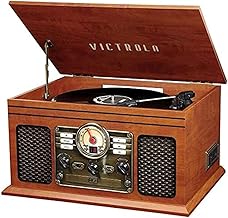
The Quincy answers a specific question: what do you buy when the boxes in the attic contain records, CDs, and cassettes all at once. It is a six-in-one music center in a mahogany finished cabinet, and it plays every one of those formats plus FM radio through its own stereo speakers.
The cabinet is a real advantage over a suitcase design. Mass absorbs energy, so vibration from the speakers has further to travel and arrives at the stylus weaker. It still shares one enclosure, so the same volume ceiling applies, but the usable range is wider and the bass has somewhere to develop.
What you give up is specialization. Every individual function here is bettered by a dedicated device, and the turntable section is a casual listening mechanism rather than a collector's tool. As a single piece of furniture that makes an entire mixed media collection playable again, though, nothing else on this list comes close.
Bottom line: the pick for households digitizing or simply enjoying an inherited collection across several formats.
- Formats: vinyl, CD, cassette, FM radio, Bluetooth, aux
- Speeds: three speed turntable
- Speakers: built-in stereo pair
- Cabinet: wood construction, mahogany finish
- Outputs: headphone jack
- Inputs: Bluetooth and 3.5 mm aux
Families with a mixed format collection, gift buyers shopping for a living room centerpiece, and anyone replacing several aging single-purpose players at once.
Not the right buy if vinyl is the only format you care about, since a component deck at similar outlay will sound better.
Keep the dust cover down between sides and wipe the cabinet with a dry cloth rather than a cleaner that could mark the finish.
Cassette mechanisms need the heads cleaned occasionally, and CD lasers dislike direct sunlight. Position the cabinet away from a window if you can.

Pros
- RCA line out allows an upgrade to real speakers
- Belt driven rather than a direct motor coupling
- Three speeds and all three record sizes
- Auto stop protects the stylus at the end of a side
- Bluetooth input and headphone jack included
Cons
- Internal speakers are modest compared with separates
- Cartridge is not designed for frequent upgrading
- Compact chassis offers limited vibration isolation
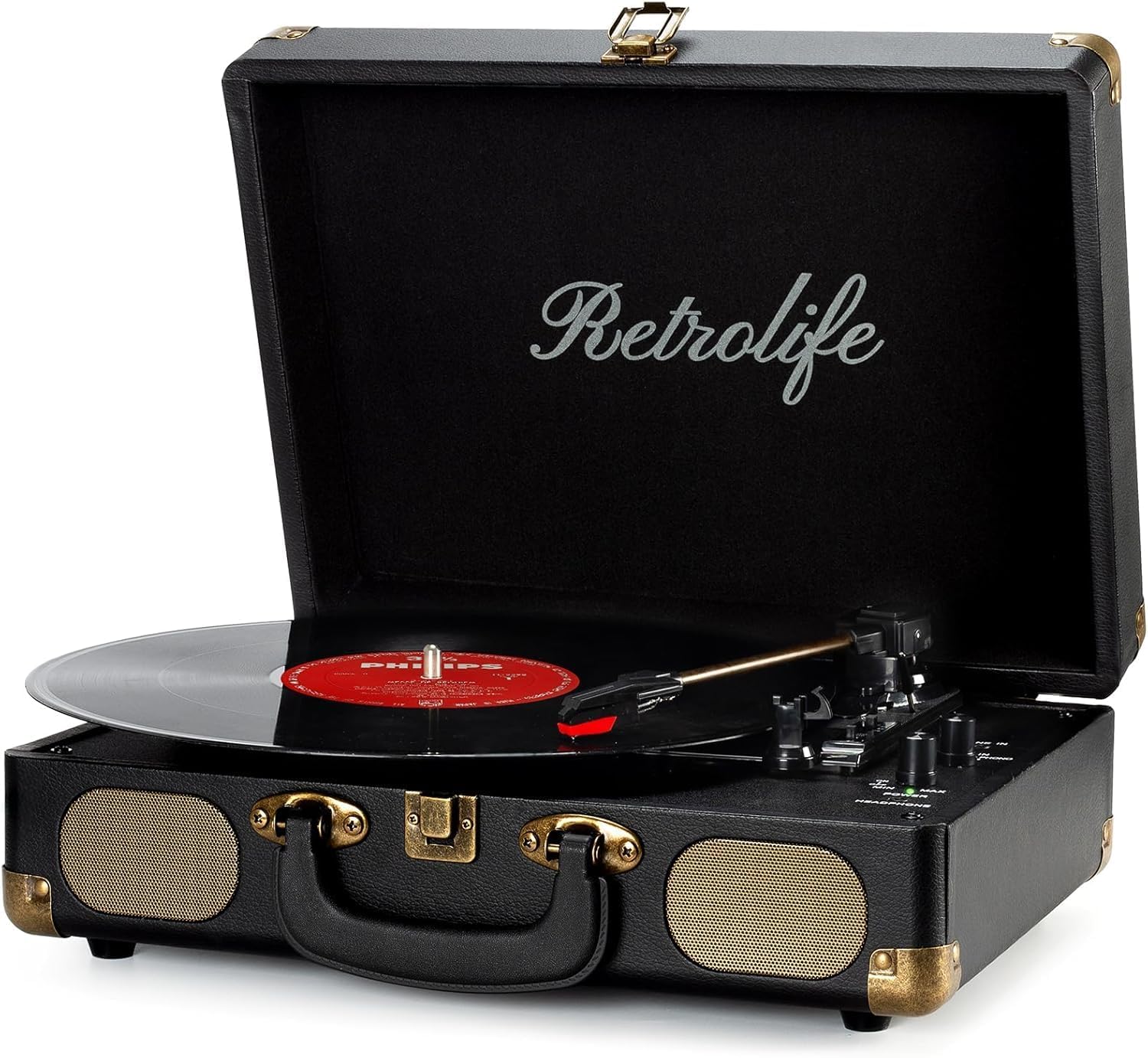
The Retrolife sits in the useful middle of this list. It is an all-in-one player with speakers in the chassis, so it works out of the box, but it also carries RCA line outputs, which means the day you buy powered speakers the same player feeds them.
Mechanically it does the sensible things. The platter is belt driven rather than sitting directly on a motor shaft, three speeds cover everything from albums to shellac, and auto stop halts the platter at the end of a side so the stylus is not left tracking the run-out groove for hours.
Expectations should be set at the right level. The built-in drivers are small and the chassis is compact, so this is a background listening machine at moderate volume until you connect it to something better. The point is that connecting it to something better is possible.
Bottom line: the right buy when you want to start simple but do not want to buy a second player in two years.
- Drive type: belt drive
- Speeds: 33-1/3, 45, and 78 RPM
- Record sizes: 7, 10, and 12 inch
- Speakers: built-in stereo pair
- Outputs: RCA line out, headphone jack
- Features: Bluetooth input, auto stop
The feature to weigh is the RCA output. If there is any chance you will add powered bookshelf speakers, that jack turns this from a disposable player into the front end of a real system.
Check whether the output is line level or phono level on the listing before pairing it with speakers, since powered speakers usually expect line level.
Use the stylus guard whenever the player is not in use and brush records before each side. Dust is the main enemy of a compact player with a small dust cover.
Auto stop protects the stylus at the end of a side, but it is still worth switching the unit off rather than leaving it powered overnight.

Pros
- Wooden cabinet damps vibration better than plastic
- Three speeds with belt drive
- RCA and aux connections plus headphone out
- Auto stop at the end of each side
- Retro styling that suits a shelf or sideboard
Cons
- Heavier and less portable than a suitcase player
- Internal speakers are modest at higher volume
- Cartridge is basic and not intended for upgrades
The Seasonlife takes the all-in-one formula and puts it in a wooden box instead of a vinyl-wrapped suitcase, and that choice matters more than the styling suggests. Mass and rigidity are how a turntable keeps speaker vibration away from the stylus, and a wooden cabinet gives the design a head start over a thin portable shell.
Everything else is familiar territory done properly. The platter is belt driven, three speeds are on offer, Bluetooth input covers streaming, and there are RCA and aux connections along with a headphone jack so the player can either stand alone or feed something larger.
The tradeoffs are the usual ones for the category. Internal speakers of this size cannot fill a large room, and the cartridge is a fixed part of the package rather than a component you will upgrade. Within its intended use, which is unhurried listening in a living room, it is a pleasant machine.
Bottom line: choose it over a suitcase player when the deck will live in one place and you value the cabinet.
- Drive type: belt drive
- Speeds: 33-1/3, 45, and 78 RPM
- Cabinet: wood, vintage finish
- Speakers: built-in stereo pair
- Connections: Bluetooth input, RCA, aux, headphone jack
- Features: automatic stop
Buyers who want a decorative piece that plays records properly in one fixed spot, and beginners who prefer a single purchase over assembling a system.
Skip it if you need to carry the player around, since the cabinet that helps the sound also adds the weight.
Measure the shelf before ordering. Cabinet players need depth for the dust cover to open as well as the closed footprint quoted in the listing.
Keep the deck off the same surface as the speakers if you ever add external ones, since shared furniture reintroduces the vibration the cabinet was chosen to avoid.

Pros
- Magnetic cartridge with a replaceable stylus
- Belt drive with built-in speakers
- Wireless playback and aux input
- Automatic shutoff at the end of a side
- Tracks lighter than a ceramic budget cartridge
Cons
- Built-in speakers still share a cabinet with the stylus
- Two channel output is modest for a large room
- Fewer speed options than the three speed players here
The interesting thing about this 1 BY ONE deck is the cartridge. Most all-in-one players in this bracket use a ceramic pickup that presses hard on the groove and sounds coarse. Fitting a magnetic cartridge with a replaceable stylus instead means lighter tracking, better detail, and a wear part you can actually replace.
The rest is a conventional all-in-one package executed cleanly: belt drive to keep motor noise out of the signal path, built-in stereo speakers so nothing else is required, wireless playback and an aux input for non-vinyl sources, and automatic shutoff so a finished side does not leave the stylus circling.
Physics still applies. Speakers and stylus share one cabinet, so this is a moderate volume machine, and the driver size limits how much room it can fill. What it does is deliver noticeably better groove tracking than most players that sell alongside it.
Bottom line: the all-in-one to pick when sound quality matters more to you than the suitcase form factor.
- Drive type: belt drive
- Cartridge: magnetic with replaceable stylus
- Speakers: built-in stereo pair
- Connections: wireless playback, aux in
- Features: automatic shutoff
- Chassis: compact all-in-one
Because the stylus is replaceable, put a rough count of playing hours somewhere you will see it and change the stylus on schedule rather than waiting for the sound to degrade.
Brush records before each side and keep the cover closed between sessions. Clean grooves are the cheapest sound upgrade available.
Listeners who want an all-in-one but care about groove wear, and anyone buying a first player for a collection they intend to keep.
Look at the Audio-Technica decks instead if you already own speakers, since removing the speakers from the cabinet is a larger upgrade than any cartridge change.
How to Choose a Vinyl Record Player
Turntable spec sheets are full of numbers that sound impressive and mean very little on their own. What actually decides whether you enjoy a deck for a decade comes down to a short list of mechanical and electrical choices, most of which are visible in the product photos if you know what to look for. Work through the ten criteria below in order and the shortlist usually narrows itself to two or three candidates.
Belt Drive Versus Direct Drive

Belt drive means the motor sits off to the side and turns the platter through a rubber belt. That belt acts as a mechanical filter, absorbing motor vibration before it can reach the stylus, which is why belt-drive decks tend to sound quieter and smoother at low volumes. The tradeoff is that belts stretch over the years and need replacing, and the platter takes a second or two to reach full speed. For someone who mostly sits down and listens to an album front to back, belt drive is the natural default, and it is what the AT-LP60X, the AT-LP60XBT, the Retrolife, and the 1 BY ONE all use.
Direct drive puts the motor directly under the platter with no belt between them. Speed comes up almost instantly, torque is far higher, and the platter holds pitch even when you rest a hand on it. That is why every DJ booth in the world runs direct drive, and it is why the AT-LP120XUSB includes a pitch fader and a strobe dot on the platter edge. Direct drive also removes a consumable part from the maintenance list. If you have any intention of beat matching, scratching, or simply want a deck that never needs a belt swap, the AT-LP120XUSB is the only genuine direct-drive option in this group.
All-in-One Players Versus Component Turntables

An all-in-one player like the Victrola Journey or the Victrola Quincy has speakers built into the cabinet, so the entire system is one purchase and one power cable. That convenience is real and it is the reason these players sell in enormous numbers. The physics, however, are unforgiving: speakers vibrate, and vibrating a cabinet that also holds a stylus creates feedback that muddies the sound as you turn the volume up. Suitcase players work best at conversational volume in a small room, which is exactly how most people use them.
A component turntable such as the AT-LP60X has no speakers at all. It sends a line-level signal out through RCA cables to powered bookshelf speakers, a stereo receiver, or a soundbar with analog inputs. Separating the vibrating parts from the sensitive parts is the single biggest sound-quality upgrade available in this price bracket, and it also means you can improve the system later by changing speakers without touching the deck. The catch is that you need those speakers, and they are a separate purchase.
There is a useful middle ground worth knowing about. Several of the all-in-one players here, including the Retrolife and the Seasonlife, include RCA line outputs, so you can start with the internal speakers and later run the same player into a real amplifier. If you suspect you will want more sound eventually but are not ready to buy speakers today, that output jack is worth checking for before you order.
Cartridge and Stylus Quality
The cartridge is the small block at the end of the tonearm that holds the stylus and converts groove wiggle into an electrical signal. It has more influence on sound than any other single part, and it is also the part manufacturers cut first to hit a price. A proper magnetic cartridge, like the dual magnet unit Audio-Technica fits to the AT-LP60X family, reads the groove with light tracking force and produces a clean, detailed signal. A ceramic cartridge, common on the cheapest suitcase players, presses harder on the vinyl and produces a flatter, harsher sound.
Replaceability matters just as much as quality. Styli wear out, typically somewhere between five hundred and a thousand hours of play, and a worn stylus does permanent damage to records. On the Audio-Technica decks and the 1 BY ONE, the stylus slides off and a fresh one clicks on in under a minute for the cost of a couple of albums. On sealed budget players the cartridge may be part of the tonearm assembly, which effectively puts an expiration date on the whole machine. If you own records you care about, buy a player with a user-replaceable stylus.
Tracking force is the related number to watch. Heavier tracking force means more groove wear over time. Entry decks set this at the factory and you cannot adjust it, while the AT-LP120XUSB gives you a counterweight and an anti-skate dial so you can set it precisely to the cartridge specification. That adjustability is one of the quiet reasons collectors gravitate toward manual decks.
Built-In Preamp and Output Options
The signal coming off a cartridge is tiny and needs both amplification and a specific tone correction called RIAA equalization before it sounds right. That job belongs to a phono preamp. Some turntables include one and some assume you already have one in your receiver. Getting this wrong is the most common reason a new deck arrives and sounds almost silent or unpleasantly thin.
Every model on this list except the classic component setups includes a switchable or fixed built-in preamp, which is the right call for most buyers. The AT-LP60X and AT-LP120XUSB both offer a line and phono switch on the back, so they work with powered speakers today and with a vintage receiver later. Look for RCA outputs at minimum, a headphone jack if you listen late at night, and a USB output if you intend to archive records to digital files, which is the standout feature of the AT-LP120XUSB.
If you plan to feed a home theater setup rather than dedicated speakers, check the input list on your receiver before ordering. Our guide to the best home theater receivers explains which models still carry a dedicated phono input and which ones expect a line-level signal from the turntable itself.
Bluetooth Streaming and Wireless Convenience
Bluetooth on a turntable comes in two directions and buyers mix them up constantly. Bluetooth output means the deck transmits to wireless speakers or headphones, which is what the AT-LP60XBT does. Bluetooth input means the deck receives audio from your phone and plays it through its own speakers, which is what most suitcase players including the Victrola Journey and the Victrola Quincy offer. One replaces speaker cables, the other turns the player into a phone speaker.
Wireless transmission does compress the signal slightly, so purists will always prefer a wired connection. In practice, sending a record to a good wireless speaker across the room sounds far better than most people expect and removes the biggest obstacle to actually using a turntable, which is finding somewhere to put speakers. The AT-LP60XBT is the cleanest execution here because it keeps a full analog output alongside the wireless one, so you are never locked into either path.
Speed Support for Seven, Ten, and Twelve Inch Records
Records come in three common speeds. Full albums almost always run at 33 and a third revolutions per minute, singles run at 45, and pre-war shellac discs run at 78. A two-speed player covers 33 and 45, which handles essentially everything sold new today. A three-speed player adds 78 support, which matters only if you are inheriting or collecting older shellac, and even then a proper 78 needs a wider stylus to sound right.
The Victrola Journey, the Retrolife, and the Seasonlife all handle three speeds and physically accept seven, ten, and twelve inch discs. The AT-LP60X and AT-LP60XBT stick to two speeds, which is a deliberate simplification rather than a shortcoming. The AT-LP120XUSB covers all three and adds a pitch fader so you can fine-tune the exact rotation speed, useful both for DJ work and for matching pitch with an instrument.
Automatic Operation Versus Manual Control
A fully automatic turntable lifts the tonearm, moves it over the lead-in groove, lowers it, and at the end of the side lifts it again and shuts the motor off. You press one button and walk away. That is the AT-LP60X and AT-LP60XBT, and it is the single best feature for households with kids, guests, or anyone who has ever fallen asleep with a record still spinning. Automation also removes the most common way beginners damage a stylus, which is dropping the arm carelessly.
A manual turntable makes you place and lift the arm yourself. Enthusiasts prefer it because there is no automatic mechanism linked to the tonearm, which in theory means nothing tugging on the arm as it tracks. The AT-LP120XUSB is fully manual, though it does include a cueing lever that raises and lowers the arm smoothly so you are not relying on a steady hand.
Auto-stop is the compromise feature to look for on budget players. The Retrolife, the Seasonlife, and the 1 BY ONE all stop the platter at the end of a side without lifting the arm. It saves the motor and stops the stylus riding the run-out groove all night, which is the outcome that actually matters.
Build Materials, Plinth, and Isolation
Everything about turntable sound quality traces back to keeping unwanted vibration away from the stylus. Mass and rigidity are how that is achieved. A heavy die-cast aluminum platter, which Audio-Technica uses across its range, stores rotational energy and smooths out tiny speed variations, and it resists ringing far better than a stamped metal or plastic platter. A dense plinth does the same job for the chassis.
Feet matter more than people assume. Rubber or damped feet decouple the deck from the furniture it stands on, which is the difference between a footstep across a wooden floor causing a skip or causing nothing at all. Wooden cabinet players like the Seasonlife and the Victrola Quincy benefit here because the mass of the cabinet itself absorbs a lot of energy that a thin vinyl-wrapped suitcase shell would pass straight through.
A dust cover is the last piece of the physical package and it is genuinely functional rather than cosmetic. Dust in a groove sounds like crackle and it also grinds the stylus tip. Every deck here ships with a hinged lid or a fitted case, but check whether the lid can stay open at an angle, because a lid that has to be fully removed usually ends up on the floor.
Digital Recording and USB Archiving
Plenty of collectors own records that were never reissued digitally, and the only way to get them onto a phone is to record them. A turntable with a USB output makes that a direct process: connect the deck to a computer, open free recording software such as Audacity, and capture the side as a single file that you split into tracks afterward. The AT-LP120XUSB is built for this and includes the software bundle to match.
Quality depends mostly on what happens before the conversion. A clean record, a fresh stylus, and a properly set tracking force do more for the final file than any setting in the software. Record at a decent sample rate, leave headroom so nothing clips, and expect a full album side to take exactly as long as the album does, since this is a real-time process with no shortcut.
If archiving is a side interest rather than the main event, note that any turntable with an analog output can be recorded through an external interface. USB support simply removes a box from the chain. For a broader look at how people are still ripping physical media at home, our guide to the best home audio CD players covers the adjacent side of that same project.
Portability and Cabinet Footprint
Suitcase players exist because they solve a real problem. A Victrola Journey folds shut with a latch and a handle, weighs very little, and can move from a bedroom to a dorm common room to a back porch without any setup beyond finding an outlet. Nothing with separate speakers can do that. If your listening happens in several different rooms, or if you are shopping for a student, portability outranks almost every audio consideration on this list.
Fixed-position players ask for a stable, level surface roughly the depth of a full album sleeve. Measure before you order, because a component turntable with the dust cover raised needs noticeably more vertical clearance than the closed dimensions suggest, and a shelf that is too shallow will not let the lid open at all. The AT-LP120XUSB in particular has a substantial footprint that reflects its DJ heritage.
Setup Effort and Long-Term Maintenance
Out-of-box effort varies more than any other factor here. An all-in-one player is genuinely plug and play: open the lid, remove the stylus guard, and drop a record on. A fully automatic component deck like the AT-LP60X takes about ten minutes because you also seat the platter, fit the belt, and connect RCA cables. A manual deck like the AT-LP120XUSB adds counterweight balancing and anti-skate setting, which is a fifteen minute job the first time and never again.
Ongoing maintenance is light but not zero. Brush the record before each side, clean the stylus tip with a soft brush moving back to front, and keep the dust cover down when the deck is idle. Belts want replacing every few years depending on use, and styli want replacing on schedule rather than when they start sounding bad, because by then groove damage has already happened.
Warranty and parts availability separate a purchase you keep from one you replace. Established brands stock replacement belts, styli, and dust covers years after a model ships, which is a meaningful advantage for the Audio-Technica and Victrola decks here over less established sellers.
| Model | Drive type | Speakers | Standout feature |
|---|---|---|---|
| Audio-Technica AT-LP60X | Belt | None, line out | Fully automatic hi-fi entry deck |
| Victrola Journey | Belt | Built-in stereo | Portable suitcase design |
| Audio-Technica AT-LP120XUSB | Direct | None, line out | USB archiving and pitch control |
| Audio-Technica AT-LP60XBT | Belt | None, wireless out | Bluetooth transmission to speakers |
| Victrola Quincy | Belt | Built-in stereo | Vinyl, CD, cassette, and FM in one |
| Retrolife | Belt | Built-in stereo | Three speeds with RCA line out |
| Seasonlife | Belt | Built-in stereo | Wooden cabinet with auto stop |
| 1 BY ONE | Belt | Built-in stereo | Magnetic cartridge on an all-in-one |
Why You Should Trust Us
We build these shortlists from the same information a careful shopper would gather, then organize it so the tradeoffs are visible instead of buried. Every model here was screened against verified customer ratings at scale, with a floor on both average score and total number of ratings, so nothing makes the list on the strength of a handful of early reviews. We then read through the recurring complaints as closely as the praise, because a pattern of tonearm or belt failures tells you more about long-term ownership than a high average ever will.
From there the editorial work is comparison rather than measurement. We deliberately kept both all-in-one players and component decks in this roundup because they answer different questions, and we removed near-identical color variants of the same chassis so the list reflects eight genuine choices rather than eight listings. Specifications are taken from manufacturer documentation. Where a claim could not be verified against the maker’s own materials, we left it out rather than repeat it.
Final Thoughts
The best overall pick is the Audio-Technica AT-LP60X. It hits the point where a turntable stops being a toy and starts being an instrument: a real magnetic cartridge, a replaceable stylus, a die-cast aluminum platter, and fully automatic operation that makes it as easy to use as a suitcase player. Pair it with any set of powered bookshelf speakers and you have a system that will still be worth listening to in ten years.
For best value, the Victrola Journey is hard to argue with. One purchase gets you a complete playback system with speakers, Bluetooth input, and a handle, and it plays all three speeds. It is not the deck for a serious collection, but it is the right first turntable for a lot of people and it costs a fraction of a component setup. The Victrola Quincy earns a mention in the same spirit for anyone who also has CDs and cassettes to play.
If you want one deck for the long haul, the Audio-Technica AT-LP120XUSB is the best choice for enthusiasts and anyone archiving records to digital, thanks to direct drive, full manual adjustment, and USB output. The AT-LP60XBT is the pick for wireless households, and the Retrolife, Seasonlife, and 1 BY ONE cover the middle ground where you want built-in speakers with an upgrade path. Browse more audio coverage in our electronics guides or see everything new in our latest articles.
Frequently Asked Questions
Does a vinyl record player damage records over time
Any stylus riding in a groove causes microscopic wear, but a well-set-up deck causes so little that records last generations. Damage comes from three specific things: a worn stylus, excessive tracking force, and dust. Replace the stylus on schedule rather than waiting for it to sound bad, use a player whose tracking force is either factory set correctly or adjustable, and brush every record before you play it. Do those three things and groove wear stops being a concern.
Do I need separate speakers in 2026
Only if you buy a component turntable. Every all-in-one player here has speakers in the cabinet and works on its own. If you buy an Audio-Technica deck without built-in speakers, you need either powered bookshelf speakers, a stereo receiver with passive speakers, or in the case of the AT-LP60XBT a Bluetooth speaker. Check our Bluetooth transmitter and receiver guide if you want to send a wired turntable to speakers you already own.
What is the difference between a turntable and a record player
In common usage a record player is a complete system with amplification and speakers built in, while a turntable is just the spinning and tracking mechanism that outputs a signal for something else to amplify. Manufacturers use the terms loosely, so read the specification rather than the product name. If the listing mentions built-in stereo speakers, it plays on its own. If it mentions RCA line output and a phono switch but no speakers, you need to supply the rest of the chain.
Can a vinyl record player play 78 RPM shellac records
Some can spin at 78, including the Victrola Journey, the Retrolife, the Seasonlife, and the AT-LP120XUSB. Spinning at the right speed is only half the job, though. Shellac grooves are much wider than vinyl grooves, so a standard stylus sits too deep and sounds noisy while wearing the disc. For a serious 78 collection you want a player that supports the speed and a dedicated 78 stylus to go with it.
How long does a stylus last before it needs replacing
Most conical and elliptical styli are rated somewhere between five hundred and one thousand hours of play, which for an average listener is a few years. Track it roughly by counting albums rather than trying to log hours precisely. Signs that you have waited too long include harshness on loud passages, sibilance on vocals, and mistracking on inner grooves. Replacing a stylus is a one-minute job on every replaceable-stylus deck in this roundup.

Write Your Review
No reviews yet. Be the first to share your experience!