

The most expensive mistake in this category is buying a component CD player and discovering it makes no sound on its own. A separate deck outputs a signal and nothing more, so it needs an amplifier and speakers around it before it does anything at all. An all-in-one shelf system contains its own amplification and speakers and plays music the moment you plug it in. Both are sold under the same search term. Our top pick is the Onkyo DXC390 for offering six disc capacity and a proper component output at a sensible level of investment. This shortlist of 8 options from Onkyo, Sharp, Philips and more separates the two types and compares them on disc handling, outputs, and how they age.
Every model here is a current listing backed by real customer ratings, covering single disc decks, carousel changers, and compact systems with speakers built in. For related equipment, see our electronics guides.
Pros
- Six disc carousel suits long uninterrupted listening
- Component output means quality is set by your amplifier
- Long track record with a deep rating history
- Standard component width fits existing racks
- Simple, well proven control layout
Cons
- Needs an amplifier and speakers to make any sound
- Carousel mechanism has more moving parts than a single tray
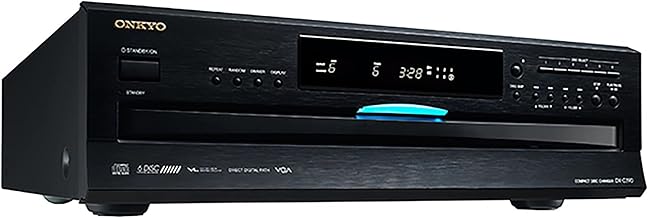
The DXC390 is the pick for anyone who already has an amplifier and speakers, because in that situation it is the cheapest route to good disc playback: you are buying only the part you are missing rather than a whole system.
Six disc capacity is the practical feature. Loading an afternoon of music and leaving it alone is what a carousel is for, and it is genuinely useful in a way that a single tray deck cannot match for background listening or entertaining.
Two caveats matter. This box makes no sound by itself, which surprises a steady stream of buyers each year, and it needs an interconnect cable that is rarely supplied. The carousel also adds a rotation motor and positioning mechanism to the usual tray, and those extra moving parts are the ones that eventually stick on any changer.
Bottom line: excellent value as an addition to an existing system, and the wrong purchase entirely if you have nothing to plug it into.
- Type: component CD changer
- Capacity: 6 discs on a carousel
- Output: analogue stereo to an amplifier
- Chassis: standard component width
- Control: front panel plus remote
- Functions: programming, repeat, random
- Speakers: not included, none built in
Listeners with an existing amplifier and speakers who want to add or replace disc playback, and anyone with a large collection who values leaving several albums loaded.
It is not suitable for someone starting from nothing, who should choose one of the all-in-one systems in this shortlist.
Keep the tray closed when idle so dust does not settle on the lens, which is the most common preventable cause of read errors.
Leave ventilation space above the unit and avoid stacking equipment on top, since heat shortens the life of the electronics and the mechanism alike.

Pros
- Complete system that plays straight out of the box
- Bluetooth receiving covers phone and tablet playback
- Separate speaker enclosures allow real stereo placement
- USB and MP3 support alongside discs
- Strong rating history for a compact system
Cons
- No digital output, so no upgrade path for conversion
- Compact cabinets limit low frequency output
This is the value pick for anyone starting from nothing. It arrives complete, plays a disc the moment it is plugged in, and covers the three sources most households actually use: discs, phone streaming over Bluetooth, and radio.
The separate speaker enclosures are worth more than the specification sheet suggests. Two cabinets that can be placed apart produce real stereo separation and have more internal volume than speakers crammed into a single unit, which is the main reason systems like this sound better than the all-in-one boxes below them in the market.
The ceiling is real though. There is no digital output, so the internal conversion is what you have for the life of the unit, and small cabinets cannot produce deep bass regardless of the power figure printed on the front. Bluetooth here is receive only, as it is on nearly every system in this class.
Bottom line: the sensible complete answer for a first system or a kitchen and bedroom setup, with a quality ceiling you should be aware of before expecting more.
- Type: all-in-one shelf system
- Disc: CD with MP3 disc support
- Wireless: Bluetooth receiving
- Radio: FM tuner
- Other inputs: USB, auxiliary
- Speakers: separate enclosures included
- Control: front panel and remote
Place the two speakers as far apart as the cable allows and at roughly ear height when seated. Stereo separation is free performance and most owners never claim it.
If you have a large collection of burned discs, confirm MP3 and CD-RW behaviour before relying on it, since rewritable discs are the least consistently supported format.
Pair a phone once and the system will generally reconnect automatically afterwards. If it does not, remove the pairing on both devices and start again rather than pairing twice.
Position the FM wire aerial high and extended rather than coiled behind the unit, which is where most reception complaints originate.

Pros
- Bass boost helps thin sound from small cabinets
- Covers discs, Bluetooth, USB, and radio
- Separate speakers allow stereo placement
- Simple operation from panel or remote
- Established model with solid rating history
Cons
- Bass processing cannot replace cabinet volume
- No digital output for future upgrades
The FX10 is the same idea as the other Philips system here with a different emphasis. The bass boost mode is aimed squarely at the known weakness of compact systems, which is that small sealed cabinets cannot move enough air to produce low frequencies.
Used sensibly it helps. Boosting the upper bass region makes music sound fuller at moderate volume, and for background listening in a kitchen or bedroom that is exactly the right trade. It covers the usual sources too, with discs, Bluetooth, USB, and radio all present.
What processing cannot do is create bass the speakers are physically unable to produce, and pushed hard it costs clarity in the midrange where voices live. Treat it as a tone control for quiet listening rather than a fix. Like its sibling, there is no digital output, so the internal conversion is fixed for the life of the unit.
Bottom line: a good compact system whose headline feature is genuinely useful within limits that are worth understanding.
- Type: all-in-one shelf system
- Disc: CD and MP3 disc playback
- Wireless: Bluetooth receiving
- Radio: FM tuner
- Inputs: USB and auxiliary
- Audio: bass boost mode
- Speakers: separate enclosures
Use bass boost at low and moderate volumes where it fills out the sound, and switch it off when playing loudly, since that is where it muddies voices.
Keep the speakers off the surface they sit on with small pads if the shelf resonates, which is a cheap improvement to perceived bass quality.
Buyers who want a complete compact system and know their listening happens at background and moderate levels, where the bass mode does its best work.
Anyone chasing genuine low end should be looking at larger speakers on a component system instead.

Pros
- Working cassette deck is genuinely rare now
- Five disc changer for long listening sessions
- Separate speakers with useful cabinet volume
- Bluetooth streaming alongside physical formats
- Covers the widest range of sources here
Cons
- Cassette mechanisms need belts that perish with age
- Larger footprint than single disc systems
The CD-BH950 exists for a specific and underserved buyer: someone with tapes. Cassette decks have almost disappeared from new products, and for anyone holding recordings that were never transferred to another format, this system is the practical way to hear them without hunting down a separate deck of unknown condition.
Around that it is a capable mini system. The five disc changer suits long sessions, the separate speakers give real stereo placement and better cabinet volume than an all-in-one box, and Bluetooth covers modern sources so the system does not feel like a museum piece.
The caution is mechanical. Cassette transports rely on rubber belts and pinch rollers that perish with age whether used or not, and they are the part most likely to need attention over years. The unit is also larger than single disc systems, which matters on a crowded shelf.
Bottom line: the obvious choice if tapes are part of your collection, and a solid multi disc system even if they are not.
- Type: mini shelf system
- Disc capacity: 5 discs
- Cassette: tape deck included
- Wireless: Bluetooth receiving
- Radio: FM tuner
- Speakers: separate enclosures
- Control: front panel and remote
Clean the cassette heads periodically with a proper head cleaner, since oxide build up degrades playback long before anything fails outright.
Do not store tapes in the deck. Leaving a cassette engaged puts constant pressure on the pinch roller and flattens it.
Households with a mixed collection of discs and tapes, and anyone digitising old recordings who needs a reliable transport to play them from.
Buyers with no tapes can save space with one of the single disc systems here.

Pros
- Single cabinet takes minimal shelf space
- Straightforward operation with few menus
- Bluetooth and disc playback in one unit
- Suits bedrooms, kitchens, and workshops
- Light enough to move between rooms
Cons
- Single cabinet gives little stereo separation
- Limited low frequency output from a small enclosure
The Exos Home is the compact end of this shortlist. Everything lives in one cabinet, which makes it the easiest unit here to fit on a crowded shelf or to carry between a kitchen and a workshop.
For its intended use it does the job well. Discs play, phones connect over Bluetooth, radio works, and the controls are simple enough that nobody needs a manual. That simplicity is a genuine feature in a category where menu driven systems frustrate casual users.
The compromises follow from the format. Two drivers in one small box cannot produce meaningful stereo separation, because the speakers are only inches apart, and a small sealed enclosure limits bass no matter what the wattage says. This is a background music machine rather than a listening system.
Bottom line: the right choice when space and simplicity matter more than sound staging, and the wrong one if you want a proper stereo image.
- Type: compact all-in-one system
- Disc: CD playback
- Wireless: Bluetooth receiving
- Radio: FM tuner
- Rated output: 30W
- Cabinet: single unit
- Control: panel and remote
Kitchens, bedrooms, garages, and workshops where a small footprint and easy operation matter more than sound quality ceilings.
Listeners seated in one place for an album should choose a system with separate speakers instead.
Keep it away from cooking steam and dust if it lives in a kitchen, since both reach the disc mechanism through the tray opening.
Leave clearance around the cabinet for ventilation, and avoid carrying it with a disc loaded.

Pros
- Simplest possible mechanism with fewest failure points
- Digital output allows external conversion later
- Established audio brand with strong build quality
- Clean component design for a hi-fi rack
- Highest sound quality potential in this shortlist
Cons
- Requires an amplifier and speakers to work
- Single disc only, no changer convenience
The CD-S303 is the audiophile choice in this group, and its case rests on doing one thing without compromise. A single tray is the simplest transport available, with no carousel motor and no positioning mechanism, which means fewer parts to age and a more stable platform for reading a disc.
The digital output is the feature worth paying for. It lets the raw data leave the player untouched so an external converter or a modern amplifier can handle conversion, and since converters have improved far more over the years than disc mechanisms have, that is the most effective upgrade path this category offers.
The requirements are the usual ones for separates. You need an amplifier with a free input, speakers, and cables, and if you do not have those already the total cost is well above any of the shelf systems here. There is also no changer convenience: one disc at a time, every time.
Bottom line: the best sounding option in this shortlist for a system that can make use of it, and an expensive paperweight for anyone who cannot.
- Type: component single disc player
- Capacity: 1 disc
- Outputs: analogue stereo and digital
- Chassis: full width component
- Control: front panel and remote
- Speakers: none, requires amplification
- Build: hi-fi component construction
Check your amplifier's inputs before ordering. If it is digital only, plan to use the digital output, and if it is analogue only, the internal conversion is what you will hear.
Budget for a stereo interconnect cable, which is almost never supplied with component players.
Keep the tray closed when idle and leave ventilation clearance above the chassis. Component players run warm and heat is what ages electronics.
Handle discs by the edges. Fingerprints and radial scratches are the two things that cause read errors on an otherwise healthy player.

Pros
- Established brand with consistent build standards
- Covers discs, Bluetooth, radio, and USB
- Compact enough for a shelf or sideboard
- Simple controls suited to everyday use
- Bass adjustment for small room listening
Cons
- Compact enclosures limit low frequency output
- No digital output for future upgrades
The Panasonic system is a straightforward, well built compact system from a brand that has been making them for decades, and that consistency is most of its argument. Everything works the way you expect, the controls are labelled clearly, and the source switching is simple.
Coverage is complete for ordinary use: discs, Bluetooth from a phone, FM radio, and USB files. For a living room, bedroom, or study where the system provides music rather than being the focus of attention, that is the full set of sources most people need.
The limits are those of the format. Compact cabinets do not produce deep bass, the bass adjustment helps within limits rather than transforming it, and there is no digital output, so the internal conversion is what you have permanently.
Bottom line: a dependable compact system with no surprises, which in this category is worth a great deal.
- Type: compact shelf system
- Disc: CD playback
- Wireless: Bluetooth receiving
- Radio: FM tuner
- Input: USB
- Audio: bass adjustment
- Control: panel and remote
Buyers who want a known brand, predictable operation, and all common sources in one compact unit for a room where music plays in the background.
Listeners who want depth and scale should look at component separates with full sized speakers.
Set bass adjustment by ear at the volume you normally use, since a setting that sounds full at low volume often sounds heavy when turned up.
Extend the radio aerial fully and route it away from the mains lead, which reduces interference on weaker stations.

Pros
- Retro styling suits rooms where equipment is visible
- Compact micro system footprint
- Bluetooth and disc playback together
- Straightforward controls with a classic layout
- Works as a decorative as well as functional item
Cons
- Newer listing with a shorter rating history
- Micro format limits output and bass extension
The WISCENT trades on appearance as much as function, and that is a legitimate reason to buy audio equipment that sits in view. The vintage styling suits rooms where a black plastic box would look out of place, and the classic control layout is easier for casual users than menu driven systems.
Functionally it covers the essentials: discs play, phones connect over Bluetooth, and radio is there. For a bedroom, a study, or a room where the system is part of the decor, that combination is sufficient.
Two things temper the recommendation. This is a newer listing with less accumulated feedback than the established names here, which matters in a category where the mechanism is the part that ages. And the micro format constrains both output and bass extension, so it is a background system rather than a serious listening one.
Bottom line: buy it because you want how it looks as well as what it does, and set expectations for sound accordingly.
- Type: micro hi-fi system
- Disc: CD playback
- Wireless: Bluetooth receiving
- Radio: tuner included
- Styling: vintage inspired
- Footprint: compact
- Control: panel and remote
Rooms where the equipment is on display and its appearance matters, and users who prefer simple physical controls to layered menus.
Anyone prioritising sound quality per pound should choose a plainer system with larger speakers.
Dust the cabinet and keep the tray closed when idle, since a system on display collects more dust than one in a rack.
Allow ventilation clearance behind the unit even where it is placed for looks rather than airflow.
How to Choose a Home Audio Cd Player
The first decision decides all the others, so it belongs at the top.
Separates or All-in-One
A component CD player is one box in a chain. It reads the disc, converts the digital data to an analogue signal, and sends that signal out through a pair of sockets to an amplifier, which drives speakers. Remove any part of that chain and there is silence. The Yamaha CD-S303 and the Onkyo carousel decks in this list are component players.
An all-in-one shelf system puts the disc mechanism, the amplifier, and often the speakers into a single package. Plug it in, put a disc in, and it plays. The Philips, Sharp, AIWA, Panasonic, and WISCENT models here are all systems of this kind, and for most people replacing an old stereo, this is the category they actually want.
The reason to choose separates is upgrade path and sound quality ceiling. A component deck feeding a decent amplifier and real speakers will outperform any compact system, and each part can be replaced independently as budget allows. The reason to choose an all-in-one is that it works out of the box, occupies one shelf, and costs less in total than the three boxes it replaces.
What a Component Deck Needs Around It
If you go the separates route, budget for the rest. You need an amplifier or receiver with a spare analogue input, a pair of speakers with cable to reach them, and a stereo interconnect cable to join the player to the amplifier, which is rarely supplied in the box.
An existing setup changes this calculation entirely. If there is already an amplifier and speakers in the room, adding a component player is the cheapest possible way to get high quality disc playback, because you are buying only the part you lack.
Check what inputs your amplifier actually has before ordering. Older receivers have plenty of analogue inputs. Some newer compact amplifiers are digital only, in which case a player with a coaxial or optical output becomes necessary rather than optional.
Changers, Single Trays, and Moving Parts
Carousel changers hold several discs on a rotating platter and swap between them, which is genuinely useful for long listening sessions or for keeping a few albums permanently loaded. The Onkyo decks in this shortlist hold six discs and the Sharp system holds five.
The trade is mechanical complexity. A carousel has a rotation motor, a positioning mechanism, and a tray in addition to everything a single disc player has, and every one of those is a moving part that can eventually stick. A single tray player like the Yamaha has the simplest mechanism available and correspondingly fewer ways to fail.
If a changer appeals, be honest about whether you will use it. Many owners load one disc and treat a six disc machine as a single disc player, in which case they have bought five extra mechanisms and the wear that comes with them.
Digital Outputs Matter More Than They Look

A digital output, either coaxial or optical, sends the raw data off the disc without converting it inside the player. That lets an external converter or a modern amplifier do the conversion instead, which is the single most effective upgrade path available in this category because converters have improved far more than disc mechanisms have.
It also future proofs the purchase. A player with only analogue outputs is locked to the quality of its internal conversion for life. A player with a digital output can be paired with better electronics later without being replaced.
All-in-one systems rarely offer this, and that is not a flaw, it is a consequence of the format. If a digital output matters to you, that decision points firmly toward separates.
Bluetooth Goes One Way or the Other
Bluetooth on a shelf system almost always means receiving: a phone sends audio to the system and the system plays it. That is what most buyers want and it is what the Philips, AIWA, and Panasonic systems here provide.
Sending is the opposite and much rarer. A system that transmits Bluetooth can send the sound from a disc to wireless headphones or a wireless speaker elsewhere in the house. If that is what you had in mind, look for it explicitly, because a listing saying only Bluetooth almost certainly means receive only.
Version numbers matter less than people expect for stereo music, though newer versions generally hold connections more reliably across a room. Multi-room streaming features on some systems are a separate capability again and are worth checking individually.
Which Discs Will Actually Play
Pressed commercial CDs play in everything. Home burned discs are less certain. CD-R, which is write once, is widely supported. CD-RW, which is rewritable, has a lower reflectivity and some players refuse it entirely, and older mechanisms are the fussiest.
Discs full of MP3 files are a third case. A player that supports MP3 discs can hold many hours of music on one disc and needs a display and navigation system to find anything on it. A player without MP3 support will look at the same disc and report an error, since it is a data disc rather than an audio one.
If you have a large collection of burned discs, check this specifically against each model. It is the compatibility question most likely to produce disappointment after delivery.
Built-In Speakers Are Limited by the Box

A compact system’s speakers are constrained by their cabinets, and cabinet volume is what produces low frequencies. There is no processing that overcomes a small sealed box, which is why systems in this class often sound thin at the bottom regardless of the wattage printed on the front.
Systems with separate speaker boxes, as the Sharp and several Philips models here have, generally do better than those with speakers built into the main unit, simply because two separate enclosures give more internal volume and allow real stereo separation once they are placed apart.
Watt ratings on compact systems are close to meaningless for comparison, since manufacturers measure them differently. Cabinet size and driver size tell you more about what you will hear.
Radio, Cassette, and USB as Real Features
FM radio is standard on nearly every system here and works as well as its aerial allows, which for an indoor wire aerial means reception depends heavily on placement. If radio matters, look for an external aerial socket.
Cassette is genuinely rare now, and the Sharp system in this list includes it. For anyone with tapes that have never been transferred, that is not nostalgia, it is the only practical way to hear them without buying a separate deck.
USB playback varies more than the listing suggests. Some systems play files from a stick and some also record from disc to stick. Recording is worth having if you plan to move a collection onto digital storage, and it is worth confirming rather than assuming.
Displays and Remotes Decide Daily Use

A player used from an armchair lives or dies by its display and remote. Track numbers on a small dim panel are unreadable from across a room, and on systems that show file names from MP3 discs, a short scrolling display makes navigation frustrating.
Remotes vary from full function handsets to minimal ones that omit direct track entry. If the system will be used by someone who wants simple, large buttons rather than a dense grid, that is worth checking in the product photographs before ordering.
Front panel controls matter as a fallback. Remotes are lost and batteries die, and a unit whose basic functions are all on the front will keep working when that happens.
The Mechanism Is What Wears Out
The electronics in a CD player generally outlast the mechanics. What fails first is the optical assembly that reads the disc, the small motor that moves it, and on older designs the rubber belts that open trays and rotate carousels. Belts perish with age whether or not the machine has been used, which is why long stored players often work electrically but will not open.
Symptoms follow a pattern. Discs that used to play begin skipping, then the player takes longer to read a disc, then it refuses discs that are visibly fine. That progression usually means the laser assembly is losing output rather than that your discs have degraded.
Keep the tray closed when not in use, since dust on the lens is a common and entirely preventable cause of read errors. Avoid stacking anything on top of a player, as heat has nowhere to go and warm electronics age faster.
| Model | Type | Disc capacity | Speakers included |
|---|---|---|---|
| Onkyo DXC390 | Component changer | 6 discs | No |
| Yamaha CD-S303 | Component single deck | 1 disc | No |
| Philips Bluetooth system | All-in-one shelf system | 1 disc | Yes |
| Philips FX10 | All-in-one with bass boost | 1 disc | Yes |
| Sharp CD-BH950 | Mini shelf system with cassette | 5 discs | Yes |
| AIWA Exos Home | Compact Bluetooth system | 1 disc | Yes |
| Panasonic compact system | All-in-one shelf system | 1 disc | Yes |
| WISCENT vintage system | Micro HiFi system | 1 disc | Yes |
If portability matters more than home listening, our guide to portable CD players for the car covers a different set of needs entirely.
Why You Should Trust Us
We separate component players from all-in-one systems at the top of this guide because that distinction is where buyers most often go wrong, and the listings themselves rarely make it clear. Every model here is a current listing with enough customer rating history to show how the mechanism behaves over time.
We do not accept payment for placement. Where a system’s built-in speakers limit what it can do, or where a deck needs an amplifier you may not own, we say so directly rather than describing everything as a complete solution.
Final Thoughts
The Onkyo DXC390 is our best overall pick for anyone who already has an amplifier and speakers. Six disc capacity suits long listening, the component output means the sound quality ceiling is set by the rest of your system rather than by the player, and it has the longest track record of anything here.
The Philips Bluetooth stereo system is our best value choice for anyone starting from nothing, since it arrives complete and plays the moment it is plugged in. For the best sound from a single disc, the Yamaha CD-S303 has the simplest mechanism and the cleanest component design in this group, and the Sharp CD-BH950 is the one to buy if you still have cassettes worth hearing.
Decide between separates and all-in-one before anything else, confirm your amplifier has an input free if you go the component route, and check MP3 disc support if your collection is burned rather than pressed. More audio equipment is in our latest guides.
Frequently Asked Questions
Will a home audio cd player work without an amplifier?
A component deck will not, because it outputs a signal rather than driving speakers. It needs an amplifier or receiver and a pair of speakers to make any sound. An all-in-one shelf system does work on its own, since the amplifier and speakers are built in, which is why that distinction is the first thing to settle.
Are CD players still worth buying in 2026?
If you own discs, yes, because playing them is the only way to hear that collection without buying it again through a streaming service. Discs also play the same whether or not a licensing deal changes, which is not true of streamed catalogues. If you own no discs, the case is much weaker.
Will these play burned CD-R and MP3 discs?
CD-R support is common, CD-RW support is less consistent because rewritable discs reflect less light, and MP3 data discs need explicit support along with a display for navigation. Check each model individually if your collection is mostly burned discs, since this is the most common source of post purchase disappointment.
Is a multi disc changer better than a single tray?
It is more convenient and mechanically more complex. A carousel adds a rotation motor and positioning mechanism on top of everything a single tray has, and those are the parts that stick with age. If you would genuinely keep several discs loaded, the convenience is real. If not, a single tray has fewer things to fail.
Why has my player started skipping?
Usually the optical assembly losing output rather than the discs degrading, especially if it now takes longer to read a disc before playing. Dust on the lens is the preventable version of the same symptom, so keep the tray closed when not in use. On older machines, perished drive belts stop trays opening even when everything else works. More audio picks are in our category directory.


Write Your Review
No reviews yet. Be the first to share your experience!