

Anyone who has fallen down the coffee rabbit hole eventually hits the same wall: the machine on the counter cannot make the cup in your head. That is where the specialty coffee makers category begins. These brewers give you control over the variables that actually change flavor, namely water temperature, the ratio of water to coffee, how long the water and grounds stay in contact, and how evenly the bed of coffee is saturated. For September 2026 we pulled together a shortlist of 11 specialty coffee makers covering espresso, pour-over, immersion and cold brew, with real customer ratings from brands like Bodum, Chemex, Hario and more. Our top pick is the Breville Barista Pro for its built-in conical burr grinder and fast ThermoJet heating system, which lets one machine handle grinding, dosing and steaming without a separate grinder on the counter.
One thing to be clear about up front: this list deliberately skips ordinary drip machines and timer-driven brewers. If your goal is a full carafe waiting for you at seven in the morning, you want a simple automatic machine instead, and our roundup of the best coffee makers covers that ground properly. Everything below is built for people who want to steer the brew rather than press one button. Some of these are electric, some are entirely manual, and a few cost less than a week of cafe visits.

Pros
- Integrated conical burr grinder doses straight into the portafilter
- ThermoJet heating system reaches brew temperature in seconds
- Digital temperature control keeps shots consistent
- Manual steam wand handles microfoam for latte art
- LCD display walks you through each stage of the shot
Cons
- Takes up meaningful counter space and needs headroom for the hopper
- Steeper learning curve than a pod machine
- Single boiler means brewing and steaming happen in sequence, not together
The Barista Pro is the machine most people should buy if they want cafe style drinks at home without assembling a whole setup. It packs a conical burr grinder, a pump espresso group and a steam wand into a single stainless body, and the grinder feeds the portafilter directly so the coffee goes from bean to puck in seconds.
Its strongest feature is the ThermoJet heating system, which brings the machine to brew temperature in a few seconds rather than the minutes older thermoblock machines need. Paired with digital temperature control, that means the second shot of the morning tastes like the first. The LCD display shows extraction progress, which turns an abstract process into something you can adjust deliberately.
The honest limitations are physical. It is a single boiler machine, so brewing and steaming happen one after the other, and the hopper needs clearance above the unit. It also demands attention: a level tamp and a correct grind setting matter far more here than on a pod machine, and the first week involves some wasted coffee.
Bottom line: for anyone serious about espresso and milk drinks who wants one appliance instead of two, the Barista Pro is the most complete package on this list and our best overall pick.
- Type: semi-automatic pump espresso machine
- Grinder: integrated conical burr with adjustable settings
- Heating: ThermoJet system with digital temperature control
- Milk: manual steam wand for microfoam
- Portafilter: 54 mm
- Body: brushed stainless steel
- Extras: dosing and tamping tools included
Best for the drinker who orders lattes and cappuccinos more often than black coffee, and who wants to learn espresso properly rather than press a capsule button. It also suits households replacing both an old machine and a blade grinder in one purchase.
It is not the right pick if you mainly drink filter coffee by the carafe, or if counter space is genuinely tight.
Run a blank shot of water through the group head before your first espresso to warm the portafilter and the cup. Dial the grind finer if the shot runs fast and thin, coarser if it chokes and drips.
Keep the steam wand purged and wiped after every milk drink. Dried milk inside the tip is the fastest way to lose steam power.

Pros
- Built-in conical burr grinder for fresh grounds
- Real steam wand for lattes and cappuccinos
- Precise dose and temperature control
- Solid stainless steel build
- Grind, brew, and steam from one machine
Cons
- Higher price than drip or pod machines
- Steeper learning curve
- Needs regular cleaning of wand and portafilter
The Breville Barista Express is the machine to buy when drip coffee no longer cuts it and you want cafe drinks at home. It is a semi-automatic espresso maker with a conical burr grinder built right in, so whole beans are ground fresh straight into the portafilter moments before you pull a shot.
The powerful pump and steam wand let you make espresso, then steam and texture milk for lattes, flat whites, and cappuccinos. Dose control and temperature regulation give you the levers to refine your shot, and the all-metal build feels built to last on the counter.
This control comes with a learning curve and a higher price than any drip or pod machine on our list. You will also need to clean the steam wand and portafilter regularly to keep drinks tasting right, so it rewards people who enjoy the ritual.
Bottom line: for genuine espresso and milk drinks without a trip to the coffee shop, the Barista Express is our best espresso pick and a joy for hands-on brewers.
- Type: Semi-automatic espresso
- Grinder: Integrated conical burr
- Pump: 15-bar Italian
- Milk: Manual steam wand
- Control: Dose and temperature regulation
- Body: Stainless steel
The steam wand produces the microfoam you need for latte art and silky cappuccinos. Purge the wand before and after steaming, keep the milk cold to start, and you can build cafe-quality drinks once you get the technique down.
Wipe and purge the steam wand after every use, backflush the group head periodically, and run the descaling cycle as recommended. Keeping the grinder and portafilter clean is the single biggest factor in consistent flavor.

Pros
- Very affordable entry into real pump espresso
- 15 bar pump delivers proper pressure for extraction
- Manual frother makes cappuccino and latte possible
- Slim footprint fits small kitchens
- Simple controls with almost nothing to configure
Cons
- No grinder included, so a burr grinder is an extra purchase
- Plastic portafilter and pressurised basket limit how far you can push flavor
- Thermoblock needs a warm-up before the first shot
The Stilosa strips espresso back to the essentials: a 15 bar pump, a boiler, a portafilter and a frothing wand. There is no display, no grinder and no automation, which is exactly why it costs so little and why it is our best value pick.
What it does well is teach. Because nothing is automated, you learn how dose, tamp pressure and grind size change the shot, and those lessons transfer to any machine you buy later. The frother produces enough steam for a home cappuccino, and the compact body slots into kitchens where a full setup would never fit.
The compromises are visible. The portafilter and basket are pressurised, which makes the machine forgiving of coarse or stale coffee but also puts a ceiling on how expressive the shot can get. There is no grinder, so budget for a burr grinder alongside it, and give the thermoblock a couple of minutes to stabilise before the first pull.
Bottom line: the best low-cost path from drip coffee to real espresso, provided you accept that a grinder is the next purchase rather than an optional one.
- Type: manual pump espresso machine
- Pump pressure: 15 bar
- Boiler: stainless steel
- Milk: manual frother wand
- Baskets: single and double, pressurised
- Water tank: removable
- Grinder: not included
Pair it with a burr grinder and freshly roasted beans and the gap to far pricier machines narrows considerably. Pair it with pre-ground supermarket coffee and you will get a thin, flat shot no matter what you do.
If you want an all-in-one instead, step up to a machine with an integrated grinder. If you only want milk drinks quickly, a pod machine is a different answer to a different question.
Descale on a schedule that matches your water hardness, since thermoblock machines are sensitive to scale build-up. Empty and rinse the drip tray regularly and never immerse the body in water.
Purge the steam wand after each use and let the machine cool before dismantling the portafilter.

Pros
- 20 bar pump with a stable pressure gauge on the front
- Stainless steel body feels sturdier than its price suggests
- Powerful steam wand for milk foam
- Narrow footprint suits apartment kitchens
- Removable water tank refills without moving the machine
Cons
- No grinder included
- Small water tank needs frequent refilling for milk drinks
- Pressurised basket limits fine tuning
CASABREWS built the CM5418 around a single problem: espresso machines are usually too wide for small kitchens. The body is noticeably slim, wrapped in stainless steel, and the front carries a pressure gauge so you can see what the pump is doing during a shot.
In use it behaves like a capable entry level machine. The 20 bar pump has no trouble reaching extraction pressure, and the steam wand produces enough dry steam for a proper cappuccino, which is not always true at this level. Heat-up is quick and the controls are limited to a couple of buttons, so there is nothing to learn beyond the coffee itself.
Its weaknesses are the ones common to the category. There is no grinder, the basket is pressurised so it flatters mediocre coffee while capping the ceiling, and the water tank empties quickly if you make several milk drinks in a row.
Bottom line: a strong choice when counter width is the constraint and you want a metal-bodied machine with visible feedback rather than a plastic starter unit.
- Type: semi-automatic pump espresso machine
- Pump pressure: 20 bar Italian pump
- Body: stainless steel
- Milk: rotating steam wand
- Display: front mounted pressure gauge
- Water tank: removable
- Grinder: not included
Aimed at apartment dwellers and anyone whose counter cannot host a wide machine, but who still wants stainless construction and a real steam wand rather than a panarello tube.
Skip it if you plan to make four or five milk drinks back to back, because the tank size will slow you down.
Let the machine sit for a minute after the ready light before pulling the first shot, then run a short blank flush to warm the group. Watch the gauge: a needle that races to the top usually means the grind is too coarse.
Steam milk to just above the point where the pitcher becomes uncomfortable to hold, then wipe and purge the wand immediately.

Pros
- Thick bonded filters produce the cleanest cup of any method here
- One piece borosilicate glass with no plastic in the brew path
- Serves several people from a single brew
- Nothing mechanical to fail or descale
- Doubles as a serving carafe on the table
Cons
- Proprietary filters are an ongoing cost
- Glass needs careful handling and hand washing
- Slower pour than a standard cone because of filter thickness
The Chemex is the reference point for clean filter coffee. It is one continuous piece of borosilicate glass with a wooden collar, and the whole system depends on its unusually thick bonded paper filters, which trap far more oil and sediment than ordinary cone filters.
The result is a cup with remarkable clarity. Bright, delicate notes in a light roast come through in a way they simply do not in a French press, and the absence of sediment makes the finish clean. The eight cup size also solves a real problem, since most manual brewers make one mug at a time while this one fills a table.
The trade-offs are practical rather than qualitative. Filters are proprietary and must be restocked, the thick paper slows the pour so a full brew takes patience, and glass is glass, so hand washing and a careful grip are part of the deal.
Bottom line: the best pick on this list for anyone who wants cafe grade filter coffee for more than one person and enjoys the ritual of making it.
- Type: manual pour-over coffeemaker
- Capacity: 8 cups
- Material: non-porous borosilicate glass
- Collar: polished wood with leather tie
- Filters: Chemex bonded paper, sold separately
- Power: none required
- Care: hand wash
Fold the filter so the triple layer sits against the pouring spout, rinse it with hot water and discard the rinse. Add medium ground coffee, pour just enough water to wet the bed and wait about forty seconds for the bloom.
Then pour in slow spirals, keeping the bed level, until you reach your target weight. A gooseneck kettle makes this far easier to control.
Rinse immediately after brewing so coffee oils do not set in the glass. Remove the collar before washing and dry the wood separately.
Avoid sudden temperature swings, such as putting a hot vessel straight into cold water, which is the usual cause of glass failure.

Pros
- The most affordable serious entry into pour-over
- Spiral ribs and a large opening let you control flow with your pour
- Ceramic holds heat better than plastic cones
- Filters are cheap and widely available
- Brews directly into a mug, carafe or server
Cons
- Very technique dependent, so early cups vary
- Ceramic should be preheated for best results
- Makes one or two cups at a time only
The V60 is the most widely used manual dripper in specialty coffee, and it is also one of the cheapest items in this guide. The design is deliberately minimal: a 60 degree cone, spiral ribs on the inner wall and one large hole at the bottom.
That single large opening is the key. Unlike a flat bottomed brewer that meters flow for you, the V60 lets water leave as fast as you pour it in, which means your pour rate becomes the brew control. Slow, careful pours extend contact time and build sweetness, faster pours give a lighter cup. The ceramic version holds heat far better than the plastic one, which matters on cold mornings.
The flip side is that it is unforgiving. An uneven pour or the wrong grind shows up immediately in the cup, and it only makes one or two servings at a time. A scale and a gooseneck kettle move it from unpredictable to repeatable.
Bottom line: the best value in manual brewing and the right first buy for anyone curious about pour-over, as long as you are willing to practise.
- Type: manual pour-over dripper
- Size: 02, roughly one to four cups
- Material: ceramic
- Design: 60 degree cone with spiral ribs, single large opening
- Filters: V60 size 02 paper, sold separately
- Power: none required
Rinse the paper filter and preheat the ceramic with hot water, then discard it. Use a medium grind at roughly 1 gram of coffee to 16 grams of water.
Bloom with twice the coffee weight in water for around forty seconds, then pour in slow circles, finishing the brew near three minutes total.
Choose size 02 for one to four cups and size 01 if you only ever brew a single mug. Ceramic retains heat, glass looks best, and plastic is the most travel friendly.
Budget for filters and, if you can, a temperature controlled gooseneck kettle. That kettle changes results more than upgrading the dripper ever will.

Pros
- Auto-drip lid meters water so the pour is consistent every time
- Removes the skill barrier from pour-over brewing
- Brews directly onto a mug
- Stainless and BPA free materials in the water path
- Compact enough to store in a cupboard
Cons
- Single serve only
- Less control than a manual cone for those who want it
- Still needs a kettle for hot water
The OXO Brew single serve brewer answers the main objection to pour-over: not everyone wants to stand there pouring in careful spirals. You fill the upper tank in one go and the auto-drip lid releases water onto the coffee bed at a measured rate.
What you get is a repeatable cup. The water distributes evenly, the flow rate stays steady and the result is closer to a good manual pour-over than to drip machine coffee, without any technique on your part. Assembly is simple and it sits directly on top of your mug, so there is no extra carafe to wash.
The limits are obvious in the name. It brews one serving, so it is no help when guests arrive, and enthusiasts who want to manipulate bloom time and pour rate will find the automation restrictive. You also still need a kettle to heat the water.
Bottom line: the most convenient way to get pour-over character on a weekday morning, and the right choice for a one person household.
- Type: single serve pour-over brewer
- Mechanism: auto-drip lid with metered flow
- Capacity: one cup
- Materials: BPA free plastic with stainless components
- Filters: standard number 2 cone paper filters
- Care: dishwasher safe parts
Ideal for solo drinkers, desk setups and small kitchens where a machine would be overkill. Also a sensible travel brewer for hotel rooms with a kettle.
Look elsewhere if you regularly brew for two or more people at once.
Rinse the paper filter, add a medium grind, then fill the top tank with water just off the boil and let the lid do the work. Give the grounds a short bloom first if you want extra sweetness.
Rinse the parts straight after brewing so oils do not build up in the lid holes.

Pros
- Full immersion with a metal filter gives rich body and oils
- Iconic design that looks good on a table
- No paper filters to buy
- Simple to use with almost no technique required
- Stainless frame protects the glass beaker
Cons
- Sediment settles in the cup by design
- Coffee keeps extracting if you leave it in the press
- Glass beaker needs care and hand washing
The Chambord is the French press most other presses imitate. A borosilicate glass beaker sits inside a polished stainless steel frame, and a three part mesh plunger separates the grounds when brewing is done.
Immersion brewing is the most forgiving hot method there is. Coarse grounds sit in hot water for about four minutes, the metal mesh lets the oils through, and the cup that comes out is heavier and rounder than any paper filtered coffee. There is no learning curve worth mentioning and nothing to calibrate.
Two things to accept. Fines pass through the mesh, so a little sediment in the last mouthful is part of the character, and coffee left sitting on the grounds keeps extracting and turns bitter, which means decanting or drinking promptly. The glass also needs to be handled with some care.
Bottom line: the reference French press and the easiest route to full bodied coffee for two or three people, provided you drink it soon after plunging.
- Type: French press, full immersion
- Capacity: 34 oz, about 8 small cups
- Beaker: high heat borosilicate glass
- Frame: polished stainless steel
- Filter: three part stainless mesh plunger
- Care: dishwasher safe, hand washing recommended for the beaker
Use a coarse grind at roughly 1 gram of coffee to 15 grams of water. Pour water just off the boil, stir the crust after a minute, then leave it until four minutes have passed and press slowly.
Decant into mugs or a carafe straight away rather than leaving the coffee sitting on the bed.
Dispose of grounds before washing rather than rinsing them down the sink. Dismantle the plunger every few weeks and clean the mesh discs, since oils collect between them.
Never press with force if the plunger resists, as that is usually a sign the grind is too fine and it can push hot coffee up the sides.

Pros
- Double wall stainless keeps coffee hot far longer than glass
- No breakable beaker, so it survives camping and travel
- Three layer filter reduces sediment in the cup
- Extra screens included as replacements
- Dishwasher safe
Cons
- You cannot see the brew level through the body
- Heavier than a glass press
- Coffee still over extracts if left on the grounds
The Secura press takes the standard immersion design and swaps fragile glass for double wall 18/10 stainless steel. That single change solves the two biggest complaints about French press coffee: batches going cold within minutes, and beakers breaking.
The three layer filter system is the other worthwhile upgrade. Stacking screens catches more of the fine particles than a single mesh, so the cup keeps the body of press coffee with noticeably less silt at the bottom. Two spare screens come in the box, which is a small thing that quietly doubles the useful life of the press.
What you give up is visibility, since you cannot see how full it is or watch the bloom, and it weighs more than a glass equivalent. Insulation also does not stop extraction, so decanting after plunging is still the right habit.
Bottom line: the French press to buy if your coffee tends to sit for a while, or if the press has to survive a backpack and a campsite.
- Type: insulated French press, full immersion
- Capacity: 34 oz
- Material: 18/10 stainless steel, double wall vacuum construction
- Filter: three layer screen system
- Included: two spare filter screens
- Care: dishwasher safe
Made for slow drinkers, home offices and anyone who pours a second mug half an hour after the first. It is also the obvious pick for camping, boats and anywhere glass is a bad idea.
Choose a glass press instead if you like watching the brew or want the lowest possible weight.
Separate the filter stack when you wash it so oils do not build up between the screens. Avoid abrasive pads on the polished exterior.
The body stays cool to the touch but the contents do not, so use the handle and keep the lid spout turned away when pouring.
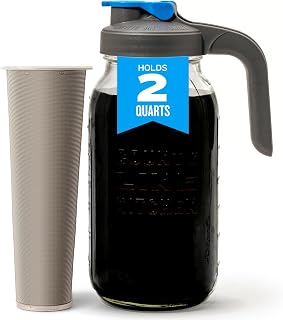
Pros
- Large 64 oz batch covers most of a week
- Thick glass jar with a wide mouth is easy to fill and clean
- Leak-proof lid lets you invert the jar while steeping
- Laser cut stainless filter is reusable, so no paper needed
- Brews iced tea just as well
Cons
- Full jar is heavy and takes real fridge shelf space
- Glass demands more care than plastic pitchers
- Needs a long steep, so it requires planning ahead
Cold brew is the least demanding method in this guide, and the County Line Kitchen jar is a straightforward take on it. A heavy 64 oz wide mouth mason jar holds the water, a laser cut stainless mesh tube holds the grounds, and a sealing lid keeps everything airtight.
The volume is what sets it apart. Most cold brew makers produce a couple of servings, while this one makes enough concentrate to keep a serious iced coffee habit running for the better part of a week. Because the lid seals properly you can lay the jar down or invert it during steeping to keep every ground saturated, and the whole filter tube lifts out afterwards, so cleanup is one rinse rather than a straining operation.
The drawbacks are logistical. Filled with water it is heavy, it needs a clear shelf in the refrigerator, and it is glass, so it deserves a firm grip. There is also the obvious point that cold brew takes twelve hours or more, which is planning rather than effort.
Bottom line: the best pick for anyone who drinks iced coffee daily and would rather brew once a week than every morning.
- Type: immersion cold brew system
- Capacity: 64 oz
- Jar: thick wide mouth glass
- Filter: laser cut stainless steel mesh tube
- Lid: leak-proof sealing lid
- Care: dishwasher safe components
Use an extra coarse grind at roughly 1 part coffee to 4 parts water for concentrate. Fill the filter tube, lower it into the jar, seal and refrigerate for twelve to twenty four hours.
Lift the filter out as soon as steeping ends, then dilute the concentrate with water, milk or ice to taste.
Rinse the mesh tube immediately so grounds do not dry inside the perforations. An occasional soak in warm soapy water clears the coffee oils that dull the flavor over time.
Carry a full jar with two hands and avoid moving it straight from a cold fridge onto a hot surface.
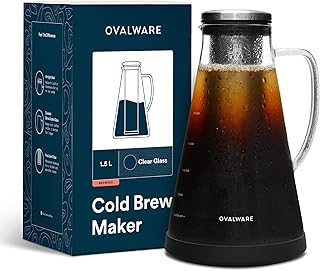
Pros
- Airtight silicone seal keeps the brew fresh in the fridge
- Fine laser cut filter produces a notably clear concentrate
- Slim pitcher shape fits a fridge door or shelf
- Pours directly from the vessel, no decanting needed
- Also works as an iced tea and infused water pitcher
Cons
- Smaller batch than a 64 oz jar
- Borosilicate glass needs careful handling
- Filter mesh is fine enough to clog if the grind is too small
The OVALWARE pitcher is the more refined take on cold brew. Borosilicate glass, a slim profile, a proper pouring spout and an airtight lid with a silicone seal make it something you can bring to the table rather than hide in the fridge.
Brew quality is genuinely good. The laser cut stainless filter is fine enough to hold back most of the sediment that cheaper mesh baskets let through, so the concentrate pours clear and tastes clean rather than muddy. The airtight seal matters more than it sounds: cold brew loses aroma quickly in a loosely covered container, and this one keeps a batch tasting fresh for days.
Against that, 1.5 litres is a modest batch if you drink iced coffee all day, the glass asks for care, and a grind that drifts too fine will clog the fine mesh and slow the pour.
Bottom line: the pick for one or two people who want the cleanest cold brew in the fridge and care how the vessel looks while doing it.
- Type: immersion cold brew pitcher
- Capacity: 1.5 L, about 51 oz
- Body: borosilicate glass with pouring spout
- Filter: laser cut fine stainless steel mesh
- Lid: airtight with silicone seal
- Uses: cold brew coffee, iced tea, infused water
Best for one or two drinkers who want cold brew on hand without a bulky jar, and for anyone who serves iced coffee to guests and wants a vessel worth putting on the table.
Go for a larger jar instead if you drink several glasses a day or brew for a whole household.
Grind extra coarse, fill the filter, then add water slowly so every ground is wet. Steep in the refrigerator for around eighteen hours for a balanced concentrate.
Remove the filter as soon as the steep is done and keep the lid sealed between pours to hold the aroma.
How to Choose the Best Specialty Coffee Makers
Specialty brewing is less about brand loyalty and more about matching a method to the way you drink coffee. The criteria below are the ones that change what lands in your cup, in rough order of how much they matter.
What Actually Separates a Specialty Brewer From a Drip Machine
A basic drip machine makes one decision for you and hides the rest. Water goes in, a heating element brings it to roughly the right temperature, and a showerhead drips it over a flat bed of grounds for a fixed number of minutes. You cannot change the temperature, you cannot change how quickly the water flows, and the ratio is whatever you happen to scoop.
A specialty brewer opens those variables up. Coffee extracts best when brewing water sits in a fairly narrow band just off the boil, commonly cited as 195 to 205 degrees Fahrenheit. Below that band the cup reads sour and thin because the sweeter compounds never dissolve. Above it, the cup turns harsh. Machines certified by the Specialty Coffee Association hold that band on purpose, and manual methods let you hit it by resting boiled water for a moment or by using a temperature controlled kettle.
The second lever is contact time paired with grind size. Espresso pushes water through a compacted puck of very fine grounds in roughly 25 to 30 seconds at around nine bars of pressure. Pour-over runs medium ground coffee for two and a half to four minutes under gravity alone. A French press soaks coarse grounds for about four minutes with no filter paper in the way. Cold brew skips heat entirely and leans on twelve to twenty four hours of steeping. Same beans, four completely different cups. Choosing a specialty maker is really choosing which of those curves you want to ride.
Pick Your Brew Method First, Then the Machine

Espresso machines like the Breville Barista Pro, the Breville Barista Express and the De’Longhi Stilosa exist for people who want short, concentrated shots and milk drinks. They ask the most of you in return: a consistent grind, a level tamp, and a few minutes of cleanup. The payoff is the widest range of drinks, from straight espresso to flat whites and iced lattes.
Pour-over gear like the Chemex Classic Series and the Hario V60 sits at the opposite end. There are no pumps, no boilers and almost nothing to break. Clarity is the selling point here, since paper filters trap most of the oils and fine particles and leave a clean, tea-like cup that shows off single origin beans. The trade is that you stand there for three or four minutes doing the work yourself, unless you go with an automatic pour-over style device such as the OXO Brew single serve unit.
Immersion brewers, meaning French presses like the Bodum Chambord and the insulated Secura, sit in the middle. Full immersion with a metal mesh filter means more body and more oils, and it forgives sloppy technique better than any other hot method. Cold brew systems from County Line Kitchen and OVALWARE are the most hands-off of all, because you build a batch once and pour from the fridge for days.
| Method | Grind | Typical brew time | Cup character | Effort per cup |
|---|---|---|---|---|
| Espresso | Very fine | 25 to 30 seconds | Concentrated, syrupy, milk friendly | High |
| Pour-over | Medium | 2.5 to 4 minutes | Clean, bright, aromatic | Medium |
| French press | Coarse | About 4 minutes | Full bodied, oily, rich | Low |
| Cold brew | Extra coarse | 12 to 24 hours | Smooth, sweet, low acidity | Very low per cup |
| Moka pot | Fine to medium fine | 4 to 6 minutes | Strong, roasty, espresso adjacent | Medium |
Temperature Control and Brew Stability

Stability matters more than peak temperature. An espresso machine that reaches brew temperature quickly but drops several degrees during the shot will give you a different cup every morning. The Barista Pro uses a ThermoJet heating system that reaches temperature in seconds and includes digital temperature control, which is why it sits at the top of this list. Entry level pump machines such as the Stilosa and the CASABREWS CM5418 use a simpler thermoblock, so a short warm-up and a blank flush through the group head make a noticeable difference.
Manual brewers move the problem to your kettle. A gooseneck kettle with temperature control is the single most useful accessory for anyone brewing with a V60 or a Chemex, because it fixes both the temperature and the pour rate at the same time. If you do not own one, boiling water and letting it rest for about thirty seconds gets you close enough to start. For a deeper look at the rest of the kitchen counter, browse our home and kitchen deals.
Grind Size, Grinders and Dose Control

No specialty brewer can rescue a bad grind. Blade grinders produce a mix of boulders and dust, which means part of the coffee over extracts into bitterness while the rest under extracts into sourness, in the same cup. A burr grinder produces particles of a consistent size, and that consistency is what makes brewing repeatable.
This is where machines with an integrated grinder earn their keep. The Barista Pro and the Barista Express both include a conical burr grinder with adjustable settings and grind directly into the portafilter, so your dose stays fresh and your workflow stays short. If you choose a machine without a grinder, budget separately for one, because pairing a capable espresso machine with pre-ground supermarket coffee wastes most of what you paid for. Whole beans matter too, and our guide to the best top rated coffee is a reasonable place to start restocking.
Ratio deserves a mention alongside grind. Most specialty guidance lands near 1 gram of coffee for every 15 to 17 grams of water for filter brewing, and roughly 1 to 2 for espresso. A cheap kitchen scale turns those numbers into something you can repeat rather than guess.
Capacity, Counter Space and Daily Routine
Be honest about volume. A single serve pour-over device or a V60 dripper is perfect for one person and frustrating for a household of four. A Chemex in the eight cup size or a large French press handles a table full of guests without a second thought, and a 64 ounce cold brew jar can carry a heavy coffee drinker through most of a work week.
Counter space is the other constraint people underestimate. Semi-automatic espresso machines need room above them for the hopper and room in front for the portafilter and tamp. Compact models such as the CASABREWS CM5418 were designed around exactly that problem. Manual brewers, on the other hand, live in a cupboard when they are not in use.
Materials, Filters and Cleanup
Borosilicate glass shows off the brew and cleans easily but needs care around hard knocks. Stainless steel bodies, as on the Secura French press and most espresso machines, survive daily abuse and hold heat far longer. Vacuum insulated pitchers keep a French press batch hot for an hour or more, which solves the classic problem of press coffee going cold and bitter while it sits on the plunger.
Filters shape flavor as much as material. Chemex bonded paper filters are notably thick and produce the cleanest cup in this roundup. The stainless mesh in most French presses and in reusable pour-over cones lets oils through for a heavier body but also lets fines settle at the bottom. Cold brew systems usually use a fine mesh basket, and the good ones let you lift the whole basket out and rinse it rather than picking grounds out of a pitcher.
Finally, factor in descaling. Any machine that heats water needs periodic descaling, and hard water speeds that up considerably. Manual brewers avoid the issue entirely, which is one quiet reason a Chemex from decades ago can still be in service.
Why You Should Trust Us
We build these roundups from data rather than press releases. Every product here was pulled from live Amazon listings, filtered for a strong customer rating backed by a meaningful volume of verified buyer reviews, then scored with the same system we apply across the site so that ratings, review depth and sales signals are weighed consistently. We do not accept payment for placement, and a brand cannot buy a spot on this list.
On top of the data, we curate. For this guide that meant a hard editorial rule: ordinary drip machines and timer brewers were removed even when they ranked well, because they belong in a different guide. We also cut duplicate size and color variants of the same brewer so that 11 entries mean 11 genuinely different ways to make coffee. Brewing specifications quoted above follow widely published specialty coffee guidance on temperature, ratio and extraction time rather than our own claims. More of our buying guides live on the articles page.
Final Thoughts
The Breville Barista Pro is our best overall pick because it collapses an entire coffee setup into one footprint. The integrated conical burr grinder, the fast heating system, the digital temperature control and the steam wand together cover espresso, cappuccino and iced milk drinks, and the interface gives you feedback while you learn. If you want the same core capability with a more traditional interface, the Breville Barista Express remains the classic choice and is still one of the most recommended machines in home espresso.
The De’Longhi Stilosa is our best value pick. It is a manual pump machine with a steam wand and very little else, and that simplicity is the point: it teaches you dose, tamp and timing without a large outlay, and it stays useful as a second machine later. For a compact stainless alternative with a stronger pump specification, the CASABREWS CM5418 covers similar ground in a slim body.
Beyond espresso, pick by ritual. The Chemex Classic Series is the best choice for clean, aromatic filter coffee served to more than one person, while the Hario V60 is the most affordable entry into serious pour-over and the one most cafes use for single cups. The OXO Brew single serve pour-over automates that same shape of brew for mornings when you have no patience. For body and simplicity, the Bodum Chambord is the reference French press and the insulated Secura is the one to buy if your coffee tends to sit. For iced coffee all summer, County Line Kitchen and OVALWARE both produce smooth, low acidity concentrate overnight with almost no effort. Whichever route you take, the beans matter as much as the brewer, so it is worth pairing your new setup with something from our best organic coffee picks.
Frequently Asked Questions About Specialty Coffee Makers
What makes a coffee maker a specialty coffee maker in 2026?
A specialty coffee maker gives you control over the brewing variables instead of hiding them. In practice that means stable water temperature in the 195 to 205 degree Fahrenheit range, a brew time you can influence, a ratio you choose, and a grind size matched to the method. Espresso machines, pour-over cones, French presses, moka pots, siphons and cold brew systems all qualify. A standard drip machine with a timer does not, because every one of those variables is fixed for you.
Do I need a separate grinder for these specialty coffee makers?
For the Breville machines, no, since both include a conical burr grinder that doses straight into the portafilter. For everything else on this list, a burr grinder is the upgrade that will change your cup more than any other purchase. Grind consistency controls how evenly water extracts the coffee, and pre-ground coffee is already stale and locked to one grind size, which makes it a poor match for espresso in particular.
Is manual pour-over really better than an automatic machine?
Better is the wrong frame. Manual pour-over gives you the most control over the pour rate, the bloom and the total brew time, so it rewards attention and good beans. An automatic brewer gives you consistency and your morning back. Many people keep both, using a machine on weekdays and a V60 or Chemex at the weekend. If convenience is the priority, our guide to the best programmable coffee makers is a better starting point than this one.
How long does cold brew last once it is made?
Cold brew concentrate keeps well in a sealed container in the refrigerator for roughly a week to ten days, and diluted cold brew is best inside two or three days. Always remove the filter basket once steeping is done, because leaving grounds in the pitcher keeps extraction going and turns the batch bitter. That is one practical reason to choose a system with a lift-out basket rather than a bag.
Are expensive specialty coffee makers worth the money?
It depends entirely on what you drink. If you want milk drinks at home every day, a capable espresso machine pays for itself against cafe visits within months and there is a real gap between entry level and mid range pump machines in heating stability and steam power. If you drink black filter coffee, a modest pour-over cone and a good grinder will get you most of the way to a cafe cup for a fraction of the outlay. Spend where your habit is, not where the marketing is.

Write Your Review
No reviews yet. Be the first to share your experience!