

A stuck jar lid is not a strength problem, it is a torque problem, and the two are only loosely related. Torque is force multiplied by the distance from the centre of rotation, which is why a device that grips the lid two inches out from its middle beats a bare hand every time regardless of how strong the hand is. That principle splits this category into three genuinely different tools. Our top pick is the Otstar adjustable opener for delivering that leverage without needing power, counter space, or a working grip. This shortlist of 7 automatic jar opener options from OXO, Higher Torque, Otstar and more is grouped by mechanism, because the right one depends entirely on which part of your hand is giving trouble.
Every product here is a current listing with real customer ratings behind it, covering electric units, handheld levers, and multi size grips. For more kitchen equipment, see our home and kitchen guides.

Pros
- Adjustable jaw covers a wide range of lid sizes
- Lever geometry means grip strength barely matters
- No power, no charging, and no counter space needed
- Opens bottles as well as jars
- Lives in a drawer so it is always to hand
Cons
- Still requires the wrist to rotate
- Two hands needed, one on the jar and one on the handle
The Otstar takes the top spot because it solves the most common version of this problem at the lowest cost. Reduced grip strength is what defeats most people at a jar lid, and a lever removes grip from the equation entirely: you close the jaw and pull the handle, and the leverage does what a hand cannot.
The adjustable jaw is the practical advantage over fixed electric units. It covers small pesto lids through to wide preserve jars, so it is not defeated by the one jar in your kitchen that falls outside a fixed span.
What it does not remove is wrist rotation. The handle has to be turned, and for anyone whose wrists rather than grip are the problem, that is the wrong tool and an electric opener is the answer. It also needs two hands, one steadying the jar, which is worth knowing before buying for someone who can only use one.
Bottom line: the right first purchase for weakened grip, and the wrong one if turning itself is what hurts.
- Type: handheld lever opener
- Jaw: adjustable across multiple diameters
- Also opens: bottle caps
- Power: none required
- Hands needed: two
- Storage: drawer sized
- Handle: textured grip
Anyone whose grip has weakened but whose wrists still rotate comfortably, and small kitchens with no counter space to spare for an appliance.
People with painful or limited wrist movement should choose one of the electric openers in this shortlist instead.
Set the jaw so it grips the very edge of the lid rather than the middle, which puts the force where the seal is and reduces the chance of slipping.
Put a damp tea towel under the jar first. Holding the jar still is often the harder half of the job, and the towel does that for free.

Pros
- Hooked edge breaks the vacuum rather than fighting it
- Base pad stops the jar rotating on the counter
- Cushioned handle comfortable for sore hands
- Dishwasher safe with no cavities to trap residue
- Addresses both halves of the job in one purchase
Cons
- Still requires wrist rotation
- Jaw range narrower than fully adjustable levers
The OXO opener earns the value pick by attacking the actual cause. Most unopened lids are held by vacuum rather than by friction on the threads, and this tool has a hooked edge that slips under the lid rim and lifts just enough to admit air. Once the seal releases, the lid turns freely.
It also ships the piece most competitors forget. Opening a jar requires turning the lid and stopping the jar turning with it, and the included base pad handles the second, which for someone with weak hands is frequently the harder half.
The handle is cushioned rather than bare plastic, which matters when the hands using it are sore, and the whole thing goes in the dishwasher with no cavity for dried jam to hide in. It still needs enough hand function to lift and twist, so anyone whose wrists are the problem wants an electric opener.
Bottom line: the smartest cheap purchase here, because it targets the vacuum rather than trying to out muscle it.
- Type: handheld hooked opener
- Action: lifts the lid rim to break the vacuum
- Included: non-slip base pad
- Handle: cushioned grip
- Cleaning: dishwasher safe
- Power: none required
- Storage: drawer sized
Check the lid diameters you struggle with against the stated range before ordering, since this jaw covers less than fully adjustable models.
Keep the base pad with the opener rather than in a different drawer, because the pair works far better than either half alone.
Wash after sticky jars rather than at the end of the week, since dried syrup on the gripping surface reduces friction exactly where it is needed.
Replace the base pad if it hardens with age. A pad that has lost its grip is worse than none, because it gives false confidence.

Pros
- Removes grip and wrist rotation entirely
- One button operation with no technique to learn
- Handles a broad range of common lid sizes
- Enables independence for anyone who needed help before
- Heavy enough to stay put while working
Cons
- Occupies counter space to be useful
- Cannot be immersed for cleaning
This is the design that removes force from the task rather than reducing it. The unit clamps the lid, holds the jar, and turns the lid under motor power, so neither grip strength nor wrist rotation is asked for. For anyone whose wrists are the limiting factor, that is the only approach in this category that works.
Operation is a single button, which matters more than it sounds. A tool that requires positioning, squeezing, and turning in sequence is a tool that gets abandoned, while a button does not.
The costs are practical. It needs to live on the counter to be used, because a device fetched from a cupboard loses to running the lid under hot water, and it cannot be immersed, so sticky jars mean wiping around the jaws rather than rinsing. It also has a fixed gripping span, so very small or very wide lids may fall outside it.
Bottom line: the right answer when turning is what hurts, provided you have somewhere to keep it out.
- Type: electric countertop opener
- Operation: single button, automatic
- Grip: motorised lid clamping
- Lid range: most common jar sizes
- Grip strength required: none
- Wrist rotation required: none
- Cleaning: wipe only, do not immerse
Anyone with painful or limited wrist movement, and households where jars have been a daily obstacle requiring help from someone else.
Small kitchens with no free counter space may get more use from a handheld lever that lives in a drawer.
Wipe the gripping jaws after any jar that leaks, since residue collects exactly where the machine needs friction. Never immerse the unit.
Keep fingers clear of the jaws while the motor runs, and set the jar down fully before pressing the button rather than holding it in the air.

Pros
- One touch operation with automatic size adjustment
- Wider lid span than many electric units
- No grip or wrist effort required
- Compact for an electric opener
- Simple with a single control
Cons
- Countertop space needed for regular use
- Wipe clean only, like all electric units
The INSTACAN addresses the main weakness of electric openers, which is the fixed gripping span. It adjusts to lid diameter automatically rather than needing to be set, which widens the range of jars it can actually catch and removes a step from the process.
Operation is a single touch, and the automatic adjustment means the person using it does not have to judge whether a lid is within range before trying. For someone with reduced dexterity, removing that judgement is worth as much as removing the force.
It shares the constraints of the category. It needs to stay on the counter to be useful, it cannot be immersed, and the jaws sit where drips collect so they need wiping after messy jars. Its footprint is smaller than some, which helps in a tight kitchen.
Bottom line: the electric opener to choose if the jars in your kitchen vary widely in lid size.
- Type: electric countertop opener
- Operation: one touch
- Sizing: automatic adjustment to lid diameter
- Lid range: wide span
- Grip strength required: none
- Footprint: compact for the class
- Cleaning: wipe only
Automatic sizing widens the range but does not remove it entirely. Measure your widest problem lid against the stated maximum before ordering.
Plan where it will live before buying. An electric opener kept in a cupboard is rarely used.
Wipe the jaws after sticky jars and keep the base dry. Residue in the mechanism reduces grip on the next lid.
Place the jar on a flat surface and let the machine take it rather than supporting the weight by hand while the motor turns.

Pros
- Higher torque than the standard model for stubborn lids
- One touch operation with no setting required
- Removes grip and wrist effort completely
- Established design with a long rating history
- Stable on the counter while working
Cons
- Bulkier than handheld options
- Battery versions lose torque as cells drain
The Robotwist Deluxe is the torque specialist here. Standard electric openers handle vacuum sealed lids well and can struggle with the genuinely stuck ones, which are usually jars that were opened, resealed, and left with dried syrup on the threads. This version is built for those.
It operates at one touch like the others, with no size setting or technique, and it has been on the market long enough to have accumulated a broad rating history, which in a category full of similar looking devices is useful evidence.
Two considerations. It is bulkier than a handheld tool, so counter space is a real requirement. And where a version runs on batteries, torque falls as the cells drain, which undermines the exact reason you bought it, so fresh cells replaced as a set matter more here than in most devices.
Bottom line: the pick for stubborn resealed lids, with battery discipline if you choose the cordless version.
- Type: electric automatic jar opener
- Torque: improved over standard model
- Operation: one touch
- Sizing: automatic lid gripping
- Grip strength required: none
- Placement: countertop
- Cleaning: wipe only
For a jar with dried residue on the threads, run hot water over the lid first and then use the machine. Warming the metal does part of the work and reduces the load on the motor.
Use fresh alkaline cells as a complete set on battery versions, and replace them together rather than one at a time.
Wipe the gripping surfaces after every messy jar. Sugar residue hardens and turns a grip surface slippery.
Keep the unit unplugged or switched off while cleaning, and never run water into the body.

Pros
- Jaw tightens as you turn, so grip does not slip
- Base pad included to steady the jar
- Comfortable cushioned handle
- Dishwasher safe and simple to clean
- Compact drawer storage
Cons
- Wrist rotation still required
- Narrower lid range than adjustable levers
The twisting version of the OXO opener uses a jaw that closes further as the handle turns, which is a small mechanical idea with a real benefit: the harder the lid resists, the tighter the tool grips. Slipping is the most frustrating failure mode with a handheld opener, and this design largely removes it.
Like its sibling it ships with a base pad, so the jar can be held still without hand strength, and the cushioned handle is comfortable for sore hands over repeated use.
The limits are those of the lever family. The wrist still has to rotate, so it will not help anyone whose wrists are the problem, and the jaw covers a narrower band of lid sizes than a fully adjustable model.
Bottom line: the most secure grip among the handheld options here, for anyone whose wrists still work.
- Type: handheld twisting lever opener
- Jaw: self tightening as the handle turns
- Included: non-slip base pad
- Handle: cushioned grip
- Cleaning: dishwasher safe
- Power: none required
- Storage: drawer sized
Anyone who has found handheld openers slip off lids, and households wanting a simple tool with nothing to charge or plug in.
Not suitable where wrist rotation is painful, which is the case for an electric opener.
Let the jaw find its own tightness as you begin turning rather than forcing it closed first. The mechanism is designed to grip harder under load.
Use the base pad every time, not just on stubborn jars. Steadying the jar removes half the effort.

Pros
- Covers a wide span of lid diameters
- Requires very little hand strength
- Simple with no moving parts to fail
- Lightweight and drawer sized
- No power or batteries needed
Cons
- Newer listing with a shorter rating history
- Wrist rotation still required
The Uinxan is the widest ranging handheld option here. Its gripping design is built to sit across many lid diameters rather than adjusting to each one, which means fewer jars in a kitchen fall outside what it can handle.
Hand force required is minimal, and with no hinged mechanism there is nothing to seize, wear, or need cleaning inside. For a tool that will be used for years by someone whose hands are the reason they bought it, that simplicity has value.
Two notes. This is a newer listing with less accumulated feedback than the established names here, and like every handheld design it still asks the wrist to turn. If turning is the painful part, this is not the answer.
Bottom line: the handheld option to choose when the problem jars in your kitchen span a wide range of lid sizes.
- Type: handheld multi size opener
- Coverage: wide span of lid diameters
- Mechanism: no hinged moving parts
- Hand force: minimal
- Power: none required
- Weight: light
- Storage: drawer sized
Measure your widest and narrowest problem lids and check both against the stated coverage, since the appeal of this design is range.
If you need something with a longer track record, the established levers in this shortlist have far more accumulated feedback.
Rinse and dry after sticky jars so the gripping surface keeps its friction. Check the surface has not gone glossy with wear, which reduces grip.
Steady the jar on a damp cloth or base pad rather than gripping it hard, which defeats the purpose of a low force tool.
How to Choose an Automatic Jar Opener
Start by working out what your hands cannot do, because that determines which of the three designs will help.
Three Mechanisms Share One Name
Electric openers clamp the lid, hold the jar steady, and turn the lid by motor. You press one button and the machine does everything, which means neither grip strength nor wrist rotation is required at all. The Higher Torque, INSTACAN, and Robotwist units here work this way.
Handheld levers are a hinged jaw on a handle. You close the jaw around the lid and turn the handle, which converts a comfortable pull into a large twisting force at the lid. Grip strength barely matters, but the wrist still has to rotate. The Otstar and the OXO twisting opener fall here.
Hooked openers work differently again: a shaped edge slips under the lid rim and lifts it just enough to let air in, which releases a vacuum seal directly. Grip pads and cone openers add friction rather than leverage. A rubber cone with stepped ridges sits over the lid and gives your palm something that will not slip, and a base pad stops the jar rotating on the counter. These are the simplest and the cheapest, and they only help if your hands can still turn.
The Variable Is Your Hand, Not the Lid
This is the part product listings never address. Grip strength, wrist rotation, and pain tolerance are three separate capabilities, and different conditions affect different ones. Someone with reduced grip but good wrist movement is helped enormously by a lever. Someone whose wrists are the problem needs a motor, because a lever still asks the wrist to turn.
Pain changes the calculation again. A tool that works but hurts is a tool that stops being used, and an electric opener that requires only a button press is the only design in this category that removes force entirely rather than reducing it.
If you are buying for someone else, the useful question is not whether they can open jars but which part of the motion defeats them. That answer points straight at one of the three groups above.
Electric Openers Need Somewhere to Live
An electric jar opener is a countertop appliance roughly the size of a large mug, and it is only useful if it is out and plugged in or charged. Stored in a cupboard it becomes something to fetch, and a device you have to fetch to open a jar is a device that loses to running the lid under hot water.
That makes counter space a genuine buying criterion rather than a detail. In a small kitchen where the counter is already full, a handheld lever that lives in a drawer may get used far more often than a better machine that lives in a cupboard.
Weight matters for the opposite reason. A heavier unit stays put on the counter while it works, and a very light one can walk across the surface as it turns, which for someone with limited hand function is exactly the wrong behaviour.
Lid Diameter Range Is a Hard Limit

Every opener states a lid size range and it is a physical limit. Electric units grip within a fixed span, so a very small pesto lid or a very wide pickle jar can fall outside what the jaws will close on, and the machine simply spins without catching.
Handheld levers usually cover a wider range because the jaw is adjustable by hand, and cone style grips cover the widest range of all since a single stepped cone touches lids of many diameters. This is the main practical advantage of the simplest design.
Check the lids you actually struggle with before buying. If the problem jars in your kitchen are the wide ones, a device with a narrow span solves nothing, and this is the most common source of disappointment in this category.
What Actually Breaks the Seal
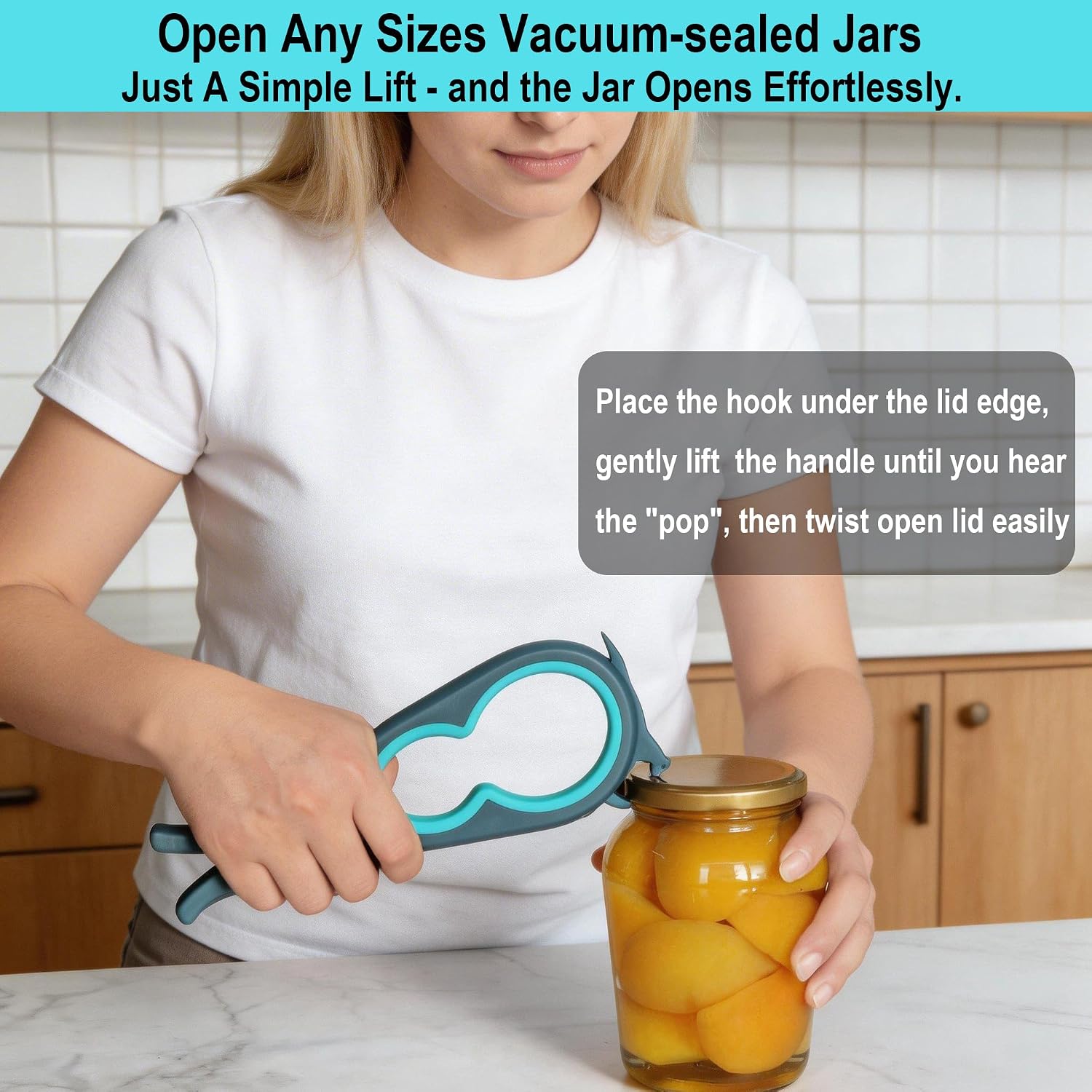
Most stuck lids are held by vacuum rather than by friction on the threads. During processing the jar is filled hot and sealed, and as the contents cool the pressure inside drops, which pulls the lid down hard against the rim. That is why a lid that will not budge suddenly turns freely the moment air gets in.
Understanding that gives you two free techniques before any tool is needed. Tapping the edge of the lid against a counter, or prying gently under the rim of a pop up safety button with a spoon handle, admits air and releases the vacuum. Hot water on the metal lid expands it faster than the glass beneath, which loosens the fit.
None of that helps with a lid that has been opened and resealed and is now sticky with dried jam or syrup. That is genuine friction on the threads, and it is where mechanical leverage earns its place.
Grip Material and Wet Hands
Kitchens are wet, and grip devices depend entirely on friction. Textured rubber holds well dry and much less well with oil or water on it, while silicone stays grippier when damp but attracts dust in a drawer.
The other half of the problem is the jar, not the lid. A jar that rotates on the counter while you turn the lid is going nowhere, which is why a non slip base pad, as supplied with the OXO opener here, is more useful than it looks. Holding the jar is often the harder half of the job for someone with weak hands.
A damp tea towel under the jar does the same thing for free, and is worth knowing about whichever tool you buy.
Battery or Mains

Electric openers come both ways and the difference matters more than usual here. Battery units are cordless and can be used anywhere on the counter, but they lose torque as the cells drain, and a device bought specifically because it produces enough force is a device that should not become weaker over a month.
Mains units deliver the same torque every time and are tethered to an outlet. In a kitchen where the counter near a socket is also the counter where you prepare food, that is a real constraint.
If you choose battery, use fresh alkaline cells rather than the ones that came in the box and replace them as a set. Mixed cells are a common reason an opener that worked in week one struggles in week six.
Under Cabinet and Mounted Options
Some openers mount under a cabinet or on a wall, which puts them at a fixed height and frees the counter entirely. Because they are anchored, they can also take a two handed push without moving, which produces far more force than a countertop device that slides.
The trade is installation and a fixed working height. A mount screwed at a height that suits one person may be wrong for another, and it cannot be moved to where the light is better.
For most households a portable tool is the more sensible answer, but if jars are a daily obstacle rather than an occasional one, a mounted opener is worth considering.
Cleaning Around a Mechanism
Jars leak. Anything that grips a lid will eventually grip a lid coated in honey, tomato, or brine, and where that residue ends up decides how long the tool stays pleasant to use.
Handheld levers and grips are simple to wipe and often dishwasher safe, with no cavity for residue to hide in. Electric units cannot be immersed, and their gripping jaws sit right where drips collect, so they need wiping after messy jars rather than at the end of the week.
Check whether the parts that touch the lid detach. A removable gripping ring is far easier to keep clean than one moulded into the body.
When This Is the Wrong Purchase
If the jars defeating you are new and unopened, the vacuum techniques above solve most of them and cost nothing. If the problem is only ever one specific jar in your kitchen, a different brand of that product with an easier lid is a cheaper fix than a device.
Note also that an electric jar opener is not a can opener, and several of the best selling products in searches for this category are actually can openers. They are different mechanisms for different containers, and one will not do the other’s job.
Where a device genuinely helps is daily independence: someone who was waiting for help to open a jar and now does not have to. That is the case worth buying for, and it is why the electric options here matter despite the counter space they take.
| Model | Mechanism | Needs grip | Needs wrist rotation |
|---|---|---|---|
| Otstar adjustable | Handheld lever | Minimal | Yes |
| OXO Good Grips with base pad | Hooked rim lifter plus jar pad | Minimal | Yes |
| Higher Torque electric | Electric, automatic | No | No |
| INSTACAN one touch | Electric, one touch | No | No |
| Robotwist Deluxe | Electric, automatic | No | No |
| OXO twisting opener | Handheld lever | Some | Yes |
| Uinxan patented | Handheld, multi size | Minimal | Yes |
For other kitchen tools that reduce hand effort, browse our kitchen guides.
Why You Should Trust Us
We group these tools by mechanism rather than ranking them on a single scale, because a lever and a motor solve different problems and recommending one to the wrong person wastes their money. Every product here is a current listing with enough customer rating history to show how it holds up in daily use.
We do not accept payment for placement, and we say plainly where a design still requires wrist rotation, because for a large part of the audience for this category that is the deciding factor.
Final Thoughts
The Otstar adjustable opener is our best overall pick because it delivers real leverage across a wide range of lid sizes, needs no power or counter space, and costs a fraction of an electric unit. For most people whose grip has weakened, it is enough.
The OXO Good Grips opener with its non slip base pad is our best value choice. Its hooked edge lifts the lid rim to break the vacuum rather than trying to out muscle it, and the pad addresses the half of the job people forget, which is holding the jar still. If wrist rotation rather than grip is the problem, the Robotwist Deluxe removes the turning motion entirely, and the Uinxan is the one to look at if the jars defeating you span a wide range of sizes.
Before buying anything, try tapping the lid rim and running the metal under hot water, since most unopened jars are held by vacuum rather than friction. More kitchen picks are in our latest guides.
Frequently Asked Questions
Does an automatic jar opener work on every jar?
No. Each design states a lid diameter range, and electric units have the narrowest span because their jaws close within fixed limits. Very small lids and very wide ones often fall outside it. Handheld levers cover more sizes and stepped cone grips cover the most, so check the lids you actually struggle with before choosing.
Which type should I buy in 2026?
It depends which part of the motion is the problem. If grip strength is weak but wrists still rotate, a handheld lever is enough and takes no counter space. If wrist rotation is painful or limited, only an electric opener removes the turning entirely. Grip pads help only if hands can still turn.
Why do lids get stuck in the first place?
Usually vacuum rather than friction. Jars are filled hot and sealed, and as the contents cool the internal pressure drops and pulls the lid hard onto the rim. Admitting air by tapping the rim or lifting the edge of the safety button releases it. Sticky residue from a previously opened jar is a different problem and genuinely needs leverage.
Is a jar opener the same as a can opener?
No, and this catches people out because searches for one return the other. A can opener cuts or unrolls a sealed metal lid, while a jar opener grips and twists a threaded lid. Several very popular products in this category are can openers, so read the title rather than the category.
Do battery powered openers lose strength?
Yes, torque falls as cells drain, which matters more here than in most battery devices because force is the entire reason for the purchase. Use fresh alkaline cells rather than the ones supplied, replace them as a complete set, and consider a mains powered unit if consistent force matters. More kitchen picks are in our category directory.





Write Your Review
No reviews yet. Be the first to share your experience!