

A dull, oversized saw turns a five minute pruning job into an afternoon of ragged cuts and sore shoulders. The right blade does the opposite: it glides through green wood, leaves a clean wound that heals fast, and folds away safely when the branch is down. To build this shortlist of the 7 best pruning saws, we looked at how real gardeners rate these tools after full seasons of use, weighing everything from tooth geometry and blade steel to how a handle feels when your gloves are wet. The brands that rose to the top include Fiskars, Bahco, Corona Tools and more, each earning its place for a different job around the yard.
Whether you are shaping fruit trees in early spring, clearing storm damage in September, or packing a compact folder for a backcountry trail, there is a saw here built for it. Below you will find our ranked picks for 2026, followed by a full buying guide that explains the trade-offs so you can match a saw to your own branches. If you are outfitting a wider tool shed at the same time, our patio, lawn, and garden guides cover the companion tools that pair well with a good pruning saw.

Pros
- Long curved blade powers through wrist-thick limbs
- Roomy D-handle suits gloved or two-handed cutting
- Aggressive triple-ground RazorTOOTH teeth pull into the wood
- Replaceable blade keeps the tool sharp for years
- Impulse-hardened steel holds its edge all season
Cons
- Too large and heavy for tight, delicate trimming
- Fixed blade needs a sheath for safe storage
The Corona Tools RazorTOOTH 18-inch is the saw you reach for when a branch is too thick for a folder to handle. Its long curved blade and open D-handle are built around one goal: removing wrist-thick and heavier limbs with as little effort as possible. This is a full-size garden tool, not a pocket companion, and it rewards anyone who regularly cuts hardwood, fruit trees, or storm damage.
The curved blade cuts on the pull stroke, drawing itself into the wood so you push less and control more, which matters when you are reaching up into a canopy. The triple-ground, impulse-hardened teeth stay aggressive through green sappy wood and dry limbs alike, and the D-handle gives you room for a gloved fist or a two-handed grip when a cut fights back.
The trade-offs are size and storage. At 18 inches the blade is unwieldy for delicate thinning near the trunk collar, and because it does not fold you will want the scabbard on hand to cover those teeth. The blade is also replaceable, so when it finally dulls you swap it instead of retiring the saw.
Bottom line: for gardeners who need real cutting power and want one saw to tame the biggest limbs a hand tool can manage, the Corona RazorTOOTH 18-inch is our best overall pick and a genuine buy-it-for-life tool.
- Blade length: 18 inches
- Blade style: curved, fixed
- Teeth: impulse-hardened, triple-ground RazorTOOTH
- Handle: ergonomic D-handle
- Max cut capacity: branches up to 10 inches
- Blade: replaceable
This saw is built for homeowners with mature trees, orchard keepers, and anyone clearing heavy limbs or storm damage. If most of your pruning is thick, established wood rather than light shaping, the 18-inch blade and two-hand grip will save your shoulders. Gardeners who mostly trim small canes or need a packable saw will be happier with a compact folder.
Keep the scabbard on the blade whenever the saw is not in use, since the exposed teeth are sharp enough to bite through a glove. Wipe the blade dry after each session and clear sap with a light solvent to protect the coating. When the teeth eventually lose their edge, fit a fresh replacement blade rather than trying to file the hardened teeth at home.

Pros
- Rust-protected blade shrugs off damp storage
- Locks securely in both open and closed positions
- XT toothing cuts green wood, dry wood, and plastic
- Ergonomic two-component grip stays put when wet
- Folds to pocket size for the trail
Cons
- Short blade limits it on thick branches
- Pivot needs cleaning after sappy cuts
The Bahco Laplander is the folding saw that outdoor people keep recommending to each other, and it earns that word of mouth. It is a compact 7.5-inch folder built to ride in a jacket pocket or a pack and come out ready to cut green branches, seasoned firewood, or the odd length of plastic pipe.
What sets it apart is the toothing and the lock. The XT teeth clear sawdust fast and leave a clean cut, while the two-position lock holds the blade rigid when open and safely stowed when closed, so it will not flap around in your bag. The rust-protected blade and grippy two-component handle make it a saw you can leave in a damp shed or a wet pack without worry.
Its limits are honest. At 7.5 inches the blade is made for branches up to a couple of inches, not for felling, and the pivot benefits from an occasional wipe to clear sap. Within that range it punches well above its size.
Bottom line: as a folding pruning and trail saw, the Laplander is our top pick for gardeners and campers who want a light, tough, pocketable saw that simply works.
- Blade length: 7.5 inches
- Blade style: folding, straight
- Teeth: XT toothing, coarse pitch
- Lock: two-position (open and closed)
- Finish: rust-protected
- Handle: two-component ergonomic grip
Open the blade until the lock clicks fully home before you start, and let the teeth do the work with long, steady strokes rather than forcing short jabs. For branches near the top of its range, cut a small notch on the underside first to stop the bark tearing. Fold it closed only after the blade has stopped moving, and confirm the closed lock has engaged before it goes back in your pack.
The Laplander suits gardeners who want a safe, packable saw for light pruning and campers, hunters, and hikers who need to process firewood and clear deadfall. If your cutting is mostly small to medium branches and you value low weight and pocket carry, it is ideal. For thick limb removal, pair it with a longer fixed-blade saw.

Pros
- Long 11-inch blade handles branches several inches thick
- Hard SK-5 steel teeth stay sharp through the season
- Secure lock holds the blade firm under load
- Comfortable non-slip grip reduces fatigue
- Folds compact for storage and transport
Cons
- Longer folder is bulkier in a pocket than a mini saw
- Lock should be checked before every heavy cut
The REXBETI 11-inch folding saw is the value champion of this list, delivering more blade and more cutting power than most folders at a price that is easy to justify. The extra-long 11-inch blade lets it reach into branches several inches thick, closing much of the gap between a pocket folder and a full-size fixed saw.
The SK-5 high-carbon steel holds its hard teeth through a season of green and dry wood, and the blade locks firmly into the grippy handle so it does not flex or fold under pressure. That combination of reach, steel, and a comfortable grip is why so many owners keep one in the garage and a second in the truck.
Because the blade is longer, it is naturally bulkier folded than a mini trail saw, and like any folder the lock deserves a quick check before you lean into a big cut. Neither is a real drawback for the money.
Bottom line: if you want the most cutting saw for the least outlay, the REXBETI 11-inch is our best value pick and a saw that will handle the majority of yard jobs without complaint.
- Blade length: 11 inches
- Blade style: folding, straight
- Steel: SK-5 high-carbon
- Teeth: hardened tri-cut
- Lock: secure single-position
- Handle: ergonomic anti-slip
Choose the 11-inch REXBETI if you want one folder that covers most pruning without stepping up to a heavy fixed blade. It is the right size for branches up to roughly three inches and light enough to use one-handed. If you mainly cut tiny canes or need the smallest possible pack size, the 8-inch version is the better fit, and if you regularly cut wrist-thick hardwood, move up to a fixed D-handle saw.
Confirm the blade lock is fully engaged before every cut, and keep your fingers clear of the folding path when you open and close it. Wipe the SK-5 blade dry after use to keep the high-carbon steel from spotting, and store the saw folded in a dry place. A drop of light oil on the pivot keeps the action smooth.

Pros
- Three swappable blades cover wood, metal, and PVC
- Quick blade change without extra tools
- Locks solidly for confident cutting
- Includes a carry pouch for the trail
- Strong value for a multi-blade kit
Cons
- Wood blade is shorter than dedicated pruning folders
- Extra blades mean more parts to keep track of
The Mossy Oak 3-in-1 is the most versatile pick here because it is really three saws in one handle. It ships with separate blades for wood, metal, and PVC, so the same tool that prunes a branch in the morning can cut a bolt or a length of pipe in the afternoon. For a mixed to-do list, that flexibility is hard to beat.
Swapping blades is quick and needs no extra tools, and each one locks solidly into the folding handle so there is no wobble mid-cut. A carry pouch keeps the spare blades together, which makes it a natural fit for a camp kit, a hunting pack, or a bushcraft loadout where you never quite know what you will need to cut.
The compromise is that the wood blade is shorter than a dedicated pruning folder, so it is best on small to medium branches, and there are more loose parts to keep organized. For pure pruning power a single-purpose saw goes further, but nothing else here is this adaptable.
Bottom line: choose the Mossy Oak 3-in-1 when versatility matters more than maximum reach, and you want one folding saw that handles wood, metal, and plastic on the same trip.
- Blades: wood, metal, and PVC (3 included)
- Blade style: folding, interchangeable
- Blade change: tool-free
- Lock: folding lock mechanism
- Extras: carry pouch included
- Use: pruning, camping, bushcraft
Pick the blade that matches the material, seat it until the lock clicks, and match your stroke to the job: long and steady for wood, shorter and lighter for metal and PVC. Keep the unused blades in the pouch so the teeth stay protected and you do not mix them up. After cutting metal, wipe any filings off the handle before folding it away.
This saw suits campers, hunters, and DIYers who want one folding tool for unpredictable cutting rather than a single dedicated pruner. If your trips mix branch clearing with the occasional metal or plastic cut, the three-blade system pays off. Gardeners focused purely on trees will get more reach from a single long-blade pruning saw.

Pros
- Compact 8-inch blade folds to a packable size
- SK-5 steel teeth cut cleanly and last
- Light enough for comfortable one-handed use
- Secure lock keeps the blade steady
- Same friendly pricing as its bigger sibling
Cons
- Shorter blade caps it on thicker limbs
- Best kept to small and medium branches
The REXBETI 8-inch is the compact sibling of our value pick, trading a little reach for a lot of packability. The shorter 8-inch blade folds down small and light, which makes it a natural for a backpack, a glovebox, or a belt pouch where a full-size folder would be overkill.
It uses the same quality SK-5 high-carbon steel as the larger REXBETI, so the hard teeth cut cleanly and hold their edge, and the blade locks securely into the same grippy handle. For light pruning, trail clearing, and campsite firewood, it does everything you need with almost none of the weight.
The trade-off is simply length. An 8-inch blade tops out on smaller branches, so if you regularly cut thicker wood you will want the 11-inch model or a fixed saw. For its intended job, though, the compact size is the whole point.
Bottom line: pick the REXBETI 8-inch when packability leads your list, and you want a light, dependable folder for small to medium branches on the trail or around the yard.
- Blade length: 8 inches
- Blade style: folding, straight
- Steel: SK-5 high-carbon
- Teeth: hardened tri-cut
- Lock: secure single-position
- Handle: lightweight anti-slip grip
This saw is made for backpackers, campers, and gardeners who prize a small, light tool for quick cuts. If you want a folder that disappears into a pack until you need it and mostly cut small to medium branches, it is an easy call. For heavy limb work, step up to a longer blade.
Open the blade until the lock seats, then use its full length with smooth strokes rather than crowding short ones. On the thickest branches it can manage, undercut slightly first to stop the bark tearing. Let the blade stop before you fold it, and store it dry so the SK-5 steel stays spot-free.

Pros
- Budget-friendly price for everyday trimming
- Triple-cut razor teeth slice cleanly on the pull
- Compact folding body stores easily
- Comfortable grip for light one-handed work
- Handy for both garden and campsite
Cons
- Lighter build than premium folders
- Best reserved for small branches and shaping
The Flora Guard 7.7-inch is the budget entry that makes owning a folding pruning saw painless. It keeps the essentials that matter, a compact folding body and triple-cut razor teeth that cut on the pull stroke, at a price that suits a first saw or a spare to leave in the shed.
The razor teeth slice cleanly through green branches and light dry wood, and the folder tucks away small enough to carry without thinking about it. For routine shaping, deadheading, and clearing small growth around the garden, it does the everyday jobs without fuss.
It is built lighter than the premium folders here, so it is happiest on smaller branches and light shaping rather than heavy limb removal. Treat it as a nimble trimming saw rather than a workhorse and it delivers real value.
Bottom line: the Flora Guard 7.7-inch is our budget pick for gardeners who want a capable, pocketable folding saw for light pruning without spending much to get it.
- Blade length: 7.7 inches
- Blade style: folding, straight
- Teeth: triple-cut razor teeth
- Cutting action: pull stroke
- Design: compact folding
- Use: light pruning, trimming, camping
Choose the Flora Guard if you want an inexpensive folder for routine trimming and light branches, or a low-cost spare to keep handy. It is ideal for shaping shrubs, roses, and small growth. If you expect to cut thicker or harder wood regularly, invest in a longer SK-5 folder or a fixed-blade saw instead, and keep this one for the quick jobs.
This saw fits budget-conscious gardeners, renters, and anyone who needs a light pruner for occasional use. If your cutting is mostly small branches and tidy-up work, it covers it at a friendly price. Heavy or frequent limb removal calls for a sturdier, longer-bladed saw.
Pros
- Extends past 12 feet to reach high branches
- Combines a bypass pruner and a saw blade
- Rotating head angles the cut where you need it
- Double-locking pole stays rigid at length
- Keeps you off the ladder for overhead work
Cons
- Long pole is heavier and needs two hands overhead
- Not meant for thick trunk cuts like a chainsaw
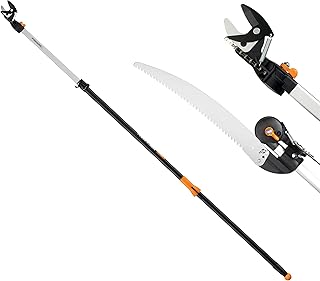
The Fiskars 2-in-1 pole saw is the pick that keeps you safely on the ground when the wood you need to cut is over your head. It combines a bypass pruner for smaller stems with a 15-inch double-grind saw blade for larger limbs, and the pole extends from around eight feet to roughly twelve, so you can reach into a canopy without dragging out a ladder.
A rotating head lets you angle the cut to the branch instead of the other way around, and the double locking system keeps the pole rigid at full extension so the blade does not wander. For shaping tall shrubs, thinning tree crowns, and clearing dead high limbs, it does a job no hand saw can match.
The trade-offs come with the reach. A fully extended pole is heavy to hold overhead and takes two hands to control, and it is built for pruning-sized limbs, not for felling or thick trunk cuts. Used within that scope, it is the safest way to handle high work.
Bottom line: when high branches are the problem, the Fiskars 2-in-1 pole saw is our pick for reach, letting you prune overhead safely and precisely without leaving the ground.
- Reach: extends from about 8 to 12 feet
- Saw blade: 15-inch double-grind
- Pruner: bypass style for smaller cuts
- Head: rotating for angled cuts
- Locking: double locking system
- Power: manual (no battery or fuel)
Extend the pole only as far as you need and confirm both locks are set before you lift it. Use the bypass pruner for stems it can close around and the saw blade for anything thicker, positioning the rotating head so the teeth meet the branch squarely. Keep your body out from directly under the cut, and let the limb fall clear rather than catching it.
Always assume a cut limb will drop straight down and stand to the side, and never use the pole saw near overhead power lines. Retract and lock the pole before carrying it, wipe the blade dry after use, and keep the pruner blade clean so it closes smoothly. Store it collapsed and vertical to protect the head.
How to Choose the Right Pruning Saws
Pruning saws look simple, but small differences in blade length, tooth pattern, and handle design decide whether a tool feels effortless or exhausting. A saw that is perfect for waist-high rose canes will fight you on a six inch oak limb, and a heavy D-handle model that tames thick wood is overkill for delicate thinning. Use the criteria below to narrow the field before you commit, and lean on the comparison table further down to see how our picks stack up side by side.
Blade Length and Reach

Blade length sets the ceiling on what you can cut. A stroke can only be as long as the blade, so a short seven inch folder is quick and precise on branches up to about two inches, while a fourteen to eighteen inch blade lets you saw through limbs the width of your wrist without binding. Longer is not automatically better, though. A big blade is harder to control in a crowded canopy and adds weight that tires your arm on a long session.
Reach is the other half of the equation. If the wood you want to remove sits above your head, no hand saw length will save you from a wobbly ladder. That is where a pole saw earns its keep, extending your effective reach to twelve feet or more so you keep both boots on the ground. Think about the tallest cut you realistically make before you decide whether a compact folder, a full-size hand saw, or an extendable pole model belongs in your kit.
Tooth Pattern and Cutting Action

Most modern pruning saws use impulse-hardened teeth ground on three faces, which slice rather than tear and stay sharp far longer than old carbon-steel patterns. Tooth count matters too. A coarse blade with fewer, larger teeth per inch clears sawdust quickly and rips through green, sappy wood, while a finer blade leaves a smoother surface on dry or hardwood limbs. Curved blades cut on the pull stroke, which pulls the saw into the wood and lets you work with less downward force, a real advantage when you are reaching overhead.
Straight blades, common on folding models, cut on both the push and pull stroke and give you more control for shallow, precise work near the trunk collar. Neither style is strictly better. Curved and coarse suits heavy limb removal, while straight and fine suits detailed shaping. When a branch is simply too thick or too hard for any hand saw, it is time to reach for a powered tool, and our roundup of the best chain saws covers where that line sits.
Handle Design and Grip

The handle is where comfort lives or dies. A soft, contoured grip with a non-slip coating keeps the saw from twisting when your hands are sweaty or gloved, and it soaks up the vibration that leaves your palm aching after a dozen cuts. Pistol-grip folders are the most versatile shape for one-handed work, while a full D-handle gives you room for two hands or a gloved fist on the biggest jobs, letting you push harder without losing control.
Pay attention to the guard and the balance as well. A finger guard or a handle that flares at the front keeps your hand from sliding onto the blade if the saw jumps free of a cut. Balance is subtler: a saw that carries its weight near the handle feels nimble, while a blade-heavy model tires you faster even if the two weigh the same on a scale.
Folding vs Fixed Blade
Folding saws win on safety and portability. The blade tucks into the handle so it rides in a jacket pocket or a pack without a sheath, and a good locking mechanism holds the blade firmly open under load and safely closed in transit. The trade-off is a shorter maximum blade and a pivot that can loosen or gum up with sap over time, so look for a lock you can feel click into place and a design you can wipe clean.
Fixed-blade saws give you the longest reach and the stiffest, most confidence-inspiring cut, which is why the heaviest-duty models skip the folding hinge entirely. They demand a scabbard for safe storage and take up more room, but there is no pivot to fail and no flex where the blade meets the handle. Many gardeners keep both: a compact folder on the belt for quick trims and a full-size fixed saw for the branches that fight back.
Blade Steel and Durability
Blade material decides how long a saw stays useful. SK-5 high-carbon steel and Japanese-style hardened blades hold an edge through seasons of hardwood, and a rust-resistant coating matters if your tools live in a damp shed or ride in a wet pack. Because impulse-hardened teeth cannot be resharpened at home, a saw with a replaceable blade is the smart long-term buy: when the teeth finally dull, you swap the blade for a few dollars instead of retiring the whole tool.
Durability also comes down to the little things. A blade that seats tightly in the handle without wobble, screws that stay snug, and a coating that shrugs off sap all add years of service. A pruning saw is one of the cheapest tools in the shed to keep sharp and one of the most satisfying to use when it is, so it pays to buy a model built to last alongside the rest of your outdoor power and garden gear.
Blade Guards, Locks, and Safe Storage
A saw is only as safe as the way it stops. On folders, look for a two-position lock that secures the blade both open and closed, so it will not snap shut on your fingers mid-cut or spring open in your pack. The best locks give a firm, audible click and hold zero play when you flex the blade against a limb. A sloppy lock is the most common reason a cheap folder ends up in a drawer, so it is worth handling before you trust it on a ladder.
Fixed blades need a scabbard or sheath, and the good ones ship with a molded holster that clips to a belt and covers the teeth completely. Storage habits extend the life of any blade: hang the saw in a dry spot, keep the coating clean of sap, and never toss a bare blade into a bucket of tools where the teeth can chip. A few seconds of care after each job keeps the edge cutting cleanly through the whole season.
| Pick | Blade Style | Blade Length | Best For |
|---|---|---|---|
| Corona Tools RazorTOOTH | Fixed, curved | 18 in | Heavy limb removal |
| Bahco Laplander | Folding, straight | 7.5 in | Trail and bushcraft |
| REXBETI 11 in | Folding, straight | 11 in | All-round value |
| Mossy Oak 3-in-1 | Folding, swappable | Interchangeable | Mixed materials |
| REXBETI 8 in | Folding, straight | 8 in | Backpacking and packability |
| Flora Guard 7.7 in | Folding, straight | 7.7 in | Budget and light trimming |
| Fiskars Pole Saw | Extendable pole | 15 in head | High branches |
Why You Should Trust Us
We build every roundup the same way: we start with the saws real buyers actually reach for, not the ones with the biggest marketing budgets. For this guide we gathered current customer ratings across thousands of verified owners, then filtered for the models that hold a strong score after long-term ownership rather than a burst of first-week enthusiasm. A saw only makes our shortlist when its reputation survives full seasons of green wood, dry limbs, and the occasional buried nail.
From there we weigh the specifications that matter for pruning specifically: blade length and steel, tooth geometry, locking security on folders, handle comfort, and how easily each tool cleans up and stores. We read the critical reviews as closely as the glowing ones, because a pattern of complaints about a loose pivot or a dull-out is exactly what separates a saw that lasts from one that disappoints. Our aim is a list you can buy from without second-guessing, whatever your branches look like.
Final Thoughts
If you want one saw that handles the widest range of work, the Corona Tools RazorTOOTH 18-inch is our best overall pick. Its long curved blade and roomy D-handle chew through wrist-thick limbs that stop smaller folders cold, and the replaceable blade means it stays sharp for years. For most gardeners who want serious cutting power without overthinking it, this is the one to buy.
For the best value, the REXBETI 11-inch folder is hard to beat. It pairs an aggressive SK-5 blade with a secure lock and a comfortable grip, folding down small enough to live in a tote or pack, and it carries one of the largest bodies of positive owner feedback on this list. When the wood is out of reach overhead, the Fiskars 2-in-1 pole saw is the pick that keeps you off the ladder, extending well past twelve feet to bring down high limbs safely. And for a trail companion that clears branches on the way to camp, the compact Bahco Laplander folds to pocket size and locks solid. Browse more of our hands-on buying guides or explore related tools by category to round out your kit.
Frequently Asked Questions
What is the best pruning saws for thick branches in 2026?
For branches from three inches up to roughly ten inches across, a long fixed-blade saw with a D-handle gives you the leverage and stroke length you need. The Corona Tools RazorTOOTH 18-inch is our top choice here because its curved, coarse-toothed blade pulls itself into thick wood and the two-hand grip lets you power through without the blade flexing. Once a limb is wider than a hand saw can comfortably handle, a powered tool becomes the safer, faster option.
Are folding pruning saws strong enough for real work?
Yes, as long as the lock is solid. Modern folders like the REXBETI and Bahco models use impulse-hardened SK-5 or XT steel and a positive locking mechanism that holds the blade rigid under load, so they cut green and dry wood every bit as cleanly as fixed blades within their length range. The folding hinge is the only part to watch: wipe sap from the pivot now and then and make sure the lock clicks fully before you bear down.
Do I need a curved or straight blade?
Choose a curved blade if most of your cutting is heavy limb removal or overhead work, because it cuts on the pull stroke and draws itself into thick wood with less effort. Choose a straight blade for precise, controlled trimming near the trunk and for detailed shaping, since it cuts on both strokes and is easier to guide. Many gardeners keep one of each, which is why our list of the 7 best pruning saws includes both styles.
Can I use a pruning saw for camping and bushcraft?
Absolutely. A compact folder like the Bahco Laplander or the REXBETI 8-inch is a favorite for the trail because it locks safely closed, weighs almost nothing, and processes firewood and clears deadfall without the bulk of an axe. Look for a rust-protected blade and a lock that works in both the open and closed positions so the saw rides safely in your pack.
How do I keep a pruning saw sharp and rust-free?
Because impulse-hardened teeth cannot be filed at home, the practical answer is to protect the edge you have and replace the blade when it finally dulls. Wipe the blade dry after each use, clear sap with a little solvent, and store the saw closed or sheathed in a dry spot. Choosing a model with a replaceable blade keeps a good handle in service for years. You can find more care tips and related garden tools across our tool categories.




Write Your Review
No reviews yet. Be the first to share your experience!