

A loose dog in a moving car is a distraction on a good day and an unrestrained mass in a hard stop. That is the entire reason this product exists, and it is also why the category is so easy to buy badly: nearly everything sold under this name is a short adjustable tether with a clip at each end, and the gap between a useful one and a pointless one sits almost entirely in how it attaches at both ends. We sorted 7 options from Duke & Dixie, BWOGUE, Mighty Paw and more by attachment method, adjustable length, clip hardware and what each maker is willing to put in writing.
Our top pick is the Mighty Paw Dog Seat Belt for its aviation aluminum carabiner and swivel clip, the hardware combination that resists both wear and tangling. Before any of that matters, one rule decides whether any restraint here is safe to use at all: it clips to a properly fitted chest harness, never to a collar, because a tether that snaps taut against a dog’s neck can cause serious injury in even a moderate stop. The shortlist reflects what is available in September 2026, and more gear for the car sits in our pet supplies section.

Pros
- Aviation aluminum carabiner instead of cast zinc
- Swivel clip stops the strap winding itself short
- Adjustment range suits a back seat rather than a whole cabin
- Maker publishes a force figure for the carabiner
Cons
- The published force rating covers the carabiner, not the assembled system in a crash
- Not crash tested, so it is a restraint rather than impact protection
- Must be used with a chest harness, never a collar
The Mighty Paw Dog Seat Belt is the entry here that spends its money on hardware rather than on features, and on a product that is fundamentally a strap with two ends, hardware is where it counts.
The car end is an aviation aluminum carabiner rather than the cast zinc snap most of this category uses. Aluminum holds a positive gate action and does not distort the way a cheap zinc gate can, which matters because a gate that stops closing fully is a clip that can work itself loose against a seat cushion.
The dog end swivels. Dogs turn around repeatedly on a car seat and a fixed clip twists the webbing tighter with every rotation until the tether has quietly shortened itself. A swivel joint removes that failure mode entirely.
Read the published force figure correctly. It describes the static strength of the carabiner, not the behavior of the whole assembly in a collision, and Mighty Paw does not claim crash testing. Clip it to a properly fitted chest harness and never to a collar, because a collar puts the entire load through a dog's neck.
Bottom line: the best built tether here, provided you understand it is a restraint rather than crash protection.
- Type: adjustable car tether
- Car end: aviation aluminum carabiner
- Dog end: swivel clip
- Webbing: nylon
- Adjustment: approximately 16 to 26 inches
- Attachment: use with a chest harness, never a collar
- Crash testing: not claimed
Fit the harness first, then clip the swivel end to the harness ring and the carabiner around the seat belt webbing or a rated anchor point. If you use the belt, pull it fully out so the retractor locks. Set the length with the dog sitting in position: it should be able to sit, turn and lie down, but not reach the footwell or get between the front seats.
Check the carabiner gate closes fully each time you clip in, and inspect the bar tack stitching at the loops every few weeks. Never clip to a collar. Never leave a restrained dog alone in a vehicle, both for heat reasons and because nylon webbing is not chew proof. Wash the webbing by hand and let it dry fully rather than putting it away damp.
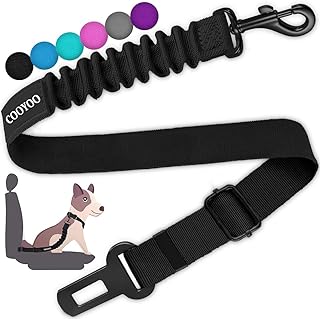
Pros
- Elastic section softens the jolt of a hard stop
- Retractable design keeps slack off the seat
- Adjustable length for different back seats
- Nylon webbing that can be wiped clean
Cons
- Elastic lengthens under load, so it needs setting shorter than a rigid strap
- Sold as a single, so a two dog car needs two
- No crash testing claimed
The COOYOO Dog Seat Belt is the elastic take on this idea. Instead of a fixed length of webbing it carries a stretch section that pays out under load and pulls back in when the dog settles.
The argument for elastic is real. A rigid strap stops a dog abruptly at the end of its travel, and a bungee section spreads that deceleration over a slightly longer moment, which is easier on both the dog and the harness stitching.
The retractable behavior also keeps loose webbing off the seat between journeys, which is the sort of small thing that decides whether a tether stays in the car or ends up in a drawer.
The catch is that elastic has working length. A bungee tether set to the same nominal length as a rigid one will let a dog travel further, so set it shorter and re-check where the dog can actually reach. As with everything on this page, clip it to a chest harness and never to a collar, and treat it as a restraint rather than crash protection.
Bottom line: a sensible single-dog choice if you want the jolt taken out, set shorter than you think you need.
- Type: retractable elastic car tether
- Webbing: nylon with elastic section
- Adjustment: adjustable length
- Pack: single
- Attachment: use with a chest harness, never a collar
- Crash testing: not claimed
This suits one dog that fidgets and settles repeatedly, where the retracting elastic keeps slack under control and softens the stop. It is a weaker fit for a household with two dogs, where a two pack costs less trouble, and for anyone who prefers a fixed length they can measure once and forget.
Set the length with the dog in position and remember the elastic stretches, so verify the dog cannot reach the footwell or the front seats when the strap is under load rather than at rest. Inspect the elastic section for fraying where it enters the webbing, since that is where stretch fabric wears first, and never leave a tethered dog alone in the car.

Pros
- Two belts cover two dogs or two vehicles
- Headrest mounting fits almost any rear seat
- Wide adjustment range across back seat sizes
- Listing states clearly that it is for use with a harness
Cons
- A headrest loop is only secure if the head restraint is pushed down and locked
- No elastic buffer, so stops are abrupt
- No crash testing claimed
The BWOGUE 2 Pack is the plainest version of this product and it is the one most people should start with, largely because it comes in twos.
The attachment is a loop around the headrest post rather than a tongue in the belt receiver. That makes it close to universal across vehicles and leaves the receiver free for a human passenger, which matters on a full back seat.
The adjustment range is wide enough to suit anything from a compact back seat to a large SUV bench, and the tether unclips to work as a short lead, so the dog is under control from the seat to the ground.
Two things to be careful about. A headrest is not a structural anchor, so push the head restraint down into its locked detent before looping anything around it. And the listing is right to say harness: clipping this to a collar would put every bit of a stop through the dog's neck.
Bottom line: the sensible default, and the pack size is the reason.
- Type: headrest restraint tether
- Pack: 2
- Adjustment: approximately 18 to 30 inches
- Function: 2 in 1 seat belt and short leash
- Suits: dogs and cats wearing a harness
- Attachment: use with a chest harness, never a collar
- Crash testing: not claimed
Push the head restraint fully down and check it locks before looping the strap around the posts. Fit the harness, clip on, then set the length with the dog sitting normally so it can lie down but cannot reach the footwell or the front seats. Unclip from the headrest and use the same strap as a short lead when you open the door.
Choose the headrest style over a buckle tongue if your car has an awkward belt receiver, if you need the receiver free for a passenger, or if you move the tether between vehicles. Choose a buckle tongue instead if your rear head restraints cannot be locked down, since a loop around a raised unlocked headrest can lift off.

Pros
- Elastic buffer reduces the snap of a hard stop
- Reflective stitching helps at the roadside after dark
- Two belts in the pack for two dogs or two cars
- Headrest mounting works across most vehicles
Cons
- Elastic adds working length, so it must be set shorter
- Sized toward medium and large dogs
- No crash testing claimed
The SlowTon Dog Seat Belt combines the two features that most improve a plain tether: a bungee section and reflective trim, in a two pack.
The elastic buffer does the same job here as elsewhere, decelerating a dog over a slightly longer moment instead of stopping it dead against rigid webbing. On a dog that lunges at passing traffic that is a meaningful difference in how the restraint feels to the animal.
Reflective stitching is not about the cabin, it is about the moment you open a rear door on a dark road. Combined with the leash function, it covers the transition from seat to ground, which is where most escapes actually happen.
The sizing leans toward medium and large dogs, so a very small dog may find the hardware heavy for its harness ring. And because elastic stretches under load, set this shorter than a rigid strap and confirm the dog still cannot reach the front seats. A chest harness is required, never a collar.
Bottom line: the best featured two pack here, and the pick if you drive at night.
- Type: headrest restraint with bungee buffer
- Pack: 2
- Trim: reflective stitching
- Function: 2 in 1 car tether and leash
- Sizing: medium and large
- Attachment: use with a chest harness, never a collar
- Crash testing: not claimed
This suits medium and large dogs, drivers who make regular night journeys, and anyone whose dog reacts to traffic and hits the end of a rigid tether hard. It is less suited to a very small dog, where the hardware weight is out of proportion to the harness.
Lock the head restraint down, loop the strap and clip to the harness ring. Because the buffer stretches, set the length shorter than feels necessary and then test it by encouraging the dog toward the footwell. Keep the reflective face outward so it is visible from outside the car when a door opens.

Pros
- Swivel carabiner prevents the strap winding short
- Reflective bungee webbing for roadside visibility
- Three way design covers tether, leash and restraint
- Clip and buckle fittings suit different attachment points
Cons
- Zinc alloy hardware is heavier than aluminum and the gate is its weak point
- Bungee stretch means the effective length is longer than the setting
- No crash testing claimed
The IOKHEIRA Dog Seat Belt is the multi-fitting option, arriving with a clip hook, a latch and a buckle so it can attach in more than one way depending on the car.
The most useful piece of that kit is the swivel carabiner. Any tether without a swivel gradually winds itself shorter as a dog turns on the seat, and this one avoids that while also giving a positive gate rather than an open hook.
The webbing is reflective bungee, which folds the two most practical extras into one part: some give in a hard stop, and visibility when a rear door opens on an unlit road. The same strap unclips into a short leash.
The hardware is zinc alloy rather than aluminum. That is heavier and its gate is the part to watch over time, so check it closes fully before each trip. Bungee also stretches under load, so set the length shorter than you would a rigid strap, and clip it to a chest harness rather than a collar.
Bottom line: the most adaptable fitting set here, with hardware worth inspecting periodically.
- Type: 3 in 1 car tether, leash and restraint
- Webbing: reflective nylon bungee
- Hardware: swivel zinc alloy carabiner
- Fittings: clip hook, latch and buckle
- Adjustment: adjustable length
- Attachment: use with a chest harness, never a collar
- Crash testing: not claimed
Take this if you move between vehicles with different attachment points, or if you want one strap that covers the car and the walk from the door. Choose the aluminum carabiner option instead if hardware weight and long term gate wear are your priority, and choose a rigid tether if you would rather set an exact length once.
Inspect the carabiner gate regularly, because zinc alloy gates are the first part of this kind of hardware to give trouble. Check the bungee section for exposed elastic where it enters the webbing. Set the working length under stretch rather than at rest, never clip to a collar, and never leave a tethered dog alone in the vehicle.

Pros
- Short adjustment range keeps a dog on the seat rather than the footwell
- Simple design with little to fail
- Suits a wide spread of dog sizes
- Straightforward attachment in most vehicles
Cons
- The listing mentions attaching to a collar, which should be ignored
- No elastic buffer, so stops are abrupt
- No crash testing claimed
The Active Pets Car Seat Belt is a plain tether with a deliberately short adjustment range, and that short range is the strongest thing about it.
Most of the failures in this category come from a strap set too long: a dog that can reach the footwell, climb between the front seats or get a head to an open window. A tether that simply does not extend that far removes the temptation to over-adjust.
The design is otherwise unremarkable in a good way. There is no elastic to stretch, no retractor to jam, and nothing to service, which suits a dog that travels calmly and settles quickly.
One warning matters more than any feature. The listing describes attaching to a harness or a collar, and the collar half of that should be disregarded outright: a tether concentrates a whole stop into one point, and on a collar that point is the dog's throat. Use a fitted chest harness, and treat this as a restraint rather than crash protection.
Bottom line: a solid short tether, bought and used with the collar instruction ignored.
- Type: adjustable car tether
- Adjustment: approximately 18 to 24 inches
- Sizing: small through large dogs
- Buffer: none, rigid webbing
- Attachment: use with a chest harness, never a collar
- Crash testing: not claimed
Ignore the collar attachment mentioned on the listing and clip only to a fitted chest harness. Because there is no elastic buffer, keep the length short so the dog never builds momentum before the strap stops it. Inspect the stitching at each loop periodically, and never leave a restrained dog alone in a parked car.
This fits a dog that already travels calmly and needs containing rather than cushioning, and anyone who wants a strap with no elastic and no moving parts. It is a poor fit for a dog that lunges at passing traffic, where a bungee section takes some of the shock, and for anyone who wants a tether that doubles as a full length leash.

Pros
- Two tethers per pack for two dogs or a second vehicle
- Heavy duty nylon webbing with adjustable length
- Universal fit across cars, trucks and SUVs
- Plain design that works as a spare in any glovebox
Cons
- No elastic buffer or reflective trim
- No swivel, so the strap can wind short as a dog turns
- No crash testing claimed
The Duke & Dixie 2 Pack is the no-frills entry, a pair of adjustable nylon tethers with nothing added and nothing to go wrong.
The pack size is the point. Two tethers means one in each car, or one for each dog, which removes the most common excuse for traveling with an unrestrained animal, namely that the belt is in the other vehicle.
The webbing is plain heavy duty nylon with an adjustable buckle, and the universal fit means it works across cars, trucks and SUVs without a vehicle specific fitting to check.
What it leaves out is worth knowing. There is no bungee section to soften a stop, no reflective stitching for the roadside and no swivel, so a dog that circles repeatedly will gradually wind the strap shorter. As ever, clip to a chest harness rather than a collar, and treat it as a restraint rather than crash protection.
Bottom line: the spare-in-every-car option, plain but genuinely useful in twos.
- Type: adjustable car tether
- Pack: 2
- Webbing: heavy duty nylon
- Fit: universal for cars, trucks and SUVs
- Function: tether and short leash
- Attachment: use with a chest harness, never a collar
- Crash testing: not claimed
Buy this if you want a tether in every vehicle and do not need a buffer, reflective trim or a swivel. Step up to a swivel model if your dog turns around constantly on the seat, and to a bungee model if it reacts to traffic and hits the end of the strap hard.
Fit the harness, attach the tether to the vehicle end first so the dog is never loose in the cabin, then clip to the harness ring. Set the shortest length that still lets the dog lie down. If the strap winds up over a journey, unclip and let it untwist rather than leaving it under tension.
How to Choose a Pet Seat Belt
Six things decide whether one of these does its job. The first is not a preference or a feature comparison, it is a safety rule, and it is worth reading even if you skip everything else on this page.
Clip It to a Harness, Never to a Collar

A tether concentrates every bit of deceleration force on whatever it is clipped to. Clipped to a collar, that force lands on a dog’s throat and neck, which is the worst possible place to load it, and a hard stop does not need to be a crash to do damage. Clipped to a well fitted harness, the same load spreads across the chest and shoulders, which is what a harness is designed for.
Several listings in this category advertise that they attach to a harness or a collar. Treat the collar half of that sentence as marketing copy rather than as an instruction. There is a second reason beyond injury: a flat collar can slip over a panicking dog’s head, and a dog that pulls free inside a car at the roadside is a serious problem in traffic.
The harness itself has to be worth clipping to. A thin nylon strap harness that a determined dog can back out of adds very little, and the attachment ring should sit on the back or chest with solid stitching behind it rather than on a decorative panel. Cats follow the same rule with a cat harness, though a secured carrier is the more practical answer for most cats.
How It Attaches to the Car
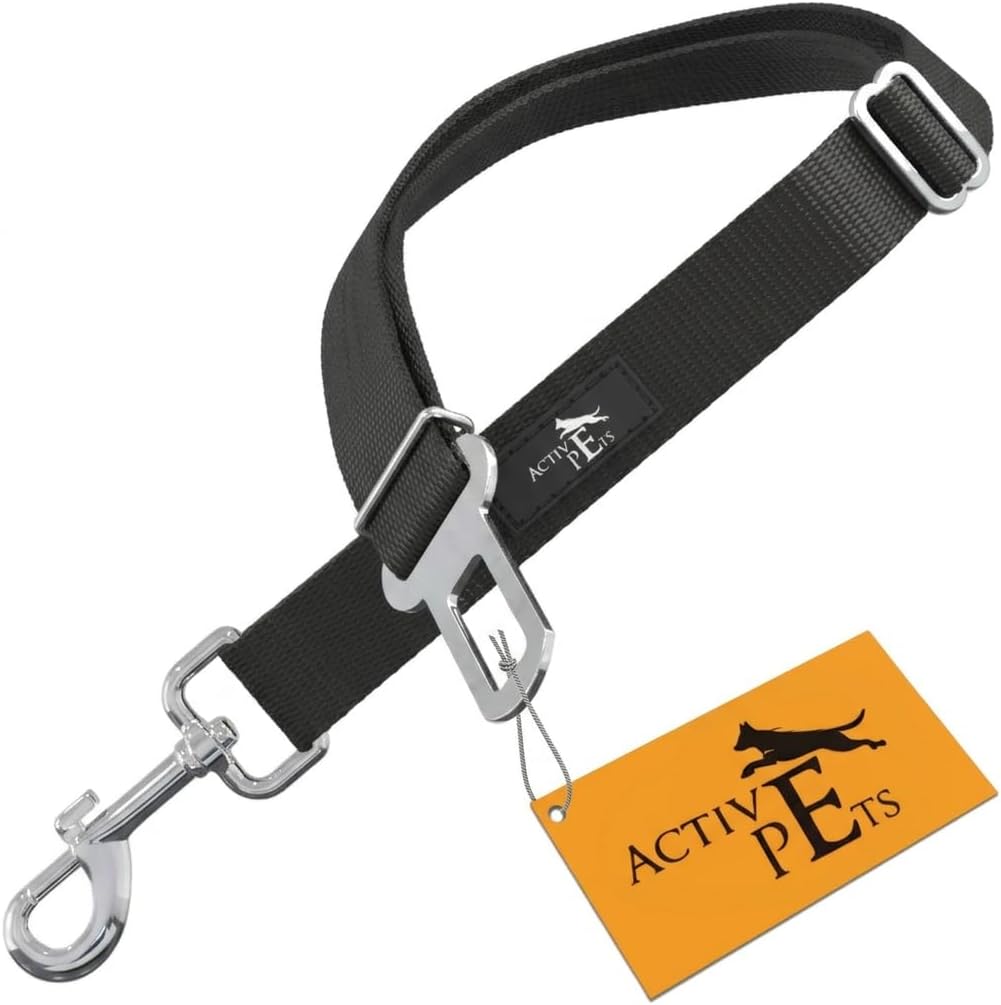
The most common design ends in a metal tongue that clicks into the car’s seat belt receiver exactly like a human belt. It is positive, quick and requires no threading. Two things to check: some vehicles have receivers that reject third party tongues, and occupying a receiver can set off the belt reminder chime on certain cars, which is irritating rather than dangerous.
The second design loops around a headrest post. This is the most universally compatible option because every rear seat has a headrest, and it keeps the belt receiver free for a passenger. The caveat is that a headrest is not a structural anchor: make sure the head restraint is pushed down and locked in its detent, because a loop around a raised, unlocked headrest can lift straight off.
The third design ends in a carabiner that goes around the seat belt webbing itself or onto a cargo anchor point. It is the most flexible of the three and it lets you use the belt as the anchor, in which case pull the belt all the way out to engage the retractor lock so it cannot spool loose. If you are considering the lower child seat anchors, check the vehicle owner’s manual first, because those points are specified for child restraints rather than for general loads.
Length, Adjustment and Where the Dog Can Reach

Adjustable ranges in this class typically run somewhere between the mid teens and about thirty inches. The correct setting is the shortest length that still lets the dog sit up, turn around and lie down on the seat. Anything longer is not extra comfort, it is extra distance for the dog to travel before the strap stops them.
The specific things a tether should prevent are a dog reaching the footwell, climbing between the front seats and getting a head out of an open window. All three are common and all three are the direct result of a strap set too long. Adjust it with the dog in position rather than guessing, and re-check after a groom or a seasonal coat change alters how the harness sits.
Two dogs need two anchor points rather than two clips onto one belt, so a two pack is genuinely useful in a multi-dog household and equally useful for keeping one belt in each car. Never route a tether where it crosses the driver’s controls or field of view. Our article archive covers more travel gear along the same lines.
What Crash Rated Means, and Why Most of These Are Not
There is no mandatory safety standard for pet car restraints. A small number of makers voluntarily submit harnesses to independent crash testing modeled on the standard used for child restraints, and that testing is expensive enough that the products carrying it are a narrow and clearly labeled group. The great majority of tethers, including most on this page, are not crash tested and do not claim to be.
Watch how force figures are worded. A carabiner described with a force rating is telling you about the static strength of that one piece of hardware, not about how the assembled system behaves in a collision. In practice the weakest link is usually somewhere else entirely: the stitching where webbing folds back on itself, the harness the tether clips to, or the anchor point in the car.
None of this makes these products pointless. Keeping a dog out of the driver’s lap, off the floor and inside the vehicle when a door opens are real safety gains that happen on every single journey. It does mean you should buy one for what it is, a restraint, and not assume protection that the label does not claim. If crash performance is your priority, a crash tested harness or a properly secured crate is a different purchase.
Clips, Swivels and the Hardware That Stops Tangles
A swivel at the dog end is the feature most people underrate. Dogs turn around repeatedly on a car seat, and a fixed clip twists the webbing tighter with every rotation until the tether has effectively shortened itself and binds. A swivel joint lets the clip rotate freely and the strap stays the length you set it to.
Hardware splits into bolt snaps, trigger snaps and carabiners, in zinc alloy or aluminum. Zinc alloy is inexpensive and heavy and its weak point is the gate, which can distort with rough handling. Aluminum carabiners are lighter and hold a positive gate action, which matters because a gate that does not close fully is a clip that can unhook itself against a seat cushion.
On the webbing, look for bar tack stitching where the strap loops around each fitting rather than a single row of straight stitch. Also accept that no nylon tether is chew proof. A bored dog left alone in a car will get through webbing surprisingly quickly, which is one more reason a restrained dog should not be left unattended in a vehicle.
Bungee Buffers, Reflective Trim and Double Duty as a Leash
Many tethers include an elastic bungee section. Its job is to take the sharpness out of a sudden stop so the dog is decelerated over a slightly longer moment rather than being snapped against a rigid strap. The trade-off is that elastic adds working length under load, so a bungee tether should be adjusted shorter than a rigid one to end up in the same place.
Reflective stitching earns its place at the roadside rather than in the car, on the night you open a rear door on the hard shoulder. The related feature worth paying attention to is the two in one design, where the tether unclips from the car and works as a short leash, so the dog is under control from the seat to the sidewalk without a gap.
Build the habit around that gap, because it is where most escapes happen. Clip the dog to the tether before anyone opens a door, and clip a walking lead on before the tether comes off. Check too that the clip actually fits your harness ring, since a wide bolt snap will not pass through a small welded D ring. More outdoor and travel kit is grouped in our sports and outdoors section.
| Car attachment | Best at | Watch out for |
|---|---|---|
| Seat belt buckle tongue | Fast, positive, no threading | Some receivers reject third party tongues, belt chimes |
| Headrest loop | Universal fit, leaves the receiver free | Headrest must be pushed down and locked |
| Carabiner on belt or anchor | Most flexible, uses the belt itself | Lock the retractor, check the manual before using child seat anchors |
Why You Should Trust Us
We build these lists from published specification and from the pattern of what long-term owners report, rather than from marketing copy. For each restraint here we looked at how it attaches to the vehicle, the adjustable length range, the clip type and material, whether there is a swivel, whether an elastic buffer is fitted, and exactly what the maker does and does not claim about testing.
Where a listing says a tether can be clipped to a collar, we flag it rather than repeat it, because that is a genuine safety issue and not a matter of preference. We also set aside near-identical listings that differ only in pack size or color, so each entry is a different product. Nothing on this page is presented as crash protection unless the maker states that testing has been done.
Final Thoughts
Best overall is the Mighty Paw Dog Seat Belt. It uses an aviation aluminum carabiner rather than cast zinc, adds a swivel at the dog end so the strap does not wind itself short, and adjusts across a sensible range for a back seat. The published force figure applies to the carabiner rather than to a crash scenario, and Mighty Paw is straightforward about that, which is the right way round.
Best value is the BWOGUE 2 Pack Dog Seat Belt. Two headrest tethers cover two dogs or two cars, the adjustment range is wide enough for most back seats, and the listing says plainly that it is to be used with a harness. It is the plainest execution of the idea and, for a dog that travels calmly, it is all the restraint most people need.
For specific needs, the COOYOO Dog Seat Belt is the pick if you want an elastic buffer built into a single retractable strap, the SlowTon Dog Seat Belt adds reflective trim and a bungee section in a two pack, and the IOKHEIRA Dog Seat Belt is the three in one to take if you want the tether to double as a short leash at the curb. The Active Pets Car Seat Belt is a solid short-range tether, though its listing mentions collar attachment and you should ignore that half of the instruction. The Duke & Dixie 2 Pack is the simple universal-fit option for a second vehicle. Everything else we index sits in the category directory.
Pet Seat Belt FAQs
Can I clip a pet seat belt to my dog’s collar?
No. Always clip it to a properly fitted chest harness. A tether puts the whole of a sudden deceleration through a single attachment point, and on a collar that point is the dog’s throat and neck, which can cause serious injury well below crash speeds. There is also an escape risk, since a flat collar can slip over the head of a frightened dog. Some listings say collar attachment is acceptable, and that is one instruction to disregard. More dog gear is grouped in our pet supplies section.
Are these crash tested?
Almost none of them are, and there is no mandatory standard requiring it. A handful of harness makers pay for independent crash testing modeled on child restraint protocols, and those products say so prominently because the testing is expensive. A force rating printed next to a carabiner describes the static strength of that fitting, not the behavior of the whole assembly in a collision. Buy a tether to stop a dog roaming the cabin and leaving through an open door, and look at a crash tested harness or a secured crate if impact protection is the goal.
Where should my dog travel in the car?
The back seat or a secured cargo area, not the front. A front passenger airbag deploys with enough force to injure a dog badly, and a dog in the front is also the version of this problem that most reliably distracts a driver. In the back, anchor the tether so the dog stays on the seat rather than able to drop into the footwell, and never route the strap where it crosses the driver’s controls.
How short should the tether be?
Short enough that the dog can sit, turn and lie down on the seat, and no longer. Set it with the dog in position rather than estimating, then check three things: that the dog cannot reach the footwell, cannot get between the front seats, and cannot put a head out of a window. If the tether has an elastic section, remember that it lengthens under load, so set a bungee model slightly shorter than a rigid one to end up in the same place.
Do these work for cats in 2026?
Some are sold for cats as well as dogs, and the same rule applies with more force: a cat harness, never a collar, because cats slip collars easily. In practice a secured carrier is the better answer for most cats. A carrier contains a frightened animal, keeps claws away from upholstery and stops a cat from disappearing under a seat, and it can itself be belted down so it does not move around the cabin. A tether suits the rare cat that is genuinely harness trained and calm in a car.






Write Your Review
No reviews yet. Be the first to share your experience!