

A pet gate looks like the simplest thing you will ever buy for an animal, and then you get it home and find that the doorway is not square, the baseboard sticks out further than the pressure cups can reach, and the dog you bought it for clears twenty-four inches without breaking stride. Almost every complaint here traces back to one of three things: the wrong mounting method, a gate that is too short, or a latch so awkward you stop closing it. We compared 8 pet gates from Carlson Pet Products, Regalo, Safety 1st and more, sorted for August 2026 by how each one mounts, how tall it stands, and how much the walk-through door will annoy you on the tenth pass of the day.
Our top pick is the Ingenuity Multi-Use Decorative Extra Tall Walk-Thru Gate for its thirty-six inch height paired with an adjustment range wide enough to cover both a standard doorway and an open hallway, which is the combination that solves the two most common failures at once. Below, the field is grouped by mounting method so you can rule most of it out before measuring. If you are setting up for a new dog from scratch, our pet supplies section covers the rest of the shopping list.

Pros
- Thirty-six inch height puts it above what most dogs will attempt
- Adjustment range covers both a doorway and a wide hallway
- Metal frame does not flex when a large dog leans on it
- Foot pedal release opens the door with your hands full
- Decorative panel looks less like safety equipment than plain bar gates
Cons
- Heavy and visually dominant in a small hallway
- Pressure mounting means the tension needs re-checking every few weeks
- Not approved for the top of a staircase without hardware mounting
The Ingenuity Multi-Use is the answer to the single most common problem in this category, which is buying a gate the dog simply jumps. At thirty-six inches it is taller than almost everything else here, and that height is what makes it a barrier rather than an obstacle for a medium or large breed.
The second thing it gets right is range. An adjustment span that reaches from a narrow doorway out to a wide hallway means one gate covers openings that would otherwise need two different products, and it also means the gate is still useful if you move it, or move house.
The metal frame matters more than it sounds. Lighter plastic gates flex when a big dog puts its weight on the bottom rail, and flex is what walks a pressure gate slowly out of position. This one stays rigid, and the foot pedal release is genuinely useful when both hands are full.
The honest drawbacks are bulk and mounting. It is a substantial object in a narrow hallway, it is heavier to move between rooms than the portable designs, and like every pressure gate it needs its tension checked periodically and should not be used at the top of stairs without hardware mounting.
Bottom line: the gate to buy if you want to solve height and width in one purchase and never think about it again.
- Height: 36 inches
- Fits openings: 28.5 to 48 inches
- Mounting: pressure mounted with wall cups
- Material: black metal with decorative panel
- Door: walk-through with foot pedal release
- Placement: doorways and bottom of stairs
Buy this if you have a medium or large dog, especially one that has already shown it can jump or climb, and if the opening you need to block is wider than a standard door frame. It also suits households that want one gate to handle several different openings over time. Skip it if your only opening is a narrow doorway you pass through constantly, where a lighter, shorter gate is less of a presence, or if you need a gate for the top of a staircase, which calls for hardware mounting.
Set the frame width so the gate sits near the middle of its range rather than at either extreme, which gives the most rigid installation. Position the pressure spindles against door casing rather than open drywall where you can, and fit the supplied wall cups if the gate is staying put, since they stop it creeping and spread the load. Re-check the tension every few weeks and after anyone moves the gate, and practise the foot pedal a few times so opening it one-handed becomes automatic.

Pros
- Auto-close hinges shut and latch the door without you touching it
- Dual lock resists a dog that has learned to nose a simple latch
- Door swings in both directions
- Wide enough range to cover most doorways and some hallways
Cons
- Auto-close only works reliably if the frame is mounted square
- Bottom threshold rail is a trip point in a dark hallway
- Pressure mounting rules it out for the top of stairs
The Cumbor solves a behavioural problem rather than a structural one. Most gates fail because somebody walks through and does not latch it, and an auto-close hinge removes that failure entirely by swinging the door shut and locking it on its own.
The dual lock is the other half of the design. A single squeeze latch is workable by a determined dog with a bit of patience, and the two-stage mechanism here asks for a deliberate motion that an animal will not stumble into. It takes a couple of days to become automatic for people.
Fit is broad enough for most doorways and reaches into hallway territory, and the door swings in either direction so you are not locked into one approach. Extension panels are available if your opening is wider than the standard range.
The compromises are the ones that come with pressure mounting. There is a bottom rail across the floor, the frame has to be square for the auto-close to latch consistently, and it should not go at the top of a staircase.
Bottom line: the pick when the gate guards something that matters and you do not trust everyone in the house to latch it.
- Fits openings: 30 to 46 inches
- Mounting: pressure mounted, no tools
- Door: auto-close with dual lock latch
- Swing: both directions
- Frame: black metal
- Placement: doorways and bottom of stairs
Check that the frame is level and square, because an out-of-square mount is the usual reason an auto-close door stops latching. Re-tension the pressure spindles every few weeks, particularly if a large dog leans on the gate. Do not fit it at the top of a staircase: the maker specifies hardware mounting there, and a friction mount is the wrong tool above a drop. Wipe the latch clear of hair and dust occasionally so the two-stage mechanism keeps moving freely.
This is for busy households, homes with children who forget to close things, and dogs that have already learned to defeat a basic latch. It suits doorways and the bottom of a staircase. It is less suited to anyone who wants a gate they can lift out and carry to another room daily, where a lighter portable design is easier, and it is not the choice if a bottom rail across the floor is a problem for someone in the house.

Pros
- Simple, proven design with very few parts to go wrong
- Sets up in a doorway in a couple of minutes with no tools
- Light enough to move between rooms easily
- One-handed release on the walk-through door
Cons
- Standard height only, so a determined jumper will clear it
- Bottom threshold rail sits across the floor
- Range covers a doorway but not a wide opening without extensions
The Regalo Easy Step is the default gate in this category and it has earned that position by doing one job without complication. It presses into a standard doorway, it has a walk-through door with a one-handed release, and there is very little else to it.
That simplicity is the argument. Fewer parts means fewer things that stop working, the frame is light enough to move between rooms without effort, and setup takes a couple of minutes with no tools and no holes in the trim.
It is also the sensible second gate. Once the difficult opening in your house is handled by something taller or wider, the remaining doorways rarely need more than this, and buying the same familiar latch twice makes the whole household more consistent about closing them.
The limits are clear. It is standard height rather than extra tall, so a dog that jumps will jump it. The width range covers a normal door frame and not much more, and there is a bottom rail across the floor as there is on almost every pressure gate.
Bottom line: the best value here and the right answer for a calm dog, a puppy, or any ordinary doorway.
- Fits openings: 29 to 38.5 inches
- Mounting: pressure mounted, no tools
- Door: walk-through with one-handed release
- Frame: white steel
- Placement: doorways and bottom of stairs
- Extensions: sold separately by the maker
Measure the opening at the height where the gate will sit rather than at the floor, because baseboard narrows the space unevenly and the narrowest figure is the one that counts. If your measurement lands right at the top or the bottom of the stated range, look at a different size instead, since a gate near the middle of its range mounts far more rigidly. Check whether matching extension kits are still sold before you rely on them, and remember this is a bottom-of-stairs and doorway gate, not a top-of-stairs one.
Re-check the pressure tension every few weeks, since a friction mount loosens gradually with use and faster if a dog leans on it. Position the spindles on door casing rather than bare drywall to avoid marking the paint. Wipe the frame with a damp cloth rather than solvent, and keep an eye on the latch for hair build-up. Do not use this or any pressure mounted gate at the top of a staircase.

Pros
- Very quick to install and to move between doorways
- Light frame is easy to handle one-handed
- Walk-through door avoids stepping over the gate
- Neutral white finish disappears against most trim
Cons
- At 28 inches it is one of the shorter gates here
- Lighter frame flexes more than the metal designs under a big dog
- Narrow width range compared with the extra wide models
The Safety 1st Easy Install is built around speed of setup. It goes into a standard doorway quickly, the frame is light, and moving it to a different room is a one-person job that takes moments rather than minutes.
Height is the defining characteristic. At twenty-eight inches it is a real barrier for a small or medium dog and a clear boundary for a puppy, but it is not the gate for an animal that jumps. Knowing that before you buy is the whole decision.
The walk-through door is the feature that keeps it in use. A gate you step over eventually gets left open or knocked out of position, and being able to walk through is what makes a gate part of the routine rather than an obstacle in it.
The compromises follow from the light build. The frame flexes more than a metal gate when a large dog pushes, the width range is narrower than the extra wide models, and like all pressure gates it needs re-tensioning and is not for the top of stairs.
Bottom line: a fast, unfussy doorway gate for small and medium dogs, best in homes where the animal respects a boundary rather than testing it.
- Height: 28 inches
- Fits openings: 29 to 38 inches
- Mounting: pressure mounted, no tools
- Door: walk-through
- Frame: white
- Placement: doorways and bottom of stairs
This suits small and medium dogs, puppies in training, and homes where the gate needs to move between doorways rather than stay in one place. It is a good choice for a rental, since nothing is drilled. It is the wrong choice for a large breed, for any dog that has cleared a gate before, or for an opening much wider than a standard door frame, where an extra wide model is the sensible option.
Measure at gate height rather than at the floor, then set the frame so the spindles land near the middle of the adjustment range. Tighten each spindle a little at a time, working around the four corners, so the frame stays square instead of pulling to one side. Test the door swing and latch before you trust it, and re-check the tension every few weeks. Lift the gate clear rather than dragging it if you relocate it, which keeps the pressure cups intact.

Pros
- Built-in small pet door lets a cat pass while the dog is blocked
- Metal frame is more rigid than the plastic designs
- Walk-through door for people, so nobody steps over it
- Long-running design with parts and extensions readily available
Cons
- Small pet door opening is tight for a large cat
- Two doors mean two latches to keep clear of hair
- Pressure mounted, so not for the top of a staircase
The Carlson exists for one specific household: a dog that needs to be kept out of a room and a cat that needs to get into it. The built-in small pet door handles that in a single piece of hardware instead of the usual compromise of propping a gate open.
The flap locks, which is the detail that makes it flexible. You can leave the route open day to day and close it when you need the barrier to be complete, without swapping the gate for a different one.
Structurally it is a metal frame rather than a plastic one, and that shows in how little it moves when a dog leans on it. The people door is a proper walk-through, so the gate does not become something everyone climbs over and eventually stops closing.
The limitation is the size of the flap. It is sized for a cat rather than for a small dog, and a large or arthritic cat may find the low opening awkward. There are also two latches to keep clean, and it is a pressure mount, so the top of the stairs is out.
Bottom line: the obvious pick for a mixed cat and dog home, and unnecessary complication for anyone else.
- Fits openings: 29.5 to 36.5 inches
- Mounting: pressure mounted
- Doors: walk-through door plus small pet door with lockable flap
- Frame: metal
- Placement: doorways and bottom of stairs
- Extensions: available separately
Buy this if the litter box or the cat food is on the wrong side of the barrier and you are tired of leaving the gate ajar. It works equally well for keeping a dog out of a home office while a cat comes and goes. It is not the right gate if your smaller animal is actually a small dog rather than a cat, since the flap is sized for the latter, and it is more gate than you need in a house with a single animal.
Keep both latches free of hair and dust, since the small door in particular jams when it collects fur. Lock the pet flap whenever the barrier needs to be complete, for example when a visitor's dog is in the house. Re-check the pressure tension regularly, and keep the gate out of the top-of-stairs position, where hardware mounting is required. Wipe the metal frame with a damp cloth and dry it, rather than using solvents that attack the finish.

Pros
- Covers openings far wider than a standard doorway
- Walk-through door so the whole gate does not need moving
- Bronze finish blends with wood trim better than white plastic
- Same familiar Regalo latch as the narrower models
Cons
- At the widest settings the frame flexes more than at mid range
- Wide spans put more load on the pressure cups and need frequent re-tensioning
- Standard height, so it will not stop a jumper
This is the wide-opening answer in the Regalo range. Where the Easy Step covers a door frame, this one reaches across a hallway or an open span between rooms, which is exactly the situation where people usually end up stacking furniture instead.
It keeps the walk-through door, and on a wide gate that matters more than on a narrow one. A wide gate you have to lift out of the way is a gate that gets left leaning against the wall, whereas one you can walk through stays in place and stays closed.
The bronze finish is a small thing that makes a real difference in a hallway with wood trim, where a white plastic frame announces itself. The latch is the same mechanism as the narrower models, so a household that already has one has nothing new to learn.
The physics of wide spans is the trade-off. The further the frame is extended, the more it flexes and the more load sits on the pressure cups, so this gate needs its tension checked more often than a narrow one. It is also standard height rather than extra tall.
Bottom line: the pick when the opening is wider than a door frame and you still want a gate you can walk through.
- Fits openings: 30.5 to 58 inches
- Mounting: pressure mounted
- Door: walk-through with one-handed release
- Finish: bronze
- Placement: doorways, hallways and bottom of stairs
- Frame: metal with extension sections
Measure the widest point of the opening at gate height, then confirm your figure sits comfortably inside the range rather than at its very top, because a frame extended to its limit is the least rigid configuration. Look at what the pressure cups will actually bear against: a wide opening often means one side is a wall corner or an architrave rather than a flat run, and that changes how well the gate holds. If the span is wider than this gate reaches, a freestanding panel design is the more practical route.
Wide gates lose tension faster than narrow ones, so check the spindles every couple of weeks and after anything heavy leans on the frame. Fit the supplied wall cups if the gate is permanent, since they take the load off the paint and stop the frame creeping sideways. Keep it out of the top-of-stairs position. Clean with a damp cloth only, as abrasives will take the bronze coating off the tubing.

Pros
- Light enough to move room to room daily
- Sets up with no tools and no wall fittings
- Low height is easy to step over when you are carrying something
- Folds flat for storage and travel
Cons
- Twenty-three inch height is a boundary rather than a barrier
- Not suitable for a dog that jumps or a determined pusher
- Narrower span than the extra wide models
The MyPet Paws gate is the portable option here, and portability is a genuine feature rather than a consolation. A gate that lives in a cupboard and comes out when visitors arrive, or travels to a relative's house, has to be light and quick, and this one is both.
The low height is deliberate. Twenty-three inches suits a puppy, a small breed or a senior dog, and it is short enough that an adult steps over it without a second thought, which is exactly what you want in a doorway you cross constantly.
It expands across a useful range for ordinary doorways and folds flat when it is not needed. Nothing is drilled and nothing is left behind on the walls, which makes it a sensible choice in a rental or somewhere you are only staying briefly.
Its limits are the direct consequence of the design. It will not hold a dog that jumps or one that leans on it steadily, and it does not stretch across a hallway. Treat it as a boundary marker for a co-operative animal rather than as containment.
Bottom line: the one to own as a second gate, a travel gate, or the everyday barrier for a small or elderly dog.
- Height: 23 inches
- Expands: 26 to 40 inches
- Mounting: pressure mounted, no tools
- Folds flat for storage
- Origin: made in the USA
- Placement: doorways and room openings
This is for puppies, small breeds, older dogs, and anyone who needs a gate occasionally rather than permanently. It travels well and it suits renters who cannot fix anything to the walls. It is the wrong gate for a large or athletic dog, for a stair opening, and for anyone who wants a fixed barrier that stays in one doorway for years, where a taller mounted gate is the better investment.
Set the expanded width slightly wider than the opening, then walk the gate into place so the ends press evenly against both sides. Aim for flat wall or casing rather than moulding, and avoid resting one end on a door stop, which lets the gate pivot. Fold it flat rather than leaving it expanded in storage, which protects the joints, and give the ends a wipe before setting up on a smooth painted surface so grit does not scuff the paint.

Pros
- Needs no mounting surface at all, so it works in arches and open rooms
- Panels hinge to fit angled and irregular openings
- Folds flat and moves from room to room in one piece
- Wood finish reads as furniture rather than safety equipment
Cons
- A dog that pushes will move it
- Takes up floor depth because it stands in a zigzag
- Wide footprint is awkward in a narrow hallway
The PETMAKER panel gate answers the openings the rest of this list cannot. A wide arch, a room divider, a hallway with an odd corner: none of these give a pressure gate two flat facing surfaces to push against, and a freestanding design does not need them.
Because the panels hinge, the gate shapes itself to the space. You can angle it into a corner, curve it around a piece of furniture, or stand it in the open middle of a room, which is something no mounted gate here can do.
It also looks like furniture. A wooden folding screen in a living room is far less obtrusive than a white metal frame wedged into an archway, and that matters in the rooms where people actually put these.
The trade-off is that it is a boundary, not a barrier. A determined dog leaning on it will move it, it needs floor depth because it stands in a zigzag rather than flat, and it is too wide to be practical in a tight hallway.
Bottom line: the right choice for a calm dog and an opening nothing else will fit, and the wrong choice for a pusher.
- Panels: four, hinged
- Overall size: about 72 by 24 inches
- Mounting: freestanding, no fixings
- Material: wood, black finish
- Folds flat for storage
- Placement: wide arches, room dividers, open spaces
This is for calm, small or older dogs, for openings with nothing to mount against, and for rooms where a metal gate would look out of place. It is also useful for temporarily fencing off a corner of a room, such as around a fireplace or a Christmas tree. Skip it if your dog pushes through obstacles, if you need a stair barrier, or if the opening is a narrow doorway, where a walk-through gate takes far less floor space.
Stand it in a shallow zigzag rather than a straight line, which is what gives the panels their stability. Keep it off wet floors and out of bathrooms, since standing water will lift a wooden finish over time. Do not use it at the top of stairs or as containment for a strong dog, because nothing is holding it in place but its own footing. Wipe with a barely damp cloth, and fold it for storage rather than leaning it against a wall where it can slide.
How to Choose Pet Gates
Read the first section even if you skip the rest. The wrong mounting method turns a perfectly good gate into a return, and quality elsewhere never makes up for it.
Pressure Mounted, Hardware Mounted, or Freestanding
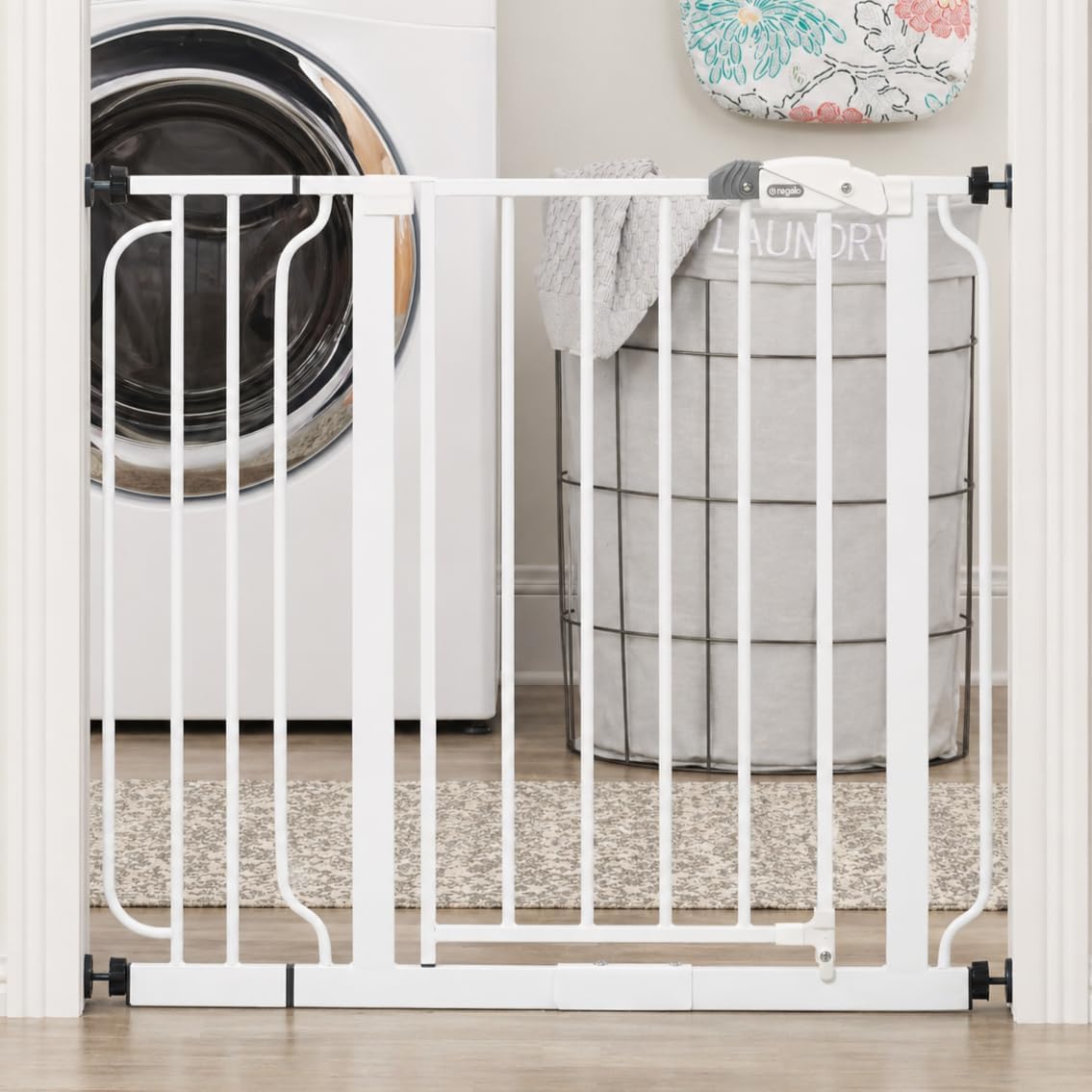
A pressure mounted gate holds itself in place by pushing four rubber cups outward against opposing walls. Nothing is drilled, nothing is permanent, and the gate moves to another doorway in about a minute. That convenience is why most of the gates here work this way. The trade-off is that the gate is held only by friction, so a determined animal leaning steadily on the bottom bar can eventually walk it out of position, and every pressure gate needs its tension re-checked every few weeks.
A hardware mounted gate screws into the door frame or the wall studs. It cannot be pushed out of place, it swings freely without a threshold bar underfoot, and it is the only category that manufacturers approve for the top of a staircase. The cost is four holes in your trim and a fixed installation, which matters more in a rental than in a house you own. Several models here ship as pressure mounted with an optional wall-cup kit, which is a middle ground rather than a true hardware mount.
A freestanding panel gate leans on its own feet and blocks an opening without touching the walls at all. It is the answer for wide arches, room dividers and openings with no facing surfaces, and the only type you can fold up and carry elsewhere. It will not stop a dog that pushes, so it suits calmer or smaller animals and owners who need a visual boundary rather than a physical one.
Height, and Why Most Buyers Go Too Short
Gate height in this class runs from roughly twenty-three inches on portable models to thirty-six inches on the extra tall ones, and the difference decides whether you own a barrier or a hurdle. A healthy medium dog can clear thirty inches from a standing start when it wants to, and many owners discover this the first time they leave the house. If your animal has ever jumped onto a kitchen counter, buy the tallest gate that fits.
The short gates are not a mistake, they are a different product. A twenty-three inch panel is the right height for a puppy, a small breed, a senior dog, or a cat you want to slow down rather than stop. It is also far easier to step over, which matters if the gate lives in the one doorway you use forty times a day. Choosing short knowingly is fine; choosing short by accident is the expensive version.
Height interacts with the vertical bar spacing. A tall gate with widely spaced bars can still let a small dog or a cat straight through, so check the stated spacing rather than assuming the height covers it. Mesh panels and closely spaced metal bars are the safe choice in a home with animals of very different sizes, and mesh also removes the foothold that lets a climbing cat use the bars like a ladder.
Measure the Opening, Then Measure It Again

Every gate here is sold with a width range rather than a single size, and the range is the number that matters. Measure across the opening at the exact height where the gate will sit, not at the floor, because baseboard, door stops and casing all narrow the space and rarely do it symmetrically. Write down the narrowest measurement you get and shop against that figure.
Read the advertised range carefully, because some of it depends on extension panels. A gate listed as covering a very wide span often reaches the top of that range only with extensions that may or may not be in the box. Check what ships as standard, then check whether the maker still sells matching extensions, since a discontinued extension turns a wide gate into a narrow one permanently.
Aim for the middle of the range rather than either edge. At the very bottom the spindles are wound almost fully in and the frame overlaps itself awkwardly; at the very top they are extended so far that tension goes soft and the gate flexes. A model whose range centres on your opening gives the most rigid fit and leaves room to move it later.
The Walk-Through Door Is the Part You Live With

A gate you have to step over gets stepped over, and a gate you have to unmount gets left open. The question worth asking is whether you can open it one-handed while carrying a laundry basket, because that scenario decides whether the gate stays closed in real life.
Latch designs split into a few families. A squeeze-and-lift handle needs two motions and some grip strength. A slide-and-push button is easier one-handed but can be worked out by a clever dog. A double-action lock is the most secure and the most fiddly. Auto-close hinges, which swing the door shut and latch it without you touching it, remove the whole problem and are the single feature most worth having if the gate guards something that genuinely matters.
Look for the threshold bar, the low rail that runs along the floor across the bottom of most pressure gates. It is structurally necessary on that design and it is also the thing people catch their toes on in the dark. Hardware mounted gates usually have no bottom bar at all, which is a real quality-of-life difference in a hallway you walk through at night.
Stairs Change the Rules
At the top of a staircase, use a hardware mounted gate. Manufacturers say this, and the reason is straightforward: a pressure gate is held by friction, and if it shifts under load, the fall behind it is a flight of stairs rather than a step into the next room. This is the one place in the category where the convenient option is the wrong option.
At the bottom of a staircase, pressure mounting is fine and is what most of these gates are designed for. The load direction is different, since an animal pushing on the gate pushes away from the drop rather than toward it. Several models here specifically call out bottom-of-stairs and doorway use, which is exactly the job they suit.
Stair openings are also where mounting surfaces get complicated. One side is often a banister rather than a wall, and a round baluster gives a pressure cup nothing flat to bite. Banister adapter kits, which are straps or brackets that clamp to the post and present a flat plate to the gate, solve this properly.
Awkward Openings: Angles, Baseboards, and Trim
Most homes do not offer two parallel, flat, full-height surfaces at gate height, which is what a pressure gate assumes. Baseboard is the usual culprit: the gate frame sits against the wall above it while the bottom rail hits the moulding, and the whole assembly ends up tilted forward. Wall cups, the small plastic discs you screw to the wall for the pressure spindles to seat into, fix the tilt and stop the gate from creeping.
Angled openings need a gate whose frame can pivot at the hinges rather than one that assumes ninety degrees. Freestanding panel gates handle this naturally because each panel hinges against the next, which is why they are the go-to for a bay opening, a room divider or a hallway with an odd corner. A rigid rectangular gate forced into an angled space will hold on one side and hang loose on the other.
Consider the wall finish before you commit. Pressure cups concentrate real force on a small area, and on soft plaster or painted trim they leave marks and occasionally dents. In a rental, put the pressure on the door casing rather than open drywall.
| Gate type | Best at | Weak at |
|---|---|---|
| Pressure mounted walk-through | Doorways, bottom of stairs, moving between rooms | Needs tension re-checked, bottom rail underfoot |
| Hardware mounted | Top of stairs, strong dogs, no bottom rail to trip on | Permanent holes, not for rentals |
| Extra tall metal | Jumpers, climbers, large breeds | Heavier, more obtrusive in a small hallway |
| Freestanding panel | Wide arches, angled openings, portability | A pushing dog moves it |
Use the table as a filter rather than a ranking. Most disappointing purchases here are a gate from one row being asked to do the job of another, which is why the brands in our store directory each make several types. The category index shows what sits alongside this one.
Why You Should Trust Us
We build these lists from published specification and from the pattern of what long-term owners report, rather than from marketing copy. For every gate here we checked the mounting method, the actual height, the width range and whether it depends on extensions sold separately, the latch mechanism, whether a bottom threshold rail is present, and whether the maker approves the model for the top of a staircase. Those details decide whether a gate works in your doorway, and most product pages bury them.
We set aside near-identical listings that differ only in colour or finish, so every entry above is a genuinely different gate rather than the same frame in a second shade. Where a stated width range is only reachable with an extension kit, we say so rather than repeating the headline number, and where owner feedback consistently flags the same weakness across years of a product’s life, we treat that as a real characteristic of the design rather than an outlier.
Final Thoughts
Best overall is the Ingenuity Multi-Use Decorative Extra Tall Walk-Thru Gate. It is tall enough that jumping stops being a question, its adjustment range covers both a standard doorway and a wider hallway opening, and the metal frame does not flex the way the lighter plastic designs do when a big dog leans into it. If you want to think about this purchase once, this is it.
Best value is the Regalo Easy Step Walk Through Gate. It is the plainest execution of the pressure mounted idea, it covers an ordinary doorway, and for a calm dog or a puppy learning house rules it does the whole job without asking you to drill anything. It is also what to buy when you need a second or third gate and the first is already handling the difficult opening.
For specific situations, the Cumbor Auto Close Safety Gate is the pick if you want the door to latch itself every time, the Carlson Extra Wide Walk-Through Gate with Small Pet Door is the answer in a home where the cat needs a route the dog does not get, the Regalo Extra Wide Gate covers openings well past a normal door frame, the MyPet Paws Portable Pet Gate is the one to travel with, and the PETMAKER four panel freestanding wood gate is the choice for a wide arch or an angled space where nothing can be mounted at all. More picks for the rest of the house are indexed in our article archive.
Pet Gates FAQs
Can I use pet gates at the top of the stairs?
Only hardware mounted ones. A pressure gate is held in place by friction against the walls, and if it shifts while an animal or a child leans on it, the space behind it is a staircase. Manufacturers are consistent on this point and it is worth following. At the bottom of the stairs a pressure mounted gate is fine, because the load pushes away from the drop rather than toward it. If one side of your stair opening is a banister, use a banister adapter kit so the gate clamps to a flat plate instead of trying to grip a round post.
How tall does a gate need to be for my dog?
Measure your dog at the shoulder and add a generous margin, because a motivated dog jumps considerably higher than its own height. As a rough guide, a twenty-three inch gate suits puppies, small breeds and seniors, thirty inches covers most medium dogs, and thirty-six inches is what you want for a large breed or any dog that has already shown you it can jump. Check the bar spacing too, so a small dog cannot simply walk through a gate that is plenty tall.
Will a pressure mounted gate damage my walls?
It can, and the risk depends on the surface. Pressure cups concentrate force on a small area, so on soft plaster, thin drywall or freshly painted trim they leave rings and occasionally shallow dents, especially after years under high tension. Position the cups on the door casing rather than open drywall wherever possible, since casing is thicker and better supported. If the gate is permanent and the finish is delicate, screwing in the supplied wall cups does less damage over time than leaving high pressure on bare paint.
Do I need a gate with a small pet door?
Only if you are separating animals of different sizes and the smaller one needs regular access to the other side, which usually means a litter box or a food bowl. A built-in flap is far better than propping the gate open, and a lockable one lets you close the route when you need to. Check the opening against your actual cat rather than trusting the word small. If the size gap is large, a shorter gate the cat hops and the dog respects does the same job with no moving parts.
Can I use an indoor pet gate outside on a porch or deck?
Short term yes, permanently no. The designs here use painted steel, plastic and mesh that are not rated for weather, and outdoors they face rain, ultraviolet light and temperature swings that fade plastic, seize spindles and rust fasteners within a season or two. Decking also flexes and is rarely as flat as an interior floor, which undermines a freestanding gate’s footing. For a covered porch in fair weather an indoor gate is fine if you bring it in, but for anything permanent outdoors look at purpose-built enclosures in our patio and garden section.









Write Your Review
No reviews yet. Be the first to share your experience!