

Walk any seed rack, physical or digital, and nearly every packet shouts the same three words: heirloom, non-GMO, open pollinated. Very few of them say certified organic, and that gap matters far more than most gardeners realize. This guide covers the 8 best organic heirloom seeds we could verify for October 2026, drawn from Sereniseed, Purely Organic Products, Back and more. Every pick on the list carries an organic certification issued by a USDA accredited agency rather than a reassuring phrase printed on the envelope.
Our top pick is the Sereniseed Certified Organic Vegetable Seeds 10-Pack for its Oregon Tilth organic certification applied to all ten crops in the collection. Below that sit two more shapes of the same idea: certified organic multi crop collections for gardeners who want a whole bed planned in one purchase, and single variety USDA Organic packets for people who already know they want Marketmore cucumbers and nothing else. If you are shopping for a bulk emergency stash instead of certified stock, our separate roundup of heirloom seed vault kits covers that angle, and our guide to heirloom seed catalogs and reference books is the better starting point if you want reading material rather than something to sow this weekend.

Pros
- Every crop in the box carries organic certification through Oregon Tilth
- Ten staple vegetables cover a full first raised bed
- Open pollinated throughout, so seed can be saved and replanted
- Seeds stored in temperature and humidity controlled conditions before packing
- Includes a seed starting guide and video aimed at beginners
Cons
- Packet counts are sized for a home plot rather than a market row
- You get the packer's variety choices, not your own
The Sereniseed Certified Organic Vegetable Seeds 10-Pack is the collection that most directly answers what people are actually asking for when they search for organic heirloom seeds. Ten crops, one box, and an organic certification issued by Oregon Tilth that applies to the whole set rather than to one hero item in the lineup. The crop selection is deliberately unglamorous and that is a compliment: basil, snap pea, broccoli, bean, jalapeno, tomato, lettuce, cucumber, carrot and zucchini are the vegetables a household will actually eat through a season.
What sets it apart from the huge non-GMO survival kits that dominate this search is honesty about scope. This is not thirty thousand seeds in a mylar bag. It is a properly certified planting set with packet counts that make sense for a raised bed or two, backed by a company that stores stock in temperature and humidity controlled conditions and verifies germination and purity before packing. Every variety is open pollinated, so a gardener who wants to move toward saving their own seed can start doing so from the first harvest.
The weaknesses are the ones inherent to any curated collection. You do not choose the varieties, and if your climate or your palate rules out two or three of the ten, that portion of the box sits unused. Quantities per crop are modest, so a gardener planting a long bean row or a succession of lettuce will exhaust a packet faster than expected and end up buying single packets anyway.
Bottom line: if you want certified organic rather than merely non-GMO, and you want a whole bed planned in one order, this is the pick. It is the most complete and best documented certified organic starter collection on the list.
- Format: 10 individual seed packets
- Crops: basil, snap pea, broccoli, bean, jalapeno, tomato, lettuce, cucumber, carrot, zucchini
- Certification: certified organic through Oregon Tilth
- Pollination: open pollinated, non-GMO
- Storage before packing: temperature and humidity controlled
- Included: seed starting guide and instructional video access
- Suitable for: indoor starting, raised beds, containers, in ground
- Basil for continuous kitchen cutting through summer
- Snap pea and bean for a spring and a summer legume slot
- Broccoli for cool season brassica planting
- Jalapeno and tomato as the warm season fruiting pair
- Lettuce and carrot for succession sowing
- Cucumber and zucchini for high volume summer output
This is the collection for a gardener setting up a first or second certified organic bed who wants the certification question settled in one purchase. It suits households that cook from the garden rather than gardeners chasing rare varieties, and it works particularly well for anyone planting a standard four by eight raised bed.
It is less suited to experienced growers who already know exactly which cultivars perform in their region, or to anyone stocking a long term seed store. Those two groups are better served by single variety packets and by dedicated storage kits respectively.

Pros
- Twenty packets makes it the deepest certified organic herb set here
- Covers the nine culinary herbs a home kitchen uses most
- Certified organic through Oregon Tilth rather than self declared
- Works equally well indoors on a sill and outdoors in beds
- Seed starting guidance included for slower germinating herbs
Cons
- Twenty packets is more herb seed than a small household will sow in one season
- Lavender is slow and fussy compared with the rest of the set
Herbs are where organic certification arguably matters most, because herbs are the crop you eat raw, in quantity, and often straight from the plant without washing. The Sereniseed Certified Organic Herb Seeds 20-Pack is the deepest certified organic herb set in this roundup, built on the same Oregon Tilth certification as the brand's vegetable collection and covering the nine herbs a working kitchen actually reaches for.
The selection is well judged. Basil, cilantro, parsley, dill and chives are the high turnover soft herbs that a household will resow several times a year. Oregano, thyme and sage are the perennials that pay for themselves over multiple seasons. Lavender is the outlier, more ornamental and aromatic than culinary, and it is also the slowest and least forgiving germinator in the box, which is worth knowing before you judge the whole set on one tray of no shows.
Twenty packets is a lot. For a single household this is realistically a two or three season supply, which is fine given that properly stored herb seed keeps well, but it does mean the value case rests on you actually using it over time rather than in one spring. Gardeners who only want a windowsill trio will find the smaller sets in the same line a better match.
Bottom line: the herb pick of the list, and the right buy for anyone who cooks seriously and wants certified organic rather than merely non-GMO leaves in the pan.
- Format: 20 individual seed packets
- Herbs: basil, cilantro, oregano, thyme, parsley, lavender, chives, sage, dill
- Certification: certified organic through Oregon Tilth
- Pollination: open pollinated, non-GMO
- Growing environments: indoor, outdoor, hydroponic
- Included: seed starting video and written guidance
Sow the soft herbs in short successions rather than all at once. Cilantro and dill bolt quickly in warm weather, so a fresh small sowing every three weeks keeps a usable supply going far longer than one large planting.
Start the perennials, oregano, thyme and sage, in their own pots and give them a full season before heavy harvesting. Lavender benefits from a cold period before sowing and germinates slowly, so give it its own tray and do not judge it against basil's speed.
- Keep unsown packets cool, dark and dry to hold germination rates across seasons
- Herb seedlings rot easily, so water from below and avoid saturated trays
- Harvest soft herbs by pinching above a leaf pair to encourage branching
- Lavender and sage prefer sharp drainage and dislike rich wet soil
- Label everything at sowing, since young parsley and cilantro look alike

Pros
- Thirty organic packets makes it the strongest value per packet on the list
- Mixes vegetables, herbs and flowers rather than vegetables only
- Surplus rescue model keeps viable seed out of the waste stream
- Seed complies with Uniform State Seed Law germination requirements
- USA grown and packed
Cons
- Assortment varies between orders, so you cannot request specific crops
- Not the right buy if you need a particular variety on a particular date
The Back to the Roots Heirloom Rescued Seeds box is the most interesting product in this category and the best value on the list. Rather than packing a fixed assortment, the company builds each thirty packet box from surplus organic seed lots that would otherwise be thrown away. The seed is good, the packets are current, and the only thing you give up is the ability to choose what arrives.
For the money, thirty organic packets of vegetables, herbs and flowers is a lot of garden. It is also a genuinely enjoyable way to shop, because the box pushes you into crops you would never have selected deliberately, and those accidental plantings are often the ones people end up growing every year afterward. The flower inclusion matters more than it sounds, since flowering plants pull pollinators into a vegetable bed and improve fruit set on squash, cucumber and melon.
The obvious limitation is planning. If you have a bed mapped out and need Marketmore cucumbers by a specific week, a surprise box cannot serve you. There is also natural variation in how well any given assortment matches your climate, so expect to give away or trade a few packets. Back to the Roots states that all seed complies with Uniform State Seed Law germination requirements, which is the reassurance you want when the contents are unknown in advance.
Bottom line: the value pick, and the best gift on this list for someone starting out. Buy it as a supplement to a planned order rather than as your only seed purchase.
- Format: 30 seed packets, assortment varies by order
- Contents: mix of organic vegetables, herbs and flowers
- Certification: 100 percent organic, heirloom, USA grown
- Germination: compliant with Uniform State Seed Law requirements
- Sourcing: surplus lots rescued from disposal
- Pollination: heirloom, open pollinated
This is for the gardener who enjoys the process more than the plan, and for anyone buying a gift. Thirty packets across three plant types gives a beginner enough material to fail at a few things and still end the season with a productive bed.
It is not for the grower with a fixed planting calendar or limited space who needs every packet to earn its place. Pair it with two or three chosen single variety packets and you get both certainty and surprise.
- Sort the box by season on arrival so cool crops are not sown in midsummer
- Store unsown packets in a sealed container somewhere cool and dark
- Check each packet for its own days to maturity, since the mix spans fast and slow crops
- Trade or gift packets that do not suit your climate rather than sowing them badly

Pros
- Focused entirely on salad greens rather than diluting across a whole garden
- Certified organic, which matters most on crops eaten raw
- Open pollinated so plants can be left to set seed
- Well suited to containers, window boxes and small balconies
- Supports cut and come again harvesting for weeks per sowing
Cons
- Narrow scope means it is a supplement rather than a complete garden
- Most greens bolt in summer heat and need succession sowing
Salad greens are the crop where certified organic status carries the most practical weight, because lettuce leaves go from bed to bowl with nothing more than a rinse. The Sereniseed Certified Organic Leafy Greens Collection narrows the brand's usual scope to exactly that job, supplying ten packets of lettuce and greens rather than spreading the selection across a whole vegetable garden.
Greens are also the most forgiving entry point in gardening. They germinate quickly, tolerate containers and shallow soil, and reward cut and come again harvesting, which means one sowing can supply a household for weeks. That combination makes this collection unusually well suited to balconies, window boxes and small courtyard setups where a full vegetable bed is not an option.
The limitation is scope by design. This is a supplement, not a garden in a box, and it does not pretend otherwise. The other constraint is seasonal: nearly all lettuce and salad greens bolt and turn bitter once summer heat arrives, so the collection asks for successive small sowings in spring and autumn rather than one big spring planting. Gardeners who treat it that way get months of harvest, and gardeners who sow it all in April get one flush and then a bed of bolted stems.
Bottom line: the salad specialist of the list, and the best certified organic choice for container growers with limited space.
- Format: 10 individual seed packets
- Focus: lettuce and leafy salad greens
- Certification: certified organic through Oregon Tilth
- Pollination: 100 percent non-GMO, open pollinated
- Included: written grow guide
- Suitable for: containers, window boxes, raised beds, indoor setups
Sow small amounts every two to three weeks rather than emptying packets in one go. Greens mature fast, and staggered sowing turns a single collection into a rolling supply from early spring into autumn.
Harvest by cutting outer leaves and leaving the growing centre intact. Most varieties in this style of collection regrow several times before they need replacing, which stretches the value of each packet considerably.
Best for anyone who buys bagged salad weekly and wants to stop, and for container gardeners on balconies or patios where depth is limited. It is also a strong choice for households with children, since greens germinate quickly enough to hold attention.
Skip it if you need a broad vegetable garden from one order, or if your growing season is dominated by heat with no cool shoulder seasons to work with.

Pros
- Carries the USDA Organic seal from a USDA accredited certifying agency
- Marketmore 76 is a proven, widely grown slicing heirloom
- Generous seed count for a single variety packet
- Open pollinated, so seed can be saved with isolation
- USA grown seed stock
Cons
- One crop only, so it is a supplement to a broader order
- Vines need trellising or a large footprint to produce well
Marketmore 76 has been a home garden standard for decades for the simple reason that it works. The fruits come in dark green, straight, around eight to nine inches, with a mild sweet flavour that slices well for salads and sandwiches. This Purely Organic Products packet supplies that variety with the USDA Organic seal on the front, certified by a USDA accredited agency, which is the specific thing most cucumber listings on Amazon do not offer.
Seed count is generous for a single variety packet at roughly one hundred seeds, which is far more than a household bed needs in one season and means a packet realistically covers two or three years of sowing if stored properly. The variety is open pollinated, so seed saving is possible, although cucumbers cross readily with other cucumber varieties nearby and need isolation if you want the saved seed to come true.
The obvious caveat is scope. This is one crop. It earns a place on this list because it demonstrates the single variety end of the certified organic market, where you buy exactly what you intend to grow rather than accepting a curated mix. Cucumber vines also demand space or vertical support, and growers who let them sprawl on the ground will get more damaged and curved fruit than those who trellis.
Bottom line: the reliable certified organic cucumber, and the right way to buy when you already know which variety suits your garden.
- Variety: Marketmore 76 slicing cucumber
- Seed count: approximately 100 seeds
- Certification: USDA Organic seal, USDA accredited certifier
- Pollination: open pollinated, non-GMO, heirloom
- Origin: USA grown
- Fruit: dark green, straight, roughly eight to nine inches
- Habit: vining, benefits from trellis support
Sow directly once soil has warmed properly, since cucumbers resent cold ground and transplant shock. A trellis or netting encourages the vines to climb, keeps fruit off the soil and saves considerable bed space in a small garden.
Harvest consistently once fruiting starts. Leaving mature cucumbers on the vine signals the plant to stop setting new fruit, so picking every couple of days extends the productive window substantially.
For gardeners who already grow cucumbers and want the certified organic version of a variety they trust, and for anyone buying single crops to fill gaps in a planned bed rather than buying a collection.
Less useful as a standalone purchase for a brand new gardener, who would get more out of a multi crop certified organic collection first and single packets afterward.

Pros
- Carries the USDA Organic seal from a USDA accredited certifying agency
- Stringless pods need no destringing before eating
- Compact bushy habit suits containers and short supports
- Peas are among the easiest crops for saving your own seed
- Cool season crop that fits the early spring gap
Cons
- Bolts and declines once summer heat sets in
- Smaller seed count than the leafier crops in this roundup
Sugar Daddy is the snap pea for people who cannot be bothered with strings. The variety was bred to be genuinely stringless, so pods go from vine to mouth or wok with no preparation at all, and the flavour is sweet and crisp enough that most of a harvest tends to be eaten standing in the garden. This Purely Organic Products packet carries the USDA Organic seal certified by an accredited agency.
The plant habit is a real advantage in small gardens. Sugar Daddy grows on bushy, relatively compact vines rather than the tall climbers some snap peas produce, which means a short trellis or even a few twiggy supports will do. That makes it one of the better certified organic choices for containers and narrow beds.
Two constraints matter. First, this is a cool season crop, and it will slow, toughen and eventually stop once real summer heat arrives, so the sowing window is early spring and again for an autumn crop in mild regions. Second, the packet holds around seventy five seeds, which is a reasonable single household planting but not a lot if you want a long row. On the positive side, peas self pollinate and rarely cross, making them one of the easiest crops on this list to save seed from year after year.
Bottom line: the cool season pick, and the easiest certified organic crop here for a gardener who wants to start saving their own seed.
- Variety: Sugar Daddy stringless snap pea
- Seed count: approximately 75 seeds
- Certification: USDA Organic seal, USDA accredited certifier
- Pollination: open pollinated, non-GMO, heirloom
- Origin: USA grown
- Habit: bushy vines with dwarf pods, low support needed
- Season: cool weather, spring and autumn
Peas go in early, often as soon as soil can be worked, and they will tolerate light frost as seedlings. Getting them in ahead of the main season means the crop finishes before heat arrives and frees the bed for a summer planting behind it.
In mild winter regions a late summer sowing gives a second autumn harvest. Where winters are hard, treat this as a spring only crop and follow it with beans in the same space.
- Do not soak seed for long before sowing, as waterlogged peas rot readily
- Provide low support early, since the vines flop once pods fill
- Pick pods young for the best texture and to keep the plant producing
- Leave a few pods to dry fully on the vine if you intend to save seed
- Avoid heavy nitrogen feeding, which pushes leaf growth at the expense of pods

Pros
- Carries the USDA Organic seal from a USDA accredited certifying agency
- Crimson Sweet is a proven large fruited heirloom with excellent flavour
- Small seed count is normal and appropriate for a sprawling crop
- Open pollinated heirloom, so the variety breeds true with isolation
- USA grown seed stock
Cons
- Needs a long warm season and will underperform in short cool summers
- Vines take a very large footprint compared with every other pick here
Crimson Sweet is the watermelon most people picture when they picture a watermelon: round to slightly oval, pale green with dark stripes, and heavy, typically landing somewhere between fifteen and twenty five pounds. The flesh is crisp, deep red and sweet, with relatively small seeds. This Purely Organic Products packet supplies it with the USDA Organic seal, certified through a USDA accredited agency.
The packet holds around a dozen seeds, which sounds thin next to a lettuce packet holding hundreds until you consider the space one plant occupies. A single healthy Crimson Sweet vine will run for several metres and carry only a handful of fruit, so twelve seeds is comfortably more than a home garden needs in one season.
This is the most demanding crop on the list. It wants a long warm season, consistent moisture while fruit is sizing, and considerably more room than a raised bed usually offers. Gardeners in short or cool summers should be realistic: the plant will grow, but the melons may not ripen. Watermelon also crosses easily with other melons of the same species, so saved seed needs isolation to stay true. Where the season does cooperate, the payoff is a genuinely certified organic melon of a calibre supermarkets rarely match.
Bottom line: the specialist pick. Buy it if you have heat and space, and skip it if you do not.
- Variety: Crimson Sweet watermelon
- Seed count: approximately 12 seeds
- Certification: USDA Organic seal, USDA accredited certifier
- Pollination: open pollinated, non-GMO, heirloom
- Origin: USA grown
- Fruit: striped, nearly round, roughly fifteen to twenty five pounds
- Requirements: long warm season, full sun, generous space
Sow into warm soil or start indoors a few weeks ahead in regions with a short season, handling seedlings gently since melons dislike root disturbance. Give each plant a wide area or train the vines along a path edge where they can run without smothering neighbours.
Keep moisture steady while fruit is sizing, then ease off as harvest approaches to concentrate sugars. The tendril nearest the fruit browning off is the most reliable everyday ripeness signal.
- Do not sow into cold soil, as germination stalls and seed rots
- Mulch under developing fruit to keep skins clean and dry
- Water at soil level rather than overhead to reduce foliar disease
- Isolate from other melons of the same species if you plan to save seed
- Support the vine's space needs at planning stage, not after it has run
Pros
- Organic single variety packet from a well known USA organic seed line
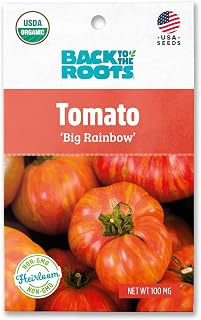
- Big Rainbow is a genuinely striking bicoloured beefsteak
- Low acid, sweet flavour that slices impressively
- Open pollinated heirloom suited to seed saving
- Small packet size keeps it easy to add to a larger order
Cons
- Indeterminate vines need staking, pruning and a long season
- Large fruit is prone to cracking with irregular watering
Big Rainbow is the showpiece tomato of this roundup. The fruit is large, often well over a pound, with golden yellow flesh streaked and marbled through with red toward the blossom end, and a cut slice looks like nothing you can buy in a shop. The flavour is mild, sweet and low in acid, which makes it a slicing tomato rather than a sauce tomato. Back to the Roots supplies it as a 100 percent organic, USA grown packet with germination checked against Uniform State Seed Law requirements.
The packet format is deliberately small, which is exactly right for a beefsteak. Two or three healthy indeterminate plants will supply a household through the season, so a 100mg packet is not the limitation it might look like at first glance. Being open pollinated, it is also one of the easiest crops here to save seed from, since tomatoes self pollinate and rarely cross.
The demands are real. Indeterminate vines grow tall and need sturdy staking or caging, regular tying and some pruning of side shoots to keep fruit sizing well. Big fruited heirlooms are also notorious for cracking if watering swings between drought and flood, and Big Rainbow is no exception. It takes a long season to ripen, so short summer regions should start it indoors early and expect a late harvest.
Bottom line: not the easiest tomato, but the most rewarding one on the list, and the single packet worth adding to any certified organic collection order.
- Variety: Big Rainbow bicoloured beefsteak tomato
- Packet size: 100mg
- Certification: 100 percent organic, USA grown
- Pollination: open pollinated heirloom, non-GMO
- Habit: indeterminate, requires staking or caging
- Fruit: large beefsteak, yellow flesh marbled with red
- Germination: compliant with Uniform State Seed Law requirements
This is a sandwich and salad tomato first. The low acid sweetness and the marbled cross section make it a plate centrepiece, and the size means one fruit can cover several servings.
It is a poor choice for sauce or paste, where dense flesh and lower water content matter more than appearance. Pair it with a Roma type if you want both jobs covered from one bed.
- Stake or cage at planting time rather than after the vine sprawls
- Water deeply and consistently to prevent fruit cracking and blossom end rot
- Prune lower leaves to improve airflow and reduce disease pressure
- Start indoors early where the growing season is short
- Ferment saved seed in water for a few days before drying to remove the gel coat
How to Choose the Right Organic Heirloom Seeds
Buying certified organic seed is a narrower job than buying seed in general. The claim you are paying for is verifiable, which means you can check it before you spend anything, and the checks below are the ones that separate a genuinely certified packet from a packet that simply uses the word organic in a product title.
Certified Organic and Non-GMO Are Not the Same Claim

This is the single most common mix up in the seed aisle, and it is worth being blunt about. Non-GMO means the seed was not produced through genetic engineering. That is a statement about breeding technique and nothing else. Certified organic means the crop that produced the seed was grown on land managed under the USDA National Organic Program, without prohibited synthetic pesticides or fertilizers, under an operation that files paperwork and accepts inspections from an accredited certifier.
The practical consequence is that a packet can be perfectly honest in calling itself non-GMO heirloom while the parent plants were sprayed with conventional chemistry all season. For most vegetable species there are no commercially available genetically engineered varieties for home gardeners anyway, so the non-GMO badge on a tomato or lettuce packet describes something that was never really in question. It is close to free for a seller to print. Organic certification is not free, which is exactly why so few listings carry it.
If you garden organically because of what ends up in your soil and on your plate, the seed is the one input where the certified version is usually available and cheap enough to be a non-issue. Every pick in this roundup states an organic certification in the listing itself, and the ones from Sereniseed and Purely Organic Products name the seal directly on the packet.
Look For the Certifying Agency, Not Just the Word Organic
Certification only means something if somebody issued it. Sereniseed is certified through Oregon Tilth, one of the older and better known accredited certifiers in the United States. Purely Organic Products prints the USDA Organic seal on each packet and states that certification comes from a USDA accredited agency. Back to the Roots describes its packets as 100 percent organic and USA grown, with germination checks against Uniform State Seed Law standards.
When a listing uses organic only inside the product title and never names a certifier anywhere in the bullet points or the packaging photos, treat it as a marketing adjective. That is not automatically a bad seed, and plenty of small growers produce excellent uncertified stock, but you are then buying on trust rather than on an audited claim. For a category where the certified option costs about the same, there is little reason to settle.
One more practical note: certification applies to the seed lot, not to the brand forever. Large sellers often carry both certified and conventional lines under one name. Read the specific packet rather than assuming the whole catalog qualifies.
Single Variety Packets Versus Multi Crop Collections

Collections and single packets solve different problems. A ten or twenty packet certified organic collection is the fastest way to fill a raised bed from nothing, and it removes the decision fatigue of picking each crop separately. The tradeoff is that you get the varieties the packer chose, and quantities per crop are sized for a small home plot rather than a market row.
Single variety packets go the other direction. If you already know Marketmore 76 handles your humidity or that Crimson Sweet is the melon that actually ripens in your season, buying one crop at a time gets you a proper seed count for that crop and no filler. It is also the honest option for anyone with a small balcony garden who will grow three things well rather than twelve things poorly.
There is a third shape worth knowing about. Back to the Roots sells a rescued seed variety box built from surplus lots that would otherwise be discarded, so the assortment differs between orders. It is the best value on this list per packet, and it is a genuinely good fit for gardeners who enjoy the surprise, but it is the wrong buy if you need a specific crop on a specific date.
Seed Count, Packing Season, and Germination Rates
Seed count per packet varies enormously between crops for good reason. A watermelon packet with roughly a dozen seeds and a lettuce packet with several hundred can be equally generous, because one watermelon vine needs a lot of square footage and a lettuce planting is a rolling succession. Compare counts within a crop, never across crops.
Packing season is the number to actually watch. Vegetable seed stays viable for years when stored cool and dry, but germination percentage drifts downward with age, and it drifts fastest for onions, parsnips, and parsley. Listings that state a current season packing date are telling you the lot is fresh. Listings that say nothing about the date may still be fine, though you are guessing.
Serious packers state a germination percentage or at least confirm that lots are checked before packing. Sereniseed stores stock in temperature and humidity controlled conditions and verifies germination and purity before packing. Back to the Roots states that its seed complies with Uniform State Seed Law germination requirements. Those are the sorts of statements that separate a seed company from a repackager.
Open Pollinated Seed Lets You Save Your Own Stock
Every pick in this guide is open pollinated, which is what makes the heirloom label meaningful. Open pollinated plants breed true, so seed saved from this year’s best tomato produces the same tomato next year. Hybrid seed, usually labelled F1, does not behave that way. The first generation can be excellent, but saved seed from it scatters into unpredictable offspring.
For a certified organic gardener this compounds nicely. Buy certified organic open pollinated seed once, save from the healthiest plants, and within two or three seasons you have stock that is both organically produced and adapted to your particular soil and microclimate. Beans, peas, lettuce, and tomatoes are the easiest crops to start with because they self pollinate and rarely cross with neighbours.
Cucumbers, squash, and melons are harder. They cross readily with other varieties of the same species nearby, so saved seed can surprise you. If seed saving is your goal, plan which crops you will save from before you plant, not after.
Match Varieties to Your Climate and Growing Window

Certification says nothing about whether a variety suits your garden. Crimson Sweet watermelon needs a long warm season and will sulk in a short cool summer no matter how well it was grown. Sugar Daddy snap pea prefers cool weather and bolts in heat. Big Rainbow is a large indeterminate beefsteak that wants staking, a long season, and patience.
Check days to maturity against your frost dates before you buy, and give the seed a fighting chance once it is in the ground. Soil that has been fed properly does more for germination and early vigour than any packet claim, which is why our guides to compost for vegetable beds and home soil pH kits pair naturally with a certified organic seed order.
| Pick | Certification stated | Format | Best suited to |
|---|---|---|---|
| Sereniseed Organic Vegetable 10-Pack | Certified organic, Oregon Tilth | 10 crop collection | Filling a first raised bed |
| Sereniseed Organic Herb 20-Pack | Certified organic, Oregon Tilth | 20 packet herb collection | Kitchen herb gardens |
| Back to the Roots Rescued Seeds | 100 percent organic, USA grown | 30 packet surprise box | Value per packet |
| Sereniseed Leafy Greens Collection | Certified organic, Oregon Tilth | 10 packet greens set | Cut and come again salads |
| Purely Organic Marketmore 76 | USDA Organic seal | Single variety packet | Slicing cucumbers |
| Purely Organic Sugar Daddy | USDA Organic seal | Single variety packet | Cool season snap peas |
| Purely Organic Crimson Sweet | USDA Organic seal | Single variety packet | Long warm summers |
| Back to the Roots Big Rainbow | 100 percent organic packet | Single variety packet | Beefsteak slicing tomatoes |
Why You Should Trust Us
We build these shortlists from live Amazon listing data rather than press releases. For this guide we pulled a wide pool of heirloom and organic seed listings, then applied one hard filter before anything else: the listing itself had to state an organic certification, and ideally name the certifier or show the USDA Organic seal. Listings that offered only non-GMO or open pollinated language were removed, however popular they were, because that is a different claim and this guide is specifically about the certified version.
What survived that filter was then screened on customer rating and on having enough real buyer feedback to be meaningful, and we cross checked each brand against its own certification statements and third party retail listings to confirm the seal was genuine rather than decorative. We also deliberately kept the mix of formats wide, so the list spans large collections, mid sized themed sets, and single crop packets. You can browse the rest of our growing coverage in the patio, lawn and garden section.
Final Thoughts
Best overall goes to the Sereniseed Certified Organic Vegetable Seeds 10-Pack. It is the cleanest expression of the whole category: ten staple crops, one named certifier in Oregon Tilth, open pollinated throughout, and enough of a growing guide included that a first year gardener is not left guessing. If you buy one thing from this list, buy that, and add a single variety packet or two for whatever your family actually eats most.
Best value is the Back to the Roots Heirloom Rescued Seeds variety box. Thirty organic packets of vegetables, herbs, and flowers in one order is a lot of garden for the money, and the surplus rescue angle means you are keeping viable seed out of the bin. Accept that the assortment shifts between orders and it becomes a genuinely fun way to try crops you would never have chosen deliberately.
For specific jobs, the picks sort themselves neatly. The Sereniseed Organic Herb 20-Pack is the one for a kitchen windowsill or a dedicated herb bed. The Sereniseed Leafy Greens Collection is the salad gardener’s set. Purely Organic Products Marketmore 76 is the reliable slicing cucumber, Sugar Daddy is the stringless snap pea for cool spring beds, and Crimson Sweet is for gardeners with heat to spare. Back to the Roots Big Rainbow is the single packet to reach for if you want one showpiece beefsteak tomato. If your interest is really a long term stored stash rather than this season’s planting, go back to our heirloom seed vault comparison instead, since those kits optimise for seed count and storage life rather than certification.
Frequently Asked Questions
Are all heirloom seeds also organic?
No, and this is the assumption that trips up most shoppers. Heirloom describes the variety, meaning an open pollinated cultivar that has been passed down and breeds true. Organic describes how the parent crop was grown and whether that growing operation is certified. A variety can be a two hundred year old heirloom and still be produced on conventionally managed land. Only a stated certification tells you which you are getting, which is why every pick in this roundup of organic heirloom seeds names one.
What is the difference between organic and non-GMO on a seed packet?
Non-GMO means the seed was not genetically engineered. Certified organic means the production system met USDA National Organic Program standards and was inspected by an accredited certifier. Organic certification already prohibits genetic engineering, so certified organic seed is always non-GMO, but non-GMO seed is very often not organic. The one way arrow is worth memorising before you shop.
Do organic heirloom seeds germinate as well as conventional seed?
Germination depends on lot freshness, storage, and the crop, not on whether the parent field was organic. A current season certified organic lot stored cool and dry will match a conventional lot of the same age. What actually moves the needle at home is soil temperature, moisture consistency, and sowing depth. Older seed of any kind fades, and onion family seed fades fastest, so buy those fresh each year.
Can I save seed from these packets and replant next year?
Yes, because every pick here is open pollinated rather than hybrid. Start with self pollinating crops such as beans, peas, lettuce, and tomatoes, where saved seed reliably reproduces the parent. Cucumbers, squash, and melons cross easily with other varieties of the same species growing nearby, so isolate them or accept some drift. Dry the saved seed thoroughly and store it in a cool dark place. If you want a deeper reference on variety history and seed saving practice, our guide to heirloom seed catalogs points to the printed resources worth owning.
When should I order organic heirloom seeds for the 2026 season?
Order in late winter for a spring garden and again in midsummer for autumn and overwintering crops. Certified organic lines are produced in smaller volumes than conventional ones, so popular collections do sell out ahead of peak planting weeks. Ordering early also gives you time to start slow crops such as peppers and tomatoes indoors on schedule rather than scrambling after the last frost has passed.




Write Your Review
No reviews yet. Be the first to share your experience!