

Soil pH decides how much of the fertilizer you already bought your plants can actually absorb, which is why a home soil pH test kit is the cheapest upgrade most gardens ever get. Our top pick is the Luster Leaf Rapitest Soil Test Kit for its real chemical color reading of pH plus nitrogen, phosphorus and potassium in one inexpensive box. Below we break down 7 kits from Luster Leaf, SONKIR, Kensizer and more, covering capsule chemistry, mail-in lab analysis, disposable strips and probe meters, so you can match the format to how seriously you plan to garden this year.
Prices and availability move constantly, so every pick here is ranked on real customer ratings and review volume as of October 2026 rather than on marketing claims. If you are amending beds this season, it pays to read the soil before you buy anything else, then pair the results with the right amendment from our guide to the best compost for vegetable gardens.

Pros
- Real chemical pH reading rather than a conductivity estimate
- Covers nitrogen, phosphorus and potassium in the same box
- Color comparators are easy to judge in daylight
- Costs less than a single bag of corrective amendment
- Works on lawns, vegetable beds, borders and containers
Cons
- Needs distilled water and a few minutes of settling time per sample
- Pastel color matching is subjective under poor lighting
- Capsules lose reliability once exposed to humidity
The Rapitest kit from Luster Leaf is the default answer to the question of how to read your soil at home, and it has held that position because it does the one thing probe meters cannot: it measures pH chemically. You collect a soil sample, mix it with distilled water in the supplied comparator, snap a capsule of reagent into the chamber and wait for the liquid to develop a color you match against the printed scale.
What makes it worth more than a pH-only tool is the nutrient side. The same box handles nitrogen, phosphorus and potassium with their own reagents, so a single afternoon gives you a rounded picture of why a bed is underperforming. That matters because pH and nutrient availability are the same problem viewed from two angles, and fixing one without seeing the other is guesswork.
The weaknesses are the ones every wet chemistry kit shares. You need distilled water, patience while the sample settles, and reasonable daylight to judge greens against greens. Reviewers who found it frustrating almost always describe rushing the settling step or reading colors under kitchen bulbs. Capsules also age once the box has been opened in a humid shed.
Bottom line: if you are about to spend money on amendments, run this kit first. It gives you an actual chemical answer plus the nutrient context, for less than most people spend on a single bag of fertilizer.
- Type: capsule reagent kit with color comparators
- Measures: pH, nitrogen, phosphorus, potassium
- Reading method: color chart comparison
- Power: none required
- Extras required: distilled water
- Suited to: lawns, vegetable beds, flower borders, containers
- Designed and assembled in the USA
Scrape back mulch and dig to root depth, then take pinches from several spots in the bed and mix them together in a clean container. Let the sample dry, crumble out stones and roots, and use the printed soil to water ratio exactly.
Fill the comparator, add the capsule powder, cap it and shake, then leave it undisturbed until the color settles. Read it in daylight against a white background, not under warm indoor lighting, and record the result with the date so you can compare after amending.
Keep unused capsules sealed in their original packet, away from humidity and heat. An unheated garage through a damp winter is the fastest way to ruin a partly used kit.
Rinse the comparators with distilled water after each test and let them air dry before storing. Write the date you first opened the box on the lid, and treat colors that look impossible as a sign the reagent has aged rather than a sign your soil changed dramatically.
Pros
- Laboratory instrumentation instead of a color chart or needle
- Reports pH alongside a full macronutrient and micronutrient panel
- Recommendations tailored to the plants you say you are growing
- Digital report you can keep and compare year over year
- Removes sampling interpretation errors from your side
Cons
- Highest cost per reading of any option here
- Results take mailing and processing time rather than minutes
- One kit equals one sample, so wide plots need several
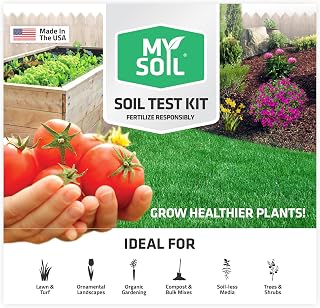
MySoil is the outlier on this list because the measurement does not happen in your kitchen. You collect a small soil sample, seal it in the supplied container and mail it to the laboratory, then receive a digital report covering pH along with a broad nutrient panel and recommendations matched to what you plan to grow.
The value is precision and breadth. A capsule kit tells you roughly where pH sits and gives you a rough read on three nutrients. A lab report gives you numbers to a tenth of a unit plus micronutrients that no home kit touches, and it interprets them for you. For anyone planning a serious vegetable plot, a new lawn or a multi year amendment program, that is a different class of information.
The trade-offs are obvious. It is by far the most expensive way to learn your pH, it is not instant, and one kit covers one sample, so a property with distinct front lawn, back beds and an orchard corner needs multiple kits or a compromise composite sample. Reviewers occasionally note that recommendations lean toward general amendment advice rather than brand specific instructions.
Bottom line: not the kit for weekly checks, but the best single source of truth on this page. Use it once to establish a baseline, then track changes with cheaper strips.
- Type: mail-in laboratory analysis kit
- Measures: pH plus macronutrients and micronutrients
- Reading method: laboratory instrumentation
- Output: digital report with recommendations
- Samples per kit: one
- Turnaround: mailing plus laboratory processing time
- Suited to: lawns, vegetable plots, orchards, ornamental beds
This is the kit for the gardener who has already guessed wrong once. If you have limed a lawn that did not need it, watched a raised bed underperform two seasons running, or are about to plant fruit trees that will live for decades, the cost of one lab report is trivial against the cost of the mistake.
It is not the right buy for someone who wants to check a few houseplant pots, or for anyone who needs an answer before the weekend. Those jobs belong to strips or a probe.
Because you only get one shot per kit, sampling technique matters more here than anywhere else. Take small amounts from six to eight spots across the area, all at the same depth and all at root level, then mix them thoroughly and fill the container from that blend.
Avoid sampling right after fertilizing, avoid the edges of paths and driveways where lime from concrete leaches in, and label clearly which area the sample came from so the report means something when it arrives.

Pros
- 100 strips makes the cost per reading extremely low
- Wide 3.5 to 9 range covers acidic beds through alkaline soil
- Web reader removes the guesswork from matching colors
- Fast enough to test a whole property in one session
- Works on garden soil, lawns, containers and compost
Cons
- Strips are single use and degrade if stored in humidity
- Colour bands resolve to roughly half a pH unit, not tenths
- Still requires a soil and distilled water slurry per test
Garden Tutor solves the problem that quietly ruins most soil testing habits: rationing. A capsule kit gives you a limited number of pH tests, so gardeners save them for important occasions and end up with almost no data. A hundred strips means you can test every bed, every large container and the compost pile, then do it again in eight weeks without thinking about it.
The chemistry is the same principle as a capsule kit. You make a soil and distilled water slurry, dip a treated strip, and read the resulting color band against the scale, across a range of 3.5 to 9 that comfortably spans blueberry soil at one end and chalky alkaline ground at the other. The web based reader is the genuinely useful addition, letting you photograph the strip and get the value read for you rather than squinting at two similar greens.
Resolution is the honest limit. Strips place you within roughly half a pH unit, which is plenty for deciding whether to lime, but not the tenths you would get from a laboratory. Strips are also single use and sensitive to damp storage, so the pack needs to live indoors rather than in a shed.
Bottom line: the best value on this page by a wide margin, and the kit most likely to turn soil testing into a habit rather than an annual event.
- Type: disposable chemical test strips
- Quantity: 100 strips
- pH range: 3.5 to 9
- Reading method: color band plus optional web reader
- Power: none required
- Extras required: distilled water
- Suited to: lawns, gardens, containers, compost
Mix a soil sample with distilled water until you have a wet slurry, let the sediment drop for a couple of minutes, then dip a strip into the liquid rather than pressing it into mud. Shake off the excess and read the band within the time stated on the pack.
Photograph the strip against the supplied reference if you are using the web reader, in even daylight rather than under a lamp. Record the reading and the bed it came from, since the whole point of a hundred strips is building a map of your property.
Treated paper strips are hygroscopic, which means humidity is their enemy. Reseal the pack immediately after removing a strip and store it indoors at room temperature rather than in a garage or greenhouse.
Handle strips by the dry end only, since skin oils and moisture on your fingers can affect the reactive pad. If bands start looking washed out or refuse to develop, the pack has likely taken on moisture and the remaining strips should be treated as unreliable.
Pros
- No batteries required, so nothing to fail in storage
- Reads moisture, pH and light from one tool
- Instant results with no water, reagents or waiting
- Long probes reach root depth in pots and beds
- Enormous review base among houseplant owners
Cons
- pH scale is conductivity based, so it is directional rather than exact
- Readings shift with soil moisture and compaction
- Not suitable for testing liquids or very dry soil
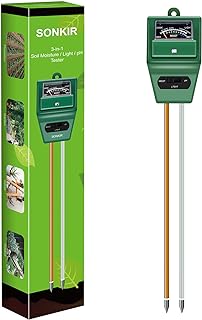
The SONKIR MS02 is the tool most people picture when they hear soil meter: a green handled probe with a dial and a selector switch for moisture, light and pH. It needs no batteries, it works the second you push it into damp soil, and it costs a fraction of a chemical kit, which explains the enormous review count it has accumulated.
Where it earns its keep is moisture. Overwatering kills more houseplants than any pH imbalance, and being able to push a probe to root depth and see whether the bottom of the pot is still wet is genuinely useful information you cannot get by poking a finger into the top inch. The light scale is a rough guide for choosing which window a plant should sit near.
The pH scale needs an honest caveat. Two dissimilar metal prongs generating a small current are measuring conductivity, and that responds to moisture, dissolved salts and how firmly the prongs contact the soil. The reading is a useful comparison between this pot and that pot, but it is not the number to base a lime purchase on. Reviewers who report it disagreeing with a chemical kit are not finding a defect, they are finding the limit of the method.
Bottom line: excellent value as a moisture meter with a bonus pH indication, provided you treat the pH scale as directional and reach for a chemical kit before you spend money on amendments.
- Type: three prong analog probe meter
- Measures: soil moisture, light intensity, pH indication
- Reading method: needle on a printed dial with mode selector
- Power: none required
- Use: indoor and outdoor, soil only
- Colour: green
- Model: MS02
Insert the probes roughly two thirds of their length into the soil, close to but not touching the root ball, and wait about a minute for the needle to settle before reading. Take two or three readings around a pot and average them rather than trusting a single insertion.
The soil must be damp for the pH and moisture scales to respond. If the ground is bone dry, water it, wait an hour and try again. Never push the probes into hard, stony ground or use them in water or liquid fertilizer.
Wipe the probes dry with a cloth after every use. Leaving them in soil, which some owners do as a permanent moisture indicator, corrodes the metal and degrades accuracy within weeks.
If readings become sluggish, lightly clean the prongs to remove oxide buildup and let them dry fully. Store the meter somewhere dry and out of reach of children, since the probes are sharp.

Pros
- Backlit LCD is far easier to read than a small printed dial
- Adds soil temperature, useful for timing seed sowing
- Digital numbers remove needle interpretation entirely
- Covers four measurements in one handheld tool
- Works indoors in low light where analog dials struggle
Cons
- Requires a battery, unlike the analog probes here
- pH remains a probe based estimate, not chemical measurement
- More electronics means more that can fail outdoors
The YAMRON takes the familiar probe concept and swaps the dial for a backlit digital screen, adding soil temperature to the usual moisture, pH and light trio. For anyone who has ever tried to judge where a thin needle sits on a crowded analog scale in a dim living room, the readability improvement alone justifies the small step up in price.
Soil temperature is the underrated extra. Seed packets specify a soil temperature for germination, and guessing that from air temperature in spring is how gardeners end up sowing into cold ground and blaming the seed. Being able to read the actual number at sowing depth is a real advantage for vegetable growers.
The pH function carries the same caveat as every probe on this page. A digital display shows the value to what looks like greater precision, but the underlying measurement is still a conductivity estimate influenced by moisture and salts, so do not read the extra decimal as extra truth. The battery requirement is also a mild downside compared with the battery free analog models, since a meter with a dead cell in a drawer is a meter you stop using.
Bottom line: the pick for indoor growers and anyone who wants numbers rather than needles, with soil temperature as a genuinely useful bonus.
- Type: digital probe meter
- Measures: soil moisture, pH, soil temperature, sunlight intensity
- Display: backlit LCD
- Power: battery operated
- Use: indoor and outdoor plants, garden beds, greenhouses
- Form factor: handheld single probe
Indoor plant collections are where this meter makes the most sense. Light levels near a window vary far more than people expect, pots dry unevenly, and none of it is visible from the surface of the soil.
The backlight matters here too, because most houseplants live in rooms that are dimmer than a garden at noon. Being able to walk a shelf of pots and take four readings each without carrying a lamp is the practical difference between using a meter and forgetting you own one.
Remove the battery if the meter will sit unused through winter, and wipe the probe clean and dry after every reading to prevent corrosion at the tip.
Do not submerge the meter or use it to read the pH of standing water or nutrient solution, and keep the display housing out of direct rain. Store it indoors rather than in a shed where condensation cycles through the electronics.

Pros
- Battery free operation with instant readings
- Simple two function dial with nothing to configure
- Slim probes slide into pots without disturbing roots
- Inexpensive enough to keep one indoors and one outdoors
- Strong review record among indoor gardeners
Cons
- pH reading is conductivity based and drifts with moisture
- No light measurement, unlike the three and four function meters
- Needs damp soil to give any reading at all
The Kensizer strips the soil meter concept back to the two functions most people actually use. There is no light scale and no screen, just a dial, a selector and two slim probes that go into a pot without excavating half the root ball.
As a moisture meter it is very good for the money. The probes reach genuine root depth, the needle responds quickly, and the absence of a battery means it works after a year in a drawer. For anyone managing a collection of houseplants, that reliability is worth more than an extra function they would never switch to.
The pH side is the same conductivity method used by every analog probe here, so it belongs in the comparison column rather than the decision column. Use it to notice that a repotted plant now reads differently from its neighbors, then confirm with strips or a capsule kit if the difference matters. Reviewers who expect laboratory agreement are consistently disappointed, and that is a mismatch of expectations rather than a fault in the tool.
Bottom line: a dependable, cheap moisture meter with a helpful pH indication, best bought as a companion to a chemical kit rather than a replacement for one.
- Type: two prong analog probe meter
- Measures: soil moisture and pH indication
- Reading method: needle on a printed dial with mode selector
- Power: none required
- Use: indoor pots, raised beds, garden soil, lawns
- Colour: green
This suits the houseplant owner whose real question is whether to water today, with pH as a secondary curiosity. It is also a sensible second meter to leave outdoors so you are not carrying one tool between the greenhouse and the living room.
It is the wrong choice for someone planning to amend a lawn or vegetable plot on the strength of the reading. That job needs the chemical kits or a lab report.
Clean and dry the probes after each use and never store the meter with the tips buried in soil, which is the fastest route to corrosion and erratic needle behaviour.
Do not force the probes into compacted or stony ground, since bending them permanently affects contact and therefore the reading. Water dry ground and wait before testing rather than pushing harder.

Pros
- Single purpose dial is uncluttered and quick to read
- No batteries and no consumables to replace
- Comes from the same brand as the widely used Rapitest chemical kits
- Long probe reaches root depth in beds and large pots
- Useful for scanning several spots across one bed
Cons
- pH indication is conductivity based like all probe meters
- No moisture or light reading, so it does one job only
- Requires damp soil and clean probes for a stable needle
The 1612 is Luster Leaf answering a narrow request: some gardeners do not want a light meter, a moisture scale or a mode switch, they want to walk a bed and see a pH indication. The dial carries one scale, which makes it noticeably faster to read than a crowded three function face.
Its most practical use is mapping. Push it in at one end of a long border, then at the middle and the far end, and you learn whether the bed is uniform or whether the corner nearest the concrete path runs alkaline from leaching lime. That is a question no single chemical test answers cheaply, because you would need a separate capsule for every sample point.
The physics limit applies here as it does to every probe: this reads conductivity, not hydrogen ion activity, so treat differences between points as meaningful and absolute values as approximate. Coming from the brand behind the Rapitest capsule kits, the sensible pairing is obvious. Scan with the probe, then confirm the interesting spots chemically.
Bottom line: a good pH-only scanner and a natural companion to a chemical kit, but not the tool to buy if you also want moisture readings for houseplants.
- Type: analog probe meter, pH only
- Measures: soil pH indication
- Reading method: needle on a single scale dial
- Power: none required
- Model: Rapitest 1612
- Use: garden beds, borders, lawns, large containers
Take readings at a consistent depth and at consistent spacing, and write them down as you go rather than trusting memory. Three to five points across a long border is usually enough to reveal whether the ground is uniform.
Water the whole area evenly a few hours before scanning so that moisture differences do not masquerade as pH differences. Once you find an outlier, take a physical sample from that spot and run it through a chemical kit for a number you can act on.
Clean the probe with a dry cloth after each session and never store it in soil. Corrosion on the metal is the single most common reason these meters stop tracking.
Avoid stony ground that could bend the probe, and keep the tool dry between uses. If the needle sits at an extreme regardless of where you insert it, clean the probe thoroughly and retry on freshly watered soil before assuming the meter has failed.
How to Choose a Home Soil pH Test Kit
Every kit on this page claims to give you a pH number, but they arrive at that number in completely different ways, and the gap in reliability between them is far wider than the gap in price. The five criteria below are the ones that actually change what you do in the garden on Saturday morning.
Chemical Kits, Test Strips, and Probe Meters: How They Differ

There are two families of home soil pH testers, and they do not work alike. The first family reacts with your soil chemically. A capsule kit like the Luster Leaf Rapitest asks you to mix a soil sample with distilled water, let it settle, then add a powdered reagent that turns the liquid a color you match against a printed chart. Test strips work on the same principle in a faster format: you dip a treated paper strip into a soil and water slurry and read the color band. Both are measuring the actual hydrogen ion activity in the water your roots drink from, which is the definition of pH.
The second family is the metal probe meter, the two prong or three prong analog tool you push straight into damp ground. The SONKIR MS02, the Kensizer tester and the Luster Leaf 1612 all sit here. These tools are not pH meters in the laboratory sense. They generate a tiny current between two dissimilar metal probes and translate the conductivity of the surrounding soil into a needle position on a pH scale. That reading responds to moisture, salt content and how firmly the probe contacts the soil, so it drifts. What a probe is genuinely good at is showing you relative differences: this corner of the bed reads more acidic than that corner, or the pot you repotted last month shifted after you switched potting mix.
The practical rule: if you are about to spend real money on lime, sulfur or a truckload of amendment, get the number from chemistry or from a lab. If you just want a fast, repeatable comparison between beds and containers, a probe is fine and far more convenient. Plenty of gardeners keep one of each and use the probe for weekly spot checks between chemical tests.
Accuracy and Resolution: What the Numbers Really Mean

Resolution is how finely a kit can split the scale, and it matters because pH is logarithmic. A soil at 5.5 is ten times more acidic than one at 6.5, and the difference between those two readings is the difference between a blueberry patch thriving and a tomato row sulking. Most capsule kits and quality strips resolve to roughly half a pH unit through their color charts, which is enough to place your soil in the acidic, neutral or alkaline band and to size an amendment. Analog probe dials are typically marked in full or half units, and the needle covers a fat slice of the dial, so treat anything closer than a full unit as noise.
If you want a number you can defend, the MySoil Soil Test Kit is the one that leaves your kitchen. You mail a small soil sample to a laboratory and receive a digital report with pH plus a full nutrient panel and amendment recommendations tailored to what you told them you are growing. It costs more per reading than anything else here and it is not instant, but it is the only option on this list that gives you laboratory instrumentation instead of a color chart or a needle.
One accuracy factor sits entirely on your side of the transaction: sampling. Scrape away surface mulch, dig down to root depth, take pinches from several spots across the bed and mix them in a clean container before you run any test. A perfect kit run on a bad sample still gives you a bad answer.
Number of Tests and Cost per Reading
Consumable kits are priced per box but used per test, so the number that matters is cost per reading. Strip packs are the clear winner on that math. The Garden Tutor kit ships 100 strips covering a pH 3.5 to 9 range, which is enough to test every bed, border and large container on a suburban lot twice a season and still have strips left for compost piles. The generic capsule kits sit in the middle, usually offering a set number of tests split across pH and the three main nutrients, so your pH allowance is only a fraction of the advertised total.
Probe meters flip the equation. There is no consumable at all, so the cost per reading falls toward zero the longer you own one, which is exactly why the SONKIR and Kensizer probes rack up such enormous review counts among houseplant owners who check pots weekly. Lab kits sit at the opposite end: one sample, one detailed report, and you buy another kit when you want another reading.
Ease of Use and How You Read the Result
Capsule kits ask for the most patience. You need distilled water, a measured soil to water ratio, a few minutes of settling time and decent daylight to judge the color against the chart. That is not difficult, but it is a project, and people who find it fiddly quietly stop testing. Strips shorten the same process to a dip and a glance, and the Garden Tutor pack adds a web based reader that lets you photograph the strip and get the value interpreted for you, which removes the guesswork from matching pastel greens.
Probes are the easiest of all: push in, wait a minute, read. Analog models like the SONKIR, Kensizer and Luster Leaf 1612 need no batteries, which is one less failure point in a shed. The YAMRON 4-in-1 goes digital with a backlit LCD, which is genuinely easier to read at dusk or inside a dim room than a small printed dial, at the cost of keeping a battery in it. Whichever style you pick, wipe the probes clean after each reading and never leave them buried in soil.
What Else the Kit Measures

pH rarely travels alone as a question. If your lawn looks pale, you want to know about nitrogen too, and pH is what determines whether the nitrogen already in the ground is available. Kits that bundle nutrients change what you can act on. The Rapitest capsule kit covers pH plus nitrogen, phosphorus and potassium, which is why it stays the default recommendation for anyone starting a vegetable bed. MySoil goes much further with a full micronutrient panel and written recommendations.
Multi function probes bundle a different set of extras. Moisture is the genuinely useful one, because overwatering kills more houseplants than any pH problem, and a probe that tells you the root zone is still wet earns its keep on that function alone. Light meters, as found on the SONKIR MS02 and YAMRON, are a rough guide for placing plants near windows rather than a precision instrument. Treat those extra dials as convenience features, not as reasons to trust the pH scale more.
Shelf Life, Storage, and Repeat Testing
Reagents age. Capsules and treated strips both lose reliability once they have been exposed to humidity, so keep them sealed, keep them out of an unheated garage through a damp winter and note the date you opened the box. If a color comes out looking impossible, suspect the reagent before you suspect your soil. Probes have the opposite problem: they corrode. Dry them, and store them somewhere the tips are not resting against anything damp.
Whatever you buy, plan on testing more than once. Soil pH shifts slowly but it does shift, especially after you add lime, sulfur, pine needles or heavy compost. Test in early spring before you amend, then again in late summer to see whether the change actually took. Gardeners who track their beds across seasons get far more out of a cheap kit than gardeners who run one dramatic test and never repeat it. If you are still assembling the rest of your outdoor kit, our patio, lawn and garden guides cover the tools that come after the soil work, including our roundup of the best lawn mowers.
| Format | How it reads pH | Typical resolution | Best for |
|---|---|---|---|
| Capsule chemical kit | Reagent color change in a soil and water slurry | About half a pH unit | Sizing lime or sulfur before amending a bed |
| Test strips | Treated paper color band, dipped in slurry | About half a pH unit | Frequent low cost testing across many beds |
| Mail-in lab kit | Laboratory instrumentation on a mailed sample | Reported to a tenth of a unit | One authoritative baseline plus nutrient panel |
| Analog probe meter | Conductivity between metal prongs, shown on a dial | Full unit, directional only | Quick comparisons between pots and beds |
| Digital probe meter | Same probe principle with an LCD readout | Full unit, easier to read | Indoor plants and low light checks |
Why You Should Trust Us
We build these shortlists from what verified buyers report at scale rather than from press releases. For this guide we pulled current Amazon listings for soil pH testers, filtered out anything rated below 4.0 stars or carrying fewer than 50 customer ratings, and then removed products that measure the pH of hydroponic nutrient solution rather than garden soil, along with duplicate pack sizes of the same tool. What remained was sorted by review volume and cross checked against the way each format physically works, so a probe meter is never presented as if it delivered laboratory precision.
Our editorial position is simple: a cheap kit that you actually use every season beats an expensive one that intimidates you into leaving it in a drawer. Where a product has a real weakness, such as needle drift on analog probes or the wait involved in a mail-in lab report, we say so in the product notes above rather than burying it. We earn commissions when readers buy through our links, and that never changes the ranking or the cautions.
Final Thoughts
For most gardeners, the Luster Leaf Rapitest Soil Test Kit remains the best overall choice. It gives you a genuine chemical pH reading instead of a conductivity guess, it adds nitrogen, phosphorus and potassium in the same box, and it costs less than a bag of the fertilizer you might otherwise apply blindly. It is the kit to run in early spring before you commit to any amendment plan.
The Garden Tutor Soil pH Test Kit is the best value pick, purely on math. A hundred strips means you can test every bed, every large container and the compost pile without rationing, and the web reader takes the argument out of matching colors. If you garden across a big or varied plot, buy this one and test far more often than you would with a capsule kit. When you want a number to build a multi year plan around, the MySoil Soil Test Kit is worth the wait for the lab report and the tailored recommendations.
For indoor growers, the calculus changes. The SONKIR MS02 and the Kensizer tester need no batteries and take five seconds to use, which is exactly what you want when the real question is whether a pot is still wet. The YAMRON 4-in-1 earns its place if you want a lit digital readout, and the Luster Leaf 1612 suits anyone who wants a pH-only dial without the extra functions. Pair whichever you choose with our list of the best indoor plants, or browse everything in our articles hub for the rest of your seasonal shopping.
Frequently Asked Questions
How accurate is a home soil pH test kit compared with a professional lab test?
A well run capsule or strip test typically lands within about half a pH unit of a laboratory result, which is close enough to decide whether you need lime, sulfur or nothing at all. Analog probe meters are looser and should be read as directional rather than exact. A mail-in lab kit such as MySoil is the only home option here that returns instrument grade numbers, and it is the one to use when a whole season of planting depends on the answer.
What pH should my soil be in 2026?
Most vegetables, lawn grasses and ornamentals do best between roughly 6.0 and 7.0, where nitrogen, phosphorus and potassium are all reasonably available. Blueberries, azaleas, rhododendrons and camellias want acidic ground closer to 4.5 to 5.5. Rather than chasing a universal target, look up the range for the specific plants in each bed, because a reading that is wrong for a blueberry patch can be perfect for a tomato row three meters away.
How often should I use a home soil pH test kit?
Twice a year is a sensible rhythm for outdoor beds: once in early spring before you amend and once in late summer to confirm the amendment worked. Test again any time you add lime, elemental sulfur, large volumes of compost or a new load of topsoil, since all of those move the number. Container plants and raised beds drift faster than open ground because the volume of soil is small, so check those more often, which is where a reusable probe pays off.
Do I need distilled water to test soil pH at home?
For capsule kits and strips, yes, use distilled water. Tap water in many areas is slightly alkaline and carries dissolved minerals that shift the result of a small sample, which can push a mildly acidic soil into looking neutral. Distilled water is inexpensive and one jug lasts through many tests. Probe meters are the exception since they read the soil directly, though the ground does need to be damp for the prongs to make proper contact.
Can one kit test garden beds, lawns and houseplants?
Yes, and most of these are designed to. A capsule kit or strip pack works on any soil sample you can collect, whether that comes from a lawn, a raised bed or a pot, provided you sample at root depth. Probe meters handle pots and beds equally well but are awkward in compacted lawn soil, where you may need to water first so the prongs seat properly. For a full picture across a property, many gardeners pair strips for volume testing with one lab report as a baseline, then use our outdoor compost bin guide to start improving whatever the results reveal.



Write Your Review
No reviews yet. Be the first to share your experience!