

Roaches are the one household pest where guessing wastes months. The chemical to kill roaches you choose decides whether a population collapses or simply shifts one wall over, which is why it pays to shop by active ingredient rather than by the picture on the front of the box. We gathered 8 products from Combat Roach, Harris Roach, Syngenta and more, covering professional gel baits, child-resistant bait stations, boric acid tablets and dilutable liquid concentrates, then sorted them by what the chemistry is actually built to do. Our top pick is the Syngenta Advion Cockroach Gel Bait for its indoxacarb bait matrix, which roaches feed on and carry back into the harborage instead of dying out in the open. If you want the wider view that also covers traps and non-chemical tools, our guide to the best cockroach killers is the companion piece to this one.
Everything below is current for October 2026 and leans on real customer ratings plus the label information published by each manufacturer. Pack sizes and formulations change, so treat the ratings as the durable signal and the product label as the final word. Every item here is legally required to carry directions telling you where it may be applied, how much to use, and how long people and pets should stay away from a treated area. Read that label before the first application, not after.
Pros
- Indoxacarb bait matrix is carried back into the harborage
- Four full size tubes cover a whole home with room to reapply
- Precise syringe placement keeps the bait out of sight
- Labeled for indoor and outdoor crack and crevice use
- Widely used by professional applicators
Cons
- Plungers and tips are sold in varying quantities depending on the listing
- Bait dries out if placed on open, exposed surfaces
- Results build over days rather than immediately
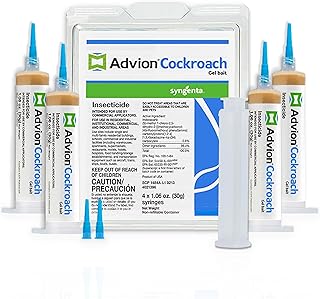
Advion Cockroach Gel Bait is the product most pest control operators reach for when a home has an active German cockroach population. It is a soft gel delivered in 30 gram syringes, and the active ingredient is indoxacarb, a compound that acts slowly by design so that a feeding roach has time to return to the harborage.
The strength of the format is placement. A pea size dot inside a cabinet hinge, along a countertop seam, behind a refrigerator or inside a motor housing puts the bait exactly where roaches travel and keeps it away from people and pets. Four tubes is a generous amount for a single household, which means you can reapply in fresh spots as feeding patterns shift instead of rationing one small syringe.
The limits are the ones every bait shares. Gel placed on an open counter dries and loses appeal, spraying a repellent insecticide near a placement can drive roaches away from it, and a kitchen full of crumbs and grease gives roaches a competing food source. Listings also vary in how many plungers and tips are included, so check the pack contents before ordering.
Bottom line: if you are buying one product for an indoor roach problem, this is the one to start with, and it is the reason the pack sits at the top of this list.
- Active ingredient: indoxacarb
- Format: gel bait in syringe tubes
- Pack: 4 tubes, 30 grams each
- Target pests: German, American and other major cockroach species per the label
- Use sites: indoor and outdoor crack and crevice placement
- Application: small bait dots, reapply as the bait is consumed
- Compatible with standard bait guns
Place many small dots rather than a few large ones. Target cabinet hinges and corners, the seam under a countertop, the void behind and beneath appliances, plumbing penetrations and any warm motor housing. Aim for placements in the rooms with confirmed activity first, then extend outward.
Keep sprays away from bait placements so the two treatments do not work against each other. Check placements after a few days and refresh the dots that have been eaten. If feeding stops while activity continues, move the placements and consider rotating to a bait with a different active ingredient.
Read the full label before the first application and follow the manufacturer directions exactly. Place the gel only in cracks, crevices and voids where children and pets cannot reach it, never as a visible bead on an open floor or counter.
Cap tubes between uses and store them in the original packaging, upright, away from food, heat and freezing temperatures. Wash your hands after handling, wipe up any accidental smear on an exposed surface, and keep the product locked away from children.

Pros
- Abamectin B1 gives you a different chemistry for rotation
- Formulated to stay attractive in dry indoor conditions
- Four 30 gram tubes in a single pack
- Fits standard bait guns for controlled placement
Cons
- Less familiar to home users than the mainstream retail brands
- Still needs careful placement in cracks and voids to work
- No plunger included in some listings
Vendetta is a professional gel bait from MGK that uses abamectin B1 instead of indoxacarb. On the shelf it looks like any other syringe of gel, and in use it behaves much the same way: small dots placed in cracks, hinges and voids, consumed by roaches that then return to the harborage.
The reason to own it is rotation. German cockroach populations can develop aversion to a bait matrix when one product is used repeatedly in the same space, and the professional answer is to switch to a bait with a different flavor base and a different active ingredient. Vendetta is the standard rotation partner for an indoxacarb gel, which is exactly why it appears on this list next to Advion.
The drawbacks are practical rather than technical. It is less familiar than a retail brand, listings vary on whether a plunger is included, and like every bait it depends on the user placing it where roaches actually travel. It rewards the same discipline as any professional product.
Bottom line: buy it as the second bait in your rotation rather than the first, and it earns its place in a long running roach problem.
- Active ingredient: abamectin B1
- Format: gel bait in syringe tubes
- Pack: 4 tubes, 30 grams each
- Target pests: cockroaches, including German cockroaches per the label
- Use sites: indoor crack and crevice placement per the label
- Compatible with standard bait guns
This bait suits the household that has already run one gel bait and noticed feeding slow down while roaches remain active. It is also a sensible pick for apartment buildings and rentals where the same product has been applied repeatedly over the years.
If this is your first roach product and you want the simplest path, start with an indoxacarb gel and keep this one in reserve. If you are managing a stubborn population across several rooms, owning both from the start saves a trip.
Follow the label directions for placement sites and quantities, and treat the product as the pesticide it is. Keep the gel inside cracks, crevices and voids that children and pets cannot access, and never apply it to surfaces where food is prepared.
Store the tubes capped and upright in their original packaging, away from food, heat and freezing temperatures, and out of reach of children. Wash your hands after handling, and clean up any gel that ends up on an exposed surface.

Pros
- Sealed stations keep the bait enclosed and out of sight
- No mixing, no sprayer and no cleanup
- Easy to place under sinks and behind appliances
- Eight stations cover the usual problem spots in a home
Cons
- Less flexible than gel for tight cracks and hinges
- Stations need replacing on the schedule the label gives
- Sized for large roaches rather than small German cockroaches
Combat bait stations are the low effort entry point to roach baiting. Each station arrives sealed and ready to place, so there is no syringe technique to learn, no sprayer to fill and nothing exposed on a surface. For a renter, a first time user or a home with a curious toddler, that simplicity is the whole appeal.
This particular pack is formulated for large roach species rather than small German cockroaches, which matters when you are choosing between the two Combat lines on a shelf. Placement is still the deciding factor. Stations belong under sinks, behind and beneath appliances, inside cabinet bases and along the routes roaches use, not in the middle of an open floor.
The tradeoff against gel is precision. A station cannot follow a roach into a cabinet hinge or a narrow appliance seam, so a heavy infestation usually needs gel as well. Stations also need replacing on the schedule printed on the pack rather than being left in place indefinitely.
Bottom line: the easiest way to get real bait into a home, and a sound choice when a sealed format matters more than pinpoint placement.
- Format: sealed plastic bait stations
- Pack: 8 stations
- Target pests: large roaches per the label
- Use sites: indoor placement under sinks, behind appliances and in cabinet bases
- Application: place and leave, replace per the label schedule
- No mixing or spraying required
- Active ingredient and concentration are printed on the package
Choose stations if you want a bait you can place in five minutes and forget about, or if an open gel deposit is not something you are comfortable having in the house. They suit rentals, small apartments and homes where a sealed format is the priority.
If you are fighting a widespread infestation, or the roaches you are seeing are small German cockroaches, pair these with a gel bait or start with the gel instead.
Place stations where children and pets cannot reach or chew them, which in practice means under and behind fixtures rather than in the open. Read the label before placement and follow the manufacturer directions for the number of stations per room and the replacement interval.
Do not open, cut or modify a station. Wash your hands after handling, keep spare stations in their sealed packaging and store the pack away from food and out of reach of children.

Pros
- One bottle mixes into a large volume of finished spray
- Bifenthrin leaves a residual barrier on treated surfaces
- Covers a long list of crawling insects besides roaches
- Works with any standard pump or hose end sprayer
Cons
- Requires mixing, measuring and a sprayer you supply
- Label restricts where it may be applied, especially indoors
- Highly toxic to fish and other aquatic life, so runoff matters
Compare-N-Save Indoor and Outdoor Insect Control is a bifenthrin concentrate, the format professionals buy because you pay for chemistry rather than for water and a plastic jug. A 32 ounce bottle mixed at label rates produces far more finished spray than any ready to use container of similar size, which is why it is the value pick on this list.
Its job on a roach program is the perimeter. Bifenthrin leaves a residual deposit on treated surfaces, so a band around the foundation, along door thresholds, around utility penetrations and at the gaps where pipes enter the wall slows the flow of roaches coming in from outside. That complements a bait working indoors instead of competing with it.
The cost of the savings is effort and care. You need a sprayer, an accurate measure, and a careful read of the label, which spells out which indoor sites are permitted and which are not. Bifenthrin is also highly toxic to fish and other aquatic life, so keep it away from ponds, drains and storm water.
Bottom line: the most economical way to buy a residual insecticide for perimeter work, provided you are willing to mix it properly.
- Active ingredient: bifenthrin
- Format: liquid concentrate for dilution with water
- Size: 32 ounces
- Target pests: roaches, ants, spiders and other listed crawling insects
- Use sites: indoor and outdoor applications permitted by the label
- Equipment: standard pump or hose end sprayer, supplied by the user
- Mixing rate: follow the label for the pest and site being treated
Measure the concentrate exactly as the label directs for the pest and site, mix it in the sprayer with water and agitate before spraying. Treat a band along the foundation, around doors and windows, at utility and pipe penetrations, and on the surfaces the label lists. Spray until the surface is wet but not running.
Keep the treatment on the perimeter and structural entry points and keep it away from indoor bait placements so the spray does not repel roaches from the bait. Let treated surfaces dry fully before people and pets return to the area, and avoid applying when rain is expected on an outdoor treatment.
Wear the protective equipment the label requires, which typically means gloves and eye protection while mixing and spraying, and ventilate any interior space you treat. Cover or remove food, dishes, pet bowls and aquariums before application, and keep children and pets out of the area until surfaces are dry.
Store the concentrate in its original container, tightly closed, away from food and out of reach of children. Rinse the sprayer as directed after use, do not pour rinse water into a storm drain, and dispose of any excess according to local rules.

Pros
- Microencapsulated formula holds a residual on porous surfaces
- Low odor and leaves little visible deposit at label rates
- Small bottle mixes into a large volume of finished spray
- Covers a broad list of crawling insects alongside roaches
Cons
- Requires a sprayer, accurate measuring and label study
- Higher entry price than a retail ready to use product
- Highly toxic to fish and other aquatic life
Demand CS is Syngenta's microencapsulated lambda-cyhalothrin concentrate, and the capsule technology is the point. On porous surfaces such as concrete, brick and unfinished wood, a conventional spray can be absorbed and lost quickly. The encapsulated formula is designed to sit on the surface and release over time, which is why it is a staple of commercial pest programs.
For a roach program it plays the same role as any residual: perimeter bands, entry points, thresholds and the label approved interior sites, working alongside a bait rather than replacing it. Low odor and a light visible deposit make it more pleasant to use indoors than many older chemistries.
The barriers are cost and complexity. An 8 ounce bottle costs more up front than a retail jug, even though it yields far more finished spray, and it assumes you own a sprayer and will read the mixing table properly. Like other pyrethroids it is highly toxic to fish and other aquatic life.
Bottom line: the pick when you want a professional residual with staying power on rough surfaces and you are comfortable mixing your own.
- Active ingredient: lambda-cyhalothrin
- Formulation: microencapsulated capsule suspension
- Size: 8 ounces
- Target pests: roaches, ants, spiders and other listed insects
- Use sites: indoor and outdoor applications permitted by the label
- Equipment: standard pump sprayer, supplied by the user
- Mixing rate: per the label for the pest and surface treated
Choose Demand CS over a basic concentrate when the surfaces you are treating are porous, when you want a low odor product for interior label sites, or when you are treating a property large enough that yield per bottle matters more than the price on the shelf.
Stay with a ready to use product if you do not own a sprayer and do not intend to buy one. A concentrate you mix incorrectly is worse than a simpler product used correctly, and the label is the authority on both the rate and the site.
Wear gloves and eye protection while measuring and mixing, ventilate interior spaces during application and drying, and keep children and pets away until treated surfaces are completely dry. Cover aquariums and remove pet bowls before you spray.
Store the bottle upright in its original container, tightly closed, away from food and out of reach of children. Follow the manufacturer directions for sprayer rinsing and disposal, and never pour leftover mix into a drain or waterway.

Pros
- Cypermethrin at 25.3 percent before dilution
- One pint mixes into many gallons of finished solution
- Long residual on exterior surfaces
- Covers a wide range of crawling pests
- Cost per treated area is very low
Cons
- Requires a separate sprayer and protective equipment
- Must be measured and mixed correctly
- Repels roaches from indoor bait if misused inside
Demon Max is the product on this list that behaves least like a consumer purchase. It arrives as a concentrated liquid at 25.3 percent cypermethrin, and a single pint dilutes into a large volume of finished spray, which is why the cost per treated square foot is a fraction of any ready to use bottle.
Used correctly it is an exterior tool. A treated band along the foundation, around door thresholds, under siding edges and at every pipe and cable penetration intercepts roaches before they get inside, and the residue holds up on those surfaces for weeks. That is a genuinely different job from anything a bait station does.
Used incorrectly it causes the classic failure. Sprayed across an indoor kitchen it leaves a residue roaches will not cross, which fences them away from the bait you paid for and pushes them deeper into voids you cannot reach. It also demands measuring, a working pump sprayer, and the protective equipment the label specifies, which is more commitment than some buyers expect.
Bottom line: excellent value and genuinely effective for exterior perimeter work, and the wrong product for anyone who wants to point a bottle at a roach in the kitchen.
- Format: liquid concentrate for dilution
- Active ingredient: cypermethrin, 25.3 percent
- Size: one pint
- Equipment needed: pump or backpack sprayer
- Primary use: exterior perimeter and entry points
- Mode of action: contact and residual
Measure the dilution rate on the label for your target pest and site, mix only what you will use in one session, and agitate the sprayer as you work. Treat a band along the foundation, the door thresholds, the garage perimeter, window frames and every utility penetration.
Do not spray indoors over or near bait placements. Keep the interior for bait and dust, and let the concentrate do the outdoor work where its residual strength is an advantage.
Wear the protective equipment listed on the label when handling the concentrate, mix outdoors or in a well ventilated space, and keep children and pets away from treated surfaces until they are completely dry.
Never decant the concentrate into an unlabelled container, and store it locked away from living areas. Cypermethrin is toxic to fish, so keep the spray away from ponds and storm drains.

Pros
- No loose powder, so nothing settles on surfaces you touch
- Tablets can be counted, placed precisely and retrieved later
- Lure is built into the tablet to draw roaches to the bait
- Fits drawer wells, cabinet corners and appliance gaps neatly
- 145 tablets cover many placements across several rooms
Cons
- Cannot reach into wall voids the way a puffed dust can
- Lower boric acid concentration than the dusts, since most of the tablet is bait matrix
- Label caps placements at twelve tablets per room, so heavy infestations still need a dust
These tablets are the answer to the most common objection to boric acid, which is that nobody wants white powder drifting around a kitchen. Harris presses boric acid together with a lure into small tablets you place by hand, so the active ingredient stays where you put it and nothing settles on a surface you later lean on.
Placement is where they shine. The label directs you to sites like the space under and behind the refrigerator, stove, sinks, tubs, dishwasher, washing machine and dryer, into openings around drains and pipes, and into cracks along baseboards and cabinet corners. It also suggests pulling out lower kitchen and bathroom drawers and dropping tablets into the empty drawer wells, an enclosed space roaches use constantly and homeowners almost never treat. Because you place a known number in known spots, you can go back and check or remove them.
The limits are real. The tablets carry a lower boric acid concentration than the dusts here, since the rest of the tablet is the bait that convinces a roach to feed, and the label caps you at no more than twelve tablets per room. A tablet also cannot travel into a wall void, so deep harborage stays untouched. This is why we treat tablets as a companion to a dust in a serious infestation rather than a replacement for one. The rating on this product runs a little lower than its siblings, and the pattern in feedback is people expecting a dust level knockdown from a bait format.
Bottom line: the best choice when loose powder is a non starter, and an excellent partner to a dust when you want cabinets and drawers covered without residue.
- Format: pressed bait tablets with formulated lure
- Active ingredient: boric acid, 40 percent
- Container: 6 oz package, approximately 145 tablets
- Maximum placement: no more than twelve tablets per room
- Labeled pests: cockroaches and other insects named on the label
- Registration: EPA registered insecticide
- Residue: none on treated surfaces when placed correctly
Work through the label sites methodically: under and behind the refrigerator, stove, sinks, tubs, dishwasher, washing machine and dryer, into openings around drains, water pipes and electrical conduits, and into cracks and crevices along baseboards and in the corners of cabinets, cupboards and closets.
Remove the lower drawers in kitchen and bathroom cabinets and in bedroom dressers, then place tablets in the drawer wells before sliding the drawers back. Any tablet still visible after placement must be pressed into a crack or removed, and the label allows no more than twelve tablets in any one room.
Tablets are still an insecticide and boric acid is toxic if swallowed. Place them only where children and pets cannot reach or dislodge them, which rules out open floor edges, the backs of accessible low shelves and anywhere a dog can nose around.
Keep them away from food, dishes, food preparation surfaces, pet bowls and pet bedding, and store the package closed and out of reach. If a child or animal swallows a tablet, call Poison Control or your local emergency number right away with the label in hand.

Pros
- Plant based active ingredient for households that prefer one
- Covers a yard and perimeter from a single 32 ounce bottle
- Can be reapplied often without a long re-entry wait
- Pleasant cedar scent rather than a solvent smell
Cons
- Built for outdoor yard and perimeter work rather than indoor baiting
- Shorter residual than a synthetic pyrethroid, so reapplication is frequent
- Not a substitute for a bait inside an infested kitchen
Wondercide's outdoor concentrate is the minimum risk option on this list. The active ingredient is cedarwood oil, and the product is designed for yard and perimeter treatment rather than for the crack and crevice work that a roach infestation inside a kitchen demands.
Households pick it for a specific reason: they want to reduce outdoor insect pressure without applying a synthetic pyrethroid around a yard where dogs, cats and children play. Within that brief it is straightforward to use, mixing into a hose end or pump sprayer and covering a typical yard from one bottle.
Set expectations correctly. A botanical concentrate does not leave the long lasting residual film that bifenthrin or lambda-cyhalothrin leaves, so reapplication is more frequent, especially after rain. It also does not replace an indoor bait if roaches are already established inside the structure.
Bottom line: a reasonable outdoor companion for a household that prefers a plant based product, used alongside an indoor bait rather than instead of one.
- Active ingredient: cedarwood oil
- Format: liquid concentrate for dilution with water
- Size: 32 ounces
- Target pests: mosquitoes, ants, roaches and other listed outdoor insects
- Use sites: yard, lawn and exterior perimeter
- Equipment: hose end or pump sprayer
- Reapplication: repeat per the label, particularly after rain
This one suits homes with pets and children where the yard sees constant use and a plant based product is the preference. It also fits a maintenance routine, keeping outdoor pressure down between the seasonal peaks.
It is not the right pick if roaches are already breeding inside the house. In that case start with a gel bait indoors, add a perimeter treatment, and use this outdoors only if a botanical product is what you want in the yard.
Minimum risk does not mean no precautions. Read the label, follow the mixing rate and the listed use sites, and keep children and pets off treated areas until they have dried. Avoid spraying directly onto pets, ponds or vegetable foliage unless the label specifically permits it.
Store the bottle closed in its original container, away from food and out of reach of children, and rinse the sprayer after use as the manufacturer directs.
How to Choose the Best Chemical to Kill Roaches
Roach products look interchangeable on a shelf and behave nothing alike in a kitchen. The six points below are the ones that change the outcome, and they are the same points a licensed applicator would walk through before opening anything.
Start With the Active Ingredient, Not the Brand

Every registered product prints its active ingredient and its percentage on the front or side panel. That single line tells you more than the marketing copy. Indoxacarb, the active in Advion gel bait, is a delayed-action compound delivered in a food matrix, so the roach that eats it returns to the nest before it dies. Abamectin B1, used in Vendetta gel bait, works the same way through a different chemical family, which matters when you need a second bait that roaches have not learned to avoid.
Pyrethroids sit at the other end of the shelf. Bifenthrin in the Compare-N-Save concentrate, lambda-cyhalothrin in Syngenta Demand CS and cypermethrin in Syngenta Demon Max are contact and residual insecticides. They leave a treated surface that kills insects walking across it, and they are the tools for perimeters, entry points and voids rather than for open kitchen counters. Boric acid, the active in Harris Roach Tablets, is a slow stomach and contact poison that keeps working as long as the deposit stays dry.
Botanical products form a third group. Cedarwood oil, the active in the Wondercide outdoor concentrate, appeals to households that want a minimum-risk option for yard and perimeter use. It behaves differently from a synthetic residual and is best judged on its own terms rather than measured against a professional pyrethroid.
| Active ingredient | Typical format | Where it fits |
|---|---|---|
| Indoxacarb | Gel bait syringe | Cracks, hinges and voids in kitchens and bathrooms |
| Abamectin B1 | Gel bait syringe | Rotation partner when roaches avoid the first bait |
| Bait station toxicant | Sealed plastic station | Under sinks and appliances, homes with children or pets |
| Boric acid | Tablet, powder | Dry voids, behind appliances, under cabinets |
| Bifenthrin | Liquid concentrate | Exterior perimeter and entry points |
| Lambda-cyhalothrin | Microencapsulated concentrate | Porous surfaces where a long residual is wanted |
| Cypermethrin | Liquid concentrate | Crack and crevice work per the label |
| Cedarwood oil | Hose-end concentrate | Yard and perimeter, minimum-risk preference |
Baits Work Differently From Residual Sprays

A bait is an invitation. It has to smell better than the crumbs behind the stove, and it has to stay attractive long enough for roaches to find it, feed and return to the harborage. That is why placement beats volume: many small pea-size dots in hinges, corners and voids beat one thick line along a baseboard. Our deeper look at roach gel baits covers placement patterns in more detail.
A residual spray is a barrier. It sits on a surface and affects insects that cross it, which makes it the right choice for foundation lines, door thresholds, utility penetrations and the gaps where roaches enter from outside. The two approaches conflict when they overlap: spraying a repellent pyrethroid over or next to a bait placement can drive roaches away from the bait you wanted them to eat. Keep sprays on the perimeter and structural entry points, and keep baits inside where the activity is. If sprays are the part you are least sure about, our roundup of roach sprays for the home explains the indoor labels in plain terms.
Match the Formulation to the Room

Formulation decides how easy a product is to live with. Gel in a syringe places precisely into a cabinet hinge or the seam under a countertop, and it stays out of sight. Sealed bait stations trade that precision for simplicity and a child-resistant shell, which is why they are the default for a rental kitchen or a house where a toddler is on the move. Tablets and dry powders reach voids that liquids cannot, but they lose effectiveness where moisture collects, so a damp cabinet under a leaking trap is the wrong place for them.
Concentrates are the most economical format by volume because you mix them with water yourself, and they demand the most from the user. You need a sprayer, correct dilution, and a clear understanding of the sites the label permits. If mixing is not something you want to take on, stay with gels and stations. If you are treating a whole property line, a concentrate is the only sensible way to buy the chemistry. Both approaches sit in our wider patio, lawn and garden coverage.
Check the Label for Approved Sites and Restrictions
Approved use sites are not a formality. A product cleared for outdoor perimeter use may not be permitted indoors, and one cleared for crack and crevice treatment is not cleared for broadcast spraying across a floor. The label also states buffer requirements around food preparation surfaces, pet bowls and aquariums. A few products carry state-level restrictions, so a listing that ships to most of the country may still be unavailable where you live.
Read the mixing rate as carefully as the site list. Concentrates are sold at very different strengths, and the correct dose for one brand is wrong for another. More product than the label allows is not faster control, it is a violation of the directions and a needless exposure.
Safety Around Children, Pets and Food Areas
Treat every item on this list as what it is: a pesticide. Store it in its original container, keep it locked away from children and pets, and wear the protective equipment the label specifies, which for most concentrates means gloves and eye protection. Ventilate the room while you apply and while treated surfaces dry, and keep pets out of the area until the deposit is fully dry. Cover or remove food, dishes and pet bowls before you start, and wash your hands when you are finished.
Placement is a safety decision as much as a performance one. Gel belongs inside cracks, hinges and voids where only insects reach it, never as a visible bead on an open counter or floor. Bait stations belong behind and under appliances rather than in the open. If you keep birds, fish or reptiles, check the label for the specific warnings that apply to them, since several pyrethroids are highly toxic to fish and other aquatic life. Follow the manufacturer directions exactly, and if a label conflicts with anything written here, the label wins.
Rotate Chemistry to Avoid Bait Aversion
German cockroach populations can develop aversion to a bait matrix over time, and repeated use of one product in one apartment is how that happens. Professionals answer it by rotating: run one bait until feeding drops off, then switch to a bait built on a different active ingredient and a different flavor base. That is the practical reason to own an indoxacarb gel and an abamectin gel rather than two tubes of the same thing.
Sanitation carries the same weight as chemistry. Bait competes with whatever else is available, so a kitchen with crumbs under the toe kick and grease behind the range gives roaches a reason to ignore your placements. Fixing leaks removes the water source, and sealing the gaps around pipes and cabinets removes the highways. A dry, sealed, crumb-free kitchen makes an ordinary bait look excellent, and no chemical fully compensates for the opposite.
Why You Should Trust Us
We build these lists the way a careful shopper would if they had the time. We start from what is actually selling and holding up on Amazon, filter down to products with a strong customer rating supported by a substantial body of reviews, then read the label and the manufacturer documentation for each candidate so the description matches what the registration actually allows. Products that repeat the same chemistry in the same format do not both earn a slot; we keep the version that covers a distinct job and drop the near-duplicate.
We do not claim a hands-on trial we did not run, and we do not publish efficacy figures that a manufacturer has not published. What we can tell you is which active ingredient sits in each product, which format it comes in, where the label allows it, and how those pieces fit a real infestation. Pest pressure varies by building, climate and species, so no product on this page or anywhere else can promise a complete elimination. If an infestation is large, spread across units, or connected to a shared wall in a multi-family building, a licensed pest control operator is the faster answer.
Final Thoughts
The Syngenta Advion Cockroach Gel Bait is our best overall for indoor roach work. It is the professional standard for a reason: a well-accepted indoxacarb bait, four generous tubes per pack, and a format that lets you place tiny dots exactly where roaches travel. Pair it with the Vendetta Roach Gel Bait, which uses abamectin B1, and you have a rotation ready the moment feeding on the first bait slows down.
For value, the Compare-N-Save Indoor and Outdoor Insect Control concentrate is hard to beat, since one bottle of bifenthrin makes far more finished spray than any ready-to-use jug of comparable size. Step up to Syngenta Demand CS when you want a microencapsulated lambda-cyhalothrin residual on porous surfaces, or Syngenta Demon Max when a cypermethrin concentrate suits the label sites you are treating. Households that prefer a simpler approach should look at the Combat bait stations for large roaches, which need no mixing and come sealed, or at Harris Roach Tablets, the boric acid option we cover in depth in our guide to boric acid for roaches.
If your problem starts outside, the Wondercide Outdoor Pest Control Concentrate is the cedarwood-oil option on this list for yard and perimeter use. Whichever route you take, work the plan in the right order: seal and clean first, bait indoors, treat the perimeter outdoors, and give the chemistry the weeks it needs before you judge it. More buying guides from our team are collected on the articles page.
Frequently Asked Questions
What is the best chemical to kill roaches for a serious infestation in 2026?
For indoor German cockroach problems, a professional gel bait is the usual starting point, and the Syngenta Advion Cockroach Gel Bait is the one we would open first. Baits are carried back into the harborage, which reaches the insects you never see. Add an exterior residual such as a bifenthrin concentrate to slow re-entry, and keep the two treatments in separate zones so the spray does not repel roaches away from the bait.
Do I need both a bait and a spray?
Often yes, but for different jobs. The bait handles the population living inside the structure, while the residual spray handles the perimeter and the entry points where new roaches arrive. If you only have one problem area and no outdoor pressure, a bait on its own may be all you need. Homes with heavy outdoor insect activity usually benefit from a perimeter treatment, which we cover in our guide to bug spray for outside the house.
Is boric acid still worth using?
It remains one of the most economical options for dry voids, and tablet formats such as Harris Roach Tablets make placement tidier than loose powder. The limits are worth knowing: boric acid needs to stay dry, it does not work as a broadcast surface treatment, and it must be placed where children and pets cannot reach it. Used as a supporting deposit behind appliances and inside cabinet voids, it earns its place alongside a modern gel bait.
How quickly should a roach bait start working?
Baits are designed to be slow on purpose, because a roach that dies instantly never makes it back to the nest. Expect to judge progress over days and weeks rather than minutes, and follow the timing the manufacturer prints on the label. If feeding on your placements stops while activity continues, that is the signal to reapply in fresh locations or rotate to a bait with a different active ingredient.
Are any of these products safe to use around pets?
Every product here can be used in a home with pets when it is applied exactly as the label directs, which generally means placing bait where animals cannot reach it, keeping pets out of the room during application, and waiting until treated surfaces are completely dry before letting them back in. Several pyrethroids are highly toxic to fish and other aquatic life, so cover aquariums and take extra care if you keep birds or reptiles. When in doubt, choose a sealed bait station over an open deposit, and ask your veterinarian about any product you are unsure of.


Write Your Review
No reviews yet. Be the first to share your experience!