

A roach problem rarely announces itself politely. You flip on the kitchen light, something scatters behind the toaster, and suddenly you want a can in your hand tonight. Aerosol and pump sprays are the fastest tool in that moment, but they are not all built for the same job: some knock down what you can see, others leave a treated band along baseboards that keeps working for weeks. We looked at 8 of the most popular roach sprays for home for September 2026, from Raid Ant, Ortho Home, Wondercide and more, and sorted them by what they actually do inside a house rather than by can size. Our top pick is the Raid Ant & Roach Killer 26 Fragrance Free Spray for its fast contact knockdown and its low odor formula that suits kitchens and bathrooms.
Spraying is one layer of control, not the whole plan. Contact sprays reach the roaches that run, residual sprays hold a line at entry points, and slow acting baits work on the ones you never see. If you are building the full approach, our guide to the best roach gel bait covers the part that travels back to the harborage. Below we focus only on sprays you can use indoors, what is in them, and how to apply them without turning your kitchen into a fume chamber.

Pros
- Kills roaches and ants on contact within seconds
- No added perfume, so the air clears faster in small rooms
- Narrow spray pattern reaches cracks and appliance gaps
- Two cans let you keep one on each floor
- Leaves a working deposit on treated surfaces for a few weeks
Cons
- Solvent smell is still noticeable during application
- Residual life is far shorter than a wand barrier product
- Aerosol format runs out quickly if used as a perimeter spray
This is the can most people picture when they think of roach spray, minus the perfume. Raid Ant & Roach Killer 26 pairs imiprothrin for fast knockdown with cypermethrin for a longer acting dose, and the fragrance free version skips the lemon or lavender masking scent that many buyers dislike more than the insecticide itself.
In practice it does exactly one job very well. Roaches that take a direct hit stop moving in seconds, and the spray pattern is tight enough to push product into a toe kick, along a counter seam, or behind a refrigerator without coating the whole floor. Treated surfaces keep a working deposit for a few weeks, which is a bonus rather than the main event.
The limits are the format. A 17.5 ounce can is a spot treatment tool, and if you try to run a perimeter band around an apartment you will empty it fast. The solvent odor is milder than scented versions but not absent, so you still ventilate and stay out of the room until surfaces dry. It also cannot reach the roaches sitting inside a wall void, which is why it belongs alongside a bait rather than instead of one.
Bottom line: the most useful can to have within arm's reach when you see movement, and the fragrance free formula makes it the easiest of the aerosols to live with indoors.
- Format: aerosol contact spray
- Actives: imiprothrin and cypermethrin (pyrethroid class)
- Size: 17.5 oz per can, 2 cans per pack
- Scent: fragrance free
- Use area: indoor, crack and crevice plus spot treatment
- Targets: cockroaches, ants and other listed crawling insects
- Shake well and hold the can upright about 12 inches from the surface
- Spray directly onto insects for immediate knockdown
- Treat cracks along baseboards, under cabinet toe kicks, and behind appliances
- Keep spray off food, dishes and food contact surfaces, and wash any that get hit
- Ventilate the room and stay out until treated surfaces are dry
Renters and homeowners who want an immediate answer to a sighting rather than a full treatment program. The fragrance free formula suits studio apartments, galley kitchens and small bathrooms where a scented aerosol lingers uncomfortably.
It is a weaker fit if your goal is a long lasting perimeter barrier across a whole house. For that, a gallon wand product covers far more ground for the money.

Pros
- Covers an entire small home with room left over
- Comfort wand removes the crouching and trigger fatigue
- Bifenthrin based residual holds well on sealed surfaces
- Labeled for both indoor use and the outside perimeter
- No mixing or measuring required
Cons
- Bulky jug takes real storage space
- Slower to knock down insects than an aerosol
- Water based formula needs hours to dry before reentry
This is the residual half of a sensible roach plan. Instead of chasing insects, you walk the room with the wand and lay a continuous band where roaches travel: the joint where baseboard meets floor, door thresholds, window frames, under sinks and around appliance bases. Anything crossing that band over the following weeks picks up a dose.
The comfort wand is the reason this format outsells trigger bottles. Holding a jug at your side and sweeping a wand for twenty minutes is far less tiring than squeezing a trigger a few hundred times, and it keeps your hands out of the spray. The 1.33 gallon volume is generous enough to cover an apartment interior and still have product left for the exterior foundation line.
What it will not do is impress you in the moment. There is no dramatic knockdown, the formula is water based and needs to dry, and the jug is awkward to store in a small closet. Residual life also depends on the surface: painted trim and sealed tile hold the deposit much longer than bare concrete or a floor you mop weekly.
Bottom line: the best choice when you want a lasting indoor barrier rather than a can for emergencies, and the format that covers the most ground per dollar.
- Format: ready to use liquid with attached comfort wand
- Active class: pyrethroid, bifenthrin based residual
- Volume: 1.33 gallons
- Use area: indoor plus outdoor perimeter
- Application: crack, crevice and continuous perimeter band
- Targets: cockroaches, ants, spiders and other listed insects
Choose this version over the indoor only barrier if you want to treat both sides of the wall. Roaches and ants often enter around foundation gaps, utility penetrations and door sweeps, and treating the exterior line reduces the pressure before it reaches your kitchen.
Plan your route before you start so you are not walking back through wet product, and treat rooms you can leave alone for a few hours. Storage matters too: the jug is tall, so measure the shelf before you buy.
- Keep people and pets out of the treated area until the surface is dry
- Cover fish tanks and turn off aquarium pumps before spraying
- Do not apply to food contact surfaces, dishes or bedding
- Ventilate treated rooms during and after application
- Store the jug upright, away from heat and out of reach of children

Pros
- Extended reach wand gets behind and under furniture
- Long residual on sealed indoor surfaces
- Low odor once the surface dries
- Dries clear on most finished trim
- Full gallon covers a whole floor of a house
Cons
- Indoor label only, so no exterior perimeter use
- No fast knockdown for insects you can see
- Large jug is awkward to store and carry
Ortho Home Defense Max Indoor Insect Barrier is the indoor specialist in the Home Defense line. The formula leans on bifenthrin, a slower acting pyrethroid chosen for how long it stays active on a treated surface rather than for speed, and the extended reach wand is built for the awkward geometry of a furnished room.
Used properly, you get a continuous treated line where roaches actually walk: behind the sofa, along the back edge of base cabinets, under the washer and dryer, around the water heater, and along the thresholds between rooms. Because it dries clear and low odor, it is easier to justify in a living room than an aerosol.
The tradeoffs are the same as any barrier product. It does nothing for the roach on the counter right now, so it needs a contact spray alongside it. The indoor only label means you cannot use the leftover on your foundation line the way you can with the indoor and perimeter version. And a gallon jug with a wand is not a small object to store.
Bottom line: the strongest indoor only barrier here, worth choosing over the perimeter version if all of your activity is inside the house.
- Format: ready to use liquid, extended reach comfort wand
- Active class: pyrethroid, bifenthrin based
- Volume: 1 gallon
- Use area: indoor only
- Application: baseboard bands, cracks, crevices, entry points
- Targets: cockroaches, ants, spiders, fleas and ticks per label
Pick this one if your roach activity is clearly interior, for example a kitchen and bathroom in an apartment building where you cannot treat the outside of the structure. Renters often fall into exactly this category.
If you own the building and see insects entering from outside, the indoor and perimeter version does both jobs from one jug and is usually the smarter buy.
- Wait for treated surfaces to dry fully before letting children or pets back in
- Never spray countertops, dishes or anything that touches food
- Ventilate while spraying and for a while afterward
- Protect aquariums and reptile enclosures before application
- Store upright in a cool place, away from children

Pros
- Kills roaches and ants on contact
- Keeps working on treated surfaces for weeks per label
- Lemon scent covers the solvent smell for some users
- Precise spray reaches cracks and crevices
- Easy to find and inexpensive to replace
Cons
- Lemon fragrance is polarizing and lingers
- Not a substitute for a full perimeter barrier
- Repeated use of the same pyrethroid can select for resistance
This is the version of the Raid can most households already recognize. The chemistry is the familiar pyrethroid pairing that knocks insects down quickly, and the label goes further than most aerosols by claiming continued killing on treated surfaces for weeks, which puts it in a middle ground between a pure contact spray and a proper barrier product.
Applied to the right places, it earns that claim reasonably well. A band along the back of a cabinet, into the gap under a toe kick or around a plumbing penetration stays effective longer than an open floor treatment, where cleaning removes the deposit quickly.
The dividing issue is the scent. Some buyers prefer the lemon over raw solvent smell, others find it clings to a kitchen for a day. If that worries you, the fragrance free version of the Raid line does the same job without the perfume. The can also carries the usual limits: it cannot reach insects in a wall void, and leaning on the same active for months at a time is how resistant populations develop.
Bottom line: a strong, inexpensive all rounder for spot treatment, best chosen if the lemon scent is a plus rather than a compromise.
- Format: aerosol contact and residual spray
- Active class: pyrethroid
- Size: 17.5 oz
- Scent: lemon
- Residual claim: continues killing listed insects on treated surfaces for weeks
- Use area: indoor spot and crack and crevice treatment
- Spray directly on insects for immediate contact kill
- Apply a narrow band into cracks, crevices and hiding places
- Reapply after cleaning, since washing removes the deposit
- Keep away from food, dishes and food preparation areas
- Ventilate and let the surface dry before normal use of the room
Households that want one affordable can to handle both sightings and the cracks around them, and that do not mind a scented product. It is the pragmatic choice for a kitchen with occasional activity rather than a serious infestation.
If anyone in the home is sensitive to fragrance, choose the fragrance free version instead.

Pros
- Plant based formula labeled for use around pets and children
- Pleasant lemongrass scent that fades quickly
- Large 32 oz trigger bottle covers a lot of surface
- Safe on most sealed floors and finished surfaces
- Kills a broad range of crawling insects on contact
Cons
- Very little residual once the oils evaporate
- Requires more frequent reapplication than a pyrethroid
- Oil based spray can leave a film on some finishes
Wondercide built its following on households that do not want conventional insecticide sprayed around a cat, a toddler or a bird. The indoor formula uses cedarwood oil with sesame oil as a carrier, and it kills crawling insects on contact while leaving a scent that most people find pleasant rather than chemical.
Where it fits best is maintenance and light activity. Wiping a treated band along a baseboard, under a sink or around a trash area gives you contact control and a short deterrent effect, and you can do it without evacuating the room for half a day. The 32 ounce trigger bottle is generous, and the sprayer is comfortable enough for a full kitchen in one session.
The honest limitation is duration. Essential oil actives evaporate, so the treated surface stops doing much within days rather than weeks. That means reapplication, and it means this is not the product to rely on alone if you have a heavy German cockroach population. The oil base can also leave a slight film on some finishes, so try a small hidden area before spraying a large area.
Bottom line: the best pick for pet heavy and child heavy homes that accept a shorter working window in exchange for a plant based formula.
- Format: ready to use trigger spray
- Actives: cedarwood oil with sesame oil
- Volume: 32 oz
- Scent: lemongrass
- Use area: indoor, home and kitchen surfaces
- Targets: roaches, ants, spiders, flies and fleas
- Labeled for use around pets and family, but still let surfaces dry first
- Try a small hidden area on finished wood and delicate surfaces before broad use
- Shake the bottle before each use so the oils stay mixed
- Keep away from aquariums, which are sensitive to any spray
- Store out of direct sunlight to protect the oil actives
Homes with cats, dogs, reptiles or young children where the deciding factor is what gets sprayed near them, not how many weeks the treatment lasts. It also suits people who simply dislike solvent odor.
If you are dealing with an established infestation, treat this as a supporting product and pair it with bait.

Pros
- Plant derived active ingredients
- Compact bottle that stores easily in a cabinet
- Light scent that clears fast
- Labeled for indoor and outdoor use
- Backed by a large consumer brand with wide availability
Cons
- 12 oz goes quickly if you treat a full room
- Minimal residual compared with pyrethroid sprays
- Contact kill is slower than a conventional aerosol
Stem is the botanical line from a mainstream household brand, which matters more than it sounds: it means consistent supply, a clearly written label and a formula that has been through a large company's compliance process rather than a small batch operation.
The spray handles the everyday version of the problem. A roach on the floor, ants tracking along a windowsill, flies around a bin. It kills on contact and leaves a scent that fades within an hour or two, so you can treat a kitchen in the evening without planning your day around it.
Two things temper the recommendation. The 12 ounce bottle is small, so using it as a perimeter treatment empties it fast and gets expensive per treated foot. And like every essential oil formula here, the residual is measured in days, not weeks, so activity that keeps returning needs a bait or a barrier alongside it.
Bottom line: a convenient, low commitment botanical spray for light indoor activity, best kept as a supplement rather than your only line of defense.
- Format: ready to use spray bottle
- Active type: plant based botanical insecticide
- Volume: 12 fl oz
- Use area: indoor and outdoor
- Targets: ants, roaches and flies
- Pack: single bottle
- Spray directly onto insects for contact kill
- Treat entry points, windowsills and areas around bins
- Reapply regularly, since botanical actives break down quickly
- Avoid food contact surfaces and wash any that get sprayed
- Shake before use to keep the formula mixed
Buy this if you want a botanical option from a familiar brand and your problem is occasional rather than established. The small bottle is a fair match for a single kitchen or a bathroom.
If you plan to treat a whole apartment, a 32 ounce trigger bottle or a dilutable concentrate delivers far more coverage for the money.

Pros
- Strong peppermint formula with a clean scent
- Plant based and free of synthetic pyrethroids
- Useful for storage areas, garages and vehicles
- Large 16 oz bottle with a sturdy sprayer
- One of the most reviewed natural sprays available
Cons
- Works mainly as a repellent, not a reliable killer
- Peppermint scent is intense right after application
- Effect fades within days and needs reapplication
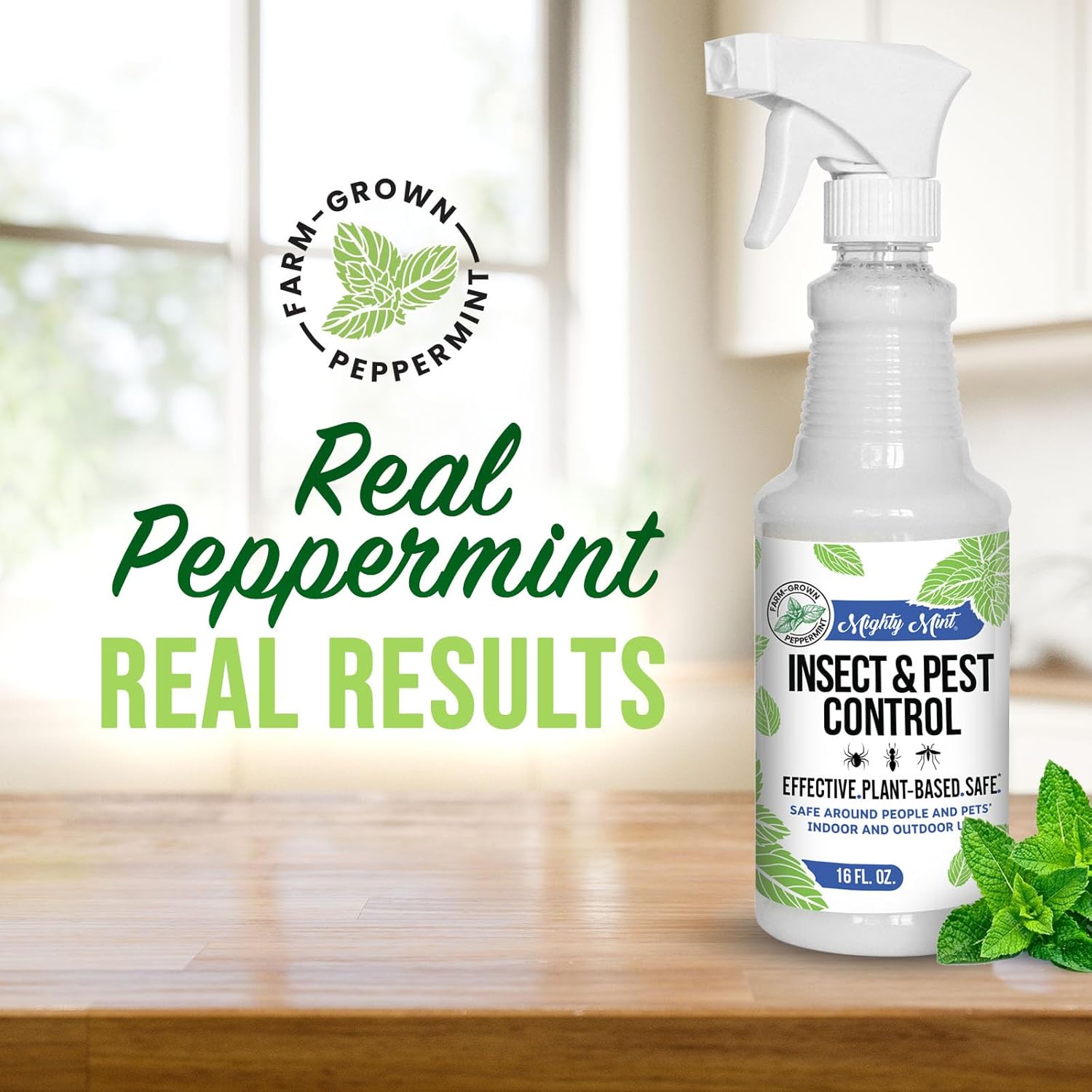
Mighty Mint is the outlier on this list, and it is worth being clear about what it is. This is a peppermint oil repellent, marketed for spiders, ants, roaches and other crawling insects. Its strength is discouraging insects from settling in a space, not clearing an active population.
That makes it genuinely useful in the places conventional sprays are annoying to use: a pantry shelf you do not want to treat with insecticide, storage bins in a garage, a shed, a camper, or the void behind a washing machine. The scent is powerful when fresh, which is exactly the point, and it settles into a pleasant background note within a day.
What it is not is a solution for a kitchen with nightly roach traffic. Direct contact can kill some insects, but coverage is inconsistent and the oil evaporates, so any deterrent effect fades within days. Buyers who expect a knockdown spray are the ones who leave disappointed reviews.
Bottom line: a good preventive layer and a fine choice for storage areas, provided you buy it as a deterrent rather than as a roach killer.
- Format: ready to use trigger spray
- Active: peppermint oil, extra strong concentration
- Volume: 16 oz
- Use area: indoor and outdoor
- Function: repellent with limited contact effect
- Targets: spiders, ants, roaches and other listed crawlers
People maintaining a space that is already clear and want to keep it that way: pantries, closets, garages, storage units, campers and sheds. It also suits anyone who wants zero synthetic insecticide inside the home.
Anyone with visible daily roach activity should start with a contact aerosol and a bait instead.
- Ventilate after spraying, since the peppermint concentration is strong
- Try a small hidden area before spraying finished wood or fabric
- Keep away from pets while wet, especially cats and small animals
- Reapply every week or two in areas you want to keep protected
- Store tightly capped and out of direct sun

Pros
- Makes several gallons of spray from one small bottle
- Lowest cost per treated square foot on this list
- Plant powered formula with no synthetic pyrethroid
- Compact bottle stores in any cabinet
- You control the dilution and how much you mix
Cons
- Requires your own sprayer and a mixing step
- Mixed spray does not keep indefinitely
- Residual is short, like other botanical formulas
BugMD approaches the problem from the value side. Instead of paying to ship water in a gallon jug, you buy a small bottle of concentrate and mix it into your own sprayer. The math is the appeal: one 3.7 ounce bottle yields several gallons of finished spray, which is enough to treat an apartment perimeter several times over for the price of a couple of aerosol cans.
The formula is plant powered rather than pyrethroid based, so it behaves like the other botanical sprays here. It kills crawling insects on contact and gives a short deterrent window, and it lets you treat areas near pets and children with less disruption than a conventional barrier product.
The friction is the process. You need a sprayer, you need to measure, and mixed product is best used rather than stored for months. Anyone who wants to grab a can and point it at a roach will find this the least convenient option in the list. Residual is also short, so the savings partly go back into treating more often.
Bottom line: the cheapest way to cover a large area with a plant based spray, as long as you are willing to mix your own.
- Format: concentrate for dilution with water
- Active type: plant powered, essential oil based
- Size: 3.7 oz concentrate
- Yield: several gallons of finished spray depending on dilution
- Use area: indoor pest control
- Targets: cockroaches, ants, spiders and flies
- Measure the concentrate into a clean sprayer per the label dilution
- Top up with water and shake thoroughly before spraying
- Treat baseboards, entry points, under sinks and behind appliances
- Mix only what you plan to use within a short period
- Rinse the sprayer after use so the nozzle does not clog
This is the right buy if you are treating a whole home, a garage and a yard, or if you already own a pump sprayer and hate paying for packaged water. It also suits people who want to adjust strength for different areas.
Skip it if you want a grab and go can, or if measuring and mixing is a step you know you will not keep up with.
How to Choose the Right Roach Sprays For Home
Two cans can look identical on the shelf and behave completely differently on your floor. The label tells you most of what matters, and once you know which four or five lines to read, choosing gets much easier. Here is what separates a spray that solves the problem from one that just moves roaches to the next room.
Contact Kill Versus Residual Coverage
A contact spray is the aerosol you grab when a roach is crossing the counter. The wet spray hits the insect directly, the active ingredient penetrates the cuticle, and the roach usually goes down in seconds. That speed is satisfying, but it only affects the individuals you actually hit. Roaches are nocturnal and spend most of their lives inside walls, under appliances, and behind cabinet kicks, so the ones you see are a small fraction of what is there.
A residual spray is the opposite trade. It dries into a thin deposit on the surface, and roaches that walk across that deposit in the days and weeks afterward pick up a dose on their legs and body. Products such as the Ortho Home Defense Insect Killer for Indoor & Perimeter and the Ortho Home Defense Max Indoor Insect Barrier are built around this idea, which is why they ship with a wand instead of a narrow aerosol straw. Residual performance depends heavily on surface: a treated deposit lasts far longer on painted baseboard or sealed tile than on raw concrete, unfinished wood, or anything you mop weekly.
Most households want both. Keep one aerosol for the sightings and treat cracks, thresholds, and the strip behind appliances with a residual product so the population runs into treated ground on its own schedule. No spray reaches every roach in a structure, and a heavy or long running infestation usually needs bait and sanitation alongside it.
Active Ingredients: Pyrethroids Versus Botanical Formulas

Conventional roach sprays are built on synthetic pyrethroids. Cypermethrin, zeta-cypermethrin, bifenthrin, deltamethrin, and imiprothrin all belong to this family, and they attack the insect nervous system. Imiprothrin is the fast knockdown component you find in Raid cans, while bifenthrin is the slower, longer lasting active behind the Ortho barrier sprays. Pyrethroids are the reason a can can claim weeks of continued killing on treated surfaces.
Botanical sprays take a different route. Wondercide leans on cedarwood and sesame oils, Mighty Mint is built around peppermint oil, and Stem and BugMD use plant derived actives you dilute or spray straight onto surfaces. These formulas generally kill on contact and repel afterward, but they break down quickly and leave little meaningful residual. They earn their place in homes with small children, birds, reptiles, or anyone who simply does not want a synthetic insecticide near food prep areas. Just set expectations: a peppermint or cedar spray is a deterrent and a contact tool, not a barrier that holds for a month.
Rotating actives matters too. German cockroaches are well documented to develop resistance to pyrethroids in populations that get sprayed with the same chemistry over and over. If a can that worked in spring stops working by autumn, switching to a different active class, or moving part of the effort to bait, is usually more productive than spraying twice as much of the same thing.
Odor, Dry Time, and Getting Back in the Room
This is the criterion buyers underestimate until the first application. Scented aerosols mask solvent smell with lemon or lavender fragrance, which some people find worse than the original. Fragrance free versions, including the Raid Ant & Roach Killer 26 Fragrance Free can, avoid the perfume entirely and clear the air faster, which is why they work better in small apartments and studio kitchens.
Every label carries a reentry instruction. In practice you spray, ventilate, and stay out of the treated room until the surface is visibly dry, which is typically a few hours for a water based wand product and less for a light aerosol band. Pets need longer, especially cats who groom whatever they walk through. Cover fish tanks and turn off their air pumps before you spray anywhere in the room, since aerosolized pyrethroids are extremely toxic to fish and invertebrates.
Botanical sprays shorten this waiting game considerably. Their odor is strong at first and fades within an hour or two, and most are labeled for use around pets once dry. If your household schedule makes it hard to vacate a kitchen for half a day, that convenience may outweigh the shorter protection window.
Applicator Design and Where the Spray Actually Lands

Roaches live in cracks, so the applicator matters as much as the chemistry. A narrow straw or a precision nozzle lets you push product into the gap under a cabinet toe kick, along the seam where the countertop meets the wall, behind the refrigerator, into the plumbing chase under the sink, and around the motor housing of the dishwasher. Those voids are where the population sits during the day.
Wand style sprayers such as the two Ortho gallons are made for a different motion: a continuous band along the baseboard, doorway thresholds, window frames, and the perimeter of the room. Holding a gallon jug at arm’s length for twenty minutes is far easier than crouching with a trigger bottle, and the wand keeps your hands away from the spray. The tradeoff is bulk and storage.
Concentrates such as BugMD sit in a third category. You mix a small amount with water in your own bottle, which brings the cost per treated square foot down sharply and lets you adjust how much you make. The extra step is measuring and shaking, and mixed product does not keep indefinitely, so make what you plan to use.
Household Safety and Coverage Per Container
Read the label section that lists where the product may not go. Almost every indoor roach spray is prohibited on food contact surfaces, and if you overspray a counter or a cutting board you are expected to wash it before use. Nothing here belongs inside a pantry among open food, on dishes, or on bedding. Keep children and pets out during application, and store cans away from heat since aerosols are pressurized.
Coverage tells you what you are really paying for. A 17.5 ounce aerosol is a spot treatment tool and disappears quickly if you use it as a perimeter spray. A gallon wand product treats an entire floor of a small home with room to spare. A 3.7 ounce concentrate makes several gallons of finished spray, which is the cheapest route per treated foot if you already own a decent sprayer. Match the format to the size of the job, not to the sticker on the front. For more products that keep pests out of the house and yard, browse our patio, lawn and garden coverage.
| Spray | Type | Active class | Best applied to |
|---|---|---|---|
| Raid Ant & Roach Killer 26 Fragrance Free | Contact aerosol | Pyrethroid | Sightings, cracks, appliance gaps |
| Ortho Home Defense Indoor & Perimeter | Residual wand | Pyrethroid | Baseboards, thresholds, perimeter |
| Ortho Home Defense Max Indoor Insect Barrier | Residual wand | Pyrethroid | Indoor barrier bands, entry points |
| Raid Ant & Roach Killer, Lemon Scent | Contact plus residual aerosol | Pyrethroid | Kitchens and baths, targeted bands |
| Wondercide Indoor Pest Control | Botanical trigger spray | Essential oil | Surfaces around pets and kids |
| Stem Ant, Roach and Fly Killer | Botanical trigger spray | Essential oil | Light indoor spot treatment |
| Mighty Mint Peppermint Oil Spray | Botanical repellent | Peppermint oil | Deterrent bands, storage areas |
| BugMD Concentrate | Dilutable concentrate | Plant derived | Large areas on a budget |
Why You Should Trust Us
We build these shortlists from what buyers actually report. Our starting pool is the set of indoor roach sprays with a substantial base of verified customer ratings on Amazon, which we then filter by average rating and review volume so that a product with a handful of glowing comments cannot outrank one that thousands of households have lived with. From that filtered pool we read the label claims, the active ingredients, the application format, and the recurring complaints, and we drop anything that duplicates another entry without offering a different approach.
We do not claim to have run these cans through a laboratory, and we are careful not to promise that any spray eliminates an infestation on its own. What we can do is compare formulas honestly, flag the limits of each format, and keep the list to sprays meant for indoor use so the comparison stays apples to apples. For persistent infestations, structural issues, or any health concern related to pesticide exposure, a licensed pest control professional or your physician is the right call. You can find our other buying guides on the articles page.
Final Thoughts
Best overall goes to the Raid Ant & Roach Killer 26 Fragrance Free Spray. It does the thing people buy a roach spray for, which is stopping the one running across the floor right now, and the fragrance free formula makes it far easier to use in a kitchen or a small bathroom than the scented cans. The two pack means you can keep one under the sink and one wherever you keep seeing activity.
Best value is the BugMD Ant & Bug Spray Concentrate. A single small bottle mixes into several gallons of finished spray, so the cost of treating an entire apartment perimeter drops to a fraction of what the same coverage costs in aerosol cans. If you want the longest working indoor barrier instead, the Ortho Home Defense Insect Killer for Indoor & Perimeter is the pick, with its comfort wand and bifenthrin based residual that holds on painted baseboard and sealed trim. Households with cats, small children, or reptiles should look first at the Wondercide Indoor Pest Control Spray, which trades residual staying power for a formula you can apply in occupied rooms with less disruption.
Whichever can you choose, treat spraying as one part of the job. Seal the gaps roaches enter through, keep food and water off the counters overnight, and pair your spray with a slow acting bait so the treatment reaches the insects hiding in the wall void. Our guides to the best boric acid for roaches and the best roach gel bait cover those layers in detail.
Frequently Asked Questions
How long do roach sprays for home keep working after they dry?
It depends entirely on the active ingredient and the surface. A pyrethroid residual applied to a sealed, non porous surface such as painted baseboard or finished trim can stay active for several weeks, and some labels claim a few months under ideal conditions. Porous concrete, bare wood, and anything you wash regularly cut that window dramatically. Botanical sprays built on peppermint or cedar oils evaporate within days, so they are a contact and deterrent tool rather than a lasting barrier.
Where exactly should I spray inside the house?
Target the harborage rather than open floor. Treat cracks and crevices where the wall meets the floor, the toe kick under base cabinets, the gap behind and beneath the refrigerator and dishwasher, the plumbing penetrations under sinks, door and window frames, and the seams inside cabinets that back onto a wall void. Avoid broadcasting spray over open floor space and never apply it to food contact surfaces, dishes, or bedding.
Are roach sprays for home safe around children and pets in 2026?
Label directions are the deciding factor, not marketing copy. Standard guidance is to keep children and animals out of the treated room during application and until the surface is fully dry, then ventilate. Cats deserve extra caution because they groom anything they walk through, and fish are highly sensitive, so cover aquariums and switch off their pumps before spraying. Botanical formulas generally allow a faster return to the room, but every product still carries its own precautions worth reading.
Why do roaches keep coming back after I spray?
Spray reaches the insects that walk over it, not the ones sitting deep in a wall void or inside an appliance motor housing, and it does nothing to egg cases that are already sealed. Populations can also carry resistance to a pyrethroid that has been used repeatedly in the same building. Pairing a spray with a slow acting bait that gets carried back to the harborage, sealing entry gaps, and removing food and water sources overnight closes the loop far better than spraying more often. Our guide to the best roach gel bait explains that second layer.
Do plant based roach sprays for home work as well as conventional ones?
For direct contact kills on insects you can see, botanical sprays perform respectably, and their repellent effect can push roaches away from a treated area for a while. Where they fall short is duration: essential oil actives break down quickly and leave little residual deposit, so treated surfaces stop working within days rather than weeks. If your priority is a low odor formula you can use around pets and small children, they are a reasonable choice, provided you accept that you will reapply more often.


Write Your Review
No reviews yet. Be the first to share your experience!