

Roaches are not one problem, so they do not have one solution. A few German roaches behind a dishwasher call for a very different tool than a basement full of large American roaches or a crawl space that keeps sending new ones inside. This guide sorts the category by weapon type instead of by brand hype, and every pick below is a real product with real customer ratings from Combat Max, TERRO, Syngenta and more. Our top pick is the Advion Cockroach Bait Arena for its pro grade indoxacarb bait sealed inside a ready to place station that works on the nest rather than the roaches you can see.
Below you will find a shortlist of 10 cockroach killers chosen for September 2026, grouped so you can see what each format actually does: enclosed bait stations, liquid bait, insecticide dust, a sprayable concentrate, a fogger, and traps that catch rather than kill. If you already know you want a syringe you can pipe into hinges and cracks, our separate roundup of the best roach gel bait covers that format in depth.

Pros
- Pro grade indoxacarb bait at 0.5 percent
- Comes pre baited, nothing to mix or measure
- Secondary transfer reaches roaches inside the nest
- Sealed plastic arena keeps bait off surfaces
- Works on German and other common indoor species
Cons
- Slower to show results than a contact spray
- Arenas are bulky in very tight gaps
- No child resistant locking claim on the package
The Advion Cockroach Bait Arena is the consumer facing version of a product line pest professionals have used for years. Each bag holds twelve small plastic arenas that arrive already loaded with an indoxacarb bait matrix, so the whole job is deciding where roaches travel and sliding a station into that spot.
Indoxacarb at 0.5 percent is a slow acting active by design. A roach feeds, walks back to the harborage, and dies there, after which other roaches in the group are exposed through the carcass and the droppings. That secondary transfer is what separates a bait program from a spray program, and it is the reason a station left alone for a week outperforms an afternoon spent chasing insects with an aerosol.
The main drawback is patience. Nothing dramatic happens on day one, and people who expect a visible pile of dead insects immediately often assume the product failed and start spraying, which ruins the bait. The arenas are also thicker than a flat station, so a few placements under a very low appliance kick plate may not fit.
Bottom line: if you buy one roach product and want it to work on the population rather than the symptom, this is the one to place first.
- Format: enclosed pre baited arena
- Active ingredient: indoxacarb, 0.5 percent
- Count: twelve stations per bag
- Use sites: indoor cracks, crevices and appliance voids
- Mode of action: ingestion with secondary transfer
- Preparation required: none
Put stations where two surfaces meet and roaches feel enclosed: inside the sink cabinet next to the plumbing penetration, behind the refrigerator near the warm motor housing, in the back upper corner of a wall cabinet, and under the lip of the stove. Roaches follow edges, so a station in the middle of a floor is close to wasted.
Count the stations as you place them and write the locations down. Retrieving every arena later is much easier when you have a list, and it also tells you which spots are drawing feeding activity so you can concentrate the next round there.
Best for homeowners and renters facing a small to medium indoor population who want a serious result without mixing chemicals or wearing protective equipment. It is also a sensible first purchase for anyone who has already tried an aerosol and watched the roaches come back.
Less suited to someone who needs an exterior perimeter treatment or a same day knockdown in a garage, where a concentrate or a fogger fits better.

Pros
- High station count covers a whole home
- Fipronil bait is effective on German roaches
- Child resistant station design
- Rated for up to twelve months of service
- No odour, vapour or residue on surfaces
Cons
- Small stations are easy to lose behind appliances
- Bait can dry out faster in hot attics or garages
- Not sized for large American roaches
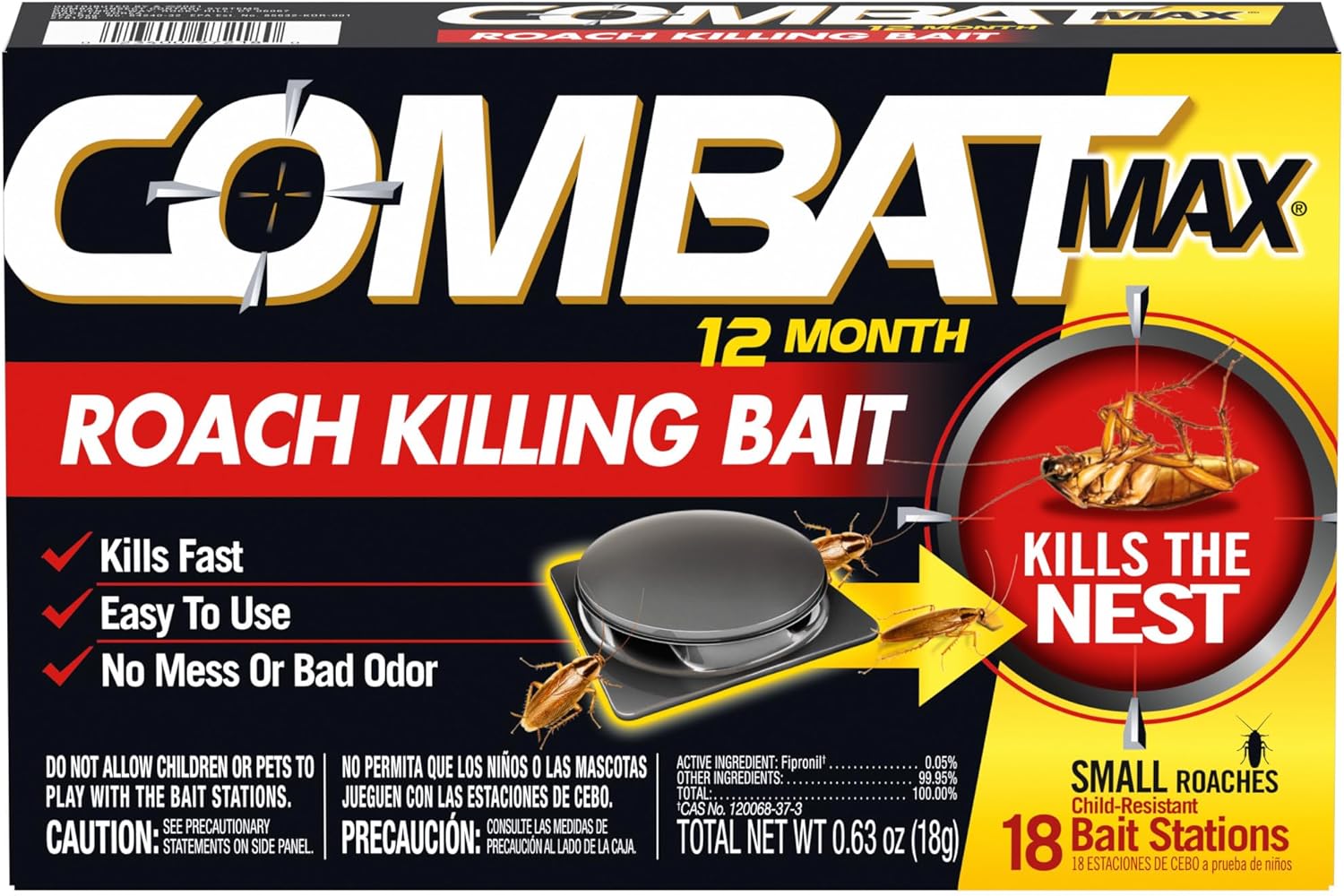
Combat Max 12 Month is the station most people should reach for when the budget matters more than the badge on the box. The active is fipronil, a fast working bait active that still allows enough delay for the roach to return to the harborage, and the eighteen count pack means you can place stations properly instead of rationing them.
Placement density is where this pack earns its keep. Professional guidance for baiting a kitchen involves many small placements rather than a few large ones, and a stingy pack of four forces the wrong approach. With eighteen stations you can put several under the sink, several behind and beneath the refrigerator and stove, and still have enough left for bathrooms and a laundry area.
The trade offs are physical rather than chemical. The stations are small, which is good for tight gaps and bad for retrieval, and the bait matrix eventually dries in very hot spaces, which shortens the practical service life below the headline twelve months. They are also designed around small roaches, so a home dealing mainly with large outdoor species should choose a station rated for them.
Bottom line: the best cost per placement in the category, and the pack to buy if you are baiting a whole home properly for the first time.
- Format: child resistant bait station
- Active ingredient: fipronil
- Count: eighteen stations
- Target: small roaches, including German roaches
- Service claim: up to twelve months
- Use sites: indoor and sheltered outdoor placements
The child resistant housing keeps the bait behind plastic, but the safest practice is still to place stations behind and beneath appliances rather than in an open pantry or on a countertop. Keep a written count so every station is recovered at the end of the program.
Wash your hands after handling stations, keep the unused ones in their packaging away from food storage, and follow the disposal instructions on the label. If a pet chews a station, contact your veterinarian rather than acting on general advice.
Buy this pack if your roaches are small, fast and mostly seen near the kitchen sink at night. Buy a large roach station instead if the insects are big, slow and turn up near drains, garages or crawl spaces.
Whatever you buy, do not spray insecticide near the stations. A pyrethroid residue on the same baseboard repels roaches from the bait and wastes the entire pack.

Pros
- Handles both small and large roach species
- Hydramethylnon at 2.0 percent works through the nest
- Child resistant housing
- No vapour, fumes or odour
- Simple drop and leave placement
Cons
- Only six stations in the pack
- Slower visible effect than contact products
- Large stations do not fit the tightest gaps
This Combat pack exists for the household that cannot tell which roach it has, or that has both. The bait uses hydramethylnon at 2.0 percent, a slow metabolic active that behaves the same way as other bait chemistries: the insect feeds, returns to the harborage, and exposes the rest of the group.
The practical advantage is the station geometry. Large American roaches physically struggle to enter stations designed around German roaches, so a pack built for both sizes removes a failure mode that most buyers never even diagnose. If your sightings are big insects near a floor drain, a garage door or a basement wall, this is the more appropriate station.
The count is the weak point. Six stations is enough for a kitchen or a basement, not for a whole home, so treat this as a targeted purchase for the rooms where large roaches appear rather than as a whole house program.
Bottom line: the right station when the insects are big, and a useful complement to a small roach pack when you have both problems at once.
- Format: child resistant bait station
- Active ingredient: hydramethylnon, 2.0 percent
- Count: six stations
- Target: small and large roaches
- Odour: none reported on the label
- Use sites: indoor placements near harborage
Place stations flat against a wall or cabinet edge in the rooms where the large roaches actually appear: near floor drains, water heaters, laundry standpipes, garage thresholds and basement corners. Large species are moisture driven, so follow the plumbing rather than the food.
Fix the moisture at the same time. A dripping trap or a damp crawl space will keep producing new arrivals no matter how good the bait is.
Aimed at homes with basements, garages, crawl spaces or older drain systems where the visitors are large outdoor roaches rather than a kitchen colony. It also suits anyone who wants one station that covers both possibilities without diagnosing the species first.
If every sighting is a small fast insect around the sink, a higher count small roach pack is the better buy.

Pros
- Liquid bait supplies the water roaches are seeking
- Dinotefuran at 0.05 percent acts quickly
- Pre filled stations, nothing to mix
- Effective where solid baits are ignored
- Bulk pack covers multiple rooms
Cons
- Reservoir empties faster than a solid bait
- Stations must sit level or they leak
- Less useful in already damp basements
Liquid bait is the format most homeowners overlook. Roaches need water more urgently than food, and in a dry, heated home in winter a liquid station can pull insects that walk straight past a solid bait. Hot Shot Ultra Liquid Roach Bait uses dinotefuran at 0.05 percent, a neonicotinoid active that works faster than the classic slow baits while still allowing the insect to move before it dies.
Because the attractant is water based, placement follows moisture logic: under the sink, near the dishwasher, behind the toilet and around the water heater. Buyers who report quick results almost always placed them in those spots rather than along a dry baseboard.
The limitation is the reservoir. Liquid runs out or evaporates sooner than a solid bait matrix, so you will replace these more often than a twelve month station, and a station tipped on an uneven surface can weep onto the floor. Plan for a shorter service interval and check them monthly.
Bottom line: a strong supporting player and sometimes the only bait that works in a very dry home, but not the one to leave in place and forget.
- Format: pre filled liquid bait station
- Active ingredient: dinotefuran, 0.05 percent
- Count: six stations per package
- Attractant: liquid, supplying water and food
- Use sites: indoor, near moisture sources
- Preparation required: none
Place stations on a flat, level surface within a short walk of a water source: the cabinet floor under a kitchen sink, behind the toilet pedestal, next to the dishwasher panel and beside the water heater pan. A tilted station wastes bait and can stain the surface underneath.
Reduce the competing water at the same time. Fix drips, dry the sink at night and empty pet bowls, and the bait becomes far more attractive by comparison.
Keep stations out of reach of children and pets and never place them on an open floor where a bowl or a toy sits. Wipe up any leaked liquid immediately and wash the surface.
Store spare stations sealed and away from food. Follow the label for disposal, and contact your veterinarian if an animal contacts the bait.

Pros
- No nerve poison chemistry involved
- One hundred percent diatomaceous earth with no fillers
- Stays effective indefinitely while it remains dry
- Works on roaches, ants, fleas and other crawling insects
- Usable indoors and outdoors
Cons
- Completely inactive once damp
- Slow, with contact death reported around forty eight hours
- Dust can be messy if over applied
Diatomaceous earth is the odd product in this category because it is not a poison at all. The powder is fossilised freshwater diatom silica, and it kills by abrading and drying out the waxy layer on an insect cuticle. Harris states that insects that contact or ingest the powder die within about forty eight hours, and that the product is one hundred percent diatomaceous earth with no fillers.
That mechanical action has two consequences. Insects cannot develop metabolic resistance to it the way they can to a repeatedly used pyrethroid, and the powder keeps working indefinitely as long as it stays dry. It is genuinely useful in wall voids, behind toe kicks, under a refrigerator and along the top plate of a basement wall.
The failure modes are equally mechanical. Damp powder does nothing. A thick visible line does almost nothing either, because roaches walk around obvious piles instead of through them. Apply a barely visible film with a duster and leave it undisturbed, and accept that this is a slow, background layer rather than a rapid fix.
Bottom line: the right choice for people who want to treat voids without a nerve poison, provided they can accept the pace and keep the application dry and thin.
- Format: ready to use dust
- Composition: one hundred percent freshwater diatomaceous earth
- Size: eight ounces
- Mode of action: mechanical desiccation
- Certification: EPA registered, OMRI listed
- Use sites: cracks, crevices, voids, indoor and outdoor
Use a bulb duster or a squeeze bottle rather than a spoon. Aim for a film so thin you can barely see it, into cracks, under the toe kick of cabinets, behind outlet covers with the power switched off, and along the void behind a dishwasher.
Reapply after any cleaning, plumbing work or water intrusion. Wet powder is spent powder, and a basement that floods once will need the treatment repeated.
Wear a dust mask while applying, because fine airborne dust is an irritant to the airways even though the material is not a nerve poison. Keep children and pets out of the room until the dust has settled.
Avoid applying near an air return or a running fan, which will distribute powder through the home instead of into the void where you want it.

Pros
- Deltamethrin at 0.05 percent kills on contact
- Waterproof formula tolerates damp locations
- Label claims up to eight months of protection
- Works on roaches, ants, spiders and other crawling insects
- Shaker container needs no separate applicator
Cons
- Contact active only, no transfer to the nest
- Not suitable for open living areas or food surfaces
- Over application repels insects instead of killing them
TERRO Ant Dust is the synthetic counterpart to diatomaceous earth. It carries deltamethrin at 0.05 percent, a pyrethroid that kills crawling insects on contact, and the formulation is waterproof, which is the property that matters most. A crawl space, a damp foundation crack or an outdoor void will neutralise a desiccant dust quickly while this one keeps working.
The label claims up to eight months of protection, and dust in an undisturbed void genuinely does last far longer than a sprayed surface. In practice it works best as a perimeter and void layer: the base of exterior walls, the gap behind the garage door frame, the void under a threshold, and the interior wall voids that connect a garage to a kitchen.
It is a contact product, so it does nothing to the nest by transfer. It also should not be treated as an interior surface treatment, since dust on an open floor near food preparation is both a label violation and pointless, and heavy application makes roaches route around the treated line.
Bottom line: the right dust for damp and outdoor voids, used alongside a bait rather than instead of one.
- Format: ready to use dust in a shaker container
- Active ingredient: deltamethrin, 0.05 percent
- Size: one pound
- Residual claim: up to eight months
- Water resistance: waterproof formula
- Use sites: cracks, crevices and voids, indoor and outdoor
Shake a light film into cracks and voids rather than onto open surfaces. The best targets are the exterior foundation band, expansion joints, the void behind a garage door frame, and utility penetrations where pipes and cables enter the wall.
Keep it away from bait stations. A pyrethroid dust near a bait placement repels roaches from the bait and undermines the part of your program that actually reaches the nest.
Wear a mask and gloves while applying, keep pets out of the treated area until the dust has settled into the void, and never apply to countertops, sinks or any food contact surface.
Store the container closed and out of reach. Follow the label for the specific sites permitted in your situation, since indoor and outdoor instructions differ.

Pros
- Cypermethrin at 25.3 percent before dilution
- One pint mixes into many gallons of finished solution
- Long residual on exterior surfaces
- Covers a wide range of crawling pests
- Cost per treated area is very low
Cons
- Requires a separate sprayer and protective equipment
- Must be measured and mixed correctly
- Repels roaches from indoor bait if misused inside
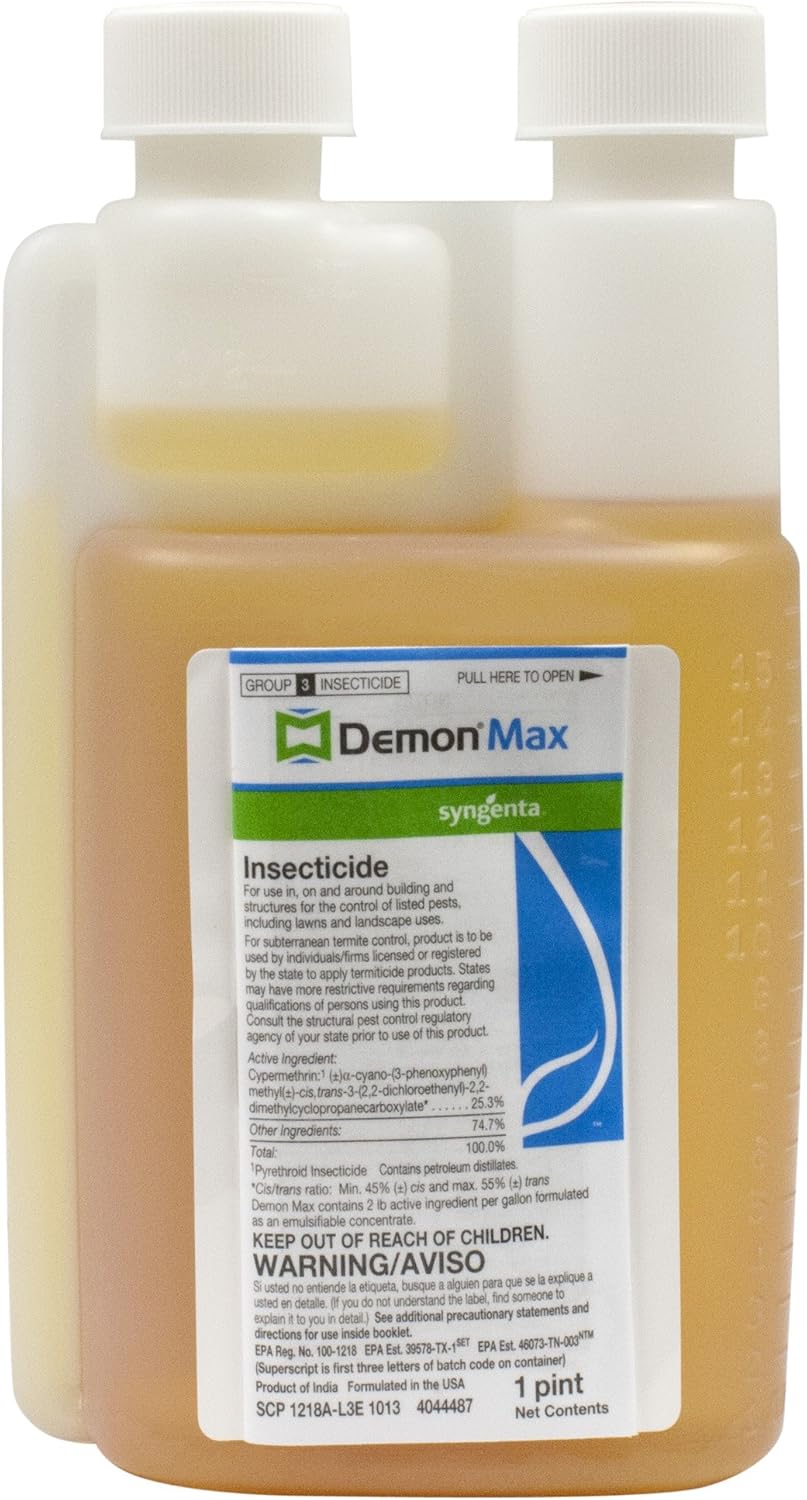
Demon Max is the product on this list that behaves least like a consumer purchase. It arrives as a concentrated liquid at 25.3 percent cypermethrin, and a single pint dilutes into a large volume of finished spray, which is why the cost per treated square foot is a fraction of any ready to use bottle.
Used correctly it is an exterior tool. A treated band along the foundation, around door thresholds, under siding edges and at every pipe and cable penetration intercepts roaches before they get inside, and the residue holds up on those surfaces for weeks. That is a genuinely different job from anything a bait station does.
Used incorrectly it causes the classic failure. Sprayed across an indoor kitchen it leaves a residue roaches will not cross, which fences them away from the bait you paid for and pushes them deeper into voids you cannot reach. It also demands measuring, a working pump sprayer, and the protective equipment the label specifies, which is more commitment than some buyers expect.
Bottom line: excellent value and genuinely effective for exterior perimeter work, and the wrong product for anyone who wants to point a bottle at a roach in the kitchen.
- Format: liquid concentrate for dilution
- Active ingredient: cypermethrin, 25.3 percent
- Size: one pint
- Equipment needed: pump or backpack sprayer
- Primary use: exterior perimeter and entry points
- Mode of action: contact and residual
Measure the dilution rate on the label for your target pest and site, mix only what you will use in one session, and agitate the sprayer as you work. Treat a band along the foundation, the door thresholds, the garage perimeter, window frames and every utility penetration.
Do not spray indoors over or near bait placements. Keep the interior for bait and dust, and let the concentrate do the outdoor work where its residual strength is an advantage.
Wear the protective equipment listed on the label when handling the concentrate, mix outdoors or in a well ventilated space, and keep children and pets away from treated surfaces until they are completely dry.
Never decant the concentrate into an unlabelled container, and store it locked away from living areas. Cypermethrin is toxic to fish, so keep the spray away from ponds and storm drains.

Pros
- Treats a whole enclosed space with no manual spraying
- Tetramethrin and cypermethrin knock down exposed insects
- Odour neutraliser reduces the lingering smell
- Three cans cover multiple rooms or repeat use
- Useful before moving into a vacant space
Cons
- Mist does not reach into wall voids where roaches live
- Requires people and pets to leave the building
- Preparation is significant: cover food, shut off ignition sources
Foggers have a poor reputation among professionals, and largely deserve it, but they do have one honest use case. When a garage, a storage unit or a vacant room is full of exposed insects and you want to clear the open population quickly before starting a bait program, a total release can does that in a couple of hours.
The chemistry is a pyrethroid pair, tetramethrin for rapid knockdown and cypermethrin for a short residual, plus an odour neutraliser that makes the aftermath less unpleasant than older cans. Each can is sized for an enclosed space of limited volume, which is why the three pack matters if you are treating more than one room.
The limitation is physical, not chemical. The mist settles on surfaces and does not penetrate wall voids, cabinet interiors or the appliance housings where roaches actually spend their day, so a fogger alone almost never resolves an infestation and can scatter a population into neighbouring rooms. The preparation burden is also real: people and pets out, food and dishes covered, pilot lights and ignition sources off, and a ventilation period afterwards.
Bottom line: a niche clearing tool for empty spaces, not a substitute for baiting, and a product where reading the label properly is not optional.
- Format: total release aerosol fogger
- Active ingredients: tetramethrin and cypermethrin
- Can size: two ounces
- Count: three cans
- Coverage: one enclosed room or space per can
- Extras: odour neutraliser in the formula
Follow the label sequence exactly. People, pets and plants leave the building. Food, dishes, utensils and food preparation surfaces are covered or removed. Pilot lights, stoves, water heaters and any ignition source are shut off, because the propellant is flammable.
Stay out for the full period stated on the label, then ventilate thoroughly before anyone returns. Never use more cans than the space calls for, which is the most common and most dangerous misuse of this format.
Reach for a fogger when a space is empty and the insect population is visible and exposed: a garage before organising it, a storage room, a vacant unit before a move in, or an outbuilding.
Skip it for an occupied kitchen with a nesting population behind the appliances. Bait and dust are both safer and far more effective in that situation.

Pros
- No insecticide involved at all
- Enclosed design hides the catch from view
- Lure draws roaches into the trap
- Safe to place where a spray would be unwelcome
- Simple to check and replace
Cons
- Catches individuals, never solves an infestation
- Glue loses tack in dust or humidity
- Only two traps per package
The Roach Motel is a monitoring device that people mistake for a control product. Inside the cardboard shell is a glue floor and a lure, and roaches that enter do not leave. Because the catch is hidden, it is far more tolerable in a living space than an open glue board.
Its real value is information. Placing a couple of these in the rooms where you have seen activity tells you which corner is the hot spot, roughly how large the population is, and whether your bait program is actually reducing numbers week over week. That feedback is what stops people from either giving up too early or reapplying products that are already working.
What it will not do is clear an infestation. A trap catches only the insects that happen to walk into it, which is a small fraction of a population, and never the ones still inside the wall void. Dusty floors and humid bathrooms also reduce the tack of the glue faster than most buyers expect.
Bottom line: buy it as a measuring instrument to run alongside bait, not as the thing that solves the problem.
- Format: enclosed glue trap
- Active ingredient: none, adhesive and lure only
- Count: two traps
- Placement: indoor, along walls and in corners
- Function: capture and monitoring
- Replacement: when the glue is loaded or dusty
Set traps flat against a wall, in a corner, or in the gap beside an appliance, since roaches travel along edges rather than across open floor. Number each trap and note where it sits.
Check them weekly and write down the catch. A falling count means the bait is working. A steady or rising count means the placement, the sanitation or the bait itself needs attention.
Ideal for households that want visible evidence of progress, renters who need to document a problem for a landlord, and anyone treating a kitchen where an insecticide near food surfaces is unwelcome.
Not the right purchase for someone expecting two traps to clear an active infestation on their own.

Pros
- Very high count for whole home monitoring
- No insecticide, safe to place in food areas
- Flat boards fit into narrow gaps
- Also catches spiders, crickets and mice
- Folds into a tunnel to reduce accidental contact
Cons
- Open glue is unpleasant to look at and to handle
- Loses tack quickly in dusty or greasy areas
- Catches insects but does nothing to the nest
Catchmaster glue boards are the workhorse monitoring tool that pest professionals put down first, and the thirty six pack is the reason they appear on this list. Monitoring only works when you have enough boards to cover every room, doorway and appliance gap at once, and a pack of two never allows that.
The boards can be laid flat under an appliance or folded into a tunnel shape, which keeps fingers, pet noses and dust off the adhesive while still leaving the entrances open to insects. Because there is no insecticide involved, they can go in a pantry, beside a bin or under a sink without any label conflict.
They are still traps, with all the limits that implies. A board catches what crosses it and nothing else, so the count is a signal rather than a solution. Greasy kitchen air and dusty garages both shorten the working life of the adhesive, and handling a loaded board is genuinely unpleasant, so plan on gloves and a bin bag.
Bottom line: the cheapest way to see what is really happening in your home, and the data layer that makes every other product on this page easier to aim.
- Format: adhesive glue board
- Active ingredient: none
- Count: thirty six traps
- Configuration: flat or folded into a tunnel
- Targets: roaches, spiders, crickets, mice and other crawling pests
- Use sites: indoor, along walls and under appliances
Place boards against walls, in cabinet corners, behind the toilet, under the refrigerator and beside the stove, then map them on a sheet of paper. Roaches follow edges, so a board in the middle of a floor is close to wasted.
Check weekly, record the count for each location, and replace boards that are loaded or coated in dust. The map plus the counts tells you exactly where to concentrate bait next.
Fold boards into the tunnel configuration in any room with pets or small children so that the adhesive is not exposed. Vegetable oil releases skin, fur or a paw from the glue if there is an accident.
Wear gloves when removing loaded boards, seal them in a bag before disposal, and keep unused boards in their packaging so they stay clean and tacky.
How to Choose the Right Cockroach Killers
Almost every disappointing roach product story comes down to the same thing: the right chemistry used in the wrong format, or the right format used in the wrong place. Work through the criteria below before you buy, and the shortlist above narrows itself down to one or two obvious answers.
Match the Product Type to the Size of the Problem
Start by classifying what you are dealing with. Seeing one or two roaches at night in a kitchen usually means a small, young population living within a few feet of the sink or the stove. That is bait territory, because a bait station lets the roaches carry the active ingredient back to a harborage you cannot reach. Seeing roaches in daylight, in multiple rooms, or in the middle of a floor usually means the population has outgrown its hiding places, and that calls for a combination approach: bait for the nest, dust for the voids, and traps to tell you whether the numbers are dropping.
The table below is the short version of the whole category. It is worth reading twice, because choosing the wrong row is the most expensive mistake in roach control.
| Format | Best for | Speed | Reaches the nest | Main limitation |
|---|---|---|---|---|
| Enclosed bait station | Small to medium indoor populations | Days to weeks | Yes, through secondary transfer | Needs correct placement, not a quick visual fix |
| Liquid bait station | Dry homes and heated buildings where roaches need water | Hours to days | Yes | Liquid runs out faster than solid bait |
| Insecticide or desiccant dust | Wall voids, under appliances, behind outlets | Days | Indirectly, by treating harborage | Useless once damp or applied too thickly |
| Sprayable concentrate | Exterior perimeters and entry points | Hours | No | Repels roaches away from bait if sprayed indoors carelessly |
| Total release fogger | Empty rooms, garages, storage units | Hours | No | Mist does not enter the voids where roaches live |
| Glue trap or motel | Monitoring, confirming species and hot spots | Immediate as a signal | No | Catches individuals, never solves an infestation alone |
Know the Active Ingredient and How Fast It Works
Bait actives are deliberately slow. Indoxacarb, the active in the Advion arenas at 0.5 percent, and fipronil, the active in Combat Max 12 Month stations, are designed to let a roach eat, walk back to the harborage, and die there, where other roaches feed on the carcass and the droppings. That secondary transfer is the entire point of baiting, and it is why a bait that killed on contact instantly would perform worse. Hydramethylnon, used at 2.0 percent in the Combat stations for small and large roaches, works the same slow way through the insect metabolism.
Contact actives are the opposite. Cypermethrin, the pyrethroid in Demon Max concentrate at 25.3 percent before dilution and in Hot Shot fogger cans at a small fraction of a percent, drops exposed insects quickly but leaves nothing useful behind in the nest. Deltamethrin at 0.05 percent in TERRO Ant Dust sits between the two: it is a contact active, but as a dust in a wall void it stays in place for months and keeps working on roaches that walk through it. Diatomaceous earth is not a nerve poison at all. It is a mechanical desiccant, and Harris states that insects that contact or ingest it die within about forty eight hours.
No product on this page, or any page, eliminates every roach in a structure by itself. Treat claims of total elimination as marketing and judge products on whether the numbers you catch on monitors fall week over week.
Placement Beats Quantity
A dozen bait stations lined up along a baseboard in the open will underperform four stations tucked into the corners roaches actually use: inside the sink cabinet near the plumbing penetration, behind the refrigerator at the motor housing, in the upper corner of an upper cabinet, and under the lip of the stove. Roaches travel along edges and prefer tight, warm, dark spaces near moisture, so every station should touch two surfaces where possible.
The same discipline applies to dust. A light film in a void does more than a visible pile, because roaches avoid crossing thick powder. Apply dust with a duster or a squeeze bottle into cracks, outlet boxes with the power off, and the gap under cabinet toe kicks, then leave it alone. For a deeper look at powder style products and how bait powders differ from mechanical dusts, see our guide to the best boric acid for roaches.
Do Not Spray Over Your Own Bait
This is the single most common self inflicted failure in do it yourself roach control. Pyrethroid residues are irritating to roaches, so a freshly sprayed baseboard becomes a wall the roaches walk around. Spray the same area where you placed bait and you have effectively fenced the roaches away from the food you wanted them to eat, and you have also contaminated the bait surface so that they refuse it.
The workable division of labor is simple. Bait and dust go inside, in the voids and cabinets. Concentrate sprays go outside, on the foundation band, around utility penetrations, under the deck, and along the garage door threshold. If you want a ready to use indoor formula for entry points rather than a mixable concentrate, our roundup of the best roach spray for home compares those bottles directly.
Safety Around Children and Pets
Child resistant bait stations exist for a reason: the bait matrix is engineered to smell like food. Combat markets its stations as child resistant, and enclosed arenas keep the bait behind plastic rather than exposed on a surface. Even so, place stations behind and under appliances rather than in an open pantry, and count them when you place them so you can retrieve every one later.
Dusts and concentrates need more caution. Keep pets out of the room while dust is airborne, wear a mask when puffing powder into voids, and follow the label for personal protective equipment when mixing a concentrate. Foggers deserve the most respect of anything on this list: the label requires people and pets to leave, food and dishes to be covered, and pilot lights and ignition sources to be shut off before you set one off. Read the label rather than the box art, and treat the label as the legal instruction it is.
Residual Life and Follow Up

Roach eggs are protected inside an ootheca that most sprays and dusts cannot penetrate, so a single treatment that looks like a total success on day three often falls apart around week three when a new generation hatches. Plan on a second round. Bait stations with long service claims, such as the twelve month rating on Combat Max, reduce the amount of follow up you have to remember, while liquid bait reservoirs and fogger residues run out much sooner.
Professionals also rotate insect growth regulators into the program, which sterilize adults and prevent nymphs from maturing. None of the products on this shortlist is a standalone growth regulator, but the concept is worth knowing if you are still catching roaches after two full bait cycles. Monitoring traps make that decision for you: keep a few glue boards down permanently and let the catch count tell you whether to reapply or call a professional. More seasonal home and yard guides live in our patio, lawn and garden section.
Why You Should Trust Us
We build these shortlists from live Amazon listing data rather than from press releases. Every product here was pulled from current catalog data, filtered for a customer rating of at least four stars and a substantial volume of verified customer feedback, and then scored with the same model we use across the site so that the ranking is consistent from one guide to the next.
On top of that data layer we read the manufacturer labels and public product pages to confirm active ingredients and concentrations, and we deliberately exclude products that duplicate a format we have already covered elsewhere so that this page stays a comparison of formats rather than a list of ten variations on one syringe. We do not claim laboratory work or hands on trials, and we do not give medical or veterinary advice. When a label and a marketing claim disagree, we follow the label.
Final Thoughts
For most households the best overall answer is the Advion Cockroach Bait Arena. It puts a professional grade indoxacarb bait inside a sealed station you can slide behind an appliance in seconds, it needs no mixing or protective gear, and it attacks the population at the harborage instead of on the floor tile. Buy it if you want one product that does the heavy lifting.
The best value pick is the Combat Max 12 Month Small Roach Bait Station set. The fipronil bait is genuinely effective on German roaches, the count in the box is high enough to cover a kitchen and two bathrooms properly, and the stations are child resistant. If your roaches are the large outdoor type that wander in from a crawl space or a drain, step over to the Combat stations rated for small and large roaches, which use hydramethylnon and are physically sized for bigger insects.
Round out the program by matching the tool to the location. Harris Diatomaceous Earth or TERRO Ant Dust for voids and under appliances, Syngenta Demon Max mixed in a pump sprayer for the exterior perimeter only, Hot Shot Ultra Liquid Roach Bait where a dry kitchen has roaches hunting for water, a Hot Shot fogger reserved for an empty garage or storage room, and Black Flag Roach Motels plus Catchmaster glue boards as the monitors that tell you whether any of it is working. More buying guides in this series are collected in our articles archive.
Frequently Asked Questions
How long do cockroach killers take to work in 2026?
It depends entirely on the format. Contact sprays and fogger mists drop the insects they touch within minutes to hours. Bait stations are slower by design and usually show a visible drop in activity within a few days to two weeks, with the full effect on the nest arriving later as the active ingredient passes through the population. Dusts sit somewhere in the middle, killing over roughly two days of contact. If nothing has changed after three weeks of correctly placed bait, the problem is normally placement, competing food sources, or a spray residue keeping roaches away from the bait.
Can I use bait stations and spray at the same time?
Yes, but not in the same square foot. Keep bait inside the structure and keep pyrethroid sprays such as diluted Demon Max on the exterior perimeter and entry points. Spraying over or near a bait station repels roaches from the bait and can contaminate it, which is why so many combined efforts stall. If you have already sprayed indoors, wait for the surface to dry fully and place new bait in untreated locations such as inside cabinet corners and behind appliance panels.
Are cockroach killers safe around cats and dogs?
Enclosed, child resistant bait stations placed out of reach are the lowest risk option in this category for a home with animals, because the active ingredient stays behind plastic. Loose dust and mixed concentrates require more care, and foggers require the animals to be out of the building entirely. Every product here carries label instructions covering pets, and those instructions are the authority. If an animal contacts a pesticide product, contact your veterinarian rather than relying on general web guidance.
Do glue traps actually reduce a roach population?
Not meaningfully on their own. A glue board or a roach motel catches whatever walks across it, which is a fraction of the population and never the ones still inside the wall. Their real value is diagnostic: they confirm which species you have, they show which room and which corner is the hot spot so you can aim bait correctly, and the weekly catch count is the cleanest evidence you have that a treatment is working. Keep them down permanently and log what they catch.
Is boric acid still worth using alongside these products?
Boric acid remains one of the cheapest effective options for dry, undisturbed voids, and it is a reasonable partner to a modern bait program as long as you keep it out of the areas where you placed gel or station bait. It is slow, it must stay dry, and a thick application is worse than a light one. We compare the powder, tablet and liquid forms in our guide to the best boric acid for roaches.
When should I stop and call a professional?
Call a licensed operator if you see roaches in daylight in multiple rooms, if you live in a multi unit building where neighbours are also affected, or if two complete cycles of correctly placed bait have not reduced the catch on your monitors. Shared walls and shared plumbing chases make single unit treatment close to impossible, and a professional can treat the whole structure and use restricted products, including growth regulators, that are not sold for consumer use.

Write Your Review
No reviews yet. Be the first to share your experience!