

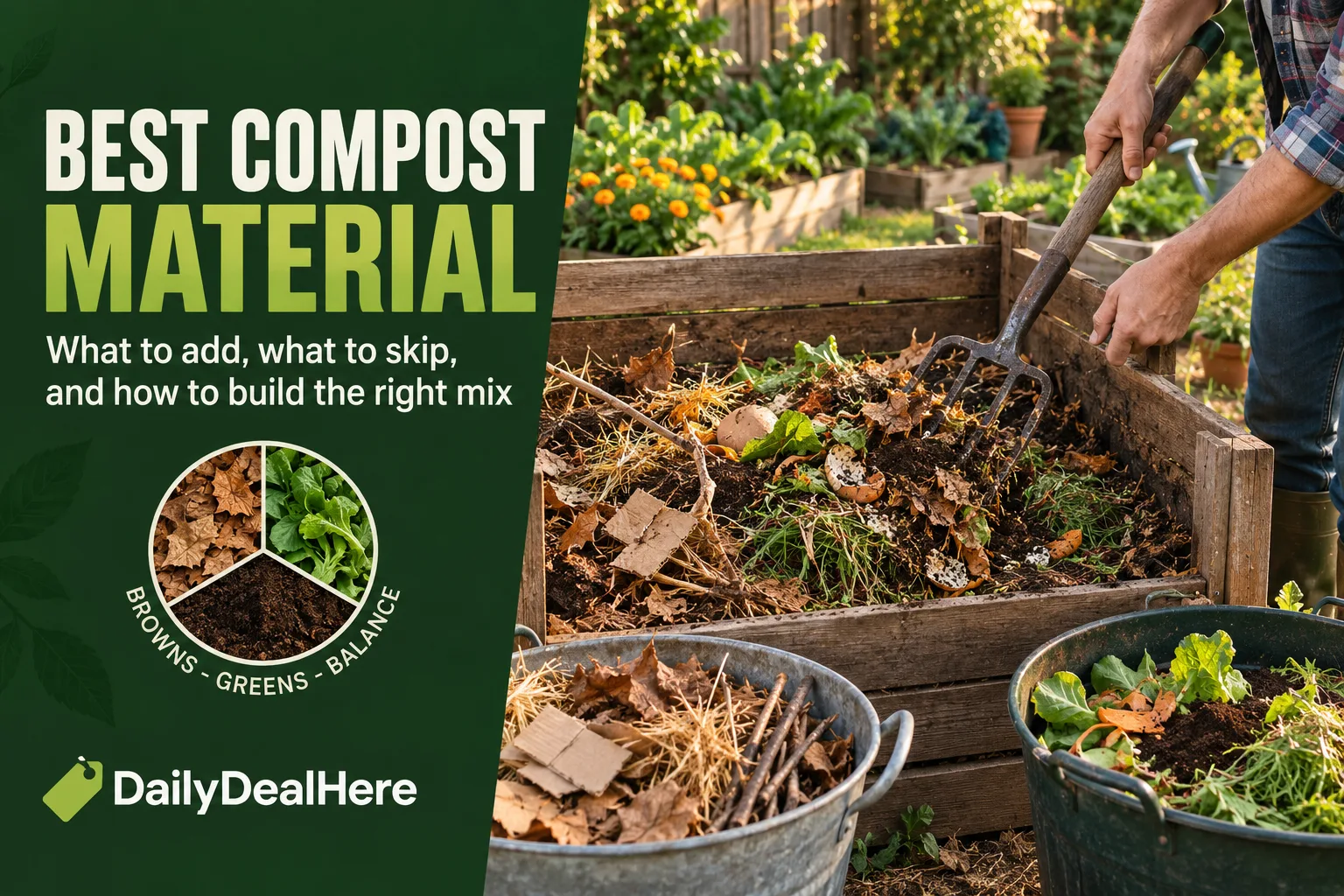
The best compost material is not a single ingredient. It is a mix of dry, carbon heavy “browns” such as fallen leaves, straw and shredded cardboard with wet, nitrogen heavy “greens” such as vegetable scraps, coffee grounds and fresh grass clippings, kept about as damp as a wrung-out sponge and given enough air. Get that pairing roughly right and almost any garden or kitchen waste breaks down. Get it wrong and even the finest ingredients turn into a slimy, smelly heap or a dry pile that sits unchanged for a year.
This guide goes through which browns and greens work best and why, how much of each to use, what the published carbon to nitrogen figures actually say, which materials to keep out of a backyard pile, where the expert sources disagree, and how to tell when the result is ready to use. The numbers come from three public sources we read in full: the EPA home composting page, the Penn State Extension guide for home gardeners, and the “Getting the Right Mix” chapter of Cornell’s Composting in the Classroom.
The short answer
If you only remember one thing, remember the pairing. A pile of nothing but food scraps is too wet and too rich, and it rots instead of composting. A pile of nothing but dry leaves is too lean and too dry, and it barely changes. Combine them and the microorganisms that do the actual work have both the energy and the protein they need, plus the right amount of water and air.
- Best browns for most yards: dry autumn leaves, straw, shredded plain cardboard and brown paper bags, and small amounts of sawdust or wood chips.
- Best greens for most kitchens: fruit and vegetable scraps, coffee grounds and paper filters, paper tea bags without staples, and fresh grass clippings in thin layers.
- The working proportion: the EPA suggests at least two to three times as much brown as green by volume.
- The moisture target: damp all the way through, like a wrung-out sponge, with only a drop or two squeezing out.
- What to leave out of a backyard pile: meat, fish, bones, dairy, fats and oils, pet waste, diseased plants, weeds carrying seed, and treated or painted wood.
Everything below is detail on those five lines. The detail matters, because most failed piles fail on proportion or moisture rather than on any single bad ingredient.
The four things every compost pile needs
The EPA lists four ingredients for backyard composting, in a proper balance: carbon rich browns, nitrogen rich greens, water and air. Each one has a job.
- Browns supply carbon, which the microorganisms burn for energy. They also add structure, holding the pile open so air can move through it.
- Greens supply nitrogen, which the microorganisms need to grow and multiply. Greens are usually wet, so they also carry much of the pile’s moisture.
- Water lets the microorganisms live and move. Too little and they go dormant. Too much and water fills the air spaces.
- Air keeps the process aerobic. Without oxygen, a different set of organisms takes over, decomposition slows, and the pile starts to smell.
When people ask for the best compost material, what they usually need is the best brown to go with the greens they already produce. A household with a lot of kitchen waste is short on carbon almost by definition. A household with a big yard and a small kitchen often has the opposite problem each autumn, when leaves pile up with nothing wet to balance them.
The best brown materials
Browns are dry, often literally brown, and high in carbon. The EPA list covers dry leaves, plant stalks and twigs, shredded paper that is not glossy or colored, shredded brown bags, shredded cardboard without wax coating, tape or glue, and untreated wood chips. Penn State adds straw, sawdust, clipped brush, dead weeds, wood ash and eggshells. The Cornell chapter gives typical carbon to nitrogen ranges for several of these, and it notes that its figures are representative ranges rather than universal values.
| Brown material | Typical C:N (Cornell) | How it behaves in a home pile |
|---|---|---|
| Autumn leaves | 40-80:1 | The closest thing to an ideal brown. Shred them first so they do not mat. |
| Straw | 50-150:1 | Slow to break down whole. Chopped, it helps keep the pile airy. |
| Mixed paper | 100-200:1 | Useful for kitchen composters. Shred it, and skip glossy or colored paper. |
| Newspaper | 400-900:1 | Very lean. Use it as a supplement, not the main brown. |
| Corrugated cardboard | 600:1 | Plentiful in most homes. Tear or shred it, and remove tape and labels. |
| Sawdust | 200-750:1 | Excellent for covering food scraps. Only from untreated wood. |
| Hardwood chips or shavings | 450-800:1 | Slow. Better as a bulking agent or path mulch than as the main brown. |
| Softwood chips or shavings | 200-1,300:1 | Widest range of all. Slow unless finely chipped. |
Read that table as a ranking of how much carbon each material brings per unit of nitrogen. Leaves sit at the low end of the brown range, which is exactly why gardeners have relied on them for generations. They bring plenty of carbon without swamping the pile, and they arrive every year for nothing. Cardboard and newspaper sit at the far end. They are fine in moderation, but a pile that leans on them for all of its carbon will need a lot of greens to keep up.
Wood is the special case. Cornell notes that woody material such as chips, branches and twigs can take up to two years to break down unless it is finely chipped or shredded. That does not make it useless. Chunky wood holds the pile open and lets air in, which is a real benefit in a pile full of soft kitchen waste. It just means wood should be a minority ingredient in a pile you want finished this season.
The best green materials
Greens are wet, often literally green, and higher in nitrogen. The EPA list covers fruit and vegetable scraps, grass clippings, coffee grounds and paper filters, paper tea bags without staples, and crushed eggshells. Penn State adds manure, while also telling readers to check local codes because some areas prohibit raw animal manure in a compost pile. Cornell’s table gives these typical ranges.
| Green material | Typical C:N (Cornell) | How it behaves in a home pile |
|---|---|---|
| Vegetable scraps | 10-20:1 | The backbone of most kitchen composting. Very wet, so pair with plenty of browns. |
| Fruit wastes | 20-50:1 | Soft and wet. Bury them under browns so they do not draw flies. |
| Coffee grounds | 20:1 | Fine textured and easy to mix. Paper filters can go in with them. |
| Grass clippings | 10-25:1 | Powerful but tricky. Add thin layers or let them dry first. |
| Horse manure | 20-50:1 | Check local and county rules first, since some areas prohibit raw manure in compost. |
| Cottonseed meal | 10:1 | Very rich in nitrogen, so a little goes a long way in a carbon heavy pile. |
Grass clippings deserve a warning of their own. Cornell puts their typical moisture at around 80 percent by weight, and the chapter explains that this is why a pile of fresh clippings turns into a slimy mess unless it is mixed with something drier such as leaves or wood chips. Penn State also points out that clippings can simply be left on the lawn to break down, which removes the problem entirely. If you do compost them, spread them thin and mix them in rather than dumping a whole bag in one layer.
Coffee grounds are the green most people underrate. They arrive already finely ground, so they mix evenly without chopping, and both the EPA and Penn State list them as a green alongside paper filters or tea bags. They behave like any other green, though, so they still need browns to balance them.
How much brown to add for every bucket of green
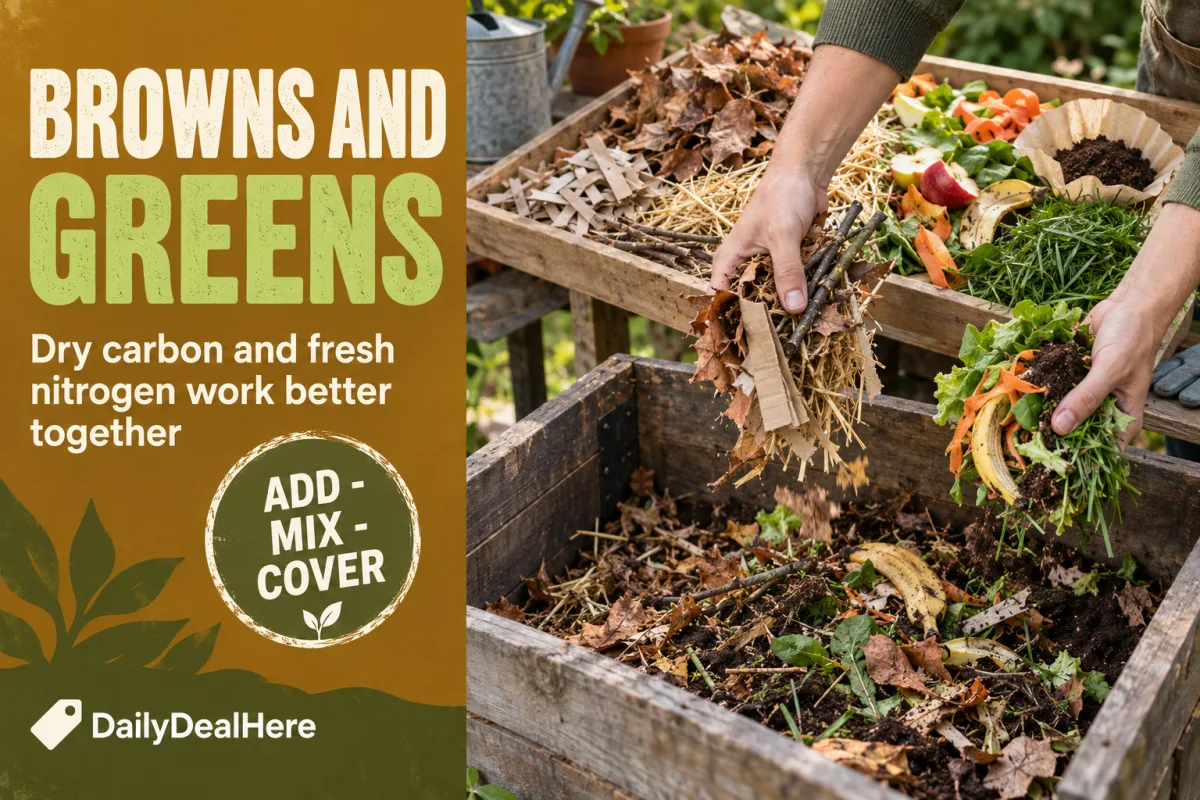
The EPA gives the simplest rule: add at least two to three times the volume of browns, such as dry leaves, to the volume of greens, such as food scraps. By volume is the key phrase. Browns are fluffy and light, greens are dense and wet, so a proportion that looks lopsided in the bucket is roughly balanced in chemical terms.
A practical way to apply it at home is to keep a bin or bag of shredded leaves or cardboard next to the pile. Every time a kitchen caddy goes in, two or three caddies worth of browns go in with it. The EPA also recommends always covering food scraps with four to eight inches of dry leaves or other browns, which handles both the proportion and the smell in one step.
Treat the ratio as a starting point, not a law. Leaves vary, food scraps vary, and the weather changes how wet everything is. The pile itself will tell you whether the mix is right, as the troubleshooting section below explains.
What the carbon to nitrogen ratio actually means
The carbon to nitrogen ratio, written C:N, is simply how many parts of carbon a material contains for each part of nitrogen. Penn State gives the preferred range for the whole pile as 25 to 30 parts carbon to 1 part nitrogen. Cornell aims for roughly 30:1. Neither source expects home gardeners to measure it. The point of knowing the figure is to understand why the brown and green rule works.
Penn State explains the tradeoff clearly. A pile with a lower ratio, meaning more green material, decomposes faster, but much of the nitrogen is lost more quickly and has to be replenished. A pile with too much brown material decomposes slowly. The target range is the compromise between speed and keeping the nitrogen you are trying to return to the soil.
Cornell works through one example that makes the idea concrete. It assumes grass clippings at about 19:1 and leaves at about 67:1, based on stated carbon and nitrogen contents, and calculates that 10 kilograms of clippings need about 3.5 kilograms of leaves to bring the mix to 30:1. By weight that is roughly one part leaves to three parts grass. Because leaves are so much lighter and fluffier than wet clippings, the same mix looks far more brown than green in a bucket, which is the logic behind the volume rule.
For anyone who wants to be exact, the Cornell chapter includes the full algebra, written by Tom Richard and Nancy Trautmann, for calculating a mix from the carbon, nitrogen and moisture content of each ingredient. It is designed for classrooms and larger systems, and it is worth a look if you compost in volume.
Not all tree leaves are equal
Leaves are the classic brown, but Cornell’s chapter shows that their carbon to nitrogen ratio varies a lot by species. Its table, drawn from a 1968 book on soil animals, lists alder leaves at about 15:1, ash at 21:1 and elm at 28:1, which puts them closer to a green than a brown. Maple comes in at 52:1, oak at 47:1, red oak at 53:1 and birch at 50:1. Conifer needles and leaves sit higher still, with pine at 66:1, Douglas fir at 77:1 and larch at 113:1.
In practice this means two things. First, a yard full of ash or elm leaves can compost faster and with fewer greens than a yard full of oak. Second, a pile made mostly of pine needles will be slow unless it gets a generous supply of greens. Neither is a problem once you know it. It simply explains why two neighbors following the same recipe can get very different results.
Moisture: the wrung-out sponge rule
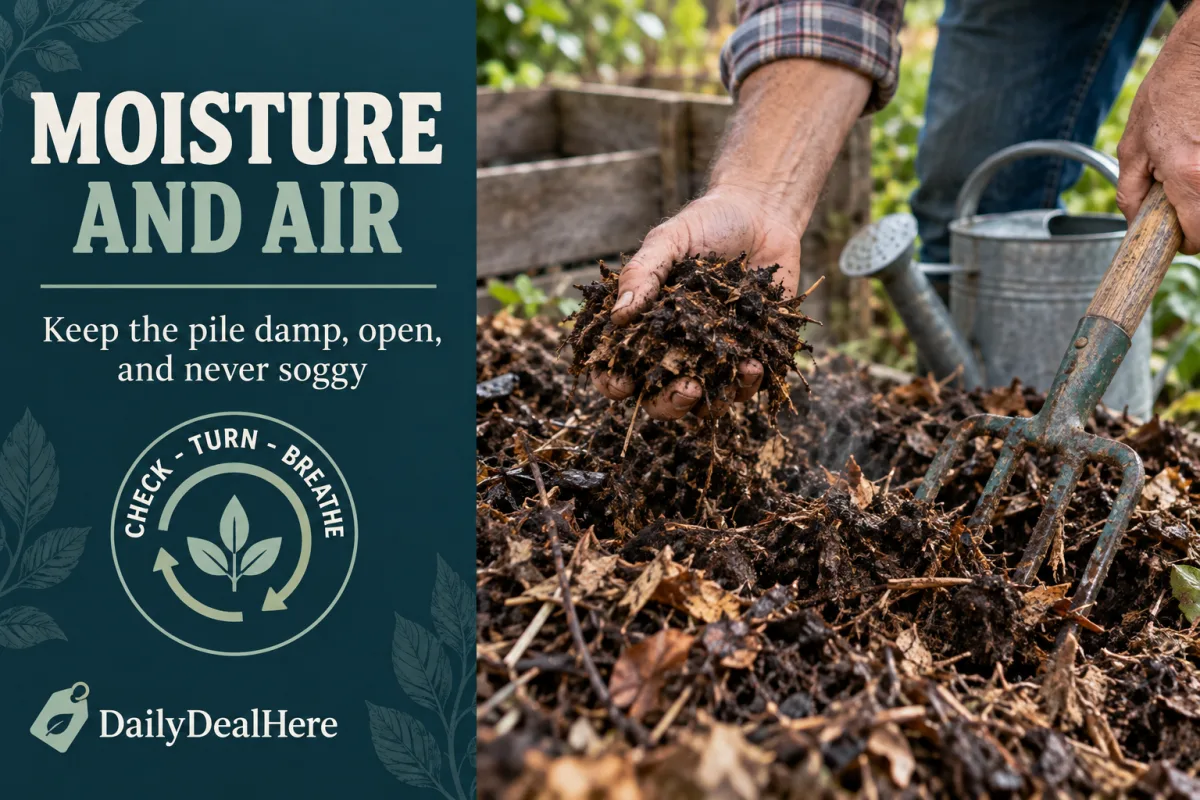
All three sources use the same image for moisture. The EPA and Cornell both describe the right texture as a wrung-out sponge, and Cornell adds that only a drop or two should come out when you squeeze a handful. Penn State says the pile should feel moist like a damp rag. Cornell puts the target at 50 to 60 percent moisture by weight.
Cornell also lists typical moisture levels for common ingredients: vegetables and fruit at 80 to 90 percent, grass clippings at about 80 percent, leaves and sawdust at about 40 percent, and shrub trimmings at about 15 percent. Once you see those numbers, the brown and green rule starts to look like a moisture rule as much as a nitrogen rule. Wet greens and dry browns average out to a damp pile.
The Cornell chapter works through an example that shows why moisture often matters more than the ratio. Balancing ten units of wet grass clippings for moisture alone takes nearly seven units of leaves by weight, while balancing the same clippings for carbon and nitrogen alone takes only about three and a half. The chapter’s conclusion is that when a mix is on the wet side, moisture is the more critical variable, so it is better to err toward extra browns. That may slow things down slightly, but it is more likely to keep the pile from going anaerobic. When a mix is dry, the advice flips: balance carbon and nitrogen and simply add water.
Penn State’s field check is refreshingly simple. Push your arm into the pile and squeeze material from several depths. If it is drying out, add water and turn the pile so the water reaches everything.
Materials to keep out of a backyard pile
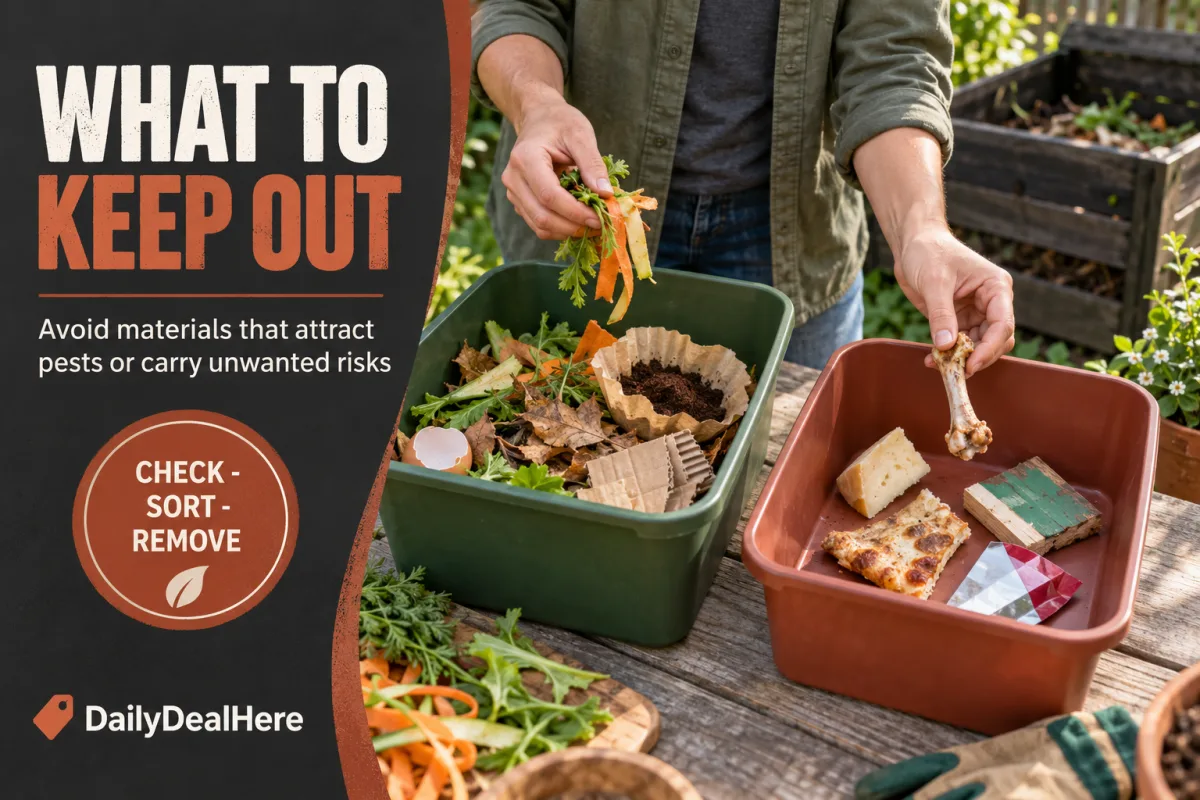
Almost any natural organic material will eventually compost, as Cornell notes, but not everything belongs in a home pile. The EPA marks two reasons on its list. Some foods attract animals, and some materials need higher temperatures than a backyard pile generally reaches to decompose fully, which is why commercial composting facilities can take several of them. The EPA adds that you should check first that your local facility accepts them. For the rest of the list, the sources simply say to leave them out.
| Keep out | Main reason given | Better destination |
|---|---|---|
| Meat, fish and bones | Attract animals, and home piles rarely get hot enough (EPA) | A commercial food waste program if your area has one |
| Cheese and other dairy | Attract animals, and home piles rarely get hot enough (EPA) | A commercial food waste program |
| Fats, oils and grease | Attract animals (EPA), and can cause odors (Penn State) | Trash or a local grease collection |
| Pet waste and cat litter | Cat and dog manure may carry pathogens not killed in composting (Cornell) | Trash, following local guidance |
| Diseased or pest infested plants | Listed to avoid by both the EPA and Penn State | Trash or yard waste collection |
| Weeds with seeds or spreading roots | Seeds and runners may survive the process (Cornell) | Yard waste collection |
| Treated or painted wood | Listed to avoid by the EPA | Trash |
| Plants treated with herbicide | Listed to avoid by the EPA | Leave on the lawn or use yard waste pickup |
| Glossy paper, produce stickers, dryer lint | Listed by the EPA as items to avoid | Recycling or trash |
| Compostable plates, cups and bags | Need commercial temperatures (EPA) | A commercial facility that accepts them |
Cooked food sits in a gray zone. The EPA lists it among items to avoid but notes that small amounts are fine. The practical line is grease and meat. Plain cooked rice, pasta or vegetables in modest quantities, buried well under browns, are unlikely to cause trouble. A pan of leftover stew with meat and fat is a different matter.
Where the expert sources disagree
Reading the three sources side by side turns up a few differences worth knowing about, mostly in how materials are classified rather than whether they belong at all.
- Eggshells. The EPA lists crushed eggshells as a green. Penn State lists eggshells as a brown. Either way they are a minor ingredient, slow to break down, and best crushed before they go in.
- Wood ash. Penn State includes wood ash as a brown. The EPA home composting page does not list it either way.
- Manure. Penn State lists manure as a green but also tells readers to check local and county codes, because some areas prohibit raw animal manure in compost piles. Pet and human waste are excluded by all three sources.
- Cooked food. The EPA allows small amounts. Penn State’s exclusion list names meat, bones, cheese, salad dressing, oils and other fats rather than cooked food as a whole.
None of these differences change the main advice. They are useful mainly as a reminder that composting guidance is a set of practical rules of thumb, not a precise specification, and that local regulations can override general advice.
Slow materials and how to use them
Cornell names a group of materials that break down slowly: wood chips, branches and twigs, corn cobs and stalks, sawdust, straw and nut shells. The chapter’s advice is not to avoid them but to shred or chip them, at which point they work well as bulking agents that increase airflow through the pile.
That is a useful way to think about the best compost material for a heavy, wet pile. If your kitchen produces a steady stream of soft scraps, a share of chunky, slow material stops the pile from compacting into a dense mass. You can even screen out the pieces that have not broken down when the batch is finished and toss them back into the next pile, where they carry some of the useful microorganisms with them.
The limit is proportion. A pile that is mostly slow material will simply be slow. Use these ingredients as a minority component, a few inches mixed through, rather than as the main source of carbon.
Weeds worth keeping out
Weeds are green plant material and can compost perfectly well, but some come back to haunt you. Cornell advises that if you plan to use the compost for growing plants, you should avoid pernicious weeds because their seeds or runners may survive the process. Its examples are bindweed, comfrey, and grasses that spread by rhizomes such as Bermuda grass and crabgrass. Penn State similarly excludes weeds that can grow from root or stem cuttings, and the EPA advises against aggressive weeds and weeds with seeds.
The reason is temperature. A well built pile can get hot enough to reduce weed seeds, and the EPA says a backyard pile can reach 130 to 160 degrees Fahrenheit, with high temperatures helping reduce pathogens and weed seeds. The trouble is that the edges and the top of a home pile rarely get that hot, and a single surviving runner can reestablish itself wherever the compost goes. Young weeds pulled before they set seed are generally safe. Mature, seeding or spreading weeds are better sent to yard waste collection.
Prepare the materials before they go in
Penn State is direct on this point: all material added to the compost pile should be shredded, because microorganisms work faster when pieces are smaller. Smaller pieces mean more surface area for the organisms to work on, and they pack together in a way that holds moisture evenly.
- Leaves: run a mower over them a few times, or use a leaf vacuum that mulches as it collects. Whole leaves mat into waterproof layers.
- Cardboard and paper: tear into strips, or use an ordinary paper shredder for plain paper and thin card. Remove tape, labels and staples.
- Kitchen scraps: chop large items such as melon rinds, cabbage cores and corn cobs.
- Stems and prunings: cut to short lengths or chip them.
- Wet leaves and clippings: Penn State recommends letting them dry first so they do not clump when added.
Preparation is also the easiest way to make a mediocre material into a good one. Straw and cardboard both perform far better shredded than whole, and the extra five minutes can save weeks of waiting.
Building the pile
Size matters because heat matters. Penn State uses a pile about 3 feet tall, 3 feet wide and 3 feet deep as its reference point for reaching 140 to 160 degrees Fahrenheit, a temperature at which the surface of the pile feels hot. It warns that a pile that is too small cannot hold that temperature through late fall and early winter, while a pile that is too large restricts air movement to its center.
Location matters too. Penn State suggests a spot that can be reached from all sides so the pile is easy to turn, close to your materials and a water source, and protected from strong wind and constant sun, both of which dry the pile out. A container helps in small yards and keeps things tidy. Our guide to the best outdoor compost bins covers the main styles, from open bays to tumblers.
The Cornell chapter adds a detail many people miss. If you add material gradually as it becomes available rather than all at once, the pile will not heat up significantly until it is large enough to insulate itself. That is not a failure, just a slower route. Many home composters run one pile that fills slowly all year and accept that it will finish slowly.
Mixing versus layering
Traditional advice says to build a compost pile in neat alternating layers of brown and green. Cornell’s chapter observes that while composters often layered materials in the past, it is probably better to mix the ingredients so the carbon to nitrogen balance and the moisture are consistent throughout the pile.
Layering still has one clear use: covering fresh food. Cornell advises always covering food scraps with a layer of sawdust, leaves or finished compost to trap odors and avoid attracting flies and other pests, which matches the EPA’s four to eight inch cover rule. A good routine is to mix new scraps into the top of the pile with a fork, then cap them with browns.
Turning and how long it takes
Penn State puts a typical compost pile at roughly 3 to 4 months to decompose, with frequent turning during the first 3 to 4 weeks and then once or twice during the rest of the process. Turning moves the cooler, less decomposed material from the outside into the hot center, reintroduces air, and redistributes moisture. The EPA also recommends turning with a garden fork.
How long your own pile takes depends mostly on the materials. A well balanced mix of shredded leaves and kitchen scraps, turned regularly, sits at the fast end. A pile heavy in wood chips, whole leaves or straw, rarely turned, can take a year or more. Neither is wrong. A slow, cold pile still makes compost. It simply takes longer and does less to reduce weed seeds.
If you want less effort, a closed tumbler makes turning easier, and small households often look at countertop units. One distinction is worth knowing: the EPA notes that appliances which grind and dehydrate food scraps do not produce compost, but a dried food scrap mixture that can then be added to a composting system. We compare the options in our guide to the best indoor composters.
Fixing a pile that smells, stays cold or dries out
A compost pile reports its problems fairly clearly, and almost all of them trace back to the mix of materials.
- It smells bad. The EPA says a bad odor may mean the pile is too wet or needs more air circulation. Add more browns or other dry material and turn it.
- It never warms up. Usually too much brown, too dry, or too small. The EPA says to mix in greens and turn the pile. Penn State notes that too much brown material makes a pile decompose slowly, and suggests adding green material or one pound of urea per cubic yard. Check moisture too, since the EPA notes activity slows or stops when a pile is too dry.
- It is slimy and matted. Too much wet green material in one place, often grass clippings. Break it up and mix in dry leaves or shredded cardboard.
- It is dry and nothing is happening. Add water while turning so it reaches the whole pile, then check again in a few days.
- Fruit flies or pests. Food scraps are too close to the surface. Bury them deeper and cap with browns.
Penn State adds a caution about overly wet piles that goes beyond smell. Without enough oxygen, decomposition can produce compounds that are toxic to some plants, which is one more reason to keep adding browns when a pile turns soggy.
Composting in small spaces and worm bins
Apartment dwellers and people without yard waste have a carbon problem. There are no autumn leaves to balance the scraps. The answer is to stockpile browns deliberately: shredded plain paper, torn cardboard boxes, brown paper bags and paper egg cartons. Keep them dry in a box next to the kitchen caddy.
Worm composting, or vermicomposting, is another route. The EPA describes keeping worms in a bin with moist bedding, chopping scraps into small pieces, and covering each addition of food with two inches of bedding. It notes that worms eat about 25 percent of their weight each day, and that a properly maintained bin should not smell or attract pests. The worm menu is narrower than a pile: the EPA says to avoid citrus fruits, strong smelling foods such as onions and garlic, meat, dairy, greasy foods, bones and pet waste.
Whether you use worms, a tumbler or a sealed indoor unit, the choice of materials is the same. The container changes the convenience, not the chemistry.
How to tell when compost is finished
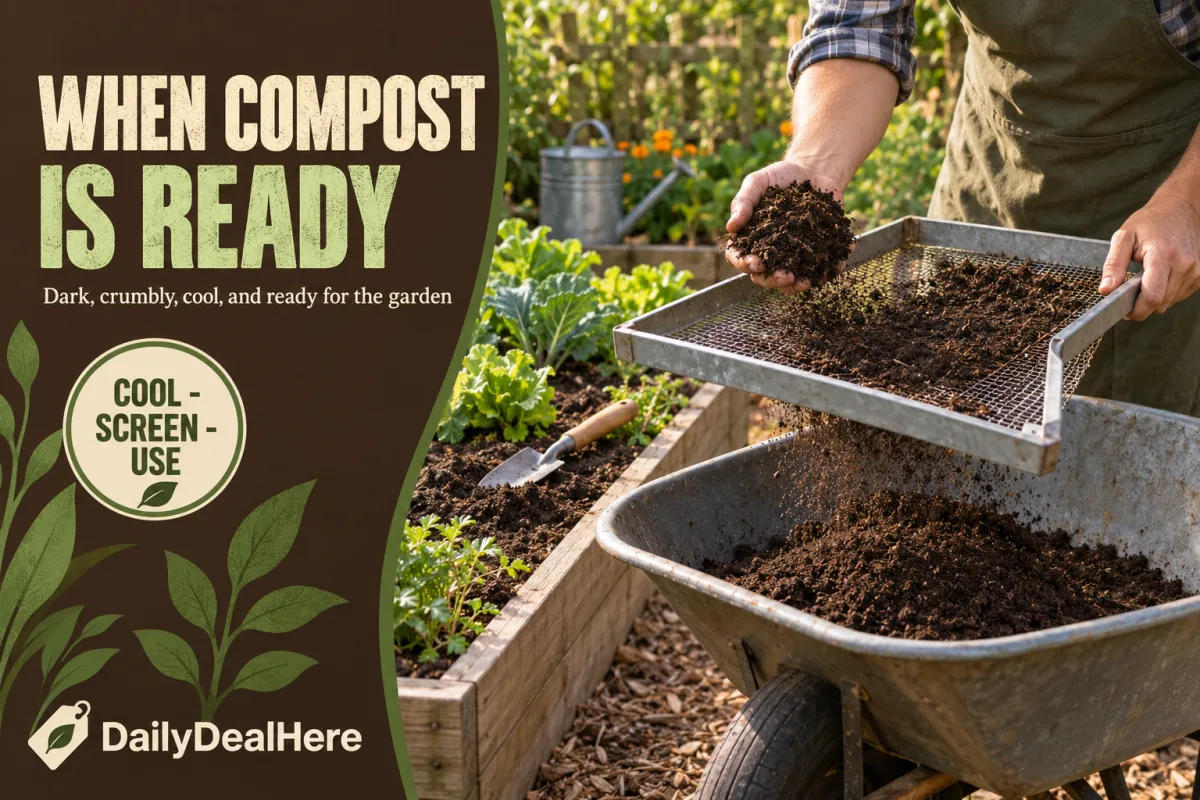
Penn State describes finished compost as no longer hot in the center, dark brown, crumbly, and smelling like fresh dirt. You should not be able to identify most of the original ingredients. A few stubborn pieces of wood, eggshell or corn cob are normal.
If clumps remain, Penn State suggests screening the compost through hardware cloth with half inch squares. The larger pieces go back into the next pile, and the fine material is ready to use. If the pile still heats up after you turn it, it is not finished. Give it more time.
Curing is the last step. The EPA advises that once the pile no longer heats up after mixing and no food scraps are visible, it should cure for at least four weeks. Penn State adds that compost used in a germination mix should sit for an additional month or two, so that microorganisms that could attack seedling roots leave the pile or die off.
Putting finished compost to work
Penn State gives two simple application rates. For garden beds or areas where turf will be planted, mix 1 to 2 inches of compost into the top 6 to 8 inches of soil. As a mulch, apply 1 to 2 inches on the surface to suppress weeds and help conserve water. Compost can also replace peat moss in potting and germination mixes.
Compost improves soil structure and feeds soil life, but it is not a precise fertilizer. Heavy feeders such as tomatoes, squash and corn often benefit from an additional nutrient source during the season. Our guides to the best fertilizer for fruits and vegetables and the best slow release fertilizers cover the options that pair well with compost.
Homemade versus bagged compost
Many people searching for the best compost material are really deciding whether to make compost or buy it. The two are not mutually exclusive.
- Homemade costs little beyond a bin and some effort, uses waste you already produce, and lets you control exactly what goes in. The tradeoff is time, and a home pile may not reach the temperatures needed to deal with every weed seed.
- Bagged is ready immediately, consistent in texture, and practical when you need a lot at once, such as when filling new raised beds. The tradeoff is cost per cubic foot and less visibility into the source materials, so read the label for what went in.
A common approach is to buy compost to get a new garden started and then make your own to maintain it. If you are shopping, our guide to the best compost for a vegetable garden compares bagged options by what they are made from.
A simple starting recipe
If you want a concrete plan rather than principles, here is one that follows the sources above and suits most suburban households.
- In autumn, shred as many fallen leaves as you can and store them dry in bags or a wire bin. These are your browns for the year.
- Choose a spot reachable from all sides, near water, out of strong wind and full sun.
- Start the pile with a few inches of coarse material such as small twigs or straw to help air move in from below.
- Each time you add kitchen scraps or clippings, mix in two to three times their volume of shredded leaves and cap the top with four to eight inches of browns.
- Keep it about as damp as a wrung-out sponge. Water it in dry weather and add browns when it gets soggy.
- Turn it often for the first few weeks once it is large enough to heat, then once or twice more.
- When it is dark, crumbly, cool and earthy smelling, screen it and use it.
That routine will not produce the fastest compost possible, but it is forgiving, and it uses the best compost materials most homes already have: leaves and kitchen scraps, in the right proportion.
Frequently asked questions
What is the best material to put in compost?
A mix rather than one ingredient. Dry autumn leaves are the most useful brown for most yards, and fruit and vegetable scraps, coffee grounds and fresh grass clippings are the most common greens. The EPA suggests at least two to three times as much brown as green by volume, kept about as damp as a wrung-out sponge.
What are 5 items that should not be composted at home?
Meat and fish, dairy products, fats and oils, pet waste, and diseased or pest infested plants all appear on both the EPA and Penn State lists. The EPA also advises against weeds with seeds, treated or painted wood, herbicide treated clippings, glossy paper and produce stickers in a backyard pile.
What is the ideal carbon to nitrogen ratio for compost?
Penn State Extension gives 25 to 30 parts carbon to 1 part nitrogen for the whole pile, and Cornell aims for roughly 30 to 1. Home composters rarely measure it. Following the brown and green proportions gets close enough in practice.
Are coffee grounds good for compost?
Yes. Coffee grounds are a green material with a typical carbon to nitrogen ratio of about 20 to 1 according to Cornell, and paper filters can go in with them. Like other greens, they need browns such as leaves or cardboard to balance them.
Can I compost cardboard and newspaper?
Yes, as browns. Shred or tear them first and remove tape, labels and glossy inserts. They are very high in carbon, with Cornell listing corrugated cardboard around 600 to 1, so they work best alongside leaves rather than as the only brown.
Why does my compost pile smell bad?
The EPA says a bad odor usually means the pile is too wet or not getting enough air. Add dry browns such as shredded leaves or cardboard and turn the pile. Keep food scraps covered with several inches of browns.
How long does compost take to be ready?
Penn State puts a typical well managed pile at about 3 to 4 months, with frequent turning in the first 3 to 4 weeks. Piles with a lot of woody material, whole leaves or little turning can take a year or more.
Is homemade compost better than bagged compost?
Neither is better in every case. Homemade compost is inexpensive and uses your own waste, while bagged compost is immediate and consistent. Many gardeners buy compost to start new beds and make their own to maintain them.
Shred your leaves in autumn, keep them next to the kitchen caddy, and add two or three scoops of brown for every scoop of green. Most of the best compost material you will ever need is already falling in your yard.










Write Your Review
No reviews yet. Be the first to share your experience!