

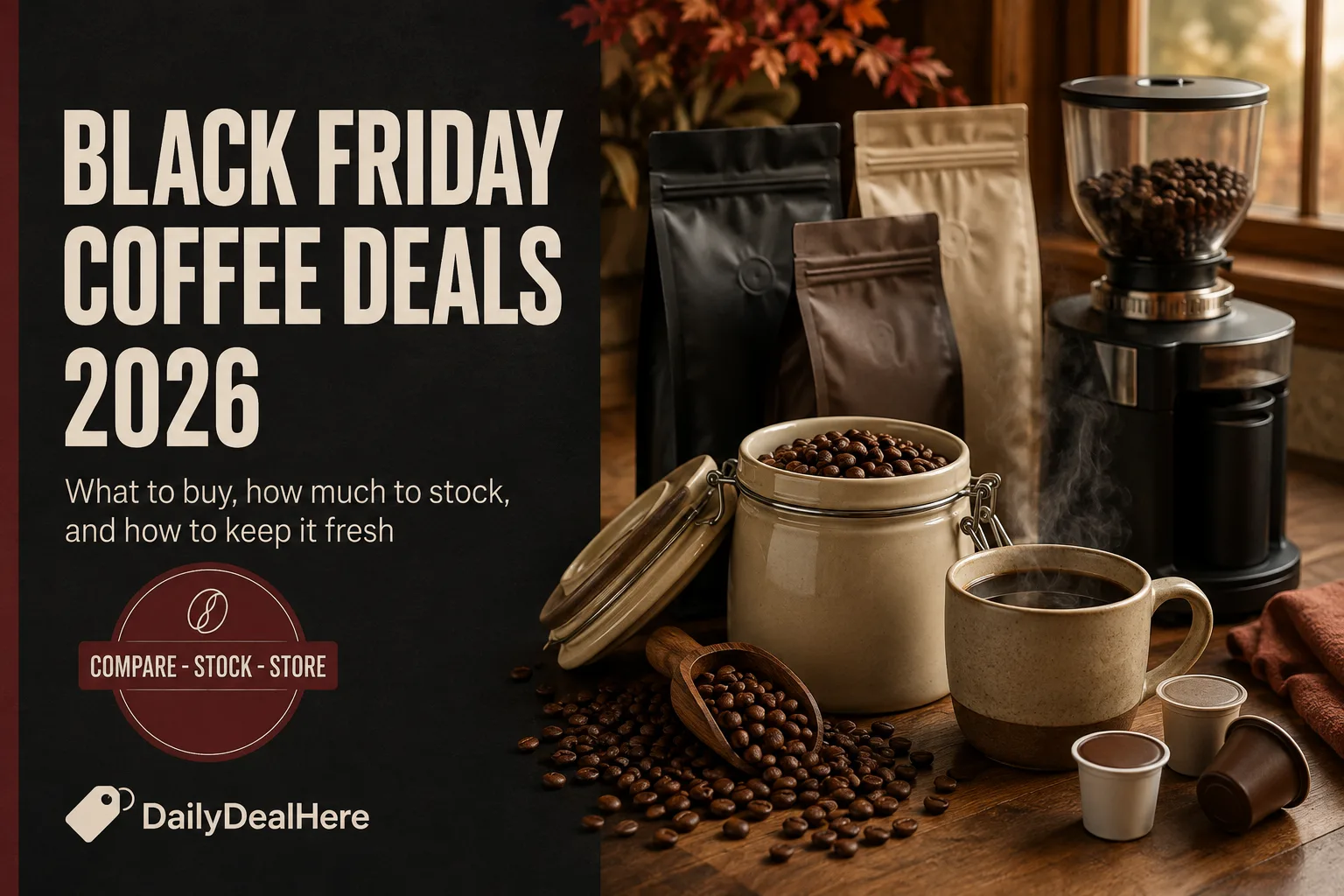
Coffee is the most reliable food discount of the holiday season. Black Friday 2026 falls on Friday, November 27, with Cyber Monday on November 30, but coffee offers open earlier than that and the deepest ones tend to sit on bulk pods, multi-bag bundles and subscriptions rather than on single bags of specialty beans.
It is also the category where stocking up genuinely works, because most households drink coffee at a predictable rate. That makes buying four months of it a real saving rather than a gamble, provided you buy the right format and store it properly.
The 2026 calendar for coffee buyers
Coffee runs slightly ahead of the general sale calendar because a lot of it is bought as a gift, and gift shopping starts before the weekend everyone talks about.
| Window | What happens | Best for |
|---|---|---|
| Early October | Expected Amazon autumn event, dates not announced for 2026 | First look at bulk pods |
| First half of November | Roaster promotions and gift set launches | Advent calendars, gift boxes |
| November 27 | Black Friday | Bulk pods, machine bundles |
| November 30 | Cyber Monday | Subscription offers, online exclusives |
| December | Clearance on seasonal packaging | Ordinary coffee in festive boxes |
Amazon has not announced Prime Big Deal Days for 2026. It ran October 10 and 11 in 2023, October 8 and 9 in 2024, and October 7 and 8 in 2025, always a Tuesday and Wednesday, with the announcement landing in September. Our guide to Black Friday versus Prime Day covers which of the two tends to price better.
Beans, ground or pods: format decides how far ahead you can buy
This is the decision that determines whether a bulk purchase is clever or wasteful, and it has nothing to do with the size of the discount.
Whole beans hold their character longest. Coffee stales through oxidation, and a whole bean exposes far less surface area to air than the same coffee ground. If you are buying several months ahead, buy beans and grind as you go.
Pre-ground coffee has the shortest useful life of the three. It is convenient and it discounts well, but a bag bought in November and opened in March will taste flat regardless of what you paid.
Pods sit in the middle and are the format best suited to stocking up, because each serving is sealed individually. That is exactly why bulk pod boxes are among the most heavily discounted coffee items of the season. If you brew single serve, our roundup of Green Mountain pods explains how roast level and pack size interact.
How much to buy without wasting it
Work backwards from consumption rather than forwards from the discount. Count how many cups the household drinks in a week, convert that to bags or boxes per month, and buy a quantity you will finish inside a sensible window.
For whole beans, three to four months is a comfortable ceiling. For pods, six months is reasonable because of the individual seals. For pre-ground, treat anything past two months as optimistic.
Buying past those points is not thrift, it is prepaying for coffee you will enjoy less. The saving on the last bag is cancelled by the fact that you drink it grudgingly.
Storing coffee so the discount survives
Four things degrade coffee: air, moisture, heat and light. Storage is simply about limiting all four, and it costs nothing.
- Keep it sealed. An airtight container beats a rolled-down bag, and beats a jar with a loose lid.
- Keep it dark and cool. A cupboard away from the hob and the window. Not the counter beside the kettle, where the steam and warmth both reach it.
- Do not decant into small jars for display. Clear glass on an open shelf is the fastest way to stale good coffee.
- Leave the freezer alone for daily coffee. Repeatedly taking a bag in and out invites condensation, and moisture is worse than the slow staling you were trying to avoid.
Buy the quantity your storage can actually protect. Six months of coffee in the original bags will be worse in month four than three months of coffee kept properly.
Subscriptions: the first box is the advertisement
Coffee subscriptions promote hard in November because the introductory offer is where the marketing budget lives. The first delivery is discounted steeply and sometimes includes an extra bag or a piece of equipment.
Before you sign up, find three numbers: the standing price per bag after the introductory period, the delivery frequency, and the notice required to skip or pause. A subscription with a good standing price and a simple skip button is a genuinely convenient way to buy. One with a low first month and a high standing price is a discount that reverses itself.
The skip function matters more than people expect. Coffee arriving faster than you drink it turns into a queue of aging bags, which is the same waste problem as overbuying, just spread across the year.
Machines discount harder than the coffee does
If your coffee frustration is the brew rather than the bean, November is the month to fix it. Coffee equipment is one of the most heavily discounted small appliance categories of the season, and unlike the coffee itself the saving does not decay in storage.
Drip machines are the volume category and where the broadest offers appear, covered in our roundup of coffee makers. If you want the machine to have the coffee ready before you reach the kitchen, programmable models are the subset to look at. For espresso, pour over and other methods that do not fit a standard basket, specialty machines is the right category.
One caution that applies every year: a machine bundle that includes coffee is not automatically good value. Price the machine alone, price the coffee alone, then judge the bundle. The included coffee is often a house blend priced at full list to inflate the apparent saving.
Choosing coffee as a gift when you do not know their taste
Coffee is a good gift and an easy one to get wrong, because preference varies more than in almost any other pantry item.
The first question is not flavour but format. Someone with a pod machine cannot use whole beans, and someone with a grinder will not thank you for pods. If you do not know what they brew with, a variety format or a gift card is safer than a guess.
The second is roast level. A medium roast is the safest default because it sits between the brightness of a light roast and the intensity of a dark one. Flavoured coffee is the riskiest gift in the category, since people who dislike it tend to dislike it strongly.
Special cases are easier than they look. Someone who avoids acidity has a clear category in low acid coffee. Someone who cares about sourcing has one in organic coffee. Someone curious about functional blends has one in mushroom coffee. Matching the category to something they have said out loud beats guessing at a roaster.
Advent calendars sell out, they do not go on sale
Coffee and tea advent calendars behave differently from the rest of the category. They are produced in limited runs for a fixed date, which means the constraint is availability rather than price.
Waiting for Black Friday to buy one usually means choosing from what is left rather than what is best. If a calendar is on your list, buy it in the first half of November. Our roundups of coffee advent calendars and tea advent calendars cover the formats, and the same logic applies to chocolate calendars.
Reading a coffee discount honestly
Coffee pricing hides behind pack size more than most groceries, so the percentage on the banner is the least useful number on the page.
- Compare cost per ounce or per pod, never per box. Pod counts vary between formats and brands, and a larger box is not always better value.
- Check the roast date if the roaster publishes one. Specialty coffee sold cheap is sometimes older stock, which is fine for immediate drinking and poor for storing.
- Watch decaf and flavoured lines. These often carry the deepest discounts because they move slower, which is only a bargain if it is what you drink.
- Look at the standing price, not the crossed-out one. Reference prices in coffee are soft, particularly on gift packaging.
Iced coffee and cold brew run on a different season
Ready-to-drink iced coffee, cold brew concentrate and the bottled category around them discount in November as part of general pantry promotions, but the deeper clearance in these lines tends to come after summer rather than before winter.
If you drink cold coffee year round, that timing quirk is worth knowing: late summer is often better for the ready-to-drink formats, while November is better for the beans and pods you brew hot. Our roundup of iced coffee brands covers the category itself.
Concentrates are the exception worth buying in November, because they store like a pantry item rather than like fresh coffee and they scale well for hosting.
Hosting season needs volume, not variety
If you are hosting between Thanksgiving and the new year, your coffee problem changes shape. You need to make a lot of coffee at once for people whose preferences you do not know.
That argues for a crowd-pleasing medium roast in bulk rather than an interesting single origin, a decaf option for the evening, and enough capacity to brew a full pot rather than cups one at a time. It also argues for buying milk alternatives and sweeteners in the same November window, since they are shelf stable and get bought at full price in a panic on the day.
The most common hosting mistake is buying variety. Guests want a decent cup, not a selection, and three half-used bags in January is the predictable outcome of a well-meant variety purchase.
What to skip
Skip a year’s supply of pre-ground coffee, no matter the price. Skip flavoured coffee bought for someone whose taste you are guessing at. Skip the second subscription. Skip machine bundles you have not priced apart.
And skip the impulse to treat a large discount as a reason to change what you drink. November is the right time to buy more of the coffee you already like, and the wrong time to discover you do not like something at four times the usual quantity.
The grinder changes more than the beans do
If you buy whole beans to keep them fresh, the grinder stops being an accessory and becomes part of the brewing. It is also the upgrade people postpone longest, usually because the coffee gets the blame for a result the grinder caused.
The difference is consistency of particle size. Blade grinders chop, producing a mixture of dust and chunks from the same batch. The dust over-extracts and turns bitter while the chunks under-extract and taste sour, and both end up in the same cup. Burr grinders crush the bean between two surfaces at a set distance, so the grounds come out closer to a uniform size.
Grind size then needs to match the brew method. A coarse grind suits a French press, where the coffee sits in water for minutes. A fine grind suits espresso, where water passes through in seconds under pressure. Drip sits in the middle. Using the wrong size is the most common reason a good bag of coffee disappoints, and it is the reason a single-setting blade grinder limits what you can brew well.
November is a reasonable time to solve this because grinders discount alongside the machines. If you are buying beans in bulk this month, the grinder is what protects that decision.
What the roast level on the bag actually tells you
Roast level is the most useful word on a coffee bag and the most misread. It describes how far the beans were taken in the roaster, not how strong the coffee will be.
Light roasts keep more of the character of the origin: brighter, more acidic in the pleasant sense, often fruity or floral. They also keep slightly more caffeine by weight, which surprises people who assume dark means strong.
Medium roasts balance origin character against roast character. This is why they are the safe default for a household with mixed preferences and for hosting.
Dark roasts take the roast further, which flattens origin character and brings out bitterness and body. They read as lower in acidity, which is why people who find coffee harsh often prefer them.
Strength in the cup is decided by the ratio of coffee to water and by the brew method, not by the roast. A weak dark roast and a strong light roast are both perfectly possible, and adjusting the dose is cheaper than changing the beans.
If acidity is the specific thing you are avoiding, the category to look at is low acid coffee rather than simply buying darker.
Certifications on the bag, and what each one covers
Coffee carries more labels than most groceries, and they cover different things. Knowing which is which stops you paying for a claim you did not want.
- Organic is about how the coffee was grown, specifically the inputs allowed on the farm. It says nothing about what the farmer was paid.
- Fair trade is about trading terms and minimum prices paid to producers. It says nothing about growing methods.
- Rainforest Alliance covers a broader set of farm and environmental criteria.
- Direct trade is not a certification at all. It is a roaster describing its own sourcing relationship, so its meaning depends entirely on the roaster.
- Single origin is a description of where the coffee came from, not a quality mark. It tells you the cup will taste of one place rather than a blend.
These stack rather than compete, so a bag can be organic and fair trade at once. Our roundup of organic coffee covers the certified side, and if sourcing is what you care about, it is worth choosing the label that matches the concern rather than the one with the biggest logo.
Decaf deserves a better shelf than it gets
Decaf is usually the afterthought of a coffee range, which is exactly why it discounts well in November: it moves slower than the caffeinated lines.
Decaffeinated coffee is not caffeine free. The process removes most of it, and a cup still carries a small residual amount, which matters to anyone cutting caffeine for a medical reason. This is general information rather than medical advice, and anyone with a specific restriction should follow the guidance they already have.
The method used to remove the caffeine is worth a glance if you buy decaf regularly. Water process decaf is the one most often named on the bag, and roasters that use it tend to say so, because it is a selling point. Bags that say nothing at all are usually solvent processed, which is standard and widely used.
Practically, decaf is the smart buy for a household that hosts in December. It lets people have a cup after dinner without the evening consequences, and it is the one coffee purchase where a discount and a genuine need line up neatly.
The rest of the coffee shelf
Coffee never arrives alone in a shopping basket, and the things around it are quietly worth buying in the same window because they are shelf stable and get bought at full price in a hurry later.
Shelf stable milk alternatives are the clearest example. Oat, almond and soy in ambient cartons keep for months unopened, they discount as part of general pantry promotions, and December is exactly when a household runs out at an inconvenient moment. Syrups and sweeteners behave the same way, and a household cutting sugar has a category of its own in sugar substitutes.
Filters and cleaning tablets are the boring purchase that prevents a genuinely annoying morning. Descaling in particular is maintenance rather than an accessory, since scale builds quietly and shows up as slow brewing and off flavour rather than as an obvious fault.
None of this is exciting, and that is the point. The items that get forgotten in November are the ones bought at full price in the last week of December.
Water is the last variable and the one nobody buys. Coffee is overwhelmingly water by volume, so hard water changes the cup and leaves scale in the machine at the same time. A household on hard water will get more out of a filter jug than out of trading up a bag of beans, and the machine will last longer for it.
Brew temperature matters nearly as much and costs nothing to fix. Water off a rolling boil scorches the grounds and pushes bitterness forward, which is why a kettle left to settle for half a minute makes a noticeably rounder cup from exactly the same coffee you already own.
Frequently asked questions
When do Black Friday coffee deals start in 2026?
Black Friday is Friday, November 27, 2026, with Cyber Monday on November 30, but coffee promotions typically begin in the first half of November. Gift formats such as advent calendars are best bought early because they sell out rather than getting discounted.
Should I buy whole beans or ground coffee when stocking up?
Whole beans, if you are buying more than a month or two ahead. Ground coffee exposes far more surface area to air and stales faster, so it is the poorest format for a bulk buy. Pods sit in between because each serving is sealed individually.
How much coffee is sensible to buy at once?
Work from how much you drink. Three to four months is a comfortable ceiling for whole beans, around six months for pods, and no more than two months for pre-ground. Beyond that the coffee declines faster than the saving is worth.
How should I store coffee bought in bulk?
Airtight, dark, cool and dry. A sealed container in a cupboard away from the hob beats a rolled-down bag. Avoid clear jars on open shelves, and avoid moving a bag in and out of the freezer, since condensation does more harm than slow staling.
Are coffee subscription offers worth taking?
Only if the standing price after the introductory period is good and you can skip deliveries easily. The first box carries the discount, so check the ongoing price per bag, the delivery frequency and how to pause before signing up.






Write Your Review
No reviews yet. Be the first to share your experience!