
A packed lunch sits in a backpack or a locker for four to five hours before anybody eats it, usually in a room that is warmer than a kitchen. That is the whole problem, and it is a food safety problem before it is a convenience one. Perishable food held between roughly 40 and 140 degrees Fahrenheit sits in what food safety agencies call the danger zone, and the standard guidance is that it should not stay there longer than two hours, or one hour when the surrounding temperature is above 90 degrees.
An ordinary school morning runs longer than that. This guide covers what actually keeps a lunch cold, why most insulated bags underperform, how to pack so the cold stays where the food is, and which foods are safe to send without any of it.
Why an insulated bag alone is not enough
An insulated lunch bag does not make anything cold. It slows the rate at which warmth from the room reaches the food, which means it extends whatever coldness you put inside it and nothing more. A bag packed with room-temperature food stays at room temperature.
That distinction explains most of the disappointment with lunch bags. The bag is doing its job; the problem is that nothing inside it was cold enough to begin with, or that the cold source was too small to last the morning.
Two properties determine how well a bag performs. The first is insulation thickness, which is why a thin fabric sleeve underperforms a bag with a visible layer of foam. The second is how well it closes, since a zip that leaves a gap lets warm air circulate and undoes the insulation entirely. A bag that seals fully and has a thick liner will hold cold for hours; a thin one with a loose flap will not manage a morning.
Start cold, because nothing warms up on purpose
The single most effective habit is packing food that is already properly chilled rather than food that will be chilled by the ice pack. An ice pack has a fixed amount of cooling in it, and using half of that to bring a sandwich down from room temperature wastes it.
In practice this means assembling lunch the night before and refrigerating it overnight, including the container it travels in. A cold container starts the morning at refrigerator temperature instead of kitchen temperature, and that difference alone buys an hour.
The same applies to the bag itself. An insulated bag left in a warm kitchen overnight is warm inside when you pack it. Storing it in the refrigerator, or simply leaving it open somewhere cool, removes a source of heat you would otherwise be paying an ice pack to remove.
Choosing and using ice packs properly
Most lunches are packed with one small ice pack, which is usually not enough for a five hour morning in a warm building.
Use two, and place them correctly
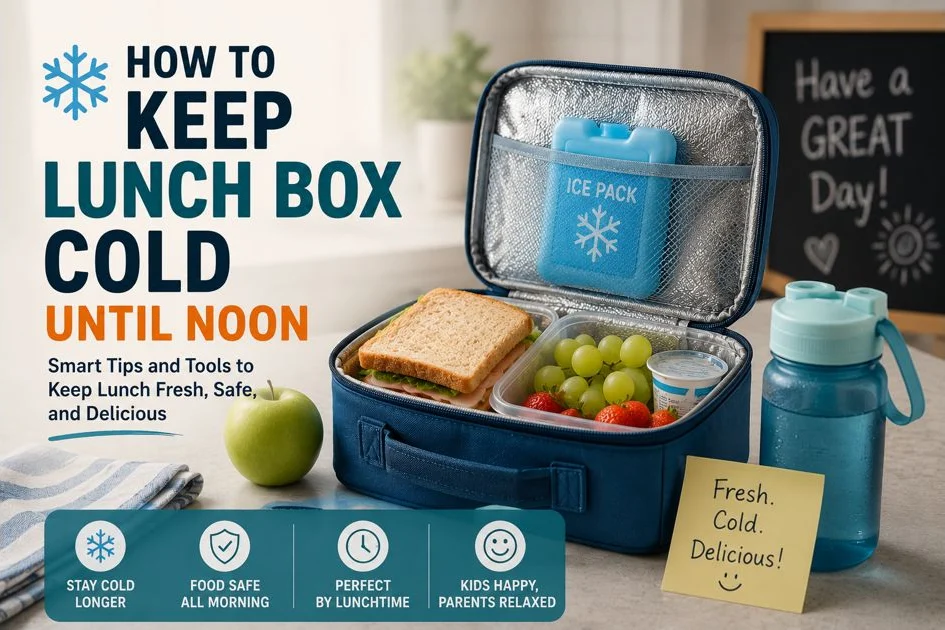
Cold air sinks, so an ice pack sitting at the bottom of a bag cools the bottom of the bag and very little else. One pack above the food and one below it surrounds what you are trying to protect, which is why two smaller packs outperform one large one even when the total mass is the same.
Bigger packs last longer
A thicker pack holds more cold and thaws more slowly than a thin flexible sheet, which is the trade against space. In a bag that is full, a slim pack is often the only thing that fits, which is an argument for a slightly larger bag rather than a smaller pack.
Fill the empty space
Air is what warms up first. A bag packed loosely has a large volume of air to keep cold; a full bag has almost none. Filling gaps with a frozen drink pouch, a chilled piece of fruit or even a folded cloth improves performance measurably, and a frozen drink does double duty by thawing into something to drink by lunchtime.
The vacuum flask approach
For food that genuinely needs to stay cold, an insulated stainless steel food jar outperforms any bag and ice pack combination, because it is a vacuum barrier rather than a foam one.
The technique matters. Fill the jar with cold water and ice, leave it for several minutes, then empty it and add the food. Pre-chilling drops the interior of the jar to near freezing, so the food is not spending its own coldness on warming up the steel. Skipping this step is why people conclude that a flask does not work.
Filling the jar completely also helps, for the same reason a full bag outperforms an empty one. A half-filled flask has a volume of air inside that warms quickly, so packing to the top or using a smaller jar produces better results.
The same jar handles hot food in winter by the reverse method: fill with boiling water, wait, empty, then add food that is genuinely hot rather than warm. A flask maintains a temperature; it does not create one.
Foods that travel well without refrigeration
The simplest way to avoid the whole problem is to pack food that does not require it, and there is more of it than parents assume.
Shelf-stable options include whole fruit, dried fruit, nuts and seeds where school policy permits them, crackers, bread and rolls, hard cheeses in sealed portions designed to be shelf stable, unopened shelf-stable milk or juice cartons, nut butter sandwiches, hummus in sealed single portions, tinned fish in pouches, and most baked goods.
The foods that genuinely need cold are the ones handled most casually: deli meat, cooked chicken, eggs, soft cheese, yogurt, milk, anything with mayonnaise, cut melon and cooked rice or pasta. Cut fruit and vegetables sit in between, since they are safer than meat but deteriorate in quality quickly when warm.
A useful middle strategy is packing one cold item that the ice packs are genuinely protecting, and building the rest of the lunch from shelf-stable components. That concentrates the cooling where it matters instead of spreading it across a bag of things that did not need it.
Where the lunch actually sits
The storage location between arrival and lunchtime affects the outcome more than most equipment choices, and it is worth asking about.
A locker in an interior corridor is usually the coolest option. A backpack under a desk in a sunny classroom is considerably warmer, and a bag left in a car or in direct sun through a window is the worst case by a wide margin, since a closed car in warm weather reaches temperatures that make the one hour rule the relevant one.
Where a classroom has a refrigerator available for student use, that solves the problem entirely, and many primary classrooms do. It is worth asking at the start of the year rather than assuming.
For older students with long gaps between classes, the practical answer is often a flask rather than a bag, since it does not depend on where the bag ends up.
Cleaning, which is the part that gets skipped
An insulated bag accumulates spills, crumbs and moisture, and in a warm building that becomes a genuine hygiene problem rather than an aesthetic one.
Empty and wipe the bag daily, and leave it open to dry overnight rather than zipping it closed with moisture inside. A bag closed damp develops odor within days, and the smell is the visible symptom of something growing in the liner.
Wash containers and lids properly, paying attention to gaskets. A silicone seal that can be removed should be taken out and cleaned separately, since residue collects in the channel underneath where nothing reaches it. This is the single most overlooked cleaning step in the category, and the reason a container can smell despite looking clean.
Check the manufacturer’s instructions before putting an insulated flask in a dishwasher, since heat can damage the vacuum seal on some models and a flask that has lost its vacuum is an ordinary steel cup.
A short packing routine
The night before: assemble the lunch, put it in the refrigerator in its container, and put the ice packs in the freezer. Leave the bag somewhere cool and open.
In the morning: pack straight from the refrigerator, ice pack below the food and one above, fill any remaining air space with a frozen drink or a chilled piece of fruit, and close the bag fully.
If using a flask: pre-chill with ice water for several minutes, empty it, then fill with cold food to the top.
At the end of the day: empty everything, wipe the liner, remove and clean the container gaskets, and leave both bag and containers open to dry.
Our guide to when back to school sales end covers the best time to buy lunch gear, which is generally the clearance window in mid to late September rather than the August rush.
Choosing a lunch box that holds cold properly
Lunch containers vary far more in performance than in price, and the features that matter are visible in the shop if you know where to look.
The liner tells you most of what you need
A welded or heat-sealed liner has no stitch holes, which means spills stay on the surface and wipe off rather than soaking into the insulation. A stitched liner absorbs whatever leaks, and once insulation is wet it both performs worse and holds odor permanently. Look at the inside seams rather than the outside pattern.
Insulation thickness beats brand
Press the side wall between your fingers. A bag that compresses to almost nothing has a thin foam sheet and will not hold cold through a morning; one with noticeable resistance has enough material to matter. This single check separates the bags that work from the ones that look the part.
The closure decides the rest
A full zip around three sides outperforms a magnetic flap or a fold-over top, because warm air moves through any gap. A bag that cannot be closed completely is an open bag with padding attached.
Size against what you actually pack
An oversized bag holds a large volume of air that has to be kept cold, so a bag matched to the food outperforms a bigger one. If lunches vary in size, filling the spare space is easier than owning two bags.
Hard containers, soft pouches and what leaks
Inside the bag, the containers determine whether anything arrives intact, and leaking is the failure that turns a lunch bag into a laundry problem.
Screw-top containers seal more reliably than clip-lid ones for anything liquid, which is why soup and yogurt travel best in a jar rather than a box. Clip lids with a silicone gasket handle solids well and are easier for small hands to open, which matters for younger children who cannot ask for help mid-lunch.
Compartment boxes suit children who dislike foods touching and make portions visible at a glance, which reduces the amount that comes home uneaten. The trade is that most are not leak-proof between compartments, so anything wet needs its own sealed container regardless.
Silicone pouches and reusable bags replace disposable plastic bags well for dry items, and they pack flat, which helps fill air space rather than creating it. For wet items they are less reliable than a rigid container and considerably harder to clean properly.
Whatever the type, the practical check is to fill it with water at home and turn it upside down over a sink. Anything that fails that will fail in a backpack.
Making a packed lunch that actually gets eaten
Food safety is the constraint, but a lunch that comes home untouched has failed regardless of what temperature it stayed at.
Two habits do most of the work. The first is packing food the child has eaten before, since a school cafeteria in a short lunch period is the worst environment for trying something new. The second is packing what can be eaten quickly, because the actual eating window at many schools is far shorter than the timetable suggests once queuing and settling are accounted for.
Texture matters more than variety. A sandwich that has been under an ice pack for five hours is cold and slightly damp, which some children accept and others do not, and packing the components separately for assembly at the table solves it for the ones who do not.
Involving children in packing raises the proportion eaten more reliably than any other change, and it takes very little: two choices offered rather than an open question, decided the night before with everything else.
Finally, check what comes home. A lunch bag returning full every day is data, and it usually points to something specific: not enough time, a container that could not be opened, or one item nobody was ever going to eat.
Allergy rules and what schools require
Many schools restrict what can come into a classroom, and the restrictions are stricter than families expect because they exist to protect a specific child rather than to set a general standard.
Nut restrictions are the most common, and they range from a nut-free table in the cafeteria to a whole-school prohibition covering anything processed in a facility with nuts. Sesame, dairy and egg restrictions appear in individual classrooms. The rules are usually sent home at the start of the year and then forgotten by October, which is when accidental breaches happen.
Where a restriction applies, the practical substitutes for nut butter are sunflower seed butter and soy butter, both of which spread and taste close enough for most children. Read labels rather than assuming, since some sunflower butters are produced on shared equipment and are prohibited under the stricter policies.
Label a lunch clearly if the child has an allergy themselves, and pack a note the child can show rather than relying on them to explain under pressure. Younger children in particular will accept food offered by a classmate rather than refuse it, which is the situation most worth preparing for.
Reducing what the lunch throws away
A daily packed lunch produces a surprising amount of waste over a school year, and most of it is avoidable without much effort.
Reusable containers replace the largest share, and the ones that survive a school year are simple: fewer moving parts, a lid that can be replaced, and a shape that fits the bag. Elaborate containers with hinges and catches fail first and are the ones abandoned by November.
A reusable bottle removes the single largest item, provided it can be cleaned properly and does not leak into a backpack. A cloth napkin costs nothing to add and replaces a paper one daily.
Buying in larger packages and portioning at home rather than buying single-serve packages reduces both packaging and cost, which is one of the few habits that improves two things at once. The exception is anything where the single-serve packaging is doing real work, meaning shelf-stable items that would otherwise need refrigeration once opened.
Finally, packing slightly less than you think is needed reduces waste more than any container choice. Food that comes home uneaten is usually food that was never going to be eaten in a twenty minute lunch period, and adjusting portions downward is easier than persuading a child to eat faster. Watching what returns for a week gives you the right portion size faster than any guideline, and the amount is almost always smaller than an adult would guess.
Frequently asked questions
How long does a packed lunch stay safe without refrigeration?
Food safety guidance treats roughly 40 to 140 degrees Fahrenheit as the danger zone, with a two hour limit for perishable food and a one hour limit when the surroundings are above 90 degrees. A typical school morning is longer than that, which is why a cold source is needed rather than optional.
How many ice packs does a lunch box need?
Two is the practical answer for a full morning, placed above and below the food rather than both at the bottom. Cold air sinks, so a single pack underneath cools the base of the bag and little else.
Does an insulated lunch bag keep food cold on its own?
No. Insulation slows the rate at which room warmth reaches the contents, so it extends whatever cold you put inside. Food packed at room temperature stays at room temperature, which is the most common reason a bag seems not to work.
How do you pre-chill a food flask?
Fill it with cold water and ice, leave it several minutes, empty it, then add the food. Without this step the food spends its own coldness bringing the steel down to temperature, which is why an unprepared flask underperforms.
Which lunch foods do not need to be kept cold?
Whole and dried fruit, nuts and seeds where permitted, crackers and bread, shelf-stable cheese portions, unopened shelf-stable milk or juice, nut butter sandwiches, sealed hummus portions, pouched fish and most baked goods. Deli meat, cooked chicken, eggs, yogurt, soft cheese, cut melon and anything with mayonnaise do need cold.
Why does my lunch bag smell?
Because it was closed while damp. Moisture trapped in the liner overnight is what produces the odor. Empty and wipe the bag daily and leave it open to dry, and remove container gaskets to clean the channel underneath, where residue collects out of reach.
Should the lunch bag be full or is empty space fine?
Full is better. Air warms first, so a loosely packed bag has a large volume to keep cold. Filling gaps with a frozen drink pouch or chilled fruit improves how long the contents stay cold and gives you something cold to drink at lunchtime.
Where should a lunch be stored during the school day?
An interior locker is usually coolest. A backpack in a sunny classroom is warmer, and a bag left in a car or in direct sun is the worst case, since a closed car in warm weather makes the shorter one hour limit the relevant one. Some classrooms have a refrigerator available, which is worth asking about.









Write Your Review
No reviews yet. Be the first to share your experience!